Personality
What is Personality? People differ from each other in meaningful ways People seem to show some consistency in behavior Personality  is defined as distinctive and relatively enduring ways of thinking, feeling, and acting
Personality Personality  refers to a person’s unique and relatively stable pattern of thoughts, feelings, and actions Personality is an interaction between biology and environment Genetic studies suggest heritability of personality Other studies suggest learned components of personality
 
 
Four Theories of Personality 1. Trait 2. Psychoanalytic 3. Humanistic 4. Socio-Cognitive
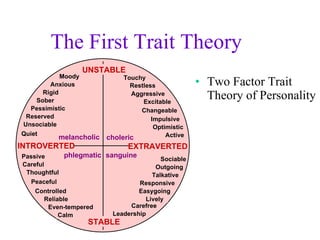
The First Trait Theory Two Factor Trait Theory of Personality UNSTABLE STABLE choleric melancholic phlegmatic sanguine INTROVERTED EXTRAVERTED Moody Anxious Rigid Sober Pessimistic Reserved Unsociable Quiet Sociable Outgoing Talkative Responsive Easygoing Lively Carefree Leadership Passive Careful Thoughtful Peaceful Controlled Reliable Even-tempered Calm Touchy Restless Aggressive Excitable Changeable Impulsive Optimistic Active
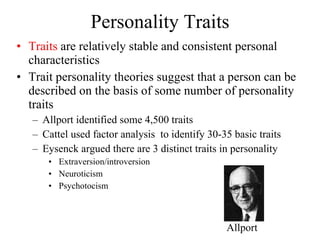
Personality Traits Traits  are relatively stable and consistent personal characteristics Trait personality theories suggest that a person can be described on the basis of some number of personality traits Allport identified some 4,500 traits Cattel used factor analysis  to identify 30-35 basic traits Eysenck argued there are 3 distinct traits in personality Extraversion/introversion Neuroticism Psychotocism  Allport
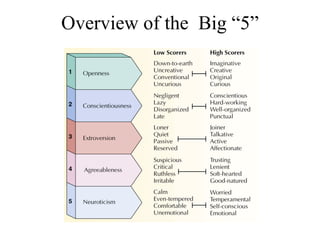
Overview of the  Big “5”
Assessing Traits: An Example   Minnesota Multiphasic Personality Inventory (MMPI) the most widely researched and clinically used of all personality tests developed to identify emotional disorders
MMPI: examples “ Nothing in the newspaper interests me except the comics.” “ I get angry sometimes.”
Evaluating Trait Theory Trait theory, especially the Big 5 model, is able to describe personality Cross-cultural human studies find good agreement for the Big 5 model in many cultures Appear to be highly correlated not only in adulthood, but also in childhood and even late preschoolers Three dimensions (extraversion, neuroticism and agreeableness) have cross-species generality Problems with trait theory include: Lack of explanation as to WHY traits develop Issue of explaining transient versus long-lasting traits
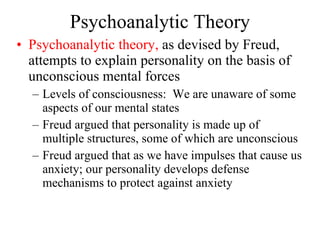
Psychoanalytic Theory Psychoanalytic theory,  as devised by Freud, attempts to explain personality on the basis of unconscious mental forces Levels of consciousness:  We are unaware of some aspects of our mental states Freud argued that personality is made up of multiple structures, some of which are unconscious Freud argued that as we have impulses that cause us anxiety; our personality develops defense mechanisms to protect against anxiety
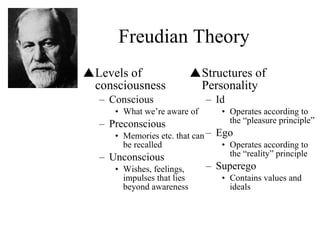
Freudian Theory Levels of consciousness Conscious What we’re aware of Preconscious Memories etc. that can be recalled Unconscious Wishes, feelings, impulses that lies beyond awareness Structures of Personality Id Operates according to the “pleasure principle” Ego Operates according to the “reality” principle Superego Contains values and ideals
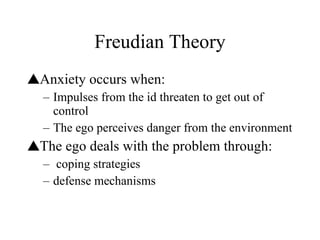
Freudian Theory Anxiety occurs when: Impulses from the id threaten to get out of control The ego perceives danger from the environment The ego deals with the problem through: coping strategies defense mechanisms
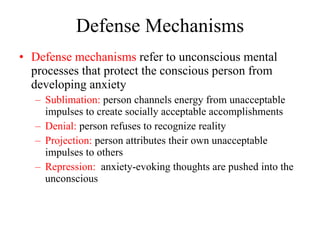
Defense Mechanisms Defense mechanisms  refer to unconscious mental processes that protect the conscious person from developing anxiety Sublimation:  person channels energy from unacceptable impulses to create socially acceptable accomplishments Denial:  person refuses to recognize reality Projection:  person attributes their own unacceptable impulses to others  Repression:   anxiety-evoking thoughts are pushed into the unconscious
Defense Mechanisms Rationalization:   Substituting socially acceptable reasons Intellectualization:   Ignoring the emotional aspects of a painful experience by focusing on abstract thoughts, words, or ideas Reaction formation:   Refusing to acknowledge unacceptable urges, thoughts or feelings by exaggerating the opposite state Regression:   Responding to a threatening situation in a  way appropriate to an earlier age or level of development Displacement:   Substituting a less threatening object for the original object of impulse
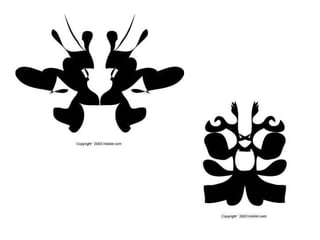
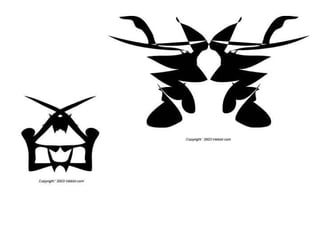
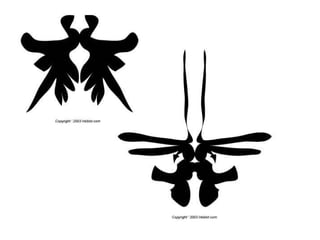
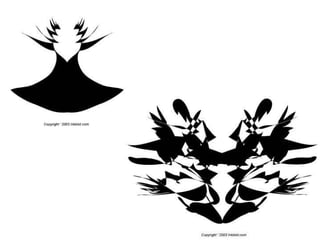
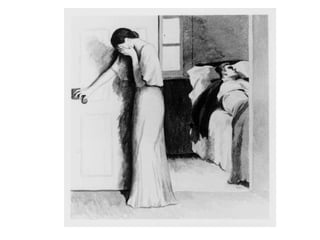
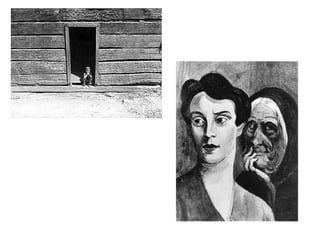
Assessing the Unconscious Projective Tests  used to assess personality (e.g., Rorschach or TAT tests) How? provides ambiguous stimuli and subject projects his or her motives into the ambiguous stimuli
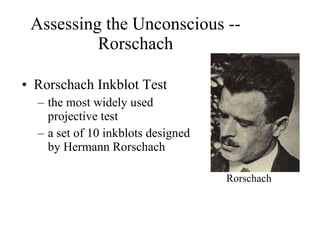
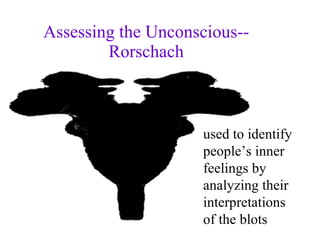
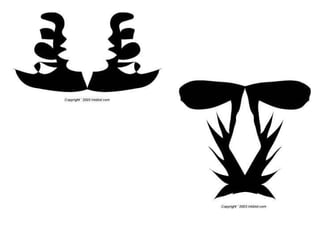
Assessing the Unconscious -- Rorschach Rorschach Inkblot Test  the most widely used projective test a set of 10 inkblots designed by Hermann Rorschach Rorschach
Assessing the Unconscious--Rorschach used to identify people’s inner feelings by analyzing their interpretations of the blots


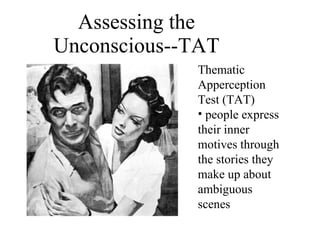
Assessing the Unconscious--TAT Thematic Apperception Test (TAT) people express their inner motives through the stories they make up about ambiguous scenes
 
 
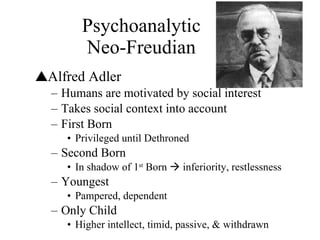
Psychoanalytic Neo-Freudian Alfred Adler Humans are motivated by social interest Takes social context into account First Born Privileged until Dethroned Second Born In shadow of 1 st  Born    inferiority, restlessness Youngest Pampered, dependent Only Child Higher intellect, timid, passive, & withdrawn
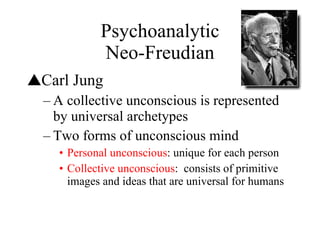
Psychoanalytic Neo-Freudian Carl Jung A collective unconscious is represented by universal archetypes Two forms of unconscious mind Personal unconscious : unique for each person Collective unconscious :  consists of primitive images and ideas that are universal for humans
Humanistic Theory Humanistic personality  theories reject psychoanalytic notions Humanistic theories view each person as basically good and that people are striving for self-fulfillment Humanistic theory argues that people carry a perception of themselves and of the world The goal for a humanist is to develop/promote a positive self-concept
Humanistic Perspectives Carl Rogers We have needs for: Self-consistency (absence of conflict between self-perceptions Congruence (consistency between self-perceptions and experience) Inconsistency evokes anxiety and threat People with low self-esteem generally have poor  congruence  between their self-concepts and life experiences.
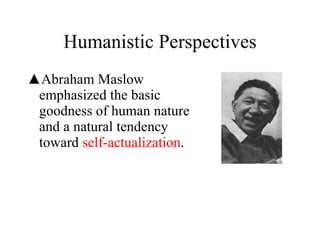
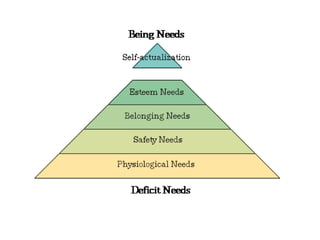
Abraham Maslow emphasized the basic goodness of human nature and a natural tendency toward  self-actualization . Humanistic Perspectives
 
Social/Cognitive Perspective Proposed that each person has a unique personality because of our personal histories and interpretations shape our personalities Albert Bandura’s social-cognitive approach focuses on  self-efficacy   and   reciprocal determinism. Julian Rotter’s  locus of control theory  emphasizes a person’s internal or external focus as a major determinant of personality.
Locus of Control (Rotter) Internal locus of control Life outcomes are under personal control Positively correlated with self-esteem Internals use more problem-focused coping External locus of control Luck, chance, and powerful others control behavior

PDC prsentation

  • 1.
  • 2.
    What is Personality?People differ from each other in meaningful ways People seem to show some consistency in behavior Personality is defined as distinctive and relatively enduring ways of thinking, feeling, and acting
  • 3.
    Personality Personality refers to a person’s unique and relatively stable pattern of thoughts, feelings, and actions Personality is an interaction between biology and environment Genetic studies suggest heritability of personality Other studies suggest learned components of personality
  • 4.
  • 5.
  • 6.
    Four Theories ofPersonality 1. Trait 2. Psychoanalytic 3. Humanistic 4. Socio-Cognitive
  • 7.
    The First TraitTheory Two Factor Trait Theory of Personality UNSTABLE STABLE choleric melancholic phlegmatic sanguine INTROVERTED EXTRAVERTED Moody Anxious Rigid Sober Pessimistic Reserved Unsociable Quiet Sociable Outgoing Talkative Responsive Easygoing Lively Carefree Leadership Passive Careful Thoughtful Peaceful Controlled Reliable Even-tempered Calm Touchy Restless Aggressive Excitable Changeable Impulsive Optimistic Active
  • 8.
    Personality Traits Traits are relatively stable and consistent personal characteristics Trait personality theories suggest that a person can be described on the basis of some number of personality traits Allport identified some 4,500 traits Cattel used factor analysis to identify 30-35 basic traits Eysenck argued there are 3 distinct traits in personality Extraversion/introversion Neuroticism Psychotocism Allport
  • 9.
    Overview of the Big “5”
  • 10.
    Assessing Traits: AnExample Minnesota Multiphasic Personality Inventory (MMPI) the most widely researched and clinically used of all personality tests developed to identify emotional disorders
  • 11.
    MMPI: examples “Nothing in the newspaper interests me except the comics.” “ I get angry sometimes.”
  • 12.
    Evaluating Trait TheoryTrait theory, especially the Big 5 model, is able to describe personality Cross-cultural human studies find good agreement for the Big 5 model in many cultures Appear to be highly correlated not only in adulthood, but also in childhood and even late preschoolers Three dimensions (extraversion, neuroticism and agreeableness) have cross-species generality Problems with trait theory include: Lack of explanation as to WHY traits develop Issue of explaining transient versus long-lasting traits
  • 13.
    Psychoanalytic Theory Psychoanalytictheory, as devised by Freud, attempts to explain personality on the basis of unconscious mental forces Levels of consciousness: We are unaware of some aspects of our mental states Freud argued that personality is made up of multiple structures, some of which are unconscious Freud argued that as we have impulses that cause us anxiety; our personality develops defense mechanisms to protect against anxiety
  • 14.
    Freudian Theory Levelsof consciousness Conscious What we’re aware of Preconscious Memories etc. that can be recalled Unconscious Wishes, feelings, impulses that lies beyond awareness Structures of Personality Id Operates according to the “pleasure principle” Ego Operates according to the “reality” principle Superego Contains values and ideals
  • 15.
    Freudian Theory Anxietyoccurs when: Impulses from the id threaten to get out of control The ego perceives danger from the environment The ego deals with the problem through: coping strategies defense mechanisms
  • 16.
    Defense Mechanisms Defensemechanisms refer to unconscious mental processes that protect the conscious person from developing anxiety Sublimation: person channels energy from unacceptable impulses to create socially acceptable accomplishments Denial: person refuses to recognize reality Projection: person attributes their own unacceptable impulses to others Repression: anxiety-evoking thoughts are pushed into the unconscious
  • 17.
    Defense Mechanisms Rationalization: Substituting socially acceptable reasons Intellectualization: Ignoring the emotional aspects of a painful experience by focusing on abstract thoughts, words, or ideas Reaction formation: Refusing to acknowledge unacceptable urges, thoughts or feelings by exaggerating the opposite state Regression: Responding to a threatening situation in a way appropriate to an earlier age or level of development Displacement: Substituting a less threatening object for the original object of impulse
  • 18.
    Assessing the UnconsciousProjective Tests used to assess personality (e.g., Rorschach or TAT tests) How? provides ambiguous stimuli and subject projects his or her motives into the ambiguous stimuli
  • 19.
    Assessing the Unconscious-- Rorschach Rorschach Inkblot Test the most widely used projective test a set of 10 inkblots designed by Hermann Rorschach Rorschach
  • 20.
    Assessing the Unconscious--Rorschachused to identify people’s inner feelings by analyzing their interpretations of the blots
  • 21.
  • 22.
  • 23.
  • 24.
  • 25.
  • 26.
    Assessing the Unconscious--TATThematic Apperception Test (TAT) people express their inner motives through the stories they make up about ambiguous scenes
  • 27.
  • 28.
  • 29.
    Psychoanalytic Neo-Freudian AlfredAdler Humans are motivated by social interest Takes social context into account First Born Privileged until Dethroned Second Born In shadow of 1 st Born  inferiority, restlessness Youngest Pampered, dependent Only Child Higher intellect, timid, passive, & withdrawn
  • 30.
    Psychoanalytic Neo-Freudian CarlJung A collective unconscious is represented by universal archetypes Two forms of unconscious mind Personal unconscious : unique for each person Collective unconscious : consists of primitive images and ideas that are universal for humans
  • 31.
    Humanistic Theory Humanisticpersonality theories reject psychoanalytic notions Humanistic theories view each person as basically good and that people are striving for self-fulfillment Humanistic theory argues that people carry a perception of themselves and of the world The goal for a humanist is to develop/promote a positive self-concept
  • 32.
    Humanistic Perspectives CarlRogers We have needs for: Self-consistency (absence of conflict between self-perceptions Congruence (consistency between self-perceptions and experience) Inconsistency evokes anxiety and threat People with low self-esteem generally have poor congruence between their self-concepts and life experiences.
  • 33.
    Abraham Maslow emphasizedthe basic goodness of human nature and a natural tendency toward self-actualization . Humanistic Perspectives
  • 34.
  • 35.
    Social/Cognitive Perspective Proposedthat each person has a unique personality because of our personal histories and interpretations shape our personalities Albert Bandura’s social-cognitive approach focuses on self-efficacy and reciprocal determinism. Julian Rotter’s locus of control theory emphasizes a person’s internal or external focus as a major determinant of personality.
  • 36.
    Locus of Control(Rotter) Internal locus of control Life outcomes are under personal control Positively correlated with self-esteem Internals use more problem-focused coping External locus of control Luck, chance, and powerful others control behavior