PERSONALITY
THEORIES
PERSONALITY
Personality refers to an
individual’s unique set of
consistent behavioral
traits.
Explaining Personality Theories
Psychodynamic
Perspectives
01
Psychodynamic theories include all the diverse
theories descended from the work of
Sigmund Freud that focus on unconscious
mental forces.
● Proposed by Sigmund Freud in the late 1800s.
● According to this theory, childhood experiences are crucial in shaping
future personality
Structure of Personality
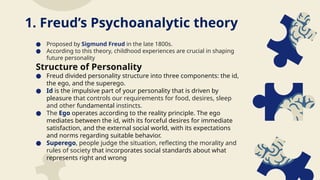
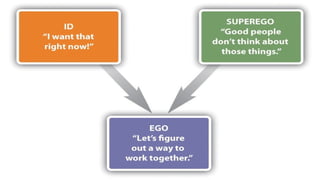
● Freud divided personality structure into three components: the id,
the ego, and the superego.
● Id is the impulsive part of your personality that is driven by
pleasure that controls our requirements for food, desires, sleep
and other fundamental instincts.
● The Ego operates according to the reality principle. The ego
mediates between the id, with its forceful desires for immediate
satisfaction, and the external social world, with its expectations
and norms regarding suitable behavior.
● Superego, people judge the situation, reflecting the morality and
rules of society that incorporates social standards about what
represents right and wrong
1. Freud’s Psychoanalytic theory
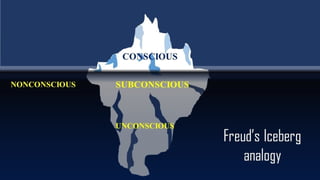
Levels of Awareness
● Freud’s most enduring insight was his recognition of how
unconscious forces can influence behavior.
● Slips of the tongue (“Freudian slip”).
● Dream analysis
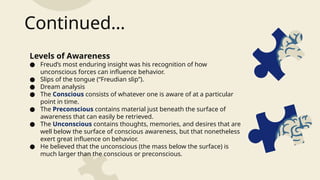
● The Conscious consists of whatever one is aware of at a particular
point in time.
● The Preconscious contains material just beneath the surface of
awareness that can easily be retrieved.
● The Unconscious contains thoughts, memories, and desires that are
well below the surface of conscious awareness, but that nonetheless
exert great influence on behavior.
● He believed that the unconscious (the mass below the surface) is
much larger than the conscious or preconscious.
Continued…
Conflicts
● Freud assumed that behavior is the outcome of an
ongoing series of internal conflicts.
● He saw internal battles among the id, ego, and
superego as routine. Why?
● Because the id wants to gratify its urges
immediately, but the norms of civilized society
frequently dictate otherwise.
● For example, your id might feel an urge to clobber a
co-worker who constantly irritates you. However,
society frowns on such behavior, so your ego would
try to hold this urge in check. Hence, you would find
yourself in conflict
Continued..
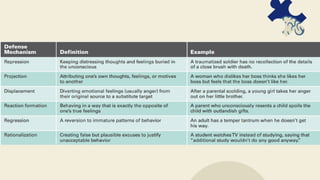
Anxiety and Defense Mechanisms
● Most internal conflicts are trivial and are quickly resolved.
Occasionally, however, a conflict will linger for days, months,
or even years, creating internal tension
● Although you may not be aware of these unconscious battles,
they can produce anxiety that slips to the surface of conscious
awareness.
● Anxiety is distressing, so people try to rid themselves of this
unpleasant emotion any way they can. This effort to ward off
anxiety often involves the use of defense mechanisms
● Defense mechanisms are largely unconscious reactions that
protect a person from unpleasant emotions, such as anxiety
and guilt.
Continued..
● Emphasized the unconscious determinants of personality.
● He proposed that the unconscious consists of two layers.
● The first layer, called the personal unconscious, is essentially
the same as Freud’s version of the unconscious.
● The personal unconscious houses material that is not
within one’s conscious awareness because it has been
repressed or forgotten.
● In addition, Jung theorized the existence of a deeper layer
that he called the collective unconscious. The collective
unconscious is a storehouse of latent memory traces
inherited from people’s ancestral past.
● Jung called these ancestral memories Archetypes. They are
not memories of actual, personal experiences. Instead,
archetypes are emotionally charged images and thought
forms that have universal meaning.
2. Jung’s Analytical Psychology
● Adler’s theory stressed the social context of personality
development
● According to Adler, the foremost source of human motivation is a
striving for superiority.
● He noted that young children understandably feel weak and
helpless in comparison with more competent older children and
adults. These early inferiority feelings supposedly motivate them to
acquire new skills and develop new talents.
● Adler asserted that everyone has to work to overcome imagined or
real feelings of inferiority. He called this process compensation.
● Adler believed that compensation is entirely normal. However, in
some people, inferiority feelings can become excessive, which can
result in what is widely known today as an inferiority complex—
exaggerated feelings of weakness and inadequacy
3. Adler’s Individual Psychology
● Adler thought that either parental pampering or parental
neglect could cause an inferiority complex. Thus, he agreed
with Freud on the importance of early childhood experiences.
● Adler maintained that some people engage in
overcompensation in order to conceal, even from themselves,
their feelings of inferiority. These people work to acquire status,
power, and the trappings of success (fancy clothes, impressive
cars) to cover up their underlying inferiority complex.
● It was Adler who first focused attention on the possible
importance of birth order as a factor governing personality. He
noted that first-borns, second children, and later-born children
enter varied home environments and are treated differently by
parents and that these experiences are likely to affect their
personality
Continued..
Behavioral
Perspectives
02
Behaviorism is a theoretical orientation based on the
premise that scientific psychology should study only
observable behavior.
Personality Structure: A View from the Outside
● Skinner showed little interest in what goes on “inside” people.
Instead, he focused how behavior is fully determined by
environmental stimuli.
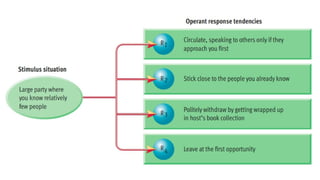
● According to his view, people show some consistent patterns
of behavior because they have some stable response
tendencies that they have acquired through experience. These
response tendencies may change in the future as a result of
new experience
● Skinner viewed an individual’s personality as a collection of
response tendencies that are tied to various stimulus
situations.
Skinner’s ideas applied to Personality
Personality Development as a Product of Conditioning
● Various response tendencies are acquired through learning
(operant conditioning)
● when responses are followed by favorable consequences
(reinforcement), they are strengthened. For example, if your joking
around friends pays off with favorable attention, your tendency to
joke will increase.
● On the other hand, when responses lead to negative consequences
(punishment), they are weakened. Thus, if your impulsive decisions
always backfire, your tendency to be impulsive will decline.
● Response tendencies are constantly being strengthened or
weakened by new experiences.
● Unlike Freud, Skinner’s theory views personality development as a
continuous, lifelong journey
Continued..
● Observational learning occurs when an organism’s
responding is influenced by the observation of others.
● For example, watching your sister get burned by a
bounced check upon selling her old smart phone could
strengthen your tendency to be suspicious of others.
● Individuals learn behaviors, attitudes, and emotional
reactions by watching others. For example, children
may adopt personality traits (e.g. aggression, kindness)
by observing role models such as parents, peers,
teachers, or media figures.
● Modelling
Bandura’s Observational Learning
Humanistic
Perspective
03
Humanism is a theoretical orientation that emphasizes the
unique qualities of humans, especially their potential for
personal growth.

● Carl Rogers viewed personality structure in terms of just one
construct. He called this construct the self, although it’s more widely
known today as the self-concept
● A self-concept is a collection of beliefs about one’s own nature, unique
qualities, and typical behavior.
● Your self-concept is your own mental picture of yourself. It’s a
collection of self perceptions. For example, a self-concept might
include beliefs such as “I’m easygoing” or “I’m shy” or “I’m pretty” or
“I’m hardworking.”
● The self-concept does not necessarily reflect reality: A person may be
highly successful and respected but still view himself or herself as a
failure
● Rogers called the gap between self-concept and reality
“incongruence.”
● Incongruence is the degree of disparity between one’s self-concept
and one’s actual experience.
1. Rogers’s Person-Centered theory
● In contrast, if a person’s self-concept is reasonably accurate, it’s
said to be congruent with reality
● Everyone experiences a certain amount of incongruence. The
crucial issue is how much.
● Rogers held that too much incongruence undermines one’s
psychological well-being
● Rogers also proposed that each of us has an ideal self, our
conception of the kind of person we would like to be.
● The closer the ideal self is to the real self, the more fulfilled and
happy the individual becomes.
● A large discrepancy between the ideal self and the real self
results in an unhappy, dissatisfied person.
Continued..
● Rogers was concerned with how childhood experiences promote a
congruent or incongruent self-concept.
● According to Rogers, people have a strong need for affection and
acceptance from others. Early in life, parents provide most of this
affection
● Rogers maintained that some parents make their affection conditional.
That is, it depends on the child’s behaving well and living up to
expectations.
● When parental love seems conditional, children might suppress or deny
parts of themselves that they believe are not acceptable. For example, if
a child feels that they must always be "perfect" to be loved, they might
hide their mistakes or flaws, leading to an incongruent self-concept.
● As a result, they might grow up constantly seeking approval and
validation from others, trying to live up to expectations that are not true
to their real selves.
Roger’s theory- In terms of personality
development
● At the other end of the spectrum, some parents make their
affection unconditional.
● If children receive unconditional love, they are more likely to
accept themselves as they are, including their flaws. This
leads to a congruent self-concept.
.
Continued..
● Abraham Maslow (1970) was a prominent humanistic theorist who
argued that psychology should take a greater interest in the nature of
the healthy personality instead of dwelling on the causes of disorders.
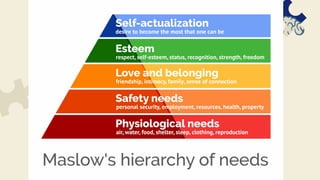
● Maslow proposed that humans have a series of needs that must be
fulfilled in a specific order to achieve personal growth and self-
fulfillment.
● Maslow argued that humans have an innate drive toward personal
growth—that is, evolution toward a higher state of being. Foremost
among them is the need for self-actualization, which is the need to
fulfill one’s potential.
● Maslow summarized this concept with a simple statement: “What a
man can be, he must be.” According to Maslow, individuals will be
frustrated if they are unable to fully utilize their talents or pursue their
true interests.
● Maslow called people with exceptionally healthy personalities self-
actualizing persons because of their commitment to continued
personal growth.
2. Maslow’s theory of Self-Actualization
personality theories Complete lecture.pptx

personality theories Complete lecture.pptx

  • 1.
  • 2.
    PERSONALITY Personality refers toan individual’s unique set of consistent behavioral traits.
  • 3.
  • 4.
    Psychodynamic Perspectives 01 Psychodynamic theories includeall the diverse theories descended from the work of Sigmund Freud that focus on unconscious mental forces.
  • 5.
    ● Proposed bySigmund Freud in the late 1800s. ● According to this theory, childhood experiences are crucial in shaping future personality Structure of Personality ● Freud divided personality structure into three components: the id, the ego, and the superego. ● Id is the impulsive part of your personality that is driven by pleasure that controls our requirements for food, desires, sleep and other fundamental instincts. ● The Ego operates according to the reality principle. The ego mediates between the id, with its forceful desires for immediate satisfaction, and the external social world, with its expectations and norms regarding suitable behavior. ● Superego, people judge the situation, reflecting the morality and rules of society that incorporates social standards about what represents right and wrong 1. Freud’s Psychoanalytic theory
  • 7.
    Levels of Awareness ●Freud’s most enduring insight was his recognition of how unconscious forces can influence behavior. ● Slips of the tongue (“Freudian slip”). ● Dream analysis ● The Conscious consists of whatever one is aware of at a particular point in time. ● The Preconscious contains material just beneath the surface of awareness that can easily be retrieved. ● The Unconscious contains thoughts, memories, and desires that are well below the surface of conscious awareness, but that nonetheless exert great influence on behavior. ● He believed that the unconscious (the mass below the surface) is much larger than the conscious or preconscious. Continued…
  • 9.
    Conflicts ● Freud assumedthat behavior is the outcome of an ongoing series of internal conflicts. ● He saw internal battles among the id, ego, and superego as routine. Why? ● Because the id wants to gratify its urges immediately, but the norms of civilized society frequently dictate otherwise. ● For example, your id might feel an urge to clobber a co-worker who constantly irritates you. However, society frowns on such behavior, so your ego would try to hold this urge in check. Hence, you would find yourself in conflict Continued..
  • 10.
    Anxiety and DefenseMechanisms ● Most internal conflicts are trivial and are quickly resolved. Occasionally, however, a conflict will linger for days, months, or even years, creating internal tension ● Although you may not be aware of these unconscious battles, they can produce anxiety that slips to the surface of conscious awareness. ● Anxiety is distressing, so people try to rid themselves of this unpleasant emotion any way they can. This effort to ward off anxiety often involves the use of defense mechanisms ● Defense mechanisms are largely unconscious reactions that protect a person from unpleasant emotions, such as anxiety and guilt. Continued..
  • 12.
    ● Emphasized theunconscious determinants of personality. ● He proposed that the unconscious consists of two layers. ● The first layer, called the personal unconscious, is essentially the same as Freud’s version of the unconscious. ● The personal unconscious houses material that is not within one’s conscious awareness because it has been repressed or forgotten. ● In addition, Jung theorized the existence of a deeper layer that he called the collective unconscious. The collective unconscious is a storehouse of latent memory traces inherited from people’s ancestral past. ● Jung called these ancestral memories Archetypes. They are not memories of actual, personal experiences. Instead, archetypes are emotionally charged images and thought forms that have universal meaning. 2. Jung’s Analytical Psychology
  • 13.
    ● Adler’s theorystressed the social context of personality development ● According to Adler, the foremost source of human motivation is a striving for superiority. ● He noted that young children understandably feel weak and helpless in comparison with more competent older children and adults. These early inferiority feelings supposedly motivate them to acquire new skills and develop new talents. ● Adler asserted that everyone has to work to overcome imagined or real feelings of inferiority. He called this process compensation. ● Adler believed that compensation is entirely normal. However, in some people, inferiority feelings can become excessive, which can result in what is widely known today as an inferiority complex— exaggerated feelings of weakness and inadequacy 3. Adler’s Individual Psychology
  • 14.
    ● Adler thoughtthat either parental pampering or parental neglect could cause an inferiority complex. Thus, he agreed with Freud on the importance of early childhood experiences. ● Adler maintained that some people engage in overcompensation in order to conceal, even from themselves, their feelings of inferiority. These people work to acquire status, power, and the trappings of success (fancy clothes, impressive cars) to cover up their underlying inferiority complex. ● It was Adler who first focused attention on the possible importance of birth order as a factor governing personality. He noted that first-borns, second children, and later-born children enter varied home environments and are treated differently by parents and that these experiences are likely to affect their personality Continued..
  • 15.
    Behavioral Perspectives 02 Behaviorism is atheoretical orientation based on the premise that scientific psychology should study only observable behavior.
  • 16.
    Personality Structure: AView from the Outside ● Skinner showed little interest in what goes on “inside” people. Instead, he focused how behavior is fully determined by environmental stimuli. ● According to his view, people show some consistent patterns of behavior because they have some stable response tendencies that they have acquired through experience. These response tendencies may change in the future as a result of new experience ● Skinner viewed an individual’s personality as a collection of response tendencies that are tied to various stimulus situations. Skinner’s ideas applied to Personality
  • 18.
    Personality Development asa Product of Conditioning ● Various response tendencies are acquired through learning (operant conditioning) ● when responses are followed by favorable consequences (reinforcement), they are strengthened. For example, if your joking around friends pays off with favorable attention, your tendency to joke will increase. ● On the other hand, when responses lead to negative consequences (punishment), they are weakened. Thus, if your impulsive decisions always backfire, your tendency to be impulsive will decline. ● Response tendencies are constantly being strengthened or weakened by new experiences. ● Unlike Freud, Skinner’s theory views personality development as a continuous, lifelong journey Continued..
  • 19.
    ● Observational learningoccurs when an organism’s responding is influenced by the observation of others. ● For example, watching your sister get burned by a bounced check upon selling her old smart phone could strengthen your tendency to be suspicious of others. ● Individuals learn behaviors, attitudes, and emotional reactions by watching others. For example, children may adopt personality traits (e.g. aggression, kindness) by observing role models such as parents, peers, teachers, or media figures. ● Modelling Bandura’s Observational Learning
  • 20.
    Humanistic Perspective 03 Humanism is atheoretical orientation that emphasizes the unique qualities of humans, especially their potential for personal growth.

  • 21.
    ● Carl Rogersviewed personality structure in terms of just one construct. He called this construct the self, although it’s more widely known today as the self-concept ● A self-concept is a collection of beliefs about one’s own nature, unique qualities, and typical behavior. ● Your self-concept is your own mental picture of yourself. It’s a collection of self perceptions. For example, a self-concept might include beliefs such as “I’m easygoing” or “I’m shy” or “I’m pretty” or “I’m hardworking.” ● The self-concept does not necessarily reflect reality: A person may be highly successful and respected but still view himself or herself as a failure ● Rogers called the gap between self-concept and reality “incongruence.” ● Incongruence is the degree of disparity between one’s self-concept and one’s actual experience. 1. Rogers’s Person-Centered theory
  • 22.
    ● In contrast,if a person’s self-concept is reasonably accurate, it’s said to be congruent with reality ● Everyone experiences a certain amount of incongruence. The crucial issue is how much. ● Rogers held that too much incongruence undermines one’s psychological well-being ● Rogers also proposed that each of us has an ideal self, our conception of the kind of person we would like to be. ● The closer the ideal self is to the real self, the more fulfilled and happy the individual becomes. ● A large discrepancy between the ideal self and the real self results in an unhappy, dissatisfied person. Continued..
  • 23.
    ● Rogers wasconcerned with how childhood experiences promote a congruent or incongruent self-concept. ● According to Rogers, people have a strong need for affection and acceptance from others. Early in life, parents provide most of this affection ● Rogers maintained that some parents make their affection conditional. That is, it depends on the child’s behaving well and living up to expectations. ● When parental love seems conditional, children might suppress or deny parts of themselves that they believe are not acceptable. For example, if a child feels that they must always be "perfect" to be loved, they might hide their mistakes or flaws, leading to an incongruent self-concept. ● As a result, they might grow up constantly seeking approval and validation from others, trying to live up to expectations that are not true to their real selves. Roger’s theory- In terms of personality development
  • 24.
    ● At theother end of the spectrum, some parents make their affection unconditional. ● If children receive unconditional love, they are more likely to accept themselves as they are, including their flaws. This leads to a congruent self-concept. . Continued..
  • 25.
    ● Abraham Maslow(1970) was a prominent humanistic theorist who argued that psychology should take a greater interest in the nature of the healthy personality instead of dwelling on the causes of disorders. ● Maslow proposed that humans have a series of needs that must be fulfilled in a specific order to achieve personal growth and self- fulfillment. ● Maslow argued that humans have an innate drive toward personal growth—that is, evolution toward a higher state of being. Foremost among them is the need for self-actualization, which is the need to fulfill one’s potential. ● Maslow summarized this concept with a simple statement: “What a man can be, he must be.” According to Maslow, individuals will be frustrated if they are unable to fully utilize their talents or pursue their true interests. ● Maslow called people with exceptionally healthy personalities self- actualizing persons because of their commitment to continued personal growth. 2. Maslow’s theory of Self-Actualization