Techniques and Tools for Es2ma2ng 
      Ionospheric Effects from Interferometric 
                  and Polarimetric SAR Data 
                                             
       P. Rosen, M. Lavalle, X. Pi, S. Buckley, W. Szeliga, H. Zebker*, E. Gurrola 
                                               
    Jet Propulsion Laboratory, California Ins6tute of Technology, Pasadena, CA 91109, USA 
                        *Stanford University, Stanford, CA 94305, USA  
 
Outline 

 The ISCE soIware tool 
    •  Mo6va6ons and overview 
    •  Focusing approach and InSAR processing 

 New features of ISCE 
    •  Polarimetric and Pol‐InSAR capabili6es 
    •  Ionospheric module: Faraday rota6on 
    •  Ionospheric module: Split Spectrum 

 Conclusions and future developments 


                  IEEE IGARSS 2011      Vancouver July 26, 2011    2 
The ISCE soIware tool 


                                                                                                   ISCE 
  Background 
      •    Two NASA sponsored InSAR workshops at Stanford 
           (2008) and Scripps (2011) 

  Mo6va6ons 
      •    To respond to the demand for an efficient, flexible and 
           extensible SAR/InSAR processor                                                                              InSAR 
  Objec6ve: to build a new SAR processing environment                                                              Scien6fic 
      • 
      • 
           accurate in phase and geoloca6on 
           easy to use, flexible, extensible and efficient  
                                                                                                                  Compu6ng 
      •    well documented, supported, accessible to all users                                                  Environment 
  Delivered to US scien6sts by 2011 


  Gurrola, E., Rosen, P., Sacco, G., Szeliga, W., Zebker, H., Simons, M., Sandwell, D., Shanker, P., Wortham, C., Chen, A., “Interferometric 
  Synthe6c Aperture Radar (InSAR) Scien6fic Compu6ng Environment,” presented at AGU Fall Mee6ng, San Francisco, December 2010. 


                                                IEEE IGARSS 2011      Vancouver July 26, 2011                                                  3 
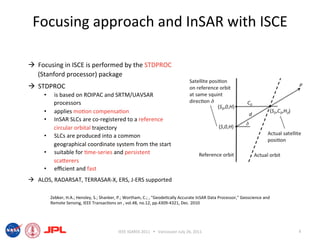
Focusing approach and InSAR with ISCE 

  Focusing in ISCE is performed by the STDPROC 
   (Stanford processor) package 
  STDPROC 
     •     is based on ROIPAC and SRTM/UAVSAR 
           processors 
     •     applies mo6on compensa6on 
     •     InSAR SLCs are co‐registered to a reference 
           circular orbital trajectory 
     •     SLCs are produced into a common 
           geographical coordinate system from the start 
     •     suitable for 6me‐series and persistent 
           scaierers                                                                                                                 !
     •     efficient and fast 
  ALOS, RADARSAT, TERRASAR‐X, ERS, J‐ERS supported 

          Zebker, H.A.; Hensley, S.; Shanker, P.; Wortham, C.; , "Geode6cally Accurate InSAR Data Processor," Geoscience and 
          Remote Sensing, IEEE Transac6ons on , vol.48, no.12, pp.4309‐4321, Dec. 2010 


                                             IEEE IGARSS 2011      Vancouver July 26, 2011                                     4 
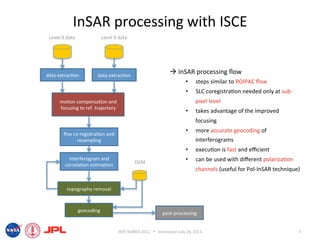
InSAR processing with ISCE 
 Level 0 data             Level 0 data 


data extrac6on           data extrac6on 
                                                                  InSAR processing flow 
                                                                          •     steps similar to ROIPAC flow 
                                                                          •     SLC coregistra6on needed only at sub‐
      mo6on compensa6on and                                                    pixel level 
      focusing to ref. trajectory 
                                                                          •     takes advantage of the improved 
                                                                               focusing   
                                                                          •    more accurate geocoding of 
        fine co‐registra6on and 
              resampling                                                       interferograms 
                                                                          •     execu6on is fast and efficient 
          interferogram and                                               •     can be used with different polariza6on 
                                              DEM 
        correla6on es6ma6on 
                                                                               channels (useful for Pol‐InSAR technique) 


         topography removal 


                 geocoding 
                                                             post‐processing 


                                     IEEE IGARSS 2011      Vancouver July 26, 2011                                      5 
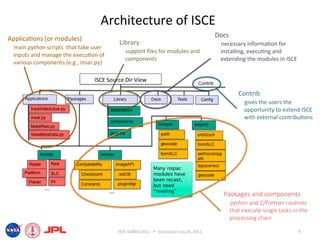
Architecture of ISCE 
                                                                                             Docs 
Applica6ons (or modules) 
                                           Library                                             necessary informa6on for 
  main python scripts  that take user 
                                              support files for modules and                     installing, execu6ng and 
  inputs and manage the execu6on of 
                                              components                                       extending the modules in ISCE 
  various components (e.g., insar.py) 

                                  ISCE Source Dir View 

                                                                                                     Contrib 
                                                                                                       gives the users the 
                                                                                                        opportunity to extend ISCE 
                                                                                                        with external contribu6ons 


                                                                                                Packages and components 
                                                                                                 !
                                                                                                    python and C/Fortran rou6nes 
                                                                                                  that execute single tasks in the 
                                                                                                  processing chain 

                                           IEEE IGARSS 2011      Vancouver July 26, 2011                                       6 
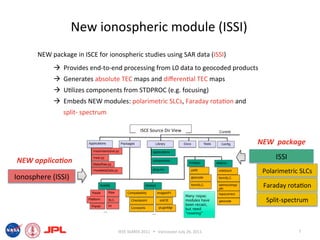
New ionospheric module (ISSI) 
       NEW package in ISCE for ionospheric studies using SAR data (ISSI) 
              Provides end‐to‐end processing from L0 data to geocoded products 
              Generates absolute TEC maps and differen6al TEC maps 
              U6lizes components from STDPROC (e.g. focusing) 
              Embeds NEW modules: polarimetric SLCs, Faraday rota6on and 
               split‐ spectrum 

                                               ISCE Source Dir View 

                                                                                         NEW  package 

NEW applica*on                                                                                ISSI 
                                                                                          Polarimetric SLCs 
Ionosphere (ISSI) 
                                                                                          Faraday rota6on 

                                                                                           Split‐spectrum 

                                                                                     !


                                   IEEE IGARSS 2011      Vancouver July 26, 2011                     7 
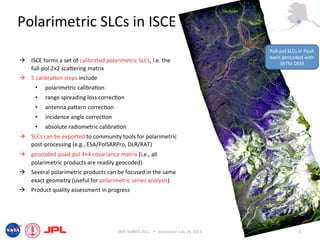
Polarimetric SLCs in ISCE 
                                                                                          Full‐pol SLCs in Pauli 
                                                                                          basis geocoded with 
  ISCE forms a set of calibrated polarimetric SLCs, i.e. the                                  SRTM DEM 
   full‐pol 2×2 scaiering matrix 
  5 calibra6on steps include 
      •    polarimetric calibra6on 
      •    range spreading loss correc6on 
      •    antenna paiern correc6on 
      •    incidence angle correc6on 
      •    absolute radiometric calibra6on 
  SLCs can be exported to community tools for polarimetric 
   post‐processing (e.g., ESA/PolSARPro, DLR/RAT) 
  geocoded quad‐pol 4×4 covariance matrix (i.e., all 
   polarimetric products are readily geocoded) 
  Several polarimetric products can be focused in the same 
   exact geometry (useful for polarimetric series analysis) 
  Product quality assessment in progress 


                                        IEEE IGARSS 2011      Vancouver July 26, 2011                  8 
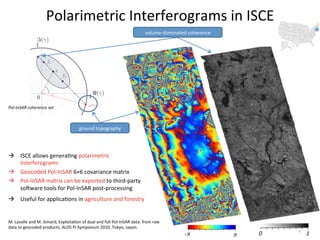
Polarimetric Interferograms in ISCE 
                                                                       volume‐dominated coherence 


Pol‐InSAR coherence set 


                                     ground topography 


  ISCE allows genera6ng polarimetric 
   interferograms  
  Geocoded Pol‐InSAR 6×6 covariance matrix 
  Pol‐InSAR matrix can be exported to third‐party 
   soIware tools for Pol‐InSAR post‐processing 
  Useful for applica6ons in agriculture and forestry 


M. Lavalle and M. Simard, Exploita6on of dual and full Pol‐InSAR data: from raw 
data to geocoded products, ALOS PI Symposium 2010, Tokyo, Japan. 
                                                                                                                9 
                                                                                      ‐π             π    0          1  
Ionospheric module in ISCE:  
                          Faraday rota6on method 

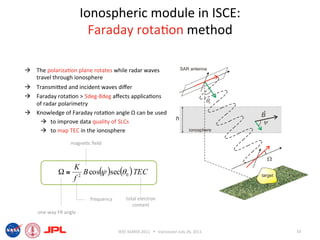
  The polariza6on plane rotates while radar waves 
   travel through ionosphere 
  Transmiied and incident waves differ 
  Faraday rota6on > 5deg‐8deg affects applica6ons 
   of radar polarimetry 
  Knowledge of Faraday rota6on angle Ω can be used 
      to improve data quality of SLCs 
      to map TEC in the ionosphere 
                  magne6c field 


                   K
            Ω≅        B cos( )sec(θ 0 ) TEC
                           ψ
                   f2

                          frequency        total electron 
                                              content 
    one‐way FR angle 


                                       IEEE IGARSS 2011      Vancouver July 26, 2011    10 
Ionospheric module in ISCE: 
                    Faraday rota6on method 
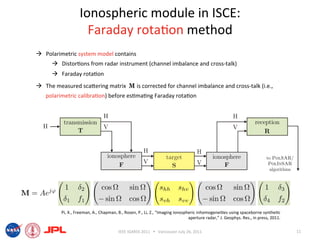
  Polarimetric system model contains 
        Distor6ons from radar instrument (channel imbalance and cross‐talk) 
        Faraday rota6on 
  The measured scaiering matrix  M is corrected for channel imbalance and cross‐talk (i.e., 
   polarimetric calibra6on) before es6ma6ng Faraday rota6on  


         Pi, X., Freeman, A., Chapman, B., Rosen, P., Li, Z., “Imaging ionospheric inhomogenei6es using spaceborne synthe6c 
                                                                              aperture radar,” J. Geophys. Res., in press, 2011.  

                                        IEEE IGARSS 2011      Vancouver July 26, 2011                                               11 
Ionospheric module in ISCE: 
                                      Faraday rota6on method 
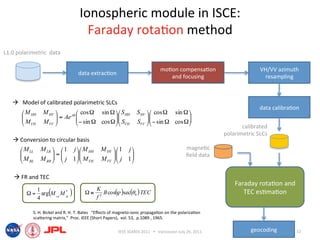
L1.0 polarimetric  data 

                                                                                mo6on compensa6on                        VH/VV azimuth 
                                   data extrac6on 
                                                                                   and focusing                           resampling 


     Model of calibrated polarimetric SLCs 
                                                                                                                         data calibra6on 
        M HH    M HV           cos Ω sin Ω  S HH              S HV  cos Ω sin Ω 
                      = Ae jφ 
                                 − sin Ω cos Ω  S
                                                                                    
       M
        VH      M VV 
                                               VH              SVV  − sin Ω cos Ω 
                                                                                      
                                                                                                                  calibrated 
                                                                                                           polarimetric SLCs 
    Conversion to circular basis 
       M LL    M LR   1 j  M HH           M HV  1 j                                   magne6c 
                    =                                                                 field data 
      M
       RL      M RR   j 1  M VH
                                           M VV  j 1 
                                                         

     FR and TEC 
                                                                                                               Faraday rota6on and 
            1                             K
                    (
         Ω = arg M LR M *      )       Ω ≅ 2 B cos( )sec(θ 0 ) TEC
                                                  ψ                                                               TEC es6ma6on 
            4           RL
                                          f

            S. H. Bickel and R. H. T. Bates   “Effects of magneto‐ionic propaga6on on the polariza6on 
            scaiering matrix,”  Proc. IEEE (Short Papers),  vol. 53,  p.1089 , 1965.  

                                                         IEEE IGARSS 2011      Vancouver July 26, 2011              geocoding         12 
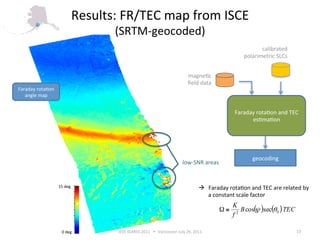
Results: FR/TEC map from ISCE 
                                (SRTM‐geocoded) 
                                                                                                    calibrated 
                                                                                             polarimetric SLCs 


                                                                      magne6c 
                                                                      field data 
Faraday rota6on 
   angle map 


                                                                                         Faraday rota6on and TEC 
                                                                                               es6ma6on 


                                                                                                geocoding 
                                                                   low‐SNR areas 


                   15 deg                                                     Faraday rota6on and TEC are related by  
                                                                               a constant scale factor 
                                                                                        K
                                                                                   Ω≅      B cos( )sec(θ 0 ) TEC
                                                                                                ψ
                                                                                        f2

                    0 deg       IEEE IGARSS 2011      Vancouver July 26, 2011                                     13 
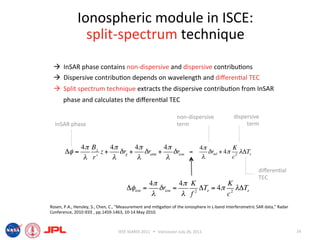
Ionospheric module in ISCE: 
                split‐spectrum technique 
   InSAR phase contains non‐dispersive and dispersive contribu6ons 
   Dispersive contribu6on depends on wavelength and differen6al TEC 
   Split spectrum technique extracts the dispersive contribu6on from InSAR 
      phase and calculates the differen6al TEC 

                                                                   non‐dispersive             dispersive 
  InSAR phase                                                      term                            term 


               4" B"    4"        4"          4"          4!           K
       !! =          z+    $ rg +    $ ratm +    $ rion =    # rnd + 4! 2 "!Te
                # r'     #         #           #           "           c

                                                                                                           differen6al 
                                                                                                           TEC 
                                                    4"          4" K          K
                                       !!ion =         $ rion =       !Te = 4" 2 #!Te
                                                     #           # f2         c
Rosen, P.A., Hensley, S., Chen, C., "Measurement and mi6ga6on of the ionosphere in L‐band Interferometric SAR data," Radar 
Conference, 2010 IEEE , pp.1459‐1463, 10‐14 May 2010.  


                                   IEEE IGARSS 2011      Vancouver July 26, 2011                                             14 
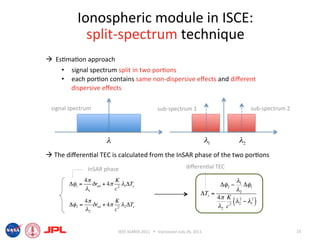
Ionospheric module in ISCE: 
             split‐spectrum technique 
  Es6ma6on approach 
     •  signal spectrum split in two por6ons 
     •  each por6on contains same non‐dispersive effects and different 
        dispersive effects 

 signal spectrum                                  sub‐spectrum 1                                   sub‐spectrum 2 


                        !                                                      !1             !2
 The differen6al TEC is calculated from the InSAR phase of the two por6ons 
                InSAR phase                                       differen6al TEC 

               4"           K                                                                "1
       !!1 =      $ rnd + 4" 2 #1!Te                                                 !!2 "      !!1
               #1           c                                                                "2
                                                                          !Te =
                                                                                    4# K 2
                                                                                         2 ( 2
             4"           K                                                                 " " "12 )
       !!2 =    $ rnd + 4" 2 #2 !Te                                                 "2 c
             #2           c


                             IEEE IGARSS 2011      Vancouver July 26, 2011                                          15 
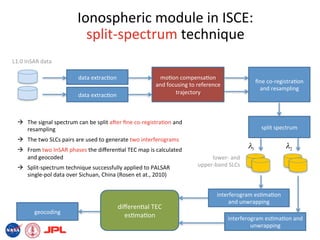
Ionospheric module in ISCE: 
                          split‐spectrum technique 
L1.0 InSAR data 

                        data extrac6on                 mo6on compensa6on 
                                                                                               fine co‐registra6on 
                                                      and focusing to reference 
                                                                                                and resampling 
                        data extrac6on                       trajectory 


   The signal spectrum can be split aIer fine co‐registra6on and 
    resampling                                                                                   split spectrum 
   The two SLCs pairs are used to generate two interferograms 
   From two InSAR phases the differen6al TEC map is calculated 
                                                                                          !1              !2
    and geocoded                                                           lower‐ and 
   Split‐spectrum technique successfully applied to PALSAR           upper‐band SLCs 
    single‐pol data over Sichuan, China (Rosen et at., 2010) 


                                                                              interferogram es6ma6on 
                                                                                   and unwrapping 
                                        differen6al TEC 
        geocoding 
                                          es6ma6on                                 interferogram es6ma6on and 
                                                                                            unwrapping 
Split‐spectrum in ISCE 
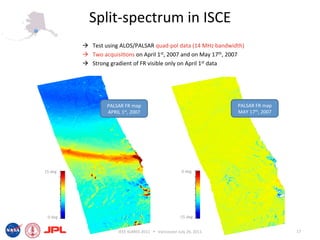
            Test using ALOS/PALSAR quad‐pol data (14 MHz bandwidth) 
            Two acquisi6ons on April 1st, 2007 and on May 17th, 2007 
            Strong gradient of FR visible only on April 1st data 


                   PALSAR FR map                                          PALSAR FR map 
                   APRIL 1st, 2007                                        MAY 17th, 2007 


15 deg                                                     0 deg 


 0 deg                                                   ‐15 deg 


                        IEEE IGARSS 2011      Vancouver July 26, 2011                      17 
Split‐spectrum in ISCE 

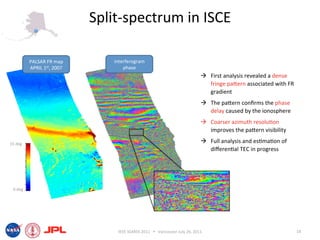
          PALSAR FR map         interferogram 
          APRIL 1st, 2007           phase 
                                                                                First analysis revealed a dense 
                                                                                 fringe paiern associated with FR 
                                                                                 gradient 
                                                                                The paiern confirms the phase 
                                                                                 delay caused by the ionosphere 
                                                                                Coarser azimuth resolu6on 
                                                                                 improves the paiern visibility 

15 deg 
                                                                                Full analysis and es6ma6on of 
                                                                                 differen6al TEC in progress 


 0 deg 


                                 IEEE IGARSS 2011      Vancouver July 26, 2011                                      18 
Conclusions & future developments 

  ISCE is a new SAR processing environment developed within a JPL‐Stanford collabora6on 
     •  designed for InSAR processing 
      •    extended to polarimetric processing 
      •    available to US scien6sts by 2011 

  Unique features of ISCE 
      •    modular, extendible, flexible, fast 
      •    accurate geocoding of output products 
  New ionospheric package recently added into ISCE 
      •    Es6ma6on of Faraday rota6on and TEC maps 
      •    Differen6al TEC maps generated from split‐spectrum technique 
  Future developments 
      •    Product quality assessment 
      •    New high‐priority packages: 6me‐series, PS methods, Pol‐InSAR, GUI 
      •    Integra6on with community tools (e.g., GMT, PolSARPro) 
      •    Extension to cloud compu6ng 


                            IEEE IGARSS 2011      Vancouver July 26, 2011                  19 

ISCE_ISSI_ML_IGARSS2011_v01-rosen.pdf

  • 1.
    Techniques and Tools for Es2ma2ng  Ionospheric Effects from Interferometric  and Polarimetric SAR Data    P. Rosen, M. Lavalle, X. Pi, S. Buckley, W. Szeliga, H. Zebker*, E. Gurrola    Jet Propulsion Laboratory, California Ins6tute of Technology, Pasadena, CA 91109, USA  *Stanford University, Stanford, CA 94305, USA    
  • 2.
    Outline   The ISCE soIware tool  •  Mo6va6ons and overview  •  Focusing approach and InSAR processing   New features of ISCE  •  Polarimetric and Pol‐InSAR capabili6es  •  Ionospheric module: Faraday rota6on  •  Ionospheric module: Split Spectrum   Conclusions and future developments  IEEE IGARSS 2011      Vancouver July 26, 2011  2 
  • 3.
    The ISCE soIware tool  ISCE    Background  •  Two NASA sponsored InSAR workshops at Stanford  (2008) and Scripps (2011)    Mo6va6ons  •  To respond to the demand for an efficient, flexible and  extensible SAR/InSAR processor  InSAR    Objec6ve: to build a new SAR processing environment   Scien6fic  •  •  accurate in phase and geoloca6on  easy to use, flexible, extensible and efficient   Compu6ng  •  well documented, supported, accessible to all users  Environment    Delivered to US scien6sts by 2011  Gurrola, E., Rosen, P., Sacco, G., Szeliga, W., Zebker, H., Simons, M., Sandwell, D., Shanker, P., Wortham, C., Chen, A., “Interferometric  Synthe6c Aperture Radar (InSAR) Scien6fic Compu6ng Environment,” presented at AGU Fall Mee6ng, San Francisco, December 2010.  IEEE IGARSS 2011      Vancouver July 26, 2011  3 
  • 4.
    Focusing approach and InSAR with ISCE    Focusing in ISCE is performed by the STDPROC  (Stanford processor) package    STDPROC  •  is based on ROIPAC and SRTM/UAVSAR  processors  •  applies mo6on compensa6on  •  InSAR SLCs are co‐registered to a reference  circular orbital trajectory  •  SLCs are produced into a common  geographical coordinate system from the start  •  suitable for 6me‐series and persistent  scaierers  ! •  efficient and fast    ALOS, RADARSAT, TERRASAR‐X, ERS, J‐ERS supported  Zebker, H.A.; Hensley, S.; Shanker, P.; Wortham, C.; , "Geode6cally Accurate InSAR Data Processor," Geoscience and  Remote Sensing, IEEE Transac6ons on , vol.48, no.12, pp.4309‐4321, Dec. 2010  IEEE IGARSS 2011      Vancouver July 26, 2011  4 
  • 5.
    InSAR processing with ISCE  Level 0 data  Level 0 data  data extrac6on  data extrac6on   InSAR processing flow  •  steps similar to ROIPAC flow  •  SLC coregistra6on needed only at sub‐ mo6on compensa6on and  pixel level  focusing to ref. trajectory  •  takes advantage of the improved  focusing    •  more accurate geocoding of  fine co‐registra6on and  resampling  interferograms  •  execu6on is fast and efficient  interferogram and  •  can be used with different polariza6on  DEM  correla6on es6ma6on  channels (useful for Pol‐InSAR technique)  topography removal  geocoding  post‐processing  IEEE IGARSS 2011      Vancouver July 26, 2011  5 
  • 6.
    Architecture of ISCE  Docs  Applica6ons (or modules)  Library   necessary informa6on for   main python scripts  that take user   support files for modules and  installing, execu6ng and  inputs and manage the execu6on of  components  extending the modules in ISCE  various components (e.g., insar.py)  ISCE Source Dir View  Contrib   gives the users the  opportunity to extend ISCE  with external contribu6ons  Packages and components  !  python and C/Fortran rou6nes  that execute single tasks in the  processing chain  IEEE IGARSS 2011      Vancouver July 26, 2011  6 
  • 7.
    New ionospheric module (ISSI)  NEW package in ISCE for ionospheric studies using SAR data (ISSI)    Provides end‐to‐end processing from L0 data to geocoded products    Generates absolute TEC maps and differen6al TEC maps    U6lizes components from STDPROC (e.g. focusing)    Embeds NEW modules: polarimetric SLCs, Faraday rota6on and  split‐ spectrum  ISCE Source Dir View  NEW  package  NEW applica*on  ISSI  Polarimetric SLCs  Ionosphere (ISSI)  Faraday rota6on  Split‐spectrum  ! IEEE IGARSS 2011      Vancouver July 26, 2011  7 
  • 8.
    Polarimetric SLCs in ISCE  Full‐pol SLCs in Pauli  basis geocoded with    ISCE forms a set of calibrated polarimetric SLCs, i.e. the  SRTM DEM  full‐pol 2×2 scaiering matrix    5 calibra6on steps include  •  polarimetric calibra6on  •  range spreading loss correc6on  •  antenna paiern correc6on  •  incidence angle correc6on  •  absolute radiometric calibra6on    SLCs can be exported to community tools for polarimetric  post‐processing (e.g., ESA/PolSARPro, DLR/RAT)    geocoded quad‐pol 4×4 covariance matrix (i.e., all  polarimetric products are readily geocoded)    Several polarimetric products can be focused in the same  exact geometry (useful for polarimetric series analysis)    Product quality assessment in progress  IEEE IGARSS 2011      Vancouver July 26, 2011  8 
  • 9.
    Polarimetric Interferograms in ISCE  volume‐dominated coherence  Pol‐InSAR coherence set  ground topography    ISCE allows genera6ng polarimetric  interferograms     Geocoded Pol‐InSAR 6×6 covariance matrix    Pol‐InSAR matrix can be exported to third‐party  soIware tools for Pol‐InSAR post‐processing    Useful for applica6ons in agriculture and forestry  M. Lavalle and M. Simard, Exploita6on of dual and full Pol‐InSAR data: from raw  data to geocoded products, ALOS PI Symposium 2010, Tokyo, Japan.  9  ‐π   π  0   1  
  • 10.
    Ionospheric module in ISCE:   Faraday rota6on method    The polariza6on plane rotates while radar waves  travel through ionosphere    Transmiied and incident waves differ    Faraday rota6on > 5deg‐8deg affects applica6ons  of radar polarimetry    Knowledge of Faraday rota6on angle Ω can be used    to improve data quality of SLCs    to map TEC in the ionosphere  magne6c field  K Ω≅ B cos( )sec(θ 0 ) TEC ψ f2 frequency  total electron  content  one‐way FR angle  IEEE IGARSS 2011      Vancouver July 26, 2011  10 
  • 11.
    Ionospheric module in ISCE:  Faraday rota6on method    Polarimetric system model contains    Distor6ons from radar instrument (channel imbalance and cross‐talk)    Faraday rota6on    The measured scaiering matrix  M is corrected for channel imbalance and cross‐talk (i.e.,  polarimetric calibra6on) before es6ma6ng Faraday rota6on   Pi, X., Freeman, A., Chapman, B., Rosen, P., Li, Z., “Imaging ionospheric inhomogenei6es using spaceborne synthe6c  aperture radar,” J. Geophys. Res., in press, 2011.   IEEE IGARSS 2011      Vancouver July 26, 2011  11 
  • 12.
    Ionospheric module in ISCE:  Faraday rota6on method  L1.0 polarimetric  data  mo6on compensa6on  VH/VV azimuth  data extrac6on  and focusing   resampling    Model of calibrated polarimetric SLCs  data calibra6on   M HH M HV   cos Ω sin Ω  S HH S HV  cos Ω sin Ω    = Ae jφ   − sin Ω cos Ω  S    M  VH M VV     VH SVV  − sin Ω cos Ω    calibrated  polarimetric SLCs   Conversion to circular basis   M LL M LR   1 j  M HH M HV  1 j  magne6c   =    field data  M  RL M RR   j 1  M VH    M VV  j 1     FR and TEC  Faraday rota6on and  1 K ( Ω = arg M LR M * ) Ω ≅ 2 B cos( )sec(θ 0 ) TEC ψ TEC es6ma6on  4 RL f S. H. Bickel and R. H. T. Bates   “Effects of magneto‐ionic propaga6on on the polariza6on  scaiering matrix,”  Proc. IEEE (Short Papers),  vol. 53,  p.1089 , 1965.   IEEE IGARSS 2011      Vancouver July 26, 2011  geocoding  12 
  • 13.
    Results: FR/TEC map from ISCE  (SRTM‐geocoded)  calibrated  polarimetric SLCs  magne6c  field data  Faraday rota6on  angle map  Faraday rota6on and TEC  es6ma6on  geocoding  low‐SNR areas  15 deg    Faraday rota6on and TEC are related by   a constant scale factor  K Ω≅ B cos( )sec(θ 0 ) TEC ψ f2 0 deg  IEEE IGARSS 2011      Vancouver July 26, 2011  13 
  • 14.
    Ionospheric module in ISCE:  split‐spectrum technique    InSAR phase contains non‐dispersive and dispersive contribu6ons    Dispersive contribu6on depends on wavelength and differen6al TEC    Split spectrum technique extracts the dispersive contribu6on from InSAR  phase and calculates the differen6al TEC  non‐dispersive  dispersive  InSAR phase  term  term  4" B" 4" 4" 4" 4! K !! = z+ $ rg + $ ratm + $ rion = # rnd + 4! 2 "!Te # r' # # # " c differen6al  TEC  4" 4" K K !!ion = $ rion = !Te = 4" 2 #!Te # # f2 c Rosen, P.A., Hensley, S., Chen, C., "Measurement and mi6ga6on of the ionosphere in L‐band Interferometric SAR data," Radar  Conference, 2010 IEEE , pp.1459‐1463, 10‐14 May 2010.   IEEE IGARSS 2011      Vancouver July 26, 2011  14 
  • 15.
    Ionospheric module in ISCE:  split‐spectrum technique    Es6ma6on approach  •  signal spectrum split in two por6ons  •  each por6on contains same non‐dispersive effects and different  dispersive effects  signal spectrum  sub‐spectrum 1  sub‐spectrum 2  ! !1 !2  The differen6al TEC is calculated from the InSAR phase of the two por6ons  InSAR phase   differen6al TEC  4" K "1 !!1 = $ rnd + 4" 2 #1!Te !!2 " !!1 #1 c "2 !Te = 4# K 2 2 ( 2 4" K " " "12 ) !!2 = $ rnd + 4" 2 #2 !Te "2 c #2 c IEEE IGARSS 2011      Vancouver July 26, 2011  15 
  • 16.
    Ionospheric module in ISCE:  split‐spectrum technique  L1.0 InSAR data  data extrac6on  mo6on compensa6on  fine co‐registra6on  and focusing to reference  and resampling  data extrac6on  trajectory    The signal spectrum can be split aIer fine co‐registra6on and  resampling  split spectrum    The two SLCs pairs are used to generate two interferograms    From two InSAR phases the differen6al TEC map is calculated  !1 !2 and geocoded  lower‐ and    Split‐spectrum technique successfully applied to PALSAR  upper‐band SLCs  single‐pol data over Sichuan, China (Rosen et at., 2010)  interferogram es6ma6on  and unwrapping  differen6al TEC  geocoding  es6ma6on  interferogram es6ma6on and  unwrapping 
  • 17.
    Split‐spectrum in ISCE    Test using ALOS/PALSAR quad‐pol data (14 MHz bandwidth)    Two acquisi6ons on April 1st, 2007 and on May 17th, 2007    Strong gradient of FR visible only on April 1st data  PALSAR FR map  PALSAR FR map  APRIL 1st, 2007  MAY 17th, 2007  15 deg  0 deg  0 deg  ‐15 deg  IEEE IGARSS 2011      Vancouver July 26, 2011  17 
  • 18.
    Split‐spectrum in ISCE  PALSAR FR map  interferogram  APRIL 1st, 2007  phase    First analysis revealed a dense  fringe paiern associated with FR  gradient    The paiern confirms the phase  delay caused by the ionosphere    Coarser azimuth resolu6on  improves the paiern visibility  15 deg    Full analysis and es6ma6on of  differen6al TEC in progress  0 deg  IEEE IGARSS 2011      Vancouver July 26, 2011  18 
  • 19.
    Conclusions & future developments    ISCE is a new SAR processing environment developed within a JPL‐Stanford collabora6on  •  designed for InSAR processing  •  extended to polarimetric processing  •  available to US scien6sts by 2011    Unique features of ISCE  •  modular, extendible, flexible, fast  •  accurate geocoding of output products    New ionospheric package recently added into ISCE  •  Es6ma6on of Faraday rota6on and TEC maps  •  Differen6al TEC maps generated from split‐spectrum technique    Future developments  •  Product quality assessment  •  New high‐priority packages: 6me‐series, PS methods, Pol‐InSAR, GUI  •  Integra6on with community tools (e.g., GMT, PolSARPro)  •  Extension to cloud compu6ng  IEEE IGARSS 2011      Vancouver July 26, 2011  19