Ground Water Hydrology 
Introduction - 2005 
Philip B. Bedient 
Civil & Environmental Engineering 
Rice University
GW Resources - Quantity 
• Aquifer system parameters 
• Rate and direction of GW flow 
• Darcy’s Law - governing flow relation 
• Dupuit Eqn for unconfined flow 
• Recharge and discharge zones 
• Well mechanics- pumping for water supply, 
hydraulic control, or injection of wastes
GW Resources - Quality 
• Contamination sources 
• Contaminant transport mechanims 
• Rate and direction of GW migration 
• Fate processes-chemical, biological 
• Remediation Systems for cleanup
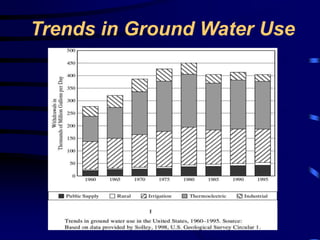
Trends in Ground Water Use
Ground Water: A Valuable 
Resource 
• Ground water supplies 95% of the drinking 
water needs in rural areas. 
• 75% of public water systems rely on 
groundwater. 
• In the United States, ground water provides 
drinking water to approximately 140 million 
people. 
• Supplies about 40% of Houston area
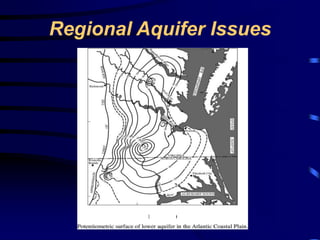
Regional Aquifer Issues
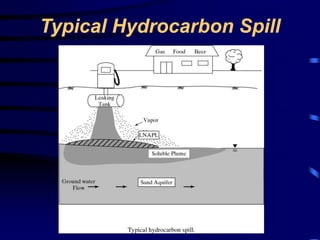
Typical Hydrocarbon Spill
Aquifer Characteristics 
1. Matrix type 
2. Porosity (n) 
3. Confined or unconfined 
4. Vertical distribution (stratigraphy or layering) 
5. Hydraulic conductivity (K) 
6. Intrinsic permeability (k) 
7. Transmissivity (T) 
8. Storage coefficient or Storativity (S)
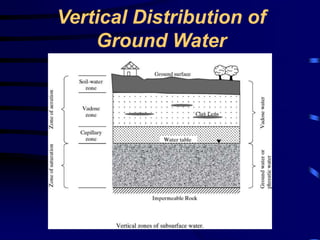
Vertical Distribution of 
Ground Water
Vertical Zones of Subsurface 
Water 
• Soil water zone: extends from the ground surface 
down through the major root zone, varies with soil 
type and vegetation but is usually a few feet in 
thickness 
• Vadose zone (unsaturated zone): extends from the 
surface to the water table through the root zone, 
intermediate zone, and the capillary zone 
• Capillary zone: extends from the water table up to 
the limit of capillary rise, which varies inversely 
with the pore size of the soil and directly with the 
surface tension
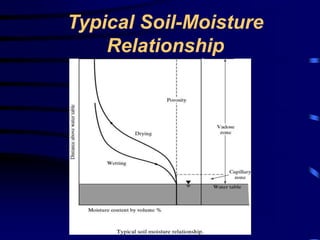
Typical Soil-Moisture 
Relationship
Soil-Moisture Relationship 
• The amount of moisture in the vadose zone 
generally decreases with vertical distance 
above the water table 
• Soil moisture curves vary with soil type and 
with the wetting cycle
Vertical Zones of Subsurface 
Water Continued 
• Water table: the level to which water will rise in a 
well drilled into the saturated zone 
• Saturated zone: occurs beneath the water table 
where porosity is a direct measure of the water 
contained per unit volume
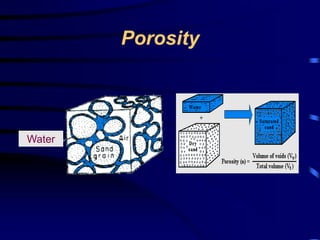
Porosity 
– Porosity averages about 25% to 35% for most 
aquifer systems 
– Expressed as the ratio of the volume of voids Vv to 
the total volume V: 
n = Vv/V = 1- b/m 
where: 
b is the bulk density, and 
m is the density of grains
Porosity 
Water
Arrangement of Particles in a 
Subsurface Matrix 
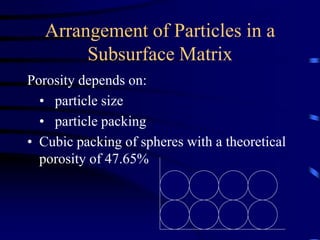
Porosity depends on: 
• particle size 
• particle packing 
• Cubic packing of spheres with a theoretical 
porosity of 47.65%
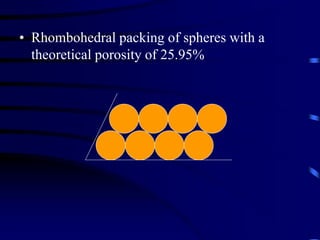
• Rhombohedral packing of spheres with a 
theoretical porosity of 25.95%
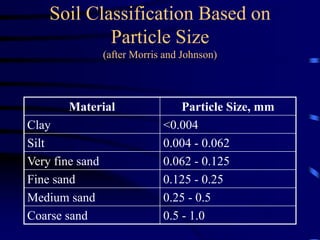
Soil Classification Based on 
Particle Size 
(after Morris and Johnson) 
Material Particle Size, mm 
Clay <0.004 
Silt 0.004 - 0.062 
Very fine sand 0.062 - 0.125 
Fine sand 0.125 - 0.25 
Medium sand 0.25 - 0.5 
Coarse sand 0.5 - 1.0
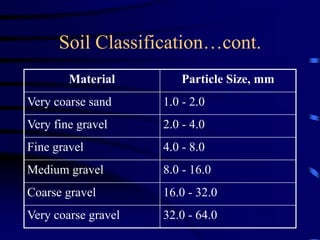
Soil Classification…cont. 
Material Particle Size, mm 
Very coarse sand 1.0 - 2.0 
Very fine gravel 2.0 - 4.0 
Fine gravel 4.0 - 8.0 
Medium gravel 8.0 - 16.0 
Coarse gravel 16.0 - 32.0 
Very coarse gravel 32.0 - 64.0
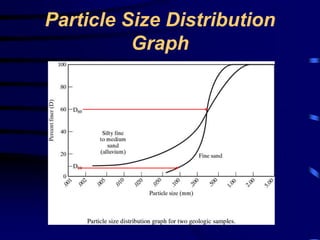
Particle Size Distribution 
Graph
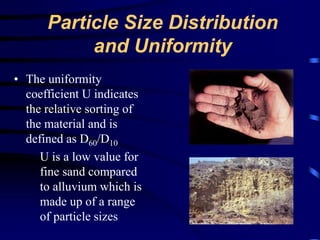
Particle Size Distribution 
and Uniformity 
• The uniformity 
coefficient U indicates 
the relative sorting of 
the material and is 
defined as D60/D10 
U is a low value for 
fine sand compared 
to alluvium which is 
made up of a range 
of particle sizes
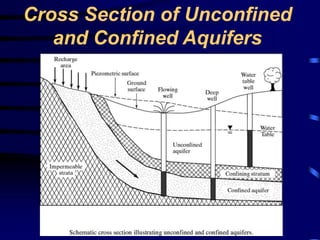
Cross Section of Unconfined 
and Confined Aquifers
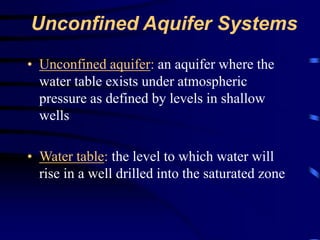
Unconfined Aquifer Systems 
• Unconfined aquifer: an aquifer where the 
water table exists under atmospheric 
pressure as defined by levels in shallow 
wells 
• Water table: the level to which water will 
rise in a well drilled into the saturated zone
Confined Aquifer Systems 
• Confined aquifer: an aquifer that is overlain 
by a relatively impermeable unit such that 
the aquifer is under pressure and the water 
level rises above the confined unit 
• Potentiometric surface: in a confined 
aquifer, the hydrostatic pressure level of 
water in the aquifer, defined by the water 
level that occurs in a lined penetrating well
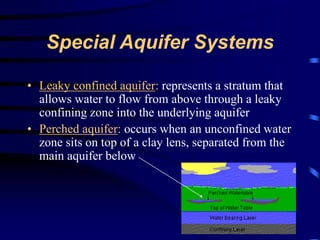
Special Aquifer Systems 
• Leaky confined aquifer: represents a stratum that 
allows water to flow from above through a leaky 
confining zone into the underlying aquifer 
• Perched aquifer: occurs when an unconfined water 
zone sits on top of a clay lens, separated from the 
main aquifer below
Ground Water Flow 
Darcy’s Law 
Continuity Equation 
Dupuit Equation
Darcy’s Law 
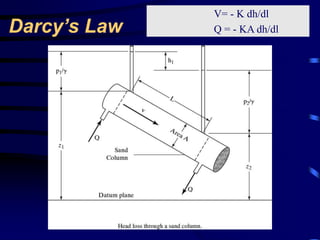
• Darcy investigated the flow of water through beds of 
permeable sand and found that the flow rate through 
porous media is proportional to the head loss and 
inversely proportional to the length of the flow path 
• Darcy derived equation of governing ground water 
flow and defined hydraulic conductivity K: 
V = Q/A 
where: 
A is the cross-sectional area 
V  -Δh, and 
V  1/ΔL
Darcy’s Law 
V= - K dh/dl 
Q = - KA dh/dl
Example of Darcy’s Law 
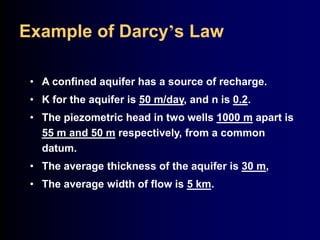
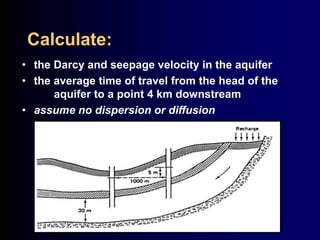
• A confined aquifer has a source of recharge. 
• K for the aquifer is 50 m/day, and n is 0.2. 
• The piezometric head in two wells 1000 m apart is 
55 m and 50 m respectively, from a common 
datum. 
• The average thickness of the aquifer is 30 m, 
• The average width of flow is 5 km.
Calculate: 
• the Darcy and seepage velocity in the aquifer 
• the average time of travel from the head of the 
aquifer to a point 4 km downstream 
• assume no dispersion or diffusion
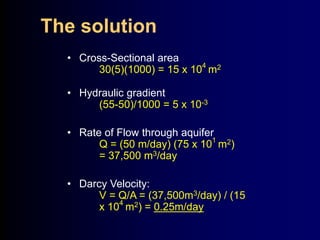
The solution 
• Cross-Sectional area 
30(5)(1000) = 15 x 104 m2 
• Hydraulic gradient 
(55-50)/1000 = 5 x 10⁻³ 
• Rate of Flow through aquifer 
Q = (50 m/day) (75 x 101 m2) 
= 37,500 m3/day 
• Darcy Velocity: 
V = Q/A = (37,500m3/day) / (15 
x 104 m2) = 0.25m/day
Therefore: 
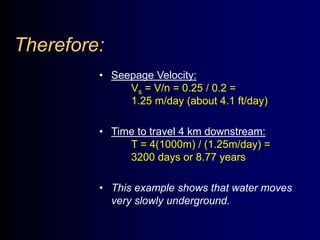
• Seepage Velocity: 
Vs = V/n = 0.25 / 0.2 = 
1.25 m/day (about 4.1 ft/day) 
• Time to travel 4 km downstream: 
T = 4(1000m) / (1.25m/day) = 
3200 days or 8.77 years 
• This example shows that water moves 
very slowly underground.
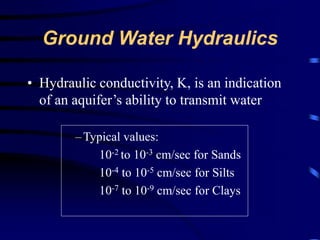
Ground Water Hydraulics 
• Hydraulic conductivity, K, is an indication 
of an aquifer’s ability to transmit water 
–Typical values: 
10-2 to 10-3 cm/sec for Sands 
10-4 to 10-5 cm/sec for Silts 
10-7 to 10-9 cm/sec for Clays
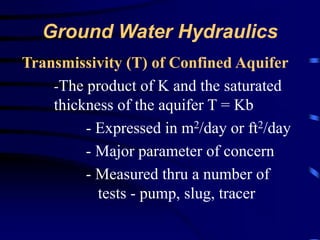
Ground Water Hydraulics 
Transmissivity (T) of Confined Aquifer 
-The product of K and the saturated 
thickness of the aquifer T = Kb 
- Expressed in m2/day or ft2/day 
- Major parameter of concern 
- Measured thru a number of 
tests - pump, slug, tracer
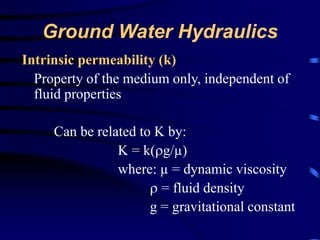
Ground Water Hydraulics 
Intrinsic permeability (k) 
Property of the medium only, independent of 
fluid properties 
Can be related to K by: 
K = k(g/μ) 
where: μ = dynamic viscosity 
 = fluid density 
g = gravitational constant
Storage Coefficient 
Relates to the water-yielding capacity of an aquifer 
S = Vol/ (AsH) 
– It is defined as the volume of water that an aquifer 
releases from or takes into storage per unit surface 
area per unit change in piezometric head - used 
extensively in pump tests. 
• For confined aquifers, S values range between 
0.00005 to 0.005 
• For unconfined aquifers, S values range 
between 0.07 and 0.25, roughly equal to the 
specific yield
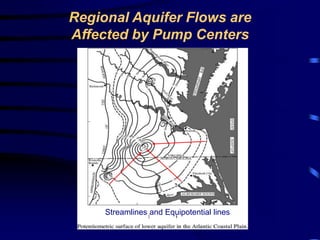
Regional Aquifer Flows are 
Affected by Pump Centers 
Streamlines and Equipotential lines
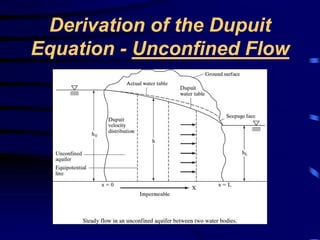
Derivation of the Dupuit 
Equation - Unconfined Flow
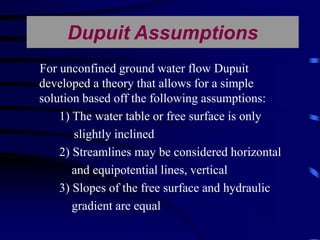
Dupuit Assumptions 
For unconfined ground water flow Dupuit 
developed a theory that allows for a simple 
solution based off the following assumptions: 
1) The water table or free surface is only 
slightly inclined 
2) Streamlines may be considered horizontal 
and equipotential lines, vertical 
3) Slopes of the free surface and hydraulic 
gradient are equal
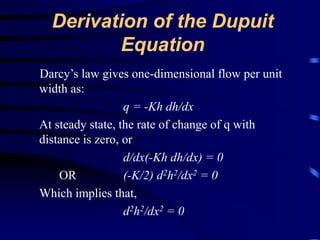
Derivation of the Dupuit 
Equation 
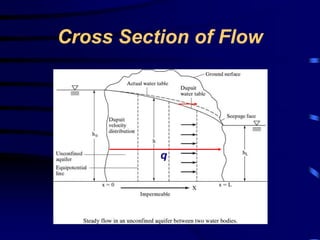
Darcy’s law gives one-dimensional flow per unit 
width as: 
q = -Kh dh/dx 
At steady state, the rate of change of q with 
distance is zero, or 
d/dx(-Kh dh/dx) = 0 
OR (-K/2) d2h2/dx2 = 0 
Which implies that, 
d2h2/dx2 = 0
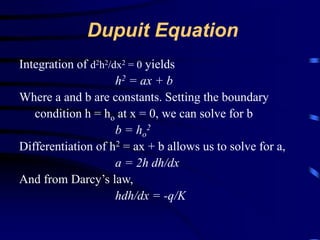
Dupuit Equation 
Integration of d2h2/dx2 = 0 yields 
h2 = ax + b 
Where a and b are constants. Setting the boundary 
condition h = ho at x = 0, we can solve for b 
b = ho 
2 
Differentiation of h2 = ax + b allows us to solve for a, 
a = 2h dh/dx 
And from Darcy’s law, 
hdh/dx = -q/K
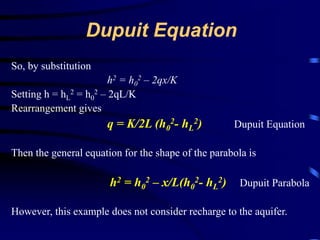
Dupuit Equation 
So, by substitution 
h2 = h0 
2 – 2qx/K 
2 = h0 
Setting h = hL 
2 – 2qL/K 
Rearrangement gives 
2- hL 
q = K/2L (h0 
2) Dupuit Equation 
Then the general equation for the shape of the parabola is 
h2 = h0 
2 – x/L(h0 
2- hL 
2) Dupuit Parabola 
However, this example does not consider recharge to the aquifer.
Cross Section of Flow 
q
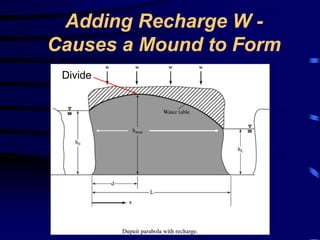
Adding Recharge W - 
Causes a Mound to Form 
Divide
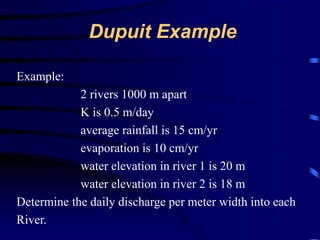
Dupuit Example 
Example: 
2 rivers 1000 m apart 
K is 0.5 m/day 
average rainfall is 15 cm/yr 
evaporation is 10 cm/yr 
water elevation in river 1 is 20 m 
water elevation in river 2 is 18 m 
Determine the daily discharge per meter width into each 
River.
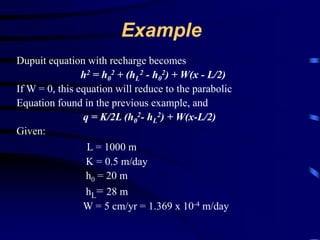
Example 
Dupuit equation with recharge becomes 
h2 = h0 
2 + (hL 
2 - h0 
2) + W(x - L/2) 
If W = 0, this equation will reduce to the parabolic 
Equation found in the previous example, and 
q = K/2L (h0 
2- hL 
2) + W(x-L/2) 
Given: 
L = 1000 m 
K = 0.5 m/day 
h0 = 20 m 
hL= 28 m 
W = 5 cm/yr = 1.369 x 10⁻⁴ m/day
Example 
For discharge into River 1, set x = 0 m 
q = K/2L (h0 
2- hL 
2) + W(0-L/2) 
= [(0.5 m/day)/(2)(1000 m)] (202 m2 – 18 m2 ) + 
(1.369 x 10⁻⁴ m/day)(-1000 m / 2) 
q = – 0.05 m2 /day 
The negative sign indicates that flow is in the opposite direction 
From the x direction. Therefore, 
q = 0.05 m2 /day into river 1
Example 
For discharge into River 2, set x = L = 1000 m: 
q = K/2L (h0 
2- hL 
2) + W(L-L/2) 
= [(0.5 m/day)/(2)(1000 m)] (202 m2 – 18 m2 ) + 
(1.369 x 10⁻⁴ m/day)(1000 m –(1000 m / 2)) 
q = 0.087 m2/day into River 2 
By setting q = 0 at the divide and solving for xd, the 
water divide is located 361.2 m from the edge of 
River 1 and is 20.9 m high
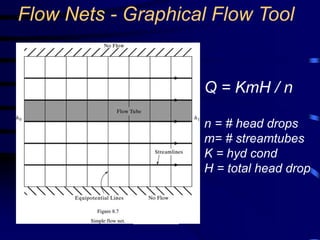
Flow Nets - Graphical Flow Tool 
Q = KmH / n 
n = # head drops 
m= # streamtubes 
K = hyd cond 
H = total head drop
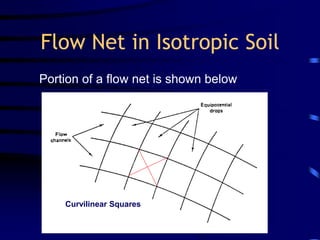
Flow Net in Isotropic Soil 
Portion of a flow net is shown below 
Y 
F 
Curvilinear Squares
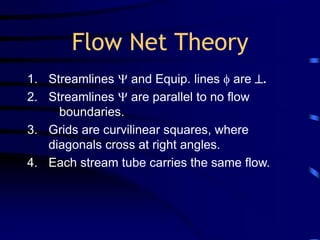
Flow Net Theory 
1. Streamlines Y and Equip. lines  are . 
2. Streamlines Y are parallel to no flow 
boundaries. 
3. Grids are curvilinear squares, where 
diagonals cross at right angles. 
4. Each stream tube carries the same flow.
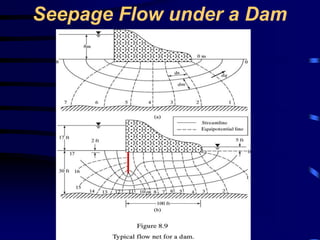
Seepage Flow under a Dam

Ch02intro

  • 1.
    Ground Water Hydrology Introduction - 2005 Philip B. Bedient Civil & Environmental Engineering Rice University
  • 2.
    GW Resources -Quantity • Aquifer system parameters • Rate and direction of GW flow • Darcy’s Law - governing flow relation • Dupuit Eqn for unconfined flow • Recharge and discharge zones • Well mechanics- pumping for water supply, hydraulic control, or injection of wastes
  • 3.
    GW Resources -Quality • Contamination sources • Contaminant transport mechanims • Rate and direction of GW migration • Fate processes-chemical, biological • Remediation Systems for cleanup
  • 4.
  • 5.
    Ground Water: AValuable Resource • Ground water supplies 95% of the drinking water needs in rural areas. • 75% of public water systems rely on groundwater. • In the United States, ground water provides drinking water to approximately 140 million people. • Supplies about 40% of Houston area
  • 6.
  • 7.
  • 8.
    Aquifer Characteristics 1.Matrix type 2. Porosity (n) 3. Confined or unconfined 4. Vertical distribution (stratigraphy or layering) 5. Hydraulic conductivity (K) 6. Intrinsic permeability (k) 7. Transmissivity (T) 8. Storage coefficient or Storativity (S)
  • 9.
  • 10.
    Vertical Zones ofSubsurface Water • Soil water zone: extends from the ground surface down through the major root zone, varies with soil type and vegetation but is usually a few feet in thickness • Vadose zone (unsaturated zone): extends from the surface to the water table through the root zone, intermediate zone, and the capillary zone • Capillary zone: extends from the water table up to the limit of capillary rise, which varies inversely with the pore size of the soil and directly with the surface tension
  • 11.
  • 12.
    Soil-Moisture Relationship •The amount of moisture in the vadose zone generally decreases with vertical distance above the water table • Soil moisture curves vary with soil type and with the wetting cycle
  • 13.
    Vertical Zones ofSubsurface Water Continued • Water table: the level to which water will rise in a well drilled into the saturated zone • Saturated zone: occurs beneath the water table where porosity is a direct measure of the water contained per unit volume
  • 14.
    Porosity – Porosityaverages about 25% to 35% for most aquifer systems – Expressed as the ratio of the volume of voids Vv to the total volume V: n = Vv/V = 1- b/m where: b is the bulk density, and m is the density of grains
  • 15.
  • 16.
    Arrangement of Particlesin a Subsurface Matrix Porosity depends on: • particle size • particle packing • Cubic packing of spheres with a theoretical porosity of 47.65%
  • 17.
    • Rhombohedral packingof spheres with a theoretical porosity of 25.95%
  • 18.
    Soil Classification Basedon Particle Size (after Morris and Johnson) Material Particle Size, mm Clay <0.004 Silt 0.004 - 0.062 Very fine sand 0.062 - 0.125 Fine sand 0.125 - 0.25 Medium sand 0.25 - 0.5 Coarse sand 0.5 - 1.0
  • 19.
    Soil Classification…cont. MaterialParticle Size, mm Very coarse sand 1.0 - 2.0 Very fine gravel 2.0 - 4.0 Fine gravel 4.0 - 8.0 Medium gravel 8.0 - 16.0 Coarse gravel 16.0 - 32.0 Very coarse gravel 32.0 - 64.0
  • 20.
  • 21.
    Particle Size Distribution and Uniformity • The uniformity coefficient U indicates the relative sorting of the material and is defined as D60/D10 U is a low value for fine sand compared to alluvium which is made up of a range of particle sizes
  • 22.
    Cross Section ofUnconfined and Confined Aquifers
  • 23.
    Unconfined Aquifer Systems • Unconfined aquifer: an aquifer where the water table exists under atmospheric pressure as defined by levels in shallow wells • Water table: the level to which water will rise in a well drilled into the saturated zone
  • 24.
    Confined Aquifer Systems • Confined aquifer: an aquifer that is overlain by a relatively impermeable unit such that the aquifer is under pressure and the water level rises above the confined unit • Potentiometric surface: in a confined aquifer, the hydrostatic pressure level of water in the aquifer, defined by the water level that occurs in a lined penetrating well
  • 25.
    Special Aquifer Systems • Leaky confined aquifer: represents a stratum that allows water to flow from above through a leaky confining zone into the underlying aquifer • Perched aquifer: occurs when an unconfined water zone sits on top of a clay lens, separated from the main aquifer below
  • 26.
    Ground Water Flow Darcy’s Law Continuity Equation Dupuit Equation
  • 27.
    Darcy’s Law •Darcy investigated the flow of water through beds of permeable sand and found that the flow rate through porous media is proportional to the head loss and inversely proportional to the length of the flow path • Darcy derived equation of governing ground water flow and defined hydraulic conductivity K: V = Q/A where: A is the cross-sectional area V  -Δh, and V  1/ΔL
  • 28.
    Darcy’s Law V=- K dh/dl Q = - KA dh/dl
  • 29.
    Example of Darcy’sLaw • A confined aquifer has a source of recharge. • K for the aquifer is 50 m/day, and n is 0.2. • The piezometric head in two wells 1000 m apart is 55 m and 50 m respectively, from a common datum. • The average thickness of the aquifer is 30 m, • The average width of flow is 5 km.
  • 30.
    Calculate: • theDarcy and seepage velocity in the aquifer • the average time of travel from the head of the aquifer to a point 4 km downstream • assume no dispersion or diffusion
  • 31.
    The solution •Cross-Sectional area 30(5)(1000) = 15 x 104 m2 • Hydraulic gradient (55-50)/1000 = 5 x 10⁻³ • Rate of Flow through aquifer Q = (50 m/day) (75 x 101 m2) = 37,500 m3/day • Darcy Velocity: V = Q/A = (37,500m3/day) / (15 x 104 m2) = 0.25m/day
  • 32.
    Therefore: • SeepageVelocity: Vs = V/n = 0.25 / 0.2 = 1.25 m/day (about 4.1 ft/day) • Time to travel 4 km downstream: T = 4(1000m) / (1.25m/day) = 3200 days or 8.77 years • This example shows that water moves very slowly underground.
  • 33.
    Ground Water Hydraulics • Hydraulic conductivity, K, is an indication of an aquifer’s ability to transmit water –Typical values: 10-2 to 10-3 cm/sec for Sands 10-4 to 10-5 cm/sec for Silts 10-7 to 10-9 cm/sec for Clays
  • 34.
    Ground Water Hydraulics Transmissivity (T) of Confined Aquifer -The product of K and the saturated thickness of the aquifer T = Kb - Expressed in m2/day or ft2/day - Major parameter of concern - Measured thru a number of tests - pump, slug, tracer
  • 35.
    Ground Water Hydraulics Intrinsic permeability (k) Property of the medium only, independent of fluid properties Can be related to K by: K = k(g/μ) where: μ = dynamic viscosity  = fluid density g = gravitational constant
  • 36.
    Storage Coefficient Relatesto the water-yielding capacity of an aquifer S = Vol/ (AsH) – It is defined as the volume of water that an aquifer releases from or takes into storage per unit surface area per unit change in piezometric head - used extensively in pump tests. • For confined aquifers, S values range between 0.00005 to 0.005 • For unconfined aquifers, S values range between 0.07 and 0.25, roughly equal to the specific yield
  • 37.
    Regional Aquifer Flowsare Affected by Pump Centers Streamlines and Equipotential lines
  • 38.
    Derivation of theDupuit Equation - Unconfined Flow
  • 39.
    Dupuit Assumptions Forunconfined ground water flow Dupuit developed a theory that allows for a simple solution based off the following assumptions: 1) The water table or free surface is only slightly inclined 2) Streamlines may be considered horizontal and equipotential lines, vertical 3) Slopes of the free surface and hydraulic gradient are equal
  • 40.
    Derivation of theDupuit Equation Darcy’s law gives one-dimensional flow per unit width as: q = -Kh dh/dx At steady state, the rate of change of q with distance is zero, or d/dx(-Kh dh/dx) = 0 OR (-K/2) d2h2/dx2 = 0 Which implies that, d2h2/dx2 = 0
  • 41.
    Dupuit Equation Integrationof d2h2/dx2 = 0 yields h2 = ax + b Where a and b are constants. Setting the boundary condition h = ho at x = 0, we can solve for b b = ho 2 Differentiation of h2 = ax + b allows us to solve for a, a = 2h dh/dx And from Darcy’s law, hdh/dx = -q/K
  • 42.
    Dupuit Equation So,by substitution h2 = h0 2 – 2qx/K 2 = h0 Setting h = hL 2 – 2qL/K Rearrangement gives 2- hL q = K/2L (h0 2) Dupuit Equation Then the general equation for the shape of the parabola is h2 = h0 2 – x/L(h0 2- hL 2) Dupuit Parabola However, this example does not consider recharge to the aquifer.
  • 43.
  • 44.
    Adding Recharge W- Causes a Mound to Form Divide
  • 45.
    Dupuit Example Example: 2 rivers 1000 m apart K is 0.5 m/day average rainfall is 15 cm/yr evaporation is 10 cm/yr water elevation in river 1 is 20 m water elevation in river 2 is 18 m Determine the daily discharge per meter width into each River.
  • 46.
    Example Dupuit equationwith recharge becomes h2 = h0 2 + (hL 2 - h0 2) + W(x - L/2) If W = 0, this equation will reduce to the parabolic Equation found in the previous example, and q = K/2L (h0 2- hL 2) + W(x-L/2) Given: L = 1000 m K = 0.5 m/day h0 = 20 m hL= 28 m W = 5 cm/yr = 1.369 x 10⁻⁴ m/day
  • 47.
    Example For dischargeinto River 1, set x = 0 m q = K/2L (h0 2- hL 2) + W(0-L/2) = [(0.5 m/day)/(2)(1000 m)] (202 m2 – 18 m2 ) + (1.369 x 10⁻⁴ m/day)(-1000 m / 2) q = – 0.05 m2 /day The negative sign indicates that flow is in the opposite direction From the x direction. Therefore, q = 0.05 m2 /day into river 1
  • 48.
    Example For dischargeinto River 2, set x = L = 1000 m: q = K/2L (h0 2- hL 2) + W(L-L/2) = [(0.5 m/day)/(2)(1000 m)] (202 m2 – 18 m2 ) + (1.369 x 10⁻⁴ m/day)(1000 m –(1000 m / 2)) q = 0.087 m2/day into River 2 By setting q = 0 at the divide and solving for xd, the water divide is located 361.2 m from the edge of River 1 and is 20.9 m high
  • 49.
    Flow Nets -Graphical Flow Tool Q = KmH / n n = # head drops m= # streamtubes K = hyd cond H = total head drop
  • 50.
    Flow Net inIsotropic Soil Portion of a flow net is shown below Y F Curvilinear Squares
  • 51.
    Flow Net Theory 1. Streamlines Y and Equip. lines  are . 2. Streamlines Y are parallel to no flow boundaries. 3. Grids are curvilinear squares, where diagonals cross at right angles. 4. Each stream tube carries the same flow.
  • 52.