Atomos, Aristotle and Alchemy
Physical Science
Objectives:
(S11/12LT-IIbd-6)
At the end of the lesson, the learners are able to:
Describe the contributions of the alchemists to the science of chemistry
1. Identify the people behind the progression of alchemy to chemistry
2. Perform differentiated activities showing the discovery of
chemistry from alchemy
3. Appreciate the influences of alchemy on the discoveries made
from chemistry
Review
Sing & Pass!
..videoplayback.mp4
https://www.youtube.com/watch?v
=TWyW9MYrMVQ
What can you observe from these pictures?
4
MOTIVATION
AncientSymbols Experiments Metals
ALCHEMY ( al–Khemia) = ancient origin of chemistry
= use of symbols and do
experiments on metals
5
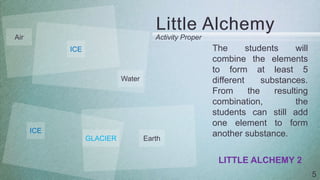
The students will
combine the elements
to form at least 5
different substances.
From the resulting
combination, the
students can still add
one element to form
another substance.
LITTLE ALCHEMY 2
Little Alchemy
Activity Proper
ICE
Water
ICE
GLACIER
Air
Earth
ALCHEMY
6
Definition
Art of transmuting metals
Mixing of different elements to form new ones
ELIXIR OF LIFE
PHILOSOPHER’S STONE
7
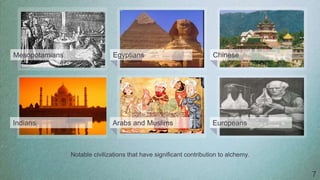
Mesopotamians Egyptians
Indians Arabs and Muslims
Chinese
Europeans
Notable civilizations that have significant contribution to alchemy.
STORY OF ALCHEMY
The Power of PowerPoint | thepopp.com 8
Lesson Discussion
VISION
TARGET
PASSIO
N
MESOPOTAMIANS:
techniques to utilize metals like gold and copper.
They even assigned certain symbols to match
metals with the heavenly bodies such as the Sun
and Moon. They also made use of other materials
such as dyes, glass, paints, and perfumes.
EGYPTIANS:
adapted techniques from the
Mesopotamians and perfected the
use of bronze, dye and glass that
the Greeks later copied.
CHINESE:
had their own processes for
metalwork and ceramic materials,
but they especially focused on
finding minerals, plants and
substances that could prolong life
(elixir of life).
STORY OF ALCHEMY
9
Lesson Discussion
VISION
TARGET
PASSIO
N
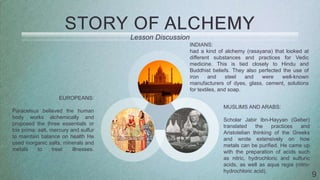
INDIANS:
had a kind of alchemy (rasayana) that looked at
different substances and practices for Vedic
medicine. This is tied closely to Hindu and
Buddhist beliefs. They also perfected the use of
iron and steel and were well-known
manufacturers of dyes, glass, cement, solutions
for textiles, and soap.
MUSLIMS AND ARABS:
Scholar Jabir Ibn-Hayyan (Geber)
translated the practices and
Aristotelian thinking of the Greeks
and wrote extensively on how
metals can be purified. He came up
with the preparation of acids such
as nitric, hydrochloric and sulfuric
acids, as well as aqua regia (nitro-
hydrochloric acid).
EUROPEANS:
Paracelsus believed the human
body works alchemically and
proposed the three essentials or
tria prima: salt, mercury and sulfur
to maintain balance on health He
used inorganic salts, minerals and
metals to treat illnesses.
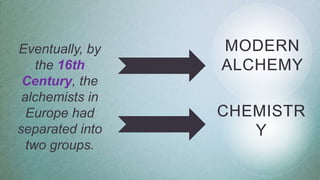
CHEMISTR
Y
Eventually, by
the 16th
Century, the
alchemists in
Europe had
separated into
two groups.
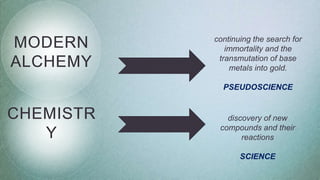
MODERN
ALCHEMY
CHEMISTR
Y
continuing the search for
immortality and the
transmutation of base
metals into gold.
PSEUDOSCIENCE
MODERN
ALCHEMY
discovery of new
compounds and their
reactions
SCIENCE
12
SKIT
Create a short skit showing how
ancient people are looking for a way
to change metals into gold and the
“elixir of life” as means of prolonging
life
DRAW
On four sheets of bond paper, create
a comic strip showing how ancient
people use alchemical approach in
their daily lives
SING
Create a short jingle expressing how
did the practice of alchemy evolved
into the science of chemistry
Activity: Skit, Sing and Draw
The students will be grouped into three and each will be
given the following situations showing how chemistry was
discovered through alchemy.
1 2 3
Scoring Rubrics
13
Activity: Sing, Draw, Skit
Presentation
(4) Detailed conclusions are
reached from the evidence
offered.
(3) Conclusions are reached
from the evidence offered.
(2) There is some indication of
conclusions from the evidence
offered.
(1) No conclusions are made
from the evidence offered.
Active
Participation
(4) All the members performed
their roles well.
(3) Some members performed
on the average.
(2) Only few of the members
performed.
(1) The group failed to perform
well.
Audience
Impact
(4) Standing Ovation, with heavy
clapping and amazement from
the class
(3) heavy clapping and
amazement from the class
(2) clapping and amazement
from the class
(1) No reaction from the class
Question!
The Power of PowerPoint | thepopp.com 14
Application
Like alchemy,
how does
chemistry
pursue its
search for the
“elixir of life”?
The Power of PowerPoint | thepopp.com 15
Modern Chemistry
Researches
University of California–San
Francisco biochemists identified a
memory-boosting chemical in
mice, which might one day be
used in humans to improve
memory.
Cheaper clean-
energy technologies
could be made
possible thanks to a
new discovery by a
professor of
chemistry at Penn
State University.
The Duke Cancer
Institute found that
an osteoporosis
drug stopped the
growth of breast
cancer cells, even in
resistant tumors.
These are just a few examples of how
modern chemistry carries on the
alchemical quest for the elixir of life
Generalization
The Power of PowerPoint | thepopp.com 16
Who are the
people behind
the creation of
alchemy?
Chinese
Europeans
Mesopotamians
Indians
Arabs and Muslim
Egyptians
How did
alchemy
evolve into the
science of
chemistry?
Through the contributions of
different people, their ancient
methods that eventually led to the
use of standardized procedures.
What are the
influences of
alchemy on the
products of
chemistry we
are using today?
Experimentation
Documentation
Continuous researches
Trivia!!
Lead into Gold???
The Power of PowerPoint | thepopp.com 17
Lead (atomic number 82) and gold (atomic number 79) are
defined as elements by the number of protons they possess.
Changing the element requires changing the atomic (proton)
number.
The number of protons cannot be altered by any chemical
means.
However, physics may be used to add or remove protons and
thereby change one element into another. Because lead is
stable, forcing it to release three protons requires a vast input
of energy, such that the cost of transmuting it greatly
surpasses the value of the resulting gold.
Good news! It was already achieve in Siberia! 
SHORT QUIZ
The Power of PowerPoint | thepopp.com 18
ASSESSMENT
Answer the following questions.
1. What was believed by the alchemists as the material that could
transform base metals into gold?
2. Who invented gunpowder instead of the elixir of life?
3. Give three techniques Jabin Ibn Hayyan used in his experiments.
4. According to Paracelsus, what are the tria prima that is important in
bringing balance to one’s health?
5. Why did alchemy failed to become a discipline in science?
See you again next meeting!
Any Questions?

Alchemy

  • 1.
    Atomos, Aristotle andAlchemy Physical Science
  • 2.
    Objectives: (S11/12LT-IIbd-6) At the endof the lesson, the learners are able to: Describe the contributions of the alchemists to the science of chemistry 1. Identify the people behind the progression of alchemy to chemistry 2. Perform differentiated activities showing the discovery of chemistry from alchemy 3. Appreciate the influences of alchemy on the discoveries made from chemistry
  • 3.
  • 4.
    What can youobserve from these pictures? 4 MOTIVATION AncientSymbols Experiments Metals ALCHEMY ( al–Khemia) = ancient origin of chemistry = use of symbols and do experiments on metals
  • 5.
    5 The students will combinethe elements to form at least 5 different substances. From the resulting combination, the students can still add one element to form another substance. LITTLE ALCHEMY 2 Little Alchemy Activity Proper ICE Water ICE GLACIER Air Earth
  • 6.
    ALCHEMY 6 Definition Art of transmutingmetals Mixing of different elements to form new ones ELIXIR OF LIFE PHILOSOPHER’S STONE
  • 7.
    7 Mesopotamians Egyptians Indians Arabsand Muslims Chinese Europeans Notable civilizations that have significant contribution to alchemy.
  • 8.
    STORY OF ALCHEMY ThePower of PowerPoint | thepopp.com 8 Lesson Discussion VISION TARGET PASSIO N MESOPOTAMIANS: techniques to utilize metals like gold and copper. They even assigned certain symbols to match metals with the heavenly bodies such as the Sun and Moon. They also made use of other materials such as dyes, glass, paints, and perfumes. EGYPTIANS: adapted techniques from the Mesopotamians and perfected the use of bronze, dye and glass that the Greeks later copied. CHINESE: had their own processes for metalwork and ceramic materials, but they especially focused on finding minerals, plants and substances that could prolong life (elixir of life).
  • 9.
    STORY OF ALCHEMY 9 LessonDiscussion VISION TARGET PASSIO N INDIANS: had a kind of alchemy (rasayana) that looked at different substances and practices for Vedic medicine. This is tied closely to Hindu and Buddhist beliefs. They also perfected the use of iron and steel and were well-known manufacturers of dyes, glass, cement, solutions for textiles, and soap. MUSLIMS AND ARABS: Scholar Jabir Ibn-Hayyan (Geber) translated the practices and Aristotelian thinking of the Greeks and wrote extensively on how metals can be purified. He came up with the preparation of acids such as nitric, hydrochloric and sulfuric acids, as well as aqua regia (nitro- hydrochloric acid). EUROPEANS: Paracelsus believed the human body works alchemically and proposed the three essentials or tria prima: salt, mercury and sulfur to maintain balance on health He used inorganic salts, minerals and metals to treat illnesses.
  • 10.
    CHEMISTR Y Eventually, by the 16th Century,the alchemists in Europe had separated into two groups. MODERN ALCHEMY
  • 11.
    CHEMISTR Y continuing the searchfor immortality and the transmutation of base metals into gold. PSEUDOSCIENCE MODERN ALCHEMY discovery of new compounds and their reactions SCIENCE
  • 12.
    12 SKIT Create a shortskit showing how ancient people are looking for a way to change metals into gold and the “elixir of life” as means of prolonging life DRAW On four sheets of bond paper, create a comic strip showing how ancient people use alchemical approach in their daily lives SING Create a short jingle expressing how did the practice of alchemy evolved into the science of chemistry Activity: Skit, Sing and Draw The students will be grouped into three and each will be given the following situations showing how chemistry was discovered through alchemy. 1 2 3
  • 13.
    Scoring Rubrics 13 Activity: Sing,Draw, Skit Presentation (4) Detailed conclusions are reached from the evidence offered. (3) Conclusions are reached from the evidence offered. (2) There is some indication of conclusions from the evidence offered. (1) No conclusions are made from the evidence offered. Active Participation (4) All the members performed their roles well. (3) Some members performed on the average. (2) Only few of the members performed. (1) The group failed to perform well. Audience Impact (4) Standing Ovation, with heavy clapping and amazement from the class (3) heavy clapping and amazement from the class (2) clapping and amazement from the class (1) No reaction from the class
  • 14.
    Question! The Power ofPowerPoint | thepopp.com 14 Application Like alchemy, how does chemistry pursue its search for the “elixir of life”?
  • 15.
    The Power ofPowerPoint | thepopp.com 15 Modern Chemistry Researches University of California–San Francisco biochemists identified a memory-boosting chemical in mice, which might one day be used in humans to improve memory. Cheaper clean- energy technologies could be made possible thanks to a new discovery by a professor of chemistry at Penn State University. The Duke Cancer Institute found that an osteoporosis drug stopped the growth of breast cancer cells, even in resistant tumors. These are just a few examples of how modern chemistry carries on the alchemical quest for the elixir of life
  • 16.
    Generalization The Power ofPowerPoint | thepopp.com 16 Who are the people behind the creation of alchemy? Chinese Europeans Mesopotamians Indians Arabs and Muslim Egyptians How did alchemy evolve into the science of chemistry? Through the contributions of different people, their ancient methods that eventually led to the use of standardized procedures. What are the influences of alchemy on the products of chemistry we are using today? Experimentation Documentation Continuous researches
  • 17.
    Trivia!! Lead into Gold??? ThePower of PowerPoint | thepopp.com 17 Lead (atomic number 82) and gold (atomic number 79) are defined as elements by the number of protons they possess. Changing the element requires changing the atomic (proton) number. The number of protons cannot be altered by any chemical means. However, physics may be used to add or remove protons and thereby change one element into another. Because lead is stable, forcing it to release three protons requires a vast input of energy, such that the cost of transmuting it greatly surpasses the value of the resulting gold. Good news! It was already achieve in Siberia! 
  • 18.
    SHORT QUIZ The Powerof PowerPoint | thepopp.com 18 ASSESSMENT Answer the following questions. 1. What was believed by the alchemists as the material that could transform base metals into gold? 2. Who invented gunpowder instead of the elixir of life? 3. Give three techniques Jabin Ibn Hayyan used in his experiments. 4. According to Paracelsus, what are the tria prima that is important in bringing balance to one’s health? 5. Why did alchemy failed to become a discipline in science?
  • 19.
    See you againnext meeting! Any Questions?