Physical Science
Quarter 1 - Module 3
1. Describe the general types of intermolecular forces.
(S11/12PS-IIIc-d-17)
At the end of the lesson, you should be able to:
2. Explain the effect of intermolecular forces
on the properties of substances. (S11/12PS-IIId-e-19)
Adhesion - the action or process of adhering to a surface
or object.
Cohesion - the sticking together of particles of the same
substance.
In our previous episode we learned about the
polarity of molecules. Specifically, bond polarity
and electronegativity. We have discussed how to
determine the overall polarity of molecules by
predicting its molecular geometry. Lastly, we
gain knowledge on the applications of the
concept of polarity through the mixing of
substances such as oil and water and the
removal of dirt.
Today we'll be talking about a
special force of attraction that is
formed between molecules.
Together let us learn about
intermolecular forces and explore
the exciting world of physical
science.
A force may be defined as a push or
a pull. Whenever there is an
interaction between two objects
or entities, force is definitely
present.
walking gif
pushing a table, gif
stretching a rubber band, gif
lifting a box gif
folding a piece of paper gif
pressing the spray bottle of
alcohol gif
We may not see it, but we feel its
effects. To start our discussion let
us recall the four fundamental
forces of nature that governs
everything that happens in the
universe.
This force is the one that holds
protons and neutrons in the
nucleus of an atom.
Do you know that the destructive
power of this force was seen and
experienced during the World War II
year 1945 on the bombing of
Hiroshima and Nagasaki in Japan?
bombing of Hiroshima and
Nagasaki in Japan gif
It binds electrons to the atomic
nucleus, and it basically deals with
the attractive and repulsive
interaction of electrical charges.
It is responsible for some of the
commonly experienced phenomena
like friction, elasticity, the normal
force, and the force holding
molecules together.
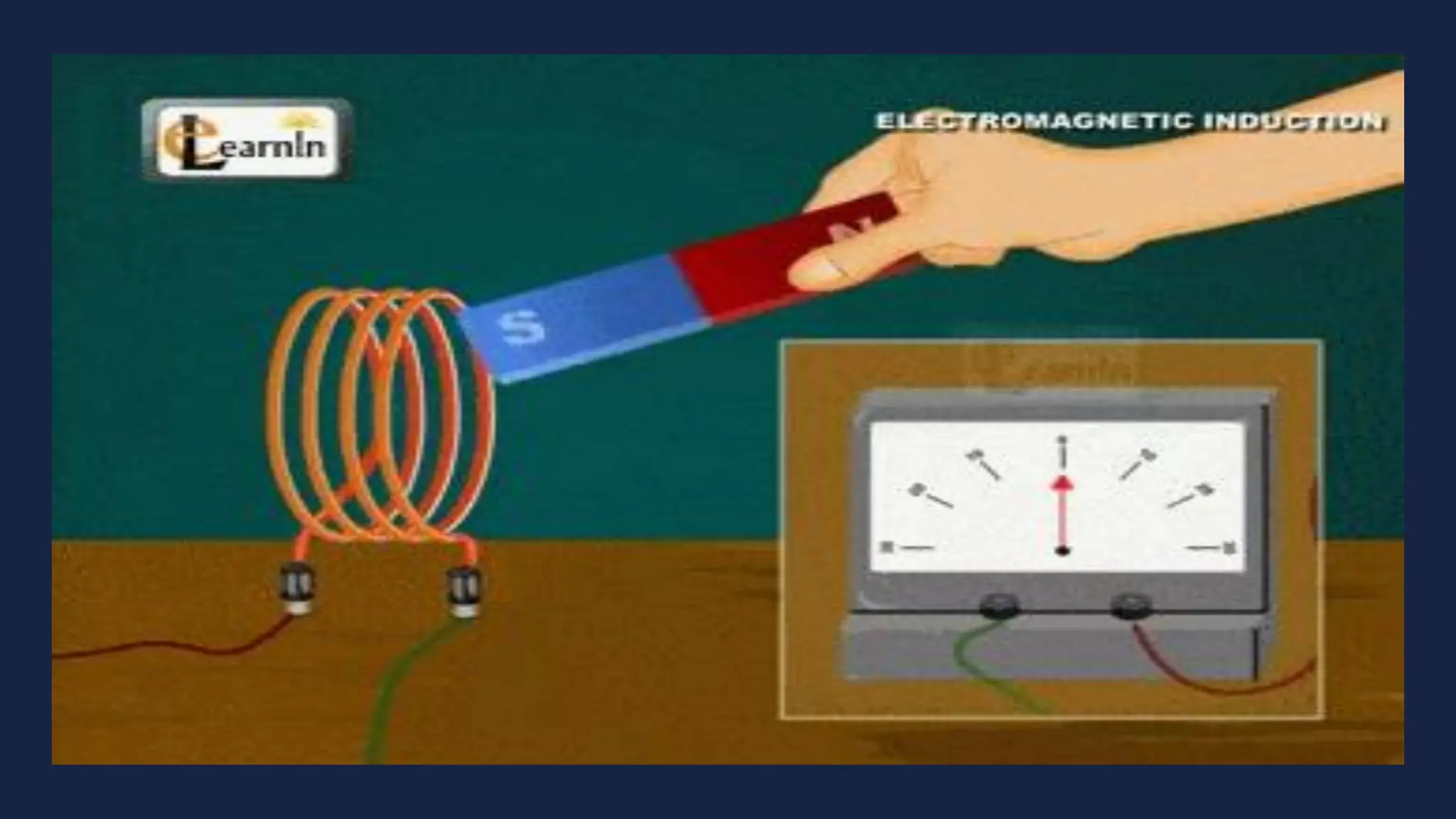
Take note that electricity and
magnetism are closely related.
Together they form an
electromagnetic field.
electromagnetic force gif
It might sound weak, but it is actually
involved in the important processes such
as the radioactive decay or the breaking
down of heavy atomic particles which
eventually forms new elements in stars
and supernova explosions.
It causes objects to be pulled
towards the earth.
Gravity ka ba?
Kasi you're always attractive and
never repulsive.
Gravity is purely an attractive
force. Take note also that gravity
is the reason why we stay on the
ground together with the planets
and moons that stay in their orbit.
gravitational force gif
DIRECTION: READ THE QUESTIONS
CAREFULLY AND CHOOSE THE
LETTTER OF THE CORRECT ANSWER.
1. This force is present in all molecules
whether polar or nonpolar.
A. London dispersion forces
B. Dipole-dipole forces
C. Ion-dipole forces
D. Hydrogen bonding forces.
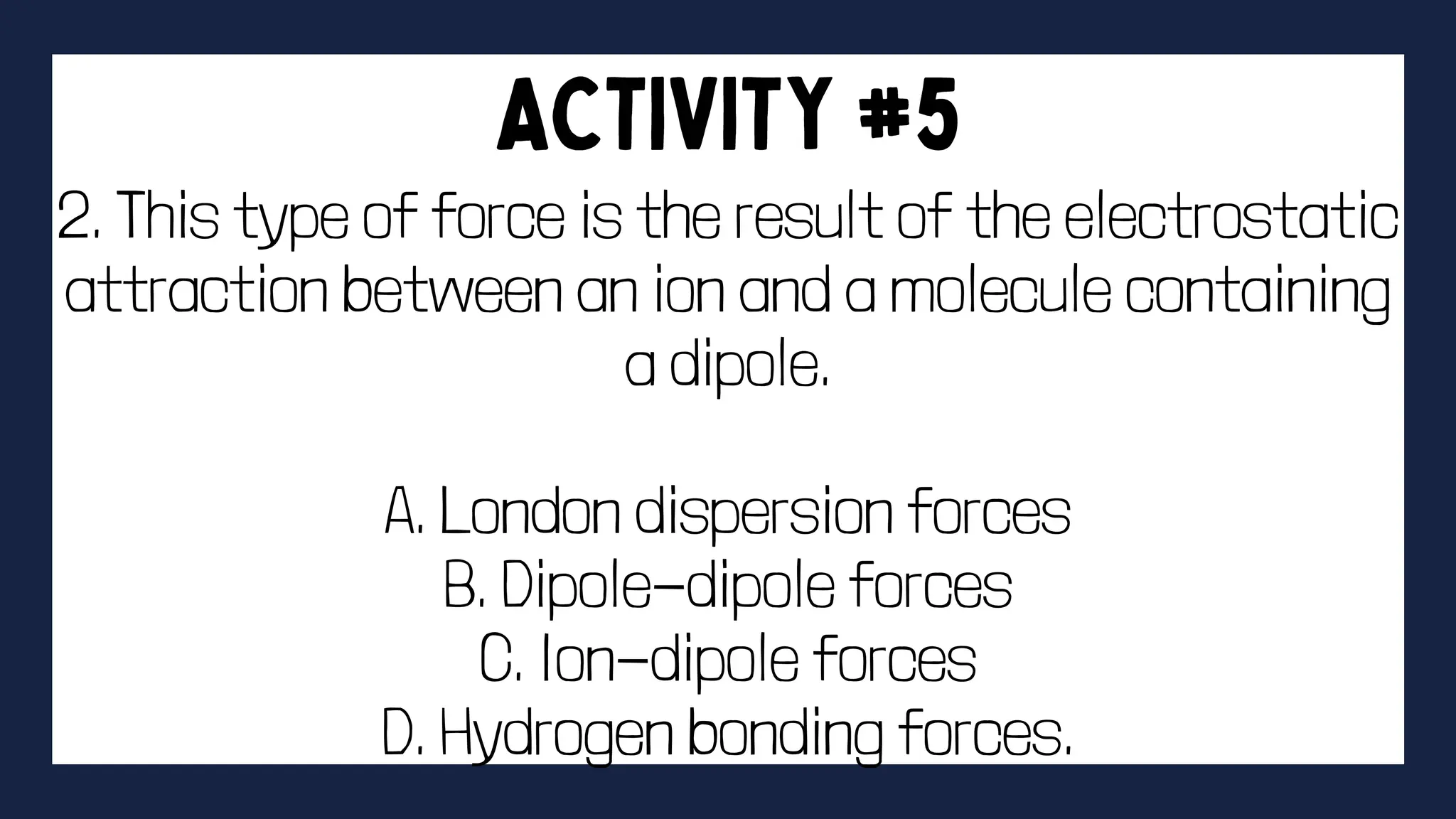
2. This type of force is the result of the electrostatic
attraction between an ion and a molecule containing
a dipole.
A. London dispersion forces
B. Dipole-dipole forces
C. Ion-dipole forces
D. Hydrogen bonding forces.
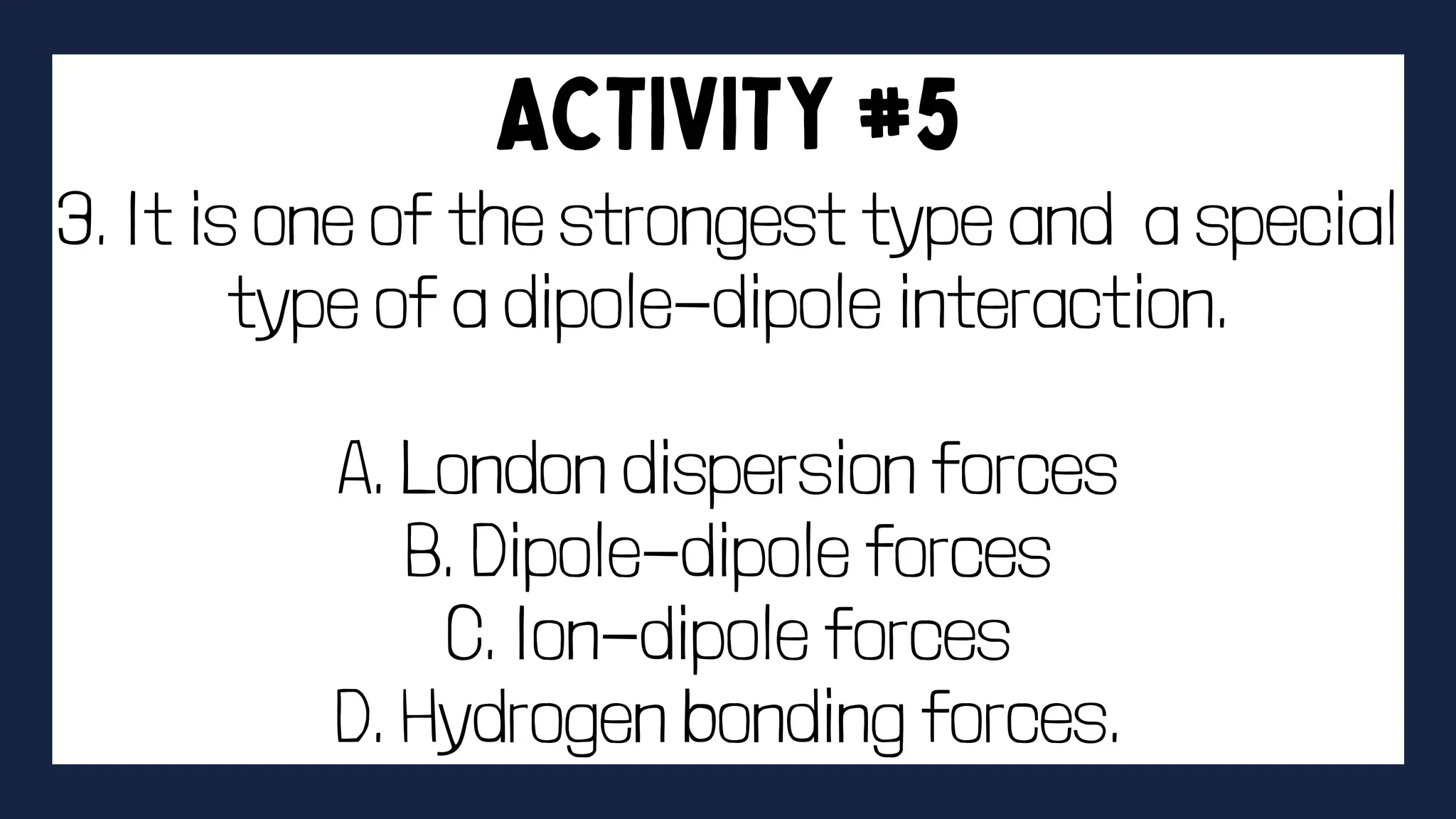
3. It is one of the strongest type and a special
type of a dipole-dipole interaction.
A. London dispersion forces
B. Dipole-dipole forces
C. Ion-dipole forces
D. Hydrogen bonding forces.
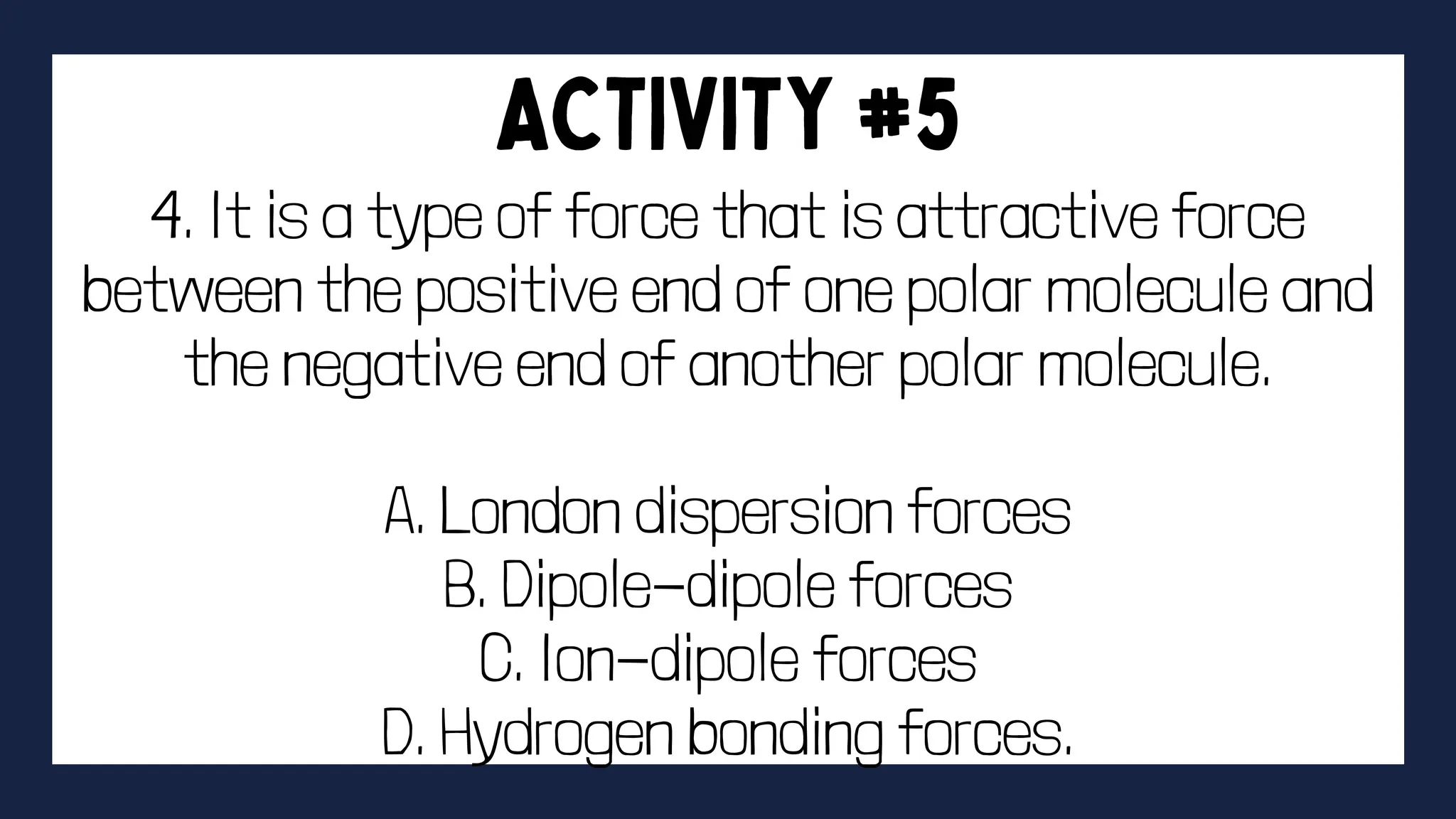
4. It is a type of force that is attractive force
between the positive end of one polar molecule and
the negative end of another polar molecule.
A. London dispersion forces
B. Dipole-dipole forces
C. Ion-dipole forces
D. Hydrogen bonding forces.
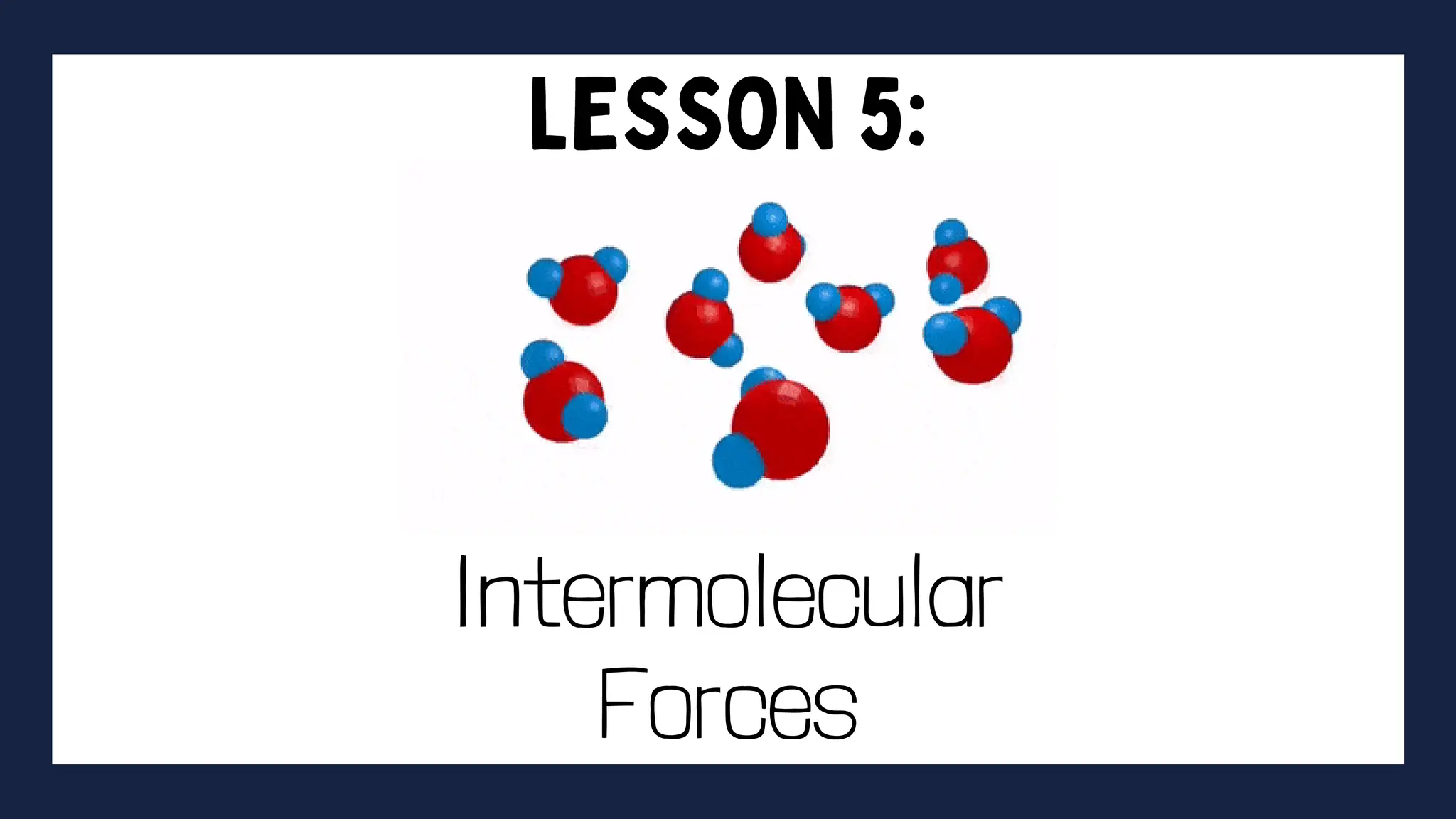
Intermolecular
Forces
As we all know matter is made up
of particles that are in constant
random motion that interact with
each other.
The interaction between particles
and their strength determines
certain properties like boiling
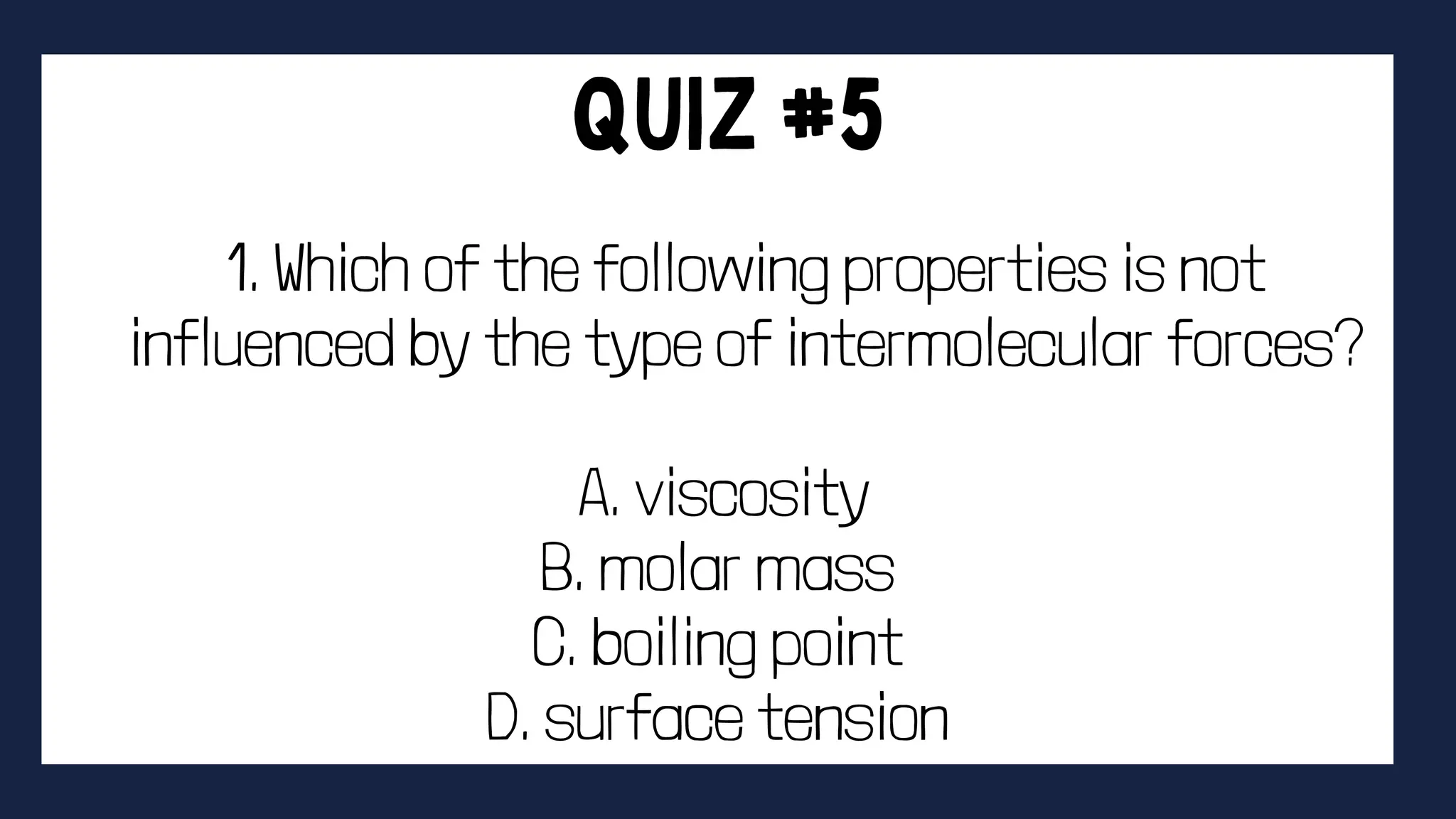
points, the temperature at which a
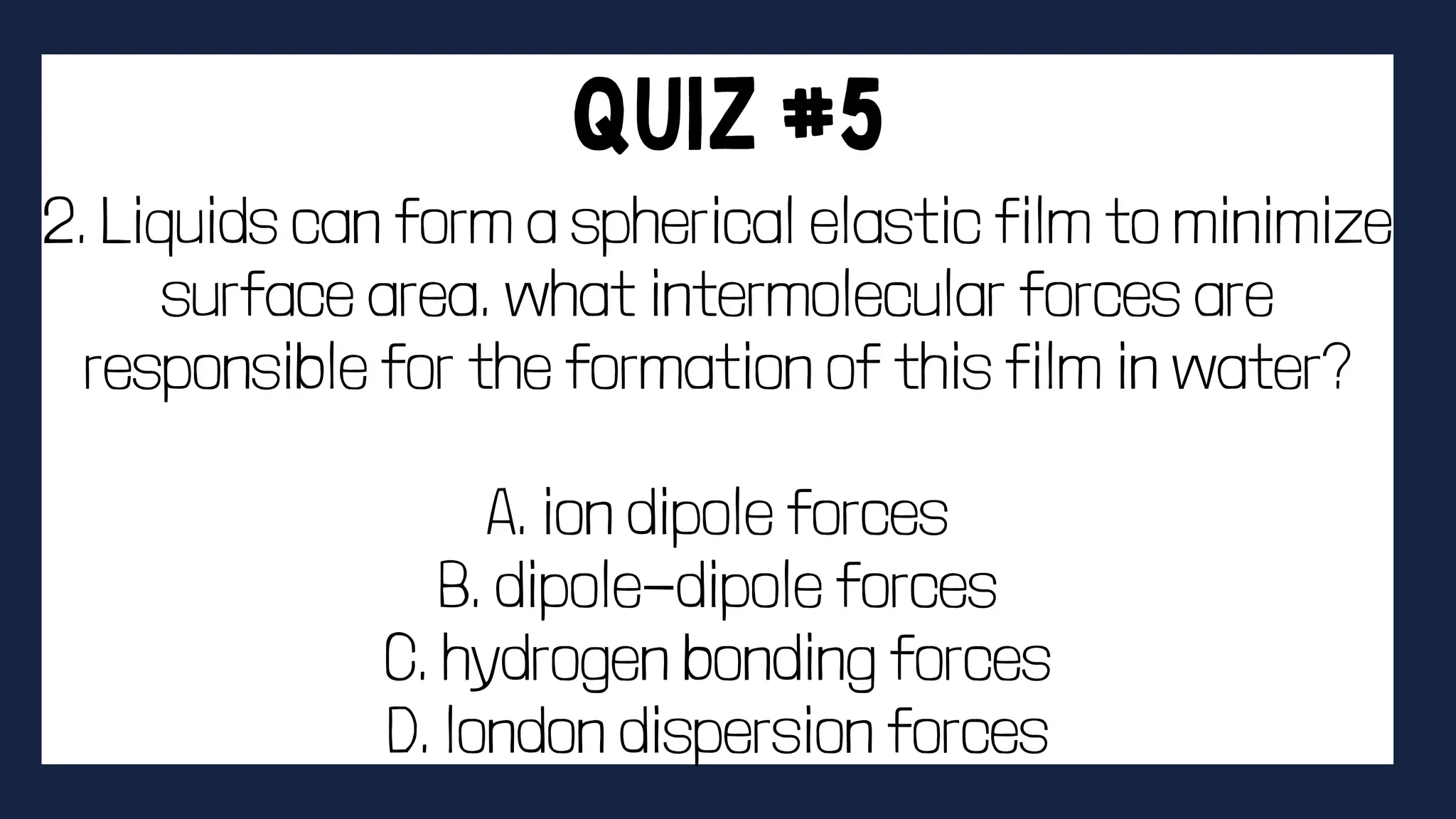
liquid boils and turns to vapor.
Intermolecular force is the
attractive force or bond between
molecules. Which is responsible for
keeping matter in its solid or in its
liquid phase.
1. London dispersion forces
2. Dipole-dipole forces
3. Ion-dipole forces
4. Hydrogen bonding forces.
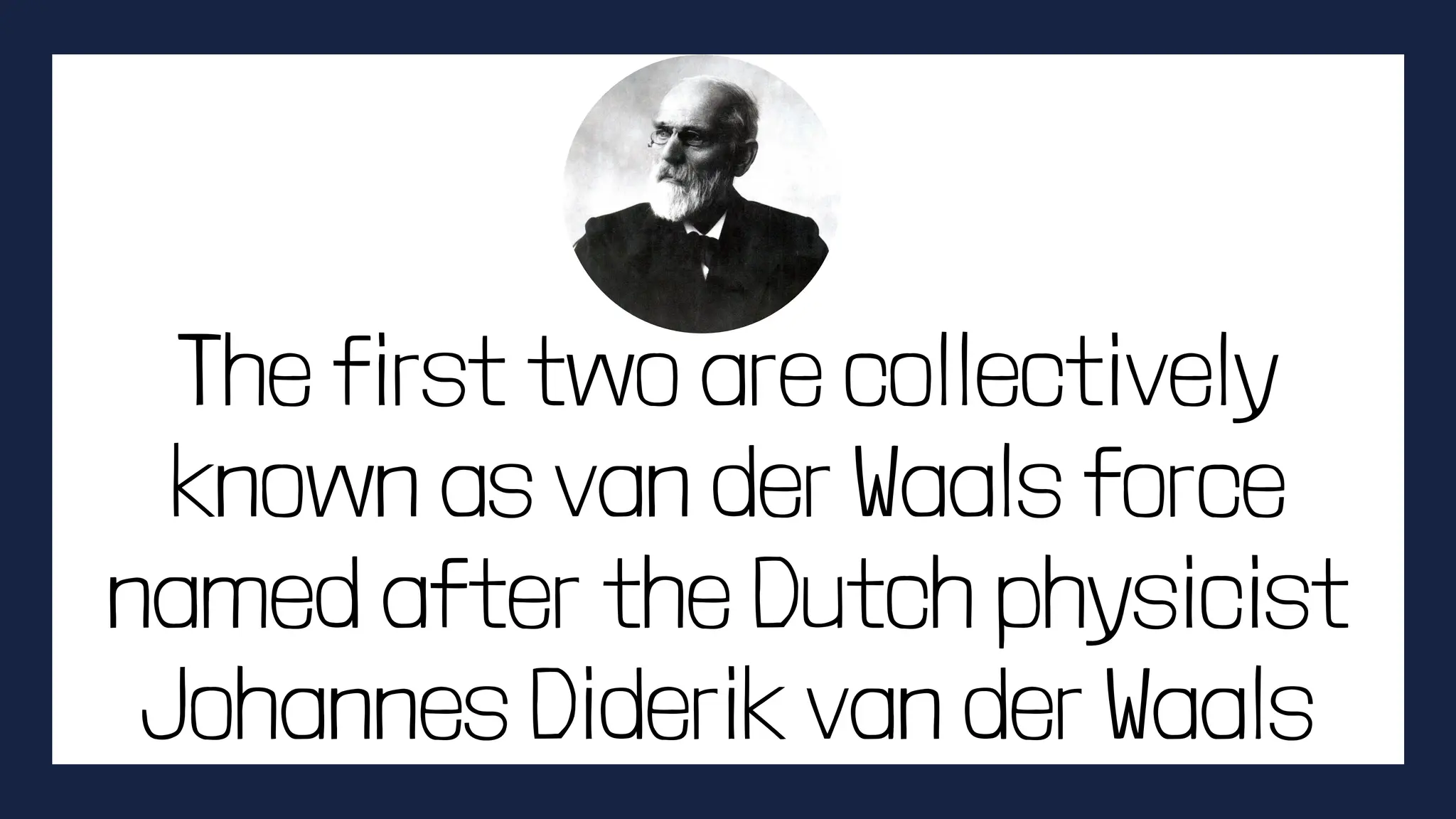
The first two are collectively
known as van der Waals force
named after the Dutch physicist
Johannes Diderik van der Waals
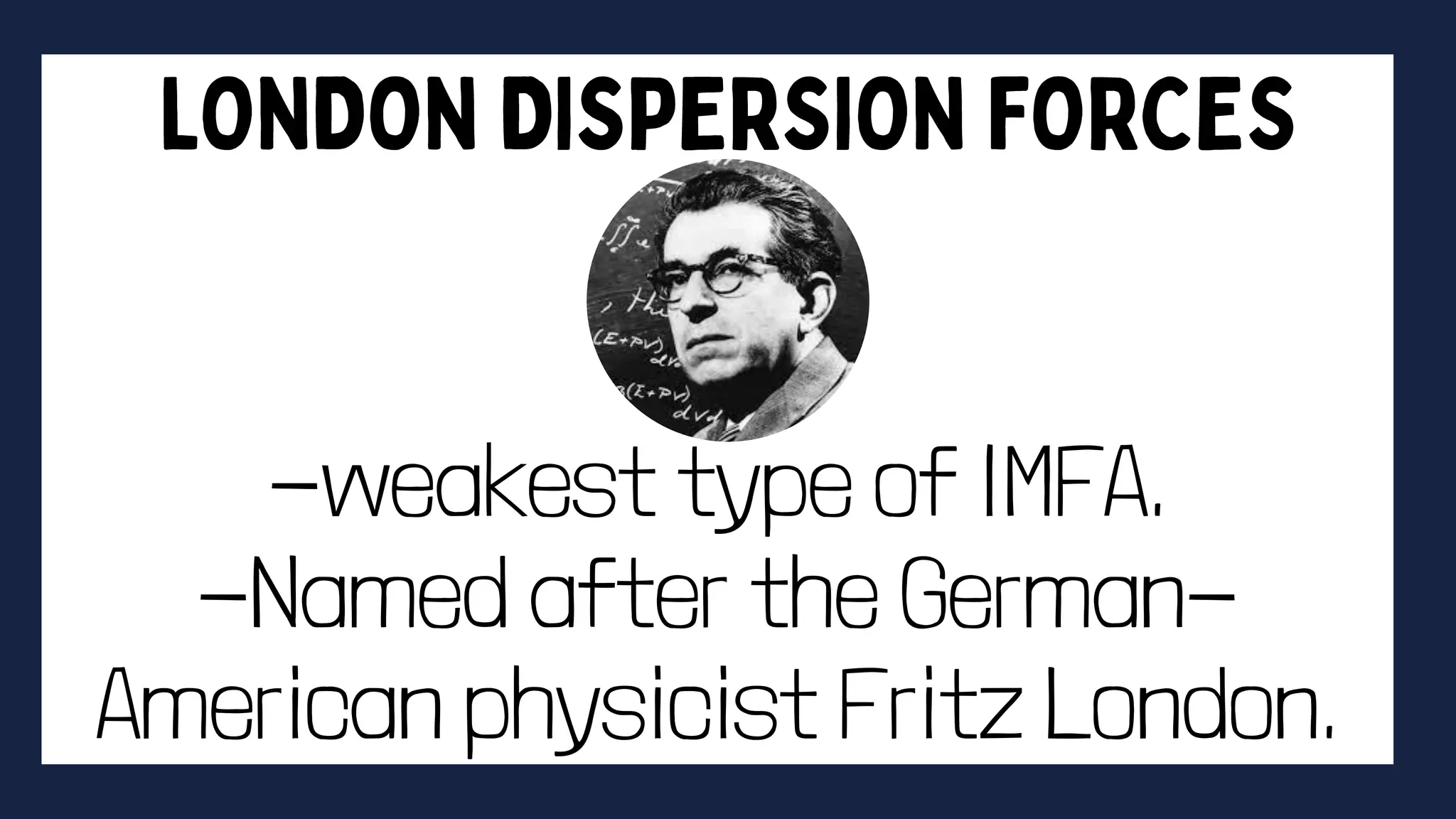
-weakest type of IMFA.
-Named after the German-
American physicist Fritz London.
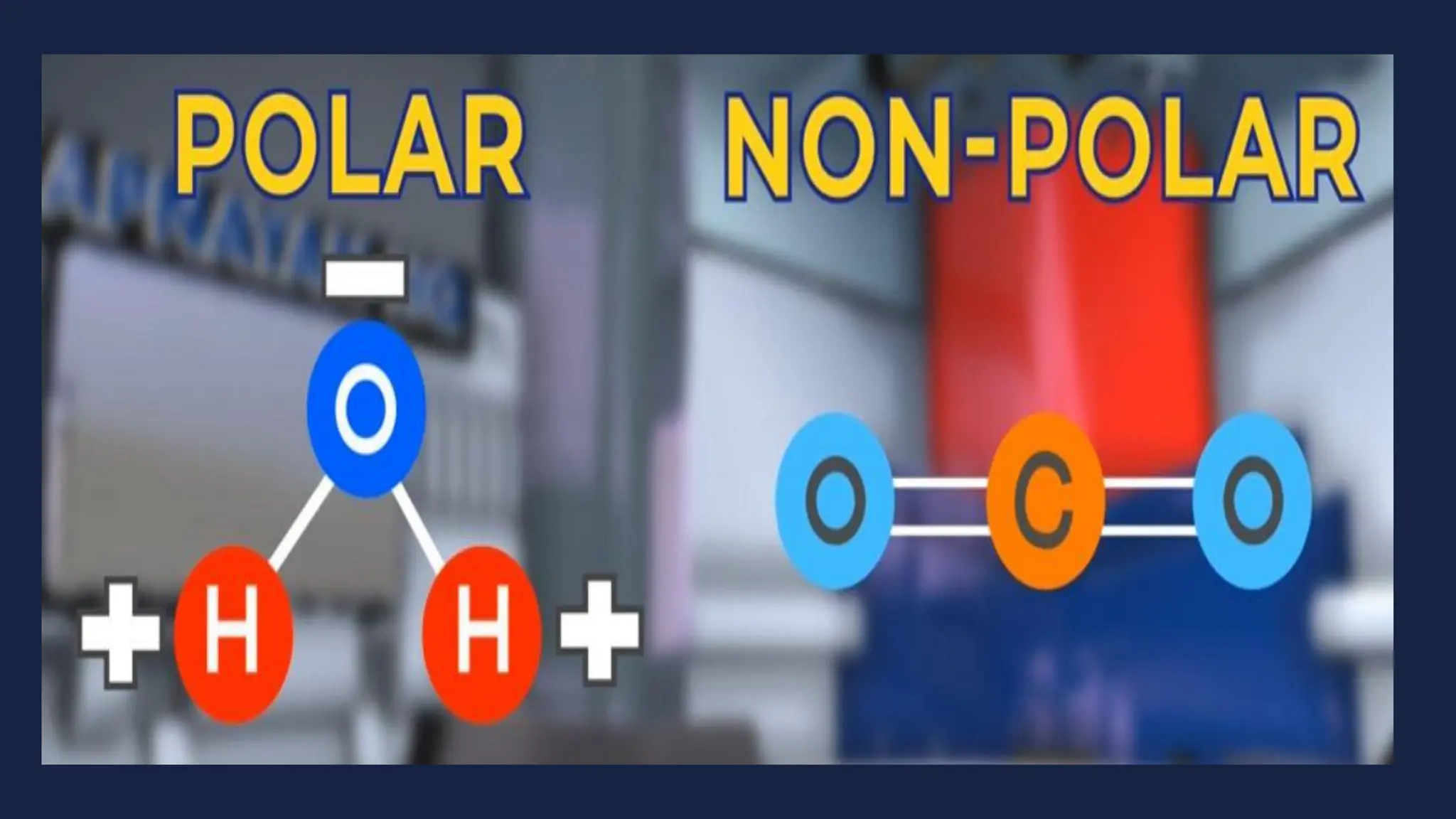
This force is present in all
molecules whether polar or
nonpolar.
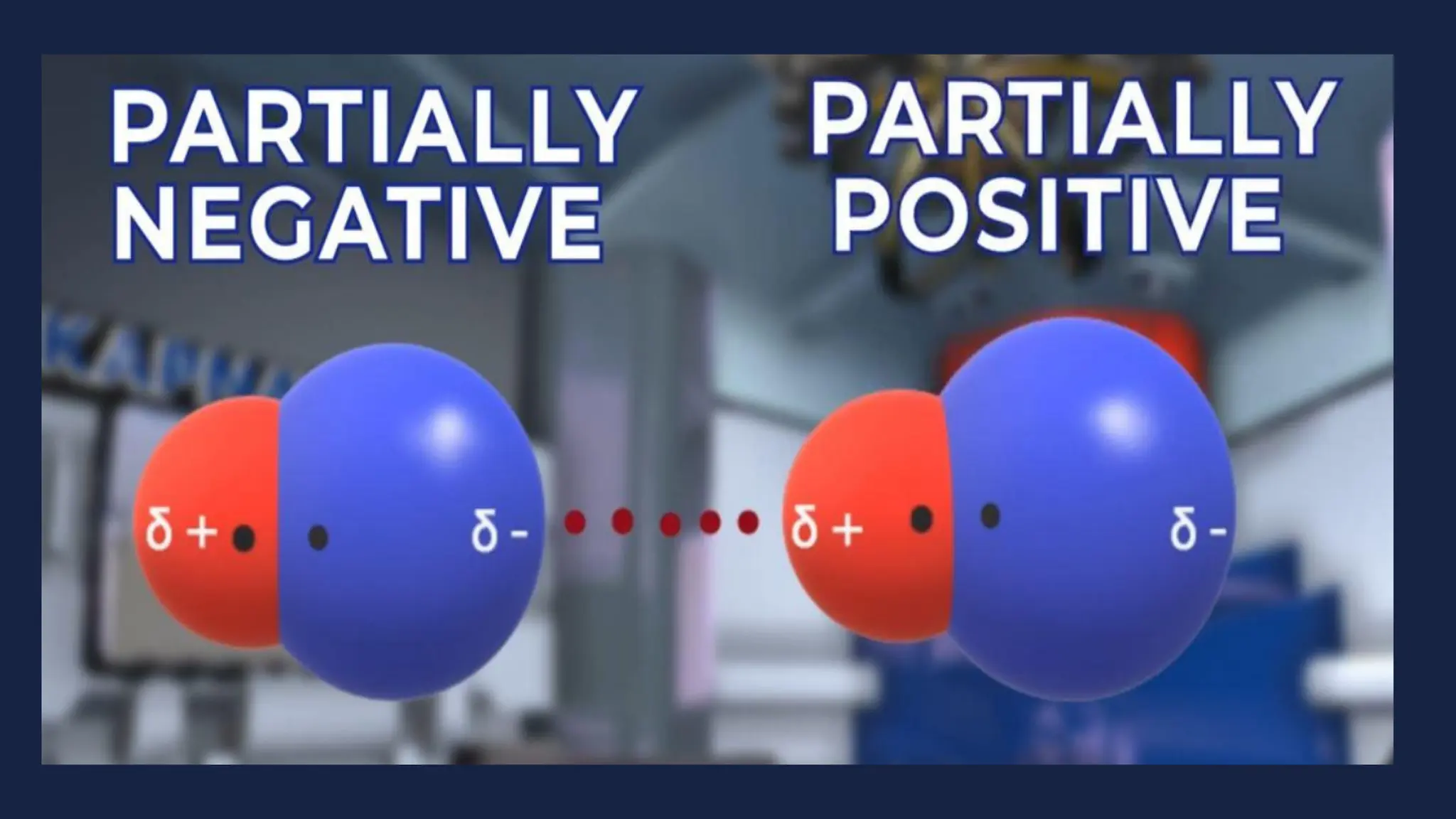
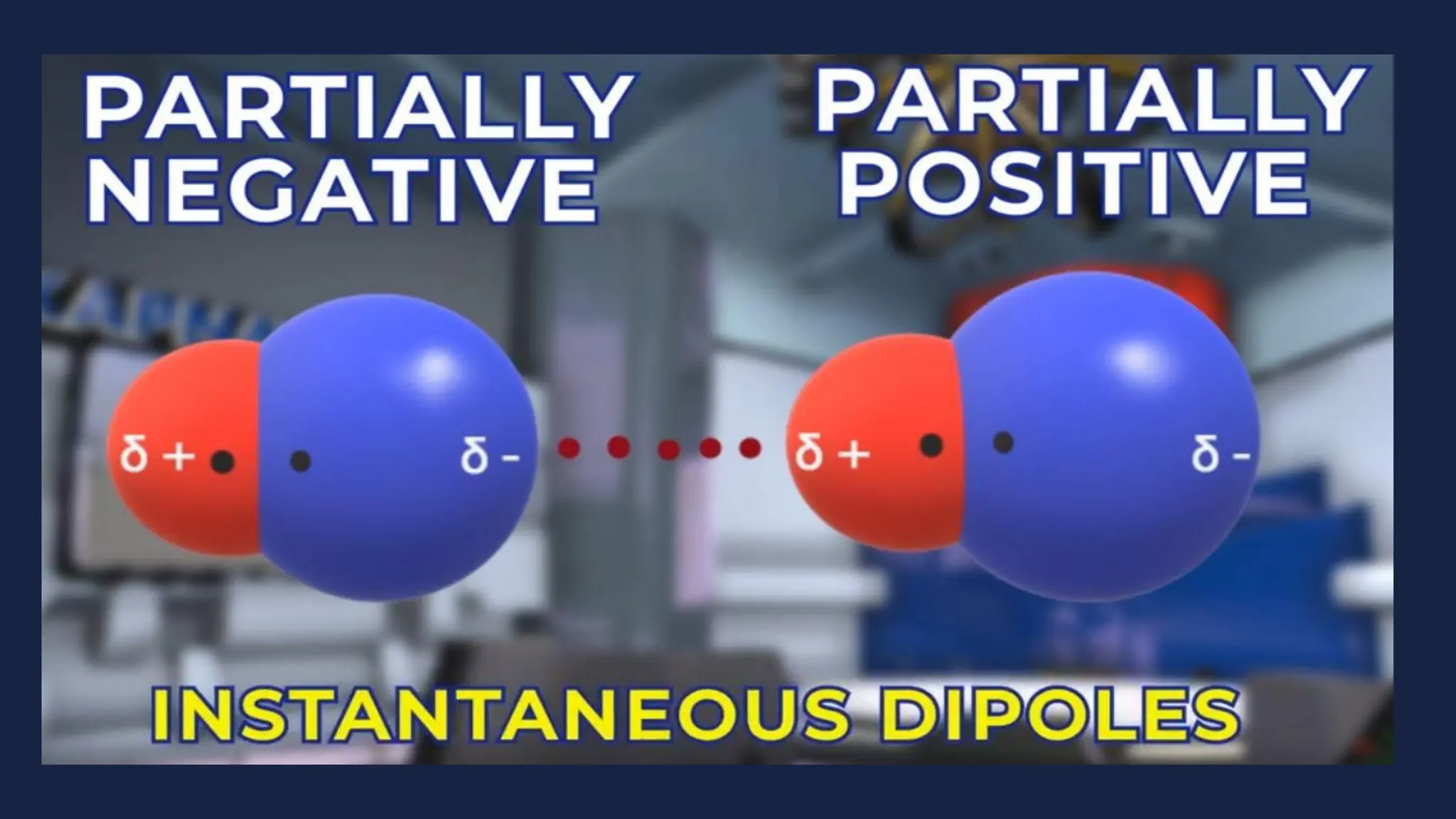
Electrons in this case are constantly
moving but there are times that
electrons are confined to one end
making it partially negative and the
other end becomes partially positive.
What do you think will happen after
this?
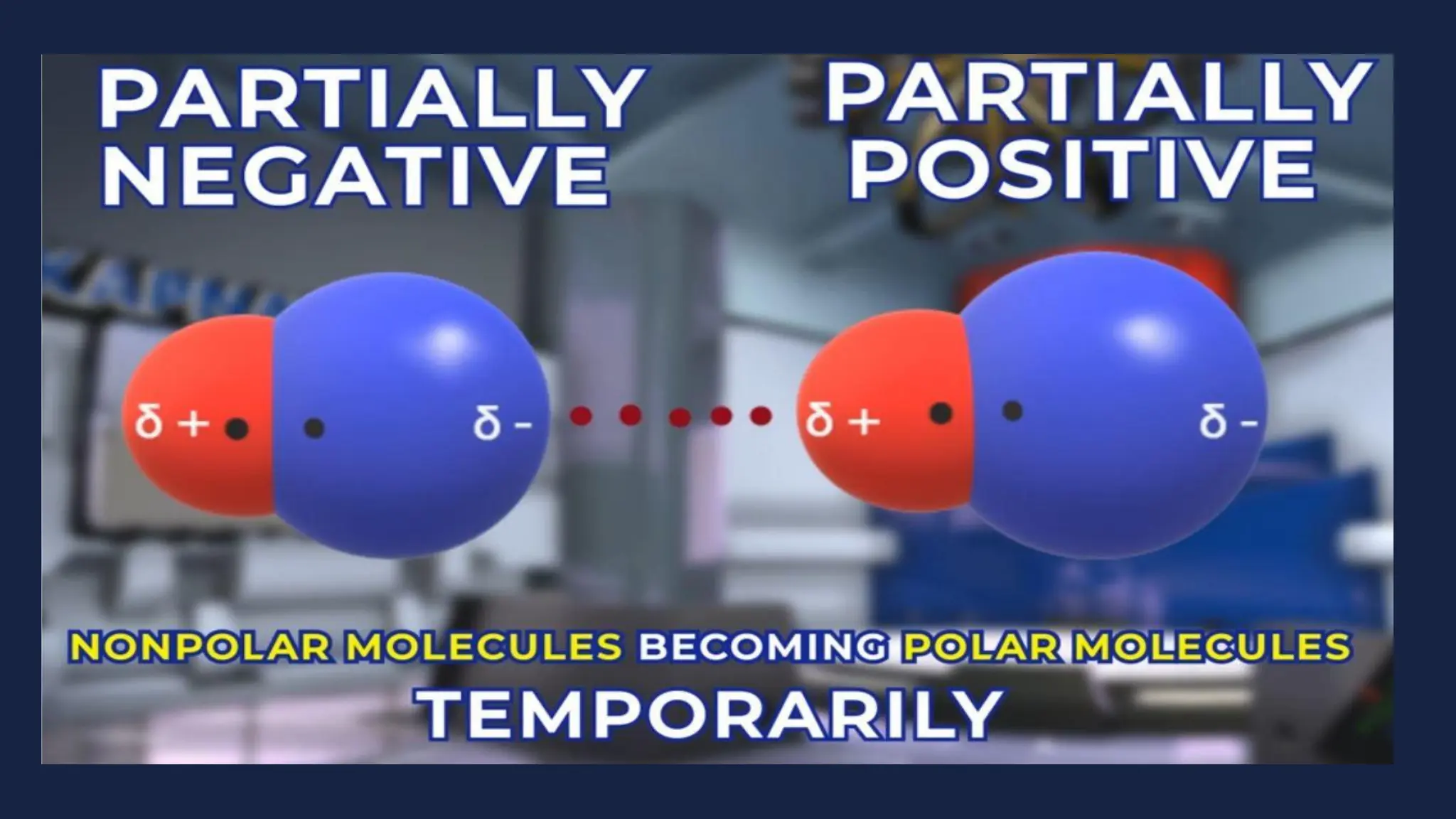
Since there is an equal distribution
of electrons it causes non-polar
molecules to be polar temporarily.
Creating a temporary dipole or an
instantaneous dipole.
Have you tried using a saline
solution or salt and water mixture
to relieve the pain caused by sore
throat or mouth sore?
Well, every time we mix an ionic
compound like salt or sodium
chloride and a polar solvent like
water the third type of IMFA is
involved.
Ion-dipole forces are the result of
the electrostatic attraction
between an ion and a molecule
containing a dipole.
The strength of this force
increases as the charge of the ion
increases.
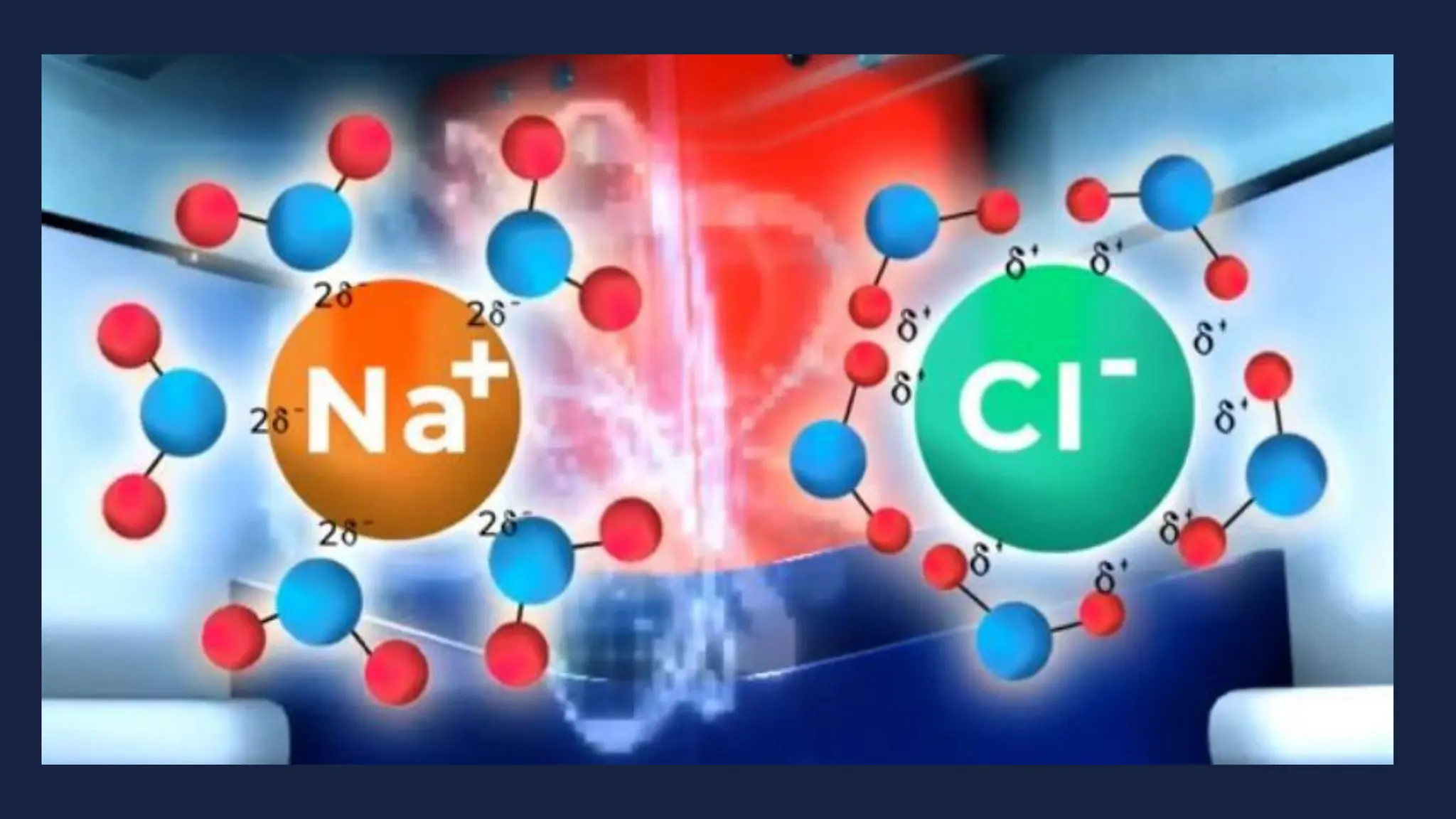
When sodium chloride dissolves in
water it exists as sodium positive
and chlorine negative.
The partial negative oxygen atom
of water is attracted to sodium.
While the partial positive hydrogen
atom of water is attracted to
chlorine.
It is a special type of a dipole-dipole
interaction. And as the name suggests
this force occurs when hydrogen is
bonded to its best friends fluorine oxygen
or nitrogen. three of the most
electronegative elements.
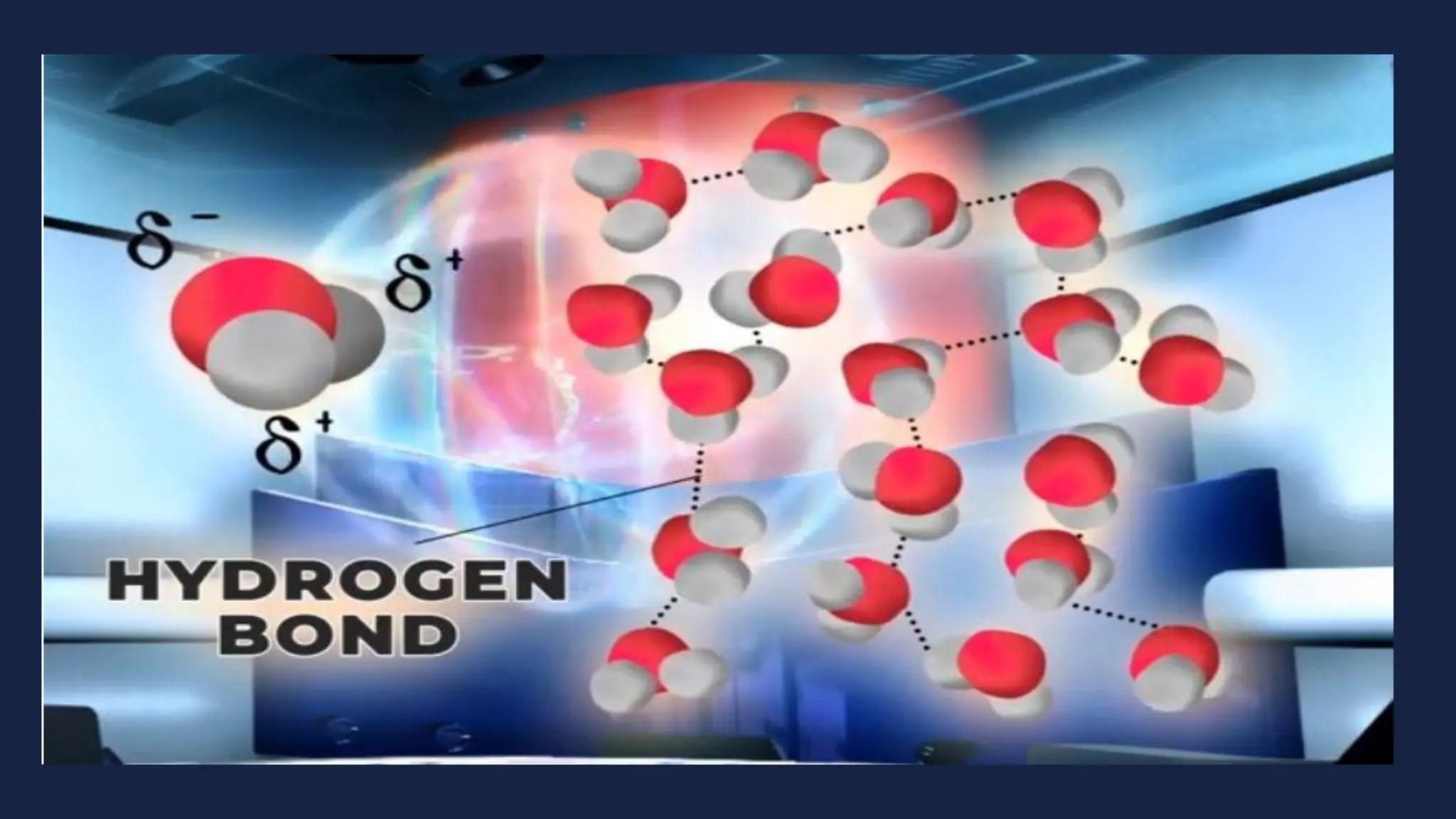
This interaction makes the partially
positive hydrogen of one molecule
interacts with a partially negative
fluorine oxygen or nitrogen atoms in
another molecule.
Together they make very strong
polar bonds just like the water
molecules. This is the reason why
they have high boiling points and
melting points.
Meaning you need a very high
temperature to break the strong
intermolecular forces between the
molecules.
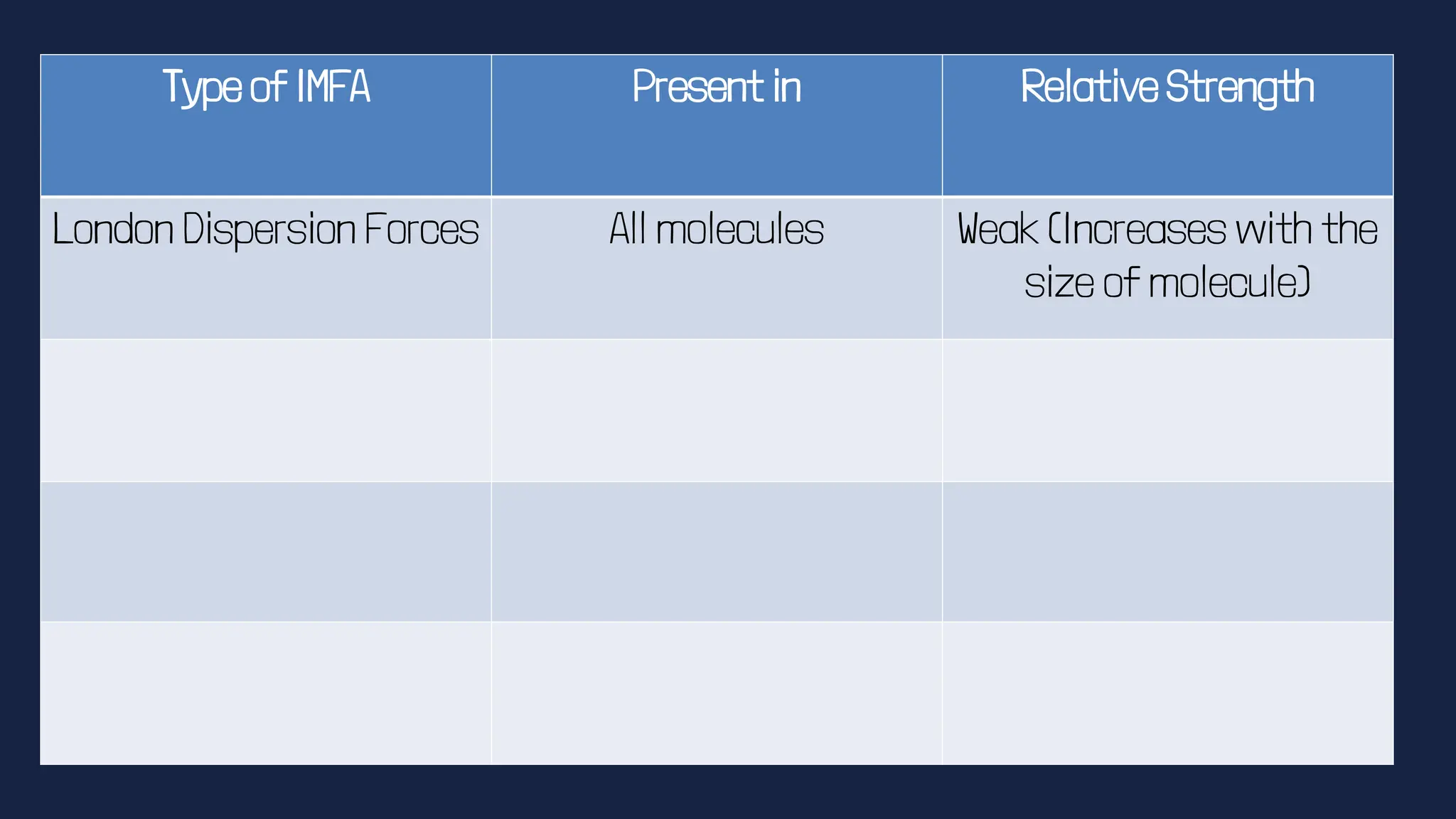
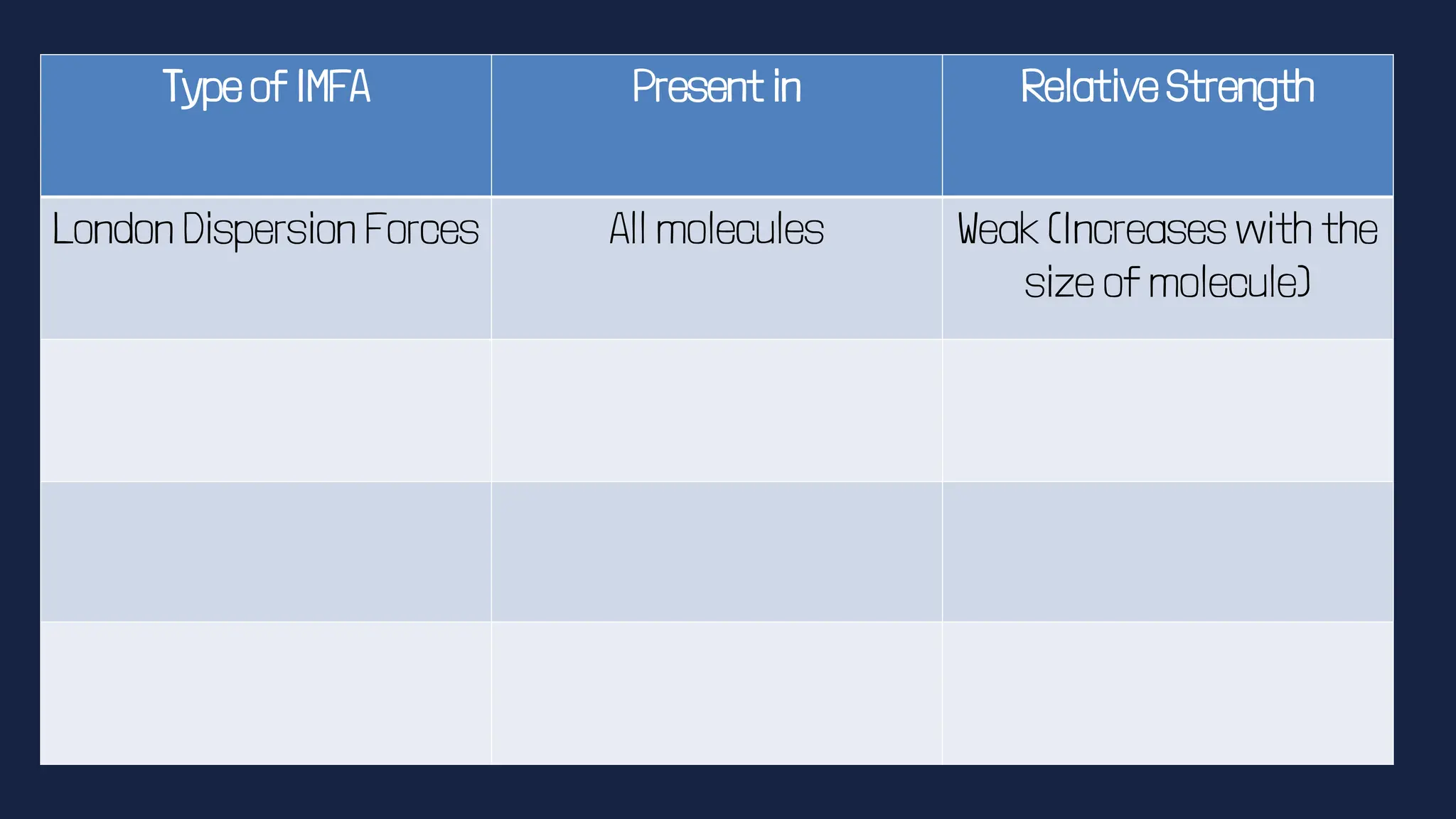
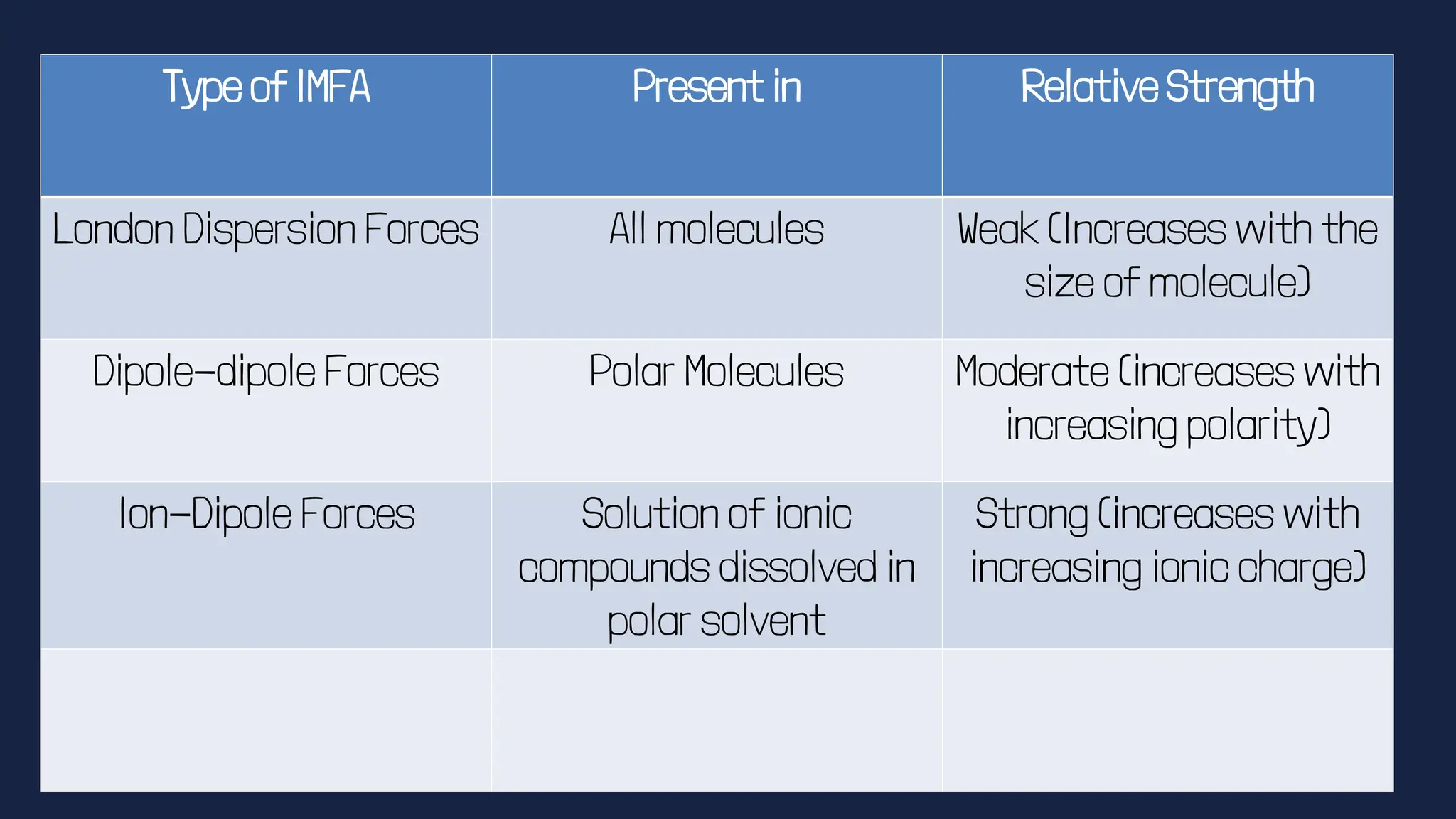
Type of IMFA Present in Relative Strength
London Dispersion Forces All molecules Weak (Increases with the
size of molecule)
Type of IMFA Present in Relative Strength
London Dispersion Forces All molecules Weak (Increases with the
size of molecule)
Type of IMFA Present in Relative Strength
London Dispersion Forces All molecules Weak (Increases with the
size of molecule)
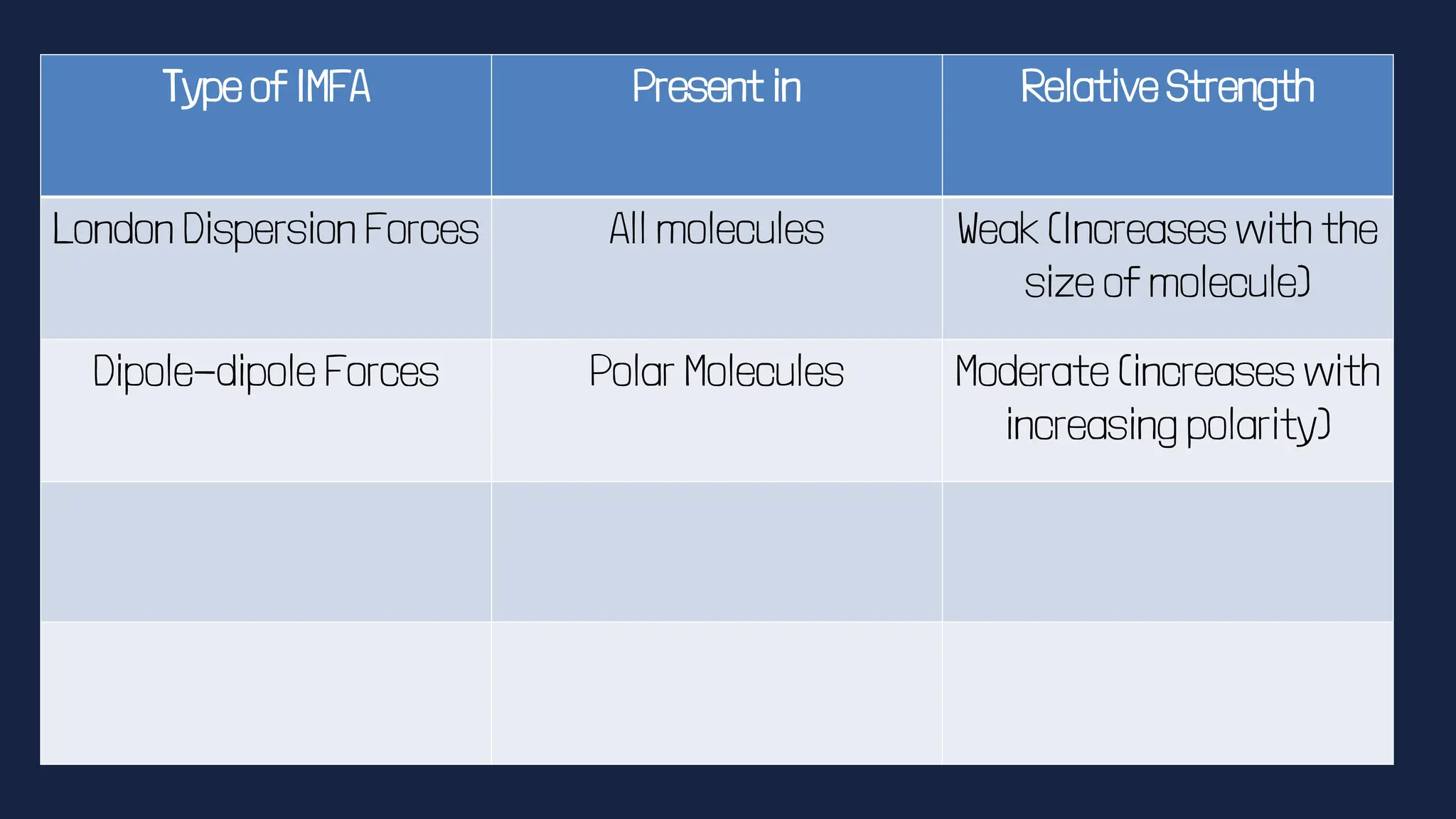
Dipole-dipole Forces Polar Molecules Moderate (increases with
increasing polarity)
Type of IMFA Present in Relative Strength
London Dispersion Forces All molecules Weak (Increases with the
size of molecule)
Dipole-dipole Forces Polar Molecules Moderate (increases with
increasing polarity)
Ion-Dipole Forces Solution of ionic
compounds dissolved in
polar solvent
Strong (increases with
increasing ionic charge)
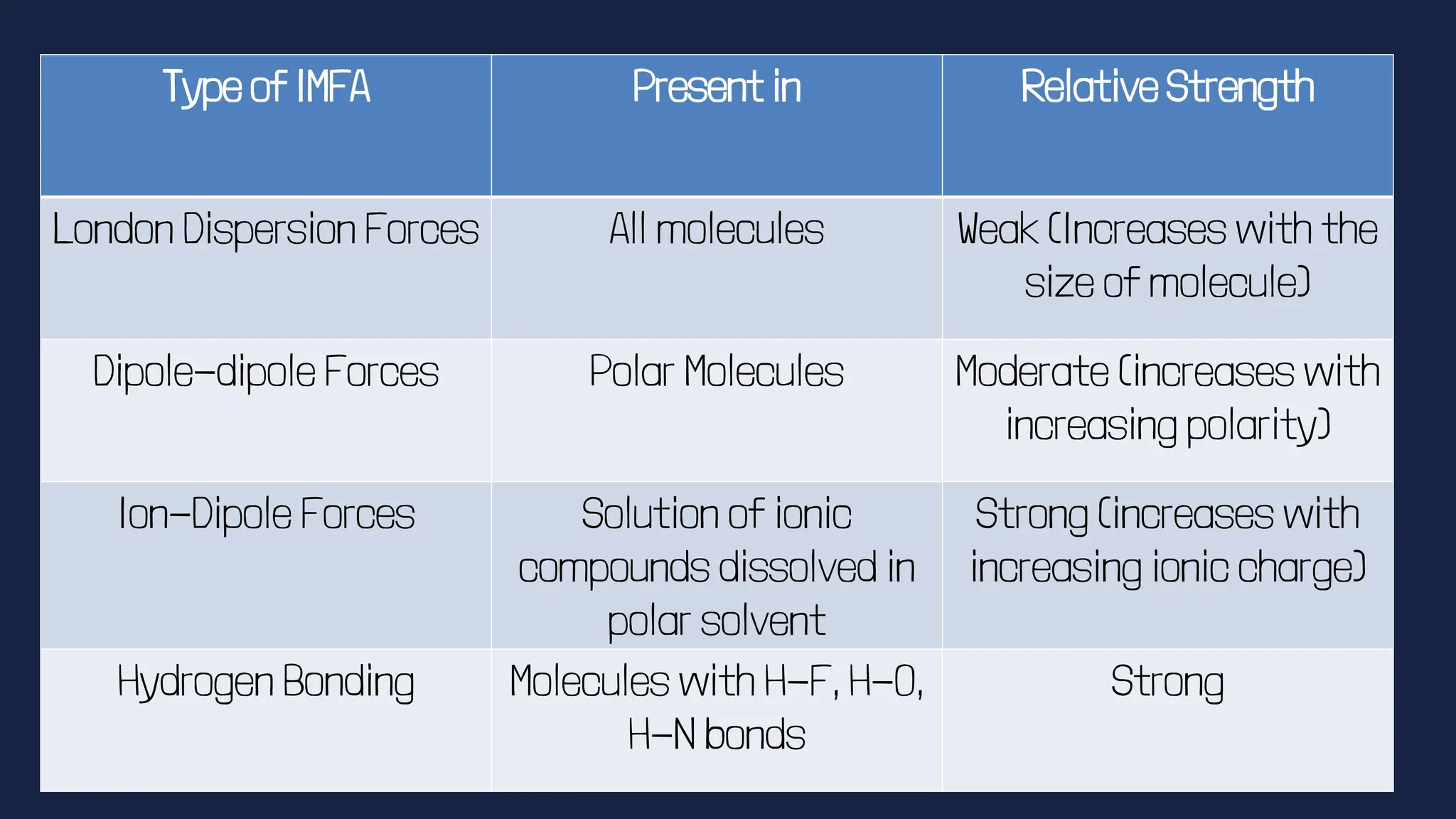
Type of IMFA Present in Relative Strength
London Dispersion Forces All molecules Weak (Increases with the
size of molecule)
Dipole-dipole Forces Polar Molecules Moderate (increases with
increasing polarity)
Ion-Dipole Forces Solution of ionic
compounds dissolved in
polar solvent
Strong (increases with
increasing ionic charge)
Hydrogen Bonding Molecules with H-F, H-O,
H-N bonds
Strong
The forces of attraction that exist
between molecules that comprise
matter is attributed to its physical
properties.
Like density solubility and the two
that have been mentioned earlier
boiling point and melting point.
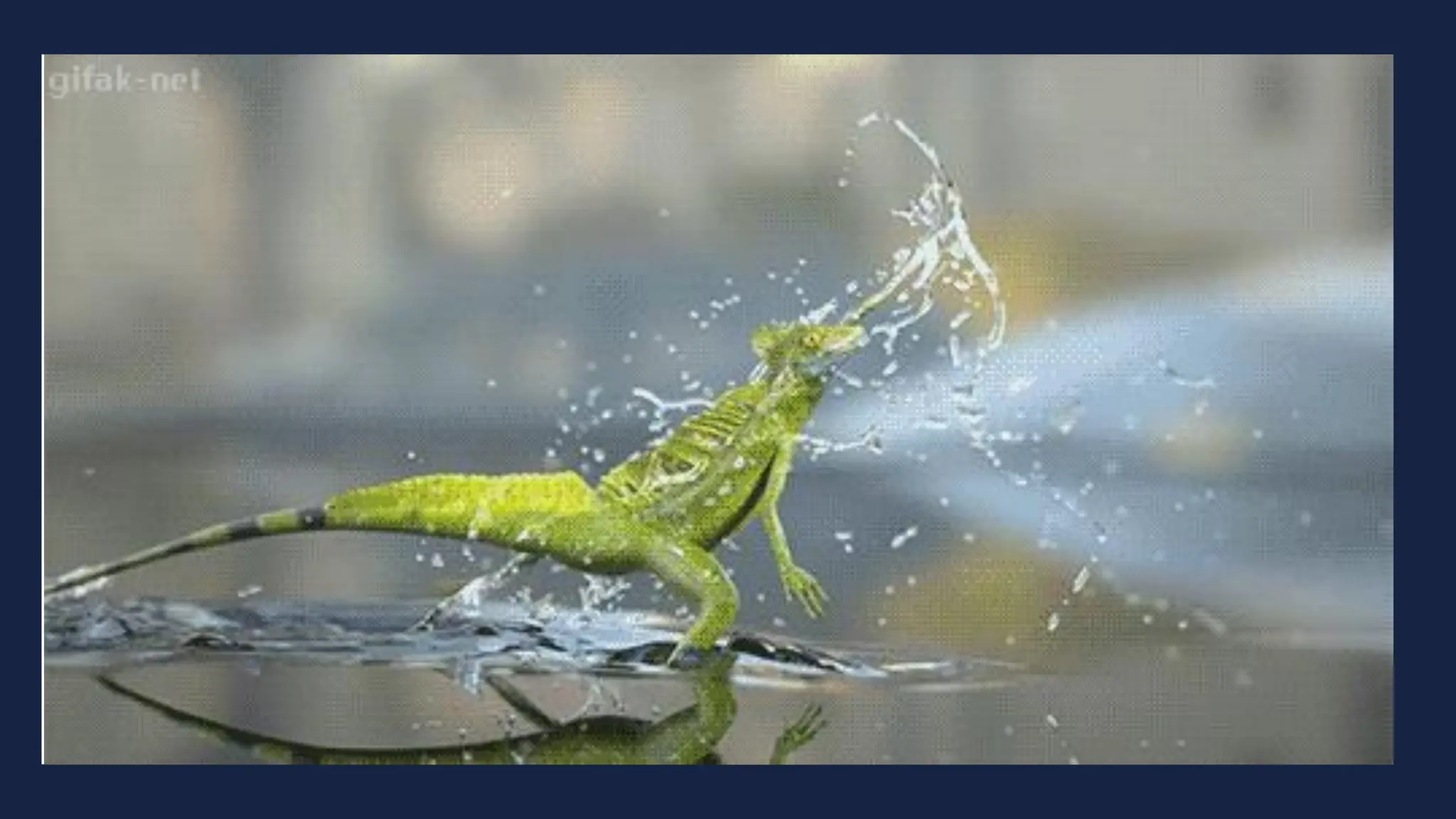
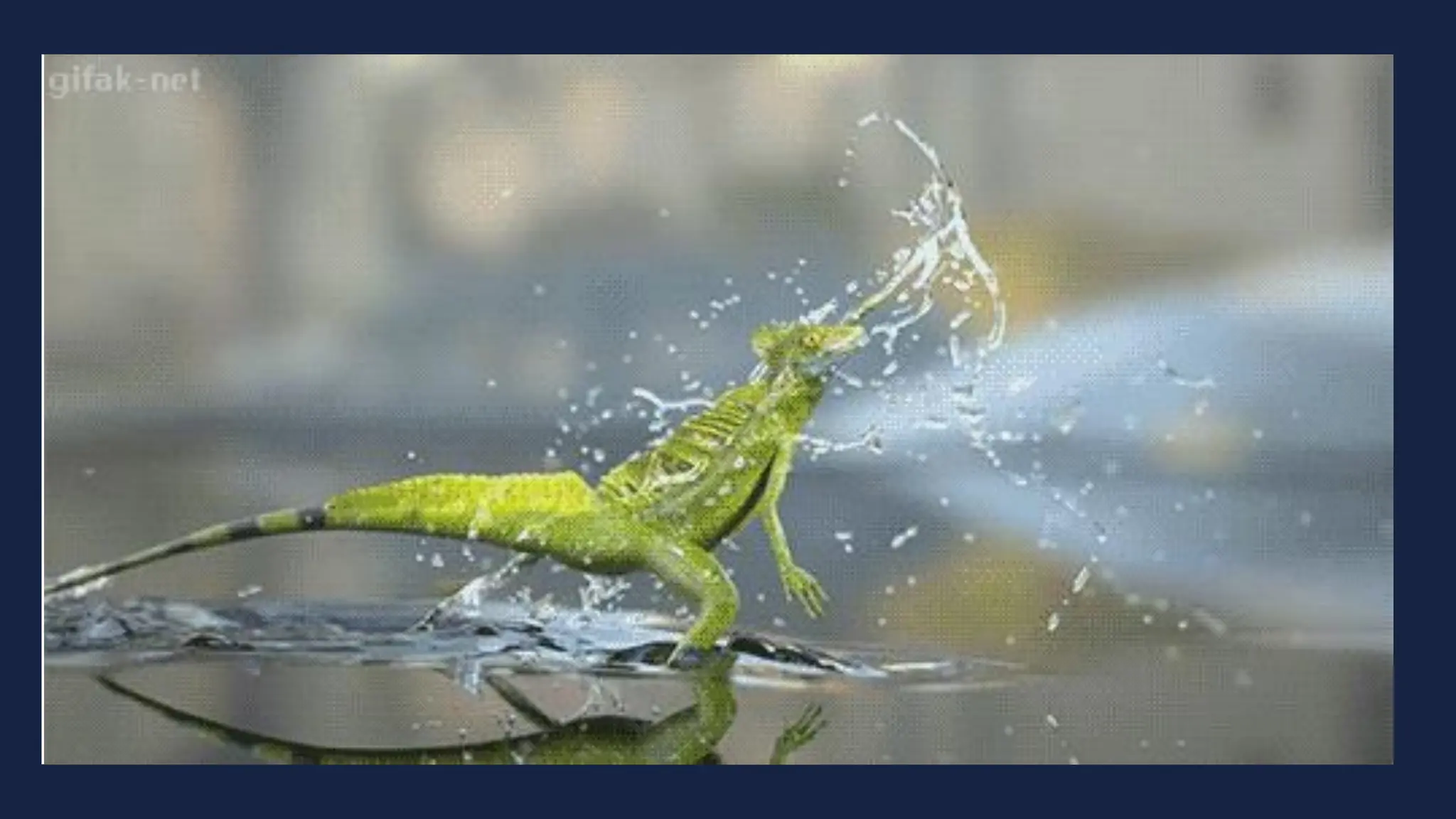
basilisk lizards gif
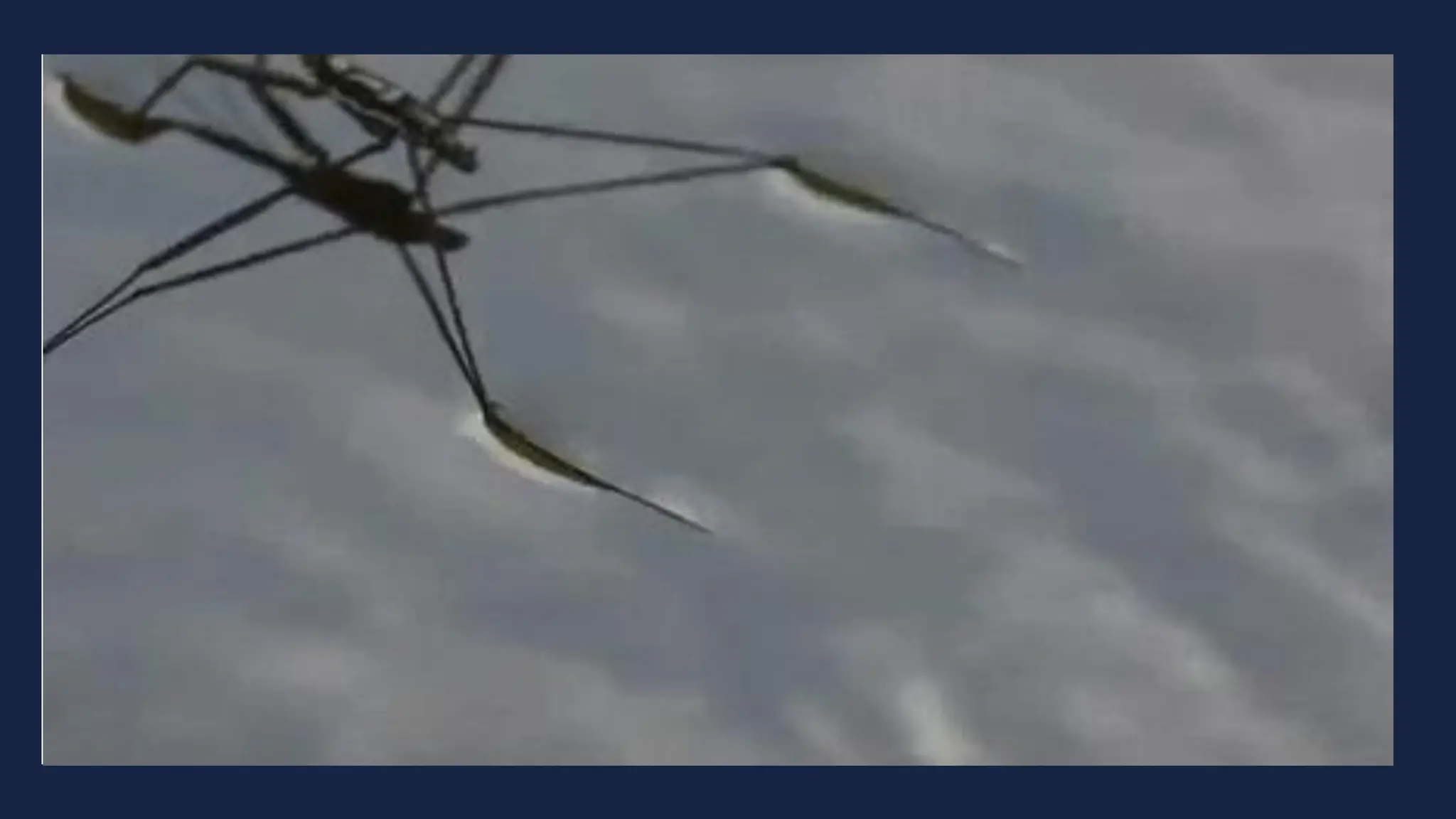
The force that causes molecules
on the surfaces of liquid to be
pushed together and form a layer.
And it is not broken by the large
surface covered by their feet.
water strider gif
I bet you have probably heard a lot
about covid 19 testing recently.
One of the types of tests used is
the rapid antibody test.
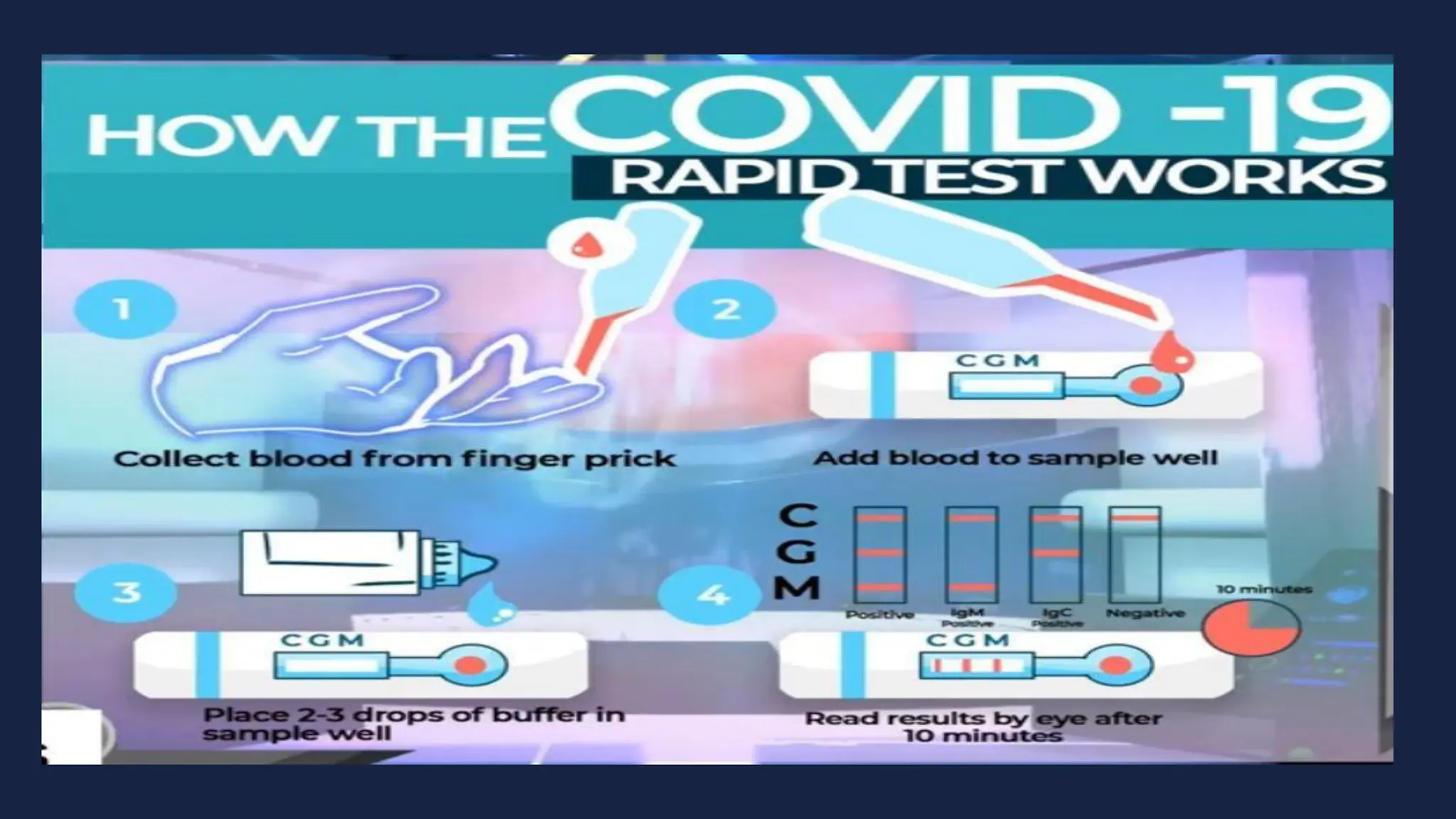
The procedure uses extracted
blood sample from a person. A
medical practitioner takes a blood
sample from a patient's finger
using a capillary tube.
Interestingly intermolecular forces
also act on this situation making
the contraction and pulling up of
the blood sample in the tube
possible.
It is the ability of liquid molecules
to flow in narrow tubes or porous
material. Liquids in this case flow
against gravity.
capillary action gif
The attraction between like
molecules or cohesion and the
attraction between unlike
molecules or adhesion bring about
capillary action.
The water molecules in our blood
are all the same. And they exhibit
cohesion.
While the attraction between
water and the sides of the glass
tube is adhesion.
Since adhesion is stronger than
cohesion in this scenario the liquid
is pulled upward.
Guess the substance!
-This liquid is considered a
superfood as it contains water
vitamins minerals and enzymes
that give energy to the body.
Guess the substance!
-It also has medicinal properties.
-When sealed in an airtight
container it is one of the few foods
known to have an eternal shelf life.
Guess the substance!
-It does not spoil.
-and finally I would say along with
the bees flying around it is one of the
most delicious substances on earth.
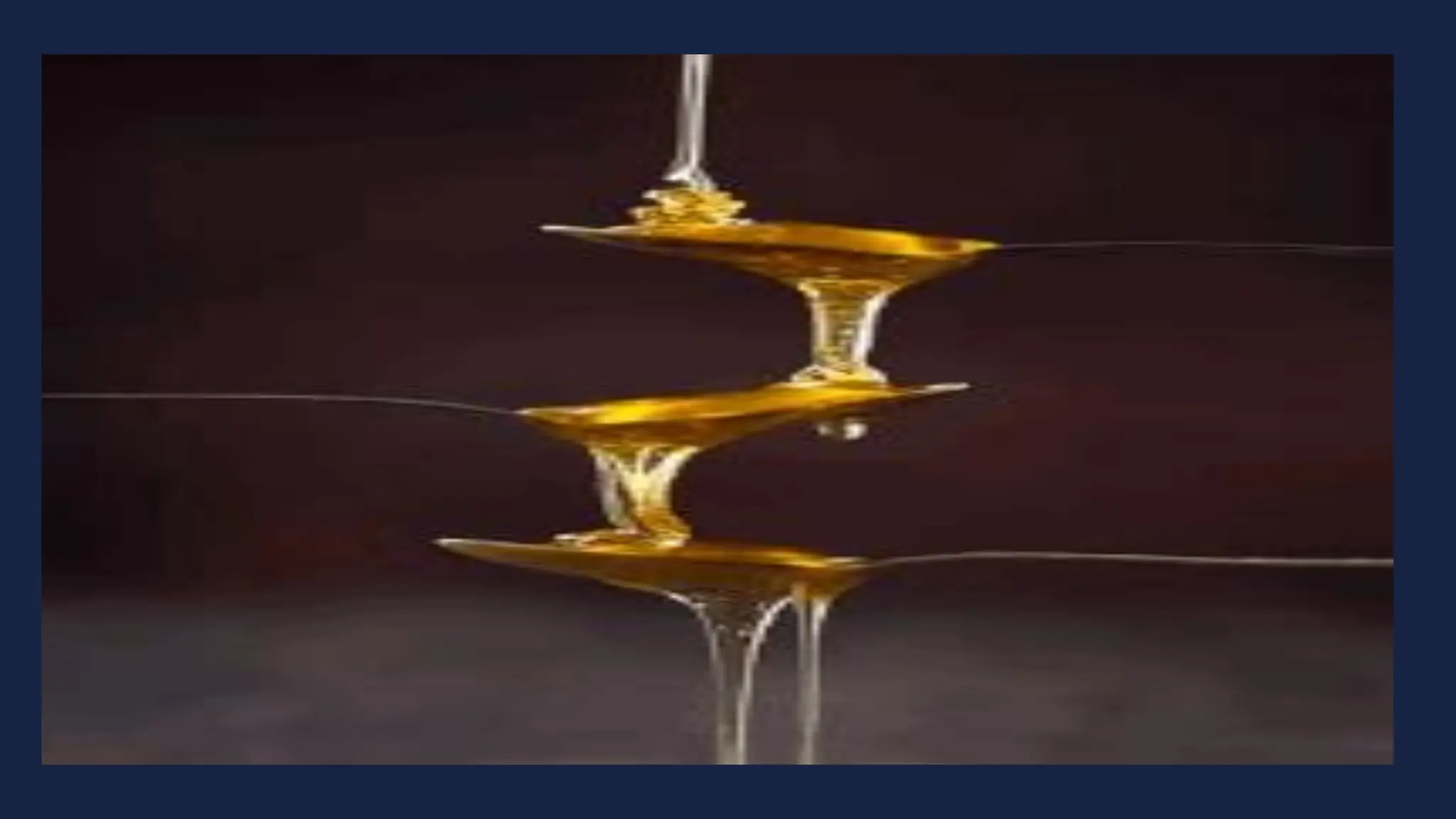
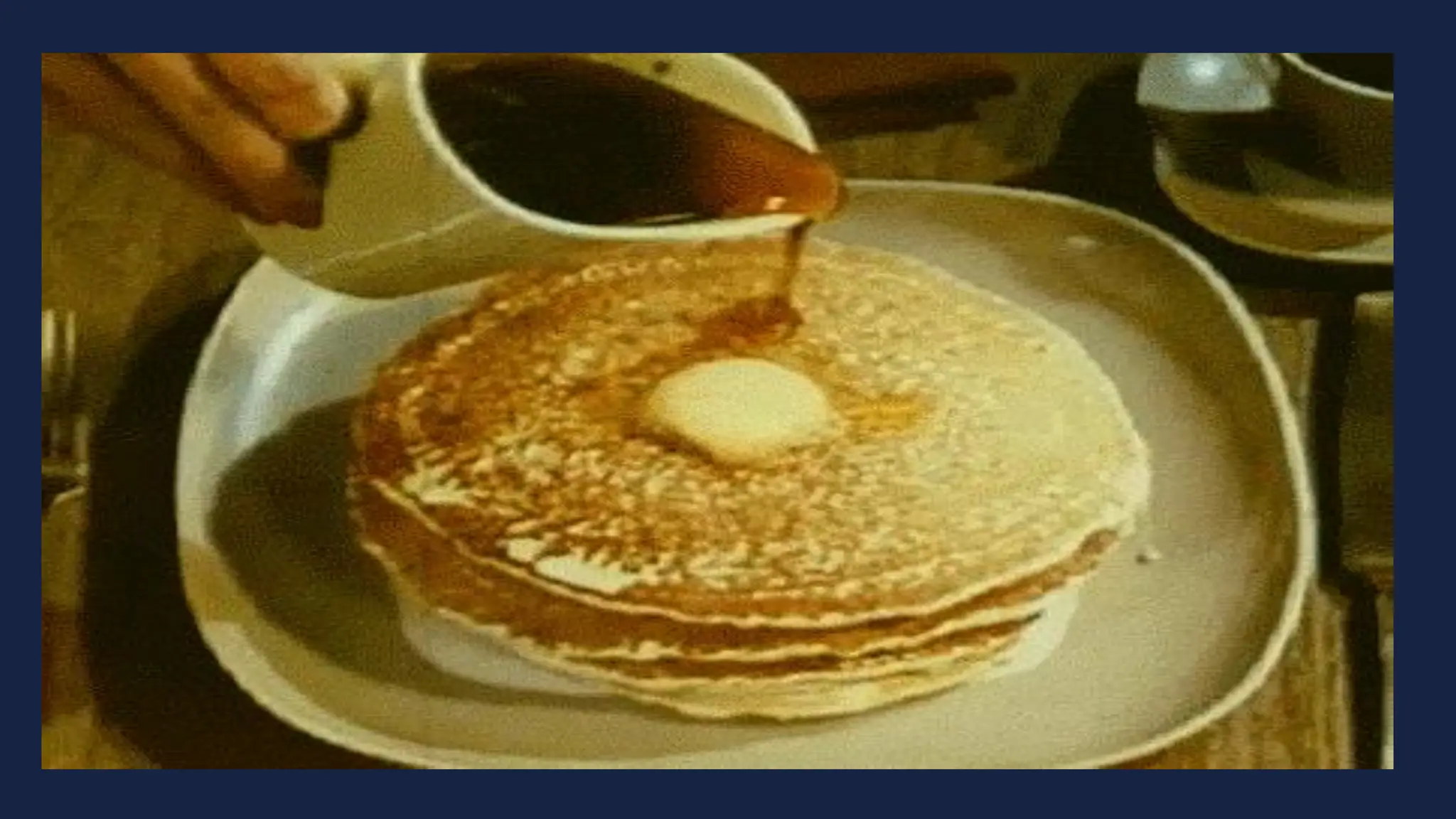
dripping honey gif
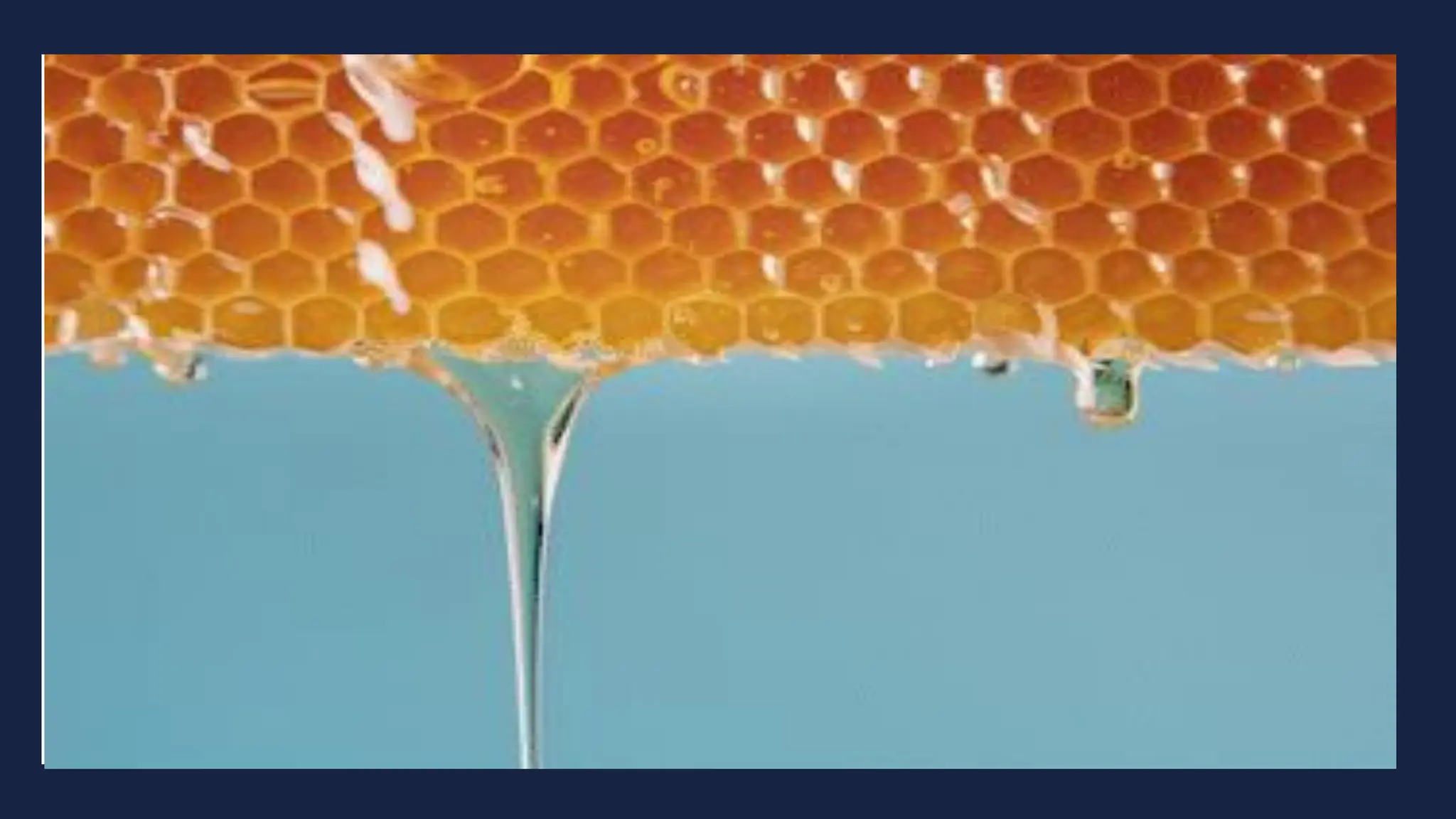
Honey is one common example of a
liquid that is thick and flows
slowly.
Do intermolecular forces of
attraction have something to do
with this? Yes of course.
Viscosity is a measure of a liquid's
resistance to flow or in layman's
term the thickness of a liquid.
The greater the viscosity of the
liquid the more slowly it flows.
Liquids that have high
intermolecular forces are highly
viscous.
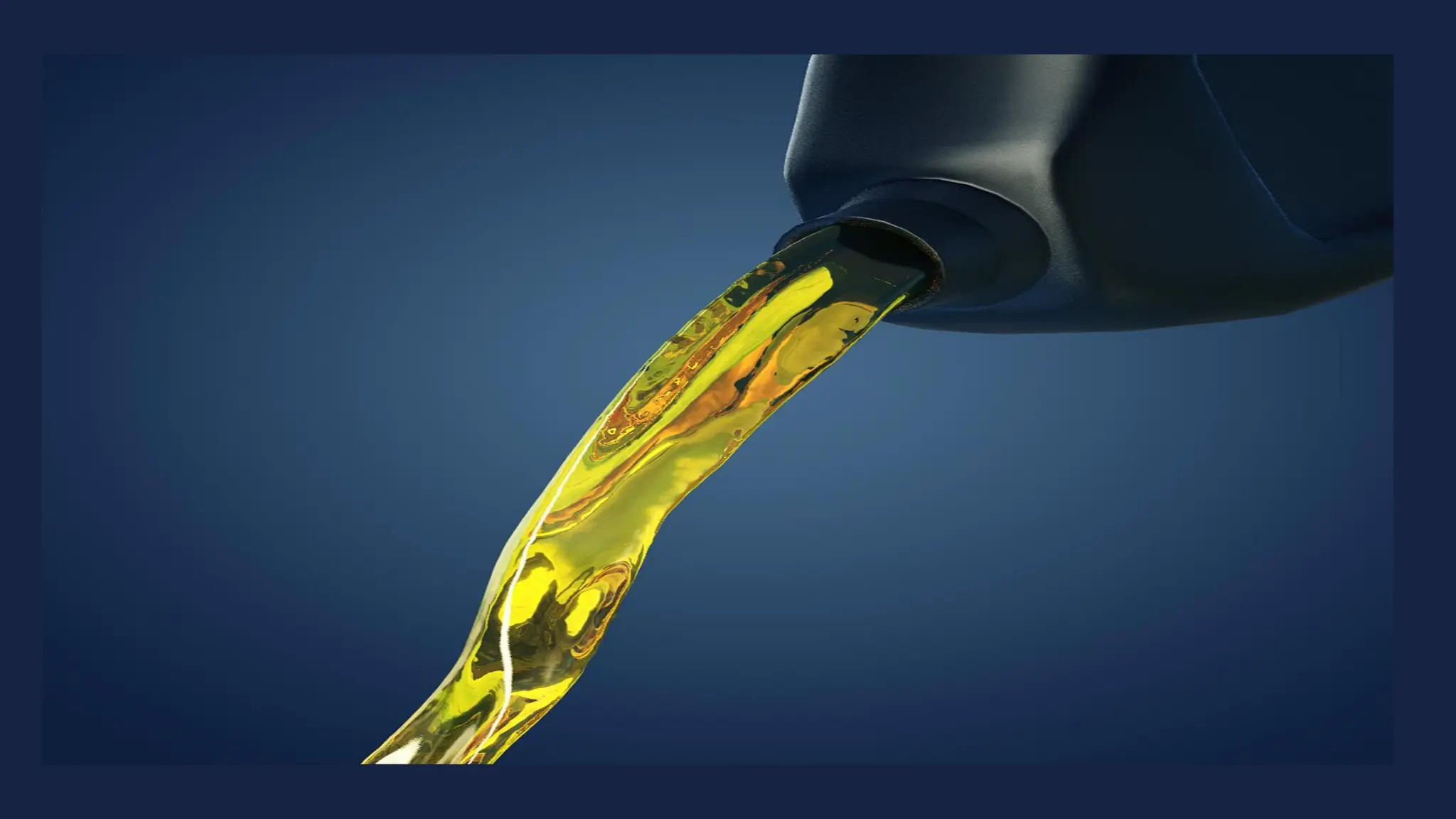
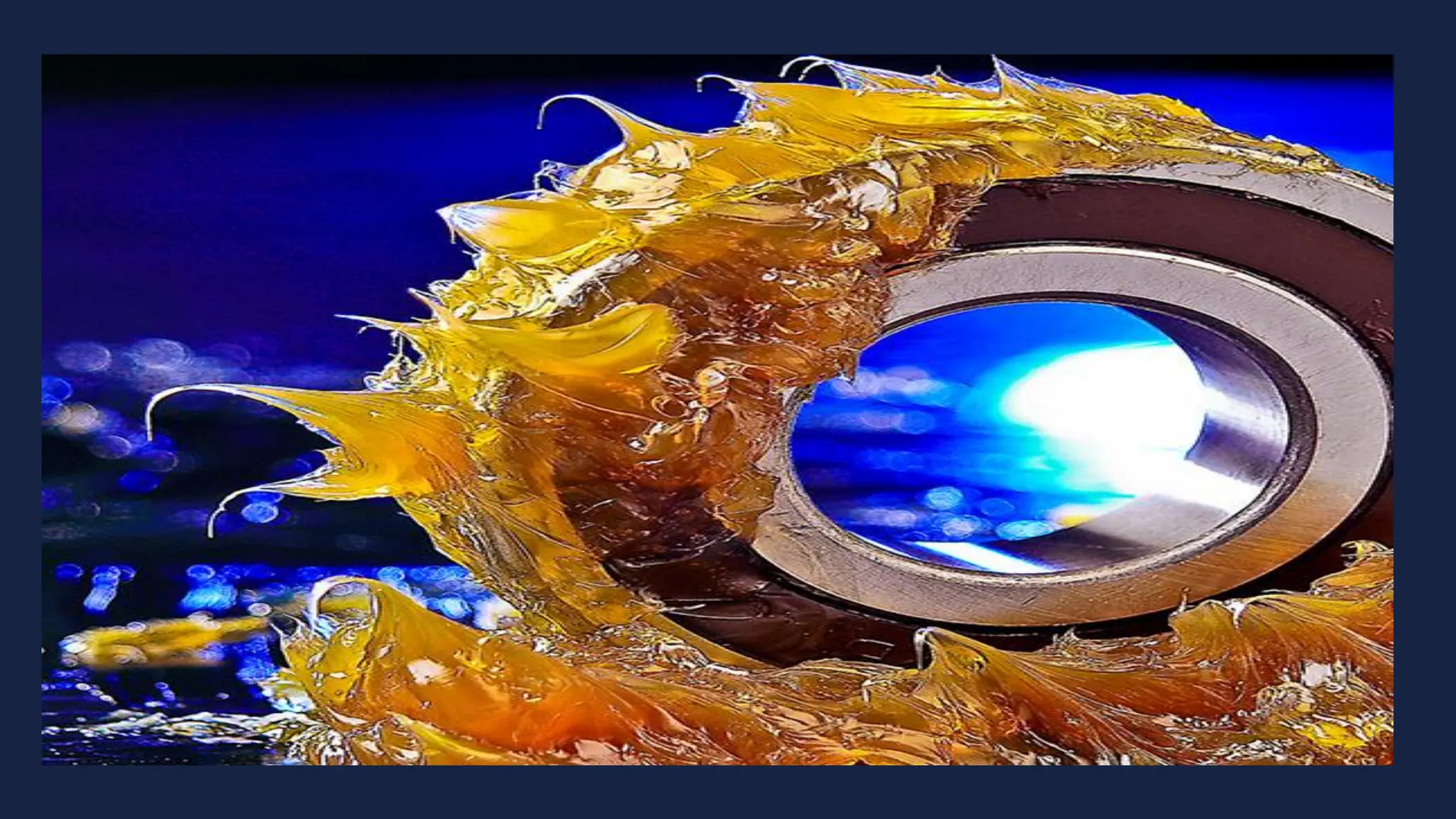
Like honey, serum, glue, fuel oil and
lubricating grease.
Like honey, serum, glue, fuel oil and
lubricating grease.
Like honey, serum, glue, fuel oil and
lubricating grease.
Like honey, serum, glue, fuel oil and
lubricating grease.
Like honey, serum, glue, fuel oil and
lubricating grease.
Temperature also affects
viscosity the higher the
temperature the lower the liquids
viscosity. Meaning they will flow
much easier.
Let's Recap!
Can you recall the different
properties of matter influenced by
the strength of the intermolecular
forces?
These are boiling and melting
points, surface tension, capillary
action, and viscosity.
These are important considerations when
materials engineer design different
materials for various uses. Thus, the
properties of the material should match
the product's intended environment.
These are important considerations when
materials engineer design different
materials for various uses. Thus, the
properties of the material should match
the product's intended environment and
should not interfere with its function.
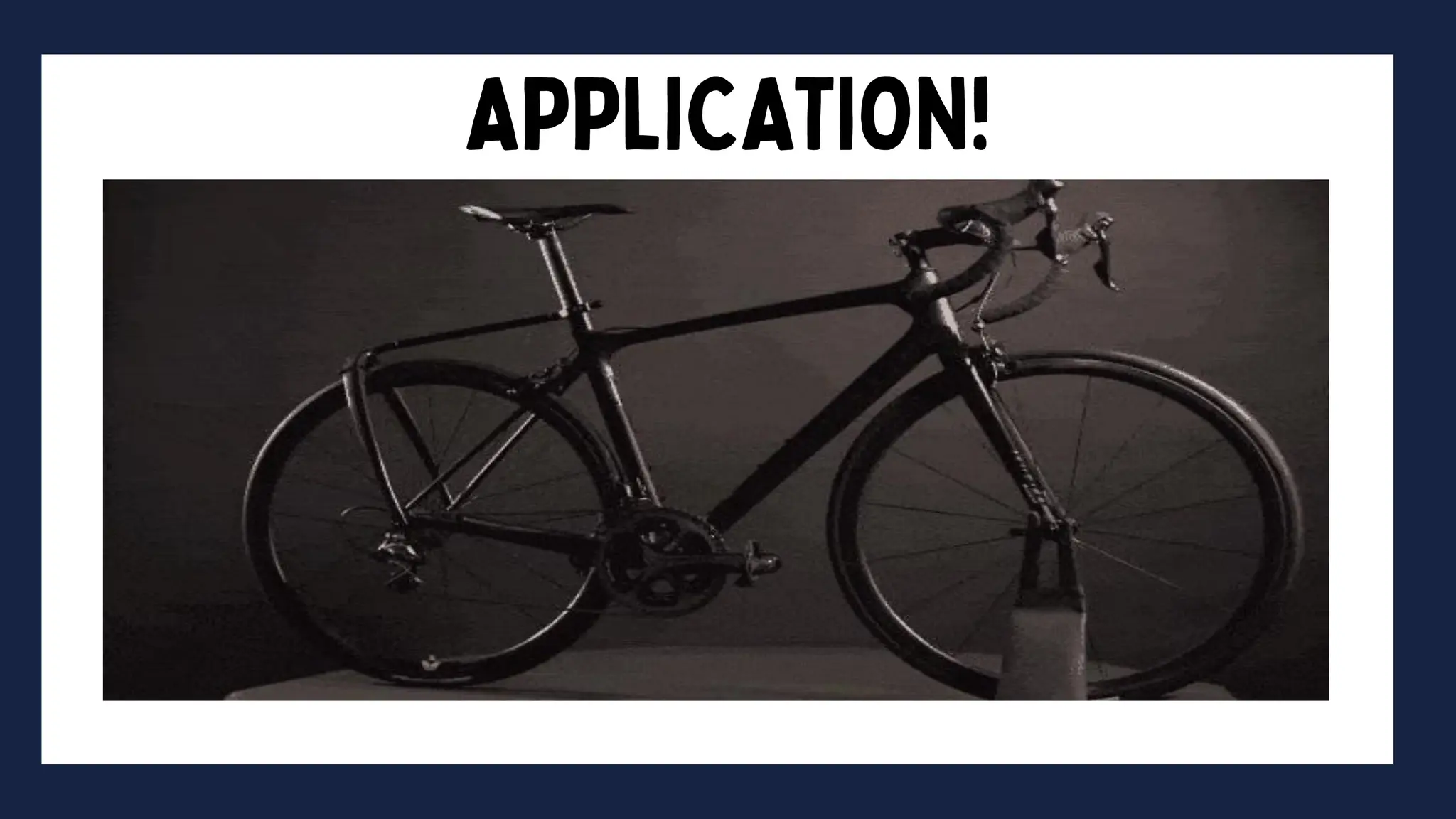
For sports equipment like bike frames
composites are used. It is a combination
of two materials with different
properties that if combined produces a
material with added strength efficiency
and durability.
Nowadays aside from aluminum and
steel, bike manufacturers use carbon
fiber composite materials comprised of
carbon atoms that are linked covalently.
Do you know that carbon fiber is five
times stronger than steel? Yet it is
lightweight these allows easy movement
for the user. It is also durable which is
important since great force is applied
when using it.
Just like any ordinary fabric it is woven
then soak in a special kind of liquid.
Afterwards it is heated and molded into
its desired shape.
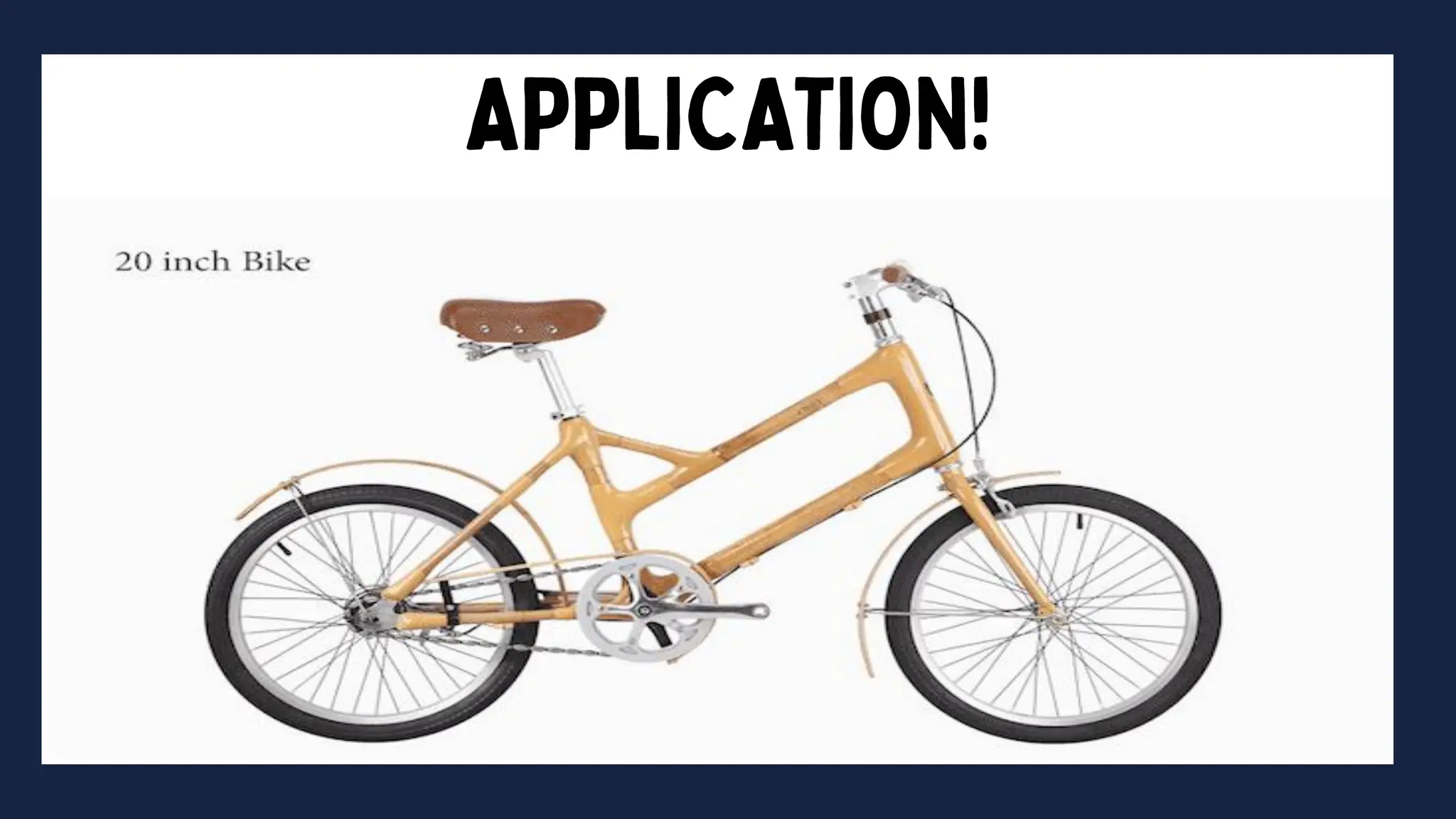
In our country bamboo or kawayan is also
being utilized as bicycle frames.
Bambike has gained popularity because
many people are looking for sustainable
and environmentally sound products.
Just like the conventional materials
bamboo is also durable. Resistant to
stress and impacts and can offer a
smooth ride as well. Truly a Tatak Pinoy
that we can all be proud of.
Wow the forces of attraction that exist
between molecules though unseen really
plays an important role in many
unbelievable properties of materials that
we use.
Did you know that your brain cells have
just produced a lot of dopamine?
Dopamine makes us feel good. That is
why it is also commonly called as the
happy hormone.
According to studies you can boost its
level by setting realistic goals and
finding ways to achieve them. Just like
what we are doing right now.
Let's Recap
Today you have learned about the
different intermolecular forces of
attraction or IMFA and how it is
related to the different properties of
matter like boiling point, melting point,
surface tension, capillary action, and
viscosity.

You gained more knowledge on some
applications of the concept of IMFA in
designing and making various
materials that we use.
The attraction between some of the
intermolecular forces might seem to be
weak. Just like as humans don't you
think? But you know what I encourage
all of you to acknowledge your
weaknesses.
There is nothing wrong with that. What is
more important is that we work hard in
overcoming them. Believe me from our
weaknesses we can also find strength
and greatness. Keep the faith and don't
give up. #LABANLANG
Materials:
Water
Paper Clip
Basin
Direction:
Let the Paper clip float in the water.
Question: Why does the paper clip
floats in water?
Question: Why does the paper clip
floats in water?
Why does the water rises?
Direction: Read and analyze the
questions and choose the best
answer.
1. Which of the following properties is not
influenced by the type of intermolecular forces?
A. viscosity
B. molar mass
C. boiling point
D. surface tension
2. Liquids can form a spherical elastic film to minimize
surface area. what intermolecular forces are
responsible for the formation of this film in water?
A. ion dipole forces
B. dipole-dipole forces
C. hydrogen bonding forces
D. london dispersion forces
3. When intermolecular forces are high the
boiling point is expected to be:
A. low
B. high
C. dependent on the kinds of atoms
D. dependent on the number of atoms
4. Looking at the diagram of attraction
between two hydrogen chloride molecules
what type of intermolecular force is present
A. ion-dipole forces
B. dipole-dipole forces
C. hydrogen bonding forces
D. London dispersion forces
5. Which of the following materials is used in
making bicycle frames that are lightweight
and durable?
A. silicones
B. polymers
C. composites
D. aggregates
1. Perform an experiment about capillary action.
2. What are the four Biological Macromolecules?
Lesson 5 Intermolecular Forces of attraction

Lesson 5 Intermolecular Forces of attraction

  • 1.
  • 2.
    1. Describe thegeneral types of intermolecular forces. (S11/12PS-IIIc-d-17) At the end of the lesson, you should be able to: 2. Explain the effect of intermolecular forces on the properties of substances. (S11/12PS-IIId-e-19)
  • 3.
    Adhesion - theaction or process of adhering to a surface or object. Cohesion - the sticking together of particles of the same substance.
  • 4.
    In our previousepisode we learned about the polarity of molecules. Specifically, bond polarity and electronegativity. We have discussed how to determine the overall polarity of molecules by predicting its molecular geometry. Lastly, we gain knowledge on the applications of the concept of polarity through the mixing of substances such as oil and water and the removal of dirt.
  • 5.
    Today we'll betalking about a special force of attraction that is formed between molecules. Together let us learn about intermolecular forces and explore the exciting world of physical science.
  • 6.
    A force maybe defined as a push or a pull. Whenever there is an interaction between two objects or entities, force is definitely present.
  • 7.
  • 8.
  • 9.
  • 10.
  • 11.
    folding a pieceof paper gif
  • 12.
    pressing the spraybottle of alcohol gif
  • 13.
    We may notsee it, but we feel its effects. To start our discussion let us recall the four fundamental forces of nature that governs everything that happens in the universe.
  • 14.
    This force isthe one that holds protons and neutrons in the nucleus of an atom.
  • 15.
    Do you knowthat the destructive power of this force was seen and experienced during the World War II year 1945 on the bombing of Hiroshima and Nagasaki in Japan?
  • 16.
    bombing of Hiroshimaand Nagasaki in Japan gif
  • 17.
    It binds electronsto the atomic nucleus, and it basically deals with the attractive and repulsive interaction of electrical charges.
  • 18.
    It is responsiblefor some of the commonly experienced phenomena like friction, elasticity, the normal force, and the force holding molecules together.
  • 19.
    Take note thatelectricity and magnetism are closely related. Together they form an electromagnetic field.
  • 20.
  • 21.
    It might soundweak, but it is actually involved in the important processes such as the radioactive decay or the breaking down of heavy atomic particles which eventually forms new elements in stars and supernova explosions.
  • 23.
    It causes objectsto be pulled towards the earth.
  • 24.
    Gravity ka ba? Kasiyou're always attractive and never repulsive.
  • 25.
    Gravity is purelyan attractive force. Take note also that gravity is the reason why we stay on the ground together with the planets and moons that stay in their orbit.
  • 26.
  • 27.
    DIRECTION: READ THEQUESTIONS CAREFULLY AND CHOOSE THE LETTTER OF THE CORRECT ANSWER.
  • 28.
    1. This forceis present in all molecules whether polar or nonpolar. A. London dispersion forces B. Dipole-dipole forces C. Ion-dipole forces D. Hydrogen bonding forces.
  • 29.
    2. This typeof force is the result of the electrostatic attraction between an ion and a molecule containing a dipole. A. London dispersion forces B. Dipole-dipole forces C. Ion-dipole forces D. Hydrogen bonding forces.
  • 30.
    3. It isone of the strongest type and a special type of a dipole-dipole interaction. A. London dispersion forces B. Dipole-dipole forces C. Ion-dipole forces D. Hydrogen bonding forces.
  • 31.
    4. It isa type of force that is attractive force between the positive end of one polar molecule and the negative end of another polar molecule. A. London dispersion forces B. Dipole-dipole forces C. Ion-dipole forces D. Hydrogen bonding forces.
  • 33.
  • 34.
    As we allknow matter is made up of particles that are in constant random motion that interact with each other.
  • 35.
    The interaction betweenparticles and their strength determines certain properties like boiling points, the temperature at which a liquid boils and turns to vapor.
  • 36.
    Intermolecular force isthe attractive force or bond between molecules. Which is responsible for keeping matter in its solid or in its liquid phase.
  • 37.
    1. London dispersionforces 2. Dipole-dipole forces 3. Ion-dipole forces 4. Hydrogen bonding forces.
  • 38.
    The first twoare collectively known as van der Waals force named after the Dutch physicist Johannes Diderik van der Waals
  • 39.
    -weakest type ofIMFA. -Named after the German- American physicist Fritz London.
  • 40.
    This force ispresent in all molecules whether polar or nonpolar.
  • 42.
    Electrons in thiscase are constantly moving but there are times that electrons are confined to one end making it partially negative and the other end becomes partially positive.
  • 44.
    What do youthink will happen after this?
  • 45.
    Since there isan equal distribution of electrons it causes non-polar molecules to be polar temporarily.
  • 47.
    Creating a temporarydipole or an instantaneous dipole.
  • 49.
    Have you triedusing a saline solution or salt and water mixture to relieve the pain caused by sore throat or mouth sore?
  • 50.
    Well, every timewe mix an ionic compound like salt or sodium chloride and a polar solvent like water the third type of IMFA is involved.
  • 51.
    Ion-dipole forces arethe result of the electrostatic attraction between an ion and a molecule containing a dipole.
  • 52.
    The strength ofthis force increases as the charge of the ion increases.
  • 53.
    When sodium chloridedissolves in water it exists as sodium positive and chlorine negative.
  • 55.
    The partial negativeoxygen atom of water is attracted to sodium. While the partial positive hydrogen atom of water is attracted to chlorine.
  • 56.
    It is aspecial type of a dipole-dipole interaction. And as the name suggests this force occurs when hydrogen is bonded to its best friends fluorine oxygen or nitrogen. three of the most electronegative elements.
  • 57.
    This interaction makesthe partially positive hydrogen of one molecule interacts with a partially negative fluorine oxygen or nitrogen atoms in another molecule.
  • 59.
    Together they makevery strong polar bonds just like the water molecules. This is the reason why they have high boiling points and melting points.
  • 60.
    Meaning you needa very high temperature to break the strong intermolecular forces between the molecules.
  • 61.
    Type of IMFAPresent in Relative Strength London Dispersion Forces All molecules Weak (Increases with the size of molecule)
  • 62.
    Type of IMFAPresent in Relative Strength London Dispersion Forces All molecules Weak (Increases with the size of molecule)
  • 63.
    Type of IMFAPresent in Relative Strength London Dispersion Forces All molecules Weak (Increases with the size of molecule) Dipole-dipole Forces Polar Molecules Moderate (increases with increasing polarity)
  • 64.
    Type of IMFAPresent in Relative Strength London Dispersion Forces All molecules Weak (Increases with the size of molecule) Dipole-dipole Forces Polar Molecules Moderate (increases with increasing polarity) Ion-Dipole Forces Solution of ionic compounds dissolved in polar solvent Strong (increases with increasing ionic charge)
  • 65.
    Type of IMFAPresent in Relative Strength London Dispersion Forces All molecules Weak (Increases with the size of molecule) Dipole-dipole Forces Polar Molecules Moderate (increases with increasing polarity) Ion-Dipole Forces Solution of ionic compounds dissolved in polar solvent Strong (increases with increasing ionic charge) Hydrogen Bonding Molecules with H-F, H-O, H-N bonds Strong
  • 66.
    The forces ofattraction that exist between molecules that comprise matter is attributed to its physical properties.
  • 67.
    Like density solubilityand the two that have been mentioned earlier boiling point and melting point.
  • 69.
  • 70.
    The force thatcauses molecules on the surfaces of liquid to be pushed together and form a layer. And it is not broken by the large surface covered by their feet.
  • 71.
  • 72.
    I bet youhave probably heard a lot about covid 19 testing recently. One of the types of tests used is the rapid antibody test.
  • 73.
    The procedure usesextracted blood sample from a person. A medical practitioner takes a blood sample from a patient's finger using a capillary tube.
  • 75.
    Interestingly intermolecular forces alsoact on this situation making the contraction and pulling up of the blood sample in the tube possible.
  • 76.
    It is theability of liquid molecules to flow in narrow tubes or porous material. Liquids in this case flow against gravity.
  • 77.
  • 78.
    The attraction betweenlike molecules or cohesion and the attraction between unlike molecules or adhesion bring about capillary action.
  • 79.
    The water moleculesin our blood are all the same. And they exhibit cohesion.
  • 80.
    While the attractionbetween water and the sides of the glass tube is adhesion.
  • 81.
    Since adhesion isstronger than cohesion in this scenario the liquid is pulled upward.
  • 82.
    Guess the substance! -Thisliquid is considered a superfood as it contains water vitamins minerals and enzymes that give energy to the body.
  • 83.
    Guess the substance! -Italso has medicinal properties. -When sealed in an airtight container it is one of the few foods known to have an eternal shelf life.
  • 84.
    Guess the substance! -Itdoes not spoil. -and finally I would say along with the bees flying around it is one of the most delicious substances on earth.
  • 85.
  • 86.
    Honey is onecommon example of a liquid that is thick and flows slowly.
  • 87.
    Do intermolecular forcesof attraction have something to do with this? Yes of course.
  • 88.
    Viscosity is ameasure of a liquid's resistance to flow or in layman's term the thickness of a liquid.
  • 89.
    The greater theviscosity of the liquid the more slowly it flows. Liquids that have high intermolecular forces are highly viscous.
  • 90.
    Like honey, serum,glue, fuel oil and lubricating grease.
  • 91.
    Like honey, serum,glue, fuel oil and lubricating grease.
  • 92.
    Like honey, serum,glue, fuel oil and lubricating grease.
  • 93.
    Like honey, serum,glue, fuel oil and lubricating grease.
  • 94.
    Like honey, serum,glue, fuel oil and lubricating grease.
  • 95.
    Temperature also affects viscositythe higher the temperature the lower the liquids viscosity. Meaning they will flow much easier.
  • 96.
  • 97.
    Can you recallthe different properties of matter influenced by the strength of the intermolecular forces?
  • 98.
    These are boilingand melting points, surface tension, capillary action, and viscosity.

  • 100.
    These are importantconsiderations when materials engineer design different materials for various uses. Thus, the properties of the material should match the product's intended environment.
  • 101.
    These are importantconsiderations when materials engineer design different materials for various uses. Thus, the properties of the material should match the product's intended environment and should not interfere with its function.
  • 102.
    For sports equipmentlike bike frames composites are used. It is a combination of two materials with different properties that if combined produces a material with added strength efficiency and durability.
  • 103.
    Nowadays aside fromaluminum and steel, bike manufacturers use carbon fiber composite materials comprised of carbon atoms that are linked covalently.
  • 104.
    Do you knowthat carbon fiber is five times stronger than steel? Yet it is lightweight these allows easy movement for the user. It is also durable which is important since great force is applied when using it.
  • 106.
    Just like anyordinary fabric it is woven then soak in a special kind of liquid. Afterwards it is heated and molded into its desired shape.
  • 107.
    In our countrybamboo or kawayan is also being utilized as bicycle frames.
  • 109.
    Bambike has gainedpopularity because many people are looking for sustainable and environmentally sound products.
  • 110.
    Just like theconventional materials bamboo is also durable. Resistant to stress and impacts and can offer a smooth ride as well. Truly a Tatak Pinoy that we can all be proud of.
  • 111.
    Wow the forcesof attraction that exist between molecules though unseen really plays an important role in many unbelievable properties of materials that we use.
  • 112.
    Did you knowthat your brain cells have just produced a lot of dopamine?
  • 113.
    Dopamine makes usfeel good. That is why it is also commonly called as the happy hormone.
  • 114.
    According to studiesyou can boost its level by setting realistic goals and finding ways to achieve them. Just like what we are doing right now.
  • 115.
  • 116.
    Today you havelearned about the different intermolecular forces of attraction or IMFA and how it is related to the different properties of matter like boiling point, melting point, surface tension, capillary action, and viscosity.
  • 117.
    You gained moreknowledge on some applications of the concept of IMFA in designing and making various materials that we use.

  • 118.
    The attraction betweensome of the intermolecular forces might seem to be weak. Just like as humans don't you think? But you know what I encourage all of you to acknowledge your weaknesses.
  • 119.
    There is nothingwrong with that. What is more important is that we work hard in overcoming them. Believe me from our weaknesses we can also find strength and greatness. Keep the faith and don't give up. #LABANLANG
  • 120.
  • 121.
    Direction: Let the Paperclip float in the water. Question: Why does the paper clip floats in water?
  • 122.
    Question: Why doesthe paper clip floats in water? Why does the water rises?
  • 123.
    Direction: Read andanalyze the questions and choose the best answer.
  • 124.
    1. Which ofthe following properties is not influenced by the type of intermolecular forces? A. viscosity B. molar mass C. boiling point D. surface tension
  • 125.
    2. Liquids canform a spherical elastic film to minimize surface area. what intermolecular forces are responsible for the formation of this film in water? A. ion dipole forces B. dipole-dipole forces C. hydrogen bonding forces D. london dispersion forces
  • 126.
    3. When intermolecularforces are high the boiling point is expected to be: A. low B. high C. dependent on the kinds of atoms D. dependent on the number of atoms
  • 127.
    4. Looking atthe diagram of attraction between two hydrogen chloride molecules what type of intermolecular force is present A. ion-dipole forces B. dipole-dipole forces C. hydrogen bonding forces D. London dispersion forces
  • 128.
    5. Which ofthe following materials is used in making bicycle frames that are lightweight and durable? A. silicones B. polymers C. composites D. aggregates
  • 129.
    1. Perform anexperiment about capillary action. 2. What are the four Biological Macromolecules?