What kind of
gas does the
following
objects were
supplemented
of?
FORMATION OF LIGHT
ELEMENTS
OBJECTIVE:
Give evidence for and explain the formation of
the light elements in the big bang theory
REVIEW THE FOLLOWING TERMS: In a 1/2 sheet of paper
copy and rank the following terms which had happened
first in the beginning of the Big Bang theory.
____ Annihilation
____Inflation
----Nucelosynthesis
____Cosmic Microwave Background
____Recombination
____Redshift
____Relative Abundance
____Singularity
Some of the Evidence which can explain the Formation
of the Light Elements in the Big Bang Theory
• Annihilation
• Inflation
• Cosmic Microwave Background
• Nucleosynthesis
• Recombination
• Redshift
• Relative Abundance
• Singularity
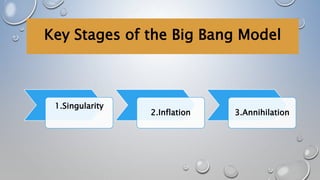
Key Stages of the Big Bang Model
1.Singularity
Singularity is a point in space where the universe was
hot and dense with all of time, matter and energy.
Key Stages of the Big Bang Model
1.Singularity
2.Inflation
It experienced an incredible burst of expansion known as inflation, in
which space itself expanded faster than the speed of light (3.0 x 10⁸ m/s).
• As the universe expands, gravity weakens and dark
energy strengthens. The Inflationary Epoch lasted
from 10 -36 seconds
The pairs of matter (quarks) and antimatter
(antiquarks) were formed from energy.
Where do we find these Quarks?
Proton is made up of
two up quarks
and one down quarks.
Neutron is made up of two
up quarks
and one down quarks.
Quarks are held
together by gluons.
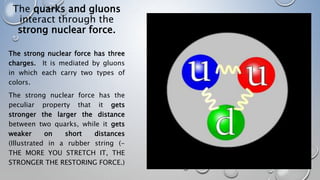
The quarks and gluons
interact through the
strong nuclear force.
The strong nuclear force has three
charges. It is mediated by gluons
in which each carry two types of
colors.
The strong nuclear force has the
peculiar property that it gets
stronger the larger the distance
between two quarks, while it gets
weaker on short distances
(Illustrated in a rubber string (-
THE MORE YOU STRETCH IT, THE
STRONGER THE RESTORING FORCE.)
The strings of the strong
nuclear force are gluon flux-
tubes, that are connections
between two color-charged
particles where the gluons
preferably travel along. The
energy of the flux-tubes is
proportional to their length.
If you have a particle (called
a “meson”) made of a quark
and an anti-quark, then the
flux tube is focused on a
straight line connecting the
quarks.
Key Stages of the Big Bang Model
1.Singularity
2.Inflation 3.Annihilation
But these pairs
cancelled each other
back into energy in a
process of
Annihilation.
The universe cooled down as
it expanded. An excess of
matter (electrons, protons,
neutrons and other particles)
somehow came to be in a
highly energetic “plasma
soup”.
Radiation Era specifically in Lepton
Epoch
In the “plasma soup”,
the photons (light
particles) were being
scattered everywhere.
Protons and Neutrons
came together to
form different types
of nuclei by
nucleosynthesis or
nuclear fusion.
Photons
- the smallest discrete
amount or quantum of
electromagnetic radiation.
it is the basic unit of all
light.
- are always in motion
and, in a vacuum, travel
at a constant speed to all
observers of 2.998 x
108 m/s.
Key Stages of the Big Bang Model
4. Nucleosynthesis
NUCLEAR EPOCH:
Nucleosynthesis
What was the first
chemical element
created in the
universe?
REVIEW:
Review:
Atomic Number (Z) -
total number of protons
Atomic Mass (A) – total
number of neutron and
proton.
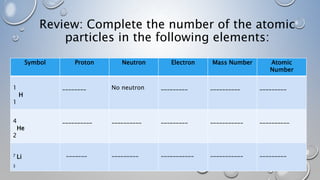
Review: Complete the number of the atomic
particles in the following elements:
Symbol Proton Neutron Electron Mass Number Atomic
Number
1
H
1
________ No neutron _________ __________ _________
4
He
2
__________ __________ _________ ___________ __________
7 Li
3
_______ _________ ___________ ___________ _________
The Universe is now 1 minute old, and all the anti-matter has been
destroyed by annihilation with matter.
The leftover matter is in the form of electrons, protons and neutrons.
As the temperature continues to drop, protons and neutrons can undergo
fusion to form heavier atomic nuclei. This process is called
nucleosynthesis.
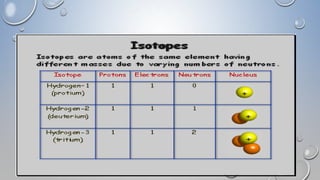
Isotopes are different versions of the same element that all have the
same atomic number but different number of neutrons. Since the
number of neutrons are different, they also have different atomic
masses, the total number of protons and neutrons combined.
Complete the table below:
Name Proton Neutron Electron Mass Number Atomic
Number
Hydrogen -1 ________ ___________ _________ __________ _________
Hydrogen -2 __________ __________ __________ ___________ __________
Hydrogen -3 _______ _________ ___________ ___________ _________
• Isotopes are formed, such as deuterium and tritium, but these elements are
unstable and decay into free protons and neutrons.
• MAKING HELIUM:
• Deuterium is a very fragile nucleus and can easily be broken apart by a high
energy photon:
pn + photon --> p + n (which will decay in 900 seconds)
Will Deuterium combine with another proton to
make a nucleus with 3 nucleons or will it be
photodissociated before it can do this?
This race condition depends on the density of protons:
• if the density is high then deuterium will fuse with another
proton to make helium-3
• if the density is low then most of the deuterium will be photo-
dissociated before making helium-3.
• a high density universe means a low density of deuterium
• a low density universe means a low density of helium (3 and 4)
. The end result is the conversion of 2 protons and 2 neutrons into 1
Helium-4 nucleus.
• Before the Reaction:14 protons and 2 neutrons
• After the reaction
12 protons and 1 Helium-4 nucleus
• The mass of 1 Helium-4 nucleus is about 4 times the mass of a proton
Key Stages of the Big Bang Model
4. Nucleosynthesis 5. Recombination
• The universe cools sufficiently for electrons to
combine with the proton/neutron nuclei and form
atoms. Constant impacts by photons knock
electrons off of atoms which is called ionization.
Lower temperatures mean photons with less energy
and fewer collisions. Thus, atoms become stable at
about 15 minutes after the big bang.
These atoms are now free to bond together to form simple
compounds, molecules, etc.
and these are the building blocks for galaxies and stars.
Key Stages of the Big Bang Model
4. Nucleosynthesis 5. Recombination 6. Redshifted
•Radiation, in the form of photons, and matter,
in the form of protons, neutrons and electron,
can interact by the process of scattering.
•The energy of the photons is transferred to the
matter particles.
•The distance a photon can travel before hitting
a matter particle is called the mean free path.
Redshifted
• The density and the temperature for the universe
continues to drop as it expands. At some point about
15 minutes after the big bang, the temperature has
dropped to the point where ionization no longer takes
places. Neutral atoms can form, atomic nuclei surround
by electron clouds. The number of free particles drops
by a large fraction (all the protons, neutrons and
electron form atoms) and suddenly the photons are free
to travel without collisions, this is called decoupling.
•Those dots light is found to be Redshifted
“stretched”. It means that the space itself is
expanding in all directions causing all the
galaxies to be relatively farther apart.
Key Stages of the Big Bang Model
7. Cosmic
Microwave
Backgorund
•Since matter and photons were in constant
contact, their temperatures were the same, a
process called thermalization. Note also that
the matter can not clump together by
gravity. The impacts by photons keep the
matter particles apart and smoothly
distributed.
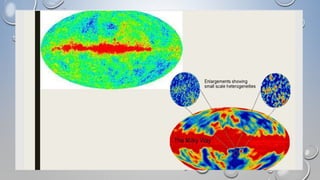
• As the universe continued to expanded over the last 15 billion years, these
cosmic background photons also `expanded', meaning their wavelengths
increased. the original gamma-ray energies of cosmic background photons
has since cooled to microwave wavelengths. Thus, this microwave radiation
that we see today is an `echo' of the big bang.
•The discovery of the cosmic microwave
background (CMB) in the early 1960's was
powerful confirmation of the big bang
theory.
• The answer is `all around you. CMB photons fill
the universe, and this room, but their energies
are so weak after 15 billion years that they are
difficult to detect without very sensitive
microwave antennas.
Where are the CMB photons at the
moment?
Key Stages of the Big Bang Model
7. Cosmic
Microwave
Backgorund
8. Relative
Abundance
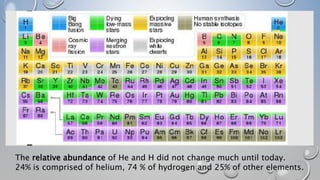
The relative abundance of He and H did not change much until today.
24% is comprised of helium, 74 % of hydrogen and 25% of other elements.
APPLICATION IN REAL LIFE:
• COMPRESSED AIR TANKS
• Whenever you see a scuba diver in the water, you should
know that he has some helium in his air tank. Divers combine
helium and regular air in those tanks at very high pressures.
When they go deep in the water the helium makes it easier
for them to breathe. the tanks you use for scuba diving are
actually a combination of 20 percent oxygen and 80 percent
helium. this gas is used because it is light and does not add
extra weight to the diver. it is also cheap and safe to use.
APPLICATION IN REAL LIFE:
• BLIMPS
-used helium to stay up in the air. Helium is
lighter than regular air so it helps things
float. A blimp is filled with helium and floats
for a very long time. They use propellers to
move around.
WHERE DO WE FIND HYDROGEN?
WHERE DO WE FIND LITHIUM?
• AIR CONDITIONERS
Next time it's really hot out and you're nice and cool inside, you
should thank lithium. lithium is used in air conditioning systems.
you know that everyone uses air conditioning. that means everyone
is using some lithium.
• BATTERIES
You have batteries in many of your toys. In flashlights you need
batteries. In your watch you probably have a battery. well... most of
those batteries need lithium to work. Lithium is an important
element in the way a battery makes electricity.
REFERENCES:
• http://www.sliderbase.com/spitem-42-2.html
• www.astro.ufl.edu/~guzman/ast7939/lectures/basics/lect03.html
• www.livescience.com/18141-wacky-physics-particle-flavors.html
• www.sciencelearn.org.nz/image_maps/50-universal-element-formation
• sciencing.com/lightest-elements-8577396.html
• http://www.chem4kids.com/files/elements/002_speak.html
• medium.com/@singulardtv/what-is-the-singularity-ad32edaf7f5b
• /www.slideshare.net/abbiemahinay/lesson-1-in-the-beginning-big-bang-theory-and-the-
formation-of-light-elements-82754388
• /www.astro.ufl.edu/~guzman/ast7939/lectures/basics/lect03.html
• http://www.chem4kids.com/files/elements/001_speak.html
REFERENCES:
• DISCLAIMER: THE PHOTOS USED IN THIS
SLIDESHOW PRESENTATION IS NOT OWNED BY
THE AUTHOR AND WERE JUST USED FOR
EDUCATIONAL PURPOSES ONLY.
Formation of Light Elements.

Formation of Light Elements.

  • 2.
    What kind of gasdoes the following objects were supplemented of?
  • 3.
    FORMATION OF LIGHT ELEMENTS OBJECTIVE: Giveevidence for and explain the formation of the light elements in the big bang theory
  • 4.
    REVIEW THE FOLLOWINGTERMS: In a 1/2 sheet of paper copy and rank the following terms which had happened first in the beginning of the Big Bang theory. ____ Annihilation ____Inflation ----Nucelosynthesis ____Cosmic Microwave Background ____Recombination ____Redshift ____Relative Abundance ____Singularity
  • 5.
    Some of theEvidence which can explain the Formation of the Light Elements in the Big Bang Theory • Annihilation • Inflation • Cosmic Microwave Background • Nucleosynthesis • Recombination • Redshift • Relative Abundance • Singularity
  • 6.
    Key Stages ofthe Big Bang Model 1.Singularity
  • 7.
    Singularity is apoint in space where the universe was hot and dense with all of time, matter and energy.
  • 8.
    Key Stages ofthe Big Bang Model 1.Singularity 2.Inflation
  • 10.
    It experienced anincredible burst of expansion known as inflation, in which space itself expanded faster than the speed of light (3.0 x 10⁸ m/s). • As the universe expands, gravity weakens and dark energy strengthens. The Inflationary Epoch lasted from 10 -36 seconds
  • 11.
    The pairs ofmatter (quarks) and antimatter (antiquarks) were formed from energy.
  • 12.
    Where do wefind these Quarks? Proton is made up of two up quarks and one down quarks. Neutron is made up of two up quarks and one down quarks. Quarks are held together by gluons.
  • 13.
    The quarks andgluons interact through the strong nuclear force. The strong nuclear force has three charges. It is mediated by gluons in which each carry two types of colors. The strong nuclear force has the peculiar property that it gets stronger the larger the distance between two quarks, while it gets weaker on short distances (Illustrated in a rubber string (- THE MORE YOU STRETCH IT, THE STRONGER THE RESTORING FORCE.)
  • 14.
    The strings ofthe strong nuclear force are gluon flux- tubes, that are connections between two color-charged particles where the gluons preferably travel along. The energy of the flux-tubes is proportional to their length. If you have a particle (called a “meson”) made of a quark and an anti-quark, then the flux tube is focused on a straight line connecting the quarks.
  • 16.
    Key Stages ofthe Big Bang Model 1.Singularity 2.Inflation 3.Annihilation
  • 17.
    But these pairs cancelledeach other back into energy in a process of Annihilation. The universe cooled down as it expanded. An excess of matter (electrons, protons, neutrons and other particles) somehow came to be in a highly energetic “plasma soup”. Radiation Era specifically in Lepton Epoch
  • 18.
    In the “plasmasoup”, the photons (light particles) were being scattered everywhere. Protons and Neutrons came together to form different types of nuclei by nucleosynthesis or nuclear fusion.
  • 19.
    Photons - the smallestdiscrete amount or quantum of electromagnetic radiation. it is the basic unit of all light. - are always in motion and, in a vacuum, travel at a constant speed to all observers of 2.998 x 10⁸ m/s.
  • 20.
    Key Stages ofthe Big Bang Model 4. Nucleosynthesis
  • 21.
    NUCLEAR EPOCH: Nucleosynthesis What wasthe first chemical element created in the universe?
  • 22.
  • 23.
    Review: Atomic Number (Z)- total number of protons Atomic Mass (A) – total number of neutron and proton.
  • 24.
    Review: Complete thenumber of the atomic particles in the following elements: Symbol Proton Neutron Electron Mass Number Atomic Number 1 H 1 ________ No neutron _________ __________ _________ 4 He 2 __________ __________ _________ ___________ __________ 7 Li 3 _______ _________ ___________ ___________ _________
  • 25.
    The Universe isnow 1 minute old, and all the anti-matter has been destroyed by annihilation with matter. The leftover matter is in the form of electrons, protons and neutrons. As the temperature continues to drop, protons and neutrons can undergo fusion to form heavier atomic nuclei. This process is called nucleosynthesis.
  • 26.
    Isotopes are differentversions of the same element that all have the same atomic number but different number of neutrons. Since the number of neutrons are different, they also have different atomic masses, the total number of protons and neutrons combined.
  • 27.
    Complete the tablebelow: Name Proton Neutron Electron Mass Number Atomic Number Hydrogen -1 ________ ___________ _________ __________ _________ Hydrogen -2 __________ __________ __________ ___________ __________ Hydrogen -3 _______ _________ ___________ ___________ _________
  • 29.
    • Isotopes areformed, such as deuterium and tritium, but these elements are unstable and decay into free protons and neutrons. • MAKING HELIUM: • Deuterium is a very fragile nucleus and can easily be broken apart by a high energy photon: pn + photon --> p + n (which will decay in 900 seconds)
  • 30.
    Will Deuterium combinewith another proton to make a nucleus with 3 nucleons or will it be photodissociated before it can do this? This race condition depends on the density of protons: • if the density is high then deuterium will fuse with another proton to make helium-3 • if the density is low then most of the deuterium will be photo- dissociated before making helium-3. • a high density universe means a low density of deuterium • a low density universe means a low density of helium (3 and 4)
  • 31.
    . The endresult is the conversion of 2 protons and 2 neutrons into 1 Helium-4 nucleus. • Before the Reaction:14 protons and 2 neutrons • After the reaction 12 protons and 1 Helium-4 nucleus • The mass of 1 Helium-4 nucleus is about 4 times the mass of a proton
  • 34.
    Key Stages ofthe Big Bang Model 4. Nucleosynthesis 5. Recombination
  • 35.
    • The universecools sufficiently for electrons to combine with the proton/neutron nuclei and form atoms. Constant impacts by photons knock electrons off of atoms which is called ionization. Lower temperatures mean photons with less energy and fewer collisions. Thus, atoms become stable at about 15 minutes after the big bang.
  • 36.
    These atoms arenow free to bond together to form simple compounds, molecules, etc. and these are the building blocks for galaxies and stars.
  • 37.
    Key Stages ofthe Big Bang Model 4. Nucleosynthesis 5. Recombination 6. Redshifted
  • 38.
    •Radiation, in theform of photons, and matter, in the form of protons, neutrons and electron, can interact by the process of scattering. •The energy of the photons is transferred to the matter particles. •The distance a photon can travel before hitting a matter particle is called the mean free path.
  • 40.
    Redshifted • The densityand the temperature for the universe continues to drop as it expands. At some point about 15 minutes after the big bang, the temperature has dropped to the point where ionization no longer takes places. Neutral atoms can form, atomic nuclei surround by electron clouds. The number of free particles drops by a large fraction (all the protons, neutrons and electron form atoms) and suddenly the photons are free to travel without collisions, this is called decoupling.
  • 42.
    •Those dots lightis found to be Redshifted “stretched”. It means that the space itself is expanding in all directions causing all the galaxies to be relatively farther apart.
  • 43.
    Key Stages ofthe Big Bang Model 7. Cosmic Microwave Backgorund
  • 44.
    •Since matter andphotons were in constant contact, their temperatures were the same, a process called thermalization. Note also that the matter can not clump together by gravity. The impacts by photons keep the matter particles apart and smoothly distributed.
  • 47.
    • As theuniverse continued to expanded over the last 15 billion years, these cosmic background photons also `expanded', meaning their wavelengths increased. the original gamma-ray energies of cosmic background photons has since cooled to microwave wavelengths. Thus, this microwave radiation that we see today is an `echo' of the big bang.
  • 48.
    •The discovery ofthe cosmic microwave background (CMB) in the early 1960's was powerful confirmation of the big bang theory.
  • 49.
    • The answeris `all around you. CMB photons fill the universe, and this room, but their energies are so weak after 15 billion years that they are difficult to detect without very sensitive microwave antennas. Where are the CMB photons at the moment?
  • 50.
    Key Stages ofthe Big Bang Model 7. Cosmic Microwave Backgorund 8. Relative Abundance
  • 51.
    The relative abundanceof He and H did not change much until today. 24% is comprised of helium, 74 % of hydrogen and 25% of other elements.
  • 52.
    APPLICATION IN REALLIFE: • COMPRESSED AIR TANKS • Whenever you see a scuba diver in the water, you should know that he has some helium in his air tank. Divers combine helium and regular air in those tanks at very high pressures. When they go deep in the water the helium makes it easier for them to breathe. the tanks you use for scuba diving are actually a combination of 20 percent oxygen and 80 percent helium. this gas is used because it is light and does not add extra weight to the diver. it is also cheap and safe to use.
  • 53.
    APPLICATION IN REALLIFE: • BLIMPS -used helium to stay up in the air. Helium is lighter than regular air so it helps things float. A blimp is filled with helium and floats for a very long time. They use propellers to move around.
  • 55.
    WHERE DO WEFIND HYDROGEN?
  • 56.
    WHERE DO WEFIND LITHIUM? • AIR CONDITIONERS Next time it's really hot out and you're nice and cool inside, you should thank lithium. lithium is used in air conditioning systems. you know that everyone uses air conditioning. that means everyone is using some lithium. • BATTERIES You have batteries in many of your toys. In flashlights you need batteries. In your watch you probably have a battery. well... most of those batteries need lithium to work. Lithium is an important element in the way a battery makes electricity.
  • 58.
    REFERENCES: • http://www.sliderbase.com/spitem-42-2.html • www.astro.ufl.edu/~guzman/ast7939/lectures/basics/lect03.html •www.livescience.com/18141-wacky-physics-particle-flavors.html • www.sciencelearn.org.nz/image_maps/50-universal-element-formation • sciencing.com/lightest-elements-8577396.html • http://www.chem4kids.com/files/elements/002_speak.html • medium.com/@singulardtv/what-is-the-singularity-ad32edaf7f5b • /www.slideshare.net/abbiemahinay/lesson-1-in-the-beginning-big-bang-theory-and-the- formation-of-light-elements-82754388 • /www.astro.ufl.edu/~guzman/ast7939/lectures/basics/lect03.html • http://www.chem4kids.com/files/elements/001_speak.html
  • 59.
    REFERENCES: • DISCLAIMER: THEPHOTOS USED IN THIS SLIDESHOW PRESENTATION IS NOT OWNED BY THE AUTHOR AND WERE JUST USED FOR EDUCATIONAL PURPOSES ONLY.