Most Essential
Learning
Competencies in
Senior High
School (STEM)
General
Chemistry
FOR SHS
STEM STUDENTS
Grade Level: Grade 11
Subject: General Chemistry 1
Quarter: 1st
Performance Standard: The learners should be able to Design using multimedia, demonstrations, or models,
a representation or simulation of any of the following:
A. Atomic structure
B. Gas behavior
C. Mass relationships
D. Reactions
Content Standard
The learners
demonstrate
understanding of...
Most Essential Learning Competencies Duration
the properties of matter
and its various forms
Use properties of matter to identify substances and to separate them
STEM_GC11MPIa-b-5
Week 1
Recognize the formulas of common chemical substances
STEM_GC11MPIa-b-9
Week 1
Compare consumer products on the basis of their components for use,
safety, quality and cost STEM_GC11MPIa-b-11
Week 1
Describe various simple separation techniques such as distillation,
chromatography STEM_GC11MPIa-b-10,12
Week 1
1. atomic structure
2. formulas and names of
compounds
Recognize common isotopes and their uses. STEM_GC11AMIc-e-19 Week 2
Represent compounds using chemical formulas, structural formulas
and models STEM_GC11AMIc-e-21
Week 2
Name compounds given their formula and write formula given the
name of the compound STEM_GC11AMIc-e-23 Week 2
the mole concept in relation
to Avogadro’s number and
mass
Calculate the empirical formula from the percent
composition of a compound STEM_GC11PCIf-32 Week 2
the relationship of
percent composition
and chemical formula
Calculate molecular formula given molar mass STEM_GC11PCIf-33
Week 3
the use of chemical
formulas to represent
chemical reactions
Write and balanced chemical equations STEM_GC11CRIf-g-34 Week 3
the quantitative
relationship of reactants
and products in a chemical
reaction
Construct mole or mass ratios for a reaction in order to calculate
the amount of reactant needed or amount of product formed in
terms of moles or mass STEM_GC11MRIg-h-38
Week 3
Calculate percent yield and theoretical yield of the reaction
STEM_GC11MRIg-h-39
Week 3
Explain the concept of limiting reagent in a chemical reaction;
identify the excess reagent(s) STEM_GC11MRIg-h-40
Week 4
(LAB) Determine mass relationship in a chemical reaction
STEM_GC11MRIg-h-42
Week 5
the mathematical
relationship between
pressure, volume, and
temperature of a gas
Define pressure and give the common units of pressure STEM_GC11G-
Ihi-43
Week 5
Use the gas laws to determine pressure, volume, or
temperature of a gas under certain conditions of change
STEM_GC11G-Ihi-45
Week 5
Use the ideal gas equation to calculate pressure, volume,
temperature, or number of moles of a gas STEM_GC11G-Ihi-46
Week 5
the partial pressures of
gases in a mixture
Use Dalton’s law of partial pressures to relate mole fraction and partial
pressure of gases in a mixture STEM_GC11DLIi-47
Week 5
quantitative
relationships of
reactants and products
in a gaseous reaction
Apply the principles of stoichiometry to determine the amounts
(volume, number of moles, or mass) of gaseous reactants and products
STEM_GC11GSIi-j-48
Week 6
the behavior and
properties of gases at the
molecular level
Relate the rate of gas effusion with molar mass STEM_GC11KMTIj-50 Week 6
Grade Level: Grade 11
Subject: General Chemistry 1
Quarter: 2nd
Performance Standard: The learners should be able to Illustrate the reactions at the molecular level in any of
the following:
1. enzyme action
2. protein denaturation
3. separation of components in coconut milk
Content Standard
The learners
demonstrate
understanding of...
Most Essential Learning Competencies Duration
the quantum mechanical
description of the atom and
its electronic structure
Use quantum numbers to describe an electron in an atom
STEM_GC11ESIIa-b-54
Week 6
Determine the magnetic property of the atom based on its
electronic configuration STEM_GC11ESIIa-b-57
Week 6
Draw an orbital diagram to represent the electronic configuration
of atoms STEM_GC11ESIIa-b-58
Week 6
the arrangement of
elements in the periodic
table and trends in the
properties of the elements
in terms of electronic
structure
Draw the Lewis structure of ions STEM_GC11CBIId-g-70 Week 7
1. ionic bond
formation in terms of
atomic properties
2. 2. the properties of ionic
compounds in relation to
their structure
Apply the octet rule in the formation of molecular
covalent compounds STEM_GC11CBIId-g-76
Week 7
1. covalent bond formation
in terms of atomic
properties
2. the properties of
molecular covalent
compounds in relation to
their structure
Write the formula of molecular compounds formed by the
nonmetallic elements of the representative block
STEM_GC11CBIId-g-77
Week 7
Draw Lewis structure of molecular covalent compounds
STEM_GC11CBIId-g-78
Week 7
Describe the geometry of simple compounds STEM_GC11CBIId-
g-81
Week 7
Determine the polarity of simple molecules STEM_GC11CBIId-g-
82
Week 8
the properties of organic
compounds and polymers
in terms of their structure
Describe the different functional groups STEM_GC11OCIIg-j-87 Week 8
Describe structural isomerism; give examples
STEM_GC11OCIIg-j-89
Week 8
Describe some simple reactions of organic compounds:
combustion of organic fuels, addition, condensation, and
saponification of fats STEM_GC11OCIIg-j-90
Week 8
Describe the formation and structure of polymers
STEM_GC11OCIIg-j-91
Week 8
Explain the properties of some polymers in terms of their
structure STEM_GC11OCIIg-j-93
Week 8
Describe the structure of proteins, nucleic acids, lipids,
and carbohydrates, and relate them to their function
STEM_GC11OCIIg-j-95
Week 8
Describe the preparation of selected organic compounds
STEM_GC11OCIIg-j-97
Week 8
Grade Level: Grade 11
Subject: General Chemistry 2
Quarter: 3rd
Performance Standard: The learners should be able to Design a simple investigation to determine the effect
on boiling point or freezing point when a solid is dissolved in water
Content Standard
The learners
demonstrate
understanding of...
Most Essential Learning Competencies Duration
1. the properties of liquids
and solids to the nature of
forces between particles
2. phase changes in terms of
the accompanying changes
in energy and forces between
particles
Use the kinetic molecular model to explain properties of
liquids and solids STEM_GC11IMFIIIa-c-99
Week 1
Describe and differentiate the types of intermolecular forces
STEM_GC11IMFIIIa-c-100
Week 1
Describe the following properties of liquids, and explain the
effect of intermolecular forces on these properties: surface
tension, viscosity, vapor pressure, boiling point, and molar heat
of vaporization STEM_GC11IMFIIIa-c-102
Week 1
Explain the properties of water with its molecular structure and
intermolecular forces STEM_GC11IMFIIIa-c-103
Week 1
Describe the difference in structure of crystalline and
amorphous solids STEM_GC11IMFIIIa-c-104
Week 1
Interpret the phase diagram of water and carbon dioxide
STEM_GC11IMFIIIa-c-107
Week 2
Determine and explain the heating and cooling curve of a
substance STEM_GC11IMFIIIa-c-109
Week 2
properties of solutions,
solubility, and the
stoichiometry of reactions in
solutions
Use different ways of expressing concentration of solutions:
percent by mass, mole fraction, molarity, molality, percent by
volume, percent by mass, ppm STEM_GC11PPIIId-f-111
Week 2
Perform stoichiometric calculations for reactions in solution
STEM_GC11PPIIId-f-112
Week 2
Describe the effect of concentration on the colligative properties
of solutions STEM_GC11PPIIId-f-115
Week 2
Differentiate the colligative properties of nonelectrolyte solutions
and of electrolyte solutions STEM_GC11PPIIId-f-116
Week 3
Calculate boiling point elevation and freezing point depression
from the concentration of a solute in a solution
STEM_GC11PPIIId-f-117
Week 3
Calculate molar mass from colligative property data
STEM_GC11PPIIId-f-118
Week 3
Describe laboratory procedures in determining concentration of
solutions STEM_GC11PPIIId-f-119
Week 3
energy changes in chemical
reactions
Explain the first law of thermodynamics STEM_GC11TCIIIg-i-
124
Week 3
Explain enthalpy of a reaction STEM_GC11TCIIIg-i-125 Week 3
Calculate the change in enthalpy of a given reaction using Hess
Law STEM_GC11TCIIIg-i-127
Week 3
1. the rate of a reaction and
the various factors that
influence it
2. the collision theory
Describe how various factors influence the rate of a reaction
STEM_GC11CKIIIi-j-130
Week 4
Differentiate zero, first-, and second-order reactions
STEM_GC11CKIIIi-j-132
Week 4
Explain reactions qualitatively in terms of molecular collisions
STEM_GC11CKIIIi-j-136
Week 4
Explain activation energy and how a catalyst affects the reaction
rate STEM_GC11CKIIIi-j-137
Week 4
Cite and differentiate the types of catalysts STEM_GC11CKIIIi-
j-138
Week 4
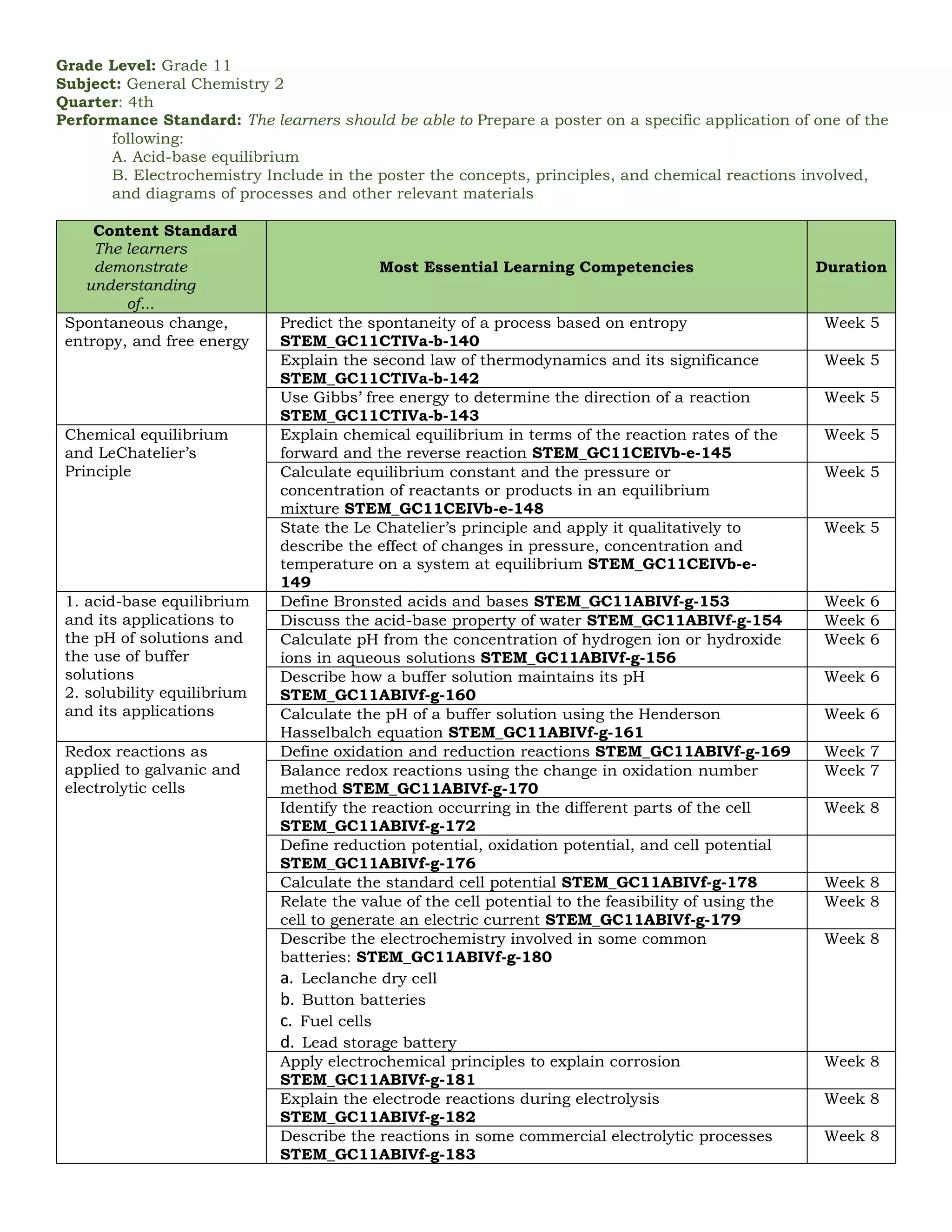
Grade Level: Grade 11
Subject: General Chemistry 2
Quarter: 4th
Performance Standard: The learners should be able to Prepare a poster on a specific application of one of the
following:
A. Acid-base equilibrium
B. Electrochemistry Include in the poster the concepts, principles, and chemical reactions involved,
and diagrams of processes and other relevant materials
Content Standard
The learners
demonstrate
understanding
of...
Most Essential Learning Competencies Duration
Spontaneous change,
entropy, and free energy
Predict the spontaneity of a process based on entropy
STEM_GC11CTIVa-b-140
Week 5
Explain the second law of thermodynamics and its significance
STEM_GC11CTIVa-b-142
Week 5
Use Gibbs’ free energy to determine the direction of a reaction
STEM_GC11CTIVa-b-143
Week 5
Chemical equilibrium
and LeChatelier’s
Principle
Explain chemical equilibrium in terms of the reaction rates of the
forward and the reverse reaction STEM_GC11CEIVb-e-145
Week 5
Calculate equilibrium constant and the pressure or
concentration of reactants or products in an equilibrium
mixture STEM_GC11CEIVb-e-148
Week 5
State the Le Chatelier’s principle and apply it qualitatively to
describe the effect of changes in pressure, concentration and
temperature on a system at equilibrium STEM_GC11CEIVb-e-
149
Week 5
1. acid-base equilibrium
and its applications to
the pH of solutions and
the use of buffer
solutions
2. solubility equilibrium
and its applications
Define Bronsted acids and bases STEM_GC11ABIVf-g-153 Week 6
Discuss the acid-base property of water STEM_GC11ABIVf-g-154 Week 6
Calculate pH from the concentration of hydrogen ion or hydroxide
ions in aqueous solutions STEM_GC11ABIVf-g-156
Week 6
Describe how a buffer solution maintains its pH
STEM_GC11ABIVf-g-160
Week 6
Calculate the pH of a buffer solution using the Henderson
Hasselbalch equation STEM_GC11ABIVf-g-161
Week 6
Redox reactions as
applied to galvanic and
electrolytic cells
Define oxidation and reduction reactions STEM_GC11ABIVf-g-169 Week 7
Balance redox reactions using the change in oxidation number
method STEM_GC11ABIVf-g-170
Week 7
Identify the reaction occurring in the different parts of the cell
STEM_GC11ABIVf-g-172
Week 8
Define reduction potential, oxidation potential, and cell potential
STEM_GC11ABIVf-g-176
Calculate the standard cell potential STEM_GC11ABIVf-g-178 Week 8
Relate the value of the cell potential to the feasibility of using the
cell to generate an electric current STEM_GC11ABIVf-g-179
Week 8
Describe the electrochemistry involved in some common
batteries: STEM_GC11ABIVf-g-180
a. Leclanche dry cell
b. Button batteries
c. Fuel cells
d. Lead storage battery
Week 8
Apply electrochemical principles to explain corrosion
STEM_GC11ABIVf-g-181
Week 8
Explain the electrode reactions during electrolysis
STEM_GC11ABIVf-g-182
Week 8
Describe the reactions in some commercial electrolytic processes
STEM_GC11ABIVf-g-183
Week 8

Most Essential Learning Competencies (MELC) in Senior High School (STEM) General Chemistry (With Learning Competency Codes)

  • 1.
    Most Essential Learning Competencies in SeniorHigh School (STEM) General Chemistry FOR SHS STEM STUDENTS
  • 2.
    Grade Level: Grade11 Subject: General Chemistry 1 Quarter: 1st Performance Standard: The learners should be able to Design using multimedia, demonstrations, or models, a representation or simulation of any of the following: A. Atomic structure B. Gas behavior C. Mass relationships D. Reactions Content Standard The learners demonstrate understanding of... Most Essential Learning Competencies Duration the properties of matter and its various forms Use properties of matter to identify substances and to separate them STEM_GC11MPIa-b-5 Week 1 Recognize the formulas of common chemical substances STEM_GC11MPIa-b-9 Week 1 Compare consumer products on the basis of their components for use, safety, quality and cost STEM_GC11MPIa-b-11 Week 1 Describe various simple separation techniques such as distillation, chromatography STEM_GC11MPIa-b-10,12 Week 1 1. atomic structure 2. formulas and names of compounds Recognize common isotopes and their uses. STEM_GC11AMIc-e-19 Week 2 Represent compounds using chemical formulas, structural formulas and models STEM_GC11AMIc-e-21 Week 2 Name compounds given their formula and write formula given the name of the compound STEM_GC11AMIc-e-23 Week 2 the mole concept in relation to Avogadro’s number and mass Calculate the empirical formula from the percent composition of a compound STEM_GC11PCIf-32 Week 2 the relationship of percent composition and chemical formula Calculate molecular formula given molar mass STEM_GC11PCIf-33 Week 3 the use of chemical formulas to represent chemical reactions Write and balanced chemical equations STEM_GC11CRIf-g-34 Week 3 the quantitative relationship of reactants and products in a chemical reaction Construct mole or mass ratios for a reaction in order to calculate the amount of reactant needed or amount of product formed in terms of moles or mass STEM_GC11MRIg-h-38 Week 3 Calculate percent yield and theoretical yield of the reaction STEM_GC11MRIg-h-39 Week 3 Explain the concept of limiting reagent in a chemical reaction; identify the excess reagent(s) STEM_GC11MRIg-h-40 Week 4 (LAB) Determine mass relationship in a chemical reaction STEM_GC11MRIg-h-42 Week 5 the mathematical relationship between pressure, volume, and temperature of a gas Define pressure and give the common units of pressure STEM_GC11G- Ihi-43 Week 5 Use the gas laws to determine pressure, volume, or temperature of a gas under certain conditions of change STEM_GC11G-Ihi-45 Week 5 Use the ideal gas equation to calculate pressure, volume, temperature, or number of moles of a gas STEM_GC11G-Ihi-46 Week 5 the partial pressures of gases in a mixture Use Dalton’s law of partial pressures to relate mole fraction and partial pressure of gases in a mixture STEM_GC11DLIi-47 Week 5 quantitative relationships of reactants and products in a gaseous reaction Apply the principles of stoichiometry to determine the amounts (volume, number of moles, or mass) of gaseous reactants and products STEM_GC11GSIi-j-48 Week 6 the behavior and properties of gases at the molecular level Relate the rate of gas effusion with molar mass STEM_GC11KMTIj-50 Week 6
  • 3.
    Grade Level: Grade11 Subject: General Chemistry 1 Quarter: 2nd Performance Standard: The learners should be able to Illustrate the reactions at the molecular level in any of the following: 1. enzyme action 2. protein denaturation 3. separation of components in coconut milk Content Standard The learners demonstrate understanding of... Most Essential Learning Competencies Duration the quantum mechanical description of the atom and its electronic structure Use quantum numbers to describe an electron in an atom STEM_GC11ESIIa-b-54 Week 6 Determine the magnetic property of the atom based on its electronic configuration STEM_GC11ESIIa-b-57 Week 6 Draw an orbital diagram to represent the electronic configuration of atoms STEM_GC11ESIIa-b-58 Week 6 the arrangement of elements in the periodic table and trends in the properties of the elements in terms of electronic structure Draw the Lewis structure of ions STEM_GC11CBIId-g-70 Week 7 1. ionic bond formation in terms of atomic properties 2. 2. the properties of ionic compounds in relation to their structure Apply the octet rule in the formation of molecular covalent compounds STEM_GC11CBIId-g-76 Week 7 1. covalent bond formation in terms of atomic properties 2. the properties of molecular covalent compounds in relation to their structure Write the formula of molecular compounds formed by the nonmetallic elements of the representative block STEM_GC11CBIId-g-77 Week 7 Draw Lewis structure of molecular covalent compounds STEM_GC11CBIId-g-78 Week 7 Describe the geometry of simple compounds STEM_GC11CBIId- g-81 Week 7 Determine the polarity of simple molecules STEM_GC11CBIId-g- 82 Week 8 the properties of organic compounds and polymers in terms of their structure Describe the different functional groups STEM_GC11OCIIg-j-87 Week 8 Describe structural isomerism; give examples STEM_GC11OCIIg-j-89 Week 8 Describe some simple reactions of organic compounds: combustion of organic fuels, addition, condensation, and saponification of fats STEM_GC11OCIIg-j-90 Week 8 Describe the formation and structure of polymers STEM_GC11OCIIg-j-91 Week 8 Explain the properties of some polymers in terms of their structure STEM_GC11OCIIg-j-93 Week 8 Describe the structure of proteins, nucleic acids, lipids, and carbohydrates, and relate them to their function STEM_GC11OCIIg-j-95 Week 8 Describe the preparation of selected organic compounds STEM_GC11OCIIg-j-97 Week 8
  • 4.
    Grade Level: Grade11 Subject: General Chemistry 2 Quarter: 3rd Performance Standard: The learners should be able to Design a simple investigation to determine the effect on boiling point or freezing point when a solid is dissolved in water Content Standard The learners demonstrate understanding of... Most Essential Learning Competencies Duration 1. the properties of liquids and solids to the nature of forces between particles 2. phase changes in terms of the accompanying changes in energy and forces between particles Use the kinetic molecular model to explain properties of liquids and solids STEM_GC11IMFIIIa-c-99 Week 1 Describe and differentiate the types of intermolecular forces STEM_GC11IMFIIIa-c-100 Week 1 Describe the following properties of liquids, and explain the effect of intermolecular forces on these properties: surface tension, viscosity, vapor pressure, boiling point, and molar heat of vaporization STEM_GC11IMFIIIa-c-102 Week 1 Explain the properties of water with its molecular structure and intermolecular forces STEM_GC11IMFIIIa-c-103 Week 1 Describe the difference in structure of crystalline and amorphous solids STEM_GC11IMFIIIa-c-104 Week 1 Interpret the phase diagram of water and carbon dioxide STEM_GC11IMFIIIa-c-107 Week 2 Determine and explain the heating and cooling curve of a substance STEM_GC11IMFIIIa-c-109 Week 2 properties of solutions, solubility, and the stoichiometry of reactions in solutions Use different ways of expressing concentration of solutions: percent by mass, mole fraction, molarity, molality, percent by volume, percent by mass, ppm STEM_GC11PPIIId-f-111 Week 2 Perform stoichiometric calculations for reactions in solution STEM_GC11PPIIId-f-112 Week 2 Describe the effect of concentration on the colligative properties of solutions STEM_GC11PPIIId-f-115 Week 2 Differentiate the colligative properties of nonelectrolyte solutions and of electrolyte solutions STEM_GC11PPIIId-f-116 Week 3 Calculate boiling point elevation and freezing point depression from the concentration of a solute in a solution STEM_GC11PPIIId-f-117 Week 3 Calculate molar mass from colligative property data STEM_GC11PPIIId-f-118 Week 3 Describe laboratory procedures in determining concentration of solutions STEM_GC11PPIIId-f-119 Week 3 energy changes in chemical reactions Explain the first law of thermodynamics STEM_GC11TCIIIg-i- 124 Week 3 Explain enthalpy of a reaction STEM_GC11TCIIIg-i-125 Week 3 Calculate the change in enthalpy of a given reaction using Hess Law STEM_GC11TCIIIg-i-127 Week 3 1. the rate of a reaction and the various factors that influence it 2. the collision theory Describe how various factors influence the rate of a reaction STEM_GC11CKIIIi-j-130 Week 4 Differentiate zero, first-, and second-order reactions STEM_GC11CKIIIi-j-132 Week 4 Explain reactions qualitatively in terms of molecular collisions STEM_GC11CKIIIi-j-136 Week 4 Explain activation energy and how a catalyst affects the reaction rate STEM_GC11CKIIIi-j-137 Week 4 Cite and differentiate the types of catalysts STEM_GC11CKIIIi- j-138 Week 4
  • 5.
    Grade Level: Grade11 Subject: General Chemistry 2 Quarter: 4th Performance Standard: The learners should be able to Prepare a poster on a specific application of one of the following: A. Acid-base equilibrium B. Electrochemistry Include in the poster the concepts, principles, and chemical reactions involved, and diagrams of processes and other relevant materials Content Standard The learners demonstrate understanding of... Most Essential Learning Competencies Duration Spontaneous change, entropy, and free energy Predict the spontaneity of a process based on entropy STEM_GC11CTIVa-b-140 Week 5 Explain the second law of thermodynamics and its significance STEM_GC11CTIVa-b-142 Week 5 Use Gibbs’ free energy to determine the direction of a reaction STEM_GC11CTIVa-b-143 Week 5 Chemical equilibrium and LeChatelier’s Principle Explain chemical equilibrium in terms of the reaction rates of the forward and the reverse reaction STEM_GC11CEIVb-e-145 Week 5 Calculate equilibrium constant and the pressure or concentration of reactants or products in an equilibrium mixture STEM_GC11CEIVb-e-148 Week 5 State the Le Chatelier’s principle and apply it qualitatively to describe the effect of changes in pressure, concentration and temperature on a system at equilibrium STEM_GC11CEIVb-e- 149 Week 5 1. acid-base equilibrium and its applications to the pH of solutions and the use of buffer solutions 2. solubility equilibrium and its applications Define Bronsted acids and bases STEM_GC11ABIVf-g-153 Week 6 Discuss the acid-base property of water STEM_GC11ABIVf-g-154 Week 6 Calculate pH from the concentration of hydrogen ion or hydroxide ions in aqueous solutions STEM_GC11ABIVf-g-156 Week 6 Describe how a buffer solution maintains its pH STEM_GC11ABIVf-g-160 Week 6 Calculate the pH of a buffer solution using the Henderson Hasselbalch equation STEM_GC11ABIVf-g-161 Week 6 Redox reactions as applied to galvanic and electrolytic cells Define oxidation and reduction reactions STEM_GC11ABIVf-g-169 Week 7 Balance redox reactions using the change in oxidation number method STEM_GC11ABIVf-g-170 Week 7 Identify the reaction occurring in the different parts of the cell STEM_GC11ABIVf-g-172 Week 8 Define reduction potential, oxidation potential, and cell potential STEM_GC11ABIVf-g-176 Calculate the standard cell potential STEM_GC11ABIVf-g-178 Week 8 Relate the value of the cell potential to the feasibility of using the cell to generate an electric current STEM_GC11ABIVf-g-179 Week 8 Describe the electrochemistry involved in some common batteries: STEM_GC11ABIVf-g-180 a. Leclanche dry cell b. Button batteries c. Fuel cells d. Lead storage battery Week 8 Apply electrochemical principles to explain corrosion STEM_GC11ABIVf-g-181 Week 8 Explain the electrode reactions during electrolysis STEM_GC11ABIVf-g-182 Week 8 Describe the reactions in some commercial electrolytic processes STEM_GC11ABIVf-g-183 Week 8