Denissa & Ella
8 Atlantic
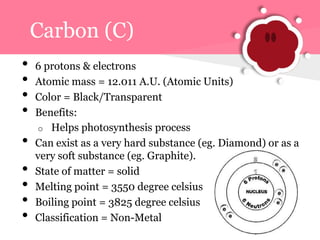
Carbon (C)
• 6 protons & electrons
• Atomic mass = 12.011 A.U. (Atomic Units)
• Color = Black/Transparent
• Benefits:
o Helps photosynthesis process
• Can exist as a very hard substance (eg. Diamond) or as a
very soft substance (eg. Graphite).
• State of matter = solid
• Melting point = 3550 degree celsius
• Boiling point = 3825 degree celsius
• Classification = Non-Metal
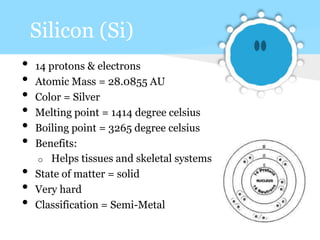
Silicon (Si)
• 14 protons & electrons
• Atomic Mass = 28.0855 AU
• Color = Silver
• Melting point = 1414 degree celsius
• Boiling point = 3265 degree celsius
• Benefits:
o Helps tissues and skeletal systems
• State of matter = solid
• Very hard
• Classification = Semi-Metal
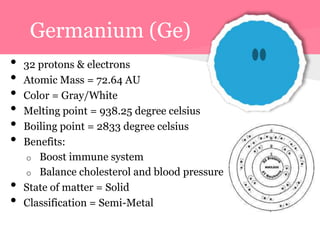
Germanium (Ge)
• 32 protons & electrons
• Atomic Mass = 72.64 AU
• Color = Gray/White
• Melting point = 938.25 degree celsius
• Boiling point = 2833 degree celsius
• Benefits:
o Boost immune system
o Balance cholesterol and blood pressure
• State of matter = Solid
• Classification = Semi-Metal
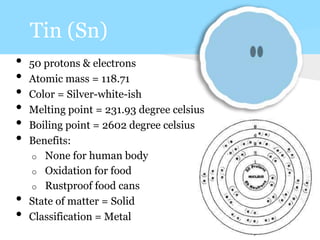
Tin (Sn)
• 50 protons & electrons
• Atomic mass = 118.71
• Color = Silver-white-ish
• Melting point = 231.93 degree celsius
• Boiling point = 2602 degree celsius
• Benefits:
o None for human body
o Oxidation for food
o Rustproof food cans
• State of matter = Solid
• Classification = Metal
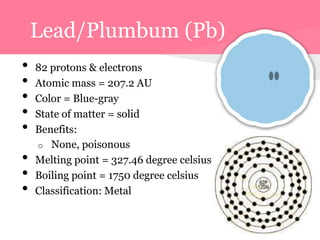
Lead/Plumbum (Pb)
• 82 protons & electrons
• Atomic mass = 207.2 AU
• Color = Blue-gray
• State of matter = solid
• Benefits:
o None, poisonous
• Melting point = 327.46 degree celsius
• Boiling point = 1750 degree celsius
• Classification: Metal
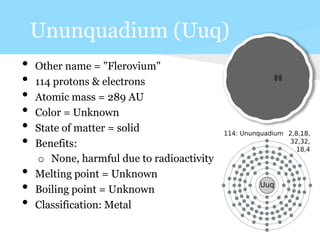
Ununquadium (Uuq)
• Other name = "Flerovium"
• 114 protons & electrons
• Atomic mass = 289 AU
• Color = Unknown
• State of matter = solid
• Benefits:
o None, harmful due to radioactivity
• Melting point = Unknown
• Boiling point = Unknown
• Classification: Metal
Differences
• First 3 has benefits
• 4th has no benefit for human
• The rest = harmful/poisonous
• Melting & boiling points decrease
• Density and conductivity increase
Similarities
• Solid
• Has metallic ingredient (except carbon)
• Neutral/Achromatic colors & transparent
• Main oxidation state for most elements is +4
Sources
• http://www.sciencekids.co.nz/sciencefacts/chemistry/carbon.html
• http://chemistry.about.com/od/elementfacts/a/silicon.htm
• http://answers.yahoo.com/question/index?qid=20081229075912AAAGw8n
• http://chemwiki.ucdavis.edu/Inorganic_Chemistry/Descriptive_Chemistry/Main_Group_Elements/Group_14%3A_The_Carbon_Family
• http://apps.angryrobotzombie.com/theelementals/
• http://education.jlab.org/itselemental/ele014.html
• http://education.jlab.org/itselemental/ele006.html
• http://www.healthy.net/scr/article.aspx?ID=2067
• http://www.herbs2000.com/minerals/silicon.htm
• http://www.chemicool.com/elements/germanium.html
• http://www.chemicool.com/elements/carbon.html
• http://www.chemicool.com/elements/silicon.html
• http://education.jlab.org/itselemental/ele032.html
• http://www.ntshealth.com.au/wellness/blog/germanium.html
• http://wiki.answers.com/Q/Functions_of_tin
• http://education.jlab.org/itselemental/ele050.html
• http://www.chemicool.com/elements/tin.html
• http://education.jlab.org/itselemental/ele082.html
• http://chemistry.about.com/od/howthingsworkfaqs/f/leadpoisoning.htm
• http://www.chemicool.com/elements/flerovium.html
• http://education.jlab.org/itselemental/ele114.html
THANKS!!!

Periodic Table Elements in Group 4: TETRELS

  • 1.
  • 2.
    Carbon (C) • 6protons & electrons • Atomic mass = 12.011 A.U. (Atomic Units) • Color = Black/Transparent • Benefits: o Helps photosynthesis process • Can exist as a very hard substance (eg. Diamond) or as a very soft substance (eg. Graphite). • State of matter = solid • Melting point = 3550 degree celsius • Boiling point = 3825 degree celsius • Classification = Non-Metal
  • 3.
    Silicon (Si) • 14protons & electrons • Atomic Mass = 28.0855 AU • Color = Silver • Melting point = 1414 degree celsius • Boiling point = 3265 degree celsius • Benefits: o Helps tissues and skeletal systems • State of matter = solid • Very hard • Classification = Semi-Metal
  • 4.
    Germanium (Ge) • 32protons & electrons • Atomic Mass = 72.64 AU • Color = Gray/White • Melting point = 938.25 degree celsius • Boiling point = 2833 degree celsius • Benefits: o Boost immune system o Balance cholesterol and blood pressure • State of matter = Solid • Classification = Semi-Metal
  • 5.
    Tin (Sn) • 50protons & electrons • Atomic mass = 118.71 • Color = Silver-white-ish • Melting point = 231.93 degree celsius • Boiling point = 2602 degree celsius • Benefits: o None for human body o Oxidation for food o Rustproof food cans • State of matter = Solid • Classification = Metal
  • 6.
    Lead/Plumbum (Pb) • 82protons & electrons • Atomic mass = 207.2 AU • Color = Blue-gray • State of matter = solid • Benefits: o None, poisonous • Melting point = 327.46 degree celsius • Boiling point = 1750 degree celsius • Classification: Metal
  • 7.
    Ununquadium (Uuq) • Othername = "Flerovium" • 114 protons & electrons • Atomic mass = 289 AU • Color = Unknown • State of matter = solid • Benefits: o None, harmful due to radioactivity • Melting point = Unknown • Boiling point = Unknown • Classification: Metal
  • 8.
    Differences • First 3has benefits • 4th has no benefit for human • The rest = harmful/poisonous • Melting & boiling points decrease • Density and conductivity increase
  • 9.
    Similarities • Solid • Hasmetallic ingredient (except carbon) • Neutral/Achromatic colors & transparent • Main oxidation state for most elements is +4
  • 10.
    Sources • http://www.sciencekids.co.nz/sciencefacts/chemistry/carbon.html • http://www.sciencekids.co.nz/sciencefacts/chemistry/carbon.html •http://chemistry.about.com/od/elementfacts/a/silicon.htm • http://answers.yahoo.com/question/index?qid=20081229075912AAAGw8n • http://chemwiki.ucdavis.edu/Inorganic_Chemistry/Descriptive_Chemistry/Main_Group_Elements/Group_14%3A_The_Carbon_Family • http://apps.angryrobotzombie.com/theelementals/ • http://education.jlab.org/itselemental/ele014.html • http://education.jlab.org/itselemental/ele006.html • http://www.healthy.net/scr/article.aspx?ID=2067 • http://www.herbs2000.com/minerals/silicon.htm • http://www.chemicool.com/elements/germanium.html • http://www.chemicool.com/elements/carbon.html • http://www.chemicool.com/elements/silicon.html • http://education.jlab.org/itselemental/ele032.html • http://www.ntshealth.com.au/wellness/blog/germanium.html • http://wiki.answers.com/Q/Functions_of_tin • http://education.jlab.org/itselemental/ele050.html • http://www.chemicool.com/elements/tin.html • http://education.jlab.org/itselemental/ele082.html • http://chemistry.about.com/od/howthingsworkfaqs/f/leadpoisoning.htm • http://www.chemicool.com/elements/flerovium.html • http://education.jlab.org/itselemental/ele114.html
  • 11.