All About Carbon
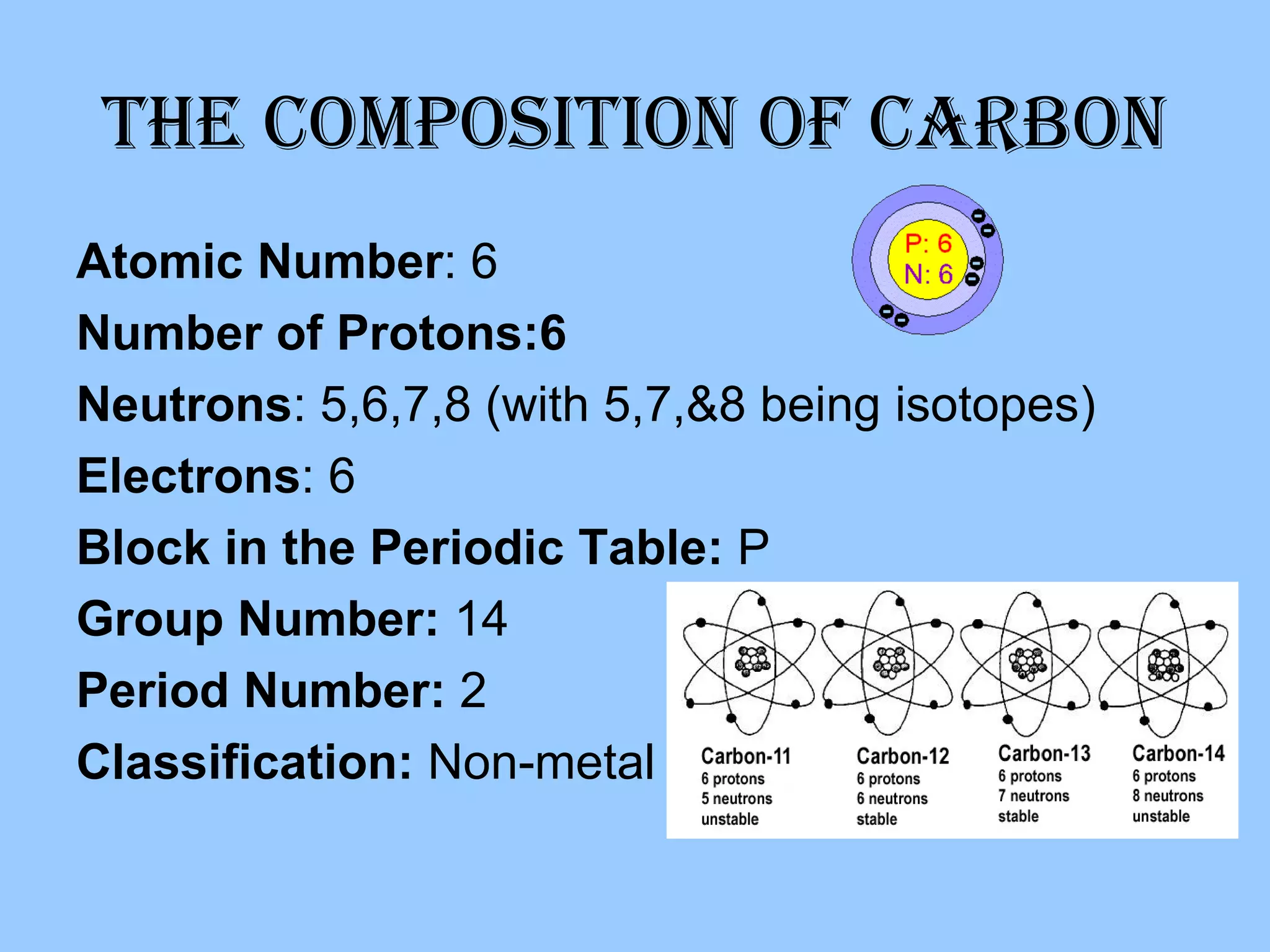
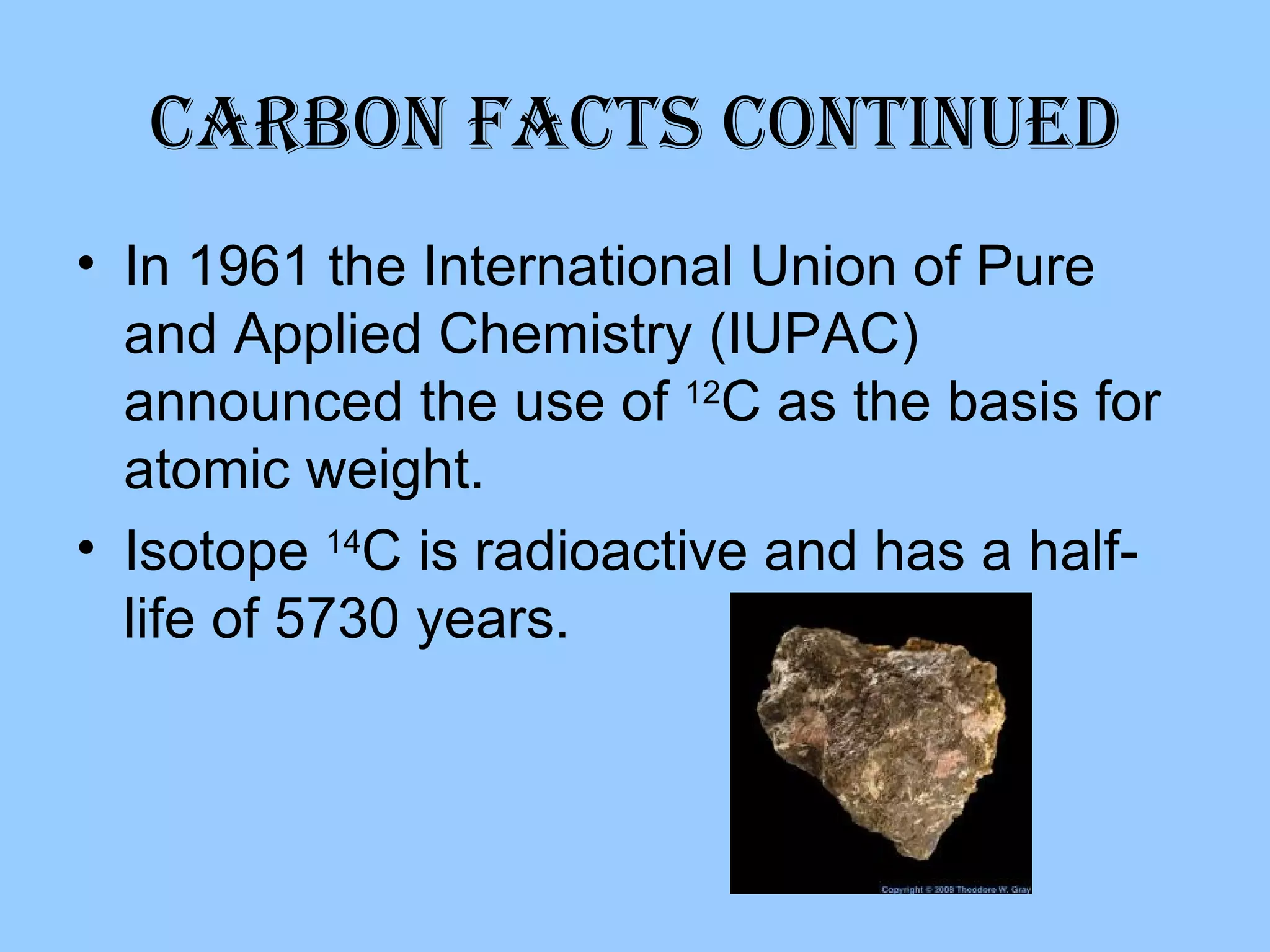
The Composition of Carbon Atomic Number : 6 Number of Protons:6 Neutrons : 5,6,7,8 (with 5,7,&8 being isotopes) Electrons : 6 Block in the Periodic Table:  P Group Number:  14 Period Number:  2 Classification:  Non-metal
Carbon Facts Carbon is the 6 th  most abundant element in the Atmosphere & 4 th  most in the universe, yet only makes up 0.032% of the Earth’s crust. It is one of the most well-known elements and has been studied since ancient times. Carbon is often found in coal deposits but processed for commercial use (i.e. graphite; which can be found naturally but is often formed by petroleum coke in an oxygen free oven).  Diamonds are the 3 rd  most common natural occurrence of Carbon, yet one of the hardest materials known to man. Look at all that carbon!
Carbon Facts Continued Hydrocarbons : Coal, Petroleum, and Natural Gas (fossil fuels) Organic chemistry is based on carbon. Carbon is made inside stars yet we cannot prove it was formed at all during the Big Bang. The name Carbon comes from the Latin term  Carbo  for charcoal Pure Carbon is classified as non-toxic
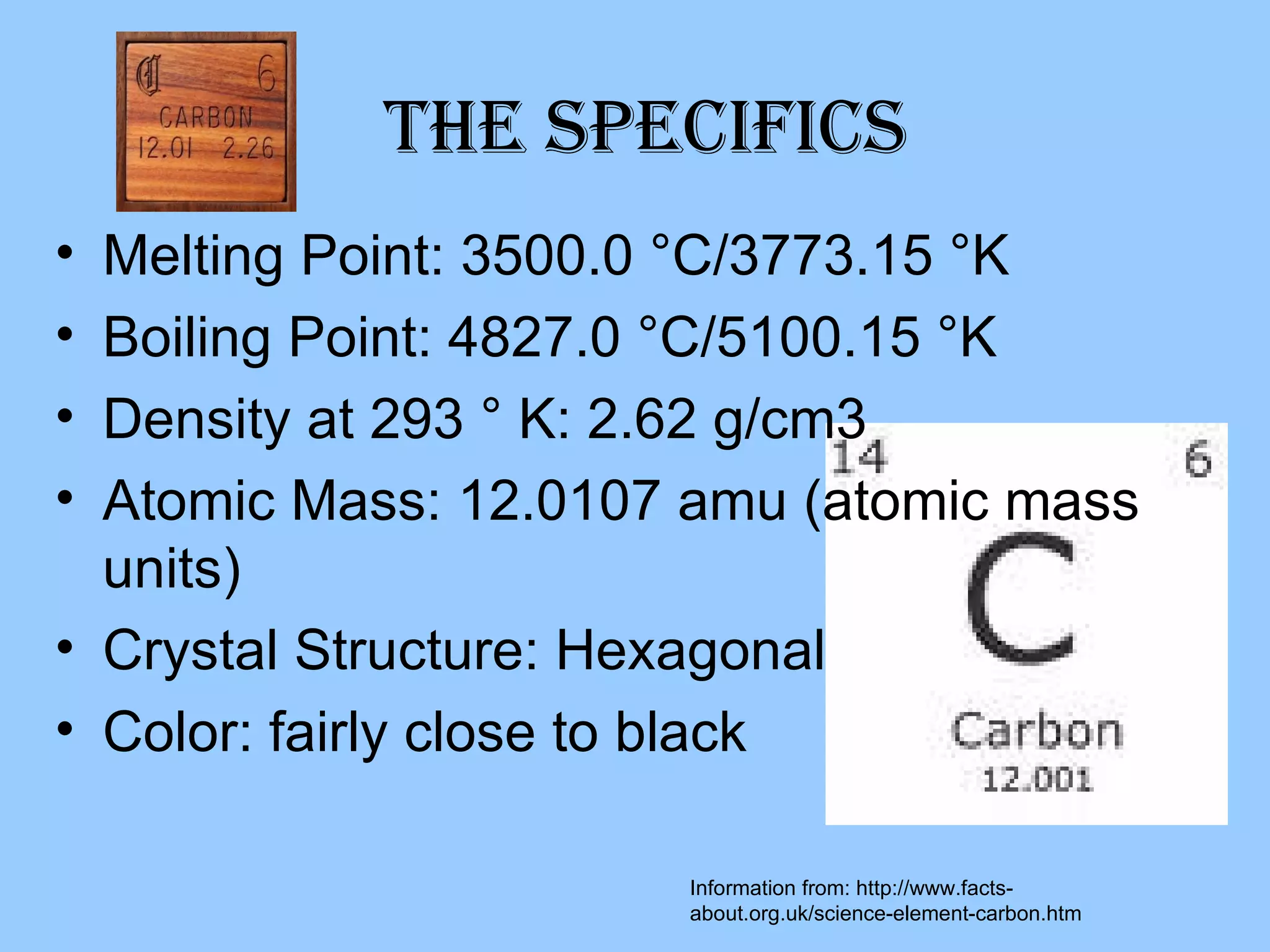
Carbon Facts Continued In 1961 the International Union of Pure and Applied Chemistry (IUPAC) announced the use of  12 C as the basis for atomic weight. Isotope  14 C is radioactive and has a half-life of 5730 years.
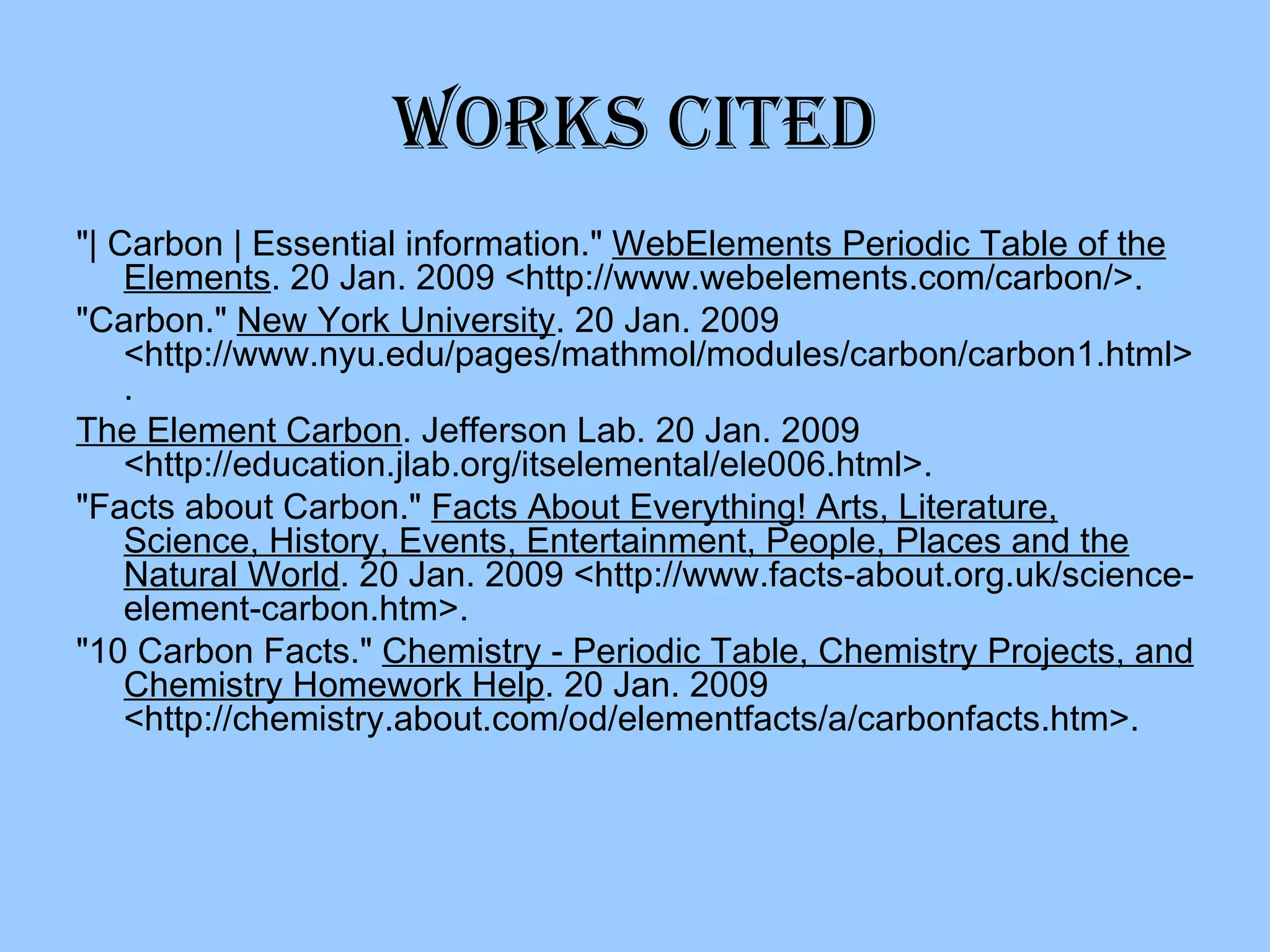
The Specifics Melting Point: 3500.0 °C/3773.15 °K Boiling Point: 4827.0 °C/5100.15 °K Density at 293 ° K: 2.62 g/cm3  Atomic Mass: 12.0107 amu (atomic mass units) Crystal Structure: Hexagonal  Color: fairly close to black Information from: http://www.facts-about.org.uk/science-element-carbon.htm
Uses of Carbon Just a few uses for carbon include: - Carbon can be added to iron to make    steel - Powdered Graphite Carbon can be      used as charcoal in cooking & artwork - Charcoal pills can be used to absorb      toxins in the digestive system - Bone black carbon can be used to    decolorize raw sugar
How does the cycle of Carbon affect us? …check out the website to find out!
Pictures Cited http://serc.carleton.edu/images/usingdata/nasaimages/carbon_atom.gif http://www.uwm.edu/Dept/EHSRM/RAD/Figure_1.jpg http://www.mineralminers.com/images/diamond/mins/diam121.jpg http://www.theodoregray.com/PeriodicTable/Elements/Source-jensan/index.s7.html http://school.discoveryeducation.com/clipart/images/pencil.gif http://www.actcharcoal.com/page/natural/product/4%5B1%5D.100CharcoalPills.jpg
Works Cited &quot;| Carbon | Essential information.&quot;  WebElements Periodic Table of the Elements . 20 Jan. 2009 <http://www.webelements.com/carbon/>. &quot;Carbon.&quot;  New York University . 20 Jan. 2009 <http://www.nyu.edu/pages/mathmol/modules/carbon/carbon1.html>. The Element Carbon . Jefferson Lab. 20 Jan. 2009 <http://education.jlab.org/itselemental/ele006.html>. &quot;Facts about Carbon.&quot;  Facts About Everything! Arts, Literature, Science, History, Events, Entertainment, People, Places and the Natural World . 20 Jan. 2009 <http://www.facts-about.org.uk/science-element-carbon.htm>. &quot;10 Carbon Facts.&quot;  Chemistry - Periodic Table, Chemistry Projects, and Chemistry Homework Help . 20 Jan. 2009 <http://chemistry.about.com/od/elementfacts/a/carbonfacts.htm>.

All About Carbon

  • 1.
  • 2.
    The Composition ofCarbon Atomic Number : 6 Number of Protons:6 Neutrons : 5,6,7,8 (with 5,7,&8 being isotopes) Electrons : 6 Block in the Periodic Table: P Group Number: 14 Period Number: 2 Classification: Non-metal
  • 3.
    Carbon Facts Carbonis the 6 th most abundant element in the Atmosphere & 4 th most in the universe, yet only makes up 0.032% of the Earth’s crust. It is one of the most well-known elements and has been studied since ancient times. Carbon is often found in coal deposits but processed for commercial use (i.e. graphite; which can be found naturally but is often formed by petroleum coke in an oxygen free oven). Diamonds are the 3 rd most common natural occurrence of Carbon, yet one of the hardest materials known to man. Look at all that carbon!
  • 4.
    Carbon Facts ContinuedHydrocarbons : Coal, Petroleum, and Natural Gas (fossil fuels) Organic chemistry is based on carbon. Carbon is made inside stars yet we cannot prove it was formed at all during the Big Bang. The name Carbon comes from the Latin term Carbo for charcoal Pure Carbon is classified as non-toxic
  • 5.
    Carbon Facts ContinuedIn 1961 the International Union of Pure and Applied Chemistry (IUPAC) announced the use of 12 C as the basis for atomic weight. Isotope 14 C is radioactive and has a half-life of 5730 years.
  • 6.
    The Specifics MeltingPoint: 3500.0 °C/3773.15 °K Boiling Point: 4827.0 °C/5100.15 °K Density at 293 ° K: 2.62 g/cm3 Atomic Mass: 12.0107 amu (atomic mass units) Crystal Structure: Hexagonal Color: fairly close to black Information from: http://www.facts-about.org.uk/science-element-carbon.htm
  • 7.
    Uses of CarbonJust a few uses for carbon include: - Carbon can be added to iron to make steel - Powdered Graphite Carbon can be used as charcoal in cooking & artwork - Charcoal pills can be used to absorb toxins in the digestive system - Bone black carbon can be used to decolorize raw sugar
  • 8.
    How does thecycle of Carbon affect us? …check out the website to find out!
  • 9.
    Pictures Cited http://serc.carleton.edu/images/usingdata/nasaimages/carbon_atom.gifhttp://www.uwm.edu/Dept/EHSRM/RAD/Figure_1.jpg http://www.mineralminers.com/images/diamond/mins/diam121.jpg http://www.theodoregray.com/PeriodicTable/Elements/Source-jensan/index.s7.html http://school.discoveryeducation.com/clipart/images/pencil.gif http://www.actcharcoal.com/page/natural/product/4%5B1%5D.100CharcoalPills.jpg
  • 10.
    Works Cited &quot;|Carbon | Essential information.&quot; WebElements Periodic Table of the Elements . 20 Jan. 2009 <http://www.webelements.com/carbon/>. &quot;Carbon.&quot; New York University . 20 Jan. 2009 <http://www.nyu.edu/pages/mathmol/modules/carbon/carbon1.html>. The Element Carbon . Jefferson Lab. 20 Jan. 2009 <http://education.jlab.org/itselemental/ele006.html>. &quot;Facts about Carbon.&quot; Facts About Everything! Arts, Literature, Science, History, Events, Entertainment, People, Places and the Natural World . 20 Jan. 2009 <http://www.facts-about.org.uk/science-element-carbon.htm>. &quot;10 Carbon Facts.&quot; Chemistry - Periodic Table, Chemistry Projects, and Chemistry Homework Help . 20 Jan. 2009 <http://chemistry.about.com/od/elementfacts/a/carbonfacts.htm>.