

The Cognitive Process Of Attention And Its
Various Aspects
Shaheer Shaikh
Farzan Sheikh
Zubair Khan
Content
• Attention (Definition)
• Types Of Attention
• Attention and Education
• Attention Disorders
• Conclusion
Attention: Definition
“Attention is the cognitive process of selectively concentrating on one
aspect of the environment while ignoring other things. Attention has
also been referred to as the allocation of processing
resources”
(John R. Anderson)
Attention: Definition
• “(Attention) is the taking possession by the mind, in clear and vivid form,
of one out of what seem several simultaneously possible objects or trains
of thought…….It implies withdrawal from some things in order to deal
effectively with others”
{William James (Principles Of Psychology)}
Test Your Awareness
Types of Attention
Selective Visual Attention
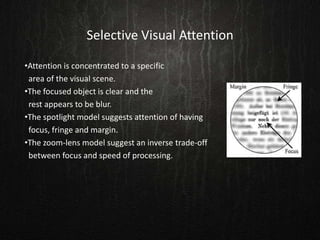
•Attention is concentrated to a specific
area of the visual scene.
•The focused object is clear and the
rest appears to be blur.
•The spotlight model suggests attention of having
focus, fringe and margin.
•The zoom-lens model suggest an inverse trade-off
between focus and speed of processing.
Overt And Covert Attention
•Overt attention is the act of directing sense organs towards a
stimulus source.
•Covert attention is the act of mentally focusing on one of several
possible sensory stimuli.
•In covert attention, one may appear to be focusing on something but
in reality it is focusing on some other object.
Focused Attention
•Kind of attention we use when we are actively attending to
something.
•The attention span for this level is very brief, with a maximum span,
without any lapse at all, that may be as short as 8 seconds.
•Focused attention is physiologically very demanding and we tend to
get tired.
Sustained Attention: Vigilance
•Sustained attention refers to the state in which attention must be
maintained over time.
•Sustained attention is important for cognitive development.
•Difficulty sustaining attention often presents with an accompanying
inability to adapt to environmental demands or modify behavior.
Alternating Attention
•Ability to quickly and without error, move from one kind of selective task
to another and then back.
•Some may experience mental rigidity that impedes their ability to switch
between such cognitive tasks
•Can be cured by constant mental exercises of switching the exercises in
short periods of time.
Divided Attention
•One is dealing with two
tasks simultaneously or
are attending to two aspects
of a task at the same time.
•Since the focus is divided
towards separate activities, efficiency is
usually
reduced considerably.
•Example of using cell phone while driving.
Automaticity
•Ability to do things without occupying the mind with the low-level
details required, allowing it to become an automatic response pattern
or habit.
•It is usually the result of learning, repetition, and practice.
•Examples of automaticity are common activities such as speaking,
bicycle-riding and assembly-line work.
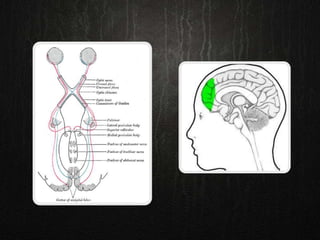
Neural Activity
•Brain reacts differently to the two different types of attention.
•In top-down situation, pre-frontal cortex and superior colliculus directs
senses to pay attention on an object.
•In bottom-up situation, sensory cortical areas like the parietal cortex
directs our eyes toward the stimulus.
Attention In Education Psychology
• Research published in NTLF showed :
• Attention Span of an average healthy adult student is not
more than 15-20 minutes in US universities
• Our Attention Span has been reducing with the
development in Information technology
1. Average Attention Span
• Attention span is the amount of time that a person can concentrate on a
task without becoming distracted.
• Research by Johnstone and F. Percival
• Study by Ralph A. Burns
Reason
• Cognitive Psychology
– Superior Colliculus and Prefrontal Cortex
– Neurons stop stimulating them due to which we lose attention
2. Attention Span has been Reducing
• Neil Postman’s “Amusing Ourselves To Death”
1. A Study of 2600 children
2. Study by Nicholas Carr
3. Lincoln and Douglass Debates
Attention Disorders
ADHD (attention deficit hyperactivity
disorder)
o A neurobehavioral developmental disorder.
o Characterized by "the co-existence of attention
problems and hyperactivity, with each behavior occurring
infrequently alone“.1
o May also include impulsiveness and restlessness.
o Inhibits the child’s learning.
o Symptoms usually appear before the age of seven.
1. The Journal of Clinical Psychiatry
What are the symptoms of ADHD?
• ADD broken down into three subtypes in 1994:
1. Inattentive type, signs:
• inability to pay attention
• difficulty with sustained attention
• apparent listening problems
• difficulty following instructions
• problems with organization
• avoidance of tasks that require mental effort
• tendency to lose things like toys, notebooks, etc.
• distractibility
• forgetfulness in daily activities
• 2. A hyperactive-impulsive type, signs:
• fidgeting or squirming
• difficulty remaining seated
• excessive running or climbing
• difficulty playing quietly
• excessive talking
• blurting out answers before hearing the full question
• difficulty waiting for a turn or in line
• problems with interrupting or intruding
• 3. a combined type, involving a combination of the two
types and is the most common.
Diagnosis
• Diagnosis depends on a complete evaluation, rather than a
test.
• Many patients are diagnosed by primary care doctors, but
some may also need to be referred to specialists such as
psychiatrists, neurologists.
• To be considered for a diagnosis of ADHD:
– must display behaviors before age 7
– more severe than usual
– must persist
– must negatively affect at least two areas of a child's life (such as
school, home, day-care settings, or friendships).
• The behaviors must also not only be linked to stress at home,
such as divorce, moving, or changing schools.
• Doctors will examine the child’s medical history, child’s and
family’s past health, and any medications that the child might
have been taking.
• The doctor may also check hearing and vision so other
medical conditions can be ruled out. Because some
emotional conditions, such as extreme stress, depression,
and anxiety. can also look like ADHD, you'll fill out
questionnaires to help rule them out.
What causes ADHD?
• Biological factors
– The child's temperament, as this contributes to their attitude and
personality.
– Studies of twins suggest a genetic link to ADHD. In 80-90 per cent of
identical twins where one has ADHD so does the other.
– Brain injuries due to birth trauma or pre-birth problems. The brain
structures believed to be linked to the development of ADHD are
vulnerable to hypoxic damage during birth. The damage is caused by
inadequate oxygen reaching parts of the brain while blood flow is
reduced.
• Environmental factors
– Family stress.
– Educational difficulties.
Treatment for ADHD.
• Management techniques for parents and teachers
• Create a daily routine.
• Be specific in your instructions.
• Set clear and easily understood boundaries.
• Be consistent in the handling of the child.
• Remove disturbing elements from their daily routine.
• Plan structured programmes aimed at gradually lengthening the child's
concentration span and ability to focus on tasks.
• Communicate with the child on a one-to-one basis.
• Use rewards to reinforce appropriate behavior such as listening to adults.
• Use punishments for unacceptable behavior or 'overstepping' of
boundaries.
• Medication
– The most common and effective medications are amphetamine-like
stimulants, mainly methylphenidate (eg Ritalin) and Dexedrine.
– Ritalin reduces hyperactivity and impulsiveness and helps to focus a
child's attention. They become less aggressive, seem to comply with
requests, and become less forgetful.
– Growing concern about the use of Ritalin to treat ADHD.
• Psychological treatments
– Psychological treatment might include anxiety management, cognitive
therapy, individual psychotherapy and social skills training.
• Educational management
– This includes individual, or group, learning support for coexisting
learning difficulties and educational underachievement.
• Diet
Thank You
Sources
• http://www.pnas.org/content/102/3/524.full
• http://www.britannica.com/EBchecked/topic/42134/attention
• http://www.ntlf.com/html/pi/9601/article1.htm
• http://kidshealth.org/parent/medical/learning/adhd.html
• http://www.netdoctor.co.uk

The Coginitive Process of Attention

  • 1.
    The Cognitive ProcessOf Attention And Its Various Aspects Shaheer Shaikh Farzan Sheikh Zubair Khan
  • 2.
    Content • Attention (Definition) •Types Of Attention • Attention and Education • Attention Disorders • Conclusion
  • 3.
    Attention: Definition “Attention isthe cognitive process of selectively concentrating on one aspect of the environment while ignoring other things. Attention has also been referred to as the allocation of processing resources” (John R. Anderson)
  • 4.
    Attention: Definition • “(Attention)is the taking possession by the mind, in clear and vivid form, of one out of what seem several simultaneously possible objects or trains of thought…….It implies withdrawal from some things in order to deal effectively with others” {William James (Principles Of Psychology)}
  • 5.
  • 6.
  • 7.
    Selective Visual Attention •Attentionis concentrated to a specific area of the visual scene. •The focused object is clear and the rest appears to be blur. •The spotlight model suggests attention of having focus, fringe and margin. •The zoom-lens model suggest an inverse trade-off between focus and speed of processing.
  • 8.
    Overt And CovertAttention •Overt attention is the act of directing sense organs towards a stimulus source. •Covert attention is the act of mentally focusing on one of several possible sensory stimuli. •In covert attention, one may appear to be focusing on something but in reality it is focusing on some other object.
  • 9.
    Focused Attention •Kind ofattention we use when we are actively attending to something. •The attention span for this level is very brief, with a maximum span, without any lapse at all, that may be as short as 8 seconds. •Focused attention is physiologically very demanding and we tend to get tired.
  • 10.
    Sustained Attention: Vigilance •Sustainedattention refers to the state in which attention must be maintained over time. •Sustained attention is important for cognitive development. •Difficulty sustaining attention often presents with an accompanying inability to adapt to environmental demands or modify behavior.
  • 11.
    Alternating Attention •Ability toquickly and without error, move from one kind of selective task to another and then back. •Some may experience mental rigidity that impedes their ability to switch between such cognitive tasks •Can be cured by constant mental exercises of switching the exercises in short periods of time.
  • 12.
    Divided Attention •One isdealing with two tasks simultaneously or are attending to two aspects of a task at the same time. •Since the focus is divided towards separate activities, efficiency is usually reduced considerably. •Example of using cell phone while driving.
  • 13.
    Automaticity •Ability to dothings without occupying the mind with the low-level details required, allowing it to become an automatic response pattern or habit. •It is usually the result of learning, repetition, and practice. •Examples of automaticity are common activities such as speaking, bicycle-riding and assembly-line work.
  • 14.
    Neural Activity •Brain reactsdifferently to the two different types of attention. •In top-down situation, pre-frontal cortex and superior colliculus directs senses to pay attention on an object. •In bottom-up situation, sensory cortical areas like the parietal cortex directs our eyes toward the stimulus.
  • 15.
  • 16.
    Attention In EducationPsychology • Research published in NTLF showed : • Attention Span of an average healthy adult student is not more than 15-20 minutes in US universities • Our Attention Span has been reducing with the development in Information technology
  • 17.
    1. Average AttentionSpan • Attention span is the amount of time that a person can concentrate on a task without becoming distracted. • Research by Johnstone and F. Percival • Study by Ralph A. Burns
  • 18.
    Reason • Cognitive Psychology –Superior Colliculus and Prefrontal Cortex – Neurons stop stimulating them due to which we lose attention
  • 20.
    2. Attention Spanhas been Reducing • Neil Postman’s “Amusing Ourselves To Death” 1. A Study of 2600 children 2. Study by Nicholas Carr 3. Lincoln and Douglass Debates
  • 21.
  • 22.
    ADHD (attention deficithyperactivity disorder) o A neurobehavioral developmental disorder. o Characterized by "the co-existence of attention problems and hyperactivity, with each behavior occurring infrequently alone“.1 o May also include impulsiveness and restlessness. o Inhibits the child’s learning. o Symptoms usually appear before the age of seven. 1. The Journal of Clinical Psychiatry
  • 23.
    What are thesymptoms of ADHD? • ADD broken down into three subtypes in 1994: 1. Inattentive type, signs: • inability to pay attention • difficulty with sustained attention • apparent listening problems • difficulty following instructions • problems with organization • avoidance of tasks that require mental effort • tendency to lose things like toys, notebooks, etc. • distractibility • forgetfulness in daily activities
  • 24.
    • 2. Ahyperactive-impulsive type, signs: • fidgeting or squirming • difficulty remaining seated • excessive running or climbing • difficulty playing quietly • excessive talking • blurting out answers before hearing the full question • difficulty waiting for a turn or in line • problems with interrupting or intruding • 3. a combined type, involving a combination of the two types and is the most common.
  • 25.
    Diagnosis • Diagnosis dependson a complete evaluation, rather than a test. • Many patients are diagnosed by primary care doctors, but some may also need to be referred to specialists such as psychiatrists, neurologists. • To be considered for a diagnosis of ADHD: – must display behaviors before age 7 – more severe than usual – must persist – must negatively affect at least two areas of a child's life (such as school, home, day-care settings, or friendships).
  • 26.
    • The behaviorsmust also not only be linked to stress at home, such as divorce, moving, or changing schools. • Doctors will examine the child’s medical history, child’s and family’s past health, and any medications that the child might have been taking. • The doctor may also check hearing and vision so other medical conditions can be ruled out. Because some emotional conditions, such as extreme stress, depression, and anxiety. can also look like ADHD, you'll fill out questionnaires to help rule them out.
  • 27.
    What causes ADHD? •Biological factors – The child's temperament, as this contributes to their attitude and personality. – Studies of twins suggest a genetic link to ADHD. In 80-90 per cent of identical twins where one has ADHD so does the other. – Brain injuries due to birth trauma or pre-birth problems. The brain structures believed to be linked to the development of ADHD are vulnerable to hypoxic damage during birth. The damage is caused by inadequate oxygen reaching parts of the brain while blood flow is reduced. • Environmental factors – Family stress. – Educational difficulties.
  • 28.
    Treatment for ADHD. •Management techniques for parents and teachers • Create a daily routine. • Be specific in your instructions. • Set clear and easily understood boundaries. • Be consistent in the handling of the child. • Remove disturbing elements from their daily routine. • Plan structured programmes aimed at gradually lengthening the child's concentration span and ability to focus on tasks. • Communicate with the child on a one-to-one basis. • Use rewards to reinforce appropriate behavior such as listening to adults. • Use punishments for unacceptable behavior or 'overstepping' of boundaries.
  • 29.
    • Medication – Themost common and effective medications are amphetamine-like stimulants, mainly methylphenidate (eg Ritalin) and Dexedrine. – Ritalin reduces hyperactivity and impulsiveness and helps to focus a child's attention. They become less aggressive, seem to comply with requests, and become less forgetful. – Growing concern about the use of Ritalin to treat ADHD. • Psychological treatments – Psychological treatment might include anxiety management, cognitive therapy, individual psychotherapy and social skills training. • Educational management – This includes individual, or group, learning support for coexisting learning difficulties and educational underachievement. • Diet
  • 30.
  • 31.
    Sources • http://www.pnas.org/content/102/3/524.full • http://www.britannica.com/EBchecked/topic/42134/attention •http://www.britannica.com/EBchecked/topic/42134/attention • http://www.ntlf.com/html/pi/9601/article1.htm • http://kidshealth.org/parent/medical/learning/adhd.html • http://www.netdoctor.co.uk