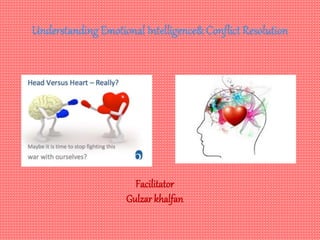
Understanding Emotional Intelligence& Conflict Resolution
Facilitator
Gulzar khalfan
Objectives
• To make participants understand about the
concept of Emotional Intelligence (EQ) and
highlight its importance in a day-to-day life;
• To let the audience feel the magic of EQ;
• How to deal with people in general and youth in
particular with some useful EQ tools, tips and
techniques.
What is Emotional Intelligence?
Emotional intelligence (EI) is the ability to understand and
manage your own emotions, and those of the people around
you.
Emotional intelligence (EI) is the capacity for understanding
our own feelings and the feelings of others, for motivating
ourselves, and for managing our emotions effectively in our
relationships.
Emotional intelligence is sometimes referred to as “people
smarts.”
History of Emotional Intelligence
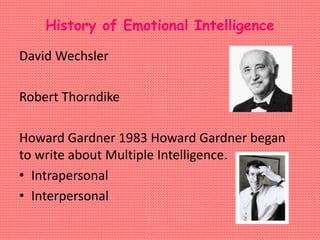
David Wechsler
Robert Thorndike
Howard Gardner 1983 Howard Gardner began
to write about Multiple Intelligence.
• Intrapersonal
• Interpersonal
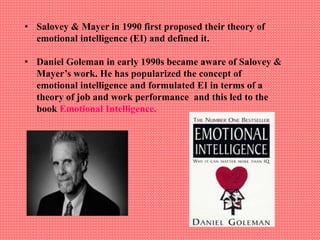
• Salovey & Mayer in 1990 first proposed their theory of
emotional intelligence (EI) and defined it.
• Daniel Goleman in early 1990s became aware of Salovey &
Mayer’s work. He has popularized the concept of
emotional intelligence and formulated EI in terms of a
theory of job and work performance and this led to the
book Emotional Intelligence.
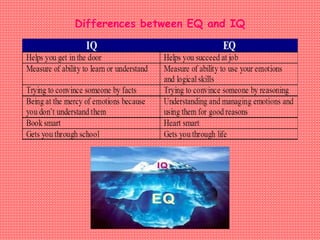
Differences between EQ and IQ
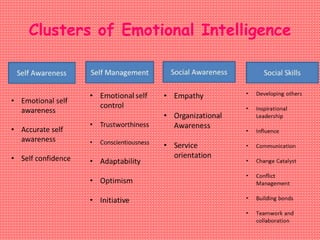
Clusters of Emotional Intelligence
• Emotional self
awareness
• Accurate self
awareness
• Self confidence
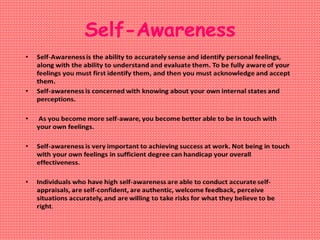
Self-Awareness
Self-Management
• Self-Management is the ability to understand your emotions and then use
that understanding to turn situations to your benefit.
• Self-management is also the ability to use your feelings to reason well and
act intentionally.
• WHY?
• Self-management is important because when people are able to better
managing their emotions, they do better in life.
• The more people allow emotions to control and direct their behavior, the
worse they do in life.
• People who are good managers of their emotions are open to change,
effective in mood management, consistent in stress management, they are
productive, and behave in a reasonable and rational way.
Social Awareness
 Social awareness refers to how people handle relationships and awareness of
others’ feelings, needs, and concerns.
 It is the ability to recognize and appropriately respond to the emotions and
feelings of others.
Why?
 Social awareness is very important for creating and maintaining good working
relationships with other people.
 People high in social awareness can feel what other people are feeling and
can put themselves in their shoes.
 People who are high in social awareness are able to read non-verbal cues,
read messages conveyed by facial gestures, posture, eye movement, and body
language.
Social Skills
 Social Skills refers to a proficiency at suggesting desirable responses in others.
 People with good social skills are good business leaders, leaders in society, and
effective parents who understand that personal success and group or family
success are inseparable.
 They lead by example, encouraging others in positive ways, validating them and
creating trust within them.
Why?
 Social skills are the basic skills everyone needs to have in order to be effective at
anything they do. Not having the basic social skills can severely limit the quality
of work that you produce.
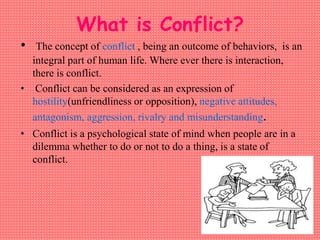
What is Conflict?
• The concept of conflict , being an outcome of behaviors, is an
integral part of human life. Where ever there is interaction,
there is conflict.
• Conflict can be considered as an expression of
hostility(unfriendliness or opposition), negative attitudes,
antagonism, aggression, rivalry and misunderstanding.
• Conflict is a psychological state of mind when people are in a
dilemma whether to do or not to do a thing, is a state of
conflict.
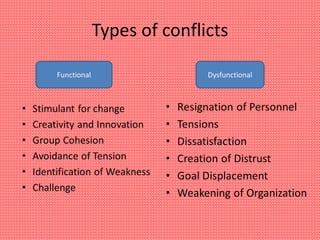
Types of conflicts
Functional Dysfunctional
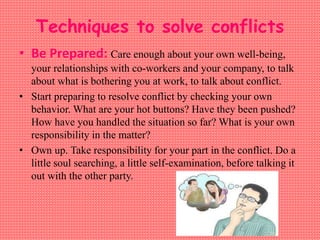
Techniques to solve conflicts
• Be Prepared: Care enough about your own well-being,
your relationships with co-workers and your company, to talk
about what is bothering you at work, to talk about conflict.
• Start preparing to resolve conflict by checking your own
behavior. What are your hot buttons? Have they been pushed?
How have you handled the situation so far? What is your own
responsibility in the matter?
• Own up. Take responsibility for your part in the conflict. Do a
little soul searching, a little self-examination, before talking it
out with the other party.
The sooner you resolve conflict, the easier it is to
resolve. Don't wait. Don't let the matter boil into
something bigger than it is.
• Don’t Wait
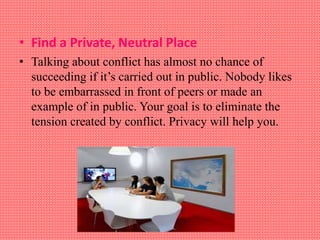
• Find a Private, Neutral Place
• Talking about conflict has almost no chance of
succeeding if it’s carried out in public. Nobody likes
to be embarrassed in front of peers or made an
example of in public. Your goal is to eliminate the
tension created by conflict. Privacy will help you.
• Be Aware of Body Language
• Be aware of your body language. You convey
information without ever opening your mouth to
speak.
• Maintain eye contact.
• Relax your neck and shoulder muscles.
• Be conscious of your expression. Show you care.
• Use a "Please pass the paper" voice: neutral tone,
moderate speed and volume, conversational.
• Avoid absolutes like "never" and "always."
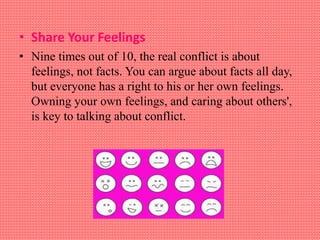
• Share Your Feelings
• Nine times out of 10, the real conflict is about
feelings, not facts. You can argue about facts all day,
but everyone has a right to his or her own feelings.
Owning your own feelings, and caring about others',
is key to talking about conflict.
• Identify the Problem
• Give specific details, including your own
observations, valid documentation, if appropriate, and
information from reliable witnesses, if appropriate.
• Listen Actively and with Compassion
• Listen actively and remember that things are not
always what they seem. Be ready to be open to the
other person’s explanation. Sometimes, getting all the
information from the right person changes the entire
situation.
• Be ready to respond with compassion. Be interested
in how the other person sees the situation differently
than you do.
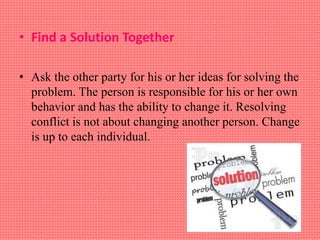
• Find a Solution Together
• Ask the other party for his or her ideas for solving the
problem. The person is responsible for his or her own
behavior and has the ability to change it. Resolving
conflict is not about changing another person. Change
is up to each individual.
• Agree on a Plan of Action
• Say what you will do differently in the future and ask
the other party to verbalize his or her commitment to
change in the future.
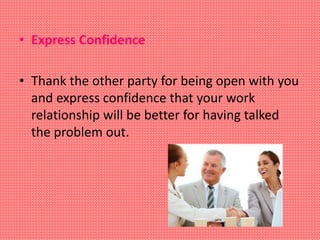
• Express Confidence
• Thank the other party for being open with you
and express confidence that your work
relationship will be better for having talked
the problem out.
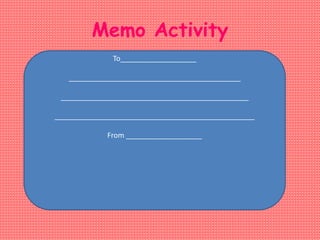
To___________________
___________________________________________
_______________________________________________
__________________________________________________
From ___________________
Memo Activity
Discussion Questions
1. What was your first reaction when you realized
you would have to perform your own tasks?
2. Do we ever expect others to do things that we
ourselves are unwilling to do?
3. If this is the case, how does having a diverse
team work to our benefit?
4. Do we always take the time to consider other
perspectives? Why not?
5. How might this affect the conflict-resolution
process?
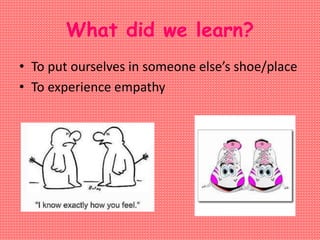
What did we learn?
• To put ourselves in someone else’s shoe/place
• To experience empathy
Emotional Intelligence & Conflict Management

Emotional Intelligence & Conflict Management

  • 1.
    Understanding Emotional Intelligence&Conflict Resolution Facilitator Gulzar khalfan
  • 2.
    Objectives • To makeparticipants understand about the concept of Emotional Intelligence (EQ) and highlight its importance in a day-to-day life; • To let the audience feel the magic of EQ; • How to deal with people in general and youth in particular with some useful EQ tools, tips and techniques.
  • 3.
    What is EmotionalIntelligence? Emotional intelligence (EI) is the ability to understand and manage your own emotions, and those of the people around you. Emotional intelligence (EI) is the capacity for understanding our own feelings and the feelings of others, for motivating ourselves, and for managing our emotions effectively in our relationships. Emotional intelligence is sometimes referred to as “people smarts.”
  • 4.
    History of EmotionalIntelligence David Wechsler Robert Thorndike Howard Gardner 1983 Howard Gardner began to write about Multiple Intelligence. • Intrapersonal • Interpersonal
  • 5.
    • Salovey &Mayer in 1990 first proposed their theory of emotional intelligence (EI) and defined it. • Daniel Goleman in early 1990s became aware of Salovey & Mayer’s work. He has popularized the concept of emotional intelligence and formulated EI in terms of a theory of job and work performance and this led to the book Emotional Intelligence.
  • 6.
  • 7.
    Clusters of EmotionalIntelligence • Emotional self awareness • Accurate self awareness • Self confidence
  • 8.
  • 9.
    Self-Management • Self-Management isthe ability to understand your emotions and then use that understanding to turn situations to your benefit. • Self-management is also the ability to use your feelings to reason well and act intentionally. • WHY? • Self-management is important because when people are able to better managing their emotions, they do better in life. • The more people allow emotions to control and direct their behavior, the worse they do in life. • People who are good managers of their emotions are open to change, effective in mood management, consistent in stress management, they are productive, and behave in a reasonable and rational way.
  • 10.
    Social Awareness  Socialawareness refers to how people handle relationships and awareness of others’ feelings, needs, and concerns.  It is the ability to recognize and appropriately respond to the emotions and feelings of others. Why?  Social awareness is very important for creating and maintaining good working relationships with other people.  People high in social awareness can feel what other people are feeling and can put themselves in their shoes.  People who are high in social awareness are able to read non-verbal cues, read messages conveyed by facial gestures, posture, eye movement, and body language.
  • 11.
    Social Skills  SocialSkills refers to a proficiency at suggesting desirable responses in others.  People with good social skills are good business leaders, leaders in society, and effective parents who understand that personal success and group or family success are inseparable.  They lead by example, encouraging others in positive ways, validating them and creating trust within them. Why?  Social skills are the basic skills everyone needs to have in order to be effective at anything they do. Not having the basic social skills can severely limit the quality of work that you produce.
  • 12.
    What is Conflict? •The concept of conflict , being an outcome of behaviors, is an integral part of human life. Where ever there is interaction, there is conflict. • Conflict can be considered as an expression of hostility(unfriendliness or opposition), negative attitudes, antagonism, aggression, rivalry and misunderstanding. • Conflict is a psychological state of mind when people are in a dilemma whether to do or not to do a thing, is a state of conflict.
  • 13.
  • 14.
    Techniques to solveconflicts • Be Prepared: Care enough about your own well-being, your relationships with co-workers and your company, to talk about what is bothering you at work, to talk about conflict. • Start preparing to resolve conflict by checking your own behavior. What are your hot buttons? Have they been pushed? How have you handled the situation so far? What is your own responsibility in the matter? • Own up. Take responsibility for your part in the conflict. Do a little soul searching, a little self-examination, before talking it out with the other party.
  • 15.
    The sooner youresolve conflict, the easier it is to resolve. Don't wait. Don't let the matter boil into something bigger than it is. • Don’t Wait
  • 16.
    • Find aPrivate, Neutral Place • Talking about conflict has almost no chance of succeeding if it’s carried out in public. Nobody likes to be embarrassed in front of peers or made an example of in public. Your goal is to eliminate the tension created by conflict. Privacy will help you.
  • 17.
    • Be Awareof Body Language • Be aware of your body language. You convey information without ever opening your mouth to speak. • Maintain eye contact. • Relax your neck and shoulder muscles. • Be conscious of your expression. Show you care. • Use a "Please pass the paper" voice: neutral tone, moderate speed and volume, conversational. • Avoid absolutes like "never" and "always."
  • 18.
    • Share YourFeelings • Nine times out of 10, the real conflict is about feelings, not facts. You can argue about facts all day, but everyone has a right to his or her own feelings. Owning your own feelings, and caring about others', is key to talking about conflict.
  • 19.
    • Identify theProblem • Give specific details, including your own observations, valid documentation, if appropriate, and information from reliable witnesses, if appropriate.
  • 20.
    • Listen Activelyand with Compassion • Listen actively and remember that things are not always what they seem. Be ready to be open to the other person’s explanation. Sometimes, getting all the information from the right person changes the entire situation. • Be ready to respond with compassion. Be interested in how the other person sees the situation differently than you do.
  • 21.
    • Find aSolution Together • Ask the other party for his or her ideas for solving the problem. The person is responsible for his or her own behavior and has the ability to change it. Resolving conflict is not about changing another person. Change is up to each individual.
  • 22.
    • Agree ona Plan of Action • Say what you will do differently in the future and ask the other party to verbalize his or her commitment to change in the future.
  • 23.
    • Express Confidence •Thank the other party for being open with you and express confidence that your work relationship will be better for having talked the problem out.
  • 24.
  • 25.
    Discussion Questions 1. Whatwas your first reaction when you realized you would have to perform your own tasks? 2. Do we ever expect others to do things that we ourselves are unwilling to do? 3. If this is the case, how does having a diverse team work to our benefit? 4. Do we always take the time to consider other perspectives? Why not? 5. How might this affect the conflict-resolution process?
  • 26.
    What did welearn? • To put ourselves in someone else’s shoe/place • To experience empathy