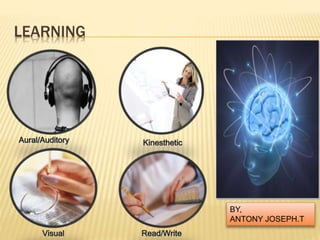
LEARNING
KinestheticAural/Auditory
Visual Read/Write
BY,
ANTONY JOSEPH.T
The acquisition of
knowledge
or skills through
experience,
practice, study,
or by being taught.
e a r n i n g
Relatively
permanent
change
in
behaviour
due
to
experience
DEFINITIONS
 Learning refers to a more or less permanent
change in behavior which occurs as a result
of practice.
(G.A.Kimale, 1961)
 Consumer learning is the process by which
individuals acquire the purchase and
consumption knowledge and experience they
apply to future related behaviour.
(Schiffman and Kanuk)
CONSUMERS LEARNING ACTIVITY
Motivation
Stimuli and Cues
Response
Reinforcement
CLASSIFICATION OF LEARNING THEORIES
LEARNING
Behavioral
Cognitiv
e
Classical
Conditionin
g
Operant
Conditioning
WHAT IS LEARNING?
 Behavioral Perspective
 A relatively permanent change in
behaviour that arises from practice
or experience
 Cognitive Perspective
 Mental change that may
or may not be associated
with changes in behaviour
TYPES OF BEHAVIORAL LEARNING
Classical
conditioning:
learning to link two
stimuli in a way that
helps us anticipate
an event to which
we have a reaction
Operant
conditioning:
changing behavior
choices in response
to consequences
CLASSICAL CONDITIONING
Ivan pavlow
1849-1936
Russian physiologist
Proponent of classical
conditioning
LEARNING TO MAKE AN INVOLUNTARY (REFLEX) RESPONSE
TO A STIMULUS OTHER THAN THE ORIGINAL, NATURAL
STIMULUS THAT NORMALLY PRODUCES THE REFLEX.
A Reflex is an
unlearned, involuntary
response that occur
under personal control
or choice
The food
causes a
particular
reaction, the
SALIVATION.
A STIMULUS can be defined
as any object, event or
experience that causes a
response, the reaction of an
organism.
DEFINITION
PAVLOV AND THE SALIVATING DOGS
Pavlov discovered that his dogs began
salivating when they weren't supposed to be
salivating. Switching his focus, Pavlov spent
the rest of his career studying on what he
termed Classical Conditioning, learning to
elicit an involuntary reflex response to a
stimulus other than the original stimulus that
produces reflex.Elements of Classical
Conditioning:
Unconditioned
Stimulus (UCS).
Unconditioned
Response
(UCR)
Conditioned
Stimulus (CS)
Conditioned
Response (CR)
UNCONDITION
ED STIMULUS
 The original naturally occurring stimulus. This is
the stimulus that ordinarily leads to the reflex
response. In the case of Pavlov dogs, the food is
the unconditioned stimulus.
UNCONDITION
ED RESPONSE
 The reflex response to the unconditioned stimulus.
It is unlearned and occurs because of genetic
‘wiring’ in the nervous system. In Pavlov’s
experiment, the salivation to the food is the UCR.
CONDITIONED
STIMULUS
 Pavlov determined that almost any kind of
stimulus could become associated with UCS. The
sight of the food dish itself became a stimulus for
salivation before the food was given. At this point,
the dish was called NEUTRAL STIMULUS.
CONDITIONED
RESPONSE
 Comes as a response to the conditioned stimulus.
PUTTING IT TOGETHER
Neutral
Stimulus
No
Response
Unconditioned
Stimulus
Unconditioned
Response
Conditioned
Response
Conditioned
Stimulus
OPERANT CONDITIONING
B.F.Skinner
(1904 – 1990)
Psychologist
Proponent of operant
conditioning
The kind of learning that applies to voluntary behavior
through the effects of pleasant and unpleasant
consequences or responses.
OPERANT CONDITIONING
•The rat is learning to
press the bar in the wall
of the cage in order to get
food .
B.F. SKINNER: THE BEHAVIORIST
Skinner box
Studied observable,
measurable behavior.
• learning depends on
consequences
Recording
deviceBar or lever
that an
animal
presses,
randomly at
first, later for
reward
Food/water dispenser
to provide the reward
COGNITIVE LEARNING THEORY
Learning is a
function of
exerting the
mind.
DEFINITION
KEYPOINTS OF THIS THEORY
 Thinking, memory, knowing, as well as
problem-solving need to be explored.
 We can view knowledge as a schema
(symbolic mental construction).
 Learning: change in a learner’s schemata.
 People need active participation, that is how
we learn, and our actions are a consequence
of thinking.
COMPONENTS OF HUMAN MEMORY
CONCLUSION
It is very important for the marketers to know
how consumers learn about their role as
consumers and about various products.
REFERENCES
 S.A.Chunwalla, Commentary on Consumer
Behaviour, Millenium publishing house,2000.
 Schiffman and kanuk, Consumer Behaviour,
8th edition, Prentice hall of india,
NewDelhi,2004.
 www.scribd.com
 www.slideshare.net
Learning Theories

Learning Theories

  • 1.
  • 2.
    The acquisition of knowledge orskills through experience, practice, study, or by being taught. e a r n i n g Relatively permanent change in behaviour due to experience
  • 3.
    DEFINITIONS  Learning refersto a more or less permanent change in behavior which occurs as a result of practice. (G.A.Kimale, 1961)  Consumer learning is the process by which individuals acquire the purchase and consumption knowledge and experience they apply to future related behaviour. (Schiffman and Kanuk)
  • 4.
    CONSUMERS LEARNING ACTIVITY Motivation Stimuliand Cues Response Reinforcement
  • 5.
    CLASSIFICATION OF LEARNINGTHEORIES LEARNING Behavioral Cognitiv e Classical Conditionin g Operant Conditioning
  • 6.
    WHAT IS LEARNING? Behavioral Perspective  A relatively permanent change in behaviour that arises from practice or experience  Cognitive Perspective  Mental change that may or may not be associated with changes in behaviour
  • 7.
    TYPES OF BEHAVIORALLEARNING Classical conditioning: learning to link two stimuli in a way that helps us anticipate an event to which we have a reaction Operant conditioning: changing behavior choices in response to consequences
  • 8.
    CLASSICAL CONDITIONING Ivan pavlow 1849-1936 Russianphysiologist Proponent of classical conditioning
  • 9.
    LEARNING TO MAKEAN INVOLUNTARY (REFLEX) RESPONSE TO A STIMULUS OTHER THAN THE ORIGINAL, NATURAL STIMULUS THAT NORMALLY PRODUCES THE REFLEX. A Reflex is an unlearned, involuntary response that occur under personal control or choice The food causes a particular reaction, the SALIVATION. A STIMULUS can be defined as any object, event or experience that causes a response, the reaction of an organism. DEFINITION
  • 10.
    PAVLOV AND THESALIVATING DOGS Pavlov discovered that his dogs began salivating when they weren't supposed to be salivating. Switching his focus, Pavlov spent the rest of his career studying on what he termed Classical Conditioning, learning to elicit an involuntary reflex response to a stimulus other than the original stimulus that produces reflex.Elements of Classical Conditioning: Unconditioned Stimulus (UCS). Unconditioned Response (UCR) Conditioned Stimulus (CS) Conditioned Response (CR)
  • 11.
    UNCONDITION ED STIMULUS  Theoriginal naturally occurring stimulus. This is the stimulus that ordinarily leads to the reflex response. In the case of Pavlov dogs, the food is the unconditioned stimulus. UNCONDITION ED RESPONSE  The reflex response to the unconditioned stimulus. It is unlearned and occurs because of genetic ‘wiring’ in the nervous system. In Pavlov’s experiment, the salivation to the food is the UCR. CONDITIONED STIMULUS  Pavlov determined that almost any kind of stimulus could become associated with UCS. The sight of the food dish itself became a stimulus for salivation before the food was given. At this point, the dish was called NEUTRAL STIMULUS. CONDITIONED RESPONSE  Comes as a response to the conditioned stimulus.
  • 12.
  • 13.
    OPERANT CONDITIONING B.F.Skinner (1904 –1990) Psychologist Proponent of operant conditioning
  • 14.
    The kind oflearning that applies to voluntary behavior through the effects of pleasant and unpleasant consequences or responses. OPERANT CONDITIONING
  • 15.
    •The rat islearning to press the bar in the wall of the cage in order to get food . B.F. SKINNER: THE BEHAVIORIST Skinner box Studied observable, measurable behavior. • learning depends on consequences Recording deviceBar or lever that an animal presses, randomly at first, later for reward Food/water dispenser to provide the reward
  • 16.
    COGNITIVE LEARNING THEORY Learningis a function of exerting the mind. DEFINITION
  • 17.
    KEYPOINTS OF THISTHEORY  Thinking, memory, knowing, as well as problem-solving need to be explored.  We can view knowledge as a schema (symbolic mental construction).  Learning: change in a learner’s schemata.  People need active participation, that is how we learn, and our actions are a consequence of thinking.
  • 18.
  • 19.
    CONCLUSION It is veryimportant for the marketers to know how consumers learn about their role as consumers and about various products.
  • 20.
    REFERENCES  S.A.Chunwalla, Commentaryon Consumer Behaviour, Millenium publishing house,2000.  Schiffman and kanuk, Consumer Behaviour, 8th edition, Prentice hall of india, NewDelhi,2004.  www.scribd.com  www.slideshare.net