CONSUMER BEHAVIOR

   By Balachandar K.
Why study Consumer Behavior?
• The Consumer is King.

• Only the Customer Can Fire Us All.

• People are different.

• Consumer behavior educates and protects consumers.

• Consumer behavior helps formulate public policy.

• Consumer behavior affects personal policy.

     Reference Book:- Consumer Behavior by Blackwell, Miniard and Engel
• It’s helpful in understanding needs.

• Helps in defining markets and identifying
  threats and opportunities of a brand.

• Segmentation becomes easy.
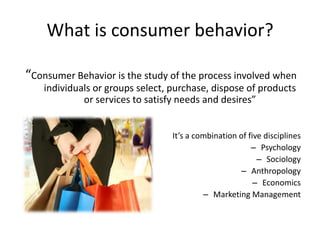
What is consumer behavior?

“Consumer Behavior is the study of the process involved when
    individuals or groups select, purchase, dispose of products
             or services to satisfy needs and desires”


                                  It’s a combination of five disciplines
                                                         – Psychology
                                                           – Sociology
                                                      – Anthropology
                                                          – Economics
                                           – Marketing Management
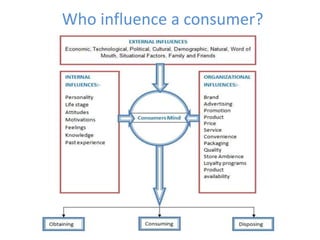
Who influence a consumer?
Obtaining
• The activity that leading up to and including
  purchase or receipt of a product.

  – How they get information?
  – How they decide what to buy?
  – Where you buy?
  – How you pay for it?
  – How you take it to their home?
Meaning of Consumption
“People don’t buy products for what they do but
  for what they mean”

Different types of relationship:-
  Self concept – user’s self image.
  Nostalgic attachment – past self
  Interdependence – part of users daily routine.
  Love – emotional bonds with the user.
Reference book:- Consumer behavior buying, having and being. Author:-
Solomon, Fifth edition.
• How they use the product?

• How they store they product in their home?

• Who use the product?

• How much they consume?

• How they compare with expectations?
Disposing

• How they get rid of remaining product?

• How much they throw away after use?

• How they recycle the product?
Dark side of consumer behavior

• Addictive consumption – Gambling, Alcohol, Drugs.

• Compulsive consumption – Shopaholics, not by choice.

• Consumed consumption – Consumers who are exploited.
  Eg) Adopting a baby, organ donors, blood donors.

• Illegal activities – Theft.

• Anti-consumption – People who create aversion towards a
  product eg) Burned lungs image, V-care shampoo ad.
Mr. Bloomberg Story
Xerox Story – Videos
   Resume tip #2
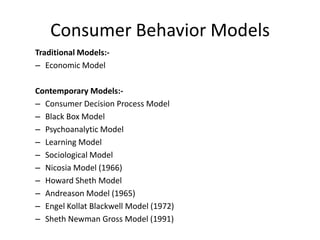
Consumer Behavior Models
Traditional Models:-
– Economic Model

Contemporary Models:-
– Consumer Decision Process Model
– Black Box Model
– Psychoanalytic Model
– Learning Model
– Sociological Model
– Nicosia Model (1966)
– Howard Sheth Model
– Andreason Model (1965)
– Engel Kollat Blackwell Model (1972)
– Sheth Newman Gross Model (1991)
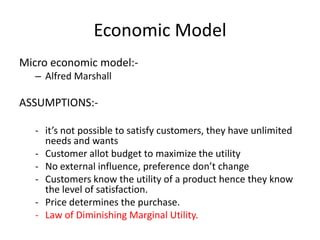
Economic Model
Micro economic model:-
  – Alfred Marshall

ASSUMPTIONS:-

  - it’s not possible to satisfy customers, they have unlimited
    needs and wants
  - Customer allot budget to maximize the utility
  - No external influence, preference don’t change
  - Customers know the utility of a product hence they know
    the level of satisfaction.
  - Price determines the purchase.
  - Law of Diminishing Marginal Utility.
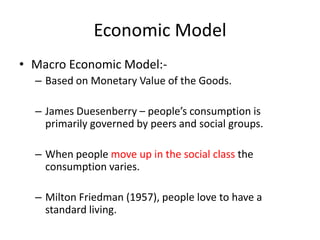
Economic Model
• Macro Economic Model:-
  – Based on Monetary Value of the Goods.

  – James Duesenberry – people’s consumption is
    primarily governed by peers and social groups.

  – When people move up in the social class the
    consumption varies.

  – Milton Friedman (1957), people love to have a
    standard living.
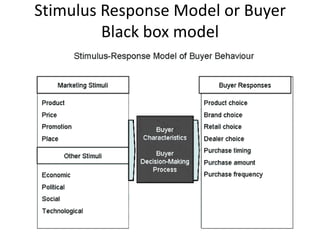
Stimulus Response Model or Buyer
         Black box model
Andreason Model (1965)
• Message reaches consumer through Five basic
  sense.
• Filtered by perception and attitude
  determines the purchase.
Psychoanalytic Model
• ID
  – It’s related to the Pleasure Principle. Needs should be
    satisfied else it will lead to tension and anxiety.
  – It’s satisfied by the Primary Process.
• Ego
  – It works with Reality Principle, tries to satisfy the needs in
    realistic and socially appropriate ways.
  – It satisfies the need through Secondary Process
• Super Ego
  – It hold all our moral acquired from the society and parents.
    It provides guidelines to make judgments.
  – Ego Ideal – rules and standards for good behavior.
  – The Conscience - information viewed as bad by parents
    and society.
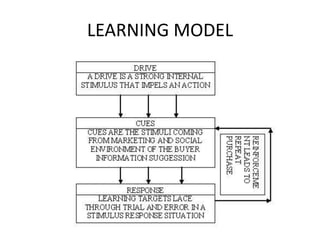
LEARNING MODEL
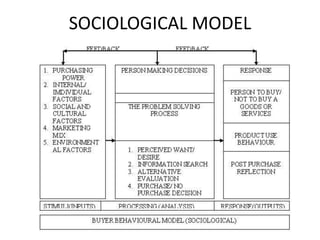
SOCIOLOGICAL MODEL
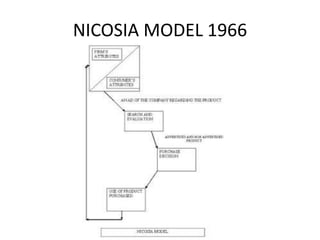
NICOSIA MODEL 1966
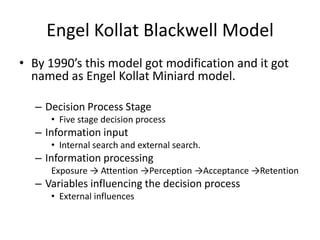
Engel Kollat Blackwell Model
• By 1990’s this model got modification and it got
  named as Engel Kollat Miniard model.

  – Decision Process Stage
     • Five stage decision process
  – Information input
     • Internal search and external search.
  – Information processing
     Exposure → Attention →Perception →Acceptance →Retention
  – Variables influencing the decision process
     • External influences
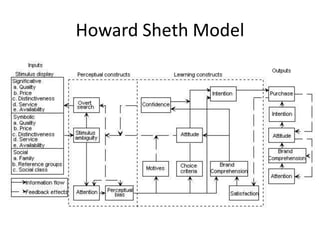
Howard Sheth Model
• Inputs
  – Significative stimuli – Price, Quality and availability.
  – Symbolic stimuli – Verbal and Visual traits
  – Social stimuli – family, reference group


• Processing of Inputs
  –   Stimulus Ambiguity
  –   Perceptual Bias
  –   Overt Search
  –   Learning Constructs – Brand comprehension, choice.
Perceptual Constructs
• All the information that is received may not
  merit `attention' and the intake is subject to
  perceived uncertainty and lack of
  meaningfulness of information received
  (stimulus ambiguity).
• This ambiguity may lead to an overt search for
  information about the product.
Sheth Newman Gross Model of
     Consumption Values

       Functional Value
          Social Value
       Emotional Value
        Epistemic Value
       Conditional Value
• Functional Value
  – Utilitarian function – Perceived satisfaction or
    dissatisfaction (Benefit) - happiness
  – Value Expressive function – use of the product
    (society)
  – Ego defensive function – consumers buy to defend
    their ego
  – Knowledge function – consumer get clarity with
    peers when they are in ambiguous situation.
• Emotional value
  – Emotions play a role in buying a product.
• Social value
  – Social image induces a person to buy a product.
• Epistemic Value
  – Set of values that satisfies their perceived satisfaction
    and dissatisfaction. Novelty of the product helps to
    sell the product
• Conditional Value
  – Situational factors induce the customer to buy the
    product
Consumer behavior Introduction with Models

Consumer behavior Introduction with Models

  • 1.
    CONSUMER BEHAVIOR By Balachandar K.
  • 2.
    Why study ConsumerBehavior? • The Consumer is King. • Only the Customer Can Fire Us All. • People are different. • Consumer behavior educates and protects consumers. • Consumer behavior helps formulate public policy. • Consumer behavior affects personal policy. Reference Book:- Consumer Behavior by Blackwell, Miniard and Engel
  • 3.
    • It’s helpfulin understanding needs. • Helps in defining markets and identifying threats and opportunities of a brand. • Segmentation becomes easy.
  • 4.
    What is consumerbehavior? “Consumer Behavior is the study of the process involved when individuals or groups select, purchase, dispose of products or services to satisfy needs and desires” It’s a combination of five disciplines – Psychology – Sociology – Anthropology – Economics – Marketing Management
  • 5.
    Who influence aconsumer?
  • 6.
    Obtaining • The activitythat leading up to and including purchase or receipt of a product. – How they get information? – How they decide what to buy? – Where you buy? – How you pay for it? – How you take it to their home?
  • 7.
    Meaning of Consumption “Peopledon’t buy products for what they do but for what they mean” Different types of relationship:- Self concept – user’s self image. Nostalgic attachment – past self Interdependence – part of users daily routine. Love – emotional bonds with the user. Reference book:- Consumer behavior buying, having and being. Author:- Solomon, Fifth edition.
  • 8.
    • How theyuse the product? • How they store they product in their home? • Who use the product? • How much they consume? • How they compare with expectations?
  • 9.
    Disposing • How theyget rid of remaining product? • How much they throw away after use? • How they recycle the product?
  • 10.
    Dark side ofconsumer behavior • Addictive consumption – Gambling, Alcohol, Drugs. • Compulsive consumption – Shopaholics, not by choice. • Consumed consumption – Consumers who are exploited. Eg) Adopting a baby, organ donors, blood donors. • Illegal activities – Theft. • Anti-consumption – People who create aversion towards a product eg) Burned lungs image, V-care shampoo ad.
  • 11.
    Mr. Bloomberg Story XeroxStory – Videos Resume tip #2
  • 12.
    Consumer Behavior Models TraditionalModels:- – Economic Model Contemporary Models:- – Consumer Decision Process Model – Black Box Model – Psychoanalytic Model – Learning Model – Sociological Model – Nicosia Model (1966) – Howard Sheth Model – Andreason Model (1965) – Engel Kollat Blackwell Model (1972) – Sheth Newman Gross Model (1991)
  • 13.
    Economic Model Micro economicmodel:- – Alfred Marshall ASSUMPTIONS:- - it’s not possible to satisfy customers, they have unlimited needs and wants - Customer allot budget to maximize the utility - No external influence, preference don’t change - Customers know the utility of a product hence they know the level of satisfaction. - Price determines the purchase. - Law of Diminishing Marginal Utility.
  • 14.
    Economic Model • MacroEconomic Model:- – Based on Monetary Value of the Goods. – James Duesenberry – people’s consumption is primarily governed by peers and social groups. – When people move up in the social class the consumption varies. – Milton Friedman (1957), people love to have a standard living.
  • 17.
    Stimulus Response Modelor Buyer Black box model
  • 18.
    Andreason Model (1965) •Message reaches consumer through Five basic sense. • Filtered by perception and attitude determines the purchase.
  • 19.
    Psychoanalytic Model • ID – It’s related to the Pleasure Principle. Needs should be satisfied else it will lead to tension and anxiety. – It’s satisfied by the Primary Process. • Ego – It works with Reality Principle, tries to satisfy the needs in realistic and socially appropriate ways. – It satisfies the need through Secondary Process • Super Ego – It hold all our moral acquired from the society and parents. It provides guidelines to make judgments. – Ego Ideal – rules and standards for good behavior. – The Conscience - information viewed as bad by parents and society.
  • 20.
  • 21.
  • 22.
  • 23.
    Engel Kollat BlackwellModel • By 1990’s this model got modification and it got named as Engel Kollat Miniard model. – Decision Process Stage • Five stage decision process – Information input • Internal search and external search. – Information processing Exposure → Attention →Perception →Acceptance →Retention – Variables influencing the decision process • External influences
  • 24.
  • 25.
    • Inputs – Significative stimuli – Price, Quality and availability. – Symbolic stimuli – Verbal and Visual traits – Social stimuli – family, reference group • Processing of Inputs – Stimulus Ambiguity – Perceptual Bias – Overt Search – Learning Constructs – Brand comprehension, choice.
  • 26.
    Perceptual Constructs • Allthe information that is received may not merit `attention' and the intake is subject to perceived uncertainty and lack of meaningfulness of information received (stimulus ambiguity). • This ambiguity may lead to an overt search for information about the product.
  • 27.
    Sheth Newman GrossModel of Consumption Values Functional Value Social Value Emotional Value Epistemic Value Conditional Value
  • 28.
    • Functional Value – Utilitarian function – Perceived satisfaction or dissatisfaction (Benefit) - happiness – Value Expressive function – use of the product (society) – Ego defensive function – consumers buy to defend their ego – Knowledge function – consumer get clarity with peers when they are in ambiguous situation.
  • 29.
    • Emotional value – Emotions play a role in buying a product. • Social value – Social image induces a person to buy a product. • Epistemic Value – Set of values that satisfies their perceived satisfaction and dissatisfaction. Novelty of the product helps to sell the product • Conditional Value – Situational factors induce the customer to buy the product