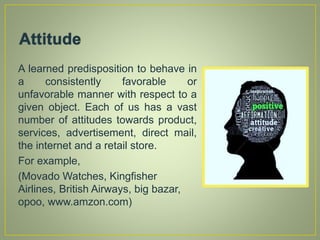
A learned predisposition to behave in
a consistently favorable or
unfavorable manner with respect to a
given object. Each of us has a vast
number of attitudes towards product,
services, advertisement, direct mail,
the internet and a retail store.
For example,
(Movado Watches, Kingfisher
Airlines, British Airways, big bazar,
opoo, www.amzon.com)
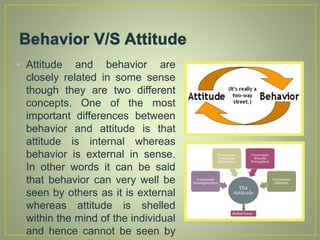
• Attitude and behavior are
closely related in some sense
though they are two different
concepts. One of the most
important differences between
behavior and attitude is that
attitude is internal whereas
behavior is external in sense.
In other words it can be said
that behavior can very well be
seen by others as it is external
whereas attitude is shelled
within the mind of the individual
and hence cannot be seen by
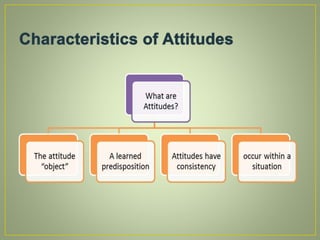
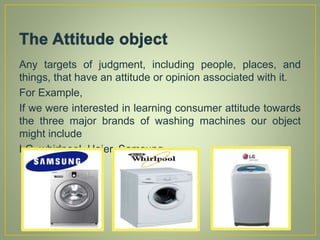
Any targets of judgment, including people, places, and
things, that have an attitude or opinion associated with it.
For Example,
If we were interested in learning consumer attitude towards
the three major brands of washing machines our object
might include
LG, whirlpool, Haier, Samsung.
A learned predisposition means attitude
have a motivational quality: that is, they
might propel a consumer towards a
particular behavior or repel the
consumer away from a particular
behavior.
For example,
This mean that attitude relevant to the
purchase behavior are formed as a
result of direct experience with the
product, W.O.M information acquired
from others, or exposure to mass
media advertising, the internet, and
various forms of direct marketing.
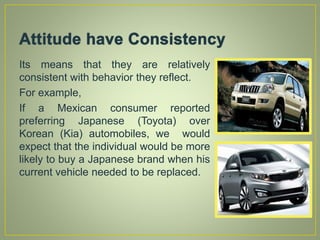
Its means that they are relatively
consistent with behavior they reflect.
For example,
If a Mexican consumer reported
preferring Japanese (Toyota) over
Korean (Kia) automobiles, we would
expect that the individual would be more
likely to buy a Japanese brand when his
current vehicle needed to be replaced.
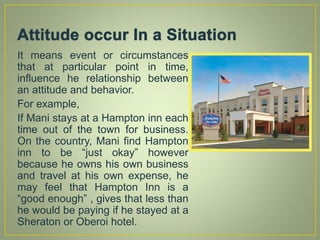
It means event or circumstances
that at particular point in time,
influence he relationship between
an attitude and behavior.
For example,
If Mani stays at a Hampton inn each
time out of the town for business.
On the country, Mani find Hampton
inn to be “just okay” however
because he owns his own business
and travel at his own expense, he
may feel that Hampton Inn is a
“good enough” , gives that less than
he would be paying if he stayed at a
Sheraton or Oberoi hotel.
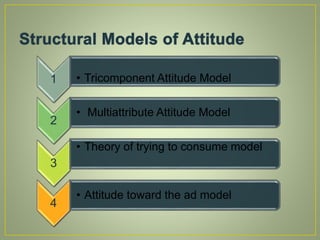
1 • Tricomponent Attitude Model
2
• Multiattribute Attitude Model
3
• Theory of trying to consume model
4
• Attitude toward the ad model
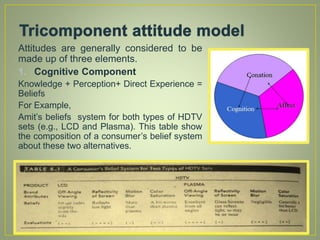
Attitudes are generally considered to be
made up of three elements.
1. Cognitive Component
Knowledge + Perception+ Direct Experience =
Beliefs
For Example,
Amit’s beliefs system for both types of HDTV
sets (e.g., LCD and Plasma). This table show
the composition of a consumer’s belief system
about these two alternatives.
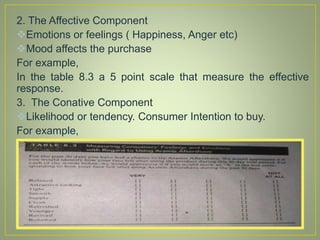
2. The Affective Component
Emotions or feelings ( Happiness, Anger etc)
Mood affects the purchase
For example,
In the table 8.3 a 5 point scale that measure the effective
response.
3. The Conative Component
Likelihood or tendency. Consumer Intention to buy.
For example,
“I will buy it”.
Attitude models that examine the composition of consumer
attitudes in terms of selected product attributes or beliefs.
Attitude Towards Object Model
Attitude is function of evaluation of product-specific beliefs
and evaluations.
For example,
HDTV sets (e.g., LCD and Plasma)
Attitude Towards Behavior Model
A model that proposes that a consumer’s attitude toward a
specific behavior is a function of how strongly he or she
believes that the action will lead to a specific outcome
(either favorable or unfavorable).
For Example,
Purchased a BMW.
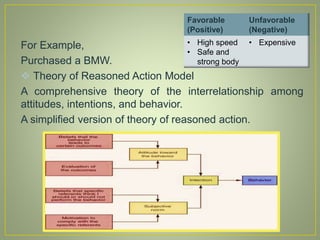
 Theory of Reasoned Action Model
A comprehensive theory of the interrelationship among
attitudes, intentions, and behavior.
A simplified version of theory of reasoned action.
Favorable
(Positive)
Unfavorable
(Negative)
• High speed
• Safe and
strong body
• Expensive
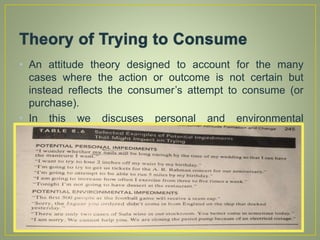
• An attitude theory designed to account for the many
cases where the action or outcome is not certain but
instead reflects the consumer’s attempt to consume (or
purchase).
• In this we discuses personal and environmental
Impediments as shown in figure.
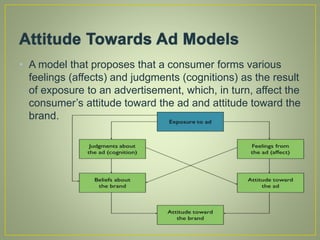
• A model that proposes that a consumer forms various
feelings (affects) and judgments (cognitions) as the result
of exposure to an advertisement, which, in turn, affect the
consumer’s attitude toward the ad and attitude toward the
brand.
How people form their initial general towards thing.
For example,
Young people their general attitude towards clothing they
wear under wear, casual wears, business atrive.
Attitude formation divided into three areas.
• How attitude are learned
• Sources of influence on attitude function
• Impact of personality on attitude
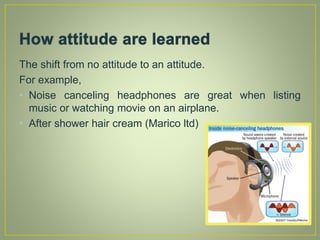
The shift from no attitude to an attitude.
For example,
• Noise canceling headphones are great when listing
music or watching movie on an airplane.
• After shower hair cream (Marico ltd)
• Personal Experience
• Influence of family
• Influence of friends
• Direct marketing
• Mass media
• Internet
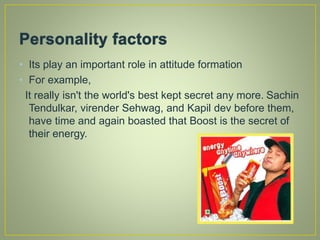
• Its play an important role in attitude formation
• For example,
It really isn't the world's best kept secret any more. Sachin
Tendulkar, virender Sehwag, and Kapil dev before them,
have time and again boasted that Boost is the secret of
their energy.
• Know a days marketer interested in product categories
especially when new product categories come into the
marketer
For example,
In 1970’s Digital watches when introduce not many
consumer are familiar to them new digital are well
accepted and consumer are familiar to the product
categories.
• Attitude changes are learned, they are influenced by
personal experience and other sources of information
and personality
• Altering consumer attitudes is key strategy consideration
for most marketers
• Marketers introduce special offers and other inducement
for consumer, so that they don’t switch to competitors
• Example Nike and tide
• Changing consumer’s basic motivational function
• Associating product with an admired group or event
• Resolving two conflicting attitudes
• Altering components of multiattribute model
• Changing consumer beliefs about competitor’s brands
Changing basic motivational
function
An effective strategy is to make particular needs
prominent.
Functional approach
• Utilitarian function
• Ego-defensive function
• Value-expressive function
• We hold certain brand attitudes partly because of brands
utility.
• When a product has been useful or helped us in past, our
attitude towards it tends to be favorable. Example of Nokia
mobile phones.
• High priced brands need to make consumers aware of
application of product whenever possible. For example brand
of dish washing.
Ego-defensive function
Most people want to protect their self-image from inner
feelings of doubt.
• They want to replace their uncertainty with a sense of security
and personal confidence.
For example
Ads for cosmetics and fashion clothing.
• During 1980’s, Colgate & double action lifebuoy plus used this
approach.
• If consumer segment generally holds a positive attitude toward
owning the latest designer jeans, then their attitudes towards
new brands of designer jeans are likely to reflect that
orientation.
• Charms cigarettes, launched during early 1980’s,created an
attitude based on “freedom and rebellion”
Knowledge function
• The consumer’s “need to know” a cognitive need is important
to marketers concerned with product positioning.
• Many products and brands are attempts to satisfy the need to
know consumer’s attitude.
For example
The vaccumizer was a new concept product used to preserve
food.
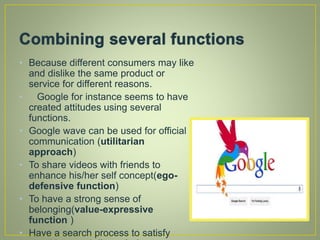
• Because different consumers may like
and dislike the same product or
service for different reasons.
• Google for instance seems to have
created attitudes using several
functions.
• Google wave can be used for official
communication (utilitarian
approach)
• To share videos with friends to
enhance his/her self concept(ego-
defensive function)
• To have a strong sense of
belonging(value-expressive
function )
• Have a search process to satisfy
• Attitudes are related, at least in part to certain groups,
social events, or causes.
• It is possible to alter attitudes toward companies and their
products by pointing out their relationships to particular
groups, events.
• For example: Aircel has partnered with world wildlife fund
India to create “save our tigers” initiative.
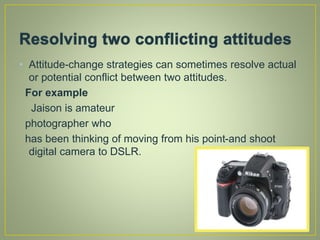
• Attitude-change strategies can sometimes resolve actual
or potential conflict between two attitudes.
For example
Jaison is amateur
photographer who
has been thinking of moving from his point-and shoot
digital camera to DSLR.
• Changing the relative evaluation of attributes.
• Changing brand beliefs.
• Adding an attributes.
• Changing the overall brand rating.
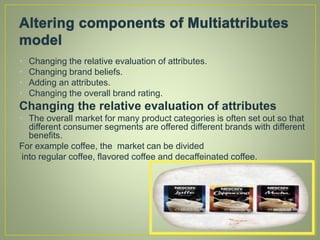
Changing the relative evaluation of attributes
• The overall market for many product categories is often set out so that
different consumer segments are offered different brands with different
benefits.
For example coffee, the market can be divided
into regular coffee, flavored coffee and decaffeinated coffee.
• A second cognitive-oriented strategy for
changing attitudes concentrates on
changing beliefs or perception about the
brand itself.
• This is by far the most common form of
advertising appeal.
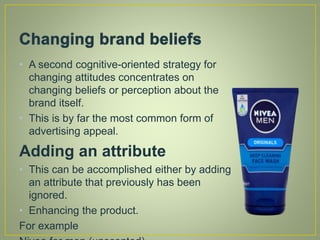
Adding an attribute
• This can be accomplished either by adding
an attribute that previously has been
ignored.
• Enhancing the product.
For example
• Still another cognitive-oriented strategy consists of
attempting to alter consumer’s overall assessment of
brand directly, without change their evaluation of any
single brand.
• Relies on some form of global statement “this is largest
selling brand”.
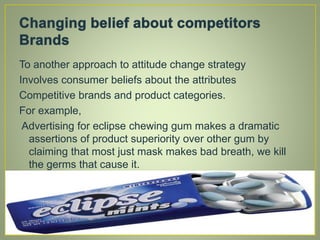
To another approach to attitude change strategy
Involves consumer beliefs about the attributes
Competitive brands and product categories.
For example,
Advertising for eclipse chewing gum makes a dramatic
assertions of product superiority over other gum by
claiming that most just mask makes bad breath, we kill
the germs that cause it.
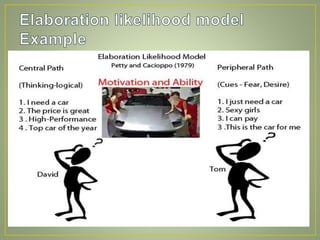
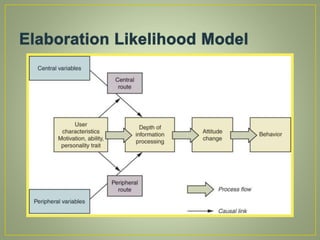
A theory that suggests that a person’s level of involvement
during ,message processing is a critical factor in
determining which route to persuasion is likely to be
effective.(see also central and peripheral routes to
persuasion.
Central Route & peripheral route
The central route is particularly relevant to attitude change
when consumer’s motivation or ability to assess the
attitude object is high(high involvement products)
Peripheral Route
consumer less motivated to think, learning through
repetition, visual cues, holistic perception.
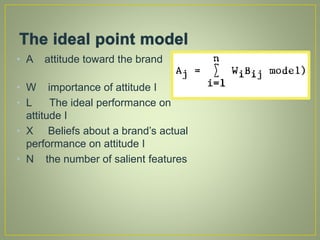
• A attitude toward the brand
• W importance of attitude I
• L The ideal performance on
attitude I
• X Beliefs about a brand’s actual
performance on attitude I
• N the number of salient features
• A model that captures consumer perception on the Ideal
brand(with ideal feature) and compares with consumer
perception on existing Brands.(associated with
demographic and Psychographic)
E.g If the model is applied to a brand of TV say ‘A’ the
following attributes can be identified.
• 1 picture Quality
• 2 audio quality
• 3 usefulness of special features
• 4 handling ease
• 5 esthetic appeal
• 6 compactness
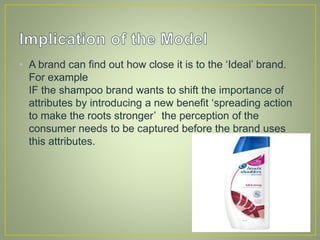
• A brand can find out how close it is to the ‘Ideal’ brand.
For example
IF the shampoo brand wants to shift the importance of
attributes by introducing a new benefit ‘spreading action
to make the roots stronger’ the perception of the
consumer needs to be captured before the brand uses
this attributes.
• Learning Objective
• To Understand how Consumers Attitudes can lead to
behavior and how behavior can lead to Attitude
• Attitude formation and attitude change has stressed that
consumers develop their attitudes before taking action
‘know what you doing before you do it’
• For analytical and Logical analysis we have Cognitive
Dissonance theory and Attribution Theory each provide
different explanation why behavior might precede attitude
formation
A Cognitive Dissonance Theory or dissonance or discomfort when a
consumer holds conflicting thoughts about a belief or an attitude
object.
For example
Consider someone who buys an expensive car but discovers that it is
not comfortable on long drives. Dissonance exists between their
beliefs that they have bought a good car and that a good car should
be comfortable. Dissonance could be eliminated by deciding that it
does not matter since the car is mainly used for short trips (reducing
the importance of the dissonant belief) or focusing on the cars
strengths such as safety, appearance, handling (thereby adding
more consonant beliefs). The dissonance could also be eliminated by
getting rid of the car, but this behavior is a lot harder to achieve than
changing beliefs
When a cognitive dissonance occurs after purchase it is called as
Post-purchase Dissonance. Because purchase decision often
require some amount of compromise, post purchase dissonance is
quite normal. The greatest dissonance is created when the two
• As a group of loosely interrelated social psychological
principles ,Attribution theory attempts to explain how people
assigns causality e.g blame or credit to events on the basis of
either their own behavior or the behavior of others. How do we
attach meaning to other's behavior, or our own? This is called
attribution theory. For example, if someone angry because
they are bad-tempered or because something bad happened ?
This process of making inferences about one’s own or another
behavior is a major component of attitude formation and
change .
• Attribution Theory is certainly part of our everyday life as
companies continue to have their name in football stadiums
and sponsor of all types of charitable events Research
indicates that the better the match between a sponsor and
event the more positive outcome is likely to be. There is an
evidence to suggest that consumers are willing to reward high
efforts firms. Appreciates the efforts of firms
Self-perception theory posits that people determine their
attitudes and preferences by interpreting the meaning of their
own behavior.
1. internal and external attribution consist on locus of control
etc.
2. The defensive attribution hypothesis (or defensive
attribution bias) is a social psychological term from the
attribution approach referring to a set of beliefs about who is
culpable in a given situation.
3. Foot-in-the-door (FITD) technique is a compliance tactic
that involves getting a person to agree to a large request by
first setting them up by having that person agree to a modest
request. The foot-in-the-door technique succeeds owing to a
basic human reality that social scientists call "successive
approximations"
• What are attitude
• Structural model of attitude
• Attitude Formation
• Strategies of attitude change
• Theory of attitude formation
Consumer Attitude Formation and Changes 1784

Consumer Attitude Formation and Changes 1784

  • 3.
    A learned predispositionto behave in a consistently favorable or unfavorable manner with respect to a given object. Each of us has a vast number of attitudes towards product, services, advertisement, direct mail, the internet and a retail store. For example, (Movado Watches, Kingfisher Airlines, British Airways, big bazar, opoo, www.amzon.com)
  • 5.
    • Attitude andbehavior are closely related in some sense though they are two different concepts. One of the most important differences between behavior and attitude is that attitude is internal whereas behavior is external in sense. In other words it can be said that behavior can very well be seen by others as it is external whereas attitude is shelled within the mind of the individual and hence cannot be seen by
  • 6.
    Any targets ofjudgment, including people, places, and things, that have an attitude or opinion associated with it. For Example, If we were interested in learning consumer attitude towards the three major brands of washing machines our object might include LG, whirlpool, Haier, Samsung.
  • 7.
    A learned predispositionmeans attitude have a motivational quality: that is, they might propel a consumer towards a particular behavior or repel the consumer away from a particular behavior. For example, This mean that attitude relevant to the purchase behavior are formed as a result of direct experience with the product, W.O.M information acquired from others, or exposure to mass media advertising, the internet, and various forms of direct marketing.
  • 8.
    Its means thatthey are relatively consistent with behavior they reflect. For example, If a Mexican consumer reported preferring Japanese (Toyota) over Korean (Kia) automobiles, we would expect that the individual would be more likely to buy a Japanese brand when his current vehicle needed to be replaced.
  • 9.
    It means eventor circumstances that at particular point in time, influence he relationship between an attitude and behavior. For example, If Mani stays at a Hampton inn each time out of the town for business. On the country, Mani find Hampton inn to be “just okay” however because he owns his own business and travel at his own expense, he may feel that Hampton Inn is a “good enough” , gives that less than he would be paying if he stayed at a Sheraton or Oberoi hotel.
  • 10.
    1 • TricomponentAttitude Model 2 • Multiattribute Attitude Model 3 • Theory of trying to consume model 4 • Attitude toward the ad model
  • 11.
    Attitudes are generallyconsidered to be made up of three elements. 1. Cognitive Component Knowledge + Perception+ Direct Experience = Beliefs For Example, Amit’s beliefs system for both types of HDTV sets (e.g., LCD and Plasma). This table show the composition of a consumer’s belief system about these two alternatives.
  • 12.
    2. The AffectiveComponent Emotions or feelings ( Happiness, Anger etc) Mood affects the purchase For example, In the table 8.3 a 5 point scale that measure the effective response. 3. The Conative Component Likelihood or tendency. Consumer Intention to buy. For example, “I will buy it”.
  • 13.
    Attitude models thatexamine the composition of consumer attitudes in terms of selected product attributes or beliefs. Attitude Towards Object Model Attitude is function of evaluation of product-specific beliefs and evaluations. For example, HDTV sets (e.g., LCD and Plasma) Attitude Towards Behavior Model A model that proposes that a consumer’s attitude toward a specific behavior is a function of how strongly he or she believes that the action will lead to a specific outcome (either favorable or unfavorable).
  • 14.
    For Example, Purchased aBMW.  Theory of Reasoned Action Model A comprehensive theory of the interrelationship among attitudes, intentions, and behavior. A simplified version of theory of reasoned action. Favorable (Positive) Unfavorable (Negative) • High speed • Safe and strong body • Expensive
  • 15.
    • An attitudetheory designed to account for the many cases where the action or outcome is not certain but instead reflects the consumer’s attempt to consume (or purchase). • In this we discuses personal and environmental Impediments as shown in figure.
  • 16.
    • A modelthat proposes that a consumer forms various feelings (affects) and judgments (cognitions) as the result of exposure to an advertisement, which, in turn, affect the consumer’s attitude toward the ad and attitude toward the brand.
  • 17.
    How people formtheir initial general towards thing. For example, Young people their general attitude towards clothing they wear under wear, casual wears, business atrive.
  • 18.
    Attitude formation dividedinto three areas. • How attitude are learned • Sources of influence on attitude function • Impact of personality on attitude
  • 19.
    The shift fromno attitude to an attitude. For example, • Noise canceling headphones are great when listing music or watching movie on an airplane. • After shower hair cream (Marico ltd)
  • 20.
    • Personal Experience •Influence of family • Influence of friends • Direct marketing • Mass media • Internet
  • 21.
    • Its playan important role in attitude formation • For example, It really isn't the world's best kept secret any more. Sachin Tendulkar, virender Sehwag, and Kapil dev before them, have time and again boasted that Boost is the secret of their energy.
  • 22.
    • Know adays marketer interested in product categories especially when new product categories come into the marketer For example, In 1970’s Digital watches when introduce not many consumer are familiar to them new digital are well accepted and consumer are familiar to the product categories.
  • 23.
    • Attitude changesare learned, they are influenced by personal experience and other sources of information and personality • Altering consumer attitudes is key strategy consideration for most marketers • Marketers introduce special offers and other inducement for consumer, so that they don’t switch to competitors • Example Nike and tide
  • 24.
    • Changing consumer’sbasic motivational function • Associating product with an admired group or event • Resolving two conflicting attitudes • Altering components of multiattribute model • Changing consumer beliefs about competitor’s brands Changing basic motivational function An effective strategy is to make particular needs prominent. Functional approach • Utilitarian function • Ego-defensive function • Value-expressive function
  • 25.
    • We holdcertain brand attitudes partly because of brands utility. • When a product has been useful or helped us in past, our attitude towards it tends to be favorable. Example of Nokia mobile phones. • High priced brands need to make consumers aware of application of product whenever possible. For example brand of dish washing. Ego-defensive function Most people want to protect their self-image from inner feelings of doubt. • They want to replace their uncertainty with a sense of security and personal confidence. For example Ads for cosmetics and fashion clothing. • During 1980’s, Colgate & double action lifebuoy plus used this approach.
  • 26.
    • If consumersegment generally holds a positive attitude toward owning the latest designer jeans, then their attitudes towards new brands of designer jeans are likely to reflect that orientation. • Charms cigarettes, launched during early 1980’s,created an attitude based on “freedom and rebellion” Knowledge function • The consumer’s “need to know” a cognitive need is important to marketers concerned with product positioning. • Many products and brands are attempts to satisfy the need to know consumer’s attitude. For example The vaccumizer was a new concept product used to preserve food.
  • 27.
    • Because differentconsumers may like and dislike the same product or service for different reasons. • Google for instance seems to have created attitudes using several functions. • Google wave can be used for official communication (utilitarian approach) • To share videos with friends to enhance his/her self concept(ego- defensive function) • To have a strong sense of belonging(value-expressive function ) • Have a search process to satisfy
  • 28.
    • Attitudes arerelated, at least in part to certain groups, social events, or causes. • It is possible to alter attitudes toward companies and their products by pointing out their relationships to particular groups, events. • For example: Aircel has partnered with world wildlife fund India to create “save our tigers” initiative.
  • 29.
    • Attitude-change strategiescan sometimes resolve actual or potential conflict between two attitudes. For example Jaison is amateur photographer who has been thinking of moving from his point-and shoot digital camera to DSLR.
  • 30.
    • Changing therelative evaluation of attributes. • Changing brand beliefs. • Adding an attributes. • Changing the overall brand rating. Changing the relative evaluation of attributes • The overall market for many product categories is often set out so that different consumer segments are offered different brands with different benefits. For example coffee, the market can be divided into regular coffee, flavored coffee and decaffeinated coffee.
  • 31.
    • A secondcognitive-oriented strategy for changing attitudes concentrates on changing beliefs or perception about the brand itself. • This is by far the most common form of advertising appeal. Adding an attribute • This can be accomplished either by adding an attribute that previously has been ignored. • Enhancing the product. For example
  • 32.
    • Still anothercognitive-oriented strategy consists of attempting to alter consumer’s overall assessment of brand directly, without change their evaluation of any single brand. • Relies on some form of global statement “this is largest selling brand”.
  • 33.
    To another approachto attitude change strategy Involves consumer beliefs about the attributes Competitive brands and product categories. For example, Advertising for eclipse chewing gum makes a dramatic assertions of product superiority over other gum by claiming that most just mask makes bad breath, we kill the germs that cause it.
  • 34.
    A theory thatsuggests that a person’s level of involvement during ,message processing is a critical factor in determining which route to persuasion is likely to be effective.(see also central and peripheral routes to persuasion. Central Route & peripheral route The central route is particularly relevant to attitude change when consumer’s motivation or ability to assess the attitude object is high(high involvement products) Peripheral Route consumer less motivated to think, learning through repetition, visual cues, holistic perception.
  • 37.
    • A attitudetoward the brand • W importance of attitude I • L The ideal performance on attitude I • X Beliefs about a brand’s actual performance on attitude I • N the number of salient features
  • 38.
    • A modelthat captures consumer perception on the Ideal brand(with ideal feature) and compares with consumer perception on existing Brands.(associated with demographic and Psychographic) E.g If the model is applied to a brand of TV say ‘A’ the following attributes can be identified. • 1 picture Quality • 2 audio quality • 3 usefulness of special features • 4 handling ease • 5 esthetic appeal • 6 compactness
  • 39.
    • A brandcan find out how close it is to the ‘Ideal’ brand. For example IF the shampoo brand wants to shift the importance of attributes by introducing a new benefit ‘spreading action to make the roots stronger’ the perception of the consumer needs to be captured before the brand uses this attributes.
  • 40.
    • Learning Objective •To Understand how Consumers Attitudes can lead to behavior and how behavior can lead to Attitude • Attitude formation and attitude change has stressed that consumers develop their attitudes before taking action ‘know what you doing before you do it’ • For analytical and Logical analysis we have Cognitive Dissonance theory and Attribution Theory each provide different explanation why behavior might precede attitude formation
  • 41.
    A Cognitive DissonanceTheory or dissonance or discomfort when a consumer holds conflicting thoughts about a belief or an attitude object. For example Consider someone who buys an expensive car but discovers that it is not comfortable on long drives. Dissonance exists between their beliefs that they have bought a good car and that a good car should be comfortable. Dissonance could be eliminated by deciding that it does not matter since the car is mainly used for short trips (reducing the importance of the dissonant belief) or focusing on the cars strengths such as safety, appearance, handling (thereby adding more consonant beliefs). The dissonance could also be eliminated by getting rid of the car, but this behavior is a lot harder to achieve than changing beliefs When a cognitive dissonance occurs after purchase it is called as Post-purchase Dissonance. Because purchase decision often require some amount of compromise, post purchase dissonance is quite normal. The greatest dissonance is created when the two
  • 42.
    • As agroup of loosely interrelated social psychological principles ,Attribution theory attempts to explain how people assigns causality e.g blame or credit to events on the basis of either their own behavior or the behavior of others. How do we attach meaning to other's behavior, or our own? This is called attribution theory. For example, if someone angry because they are bad-tempered or because something bad happened ? This process of making inferences about one’s own or another behavior is a major component of attitude formation and change . • Attribution Theory is certainly part of our everyday life as companies continue to have their name in football stadiums and sponsor of all types of charitable events Research indicates that the better the match between a sponsor and event the more positive outcome is likely to be. There is an evidence to suggest that consumers are willing to reward high efforts firms. Appreciates the efforts of firms
  • 43.
    Self-perception theory positsthat people determine their attitudes and preferences by interpreting the meaning of their own behavior. 1. internal and external attribution consist on locus of control etc. 2. The defensive attribution hypothesis (or defensive attribution bias) is a social psychological term from the attribution approach referring to a set of beliefs about who is culpable in a given situation. 3. Foot-in-the-door (FITD) technique is a compliance tactic that involves getting a person to agree to a large request by first setting them up by having that person agree to a modest request. The foot-in-the-door technique succeeds owing to a basic human reality that social scientists call "successive approximations"
  • 44.
    • What areattitude • Structural model of attitude • Attitude Formation • Strategies of attitude change • Theory of attitude formation