Submitted By: Parminder Kaur
BRAND
• MEANING:
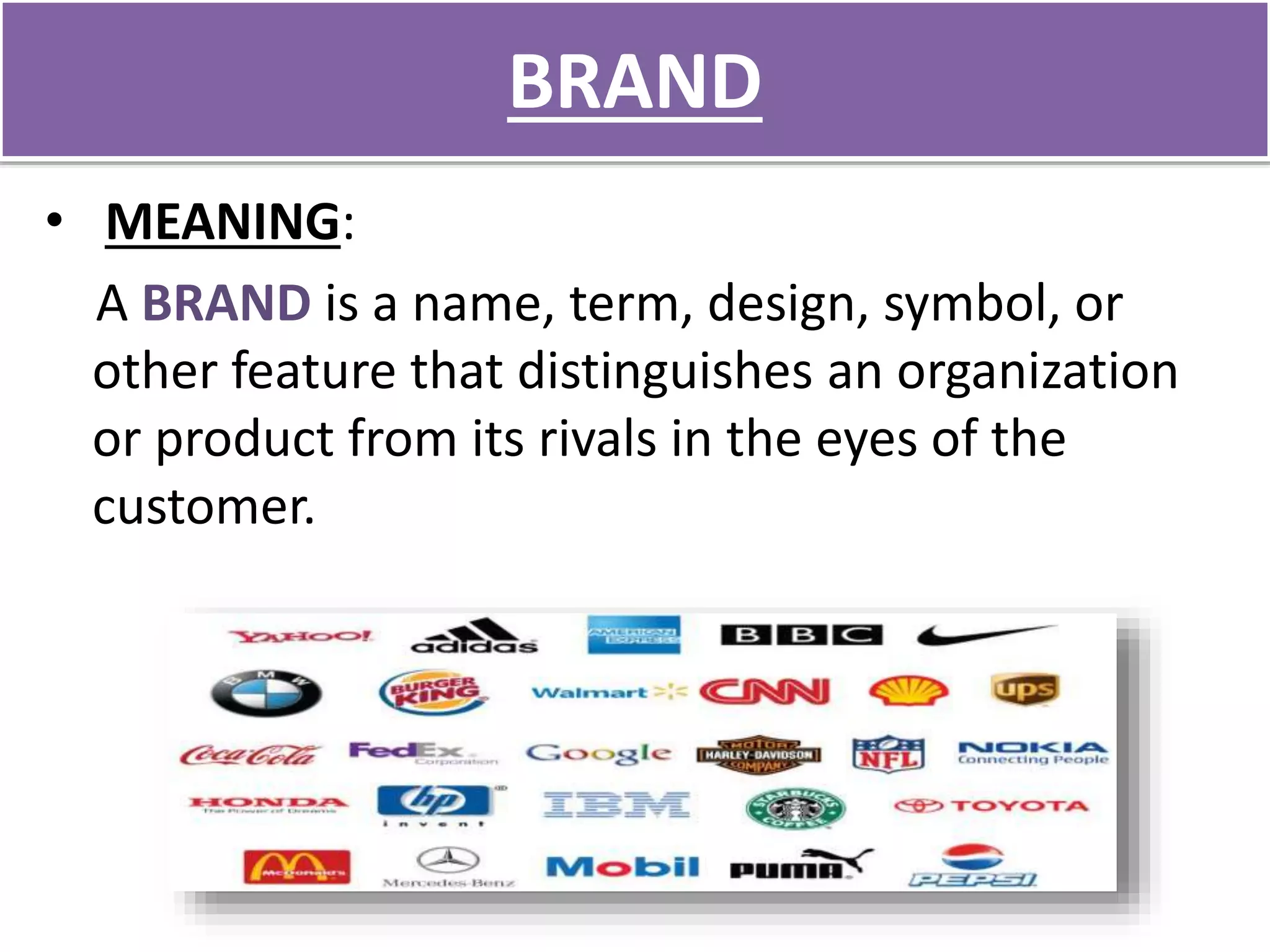
A BRAND is a name, term, design, symbol, or
other feature that distinguishes an organization
or product from its rivals in the eyes of the
customer.
BRAND PYRAMID
Emotional
involvement
Mark of
association
Moments of choice
Mark of assurance
Mark of specification
FUNCTIONS OF BRAND
Functions of brand to consumers:
 Identification of source of product
 Assignment of responsibility to maker
 Risk reducer
 Search cost reducer
 Promise/deal/bond with maker/product
 Symbolic device
 Signal of quality
Functions of brand to firms/business:
 Simplify handling/tracing
 Mean of legal protection
 Signal of quality level
 Source of competitive advantage
 Source of financial returns
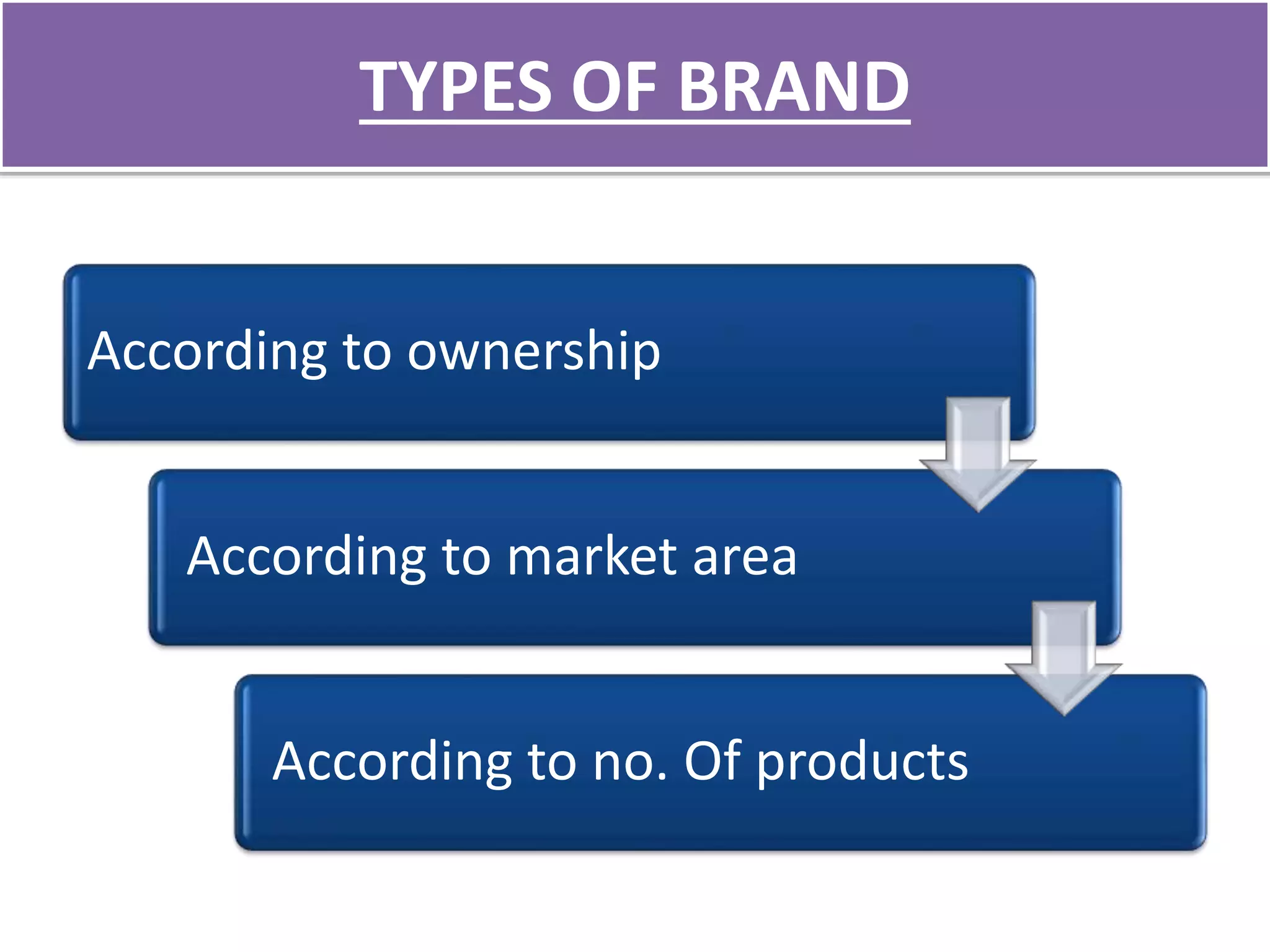
TYPES OF BRAND
According to ownership
According to market area
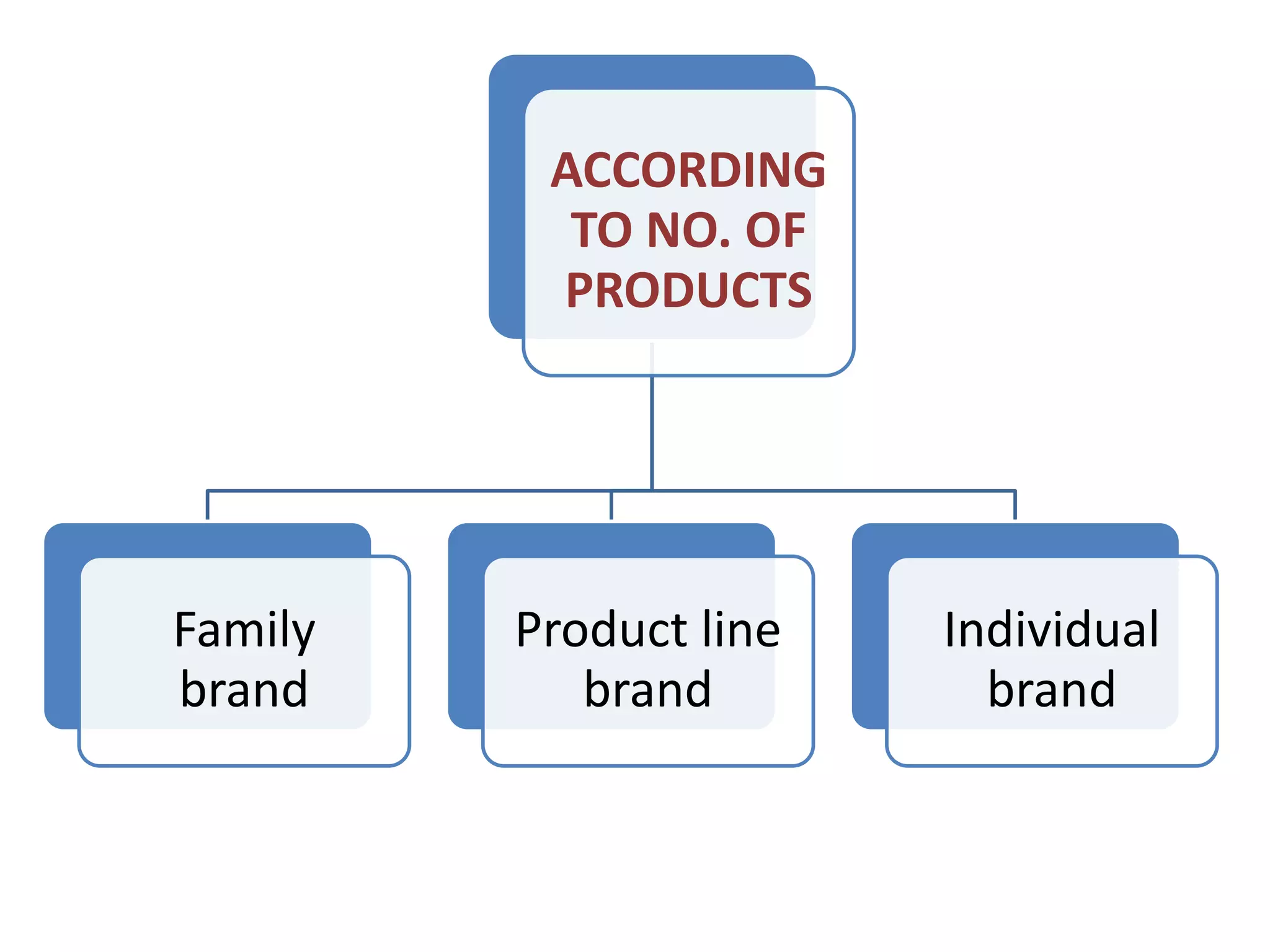
According to no. Of products
ACCORDING
TO
OWNERSHIP
Manufacturer’s
brand
Middlemen’s
brand
• MANUFACTURER’S BRAND:
When brand is named after the name of
manufacturer of the brand.
• MIDDLEMEN’S BRAND:
Under this, manufacturer doesn’t use any
brand for his product; instead, middlemen sell
the product under his name.
ACCORDING
TO MARKET
AREA
Local
brand
Provincial
brand
Regional
brand
National
brand
Inter-
national
brand
• LOCAL BRAND:
when brands are used for local market
• PROVINCIAL BRAND:
when one brand is used for a particular province or state
• REGIONAL BRAND:
when brand is used for a particular region
• NATIONAL BRAND:
when brand is used for selling the product throughout a particular
country
• INTERNATIONAL BRAND:
when brand is used for selling the product in international
markets
ACCORDING
TO NO. OF
PRODUCTS
Family
brand
Product line
brand
Individual
brand
• FAMILY BRAND:
When a manufacturer uses a single brand for all his
products and in all market segments.
Example: all the products of Bajaj group
• PRODUCT LINE BRAND:
When the business or industrial houses use different
brand names for their different product lines.
For example: Dalda is used for Banaspati Ghee
product line
• INDIVIDUAL BRAND:
When individual product is marketed under
different brand names, produces by the same
manufacturer.
For Example: Hindustan Liver Limited bear different
brands for the different products in the same
product line i.e. Lux, Lifeboy, Rexona etc.
BRAND HIERARCHY
• MEANING:
A brand hierarchy is a means of summarizing the
branding strategy by displaying the number and
nature of common and distinctive brand elements
across the firm’s products, revealing the explicit
ordering of brand elements.
BRAND HIERARCHY
Brand hierarchy
Corporate
brand
Family
brand
Individual
brand
Modifiers
Corporate Branding
• It is the practice of using a company’s name
as a product brand name.
• Example: IBM, Heinz, Coca-Cola
Family Brand
• When a group of products are given the same
brand name. I.E. Different products of
company are marketed under one name.
• Example: AMUL--- Amul milk, Amul butter,
Amul cream
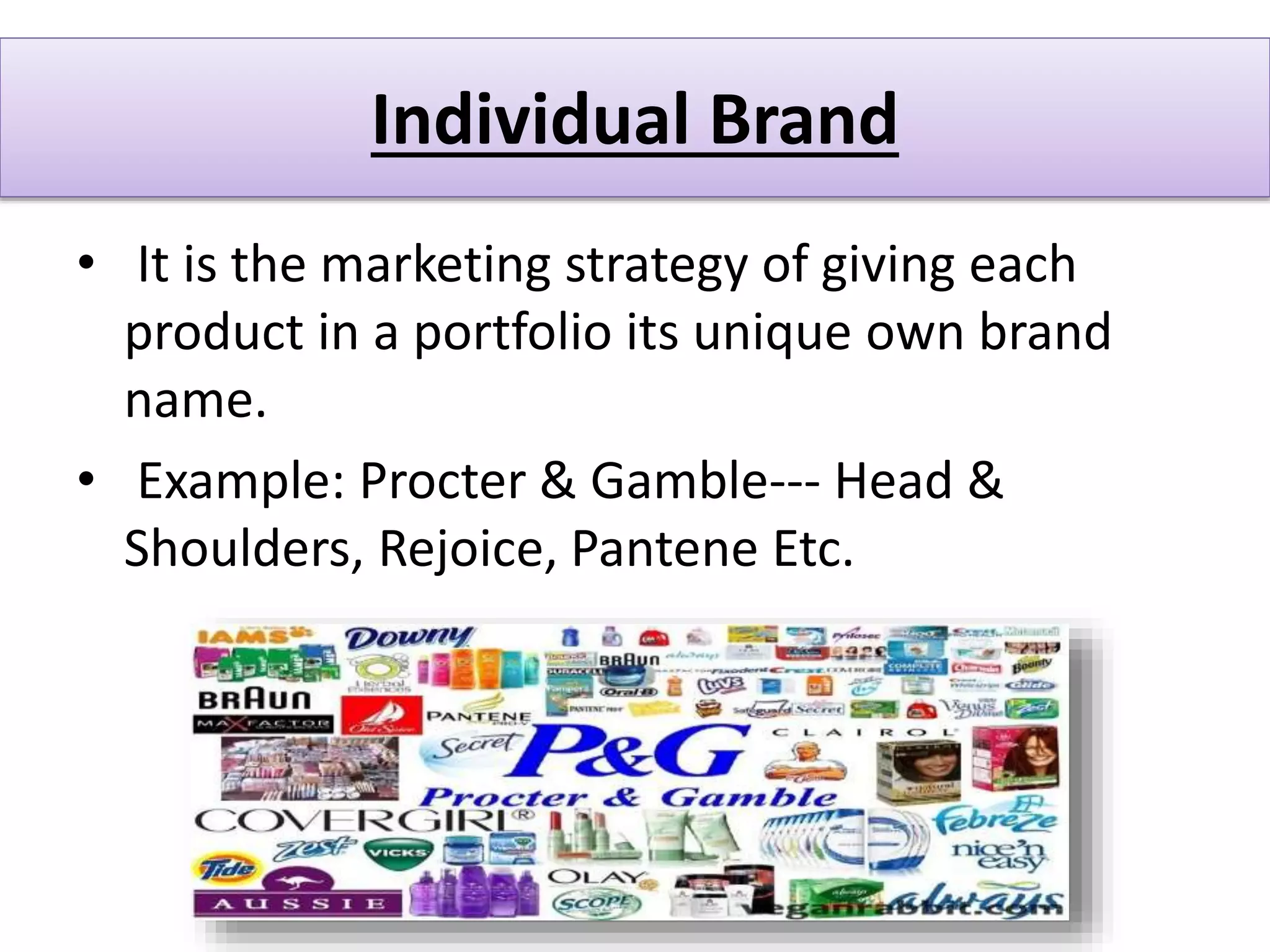
Individual Brand
• It is the marketing strategy of giving each
product in a portfolio its unique own brand
name.
• Example: Procter & Gamble--- Head &
Shoulders, Rejoice, Pantene Etc.
Modifiers
• It refers to word, phrase or clause that
functions as an adjective or adverb to qualify
the meaning of other word.
BRANDING
• MEANING:
The process involved in creating a unique name and
image for a product in the consumers' mind, mainly
through advertising campaigns with a consistent theme.
Branding aims to establish a significant and
differentiated presence in the market that attracts and
retains loyal customers.
BRANDING STRATEGIES
• Integrated Branding
• Independent Branding
• Line Branding
• Range Branding
• Umbrella Branding
• Endorsement Branding
• Integrated Branding:
Here, the retailer makes the decision regarding
what kind of product he wants
• Independent Branding:
Here, retailer is like the owner of the brand and
holds complete responsibility for its performance
• Line Branding:
The line responds to the concern of offering one
coherent response under a single name by
proposing many complementary products
• Range Branding:
It bestow a single brand name and promote
through a single promise a range of products
belonging to the same area of competence
• Umbrella Branding:
It is a parent brand that appears on a no. of
products that may each have separate brand
images
• Endorsement Branding:
It makes the product brand name more
significant and corporate brand name is related
to lesser status
brand/branding/brand hierarchy

brand/branding/brand hierarchy

  • 1.
  • 2.
    BRAND • MEANING: A BRANDis a name, term, design, symbol, or other feature that distinguishes an organization or product from its rivals in the eyes of the customer.
  • 3.
    BRAND PYRAMID Emotional involvement Mark of association Momentsof choice Mark of assurance Mark of specification
  • 4.
    FUNCTIONS OF BRAND Functionsof brand to consumers:  Identification of source of product  Assignment of responsibility to maker  Risk reducer  Search cost reducer  Promise/deal/bond with maker/product  Symbolic device  Signal of quality
  • 5.
    Functions of brandto firms/business:  Simplify handling/tracing  Mean of legal protection  Signal of quality level  Source of competitive advantage  Source of financial returns
  • 6.
    TYPES OF BRAND Accordingto ownership According to market area According to no. Of products
  • 7.
  • 8.
    • MANUFACTURER’S BRAND: Whenbrand is named after the name of manufacturer of the brand. • MIDDLEMEN’S BRAND: Under this, manufacturer doesn’t use any brand for his product; instead, middlemen sell the product under his name.
  • 9.
  • 10.
    • LOCAL BRAND: whenbrands are used for local market • PROVINCIAL BRAND: when one brand is used for a particular province or state • REGIONAL BRAND: when brand is used for a particular region • NATIONAL BRAND: when brand is used for selling the product throughout a particular country • INTERNATIONAL BRAND: when brand is used for selling the product in international markets
  • 11.
  • 12.
    • FAMILY BRAND: Whena manufacturer uses a single brand for all his products and in all market segments. Example: all the products of Bajaj group • PRODUCT LINE BRAND: When the business or industrial houses use different brand names for their different product lines. For example: Dalda is used for Banaspati Ghee product line
  • 13.
    • INDIVIDUAL BRAND: Whenindividual product is marketed under different brand names, produces by the same manufacturer. For Example: Hindustan Liver Limited bear different brands for the different products in the same product line i.e. Lux, Lifeboy, Rexona etc.
  • 14.
    BRAND HIERARCHY • MEANING: Abrand hierarchy is a means of summarizing the branding strategy by displaying the number and nature of common and distinctive brand elements across the firm’s products, revealing the explicit ordering of brand elements.
  • 15.
  • 16.
    Corporate Branding • Itis the practice of using a company’s name as a product brand name. • Example: IBM, Heinz, Coca-Cola
  • 17.
    Family Brand • Whena group of products are given the same brand name. I.E. Different products of company are marketed under one name. • Example: AMUL--- Amul milk, Amul butter, Amul cream
  • 18.
    Individual Brand • Itis the marketing strategy of giving each product in a portfolio its unique own brand name. • Example: Procter & Gamble--- Head & Shoulders, Rejoice, Pantene Etc.
  • 19.
    Modifiers • It refersto word, phrase or clause that functions as an adjective or adverb to qualify the meaning of other word.
  • 20.
    BRANDING • MEANING: The processinvolved in creating a unique name and image for a product in the consumers' mind, mainly through advertising campaigns with a consistent theme. Branding aims to establish a significant and differentiated presence in the market that attracts and retains loyal customers.
  • 21.
    BRANDING STRATEGIES • IntegratedBranding • Independent Branding • Line Branding • Range Branding • Umbrella Branding • Endorsement Branding
  • 22.
    • Integrated Branding: Here,the retailer makes the decision regarding what kind of product he wants • Independent Branding: Here, retailer is like the owner of the brand and holds complete responsibility for its performance • Line Branding: The line responds to the concern of offering one coherent response under a single name by proposing many complementary products
  • 23.
    • Range Branding: Itbestow a single brand name and promote through a single promise a range of products belonging to the same area of competence • Umbrella Branding: It is a parent brand that appears on a no. of products that may each have separate brand images • Endorsement Branding: It makes the product brand name more significant and corporate brand name is related to lesser status