
UNIT 1
INTRODUCTION TO
CONSUMER
BEHAVIOUR
PROF. MAHUA MUKHERJEE
CONCEPT
• Consumers are those individuals who purchase commodities
for deriving utilities and using them to satisfy their needs.
• Behaviour is defined as “the series of innumerable responses
potrayed by individuals.”
CONSUMER BEHAVIOUR IS DEFINED AS THAT PROCESS BY
WHICH INDIVIDUALS OR GROUPS SELECT, PURCHASE,
OBTAIN,USE,ADOPT OR DISPOSE OFF THE PRODUCTS TO
SATISFY THEIR NEEDS AND DESIRES.
It is a sumtotal of all the actions directly involved in obtaining,
consuming and disposing off products both goods & services
including the decision making process which proceeds and
follow these actions.
• The consumers or buyers are the highly complex entity in the
field of marketing management.
• Their needs and desires are innumerable and may vary from –
security needs to aesthetic needs
Some needs are latent
Some needs are manifested
Some needs are dominant
• Some needs of an individual can be met with money
• Many needs remained beyond realisation.
DEFINITIONS
• According to KOTLER & ARMSTRONG
“The buying behaviour of final consumers, individuals and
households who buys goods and services for personal
consumption.”
• According to ENGEL,BLACKWELL & MANSARD
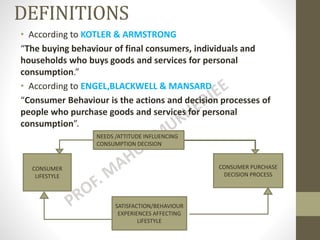
“Consumer Behaviour is the actions and decision processes of
people who purchase goods and services for personal
consumption”.
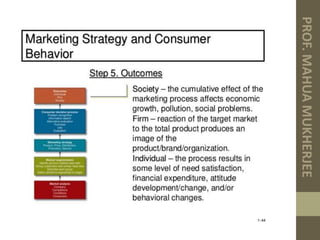
NEEDS /ATTITUDE INFLUENCING
CONSUMPTION DECISION
CONSUMER
LIFESTYLE
SATISFACTION/BEHAVIOUR
EXPERIENCES AFFECTING
LIFESTYLE
CONSUMER PURCHASE
DECISION PROCESS
• Every buyer everyday is exposed to a world full of information -
NEW PRODUCTS
NEW SERVICES
NEW USES FOR AN EXISTING PRODUCT
NEW IDEAS
NEW STYLES
• SELECTIVE PERCEPTION is the mechanism which helps the consumers
retain relevant information constantly.
• Human behaviour is changing constantly affecting an individual’s
purchase decision.
• The buyer/consumers may not follow any rigid rules while taking the
purchase decisions.
• Consumers are the most dynamic element and most difficult to
manage.
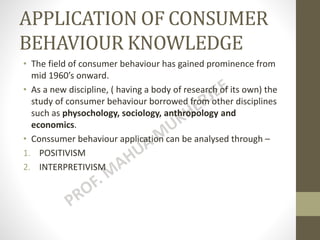
APPLICATION OF CONSUMER
BEHAVIOUR KNOWLEDGE
• The field of consumer behaviour has gained prominence from
mid 1960’s onward.
• As a new discipline, ( having a body of research of its own) the
study of consumer behaviour borrowed from other disciplines
such as physochology, sociology, anthropology and
economics.
• Conssumer behaviour application can be analysed through –
1. POSITIVISM
2. INTERPRETIVISM
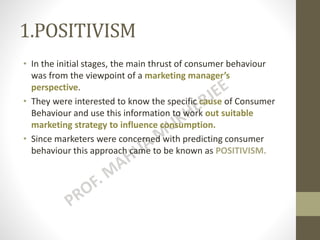
1.POSITIVISM
• In the initial stages, the main thrust of consumer behaviour
was from the viewpoint of a marketing manager’s
perspective.
• They were interested to know the specific cause of Consumer
Behaviour and use this information to work out suitable
marketing strategy to influence consumption.
• Since marketers were concerned with predicting consumer
behaviour this approach came to be known as POSITIVISM.
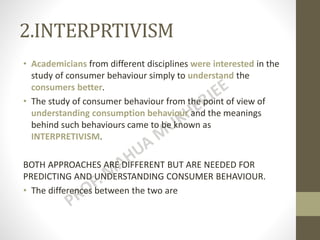
2.INTERPRTIVISM
• Academicians from different disciplines were interested in the
study of consumer behaviour simply to understand the
consumers better.
• The study of consumer behaviour from the point of view of
understanding consumption behaviour and the meanings
behind such behaviours came to be known as
INTERPRETIVISM.
BOTH APPROACHES ARE DIFFERENT BUT ARE NEEDED FOR
PREDICTING AND UNDERSTANDING CONSUMER BEHAVIOUR.
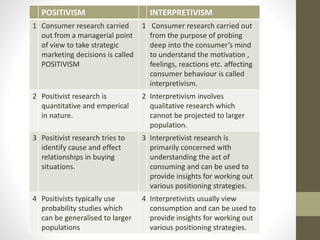
• The differences between the two are
POSITIVISM INTERPRETIVISM
1 Consumer research carried
out from a managerial point
of view to take strategic
marketing decisions is called
POSITIVISM
1 Consumer research carried out
from the purpose of probing
deep into the consumer’s mind
to understand the motivation ,
feelings, reactions etc. affecting
consumer behaviour is called
interpretivism.
2 Positivist research is
quantitative and emperical
in nature.
2 Interpretivism involves
qualitative research which
cannot be projected to larger
population.
3 Positivist research tries to
identify cause and effect
relationships in buying
situations.
3 Interpretivist research is
primarily concerned with
understanding the act of
consuming and can be used to
provide insights for working out
various positioning strategies.
4 Positivists typically use
probability studies which
can be generalised to larger
populations
4 Interpretivists usually view
consumption and can be used to
provide insights for working out
various positioning strategies.
The dynamic interaction of cognition,behaviour and
environmental events by which human beings
conduct the exchange aspects of their lives
(American Marketing Association)
A discipline dealing with how and why consumers
purchase (or don’t purchase) products and services
Those behaviours performed by decisionmaking
units in the purchase, usage and disposal of goods
and services.(Kotler & Levy)
Applications of Consumer Behavior
&Marketing Strategy
Marketing strategies and tactics are based on explicit or
implicit beliefs about consumer behavior.
Decisions based on explicit assumptions and sound theory
and research are more likely to be successful than are
decisions based solely on implicit intuition.
Knowledge of consumer behavior can be an important
competitive advantage and can greatly reduce the odds of
bad decisions and market failures!
PROF.MAHUAMUKHERJEE
PROF.MAHUAMUKHERJEE
PROF.MAHUAMUKHERJEE
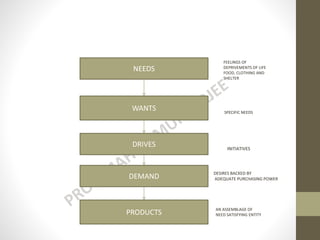
NEEDS
WANTS
DRIVES
DEMAND
PRODUCTS
FEELINGS OF
DEPRIVEMENTS OF LIFE
FOOD, CLOTHING AND
SHELTER
SPECIFIC NEEDS
INITIATIVES
DESIRES BACKED BY
ADEQUATE PURCHASING POWER
AN ASSEMBLAGE OF
NEED SATISFYING ENTITY
NEEDS
People start companies to satisfy consumer needs.
Marketing helps companies make consumers aware of
these products and services,
Marketing is made up of all the processes involved in
getting products into the consumer's hands.
Companies must ensure that the consumer's needs and
their marketing strategies are well-suited.
MOTIVATION
A psychologist has described the study of motivation as covering
al those things which are biological, social and psychological and
that they defeat our lazyness and move us either eagerly or
reluctantly to action.
According to Kreitner (1995), motivation has been
defined as:
“The psychological process that gives behavior purpose
and direction.”
Dalton E. McFarland (1974) stated that:
“Motivation refers to the way in which urges, drives,
desires, aspirations, and strivings or needs direct,
control or explain the behaviour of human beings.”
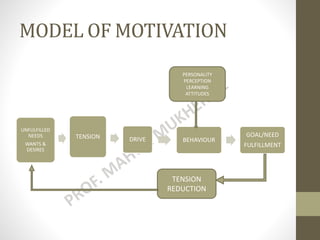
MODEL OF MOTIVATION
UNFULFILLED
NEEDS
WANTS &
DESIRES
TENSION DRIVE BEHAVIOUR
GOAL/NEED
FULFILLMENT
PERSONALITY
PERCEPTION
LEARNING
ATTITUDES
TENSION
REDUCTION
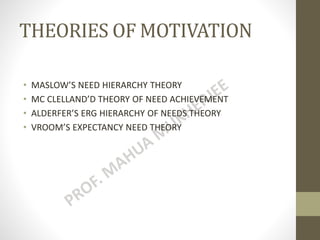
THEORIES OF MOTIVATION
• MASLOW’S NEED HIERARCHY THEORY
• MC CLELLAND’D THEORY OF NEED ACHIEVEMENT
• ALDERFER’S ERG HIERARCHY OF NEEDS THEORY
• VROOM’S EXPECTANCY NEED THEORY
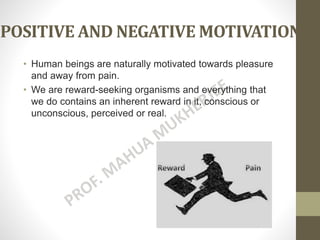
POSITIVE AND NEGATIVE MOTIVATION
• Human beings are naturally motivated towards pleasure
and away from pain.
• We are reward-seeking organisms and everything that
we do contains an inherent reward in it, conscious or
unconscious, perceived or real.
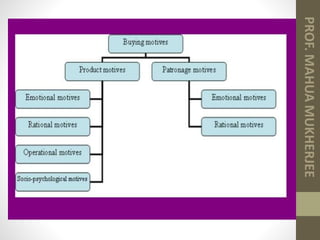
EMOTIONAL AND RATIONAL
MOTIVES
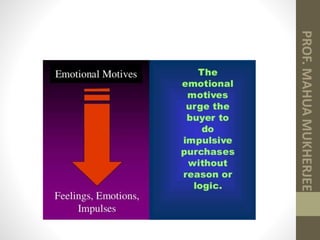
• Emotional Motives
Emotional motives are motives based on personal or
subjective criteria. They are feelings experienced by a
customer through associtation.
• Where as emotional motives ‘imply the selection of goods
fitting to personal or subjective criteria such as’:
• Pride
• Fear
• Desire for individuality
• Affection
• Status
• Vanity
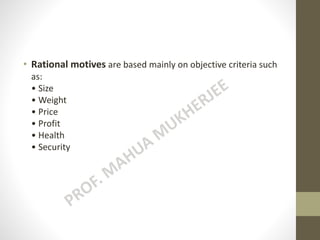
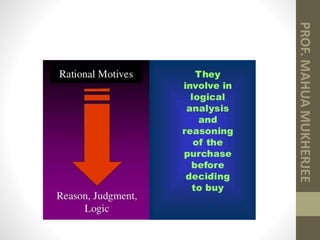
• Rational motives are based mainly on objective criteria such
as:
• Size
• Weight
• Price
• Profit
• Health
• Security
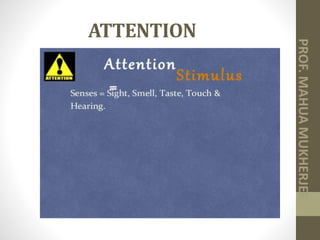
ATTENTION
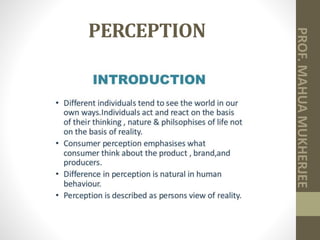
PERCEPTION
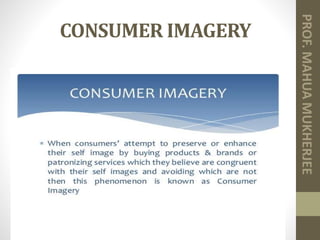
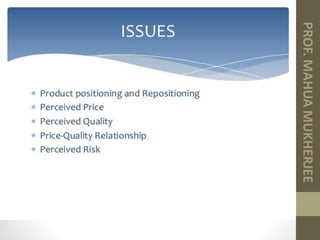
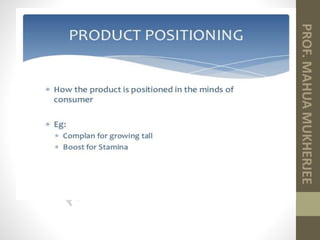
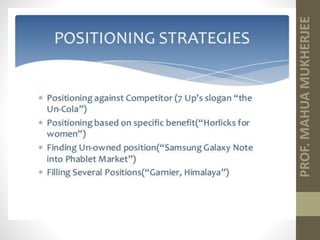
CONSUMER IMAGERY
"Everythingwe do startswithknowing
a client'sbusinessinsideout. That's the
keyto anticipatingtheir needs, to
solvingtheirproblems, to bringing
themopportunitiestheymightnotfind
ontheir own."
C J. P. Morgan
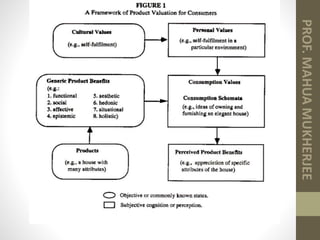
CONSUMER VALUES AND LIFESTYLES
• Consumer value is used to describe
a consumer's strong relative preference for
certain subjectively evaluated product or service
attribute.
• These values include efficiency, excellence,
status, esteem, play, aesthetics, ethics and
spirituality.
• Customer value, which is linked closely to customer
satisfaction and loyalty, is a critical aspect of
today’s effective marketing strategies.
• Businesses need to research and consider what
customers care about in order to deliver products and
services on which they want to spend their money.
• To get ahead of the cut-throat competition they face in
the market, businesses need to take into account what
their well-informed customers are thinking and feeling.
• Only by doing so can businesses enhance customer
value.
• Consumer value can refer to what the product is worth
to the customer and also what the customer is worth to
the business over his lifetime of engagement.
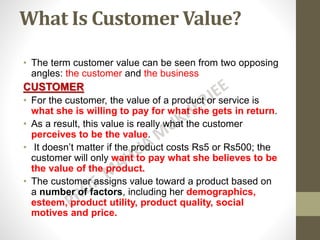
What Is Customer Value?
• The term customer value can be seen from two opposing
angles: the customer and the business
CUSTOMER
• For the customer, the value of a product or service is
what she is willing to pay for what she gets in return.
• As a result, this value is really what the customer
perceives to be the value.
• It doesn’t matter if the product costs Rs5 or Rs500; the
customer will only want to pay what she believes to be
the value of the product.
• The customer assigns value toward a product based on
a number of factors, including her demographics,
esteem, product utility, product quality, social
motives and price.
BUSINESS
• On the other hand, customer value from the business’s
perspective refers to the actual value of the customer
herself, or what the customer is worth to the
business.
• This involves the process that the business uses to
deliver value to the customer and what the customer
purchases from the business over her lifetime.
The two concepts of customer value are related. The
customer will only buy from the business if the business
offers the customer something that she values, and the
customer will only be worth something to the business
if she makes a purchase.
CONSUMER LIFESTYLES
(INDIA)
• In what types of stores do consumers shop for food and
drink?
• Do commuters drive cars to work or take public
transport?
• How do ethnic groups influence consumer preferences
and expenditure trends?
• How many households own microwave ovens? Personal
computers? Refrigerators?
• On the whole, are the India’s consumers spenders or
savers?
• Where do consumers go on holiday and how much do
they spend?
• How well are consumers served by the India’s healthcare
system?
• Consumer Lifestyles™ matches your needs and interests
to relevant products and services; helping you save
money and support the things you care about the most.
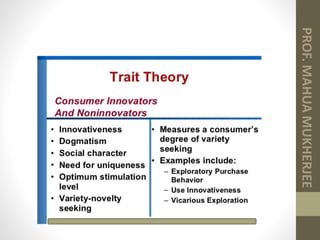
CONSUMER INNOVATIVENESS
• Consumer innovativeness is a construct that deals with
how receptive consumers are to new products[1].
• Consumer innovativeness has been defined as a
predisposition or propensity to buy or adopt new
products or a preference for new and different
experience.
Unit 1 INTRODUCTION TO CONSUMER BEHAVIOUR

Unit 1 INTRODUCTION TO CONSUMER BEHAVIOUR

  • 1.
  • 2.
    CONCEPT • Consumers arethose individuals who purchase commodities for deriving utilities and using them to satisfy their needs. • Behaviour is defined as “the series of innumerable responses potrayed by individuals.” CONSUMER BEHAVIOUR IS DEFINED AS THAT PROCESS BY WHICH INDIVIDUALS OR GROUPS SELECT, PURCHASE, OBTAIN,USE,ADOPT OR DISPOSE OFF THE PRODUCTS TO SATISFY THEIR NEEDS AND DESIRES. It is a sumtotal of all the actions directly involved in obtaining, consuming and disposing off products both goods & services including the decision making process which proceeds and follow these actions.
  • 3.
    • The consumersor buyers are the highly complex entity in the field of marketing management. • Their needs and desires are innumerable and may vary from – security needs to aesthetic needs Some needs are latent Some needs are manifested Some needs are dominant • Some needs of an individual can be met with money • Many needs remained beyond realisation.
  • 4.
    DEFINITIONS • According toKOTLER & ARMSTRONG “The buying behaviour of final consumers, individuals and households who buys goods and services for personal consumption.” • According to ENGEL,BLACKWELL & MANSARD “Consumer Behaviour is the actions and decision processes of people who purchase goods and services for personal consumption”. NEEDS /ATTITUDE INFLUENCING CONSUMPTION DECISION CONSUMER LIFESTYLE SATISFACTION/BEHAVIOUR EXPERIENCES AFFECTING LIFESTYLE CONSUMER PURCHASE DECISION PROCESS
  • 5.
    • Every buyereveryday is exposed to a world full of information - NEW PRODUCTS NEW SERVICES NEW USES FOR AN EXISTING PRODUCT NEW IDEAS NEW STYLES • SELECTIVE PERCEPTION is the mechanism which helps the consumers retain relevant information constantly. • Human behaviour is changing constantly affecting an individual’s purchase decision. • The buyer/consumers may not follow any rigid rules while taking the purchase decisions. • Consumers are the most dynamic element and most difficult to manage.
  • 6.
    APPLICATION OF CONSUMER BEHAVIOURKNOWLEDGE • The field of consumer behaviour has gained prominence from mid 1960’s onward. • As a new discipline, ( having a body of research of its own) the study of consumer behaviour borrowed from other disciplines such as physochology, sociology, anthropology and economics. • Conssumer behaviour application can be analysed through – 1. POSITIVISM 2. INTERPRETIVISM
  • 7.
    1.POSITIVISM • In theinitial stages, the main thrust of consumer behaviour was from the viewpoint of a marketing manager’s perspective. • They were interested to know the specific cause of Consumer Behaviour and use this information to work out suitable marketing strategy to influence consumption. • Since marketers were concerned with predicting consumer behaviour this approach came to be known as POSITIVISM.
  • 8.
    2.INTERPRTIVISM • Academicians fromdifferent disciplines were interested in the study of consumer behaviour simply to understand the consumers better. • The study of consumer behaviour from the point of view of understanding consumption behaviour and the meanings behind such behaviours came to be known as INTERPRETIVISM. BOTH APPROACHES ARE DIFFERENT BUT ARE NEEDED FOR PREDICTING AND UNDERSTANDING CONSUMER BEHAVIOUR. • The differences between the two are
  • 9.
    POSITIVISM INTERPRETIVISM 1 Consumerresearch carried out from a managerial point of view to take strategic marketing decisions is called POSITIVISM 1 Consumer research carried out from the purpose of probing deep into the consumer’s mind to understand the motivation , feelings, reactions etc. affecting consumer behaviour is called interpretivism. 2 Positivist research is quantitative and emperical in nature. 2 Interpretivism involves qualitative research which cannot be projected to larger population. 3 Positivist research tries to identify cause and effect relationships in buying situations. 3 Interpretivist research is primarily concerned with understanding the act of consuming and can be used to provide insights for working out various positioning strategies. 4 Positivists typically use probability studies which can be generalised to larger populations 4 Interpretivists usually view consumption and can be used to provide insights for working out various positioning strategies.
  • 11.
    The dynamic interactionof cognition,behaviour and environmental events by which human beings conduct the exchange aspects of their lives (American Marketing Association) A discipline dealing with how and why consumers purchase (or don’t purchase) products and services Those behaviours performed by decisionmaking units in the purchase, usage and disposal of goods and services.(Kotler & Levy)
  • 12.
    Applications of ConsumerBehavior &Marketing Strategy Marketing strategies and tactics are based on explicit or implicit beliefs about consumer behavior. Decisions based on explicit assumptions and sound theory and research are more likely to be successful than are decisions based solely on implicit intuition. Knowledge of consumer behavior can be an important competitive advantage and can greatly reduce the odds of bad decisions and market failures!
  • 14.
  • 15.
  • 16.
  • 19.
    NEEDS WANTS DRIVES DEMAND PRODUCTS FEELINGS OF DEPRIVEMENTS OFLIFE FOOD, CLOTHING AND SHELTER SPECIFIC NEEDS INITIATIVES DESIRES BACKED BY ADEQUATE PURCHASING POWER AN ASSEMBLAGE OF NEED SATISFYING ENTITY
  • 20.
    NEEDS People start companiesto satisfy consumer needs. Marketing helps companies make consumers aware of these products and services, Marketing is made up of all the processes involved in getting products into the consumer's hands. Companies must ensure that the consumer's needs and their marketing strategies are well-suited.
  • 21.
    MOTIVATION A psychologist hasdescribed the study of motivation as covering al those things which are biological, social and psychological and that they defeat our lazyness and move us either eagerly or reluctantly to action. According to Kreitner (1995), motivation has been defined as: “The psychological process that gives behavior purpose and direction.” Dalton E. McFarland (1974) stated that: “Motivation refers to the way in which urges, drives, desires, aspirations, and strivings or needs direct, control or explain the behaviour of human beings.”
  • 22.
    MODEL OF MOTIVATION UNFULFILLED NEEDS WANTS& DESIRES TENSION DRIVE BEHAVIOUR GOAL/NEED FULFILLMENT PERSONALITY PERCEPTION LEARNING ATTITUDES TENSION REDUCTION
  • 23.
    THEORIES OF MOTIVATION •MASLOW’S NEED HIERARCHY THEORY • MC CLELLAND’D THEORY OF NEED ACHIEVEMENT • ALDERFER’S ERG HIERARCHY OF NEEDS THEORY • VROOM’S EXPECTANCY NEED THEORY
  • 24.
    POSITIVE AND NEGATIVEMOTIVATION • Human beings are naturally motivated towards pleasure and away from pain. • We are reward-seeking organisms and everything that we do contains an inherent reward in it, conscious or unconscious, perceived or real.
  • 25.
    EMOTIONAL AND RATIONAL MOTIVES •Emotional Motives Emotional motives are motives based on personal or subjective criteria. They are feelings experienced by a customer through associtation. • Where as emotional motives ‘imply the selection of goods fitting to personal or subjective criteria such as’: • Pride • Fear • Desire for individuality • Affection • Status • Vanity
  • 26.
    • Rational motivesare based mainly on objective criteria such as: • Size • Weight • Price • Profit • Health • Security
  • 30.
  • 31.
  • 34.
  • 43.
    "Everythingwe do startswithknowing aclient'sbusinessinsideout. That's the keyto anticipatingtheir needs, to solvingtheirproblems, to bringing themopportunitiestheymightnotfind ontheir own." C J. P. Morgan
  • 44.
    CONSUMER VALUES ANDLIFESTYLES • Consumer value is used to describe a consumer's strong relative preference for certain subjectively evaluated product or service attribute. • These values include efficiency, excellence, status, esteem, play, aesthetics, ethics and spirituality. • Customer value, which is linked closely to customer satisfaction and loyalty, is a critical aspect of today’s effective marketing strategies.
  • 45.
    • Businesses needto research and consider what customers care about in order to deliver products and services on which they want to spend their money. • To get ahead of the cut-throat competition they face in the market, businesses need to take into account what their well-informed customers are thinking and feeling. • Only by doing so can businesses enhance customer value. • Consumer value can refer to what the product is worth to the customer and also what the customer is worth to the business over his lifetime of engagement.
  • 47.
    What Is CustomerValue? • The term customer value can be seen from two opposing angles: the customer and the business CUSTOMER • For the customer, the value of a product or service is what she is willing to pay for what she gets in return. • As a result, this value is really what the customer perceives to be the value. • It doesn’t matter if the product costs Rs5 or Rs500; the customer will only want to pay what she believes to be the value of the product. • The customer assigns value toward a product based on a number of factors, including her demographics, esteem, product utility, product quality, social motives and price.
  • 48.
    BUSINESS • On theother hand, customer value from the business’s perspective refers to the actual value of the customer herself, or what the customer is worth to the business. • This involves the process that the business uses to deliver value to the customer and what the customer purchases from the business over her lifetime. The two concepts of customer value are related. The customer will only buy from the business if the business offers the customer something that she values, and the customer will only be worth something to the business if she makes a purchase.
  • 49.
    CONSUMER LIFESTYLES (INDIA) • Inwhat types of stores do consumers shop for food and drink? • Do commuters drive cars to work or take public transport? • How do ethnic groups influence consumer preferences and expenditure trends? • How many households own microwave ovens? Personal computers? Refrigerators? • On the whole, are the India’s consumers spenders or savers? • Where do consumers go on holiday and how much do they spend? • How well are consumers served by the India’s healthcare system?
  • 50.
    • Consumer Lifestyles™matches your needs and interests to relevant products and services; helping you save money and support the things you care about the most.
  • 51.
    CONSUMER INNOVATIVENESS • Consumerinnovativeness is a construct that deals with how receptive consumers are to new products[1]. • Consumer innovativeness has been defined as a predisposition or propensity to buy or adopt new products or a preference for new and different experience.