Topic:
Amino Acids & Peptide Bond
Subject Biochemistry-1 Course code Chem 206
Represented by:
Ibtasam Illahi 12081507-033
Kashif Ali 12081507-035
Muhammad Danish 12081507-047
Represented to:
Dr. Sami Ullah
University Of Gujrat
Amino Acids & Peptide Bond
 What are Amino Acids?
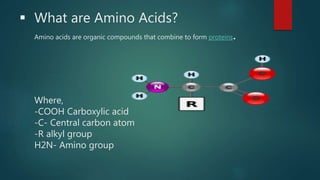
Amino acids are organic compounds that combine to form proteins.
Where,
-COOH Carboxylic acid
-C- Central carbon atom
-R alkyl group
H2N- Amino group
Why do Amino Acid are Important for us?
20 % of Human body consist of Proteins
Store nutrients in human body
Have an influence on the function of organs
Essential for healing wounds and repairing tissue
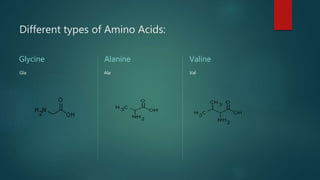
Different types of Amino Acids:
Glycine
Gla
Alanine
Ala
Valine
Val
Points to be noted:
All amino acids contain Alpha carbon.
All amino acids show isoelectric point except Glycine.
Amino acids have specific isoelectric value.
Amino acids exist as Zwitter-ions in solutions.
About 20 different type of amino acid found in human body.
Zwitter ion
Isoelectric Point
Essential amino acids
Nonessential amino acids
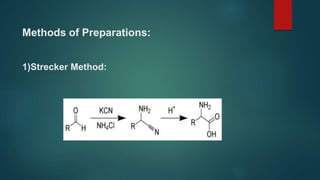
Methods of Preparations:
1)Strecker Method:
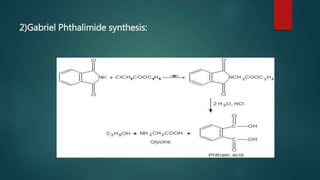
2)Gabriel Phthalimide synthesis:
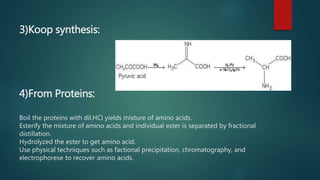
3)Koop synthesis:
4)From Proteins:
Boil the proteins with dil.HCl yields mixture of amino acids.
Esterify the mixture of amino acids and individual ester is separated by fractional
distillation.
Hydrolyzed the ester to get amino acid.
Use physical techniques such as factional precipitation, chromatography, and
electrophorese to recover amino acids.
Physical properties of amino acid:
Soluble in polar solvents and insoluble in organic solvents.
These are all optical active except glycine.
They show no effect on litmus paper because they act as
zwitterion in solution which is a neutral form of amino
acids.
Natural proteins are polymer of amino acids.
Chemical properties of amino acids:
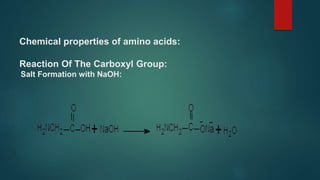
Reaction Of The Carboxyl Group:
Salt Formation with NaOH:
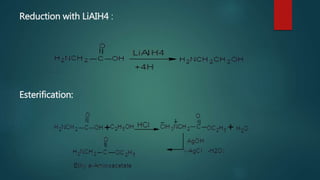
Reduction with LiAIH4 :
Esterification:
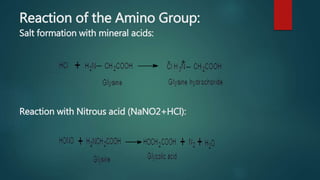
Reaction of the Amino Group:
Salt formation with mineral acids:
Reaction with Nitrous acid (NaNO2+HCl):
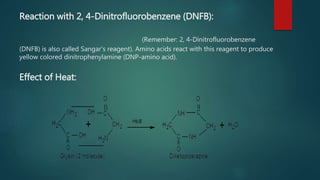
Reaction with 2, 4-Dinitrofluorobenzene (DNFB):
(Remember: 2, 4-Dinitrofluorobenzene
(DNFB) is also called Sangar’s reagent). Amino acids react with this reagent to produce
yellow colored dinitrophenylamine (DNP-amino acid).
Effect of Heat:
Application of Amino Acids:
use is as additives to animal feed
use in agriculture for fertilizer synthesis
use in the synthesis of drugs and cosmetics
Nullomers are codons that in theory code for an amino acid
Amino acids are important as low-cost feedstocks
Since 2001, 40 non-natural amino acids have been added into protein by creating
a unique codon
Disadvantages of amino acids:
As we know that
“Excess of every thing is bad” so we should be careful about amino
acid in taking.
It has following disease in humans:
1) Pulmonary Disease:
2) Increased Herpes and Viral Outbreaks:
3) Increased Blood Pressure:
4) Insulin Interference:
Peptide Bond
What is Peptide Bond???
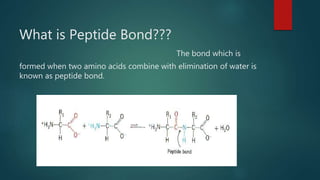
The bond which is
formed when two amino acids combine with elimination of water is
known as peptide bond.
Continued…
Covalent chemical bond in nature
forms between two molecules
-COOH from 1 amino acid and H2N- from another amino acid
One water molecule produced
-C(O)NH- is called a peptide
Polypeptides and proteins are chains of amino acids held together
by peptide bonds.
Points to remember:
When three amino acid combine in this way, the product is called tripeptide. When
four amino acids combine, the product is called tetrapeptide. When many amino acids
combine in this way, the resulting product is known as polypeptide.
Note: Proteins are polypeptides containing more than 100 amino acids.
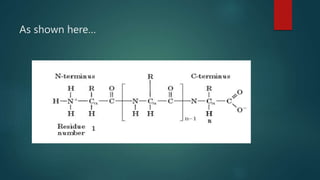
In a polypeptide, the amino acid that contains the free amino group called the N-
terminal residue. It is always written on the left hand side of the chain. Similarly, the
amino acid that contains the free carboxyl group is called the C-terminal residue. It is
always written on the right side of the chain.
For example.
As shown here…
References:
http://en.wikipedia.org/wiki/Strecker_amino-acid_synthesis
Strecker, A. (1850). "Ueber die künstliche Bildung der Milchsäure und einen neuen, dem
Glycocoll homologen Körper". Annalen der Chemie und Pharmazie 75 (1): 27–
45.doi:10.1002/jlac.18500750103.
Jump up^ Strecker, A. (1854). "Ueber einen neuen aus Aldehyd – Ammoniak und Blausäure
entstehenden Körper (p )". Annalen der Chemie und Pharmazie 91 (3): 349–
351.doi:10.1002/jlac.18540910309.
Jump up^ Shibasaki, M.; Kanai, M.; Mita, K. Org. React. 2008, 70, 1.
Wagner, Ingrid; Musso, Hans (November 1983). "New Naturally Occurring Amino
Acids". Angew. Chem. Int. Ed. Engl. 22 (22): 816–828. doi:10.1002/anie.198308161.
Jump up^ Human nutrition in the developing world – United Nations Food and Agriculture
Organization, ch.8
Jump up^ Proline is an exception to this general formula. It lacks the NH2 group because of
thecyclization of the side-chain and is known as an imino acid; it falls under the category of
special structured amino acids.
Any Question???

Amino acids & peptide bond

  • 2.
    Topic: Amino Acids &Peptide Bond Subject Biochemistry-1 Course code Chem 206 Represented by: Ibtasam Illahi 12081507-033 Kashif Ali 12081507-035 Muhammad Danish 12081507-047 Represented to: Dr. Sami Ullah University Of Gujrat
  • 3.
    Amino Acids &Peptide Bond
  • 4.
     What areAmino Acids? Amino acids are organic compounds that combine to form proteins. Where, -COOH Carboxylic acid -C- Central carbon atom -R alkyl group H2N- Amino group
  • 5.
    Why do AminoAcid are Important for us? 20 % of Human body consist of Proteins Store nutrients in human body Have an influence on the function of organs Essential for healing wounds and repairing tissue
  • 6.
    Different types ofAmino Acids: Glycine Gla Alanine Ala Valine Val
  • 7.
    Points to benoted: All amino acids contain Alpha carbon. All amino acids show isoelectric point except Glycine. Amino acids have specific isoelectric value. Amino acids exist as Zwitter-ions in solutions. About 20 different type of amino acid found in human body.
  • 8.
    Zwitter ion Isoelectric Point Essentialamino acids Nonessential amino acids
  • 9.
  • 10.
  • 11.
    3)Koop synthesis: 4)From Proteins: Boilthe proteins with dil.HCl yields mixture of amino acids. Esterify the mixture of amino acids and individual ester is separated by fractional distillation. Hydrolyzed the ester to get amino acid. Use physical techniques such as factional precipitation, chromatography, and electrophorese to recover amino acids.
  • 12.
    Physical properties ofamino acid: Soluble in polar solvents and insoluble in organic solvents. These are all optical active except glycine. They show no effect on litmus paper because they act as zwitterion in solution which is a neutral form of amino acids. Natural proteins are polymer of amino acids.
  • 13.
    Chemical properties ofamino acids: Reaction Of The Carboxyl Group: Salt Formation with NaOH:
  • 14.
    Reduction with LiAIH4: Esterification:
  • 15.
    Reaction of theAmino Group: Salt formation with mineral acids: Reaction with Nitrous acid (NaNO2+HCl):
  • 16.
    Reaction with 2,4-Dinitrofluorobenzene (DNFB): (Remember: 2, 4-Dinitrofluorobenzene (DNFB) is also called Sangar’s reagent). Amino acids react with this reagent to produce yellow colored dinitrophenylamine (DNP-amino acid). Effect of Heat:
  • 17.
    Application of AminoAcids: use is as additives to animal feed use in agriculture for fertilizer synthesis use in the synthesis of drugs and cosmetics Nullomers are codons that in theory code for an amino acid Amino acids are important as low-cost feedstocks Since 2001, 40 non-natural amino acids have been added into protein by creating a unique codon
  • 18.
    Disadvantages of aminoacids: As we know that “Excess of every thing is bad” so we should be careful about amino acid in taking. It has following disease in humans: 1) Pulmonary Disease: 2) Increased Herpes and Viral Outbreaks: 3) Increased Blood Pressure: 4) Insulin Interference:
  • 19.
  • 20.
    What is PeptideBond??? The bond which is formed when two amino acids combine with elimination of water is known as peptide bond.
  • 21.
    Continued… Covalent chemical bondin nature forms between two molecules -COOH from 1 amino acid and H2N- from another amino acid One water molecule produced -C(O)NH- is called a peptide Polypeptides and proteins are chains of amino acids held together by peptide bonds.
  • 22.
    Points to remember: Whenthree amino acid combine in this way, the product is called tripeptide. When four amino acids combine, the product is called tetrapeptide. When many amino acids combine in this way, the resulting product is known as polypeptide. Note: Proteins are polypeptides containing more than 100 amino acids. In a polypeptide, the amino acid that contains the free amino group called the N- terminal residue. It is always written on the left hand side of the chain. Similarly, the amino acid that contains the free carboxyl group is called the C-terminal residue. It is always written on the right side of the chain. For example.
  • 23.
  • 24.
    References: http://en.wikipedia.org/wiki/Strecker_amino-acid_synthesis Strecker, A. (1850)."Ueber die künstliche Bildung der Milchsäure und einen neuen, dem Glycocoll homologen Körper". Annalen der Chemie und Pharmazie 75 (1): 27– 45.doi:10.1002/jlac.18500750103. Jump up^ Strecker, A. (1854). "Ueber einen neuen aus Aldehyd – Ammoniak und Blausäure entstehenden Körper (p )". Annalen der Chemie und Pharmazie 91 (3): 349– 351.doi:10.1002/jlac.18540910309. Jump up^ Shibasaki, M.; Kanai, M.; Mita, K. Org. React. 2008, 70, 1. Wagner, Ingrid; Musso, Hans (November 1983). "New Naturally Occurring Amino Acids". Angew. Chem. Int. Ed. Engl. 22 (22): 816–828. doi:10.1002/anie.198308161. Jump up^ Human nutrition in the developing world – United Nations Food and Agriculture Organization, ch.8 Jump up^ Proline is an exception to this general formula. It lacks the NH2 group because of thecyclization of the side-chain and is known as an imino acid; it falls under the category of special structured amino acids.
  • 25.