Module 1
                                     Triangle Trigonometry


      What this module is about
         This module will guide you to determine the kind of equation you will use
to solve the missing parts of a right triangle. This will require the use of
trigonometric functions. Here, you will also learn how to solve problems involving
right triangles.


      What you are expected to learn
      This module is designed for you to:

           1. determine the equation in solving the missing parts of a right
              triangle.

           2. Apply trigonometric functions to solve right triangle given:

              a.   the length of the hypotenuse and length of one leg
              b.   the length of the hypotenuse and one of the acute angles
              c.   the length of one leg and one of the acute angles
              d.   the length of both sides

          3. Solve problems involving right triangle.


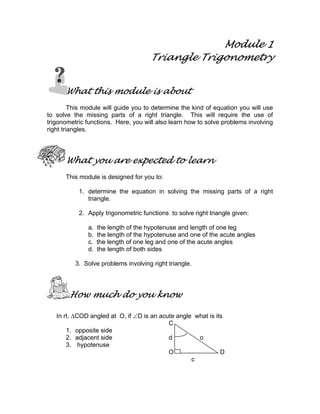
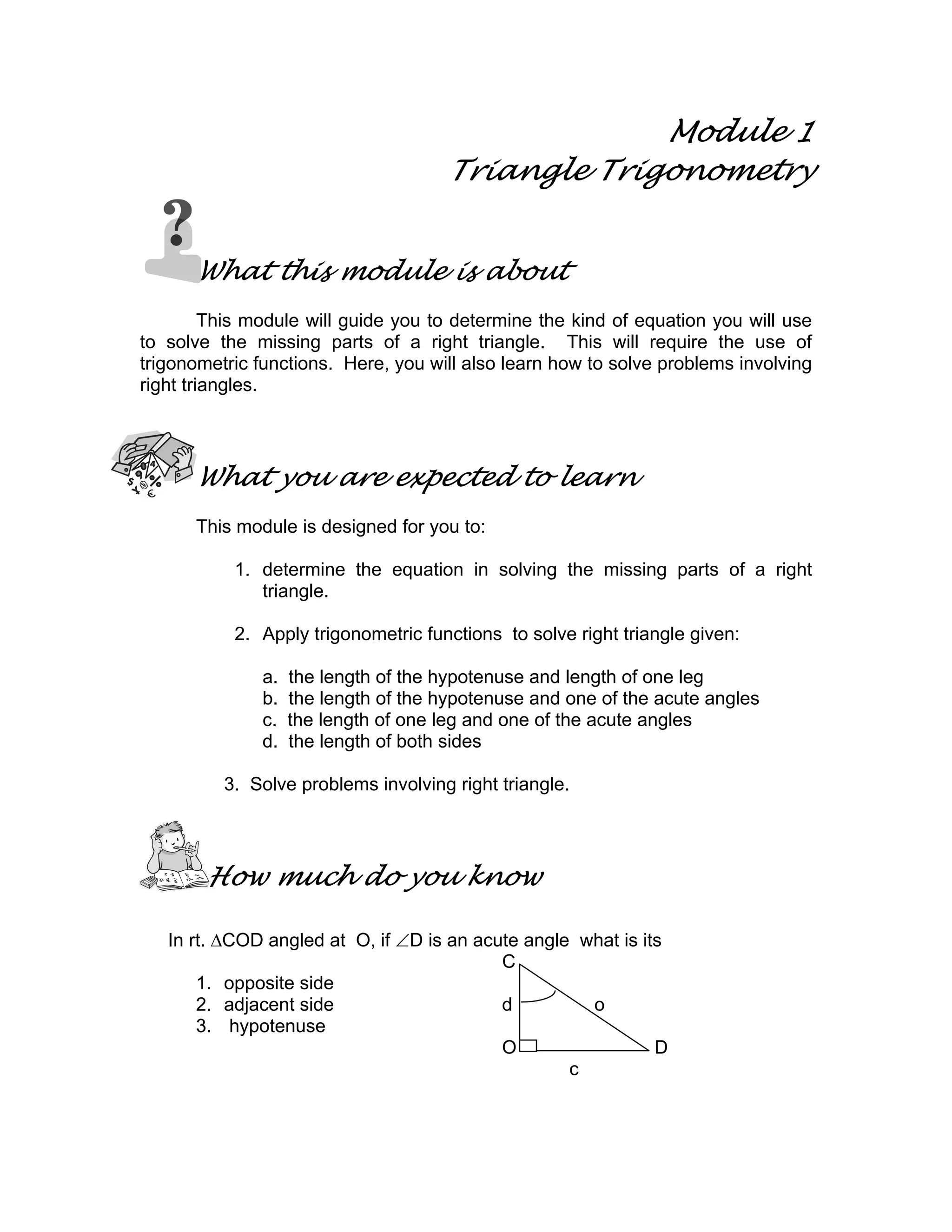
        How much do you know

   In rt. ∆COD angled at O, if ∠D is an acute angle what is its
                                           C
       1. opposite side
       2. adjacent side                    d         o
       3. hypotenuse
                                           O                  D
                                                   c
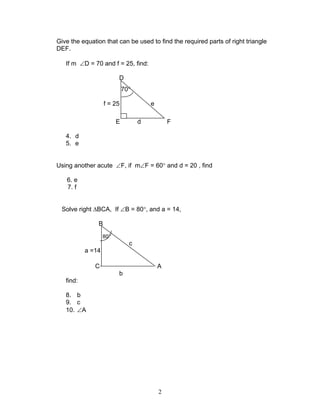
Give the equation that can be used to find the required parts of right triangle
DEF.

   If m ∠D = 70 and f = 25, find:

                         D
                             70°

                   f = 25              e

                         E         d           F

   4. d
   5. e


Using another acute ∠F, if m∠F = 60° and d = 20 , find

   6. e
   7. f


 Solve right ∆BCA, If ∠B = 80°, and a = 14,

               B
                   80°
                               c
           a =14

              C                            A
                         b
   find:

   8. b
   9. c
   10. ∠A


                                           2
What you will do

                                     Lesson 1

          Determine the Equation in Solving the Missing Parts
                          of a Right Triangle

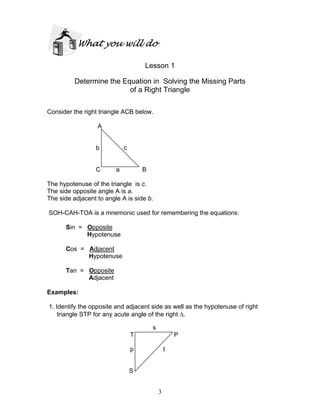
Consider the right triangle ACB below.

                  A


                 b           c


                 C       a           B

The hypotenuse of the triangle is c.
The side opposite angle A is a.
The side adjacent to angle A is side b.

SOH-CAH-TOA is a mnemonic used for remembering the equations:

      Sin = Opposite
            Hypotenuse

      Cos = Adjacent
            Hypotenuse

      Tan = Opposite
            Adjacent

Examples:

1. Identify the opposite and adjacent side as well as the hypotenuse of right
    triangle STP for any acute angle of the right ∆.

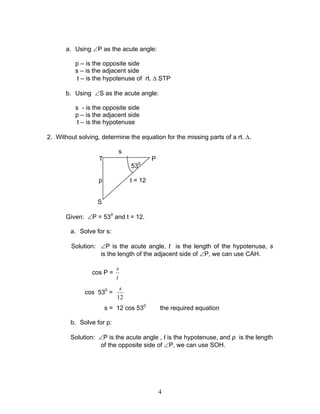
                                         s
                                 T                   P

                                 p               t


                                 S


                                             3
a. Using ∠P as the acute angle:

          p – is the opposite side
          s – is the adjacent side
           t – is the hypotenuse of rt. ∆ STP

       b. Using ∠S as the acute angle:

          s - is the opposite side
          p – is the adjacent side
           t – is the hypotenuse

2. Without solving, determine the equation for the missing parts of a rt. ∆.

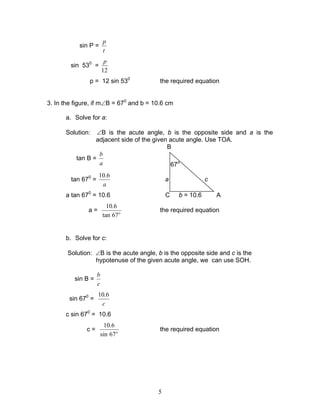
                           s
                   T                     P
                                   0
                                53

                   p            t = 12


                  S

       Given: ∠P = 530 and t = 12.

        a. Solve for s:

        Solution: ∠P is the acute angle, t is the length of the hypotenuse, s
                  is the length of the adjacent side of ∠P, we can use CAH.

                           s
                cos P =
                           t
                            s
              cos 530 =
                           12
                       s = 12 cos 530        the required equation

        b. Solve for p:

        Solution: ∠P is the acute angle , t is the hypotenuse, and p is the length
                  of the opposite side of ∠P, we can use SOH.


                                             4
p
           sin P =
                         t
                         p
        sin 530 =
                        12
               p = 12 sin 530            the required equation


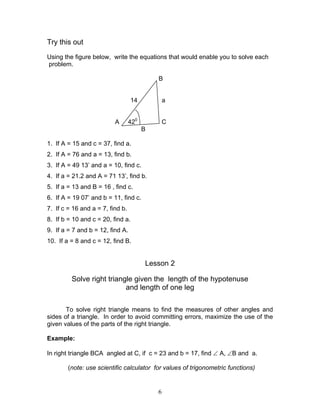
3. In the figure, if m∠B = 670 and b = 10.6 cm

      a. Solve for a:

      Solution:   ∠B is the acute angle, b is the opposite side and a is the
                 adjacent side of the given acute angle. Use TOA.
                                           B
                   b
          tan B =
                   a                        67o
                    10.6
        tan 670 =                           a               c
                     a
      a tan 670 = 10.6                      C    b = 10.6       A
                           10.6
               a=                        the required equation
                         tan 67 o


      b. Solve for c:

       Solution: ∠B is the acute angle, b is the opposite side and c is the
                 hypotenuse of the given acute angle, we can use SOH.

                    b
          sin B =
                    c
                    10.6
        sin 670 =
                     c
      c sin 670 = 10.6
                          10.6
              c=                         the required equation
                        sin 67 o


                                        5
Try this out
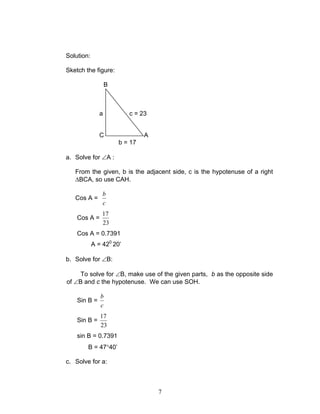
Using the figure below, write the equations that would enable you to solve each
problem.

                                            B


                                  14            a


                          A       420           C
                                        B

1. If A = 15 and c = 37, find a.
2. If A = 76 and a = 13, find b.
3. If A = 49 13’ and a = 10, find c.
4. If a = 21.2 and A = 71 13’, find b.
5. If a = 13 and B = 16 , find c.
6. If A = 19 07’ and b = 11, find c.
7. If c = 16 and a = 7, find b.
8. If b = 10 and c = 20, find a.
9. If a = 7 and b = 12, find A.
10. If a = 8 and c = 12, find B.


                                        Lesson 2

         Solve right triangle given the length of the hypotenuse
                           and length of one leg

       To solve right triangle means to find the measures of other angles and
sides of a triangle. In order to avoid committing errors, maximize the use of the
given values of the parts of the right triangle.

Example:

In right triangle BCA angled at C, if c = 23 and b = 17, find ∠ A, ∠B and a.

        (note: use scientific calculator for values of trigonometric functions)


                                            6
Solution:

Sketch the figure:

                   B


               a          c = 23


               C                A
                       b = 17

a. Solve for ∠A :

   From the given, b is the adjacent side, c is the hypotenuse of a right
   ∆BCA, so use CAH.

                b
   Cos A =
                c
                17
    Cos A =
                23
    Cos A = 0.7391
            A = 420 20’

b. Solve for ∠B:

     To solve for ∠B, make use of the given parts, b as the opposite side
of ∠B and c the hypotenuse. We can use SOH.

               b
    Sin B =
               c
               17
    Sin B =
               23
    sin B = 0.7391
        B = 47°40’

c. Solve for a:


                                    7
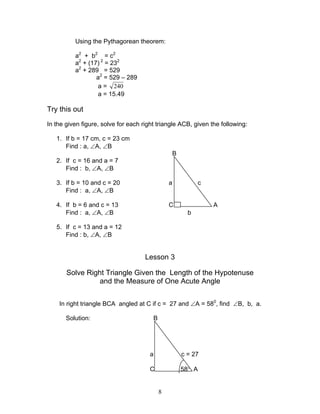
Using the Pythagorean theorem:

          a2 + b2 = c2
          a2 + (17) 2 = 232
          a2 + 289 = 529
                  a2 = 529 – 289
                   a = 240
                   a = 15.49

Try this out
In the given figure, solve for each right triangle ACB, given the following:

   1. If b = 17 cm, c = 23 cm
      Find : a, ∠A, ∠B
                                                   B
   2. If c = 16 and a = 7
      Find : b, ∠A, ∠B

   3. If b = 10 and c = 20                         a         c
      Find : a, ∠A, ∠B

   4. If b = 6 and c = 13                          C             A
      Find : a, ∠A, ∠B                                   b

   5. If c = 13 and a = 12
      Find : b, ∠A, ∠B


                                     Lesson 3

       Solve Right Triangle Given the Length of the Hypotenuse
                and the Measure of One Acute Angle


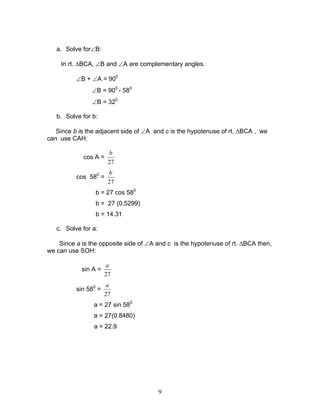
    In right triangle BCA angled at C if c = 27 and ∠A = 580, find ∠B, b, a.

       Solution:                           B


                                       a               c = 27

                                       C               58° A


                                               8
a. Solve for∠B:

    In rt. ∆BCA, ∠B and ∠A are complementary angles.

          ∠B + ∠A = 900
                ∠B = 900 - 580
                ∠B = 320

   b. Solve for b:

   Since b is the adjacent side of ∠A and c is the hypotenuse of rt. ∆BCA , we
can use CAH:

                       b
            cos A =
                       27
                       b
          cos 580 =
                       27
                 b = 27 cos 580
                 b = 27 (0.5299)
                 b = 14.31

   c. Solve for a:

    Since a is the opposite side of ∠A and c is the hypotenuse of rt. ∆BCA then,
we can use SOH:

                      a
            sin A =
                      27
                      a
          sin 580 =
                      27
                a = 27 sin 580
                a = 27(0.8480)
                a = 22.9


                                       9
Try this out

Sketch the figure and solve each right ∆ ACB angled at C if given the following:

   1. If A = 15 and c = 37
      Find : B, a, b

   2. If B = 64 and c = 19.2
      Find : A, a, b

   3. If A = 15 and c = 25
      Find: B, a, b

   4. If A = 45 and c = 7 2
      Find : B, a, b

   5. If B = 550 55’ and c = 16
      Find : A, a, b


                             Lesson 4

            Solve Right Triangle Given the Length of One Leg
                  and the Measure of One Acute Angle

Example:

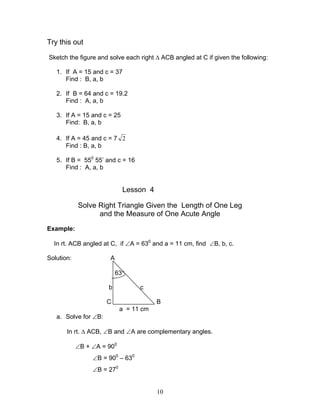
  In rt. ACB angled at C, if ∠A = 630 and a = 11 cm, find ∠B, b, c.

Solution:              A

                           63°

                      b           c

                      C                 B
                            a = 11 cm
   a. Solve for ∠B:

       In rt. ∆ ACB, ∠B and ∠A are complementary angles.

            ∠B + ∠A = 900
                 ∠B = 900 – 630
                 ∠B = 270


                                        10
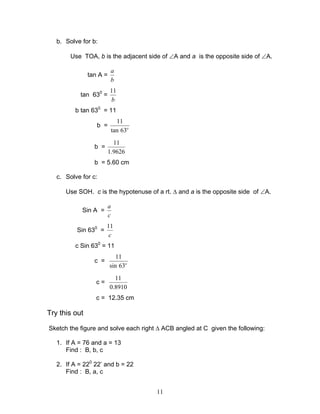
b. Solve for b:

        Use TOA, b is the adjacent side of ∠A and a is the opposite side of ∠A.

                          a
               tan A =
                          b
                         11
           tan 630 =
                         b
         b tan 630 = 11
                               11
                  b =
                             tan 63o
                           11
                 b =
                         1.9626
                 b = 5.60 cm

   c. Solve for c:

      Use SOH. c is the hypotenuse of a rt. ∆ and a is the opposite side of ∠A.

                         a
            Sin A =
                         c
                       11
          Sin 630 =
                        c
         c Sin 630 = 11
                            11
                 c =
                         sin 63o
                           11
                  c=
                         0.8910
                  c = 12.35 cm

Try this out

Sketch the figure and solve each right ∆ ACB angled at C given the following:

   1. If A = 76 and a = 13
      Find : B, b, c

   2. If A = 220 22’ and b = 22
      Find : B, a, c


                                       11
3. If B = 30 and b = 11
      Find : A, a, c

   4. If B = 18 and a =     18
      Find: A, b, c

   5. If A = 77 and b = 42
      Find : B, a, c


                                          Lesson 5

            Solve Right Triangle Given the Length of Both Sides

Example:

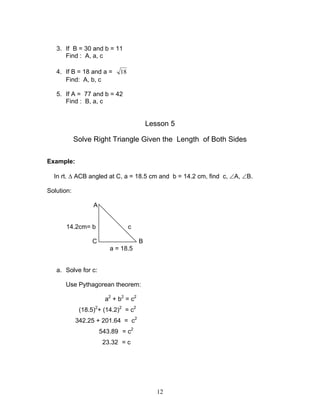
  In rt. ∆ ACB angled at C, a = 18.5 cm and b = 14.2 cm, find c, ∠A, ∠B.

Solution:

                  A


       14.2cm= b                 c

                 C                    B
                         a = 18.5


   a. Solve for c:

      Use Pythagorean theorem:

                       a2 + b2 = c2
             (18.5)2+ (14.2)2 = c2
            342.25 + 201.64 = c2
                      543.89 = c2
                       23.32 = c


                                             12
b. Solve for ∠A:

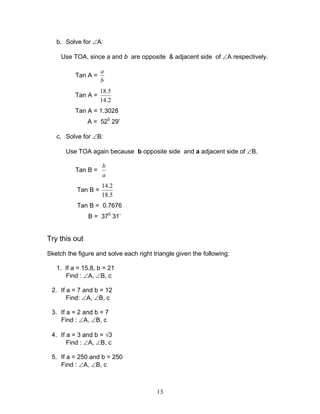
     Use TOA, since a and b are opposite & adjacent side of ∠A respectively.

                     a
          Tan A =
                     b
                     18.5
          Tan A =
                     14.2
          Tan A = 1.3028
               A = 520 29’

   c. Solve for ∠B:

       Use TOA again because b opposite side and a adjacent side of ∠B.

                     b
          Tan B =
                     a
                     14.2
           Tan B =
                     18.5
           Tan B = 0.7676
               B = 370 31’


Try this out
Sketch the figure and solve each right triangle given the following:

   1. If a = 15.8, b = 21
      Find : ∠A, ∠B, c

 2. If a = 7 and b = 12
       Find: ∠A, ∠B, c

 3. If a = 2 and b = 7
    Find : ∠A, ∠B, c

 4. If a = 3 and b = √3
       Find : ∠A, ∠B, c

 5. If a = 250 and b = 250
    Find : ∠A, ∠B, c


                                        13
Lesson 6

                                 Problem Solving

       Solving problems involving right triangles require knowledge of some
terms of importance in a particular field. For instance, in surveying the term line
of sight, angle of elevation, and angle of depression are frequently used. So we
start with familiarizing in these terms.

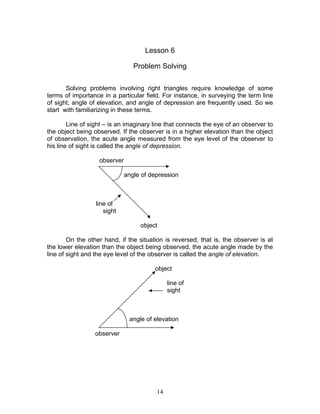
        Line of sight – is an imaginary line that connects the eye of an observer to
the object being observed. If the observer is in a higher elevation than the object
of observation, the acute angle measured from the eye level of the observer to
his line of sight is called the angle of depression.

                   observer

                              angle of depression


                  line of
                     sight

                                   object

        On the other hand, if the situation is reversed, that is, the observer is at
the lower elevation than the object being observed, the acute angle made by the
line of sight and the eye level of the observer is called the angle of elevation.

                                        object

                                              line of
                                              sight


                               angle of elevation

                 observer


                                         14
Examples:

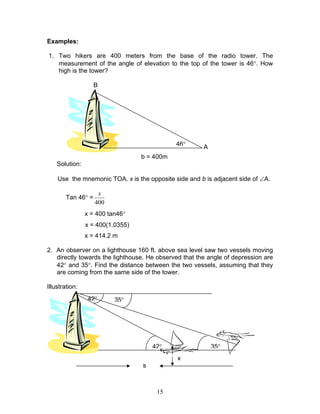
1. Two hikers are 400 meters from the base of the radio tower. The
   measurement of the angle of elevation to the top of the tower is 46°. How
   high is the tower?

                    B


                                             46°       A
                                  b = 400m
    Solution:

    Use the mnemonic TOA. x is the opposite side and b is adjacent side of ∠A.

                     x
        Tan 46° =
                    400
                x = 400 tan46°
                x = 400(1.0355)
                x = 414.2 m

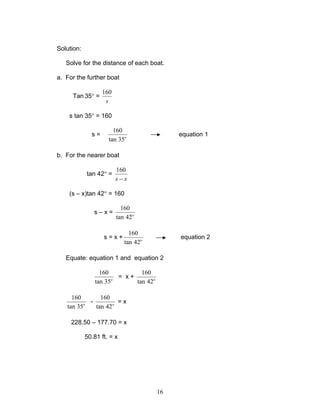
2. An observer on a lighthouse 160 ft. above sea level saw two vessels moving
   directly towards the lighthouse. He observed that the angle of depression are
   42° and 35°. Find the distance between the two vessels, assuming that they
   are coming from the same side of the tower.

Illustration:
                 42°      35°


                                      42°                  35°
                                              x
                                  s


                                       15
Solution:

   Solve for the distance of each boat.

a. For the further boat

                   160
     Tan 35° =
                    s

    s tan 35° = 160

                       160
              s=                             equation 1
                     tan 35o

b. For the nearer boat

                         160
            tan 42° =
                         s−x

    (s – x)tan 42° = 160

                           160
               s–x=
                         tan 42o

                              160
                   s=x+                      equation 2
                            tan 42o

   Equate: equation 1 and equation 2

                  160           160
                       o
                         = x+
                tan 35        tan 42o

     160       160
         o
           -         =x
   tan 35    tan 42o

     228.50 – 177.70 = x

            50.81 ft. = x


                                        16
Try this out
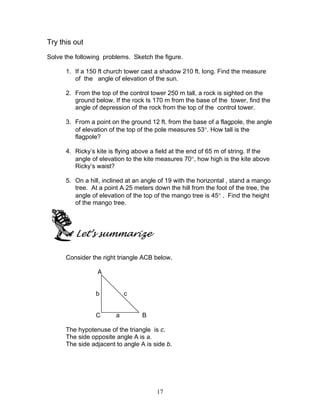
Solve the following problems. Sketch the figure.

      1. If a 150 ft church tower cast a shadow 210 ft. long. Find the measure
         of the angle of elevation of the sun.

      2. From the top of the control tower 250 m tall, a rock is sighted on the
         ground below. If the rock Is 170 m from the base of the tower, find the
         angle of depression of the rock from the top of the control tower.

      3. From a point on the ground 12 ft. from the base of a flagpole, the angle
         of elevation of the top of the pole measures 53°. How tall is the
         flagpole?

      4. Ricky’s kite is flying above a field at the end of 65 m of string. If the
         angle of elevation to the kite measures 70°, how high is the kite above
         Ricky’s waist?

      5. On a hill, inclined at an angle of 19 with the horizontal , stand a mango
         tree. At a point A 25 meters down the hill from the foot of the tree, the
         angle of elevation of the top of the mango tree is 45° . Find the height
         of the mango tree.


         Let’s summarize

      Consider the right triangle ACB below.

                 A


                 b          c


                 C      a         B

      The hypotenuse of the triangle is c.
      The side opposite angle A is a.
      The side adjacent to angle A is side b.


                                       17
Use SOH-CAH-TOA, a mnemonic for remembering the equations:

      Sin = Opposite
            Hypotenuse

      Cos = Adjacent
            Hypotenuse

      Tan = Opposite
            Adjacent

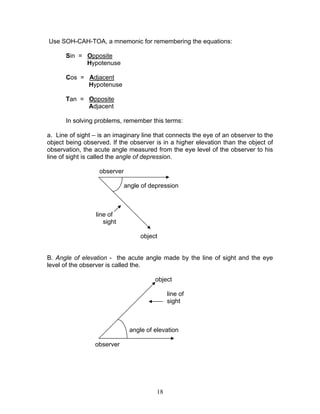
      In solving problems, remember this terms:

a. Line of sight – is an imaginary line that connects the eye of an observer to the
object being observed. If the observer is in a higher elevation than the object of
observation, the acute angle measured from the eye level of the observer to his
line of sight is called the angle of depression.

                   observer

                              angle of depression


                 line of
                    sight

                                   object


B. Angle of elevation - the acute angle made by the line of sight and the eye
level of the observer is called the.

                                        object

                                              line of
                                              sight


                               angle of elevation

                 observer


                                         18
What have you learned
In rt.∆XYZ angled at Y, if ∠X is an acute angle what is the

      1. opposite side
      2. adjacent side
      3. hypotenuse

Give the equation that could be used to find the missing parts of a rt. ∆ VWM. If
m ∠V = 48° and m = 17, find:

      4. V
      5. w

Using another acute ∠M if m∠M = 23° and w = 13, give the equation to be used
to compute:

      6. v
      7. m

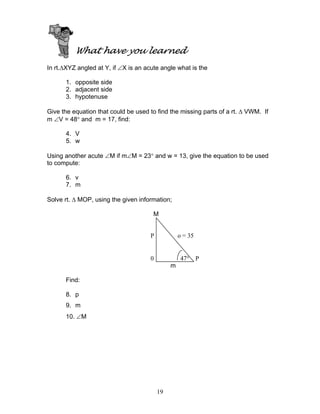
Solve rt. ∆ MOP, using the given information;

                                       M


                                      P            o = 35


                                      0             47° P
                                               m

      Find:

      8. p
      9. m
      10. ∠M


                                          19
Answer Key
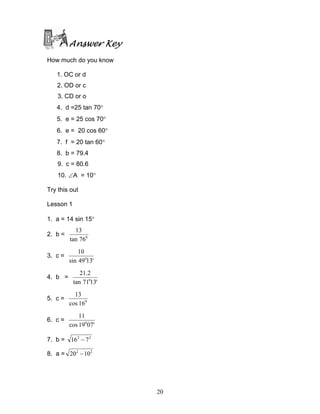
How much do you know

   1. OC or d
   2. OD or c
    3. CD or o
   4. d =25 tan 70°
   5. e = 25 cos 70°
   6. e = 20 cos 60°
   7. f = 20 tan 60°
   8. b = 79.4
    9. c = 80.6
    10. ∠A = 10°

Try this out

Lesson 1

1. a = 14 sin 15°
           13
2. b =
         tan 760
             10
3. c =
         sin 49013'
              21.2
4. b =
           tan 71013'
           13
5. c =
         cos 160
             11
6. c =
         cos 19007'

7. b = 16 2 − 7 2

8. a = 202 − 102


                        20
7
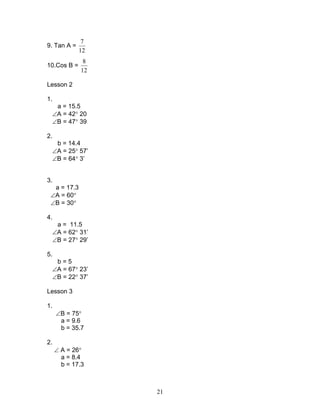
9. Tan A =
             12
               8
10.Cos B =
              12

Lesson 2

1.
      a = 15.5
     ∠A = 42° 20
     ∠B = 47° 39

2.
      b = 14.4
     ∠A = 25° 57’
     ∠B = 64° 3’


3.
  a = 17.3
 ∠A = 60°
 ∠B = 30°

4.
      a = 11.5
     ∠A = 62° 31’
     ∠B = 27° 29’

5.
      b=5
     ∠A = 67° 23’
     ∠B = 22° 37’

Lesson 3

1.
      ∠B = 75°
       a = 9.6
       b = 35.7

2.
     ∠ A = 26°
       a = 8.4
       b = 17.3


                    21
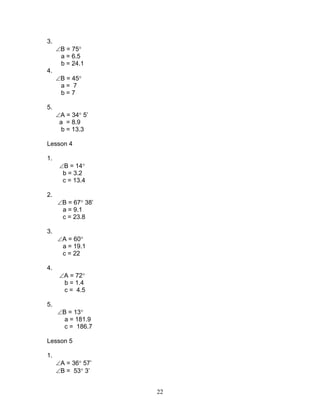
3.
     ∠B = 75°
      a = 6.5
      b = 24.1
4.
     ∠B = 45°
      a= 7
      b=7

5.
     ∠A = 34° 5’
      a = 8.9
       b = 13.3

Lesson 4

1.
      ∠B = 14°
       b = 3.2
       c = 13.4

2.
     ∠B = 67° 38’
      a = 9.1
      c = 23.8

3.
     ∠A = 60°
      a = 19.1
      c = 22

4.
      ∠A = 72°
       b = 1.4
       c = 4.5

5.
     ∠B = 13°
       a = 181.9
       c = 186.7

Lesson 5

1.
     ∠A = 36° 57’
     ∠B = 53° 3’


                    22
c = 26.3

2.
     ∠A = 30° 15’
     ∠B = 59° 45’
      c = 13.9

3.
     ∠A = 15° 57’
     ∠B = 74° 3’
      c = 7.3

4.
     ∠A = 60°
     ∠B = 30°
       c = 3.5

5.
     ∠A = 45°
     ∠B = 45°
      c = 353.6

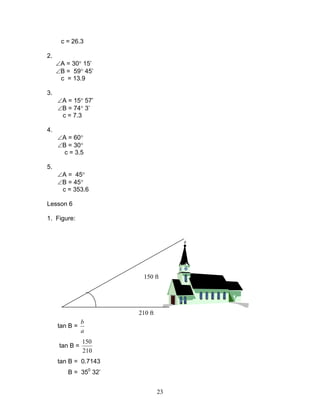
Lesson 6

1. Figure:


                         150 ft


                       210 ft
                b
     tan B =
                a
                150
      tan B =
                210
     tan B = 0.7143
         B = 350 32’


                                23
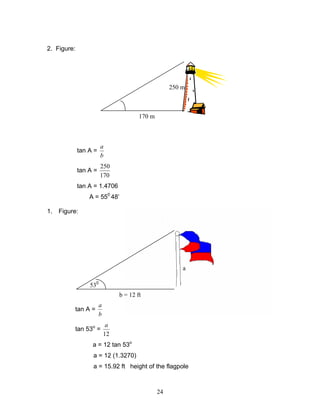
2. Figure:


                                                     250 m


                                        170 m


                       a
             tan A =
                       b
                       250
             tan A =
                       170
             tan A = 1.4706
                 A = 550 48’

1.   Figure:


                                                         a

                 530
                                b = 12 ft
                       a
          tan A =
                       b
                            a
          tan 53o =
                           12
                  a = 12 tan 53o
                  a = 12 (1.3270)
                  a = 15.92 ft height of the flagpole


                                                24
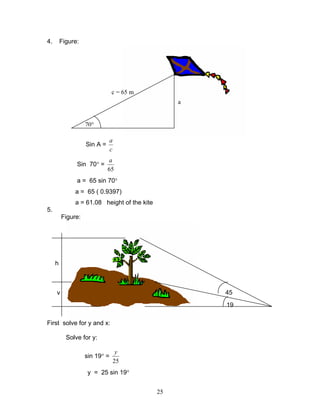
4.       Figure:


                               c = 65 m
                                                  a


                   70°

                               a
                   Sin A =
                               c
                             a
               Sin 70° =
                             65
               a = 65 sin 70°
              a = 65 ( 0.9397)
              a = 61.08 height of the kite
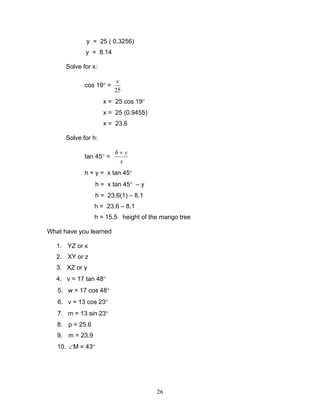
5.
         Figure:


     h


     y                                                45
                                                      19

First solve for y and x:

           Solve for y:

                                    y
                   sin 19° =
                                   25
                    y = 25 sin 19°


                                             25
y = 25 ( 0.3256)
             y = 8.14

      Solve for x:

                          x
             cos 19° =
                         25
                     x = 25 cos 19°
                     x = 25 (0.9455)
                     x = 23.6

      Solve for h:

                         h+ y
             tan 45° =
                          x
             h + y = x tan 45°
                  h = x tan 45° – y
                  h = 23.6(1) – 8.1
                 h = 23.6 – 8.1
                 h = 15.5 height of the mango tree

What have you learned

   1. YZ or x
   2. XY or z
   3. XZ or y
   4. v = 17 tan 48°
   5. w = 17 cos 48°
   6. v = 13 cos 23°
   7. m = 13 sin 23°
   8. p = 25.6
   9. m = 23.9
   10. ∠M = 43°


                                       26

Assignment # 4

  • 1.
    Module 1 Triangle Trigonometry What this module is about This module will guide you to determine the kind of equation you will use to solve the missing parts of a right triangle. This will require the use of trigonometric functions. Here, you will also learn how to solve problems involving right triangles. What you are expected to learn This module is designed for you to: 1. determine the equation in solving the missing parts of a right triangle. 2. Apply trigonometric functions to solve right triangle given: a. the length of the hypotenuse and length of one leg b. the length of the hypotenuse and one of the acute angles c. the length of one leg and one of the acute angles d. the length of both sides 3. Solve problems involving right triangle. How much do you know In rt. ∆COD angled at O, if ∠D is an acute angle what is its C 1. opposite side 2. adjacent side d o 3. hypotenuse O D c
  • 2.
    Give the equationthat can be used to find the required parts of right triangle DEF. If m ∠D = 70 and f = 25, find: D 70° f = 25 e E d F 4. d 5. e Using another acute ∠F, if m∠F = 60° and d = 20 , find 6. e 7. f Solve right ∆BCA, If ∠B = 80°, and a = 14, B 80° c a =14 C A b find: 8. b 9. c 10. ∠A 2
  • 3.
    What you willdo Lesson 1 Determine the Equation in Solving the Missing Parts of a Right Triangle Consider the right triangle ACB below. A b c C a B The hypotenuse of the triangle is c. The side opposite angle A is a. The side adjacent to angle A is side b. SOH-CAH-TOA is a mnemonic used for remembering the equations: Sin = Opposite Hypotenuse Cos = Adjacent Hypotenuse Tan = Opposite Adjacent Examples: 1. Identify the opposite and adjacent side as well as the hypotenuse of right triangle STP for any acute angle of the right ∆. s T P p t S 3
  • 4.
    a. Using ∠Pas the acute angle: p – is the opposite side s – is the adjacent side t – is the hypotenuse of rt. ∆ STP b. Using ∠S as the acute angle: s - is the opposite side p – is the adjacent side t – is the hypotenuse 2. Without solving, determine the equation for the missing parts of a rt. ∆. s T P 0 53 p t = 12 S Given: ∠P = 530 and t = 12. a. Solve for s: Solution: ∠P is the acute angle, t is the length of the hypotenuse, s is the length of the adjacent side of ∠P, we can use CAH. s cos P = t s cos 530 = 12 s = 12 cos 530 the required equation b. Solve for p: Solution: ∠P is the acute angle , t is the hypotenuse, and p is the length of the opposite side of ∠P, we can use SOH. 4
  • 5.
    p sin P = t p sin 530 = 12 p = 12 sin 530 the required equation 3. In the figure, if m∠B = 670 and b = 10.6 cm a. Solve for a: Solution: ∠B is the acute angle, b is the opposite side and a is the adjacent side of the given acute angle. Use TOA. B b tan B = a 67o 10.6 tan 670 = a c a a tan 670 = 10.6 C b = 10.6 A 10.6 a= the required equation tan 67 o b. Solve for c: Solution: ∠B is the acute angle, b is the opposite side and c is the hypotenuse of the given acute angle, we can use SOH. b sin B = c 10.6 sin 670 = c c sin 670 = 10.6 10.6 c= the required equation sin 67 o 5
  • 6.
    Try this out Usingthe figure below, write the equations that would enable you to solve each problem. B 14 a A 420 C B 1. If A = 15 and c = 37, find a. 2. If A = 76 and a = 13, find b. 3. If A = 49 13’ and a = 10, find c. 4. If a = 21.2 and A = 71 13’, find b. 5. If a = 13 and B = 16 , find c. 6. If A = 19 07’ and b = 11, find c. 7. If c = 16 and a = 7, find b. 8. If b = 10 and c = 20, find a. 9. If a = 7 and b = 12, find A. 10. If a = 8 and c = 12, find B. Lesson 2 Solve right triangle given the length of the hypotenuse and length of one leg To solve right triangle means to find the measures of other angles and sides of a triangle. In order to avoid committing errors, maximize the use of the given values of the parts of the right triangle. Example: In right triangle BCA angled at C, if c = 23 and b = 17, find ∠ A, ∠B and a. (note: use scientific calculator for values of trigonometric functions) 6
  • 7.
    Solution: Sketch the figure: B a c = 23 C A b = 17 a. Solve for ∠A : From the given, b is the adjacent side, c is the hypotenuse of a right ∆BCA, so use CAH. b Cos A = c 17 Cos A = 23 Cos A = 0.7391 A = 420 20’ b. Solve for ∠B: To solve for ∠B, make use of the given parts, b as the opposite side of ∠B and c the hypotenuse. We can use SOH. b Sin B = c 17 Sin B = 23 sin B = 0.7391 B = 47°40’ c. Solve for a: 7
  • 8.
    Using the Pythagoreantheorem: a2 + b2 = c2 a2 + (17) 2 = 232 a2 + 289 = 529 a2 = 529 – 289 a = 240 a = 15.49 Try this out In the given figure, solve for each right triangle ACB, given the following: 1. If b = 17 cm, c = 23 cm Find : a, ∠A, ∠B B 2. If c = 16 and a = 7 Find : b, ∠A, ∠B 3. If b = 10 and c = 20 a c Find : a, ∠A, ∠B 4. If b = 6 and c = 13 C A Find : a, ∠A, ∠B b 5. If c = 13 and a = 12 Find : b, ∠A, ∠B Lesson 3 Solve Right Triangle Given the Length of the Hypotenuse and the Measure of One Acute Angle In right triangle BCA angled at C if c = 27 and ∠A = 580, find ∠B, b, a. Solution: B a c = 27 C 58° A 8
  • 9.
    a. Solve for∠B: In rt. ∆BCA, ∠B and ∠A are complementary angles. ∠B + ∠A = 900 ∠B = 900 - 580 ∠B = 320 b. Solve for b: Since b is the adjacent side of ∠A and c is the hypotenuse of rt. ∆BCA , we can use CAH: b cos A = 27 b cos 580 = 27 b = 27 cos 580 b = 27 (0.5299) b = 14.31 c. Solve for a: Since a is the opposite side of ∠A and c is the hypotenuse of rt. ∆BCA then, we can use SOH: a sin A = 27 a sin 580 = 27 a = 27 sin 580 a = 27(0.8480) a = 22.9 9
  • 10.
    Try this out Sketchthe figure and solve each right ∆ ACB angled at C if given the following: 1. If A = 15 and c = 37 Find : B, a, b 2. If B = 64 and c = 19.2 Find : A, a, b 3. If A = 15 and c = 25 Find: B, a, b 4. If A = 45 and c = 7 2 Find : B, a, b 5. If B = 550 55’ and c = 16 Find : A, a, b Lesson 4 Solve Right Triangle Given the Length of One Leg and the Measure of One Acute Angle Example: In rt. ACB angled at C, if ∠A = 630 and a = 11 cm, find ∠B, b, c. Solution: A 63° b c C B a = 11 cm a. Solve for ∠B: In rt. ∆ ACB, ∠B and ∠A are complementary angles. ∠B + ∠A = 900 ∠B = 900 – 630 ∠B = 270 10
  • 11.
    b. Solve forb: Use TOA, b is the adjacent side of ∠A and a is the opposite side of ∠A. a tan A = b 11 tan 630 = b b tan 630 = 11 11 b = tan 63o 11 b = 1.9626 b = 5.60 cm c. Solve for c: Use SOH. c is the hypotenuse of a rt. ∆ and a is the opposite side of ∠A. a Sin A = c 11 Sin 630 = c c Sin 630 = 11 11 c = sin 63o 11 c= 0.8910 c = 12.35 cm Try this out Sketch the figure and solve each right ∆ ACB angled at C given the following: 1. If A = 76 and a = 13 Find : B, b, c 2. If A = 220 22’ and b = 22 Find : B, a, c 11
  • 12.
    3. If B= 30 and b = 11 Find : A, a, c 4. If B = 18 and a = 18 Find: A, b, c 5. If A = 77 and b = 42 Find : B, a, c Lesson 5 Solve Right Triangle Given the Length of Both Sides Example: In rt. ∆ ACB angled at C, a = 18.5 cm and b = 14.2 cm, find c, ∠A, ∠B. Solution: A 14.2cm= b c C B a = 18.5 a. Solve for c: Use Pythagorean theorem: a2 + b2 = c2 (18.5)2+ (14.2)2 = c2 342.25 + 201.64 = c2 543.89 = c2 23.32 = c 12
  • 13.
    b. Solve for∠A: Use TOA, since a and b are opposite & adjacent side of ∠A respectively. a Tan A = b 18.5 Tan A = 14.2 Tan A = 1.3028 A = 520 29’ c. Solve for ∠B: Use TOA again because b opposite side and a adjacent side of ∠B. b Tan B = a 14.2 Tan B = 18.5 Tan B = 0.7676 B = 370 31’ Try this out Sketch the figure and solve each right triangle given the following: 1. If a = 15.8, b = 21 Find : ∠A, ∠B, c 2. If a = 7 and b = 12 Find: ∠A, ∠B, c 3. If a = 2 and b = 7 Find : ∠A, ∠B, c 4. If a = 3 and b = √3 Find : ∠A, ∠B, c 5. If a = 250 and b = 250 Find : ∠A, ∠B, c 13
  • 14.
    Lesson 6 Problem Solving Solving problems involving right triangles require knowledge of some terms of importance in a particular field. For instance, in surveying the term line of sight, angle of elevation, and angle of depression are frequently used. So we start with familiarizing in these terms. Line of sight – is an imaginary line that connects the eye of an observer to the object being observed. If the observer is in a higher elevation than the object of observation, the acute angle measured from the eye level of the observer to his line of sight is called the angle of depression. observer angle of depression line of sight object On the other hand, if the situation is reversed, that is, the observer is at the lower elevation than the object being observed, the acute angle made by the line of sight and the eye level of the observer is called the angle of elevation. object line of sight angle of elevation observer 14
  • 15.
    Examples: 1. Two hikersare 400 meters from the base of the radio tower. The measurement of the angle of elevation to the top of the tower is 46°. How high is the tower? B 46° A b = 400m Solution: Use the mnemonic TOA. x is the opposite side and b is adjacent side of ∠A. x Tan 46° = 400 x = 400 tan46° x = 400(1.0355) x = 414.2 m 2. An observer on a lighthouse 160 ft. above sea level saw two vessels moving directly towards the lighthouse. He observed that the angle of depression are 42° and 35°. Find the distance between the two vessels, assuming that they are coming from the same side of the tower. Illustration: 42° 35° 42° 35° x s 15
  • 16.
    Solution: Solve for the distance of each boat. a. For the further boat 160 Tan 35° = s s tan 35° = 160 160 s= equation 1 tan 35o b. For the nearer boat 160 tan 42° = s−x (s – x)tan 42° = 160 160 s–x= tan 42o 160 s=x+ equation 2 tan 42o Equate: equation 1 and equation 2 160 160 o = x+ tan 35 tan 42o 160 160 o - =x tan 35 tan 42o 228.50 – 177.70 = x 50.81 ft. = x 16
  • 17.
    Try this out Solvethe following problems. Sketch the figure. 1. If a 150 ft church tower cast a shadow 210 ft. long. Find the measure of the angle of elevation of the sun. 2. From the top of the control tower 250 m tall, a rock is sighted on the ground below. If the rock Is 170 m from the base of the tower, find the angle of depression of the rock from the top of the control tower. 3. From a point on the ground 12 ft. from the base of a flagpole, the angle of elevation of the top of the pole measures 53°. How tall is the flagpole? 4. Ricky’s kite is flying above a field at the end of 65 m of string. If the angle of elevation to the kite measures 70°, how high is the kite above Ricky’s waist? 5. On a hill, inclined at an angle of 19 with the horizontal , stand a mango tree. At a point A 25 meters down the hill from the foot of the tree, the angle of elevation of the top of the mango tree is 45° . Find the height of the mango tree. Let’s summarize Consider the right triangle ACB below. A b c C a B The hypotenuse of the triangle is c. The side opposite angle A is a. The side adjacent to angle A is side b. 17
  • 18.
    Use SOH-CAH-TOA, amnemonic for remembering the equations: Sin = Opposite Hypotenuse Cos = Adjacent Hypotenuse Tan = Opposite Adjacent In solving problems, remember this terms: a. Line of sight – is an imaginary line that connects the eye of an observer to the object being observed. If the observer is in a higher elevation than the object of observation, the acute angle measured from the eye level of the observer to his line of sight is called the angle of depression. observer angle of depression line of sight object B. Angle of elevation - the acute angle made by the line of sight and the eye level of the observer is called the. object line of sight angle of elevation observer 18
  • 19.
    What have youlearned In rt.∆XYZ angled at Y, if ∠X is an acute angle what is the 1. opposite side 2. adjacent side 3. hypotenuse Give the equation that could be used to find the missing parts of a rt. ∆ VWM. If m ∠V = 48° and m = 17, find: 4. V 5. w Using another acute ∠M if m∠M = 23° and w = 13, give the equation to be used to compute: 6. v 7. m Solve rt. ∆ MOP, using the given information; M P o = 35 0 47° P m Find: 8. p 9. m 10. ∠M 19
  • 20.
    Answer Key How muchdo you know 1. OC or d 2. OD or c 3. CD or o 4. d =25 tan 70° 5. e = 25 cos 70° 6. e = 20 cos 60° 7. f = 20 tan 60° 8. b = 79.4 9. c = 80.6 10. ∠A = 10° Try this out Lesson 1 1. a = 14 sin 15° 13 2. b = tan 760 10 3. c = sin 49013' 21.2 4. b = tan 71013' 13 5. c = cos 160 11 6. c = cos 19007' 7. b = 16 2 − 7 2 8. a = 202 − 102 20
  • 21.
    7 9. Tan A= 12 8 10.Cos B = 12 Lesson 2 1. a = 15.5 ∠A = 42° 20 ∠B = 47° 39 2. b = 14.4 ∠A = 25° 57’ ∠B = 64° 3’ 3. a = 17.3 ∠A = 60° ∠B = 30° 4. a = 11.5 ∠A = 62° 31’ ∠B = 27° 29’ 5. b=5 ∠A = 67° 23’ ∠B = 22° 37’ Lesson 3 1. ∠B = 75° a = 9.6 b = 35.7 2. ∠ A = 26° a = 8.4 b = 17.3 21
  • 22.
    3. ∠B = 75° a = 6.5 b = 24.1 4. ∠B = 45° a= 7 b=7 5. ∠A = 34° 5’ a = 8.9 b = 13.3 Lesson 4 1. ∠B = 14° b = 3.2 c = 13.4 2. ∠B = 67° 38’ a = 9.1 c = 23.8 3. ∠A = 60° a = 19.1 c = 22 4. ∠A = 72° b = 1.4 c = 4.5 5. ∠B = 13° a = 181.9 c = 186.7 Lesson 5 1. ∠A = 36° 57’ ∠B = 53° 3’ 22
  • 23.
    c = 26.3 2. ∠A = 30° 15’ ∠B = 59° 45’ c = 13.9 3. ∠A = 15° 57’ ∠B = 74° 3’ c = 7.3 4. ∠A = 60° ∠B = 30° c = 3.5 5. ∠A = 45° ∠B = 45° c = 353.6 Lesson 6 1. Figure: 150 ft 210 ft b tan B = a 150 tan B = 210 tan B = 0.7143 B = 350 32’ 23
  • 24.
    2. Figure: 250 m 170 m a tan A = b 250 tan A = 170 tan A = 1.4706 A = 550 48’ 1. Figure: a 530 b = 12 ft a tan A = b a tan 53o = 12 a = 12 tan 53o a = 12 (1.3270) a = 15.92 ft height of the flagpole 24
  • 25.
    4. Figure: c = 65 m a 70° a Sin A = c a Sin 70° = 65 a = 65 sin 70° a = 65 ( 0.9397) a = 61.08 height of the kite 5. Figure: h y 45 19 First solve for y and x: Solve for y: y sin 19° = 25 y = 25 sin 19° 25
  • 26.
    y = 25( 0.3256) y = 8.14 Solve for x: x cos 19° = 25 x = 25 cos 19° x = 25 (0.9455) x = 23.6 Solve for h: h+ y tan 45° = x h + y = x tan 45° h = x tan 45° – y h = 23.6(1) – 8.1 h = 23.6 – 8.1 h = 15.5 height of the mango tree What have you learned 1. YZ or x 2. XY or z 3. XZ or y 4. v = 17 tan 48° 5. w = 17 cos 48° 6. v = 13 cos 23° 7. m = 13 sin 23° 8. p = 25.6 9. m = 23.9 10. ∠M = 43° 26