1.1 Why do companies like Pepsi  need to globalize?  1.2 What are the various ways in  which foreign companies can  enter a foreign market? 1.3 What hurdles and problems did  Pepsi face when it tried to enter  India during the 1980s?
To Broaden the markets To seek raw materials To seek the technologies To seek the production efficiencies To avoid political hurdles To diversify To postpone the payment of domestic taxes To counter foreign investments by competitors
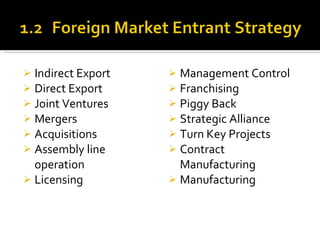
Indirect Export Direct Export Joint Ventures Mergers Acquisitions Assembly line operation Licensing Management Control Franchising Piggy Back Strategic Alliance Turn Key Projects Contract Manufacturing Manufacturing
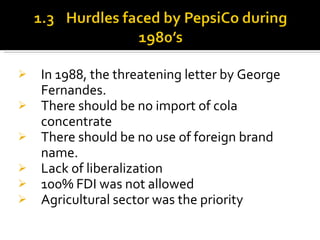
In 1988, the threatening letter by George Fernandes. There should be no import of cola concentrate There should be no use of foreign brand name. Lack of liberalization 100% FDI was not allowed Agricultural sector was the priority
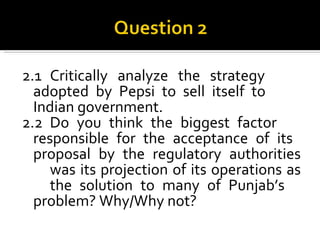
2.1 Critically analyze the strategy  adopted by Pepsi to sell itself to  Indian government. 2.2 Do you think the biggest factor  responsible for the acceptance of its  proposal by the regulatory authorities  was its projection of its operations as  the solution to many of Punjab’s  problem? Why/Why not?
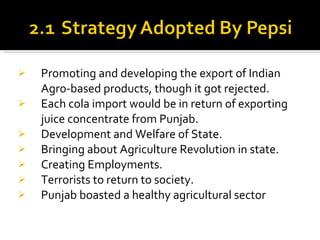
Promoting and developing the export of Indian Agro-based products, though it got rejected. Each cola import would be in return of exporting juice concentrate from Punjab. Development and Welfare of State. Bringing about Agriculture Revolution in state. Creating Employments. Terrorists to return to society. Punjab boasted a healthy agricultural sector
Development of Areas it planned to operate in Directing major (75%) investment towards agricultural sector Focusing on food and Agro-processing. Boosting the image of Indian products in foreign market. Establishing Agricultural Research Centre. More emphasis on Exports than imports to improvise the balance of payment.
Yes, Most of the commitments were related with Punjab  therefore it is the biggest factor responsible for acceptance of Pepsi.
3.1 How did company react to  changes in the business  environment after the  liberalization of the economy in  the early 1990s? 3.2 Critically comment on the  allegations that Pepsi deliberately  did not adhere to most of its  commitments?
In 1994,  it bought off  its partner in venture i.e. Voltas and PAIC. Establishing wholly owned subsidiary PepsiCo Holding India Pvt. Ltd. Changed name from “Lehar Pepsi” to “Pepsi” Sold off its Tomato Paste Plant in 1995 Gradually reduce the contract farming Plastic Exports were 67%. Till 1997, the agro research  centre  was no where.
Failing to create jobs 50% of employee working for Concentrate and Bottling Business not for Food processing Business. Pepsi with Futura Polymers Ltd. were reducing the workforce and more machine oriented More lasting impression of “Pepsi” and “Lehar Pepsi”. Export of fruit & vegetable based products was negligible & started exporting Tea, Rice & Shrimps Failed its commitment to export 50% production. Products exported were same which use to happen earlier.
4.1 Examine the contract framing initiatives  undertaken by Pepsi in India and explain  the rationale for such initiative from the  company’s prospective. 4.2 why is it important for multinational  corporations to work towards the  improvement of the economics in the  country in which the operates? 4.3 What are the various other ways in which  this can be done?
Increase in Tomato crop production Providing High yield seeds to increase the productivity in the tomato cultivation Offered advanced equipments (Free of cost) to increase the speed & efficiency Imported the required material for tomato cultivation
Rationale behind the contract farming was that in one or the other way company insisted on the development of those crops which were directly or indirectly related to their businesses such as soft drinks, snacks, fruit juices & mineral water. Other rationale behind the contract farming was to increase their own business rather than any social welfare.
Taken initiative for Chilly farming Groundnuts production over paddy production Rice production Fruits & Vegetable Farming Encouraging farmers to cultivate potato with low sugar content for chips.
Thank You

Pepsi’S Entry Into India

  • 1.
  • 2.
    1.1 Why docompanies like Pepsi need to globalize? 1.2 What are the various ways in which foreign companies can enter a foreign market? 1.3 What hurdles and problems did Pepsi face when it tried to enter India during the 1980s?
  • 3.
    To Broaden themarkets To seek raw materials To seek the technologies To seek the production efficiencies To avoid political hurdles To diversify To postpone the payment of domestic taxes To counter foreign investments by competitors
  • 4.
    Indirect Export DirectExport Joint Ventures Mergers Acquisitions Assembly line operation Licensing Management Control Franchising Piggy Back Strategic Alliance Turn Key Projects Contract Manufacturing Manufacturing
  • 5.
    In 1988, thethreatening letter by George Fernandes. There should be no import of cola concentrate There should be no use of foreign brand name. Lack of liberalization 100% FDI was not allowed Agricultural sector was the priority
  • 6.
    2.1 Critically analyzethe strategy adopted by Pepsi to sell itself to Indian government. 2.2 Do you think the biggest factor responsible for the acceptance of its proposal by the regulatory authorities was its projection of its operations as the solution to many of Punjab’s problem? Why/Why not?
  • 7.
    Promoting and developingthe export of Indian Agro-based products, though it got rejected. Each cola import would be in return of exporting juice concentrate from Punjab. Development and Welfare of State. Bringing about Agriculture Revolution in state. Creating Employments. Terrorists to return to society. Punjab boasted a healthy agricultural sector
  • 8.
    Development of Areasit planned to operate in Directing major (75%) investment towards agricultural sector Focusing on food and Agro-processing. Boosting the image of Indian products in foreign market. Establishing Agricultural Research Centre. More emphasis on Exports than imports to improvise the balance of payment.
  • 9.
    Yes, Most ofthe commitments were related with Punjab therefore it is the biggest factor responsible for acceptance of Pepsi.
  • 10.
    3.1 How didcompany react to changes in the business environment after the liberalization of the economy in the early 1990s? 3.2 Critically comment on the allegations that Pepsi deliberately did not adhere to most of its commitments?
  • 11.
    In 1994, it bought off its partner in venture i.e. Voltas and PAIC. Establishing wholly owned subsidiary PepsiCo Holding India Pvt. Ltd. Changed name from “Lehar Pepsi” to “Pepsi” Sold off its Tomato Paste Plant in 1995 Gradually reduce the contract farming Plastic Exports were 67%. Till 1997, the agro research centre was no where.
  • 12.
    Failing to createjobs 50% of employee working for Concentrate and Bottling Business not for Food processing Business. Pepsi with Futura Polymers Ltd. were reducing the workforce and more machine oriented More lasting impression of “Pepsi” and “Lehar Pepsi”. Export of fruit & vegetable based products was negligible & started exporting Tea, Rice & Shrimps Failed its commitment to export 50% production. Products exported were same which use to happen earlier.
  • 13.
    4.1 Examine thecontract framing initiatives undertaken by Pepsi in India and explain the rationale for such initiative from the company’s prospective. 4.2 why is it important for multinational corporations to work towards the improvement of the economics in the country in which the operates? 4.3 What are the various other ways in which this can be done?
  • 14.
    Increase in Tomatocrop production Providing High yield seeds to increase the productivity in the tomato cultivation Offered advanced equipments (Free of cost) to increase the speed & efficiency Imported the required material for tomato cultivation
  • 15.
    Rationale behind thecontract farming was that in one or the other way company insisted on the development of those crops which were directly or indirectly related to their businesses such as soft drinks, snacks, fruit juices & mineral water. Other rationale behind the contract farming was to increase their own business rather than any social welfare.
  • 16.
    Taken initiative forChilly farming Groundnuts production over paddy production Rice production Fruits & Vegetable Farming Encouraging farmers to cultivate potato with low sugar content for chips.
  • 17.