Coke and Pepsi
Learn to Compete in India


presented by:
Parth singh-B25
Rohit anand-B34
Renu luthra-B31
Sahil wadhwa- B
Pankaj luthra
Ishank awasthi
Political Environment in India
Key   Issues
 ◦ India seen as unfriendly to foreign
   investors for many years
 ◦ The “Principle of Indigenous Availability”
   Policy banning imports being sold in India
 ◦ The Liberalization of India’s Government
   in 1991
   “New Industrial Policy”
   Trade rules & regulations simplified
   Foreign investment increased
 ◦ Pepsi enters in 1986
 ◦ Coca-Cola follows in 1993
Indian Laws
 ◦ Unlawful to market under their Western
   name in India
   Pepsi became “Lehar Pepsi”
   Coca-Cola merged with Parle and became “Coca-
    Cola India”
 ◦ Different Laws for Pepsi and Coke
   Coca-Cola agreed to sell off 49% of its stock as a
    condition of entering and buying out an Indian
    company
   Pepsi entered earlier, and was not subject to this
Problems
 ◦ India forced Coke to sell 49% of its equity to
   Indian investors in 2002
 ◦ Coke asked for a second extension that would
   delay it until 2007
   India denied this
 ◦ Pepsi was held to this since they entered India in
   a different year.
 ◦ Coke asked the Foreign Investment Promotion
   Board to block the votes of the Indian
   shareholders who would control 49% of Coke
 ◦ Change in oversight of the FIPB
   Past lobbying efforts made useless
Could  these problems have been forecasted
 prior to market entry?
 ◦ Probably not
   Inconsistent, and changing government
How    could these developments in the
 political arena have been handled differently?
 ◦ Coke could of agreed to start new bottling plants
   instead of buying out Parle, and thus wouldn’t of
   had to agree to sell 49% of their equity
Timing of Market Entry
   Pepsi (early entry-1986)
    ◦ Advantages
       Entered the market Before Coca-Cola and was able to gain a
        foothold in the market while it was still developing
       Gained 26% market share by 1993
    ◦ Disadvantages
       Were forced to change their name to Lehar Pepsi
       Govt. limited their soft drink sales to less than 25% of total sales
       Struggled to fight off local competition
Coca-Cola (late entry-1993)

 ◦ Advantages
    Were able to buy 4 bottling plants from industry leader Parle
    Also bought Parle’s leading brands: Thums Up,       Limca, Citra,
     Gold Spot and Mazaa
    Set up 2 new ventures with Parle to bottle and       market
     product
 ◦ Disadvantages
    Denied entry until 1993 because Pepsi was already there
    Harder to establish market share with Pepsi there
    Were not allowed to buy back 49% of equity
Responses to India’s Enormity
Product   Policies
 ◦ Catering to Indian tastes
   Entering with products close to those already
    available in India such as colas, fruit drinks,
    carbonated waters
 ◦ Waiting to introduce American type drinks
   Coca-Cola introducing Sprite recently
 ◦ Introducing new products
   Bottled water
Promotional Activities
 ◦ Both advertise and use promotional material
   at Navrartri
   Pepsi gives away premium rice and candy with Pepsi
   Coca-Cola offers free passes, Coke giveaways as
    well as vacations
 ◦ Use of different campaigns for different areas
   of India
   “India A” campaigns try to appeal to young
    urbanites
   “India B” campaigns try to appeal to rural areas
Pricing Policies
 ◦ Pepsi started out with an aggressive pricing
   policy to try to get immediate market share
   from Indian competitors
 ◦ Coca-Cola cut its prices by 15-25% in 2003
   Attempt to encourage consumption to try to
    compete with Pepsi and gain market share
Distribution Arrangements
 ◦ Production plants and bottling centers placed
   in large cities all around India
 ◦ More added as demand grew and as new
   products were added
Coke and Pepsi’s Glocalization
(Global + local) Strategies
Pepsi
Pepsi  forms joint venture when first
 entering India with two local partners,
 Voltas and Punjab Agro, forming “Pepsi
 Foods Ltd”.
In 1990, Pepsi Foods Ltd. changed the
 name of their product to “Lehar Pepsi”
 to conform with foreign collaboration
 rules.
In keeping with local tastes, Pepsi
 launched its Lehar 7UP in the clear lemon
 category.
Coca-Cola
First joined forces with the local snack food
 producer Britannia Industries India Ltd. in
 the early 90’s.
Formed a joint venture with the market
 leader Parle in 1993
For the festival of Navrartri, Coca-Cola
 issued free passes to the celebration in each
 of its “Thums Up” bottles
Also ran special promotions where people
 could win free vacations to Goa, a resort
 state in western India
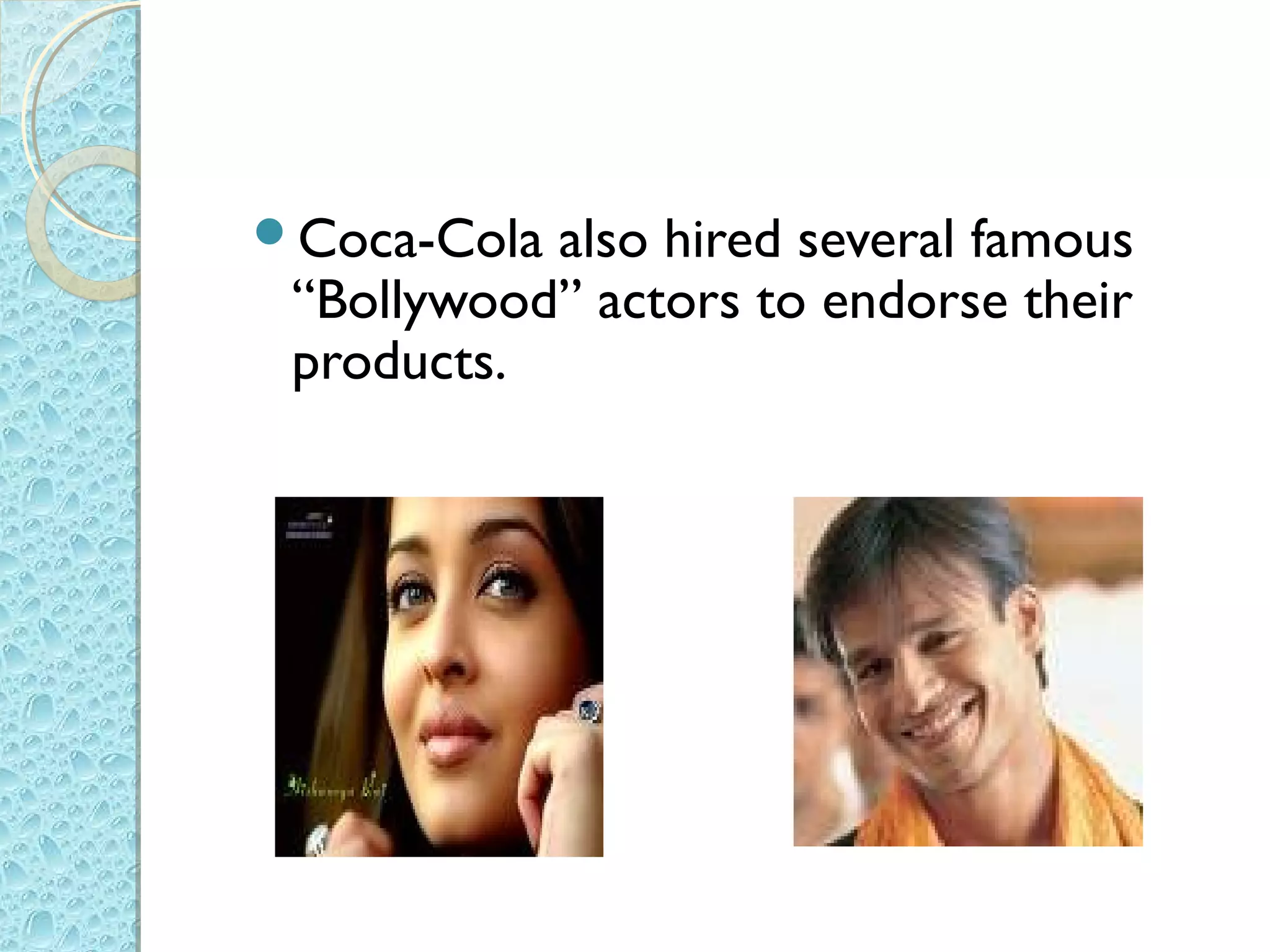
Coca-Cola also hired several famous
 “Bollywood” actors to endorse their
 products.
Coca-Cola India’s Mistakes
Enters   Market at the Wrong Time
 ◦ By entering at this time, Coca-Cola India agreed to
   abide by all the Foreign Investment Laws of that year.
Coca-Cola   India tries to expand investment
 ◦ Government allowed acquisition only if Coca-Cola
   agreed to sell 49% of equity within 2 years
Coca-Cola   tried to get extensions…twice
 ◦ India granted the first extension, denied the second
Coca-Cola  India tried to deny the upcoming
 Indian shareholders voting rights
 ◦ Foreign Investment Promotion Board (FIPB) Denies
   This
1st   Mistake
  ◦ Coca-Cola should have been more careful of
    when they entered the market and what they
    were promising when they entered.
2nd   Mistake
  ◦ Coca-Cola should not have tried to weasel
    their way out of promises that they made.
These  mistakes hurt Coca-Cola’s image
 and reputation as an International
 Company
Coke or Pepsi in the Long Run?
Pepsi
 ◦ Better marketing and advertising strategies
 ◦ More widely accepted
 ◦ More market share
Coke
 ◦ Government conflicts
 ◦ Trailing Pepsi in market share

Pepsi   will fare better in the long run
Pepsi’s Lessons Learned
Beneficial to keep with local tastes
Beneficial to pay attention to market
 trends
Celebrity appeal makes for exceptional
 advertising
It pays to keep up with emerging trends
 in the market
Coca-Cola’s Lesson’s
Learned
Pay specific attention to deals made with
 the government
Establish a good business relationship
 with the government
Investment in quality products
Advertising is crucial

Coke and Pepsi - Learn to Compete in India

  • 1.
    Coke and Pepsi Learnto Compete in India presented by: Parth singh-B25 Rohit anand-B34 Renu luthra-B31 Sahil wadhwa- B Pankaj luthra Ishank awasthi
  • 2.
    Political Environment inIndia Key Issues ◦ India seen as unfriendly to foreign investors for many years ◦ The “Principle of Indigenous Availability”  Policy banning imports being sold in India ◦ The Liberalization of India’s Government in 1991  “New Industrial Policy”  Trade rules & regulations simplified  Foreign investment increased ◦ Pepsi enters in 1986 ◦ Coca-Cola follows in 1993
  • 3.
    Indian Laws ◦Unlawful to market under their Western name in India  Pepsi became “Lehar Pepsi”  Coca-Cola merged with Parle and became “Coca- Cola India” ◦ Different Laws for Pepsi and Coke  Coca-Cola agreed to sell off 49% of its stock as a condition of entering and buying out an Indian company  Pepsi entered earlier, and was not subject to this
  • 4.
    Problems ◦ Indiaforced Coke to sell 49% of its equity to Indian investors in 2002 ◦ Coke asked for a second extension that would delay it until 2007  India denied this ◦ Pepsi was held to this since they entered India in a different year. ◦ Coke asked the Foreign Investment Promotion Board to block the votes of the Indian shareholders who would control 49% of Coke ◦ Change in oversight of the FIPB  Past lobbying efforts made useless
  • 5.
    Could theseproblems have been forecasted prior to market entry? ◦ Probably not  Inconsistent, and changing government How could these developments in the political arena have been handled differently? ◦ Coke could of agreed to start new bottling plants instead of buying out Parle, and thus wouldn’t of had to agree to sell 49% of their equity
  • 6.
    Timing of MarketEntry  Pepsi (early entry-1986) ◦ Advantages  Entered the market Before Coca-Cola and was able to gain a foothold in the market while it was still developing  Gained 26% market share by 1993 ◦ Disadvantages  Were forced to change their name to Lehar Pepsi  Govt. limited their soft drink sales to less than 25% of total sales  Struggled to fight off local competition
  • 7.
    Coca-Cola (late entry-1993) ◦ Advantages  Were able to buy 4 bottling plants from industry leader Parle  Also bought Parle’s leading brands: Thums Up, Limca, Citra, Gold Spot and Mazaa  Set up 2 new ventures with Parle to bottle and market product ◦ Disadvantages  Denied entry until 1993 because Pepsi was already there  Harder to establish market share with Pepsi there  Were not allowed to buy back 49% of equity
  • 8.
    Responses to India’sEnormity Product Policies ◦ Catering to Indian tastes  Entering with products close to those already available in India such as colas, fruit drinks, carbonated waters ◦ Waiting to introduce American type drinks  Coca-Cola introducing Sprite recently ◦ Introducing new products  Bottled water
  • 9.
    Promotional Activities ◦Both advertise and use promotional material at Navrartri  Pepsi gives away premium rice and candy with Pepsi  Coca-Cola offers free passes, Coke giveaways as well as vacations ◦ Use of different campaigns for different areas of India  “India A” campaigns try to appeal to young urbanites  “India B” campaigns try to appeal to rural areas
  • 10.
    Pricing Policies ◦Pepsi started out with an aggressive pricing policy to try to get immediate market share from Indian competitors ◦ Coca-Cola cut its prices by 15-25% in 2003  Attempt to encourage consumption to try to compete with Pepsi and gain market share
  • 11.
    Distribution Arrangements ◦Production plants and bottling centers placed in large cities all around India ◦ More added as demand grew and as new products were added
  • 12.
    Coke and Pepsi’sGlocalization (Global + local) Strategies
  • 13.
    Pepsi Pepsi formsjoint venture when first entering India with two local partners, Voltas and Punjab Agro, forming “Pepsi Foods Ltd”. In 1990, Pepsi Foods Ltd. changed the name of their product to “Lehar Pepsi” to conform with foreign collaboration rules. In keeping with local tastes, Pepsi launched its Lehar 7UP in the clear lemon category.
  • 15.
    Coca-Cola First joined forceswith the local snack food producer Britannia Industries India Ltd. in the early 90’s. Formed a joint venture with the market leader Parle in 1993 For the festival of Navrartri, Coca-Cola issued free passes to the celebration in each of its “Thums Up” bottles Also ran special promotions where people could win free vacations to Goa, a resort state in western India
  • 16.
    Coca-Cola also hiredseveral famous “Bollywood” actors to endorse their products.
  • 17.
    Coca-Cola India’s Mistakes Enters Market at the Wrong Time ◦ By entering at this time, Coca-Cola India agreed to abide by all the Foreign Investment Laws of that year. Coca-Cola India tries to expand investment ◦ Government allowed acquisition only if Coca-Cola agreed to sell 49% of equity within 2 years Coca-Cola tried to get extensions…twice ◦ India granted the first extension, denied the second Coca-Cola India tried to deny the upcoming Indian shareholders voting rights ◦ Foreign Investment Promotion Board (FIPB) Denies This
  • 18.
    1st Mistake ◦ Coca-Cola should have been more careful of when they entered the market and what they were promising when they entered. 2nd Mistake ◦ Coca-Cola should not have tried to weasel their way out of promises that they made. These mistakes hurt Coca-Cola’s image and reputation as an International Company
  • 19.
    Coke or Pepsiin the Long Run? Pepsi ◦ Better marketing and advertising strategies ◦ More widely accepted ◦ More market share Coke ◦ Government conflicts ◦ Trailing Pepsi in market share Pepsi will fare better in the long run
  • 20.
    Pepsi’s Lessons Learned Beneficialto keep with local tastes Beneficial to pay attention to market trends Celebrity appeal makes for exceptional advertising It pays to keep up with emerging trends in the market
  • 21.
    Coca-Cola’s Lesson’s Learned Pay specificattention to deals made with the government Establish a good business relationship with the government Investment in quality products Advertising is crucial