DEFINITION
A uterine fibroid is a [non cancerous] tumor that
originates from the smooth muscle layer and the
accompanying connective tissue of the uterus.
Fibroids develop with the
uterine wall or attach to it .
They may grow as a single tumor
or in clusters.
ETIOLOGY
 Etiology is not clear.
 Chromosomal abnormality.
 Reasons for occurrence of the fibroids.
 Epidermal growth factor.
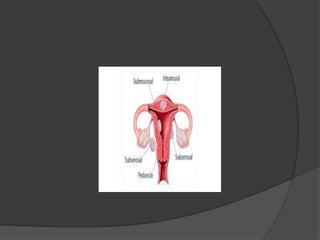
TYPES
1. Interstitial or Intramural Fibroids :
These are the most common type and are
located within the wall of the uterus
2. Subperitoneal or Subserosal fibroids
:these are located underneath the mucosal
surface of the uterus and can become very
large
3. Sub mucosal Fibroids : these are located
in the muscle beneath the endometrium of
the uterus
4. Cervical Fibroids : these are rare ,fibroids
are located in the wall of the cervix ( neck of
the uterus ) depending upon position it my
be anterior posterior lateral or central
CLINICAL FEATURES
 They grow slowly
 Fibroids may be single or multiple
 menstrual abnormalities such as menorrhagia or metrorrhagia
 Dysmenorrhoea associated with pelvic congestion or endometriosis
 Abnormal gynecologic hemorrhage heavy or painful periods abnormal
discomfort or bloating
 Menstrual bleeding pelvic pain and frequent urination
 Pain during intercourse depending on the location of the fibroids
 Infertility can be a major completed
 Defecation backache
 Painful urinary frequency or retention
 During pregnancy case of miscarriage bleeding premature labor
 Pressure on the rectum resulting in constipation
 Pelvic pressure feeling full in the lower abdomen lower abdominal pain
 Pressure on the bladder
MANAGEMENT
 EXPECTANT MANAGEMENT
 Expectant management is followed in the cases where fibroid is
asymptomatic
 Lesion can be managed expectantly depending on the
symptomatology and presence of related condition
 Thus most cases of fibroids are managed by watchful waiting
which include periodic sonographic assessment.
MEDICAL MANAGEMENT
 Drug therapy is mainly given to minimize blood loss as there is a
lot of blood loss due to excessive vaginal bleeding
 Progesterone such as norethistrone acetate or
medroxyprogestrone acetate is administered periodically from day
5 of the cycle for 20 days.
 Prostaglandin synthetase inhibitors are given to receive pain
 Antifibronylitics such as tranexamic acis is given to reduce blood
loss
 Danazole can minimize the volume of the fibroids slightly
SURGERY
 Hysterectomy or myomectomy in which
only the fibroids is removed
 Myomectomy
 Hysterectomy
 Laproscopy
 Hysterectomy
OVARIAN CYST
 DEF:- collection of fluid surround by a
very thin wall within an ovary an ovarian
cyst can very in size as it can be small
as per larger then an orange
 Ovarian cyst affect women of all ages
 Ovarian cyst can be functional non
neoplastic or benign cyst
FUNCTIONAL CYST
 An functional cyst are not related with any disease
these type cyst occur during ovulation and are part
of the normal process of the menstruation the cyst
can be treated
FOLICULAR CYST OF OVARY
 it is the commonest functional cyst it can be due to
more secretion of oestrogen
LUTEAN CYST
These cyst are usually caused due to excessive secretion
of chorionic gonadotrophin hormone
These are mostly bilateral
NON FUNTIONAL CYST
 Deroid cyst:- In around 15-20 % it is a
bilateral tumor
 Teeth and bones are found in this area
 Mucinous cyst adenoma :- bilateral tumor is
found in around 10% of total cases. It
accounts for around 20-25% of all ovarian
tumors if not treated it can be of a big size it is
the largest benign ovarian tumor.
 Serous cyst adenoma:- this tumor accounts
for about 40% of all tumors it can be bilateral
in around 40% cases it is of smaller size as
compared to mucinous cyst.
SIGN AND SYMPTOMS
 Mostly the tumor is asymptomaties defected accidentally
 Dull aching or severe swelling and sharp pain the lower
abdomen
 Fullness pressure swelling or bloating in the abdomen
 Heaviness in the lower abdomen
 Breast tenderness pitting edema of legs
 Irregular periods or abnormal uterine bleeding or spotting
 Weight gain
 Nausea and vomiting
 Headache
 Fatigue
 Infertility
 On palpation it freely mobile from side to side but restricted
from above down
 On bimanual examination a grow can be felt between the
uterus and the mass
 The lower pole of the cyst can be felt through the fornix
INVESTIGATION
 Sonography
 Abdominal x-ray
 Laproscopy
 Cystology and laparotomy
DIAGNOSIS-
Ovarian cyst usually diagnosed by
either ultrasound and CT scan
TREATMENT
 Treatment for cyst depends on the size cyst and
symptoms
 Most of the cyst are benign in nature
 To minimize complication surgery may be indicated
 In young ovarian lystectomy is performed leaving
behind the healthy ovarian tissue
 For big tumors ovariotomy is performed
 Total hysterectomy bilateral salpingo ophorectomy
is done in the parous women above 40% pain
caused by ovarian cyst may be treated with pain
relievers
 A heating pad or hot water bottle applied to the
lower abdominal near the ovarious can relaxed
tones muscles and lesion discomfort and stimulate
circulation and healing in then ovaries
 In every case the tumor must sent for histological
examination

Cysts and fibroids

  • 2.
    DEFINITION A uterine fibroidis a [non cancerous] tumor that originates from the smooth muscle layer and the accompanying connective tissue of the uterus. Fibroids develop with the uterine wall or attach to it . They may grow as a single tumor or in clusters.
  • 3.
    ETIOLOGY  Etiology isnot clear.  Chromosomal abnormality.  Reasons for occurrence of the fibroids.  Epidermal growth factor.
  • 4.
    TYPES 1. Interstitial orIntramural Fibroids : These are the most common type and are located within the wall of the uterus 2. Subperitoneal or Subserosal fibroids :these are located underneath the mucosal surface of the uterus and can become very large 3. Sub mucosal Fibroids : these are located in the muscle beneath the endometrium of the uterus 4. Cervical Fibroids : these are rare ,fibroids are located in the wall of the cervix ( neck of the uterus ) depending upon position it my be anterior posterior lateral or central
  • 6.
    CLINICAL FEATURES  Theygrow slowly  Fibroids may be single or multiple  menstrual abnormalities such as menorrhagia or metrorrhagia  Dysmenorrhoea associated with pelvic congestion or endometriosis  Abnormal gynecologic hemorrhage heavy or painful periods abnormal discomfort or bloating  Menstrual bleeding pelvic pain and frequent urination  Pain during intercourse depending on the location of the fibroids  Infertility can be a major completed  Defecation backache  Painful urinary frequency or retention  During pregnancy case of miscarriage bleeding premature labor  Pressure on the rectum resulting in constipation  Pelvic pressure feeling full in the lower abdomen lower abdominal pain  Pressure on the bladder
  • 7.
    MANAGEMENT  EXPECTANT MANAGEMENT Expectant management is followed in the cases where fibroid is asymptomatic  Lesion can be managed expectantly depending on the symptomatology and presence of related condition  Thus most cases of fibroids are managed by watchful waiting which include periodic sonographic assessment. MEDICAL MANAGEMENT  Drug therapy is mainly given to minimize blood loss as there is a lot of blood loss due to excessive vaginal bleeding  Progesterone such as norethistrone acetate or medroxyprogestrone acetate is administered periodically from day 5 of the cycle for 20 days.  Prostaglandin synthetase inhibitors are given to receive pain  Antifibronylitics such as tranexamic acis is given to reduce blood loss  Danazole can minimize the volume of the fibroids slightly
  • 8.
    SURGERY  Hysterectomy ormyomectomy in which only the fibroids is removed  Myomectomy  Hysterectomy  Laproscopy  Hysterectomy
  • 9.
    OVARIAN CYST  DEF:-collection of fluid surround by a very thin wall within an ovary an ovarian cyst can very in size as it can be small as per larger then an orange  Ovarian cyst affect women of all ages  Ovarian cyst can be functional non neoplastic or benign cyst
  • 10.
    FUNCTIONAL CYST  Anfunctional cyst are not related with any disease these type cyst occur during ovulation and are part of the normal process of the menstruation the cyst can be treated FOLICULAR CYST OF OVARY  it is the commonest functional cyst it can be due to more secretion of oestrogen LUTEAN CYST These cyst are usually caused due to excessive secretion of chorionic gonadotrophin hormone These are mostly bilateral
  • 11.
    NON FUNTIONAL CYST Deroid cyst:- In around 15-20 % it is a bilateral tumor  Teeth and bones are found in this area  Mucinous cyst adenoma :- bilateral tumor is found in around 10% of total cases. It accounts for around 20-25% of all ovarian tumors if not treated it can be of a big size it is the largest benign ovarian tumor.  Serous cyst adenoma:- this tumor accounts for about 40% of all tumors it can be bilateral in around 40% cases it is of smaller size as compared to mucinous cyst.
  • 12.
    SIGN AND SYMPTOMS Mostly the tumor is asymptomaties defected accidentally  Dull aching or severe swelling and sharp pain the lower abdomen  Fullness pressure swelling or bloating in the abdomen  Heaviness in the lower abdomen  Breast tenderness pitting edema of legs  Irregular periods or abnormal uterine bleeding or spotting  Weight gain  Nausea and vomiting  Headache  Fatigue  Infertility  On palpation it freely mobile from side to side but restricted from above down  On bimanual examination a grow can be felt between the uterus and the mass  The lower pole of the cyst can be felt through the fornix
  • 13.
    INVESTIGATION  Sonography  Abdominalx-ray  Laproscopy  Cystology and laparotomy DIAGNOSIS- Ovarian cyst usually diagnosed by either ultrasound and CT scan
  • 14.
    TREATMENT  Treatment forcyst depends on the size cyst and symptoms  Most of the cyst are benign in nature  To minimize complication surgery may be indicated  In young ovarian lystectomy is performed leaving behind the healthy ovarian tissue  For big tumors ovariotomy is performed  Total hysterectomy bilateral salpingo ophorectomy is done in the parous women above 40% pain caused by ovarian cyst may be treated with pain relievers  A heating pad or hot water bottle applied to the lower abdominal near the ovarious can relaxed tones muscles and lesion discomfort and stimulate circulation and healing in then ovaries  In every case the tumor must sent for histological examination