Sexually Transmitted Infections
Mike Guyton, MD
Assistant Clinical Professor/Academic
Faculty in General Pediatrics
Reportable STI’s in SC (2014)
• Chancroid
• Chlamydia trachomatis, genital site
• Gonorrhea (include susceptibility profile)
• (URGENT) Acute Hepatitis (A-E)
• Chronic Hepatitis (B-D)
• Hepatitis B Surface Antigen + with each pregnancy
• HIV and AIDS Clinical Diagnosis and positive test
results*
• Lymphogranuloma Venereum
• (URGENT) Syphilis (congenital, primary, secondary,
latent, tertiary, positive test
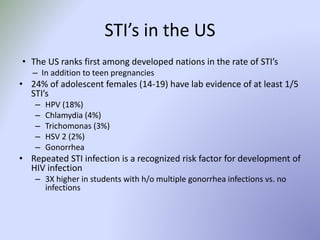
STI’s in the US
• The US ranks first among developed nations in the rate of STI’s
– In addition to teen pregnancies
• 24% of adolescent females (14-19) have lab evidence of at least 1/5
STI’s
– HPV (18%)
– Chlamydia (4%)
– Trichomonas (3%)
– HSV 2 (2%)
– Gonorrhea
• Repeated STI infection is a recognized risk factor for development of
HIV infection
– 3X higher in students with h/o multiple gonorrhea infections vs. no
infections
Quick CDC Facts
• FACT: 19 million new infections occur every year in the US
• FACT: STI’s cost the US HealthCare System $17 billion yearly
• FACT: Untreated STI’s cause 24,000 women in the US to
become infertile yearly
• FACT: While young people only represent 25% of the
sexually experienced population in the US, they account for
almost 50% of newly diagnosed STI infections
• FACT: ~20% of adolescents fail to fill Rx for STI treatment
Specific To Adolescents
Risk Factors
• Behavioral
– Time elapsed since first
intercourse
– Multiple or new partners
– Inconsistent use of condoms
– Alcohol/drug use*
• Biologic
– Cervical ectopy/immaturity
– Low levels of sIgA
Unique Issues
• Self-consent for Dx and Tx
• Concerns about privacy and
confidentiality
• Pregnancy/fear of
pregnancy
• Self-treatment
• Preference to notify
partners themselves
Expedited Partner Therapy
• Approach where partners who test positive for
certain STI’s are given RX without previous
medical evaluation
• Recommended use from CDC since 2006
• Previously recommended for Gonorrhea and
Chlamydia; however Gonorrhea recs have
changed
– Difficult to give due to new recommendations for
ceftriaxone injection only!
• EPT is permissible in SC and NC
– Visit www.cdc.gov/std/ept/legal/default.htm
STI Clinical Patterns
• Discharge Syndromes
– Gonorrhea and Chlamydia
– Bacterial Vaginosis/Candidiasis
– Mycoplasma Genitalium
• Genital Ulcer Syndromes
– Herpes Simplex Virus
– Primary Syphilis
– Chancroid/Lymphogranuloma Venereum/ Granuloma Inguinale
• Pelvic Inflammatory Disease
• Dermatologic Syndromes
– HPV
– Secondary Syphilis
– Disseminated Gonococcal Infection
– Pediculosis Pubis
Chlamydia and Gonorrhea
• Chlamydia is the most common bacterial STI in men and women
– Cervicitis (not vaginitis) with menometrorrhagia
– Dysuria-Pyuria Syndrome
– PID
– Perihepatitis
– Proctitis
– Men: See Urethritis, Prostatitis, Proctitis, Epididymitis, Reactive
Arthritis (1%)
• Gonorrhea
– Similar to above, but also can see higher incidence of pharyngitis (1-
12%)
– While mucoprulent discharge common, asymptomatic cases also occur
(50% in women vs 10-15% in men)
Chlamydia and Gonorrhea: Treatment
• Gonorrhea:
– Ceftriaxone 250mg IM x 1 PLUS Azithromycin 1g po x 1 OR Doxycycline 100mg
po BID x 7 days
– Other:
• ceftizoxime 500 mg intramuscularly/ cefotaxime 500 mg
intramuscularly/cefoxitin 2 g intramuscularly PLUS Azithro or Doxy
• Oral Cefixime 400mg x 1 dose PLUS Azithro OR Doxy
• Azithromycin Monotherapy with 2g x 1 dose
• Chlamydia:
– Azithromycin 1g po x 1 dose
– Doxycycline 100mg po BID x 7 days
– Other:
• Ofloxacin 300 mg orally twice daily for seven days
• Levofloxacin 500 mg orally once daily for seven days
• Erythromycin/PCN if pregnant and intolerant to Azithro
Rescreening
• “Rescreen all adolescents infected with chlamydia or
gonorrhea 3 months after treatment, regardless of whether
they believe that their sex partners were treated.”
Bacterial Vaginosis/Candidiasis
• Bacterial Vaginosis:
– Most common cause of vaginal discharge in women of
childbearing age (40-50%); abnormal alteration of vaginal flora
– Tx: Metronidazole 500mg po BID x 7 days OR Metronidazole
Gel 0.75% qday x 5 days OR Clindamycin 2% cream qhs x 7 days
– Other
• Clindamycin 300mg po x 7 days; Clindamycin Ovule; Tinidazole
• Candidiasis:
– Common in healthy reproductive age women; less likely sexual
transmission; often clinical diagnosis
– Tx: Recommended: Fluconazole 150mg po x 1 dose or if
severe/complicated, 150mg po every 72h x 2-3 doses.
Mycoplasma Genitalium
• Causes Non-Gonococcal Urethritis in men and emerging cause of
cervicitis and PID in women
– 15-25% of cases of NGU in men
– 18-46% of cases of NCNGU in men
– Role in women not fully established
• Co-infections with other STI-causing organisms is highly reported
• Clinical:
– Men: usually symptomatic (as high as 70%) with discharge, balantitis,
or posthitis
– Women: usually asymptomatic or occur with symptoms of PID
• Treatment:
– Empiric: Azithromycin OR Doxycycline
– Targeted: Same as above; Moxifloxicin if persistent
infection/symptoms
PREP Question
• An 18-year-old woman has a 3-day history of fever, headache, and
painful sores in the genital area. The patient has no previous history
of genital lesions. Medical history is unremarkable, and her only
medication is an oral contraceptive agent. She does not use
condoms. On physical examination, temperature is 38.1 °C (100.6
°F); other vital signs are normal. There are no signs of meningismus.
Tender ulcerative lesions with a yellow crusted roof cover the labia
bilaterally and the vaginal introitus.
• A.) Chancroid
• B.) Genital Herpes Simplex Virus Infection
• C.) Primary Syphilis
• D.) Vulvovaginal Candidiasis
PREP Question
• An 18-year-old woman has a 3-day history of fever, headache, and
painful sores in the genital area. The patient has no previous history
of genital lesions. Medical history is unremarkable, and her only
medication is an oral contraceptive agent. She does not use
condoms. On physical examination, temperature is 38.1 °C (100.6
°F); other vital signs are normal. There are no signs of meningismus.
Tender ulcerative lesions with a yellow crusted roof cover the labia
bilaterally and the vaginal introitus.
• A.) Chancroid
• B.) Genital Herpes Simplex Virus Infection
• C.) Primary Syphilis
• D.) Vulvovaginal Candidiasis
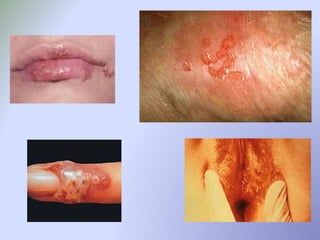
Genital Herpes
• Belongs to the Genital Ulcer Syndromes
– HSV, T. pallidum, and H. ducreyi
• HSV2 is predominant, with increasing HSV1 genital
occurrence in females
• Lesions begin as vesicles, which then rupture to form
painful ulcers
– Usually occurring as clusters
• Occurs as a Primary Outbreak, Recurrent Outbreak,
and Latent Infection
– Primary outbreak last 2-3 weeks and often associated
with systemic symptoms (fever, malaise, dysuria)
– Recurrent Outbreaks usually are shorter, 7-12 days
• HSV has a high infectivity and high recurrence rate
– Infectivity 75-80% with active infection
– HSV1 Recurrence: 60%; HSV2 Recurrence: 90%
Genital Herpes: Treatment
• Treatment differs based on type of
infection
– Primary:
• Acyclovir 400mg po TID or 200mg po 5x/d x 7-
10 days
• Famciclovir 250mg TID x 7-10 days
• Valacyclovir 1g BID x 7-10 days
– Recurrent:
• Acyclovir 800mg TID x 2 days or BID x 5 days
• Famciclovir 1g BID x 1 day or 125mg BID x 5 days
• Valacyclovir 500mg BID x 3 days
– Suppression:
• Valacyclovir 1g po qday (can be 500mg daily if
<9 recurrences/year)
– 500mg BID if immunoompromised
Primary Syphilis
• After incubation, a
ulcerating, painless papule
occurs at site of inoculation;
heal 3-6 weeks later
• Usually singular, but can be
multiple in setting of HIV
• Associated with regional
mild-moderate bilateral LAN
• Secondary Syphilis can
occur weeks to months later
Syphilis: Treatment
• Primary, Secondary, or
Latent <1 year
– PCN G Benzathine 2.4
million units IM x 1
– Doxycycline 100mg po BID
x 7 days
• Jarish-Herxheimer
Reaction
– Acute febrile reaction with
HA and myalgias in first 24
hours of treatment
Chancroid/Lymphogranuloma
Venereum/Granuloma Inguinale
• Chancroid
– Haemophilus ducreyi, very uncommon in the US
– Papule  pustule  PAINFUL ulcers with fluctuant buboes (lymph nodes can
spontaneously rupture)
– Tx: Azithromycin 1g po x 1 OR Ceftriaxone 250mg IM x 1
• Lymphogranuloma Venereum
– L1, L2, and L3 serovars of Chlamydia; tropical and subtropical areas of the
world
– Spontaneously healing PAINLESS genital ulcer extension to regional lymph
nodes (groove sign)  fibrosis and stricture of anogenital tract
– Tx: Doxycycline 100mg po BID x 21 days OR Erythromycin/Azithromycin
• Granuloma Inguinale (Donovanosis)
– Uncommon, caused by Klebsiella granulomatis (PAINLESS ULCER[S])
– Tx: Doxycycline, Azithromycin, Cipro, Erythromycin, or Bactrim x 3 weeks
Pelvic Inflammatory Disease
• Acute infection of the upper genital tract of women
– Chlamydia, Gonorrhea, or Vaginal Flora organisms (Anaerobes and
GNR)
– RF for subsequent ectopic pregnancy and infertility
• Clinical Diagnosis of PID is often imprecise; need evaluation of risk
factors
– Lower Quadrant Abdominal Pain, acute in nature
– Abnormal uterine bleeding (1/3 of patients)
– New onset discharge, urethritis, Proctitis, fever (non-specific)
• Empiric Treatment often initiated if 1 out of three clinical findings
present (in the setting of abdominal pain):
– Cervical Motion Tenderness
– Uterine Tenderness
– Adnexal Tenderness
Pelvic Inflammatory Disease:
Treatment
Indications for Hospitalization
• Pregnancy
• Nonresponse/tolerance to po
medications
• Noncompliance
• Inability to take oral medications
• Severe clinical illness (high fever,
nausea, vomiting, severe
abdominal pain)
• Complicated PID with pelvic
abscess
• Possible need for surgical
intervention or diagnostic
exploration for alternative
etiology (e.g., appendicitis)
Outpatient vs Inpatient
• Outpatient:
– Ceftriaxone 250mg IM x 1 PLUS
Doxy 100mg po BID x 14 days
– Cefoxitin 2mg IM with
Probenecid 1g po x 1 PLUS
Doxy 100mg po BID x 14 days
• Inpatient:
– Cefoxitin (2g IV q6) OR
Cefotetan (2g IV q12) PLUS
Doxy100mg po q12
– Clindamycin 900mg IV q8 PLUS
Gentamicin (Load: 2mg/kg;
Maint: 1.5mg/kg q8)
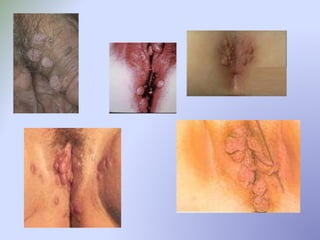
Genital Warts
• Condyloma Accuminata, caused by Human Papilloma Virus
– >70 different subtypes; High risk associated with cancers (16, 18) and low risk associated with
genital warts (6, 11)
– Incubation is 3w-8m and most infections are cleared within 2 years
• Risk Factors
– Sexual activity (more partners increases the risk in Men and Women)
– Concomitant/history of recurrent STI’s
– Individuals who are HIV positive
• Clinical
– Ranges from asymptomatic (M and F) to problematic, depending on the size of warts
– Can see Pruritus, pain, bleeding, tenderness, or vaginal discharge
• Differential Diagnosis
– Condyloma Lata
– Micropapillomatosis
– Pearly Penile Papules
– Squamous Cell Carcinoma
Genital Warts: Treatment
• Multiple Modalities of Treatment
– Spontaneous Remission (20-30% of cases)
– Chemical Agents
• Podophyllin: Teratogenic, risk of chemical burns
• Trichloroacetic Acid: can be used internally, but highly caustic
• 5-Fluorouracil Epinephrine Gel: Injected Intralesionally
– Immune Modulation
• Imiquimod: Complete clearance rates of 40-70% with few recurrence
• Interferon Alfa: side effects of interferon
• Sinecatechins: botanical
– Surgery
• Cryotherapy, Laser, Excisional
– HPV Vaccination: highly effective
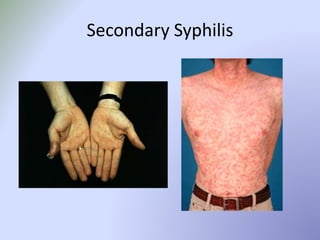
Secondary Syphilis
Disseminated Gonococcus
• 0.5-3% of those infected with Nisseria gonorrheae (M>F 3X)
• Certain Risk Factors Exist
– Recent menstruation, Pregnancy/immediate post-partum,
complement deficiencies, or SLE
• Clinical Findings:
– Triad: Tenosynovitis, dermatitis, polyarthralgias without purulent
arthritis
• Acute Fever, chills, malaise is heralding
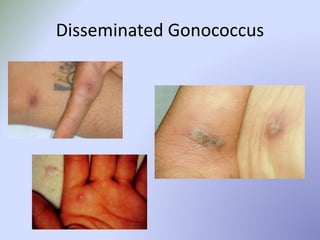
• Lesions often painless, pustular or vesiculopustular
– Purulent arthritis without skin lesions
• Asymmetric, usually knees/wrists/ankles
• Treatment:
– Ceftriaxone 1g q24 hours initially PLUS Azithromycin 1g po x 1 OR
Doxycycline 100mg po BID x 7 days
– Duration: 7-14 days; step down therapy controversial
Disseminated Gonococcus
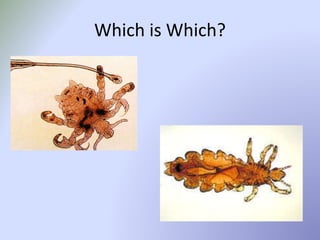
Pediculosis Pubis
• Crab Louse, transmitted through sex or sometimes Fomites
• Clinical:
– Itching
– Maculae Cerulae: pale blue macules (0.5-1cm) from the
anticoagulant present in saliva of parasite, prolonged infestation
– Sometimes LAN
• Treatment:
– Permethrin 1% cream applied and washed off after 10 minutes
– Pyrethrins with piperonyl butoxide, same as above
– Alternative
• Malathion 0.5% lotion applied and washed off after 8-12 hours
• Ivermectin 250mcg/kg orally x 1, repeated in 1-2 weeks
• Lindane not recommended
Which is Which?
A word on HIV screening
• Test: HIV Ag/Ab Combo
• CDC Recommendations:
– Opt-Out HIV testing for all patients 13-64 years old
• AAP Recommendations:
– Routine HIV testing to be offered at least once to all
adolescents (despite report of sexual activity) by 16-18yo
in clinic settings where HIV prevalence is >0.1%
– Prevalence <0.1%: HIV testing for all sexually active
adolescents and those with other risk factors
Questions?

Adolescent sti ucaya

  • 1.
    Sexually Transmitted Infections MikeGuyton, MD Assistant Clinical Professor/Academic Faculty in General Pediatrics
  • 2.
    Reportable STI’s inSC (2014) • Chancroid • Chlamydia trachomatis, genital site • Gonorrhea (include susceptibility profile) • (URGENT) Acute Hepatitis (A-E) • Chronic Hepatitis (B-D) • Hepatitis B Surface Antigen + with each pregnancy • HIV and AIDS Clinical Diagnosis and positive test results* • Lymphogranuloma Venereum • (URGENT) Syphilis (congenital, primary, secondary, latent, tertiary, positive test
  • 3.
    STI’s in theUS • The US ranks first among developed nations in the rate of STI’s – In addition to teen pregnancies • 24% of adolescent females (14-19) have lab evidence of at least 1/5 STI’s – HPV (18%) – Chlamydia (4%) – Trichomonas (3%) – HSV 2 (2%) – Gonorrhea • Repeated STI infection is a recognized risk factor for development of HIV infection – 3X higher in students with h/o multiple gonorrhea infections vs. no infections
  • 4.
    Quick CDC Facts •FACT: 19 million new infections occur every year in the US • FACT: STI’s cost the US HealthCare System $17 billion yearly • FACT: Untreated STI’s cause 24,000 women in the US to become infertile yearly • FACT: While young people only represent 25% of the sexually experienced population in the US, they account for almost 50% of newly diagnosed STI infections • FACT: ~20% of adolescents fail to fill Rx for STI treatment
  • 5.
    Specific To Adolescents RiskFactors • Behavioral – Time elapsed since first intercourse – Multiple or new partners – Inconsistent use of condoms – Alcohol/drug use* • Biologic – Cervical ectopy/immaturity – Low levels of sIgA Unique Issues • Self-consent for Dx and Tx • Concerns about privacy and confidentiality • Pregnancy/fear of pregnancy • Self-treatment • Preference to notify partners themselves
  • 6.
    Expedited Partner Therapy •Approach where partners who test positive for certain STI’s are given RX without previous medical evaluation • Recommended use from CDC since 2006 • Previously recommended for Gonorrhea and Chlamydia; however Gonorrhea recs have changed – Difficult to give due to new recommendations for ceftriaxone injection only! • EPT is permissible in SC and NC – Visit www.cdc.gov/std/ept/legal/default.htm
  • 7.
    STI Clinical Patterns •Discharge Syndromes – Gonorrhea and Chlamydia – Bacterial Vaginosis/Candidiasis – Mycoplasma Genitalium • Genital Ulcer Syndromes – Herpes Simplex Virus – Primary Syphilis – Chancroid/Lymphogranuloma Venereum/ Granuloma Inguinale • Pelvic Inflammatory Disease • Dermatologic Syndromes – HPV – Secondary Syphilis – Disseminated Gonococcal Infection – Pediculosis Pubis
  • 8.
    Chlamydia and Gonorrhea •Chlamydia is the most common bacterial STI in men and women – Cervicitis (not vaginitis) with menometrorrhagia – Dysuria-Pyuria Syndrome – PID – Perihepatitis – Proctitis – Men: See Urethritis, Prostatitis, Proctitis, Epididymitis, Reactive Arthritis (1%) • Gonorrhea – Similar to above, but also can see higher incidence of pharyngitis (1- 12%) – While mucoprulent discharge common, asymptomatic cases also occur (50% in women vs 10-15% in men)
  • 9.
    Chlamydia and Gonorrhea:Treatment • Gonorrhea: – Ceftriaxone 250mg IM x 1 PLUS Azithromycin 1g po x 1 OR Doxycycline 100mg po BID x 7 days – Other: • ceftizoxime 500 mg intramuscularly/ cefotaxime 500 mg intramuscularly/cefoxitin 2 g intramuscularly PLUS Azithro or Doxy • Oral Cefixime 400mg x 1 dose PLUS Azithro OR Doxy • Azithromycin Monotherapy with 2g x 1 dose • Chlamydia: – Azithromycin 1g po x 1 dose – Doxycycline 100mg po BID x 7 days – Other: • Ofloxacin 300 mg orally twice daily for seven days • Levofloxacin 500 mg orally once daily for seven days • Erythromycin/PCN if pregnant and intolerant to Azithro
  • 10.
    Rescreening • “Rescreen alladolescents infected with chlamydia or gonorrhea 3 months after treatment, regardless of whether they believe that their sex partners were treated.”
  • 11.
    Bacterial Vaginosis/Candidiasis • BacterialVaginosis: – Most common cause of vaginal discharge in women of childbearing age (40-50%); abnormal alteration of vaginal flora – Tx: Metronidazole 500mg po BID x 7 days OR Metronidazole Gel 0.75% qday x 5 days OR Clindamycin 2% cream qhs x 7 days – Other • Clindamycin 300mg po x 7 days; Clindamycin Ovule; Tinidazole • Candidiasis: – Common in healthy reproductive age women; less likely sexual transmission; often clinical diagnosis – Tx: Recommended: Fluconazole 150mg po x 1 dose or if severe/complicated, 150mg po every 72h x 2-3 doses.
  • 12.
    Mycoplasma Genitalium • CausesNon-Gonococcal Urethritis in men and emerging cause of cervicitis and PID in women – 15-25% of cases of NGU in men – 18-46% of cases of NCNGU in men – Role in women not fully established • Co-infections with other STI-causing organisms is highly reported • Clinical: – Men: usually symptomatic (as high as 70%) with discharge, balantitis, or posthitis – Women: usually asymptomatic or occur with symptoms of PID • Treatment: – Empiric: Azithromycin OR Doxycycline – Targeted: Same as above; Moxifloxicin if persistent infection/symptoms
  • 13.
    PREP Question • An18-year-old woman has a 3-day history of fever, headache, and painful sores in the genital area. The patient has no previous history of genital lesions. Medical history is unremarkable, and her only medication is an oral contraceptive agent. She does not use condoms. On physical examination, temperature is 38.1 °C (100.6 °F); other vital signs are normal. There are no signs of meningismus. Tender ulcerative lesions with a yellow crusted roof cover the labia bilaterally and the vaginal introitus. • A.) Chancroid • B.) Genital Herpes Simplex Virus Infection • C.) Primary Syphilis • D.) Vulvovaginal Candidiasis
  • 14.
    PREP Question • An18-year-old woman has a 3-day history of fever, headache, and painful sores in the genital area. The patient has no previous history of genital lesions. Medical history is unremarkable, and her only medication is an oral contraceptive agent. She does not use condoms. On physical examination, temperature is 38.1 °C (100.6 °F); other vital signs are normal. There are no signs of meningismus. Tender ulcerative lesions with a yellow crusted roof cover the labia bilaterally and the vaginal introitus. • A.) Chancroid • B.) Genital Herpes Simplex Virus Infection • C.) Primary Syphilis • D.) Vulvovaginal Candidiasis
  • 15.
    Genital Herpes • Belongsto the Genital Ulcer Syndromes – HSV, T. pallidum, and H. ducreyi • HSV2 is predominant, with increasing HSV1 genital occurrence in females • Lesions begin as vesicles, which then rupture to form painful ulcers – Usually occurring as clusters • Occurs as a Primary Outbreak, Recurrent Outbreak, and Latent Infection – Primary outbreak last 2-3 weeks and often associated with systemic symptoms (fever, malaise, dysuria) – Recurrent Outbreaks usually are shorter, 7-12 days • HSV has a high infectivity and high recurrence rate – Infectivity 75-80% with active infection – HSV1 Recurrence: 60%; HSV2 Recurrence: 90%
  • 16.
    Genital Herpes: Treatment •Treatment differs based on type of infection – Primary: • Acyclovir 400mg po TID or 200mg po 5x/d x 7- 10 days • Famciclovir 250mg TID x 7-10 days • Valacyclovir 1g BID x 7-10 days – Recurrent: • Acyclovir 800mg TID x 2 days or BID x 5 days • Famciclovir 1g BID x 1 day or 125mg BID x 5 days • Valacyclovir 500mg BID x 3 days – Suppression: • Valacyclovir 1g po qday (can be 500mg daily if <9 recurrences/year) – 500mg BID if immunoompromised
  • 18.
    Primary Syphilis • Afterincubation, a ulcerating, painless papule occurs at site of inoculation; heal 3-6 weeks later • Usually singular, but can be multiple in setting of HIV • Associated with regional mild-moderate bilateral LAN • Secondary Syphilis can occur weeks to months later
  • 19.
    Syphilis: Treatment • Primary,Secondary, or Latent <1 year – PCN G Benzathine 2.4 million units IM x 1 – Doxycycline 100mg po BID x 7 days • Jarish-Herxheimer Reaction – Acute febrile reaction with HA and myalgias in first 24 hours of treatment
  • 20.
    Chancroid/Lymphogranuloma Venereum/Granuloma Inguinale • Chancroid –Haemophilus ducreyi, very uncommon in the US – Papule  pustule  PAINFUL ulcers with fluctuant buboes (lymph nodes can spontaneously rupture) – Tx: Azithromycin 1g po x 1 OR Ceftriaxone 250mg IM x 1 • Lymphogranuloma Venereum – L1, L2, and L3 serovars of Chlamydia; tropical and subtropical areas of the world – Spontaneously healing PAINLESS genital ulcer extension to regional lymph nodes (groove sign)  fibrosis and stricture of anogenital tract – Tx: Doxycycline 100mg po BID x 21 days OR Erythromycin/Azithromycin • Granuloma Inguinale (Donovanosis) – Uncommon, caused by Klebsiella granulomatis (PAINLESS ULCER[S]) – Tx: Doxycycline, Azithromycin, Cipro, Erythromycin, or Bactrim x 3 weeks
  • 22.
    Pelvic Inflammatory Disease •Acute infection of the upper genital tract of women – Chlamydia, Gonorrhea, or Vaginal Flora organisms (Anaerobes and GNR) – RF for subsequent ectopic pregnancy and infertility • Clinical Diagnosis of PID is often imprecise; need evaluation of risk factors – Lower Quadrant Abdominal Pain, acute in nature – Abnormal uterine bleeding (1/3 of patients) – New onset discharge, urethritis, Proctitis, fever (non-specific) • Empiric Treatment often initiated if 1 out of three clinical findings present (in the setting of abdominal pain): – Cervical Motion Tenderness – Uterine Tenderness – Adnexal Tenderness
  • 23.
    Pelvic Inflammatory Disease: Treatment Indicationsfor Hospitalization • Pregnancy • Nonresponse/tolerance to po medications • Noncompliance • Inability to take oral medications • Severe clinical illness (high fever, nausea, vomiting, severe abdominal pain) • Complicated PID with pelvic abscess • Possible need for surgical intervention or diagnostic exploration for alternative etiology (e.g., appendicitis) Outpatient vs Inpatient • Outpatient: – Ceftriaxone 250mg IM x 1 PLUS Doxy 100mg po BID x 14 days – Cefoxitin 2mg IM with Probenecid 1g po x 1 PLUS Doxy 100mg po BID x 14 days • Inpatient: – Cefoxitin (2g IV q6) OR Cefotetan (2g IV q12) PLUS Doxy100mg po q12 – Clindamycin 900mg IV q8 PLUS Gentamicin (Load: 2mg/kg; Maint: 1.5mg/kg q8)
  • 24.
    Genital Warts • CondylomaAccuminata, caused by Human Papilloma Virus – >70 different subtypes; High risk associated with cancers (16, 18) and low risk associated with genital warts (6, 11) – Incubation is 3w-8m and most infections are cleared within 2 years • Risk Factors – Sexual activity (more partners increases the risk in Men and Women) – Concomitant/history of recurrent STI’s – Individuals who are HIV positive • Clinical – Ranges from asymptomatic (M and F) to problematic, depending on the size of warts – Can see Pruritus, pain, bleeding, tenderness, or vaginal discharge • Differential Diagnosis – Condyloma Lata – Micropapillomatosis – Pearly Penile Papules – Squamous Cell Carcinoma
  • 25.
    Genital Warts: Treatment •Multiple Modalities of Treatment – Spontaneous Remission (20-30% of cases) – Chemical Agents • Podophyllin: Teratogenic, risk of chemical burns • Trichloroacetic Acid: can be used internally, but highly caustic • 5-Fluorouracil Epinephrine Gel: Injected Intralesionally – Immune Modulation • Imiquimod: Complete clearance rates of 40-70% with few recurrence • Interferon Alfa: side effects of interferon • Sinecatechins: botanical – Surgery • Cryotherapy, Laser, Excisional – HPV Vaccination: highly effective
  • 27.
  • 28.
    Disseminated Gonococcus • 0.5-3%of those infected with Nisseria gonorrheae (M>F 3X) • Certain Risk Factors Exist – Recent menstruation, Pregnancy/immediate post-partum, complement deficiencies, or SLE • Clinical Findings: – Triad: Tenosynovitis, dermatitis, polyarthralgias without purulent arthritis • Acute Fever, chills, malaise is heralding • Lesions often painless, pustular or vesiculopustular – Purulent arthritis without skin lesions • Asymmetric, usually knees/wrists/ankles • Treatment: – Ceftriaxone 1g q24 hours initially PLUS Azithromycin 1g po x 1 OR Doxycycline 100mg po BID x 7 days – Duration: 7-14 days; step down therapy controversial
  • 29.
  • 30.
    Pediculosis Pubis • CrabLouse, transmitted through sex or sometimes Fomites • Clinical: – Itching – Maculae Cerulae: pale blue macules (0.5-1cm) from the anticoagulant present in saliva of parasite, prolonged infestation – Sometimes LAN • Treatment: – Permethrin 1% cream applied and washed off after 10 minutes – Pyrethrins with piperonyl butoxide, same as above – Alternative • Malathion 0.5% lotion applied and washed off after 8-12 hours • Ivermectin 250mcg/kg orally x 1, repeated in 1-2 weeks • Lindane not recommended
  • 31.
  • 32.
    A word onHIV screening • Test: HIV Ag/Ab Combo • CDC Recommendations: – Opt-Out HIV testing for all patients 13-64 years old • AAP Recommendations: – Routine HIV testing to be offered at least once to all adolescents (despite report of sexual activity) by 16-18yo in clinic settings where HIV prevalence is >0.1% – Prevalence <0.1%: HIV testing for all sexually active adolescents and those with other risk factors
  • 33.

Editor's Notes

  • #3 *and many labs related to the HIV diagnosis, such as CD4 results, subtype/genotype/phenotype, viral load, receptor assays
  • #4 -Gonorrhea acquisition decreased slightly among adolescent females in 2011-2012
  • #6 -In an observational study in adolescent females, ~25% were diagnosed with an STD within 1 year of first intercourse, particularly for HPV -Inconsistent condom use particularly a concern when partners become established -Alcohol/drugs may not be an independent risk factor, as this can track with poor contraceptive use or multiple partners -2011 Youth Risk Behavior Survey (high school students): 47% ever had intercourse, 34% currently sexually active, 15% intercourse with >4 partners in lifetime, 60% reported condom use at last intercourse -Columnar Epithelium is thought to be more susceptible than squamous epithelium to STI organisms -Adolescent females with slightly lower IgA levels than adult women in one small study -Self treatment reported by as much as 25% of adolescents with STD’s. Topical meds, Abx, or douching. Take about females 10 days on avg to seek care vs 6 days for males
  • #8 -Not all genital ulcers are STI’s; Non-sexually transmitted ulcers (Lipschutz Ulcers, Virginal Ulcers, Aphthous Ulcers) can be seen with vital illness, Bechet’s disease, Crohn’s Disease, or other Vasculidities
  • #9 Pharyngitis depends on women vs men, and if MSM; can also be colonization -Menometrorrhagia: prolonged/excessive uterine bleeding occurring irregularly and with increased frequency -Cervicitis: inflammation of the cervix -Vaginitis: inflammation of the vagina (more associated with Candidiasis, Trichomonas, and BV) -Strawberry Cervix with Trichomonas from capillary dilatation, not cervicitis
  • #10 -Coinfection of Gonorrhea with Chlamydia as high as 46% in men and women -Note: increased resistance to Doxycycline reserves its use for only Azithro-intolerant patients -Test of Cure (Gonorrhea) needed ~1 week after treatment if Azithro monotherapy or Oral cephalosporin therapy used; Chlamydia only needs TOC if pregnant or has persistent symptoms. -With Chlamydia and signs of Proctitis or Epididymitis, also treat for Gonorrhea; Pharyngeal suspicion needs a positive culture
  • #11 Providers should consider rescreening females previously diagnosed with trichomoniasis 3 months after treatment. If retesting at 3 months is not possible, retest whenever patients next present for health care services in the 12 months after initial treatment.
  • #12 BV: reduction in lactobacillus (H2O2 producing prevents bacterial overgrowth), The major bacteria detected are Gardnerella vaginalis (normal flora) and detection is increased in sexually active young women -Sex activity is a risk factor for BV, and most believe it does not occur in those who have never had sex -Condoms and estrogen-containing contraceptives appear to be protective -Thin fishy discharge, 50-75% asymptomatic Candida: Recurrent Infection is 4 or more times in 1 year, culture needs to be obtained; can be seen in HIV but not an indication for screening -10-20% of women are asymptomatic and don’t need treatment -Many treatments available -Other causes of Vaginitis: Peptostreptococcus, Bacteroides
  • #13 -can also see causing persistent/recurring cases of urethritis in men -Dx only through NAAT (not widespread available)
  • #15 Chancroid: Haemophilus ducreyi. Painful ulcer with irregular borders. Epidemics associated with prostitution and drug use. More in underdeveloped countries.
  • #16 -Primary infection is most often symptomatic, but can be asymptomatic in some patients -Viral culture of the lesion is diagnostic test of choice; serum PCR studies are also available. -Triggers of recurrent infections can include fever, menstruation, stress, or friction
  • #17 -Aim to start treatment within 72 hours of the lesion occurrence to decrease duration and potential for complications Side Effects: GI symptoms, HA with acyclovir/Valtrex Other Suppression: Acyclovir 400mg po BID, Famciclovir 250mg BID
  • #19 -High Risk Populations: Sex Workers, Cocaine Users, and MSM -Secondary Syphilis: may no be associated with a primary chancre, constellation of symptoms including palmar/sole rash, fever/malaise/HA/sore throat, LAN (post cervical, axillary, inguinal, and femoral regions), “moth eaten” alopecia, hepatitis, GI/MSK/Renal abnormalities, neurosyphilis
  • #21 -LGV has a high association with HIV infection
  • #23 Factors that potentially facilitate PID include: Previous episode of PID Sex during menses Vaginal douching Bacterial Vaginosis Intrauterine device The most specific criteria for diagnosing PID include: endometrial biopsy with histopathologic evidence of endometritis; transvaginal sonography or magnetic resonance imaging techniques showing thickened, fluid-filled tubes with or without free pelvic fluid or tubo-ovarian complex, or Doppler studies suggesting pelvic infection (e.g., tubal hyperemia); or laparoscopic abnormalities consistent with PID. Lab tests: Pregnancy Test, CBC, Vaginal discharge GS and micro, GC/Chlamydia, U/A, CRP, HIV, Hepatitis B profile, RPR
  • #24 Alternative IP: Unasyn + Doxy, Azithro only, Azithro + Flagyl, Azithro + beta lactam Alternative OP: use recommended with or without flagyl, can use azithromycin instead of Doxy -Duration is usually 14 days -Probenecid is synergistic with Cefoxitin, improves efficacy
  • #25 -Can also be transmitted by fomites, but this is not the predominate mode of transmission
  • #26 Other: Topical Cidofovir, Bacillus Calmette-Guerin, Infrared Coagulation Overall recurrence rates of 30-70% within 6 months, depending on the form used -Imiquimod can not be used internally
  • #29 -Overlap exists between the two stages -Some suggest step down to cefixime, Cipro, Amox, or Doxy to finish course (only if sensitivities have been established) -If recurrent episodes, screen for complement deficiency
  • #31 -No resistance has been seen or noted in past, sexual contacts need to be treated, household contacts who are asymptomatic do not need to be treated. -Permethrin = Elimite, Acticin, NIX -Pyrethrins = RID, Pronto, Licide -Malathion = Ovide -Ivermectin = Sklice -Lindane = associated with hypersensitivity, neurologic toxicity, not a first choice agent
  • #33 -Opt-Out: informing the patient, orally or in writing, that HIV testing will be performed unless he/she declines -Annual HIV testing for high risk adolescents (IV Drug Use, Sex for Money, Multiple Partners, MSM) -Testing for other STD’s = test for HIV