Pelvic fractures
Dr KTD Priyadarshani
Registrar in Emergency Medicine
National Hospital-Kandy
2024/01/17
Objectives
• Initial assessment and management
• Epidemiology
• Anatomy
• Classifications
• Management
• Complications
Case
• Age - 39 Years old male
• Timing - at 5 pm
• Mechanism – MB rider collided with a lorry
• Injury
• Perineal laceration, unstable pelvis, externally rotated LL
• Blood at the meatus
• Signs – SPO2 100% on oxygen 10L/min, BP 80/50 mmHg, HR 130/min,
GCS 15/15, Agitated
• Treatment received – Fluid resuscitation up-to 6L of NS at LH
Epidemiology
• Men in 40s
• Diversity in associated visceral and soft-tissue injuries
• Mortality –
• All type of pelvic fractures – 5-30%
• Closed pelvic fracture and hypotension - 10-42%
• Open pelvic fracture – 50%
Important considerations
• High energy mechanisms, such as:
• Motor vehicle crashes
• Collisions with pedestrians
• Falls from height
• Major hemorrhage, which can be difficult to control
• Other associated injuries
• Intra-abdominal organs (28%), including aortic injury
• Hollow viscus injury (13%)
• Genitourinary injury
• Rectal injury (up to 5%)
Initial assessment
• ATLS approach
• Receive the patient
• AT MIST
• Triage
• Activate trauma call
• Trauma surgeons,
• Orthopedic surgeons,
• interventional radiologists or vascular surgeons,
• anesthetist,
• Blood bank,
• theatre staff.
Primary survey
• Airway with C-spine immobilization
• Jaw thrust
• Manual in-line stabilization
• Breathing
• Assess RR, auscultate, SPO2
• NRBM oxygen with 10-15 l/min
• Circulation
• PR, BP, CRFT
• Supra diaphragmatic intravenous (IV) access.
• Blood for FBC, Gr & DT – 4-8 Units, PT/INR, APTT, VBG, S.Ca, fibrinogen and
ROTEM
• Activate massive transfusion protocol+ IV tranexemic
• Hemostatic resuscitation
• Permissive hypotension – Target SBP 90mmHg, MAP 50 mmHg
• Analgesia
Rapid hemorrhage control
• Look for obvious bleeding
• The floor (external hemorrhage), and four more, chest, abdomen,
pelvis, and long bones.
• Mechanical stabilization of the pelvic ring and external counter
pressure.
• Internal rotation of the lower limbs
• Pelvic binder
• REBOA with real-time fluoroscopy or under USS guidance
• HD unstable - zone III of the aorta, or just above the aortic
bifurcation
Major site of hemorrhage
•Surfaces of fractured bones
•Pelvic venous plexus – 90%
•Pelvic arterial injury – 10%
•Extra-pelvic sources (present in 30% of pelvic fractures)
•Bleeding into the retroperitonal space upto 5L.
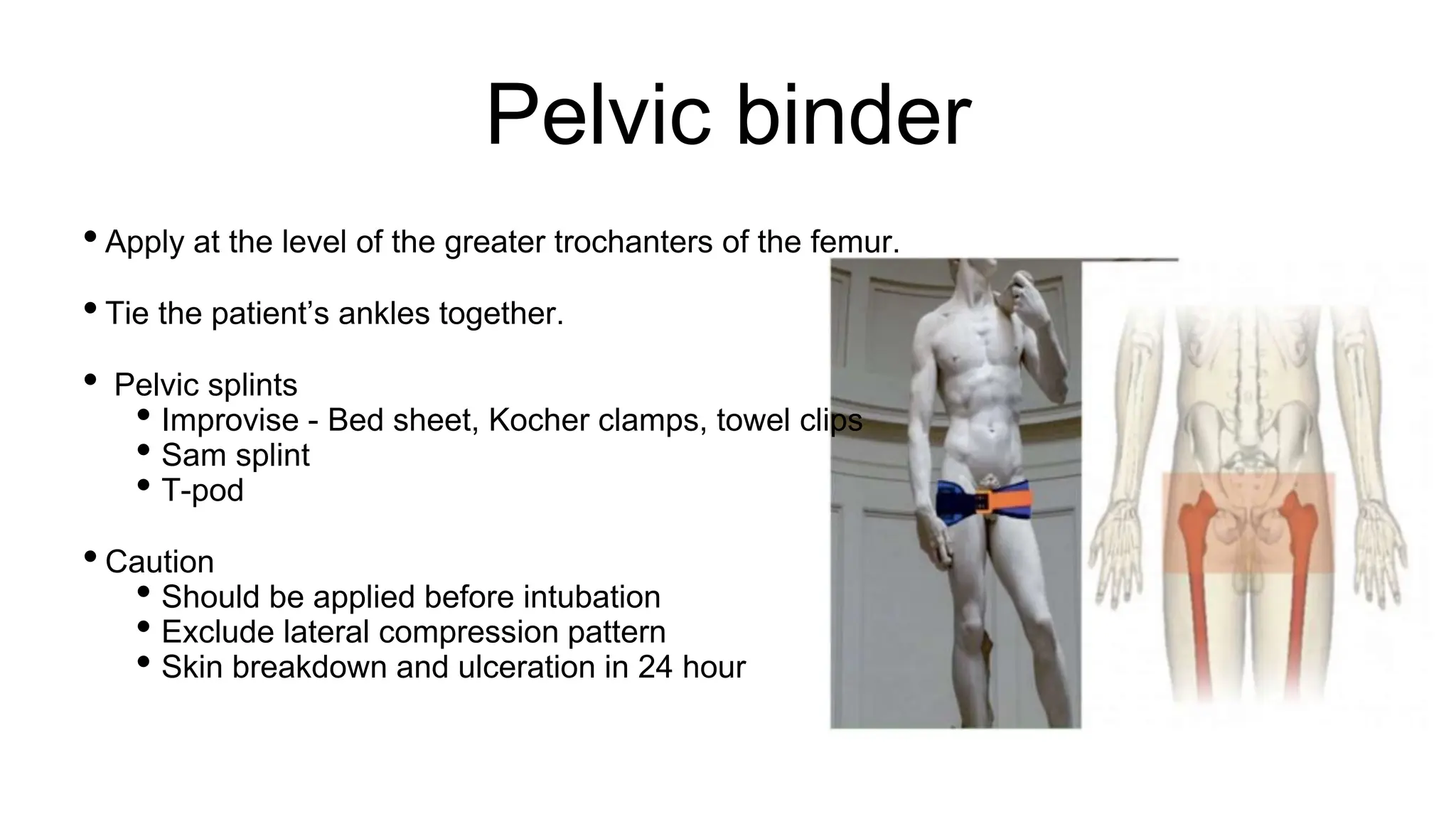
Pelvic binder
•Apply at the level of the greater trochanters of the femur.
•Tie the patient’s ankles together.
• Pelvic splints
• Improvise - Bed sheet, Kocher clamps, towel clips
• Sam splint
• T-pod
•Caution
• Should be applied before intubation
• Exclude lateral compression pattern
• Skin breakdown and ulceration in 24 hour
Following resuscitation
• A- talking, rational
• B- RR 36, SPO2 100% on RA
• C- PR 127, BP 124/80
• D – GCS 15/15
• Primary survey adjuncts
• AP pelvis XR
• EFAST
• Disability
• GCS / AVPU
• Pupils
• Exposure
• Skin and soft tissue injury - open injury, Ecchymosis
• Palpate on bony fragments, echchymisis, tenderness
• Urethral injury- ecchymosis or hematoma of the scrotum or
perineum, blood at urethral meatus, gross hematuria
• Log roll – DRE, spine tenderness
• DRE- sphincter tone, prostrate, palpable fracture, blood
• VE- fractures, mucosal integrity, blood
Secondary Survey
• Head to toe secondary survey & adjuncts
• Head injury – NCCT brain with C-spine
• Abdomen – Distention, tenderness
• LL – length discrepancy, Malrotation
• Distal neuro vascular status
AP Pelvis
Injuries
• Open book pelvic fracture
• APC III - Anterior symphyseal widening ≥ 25 mm,
disruption of anterior and posterior SI,
sacrospinous, and sacrotuberous ligaments &
vertical fracture of pubic rami
• R/ Neck of the femur fracture
• R/ Acetabular fracture
• Open wound - Perineal laceration
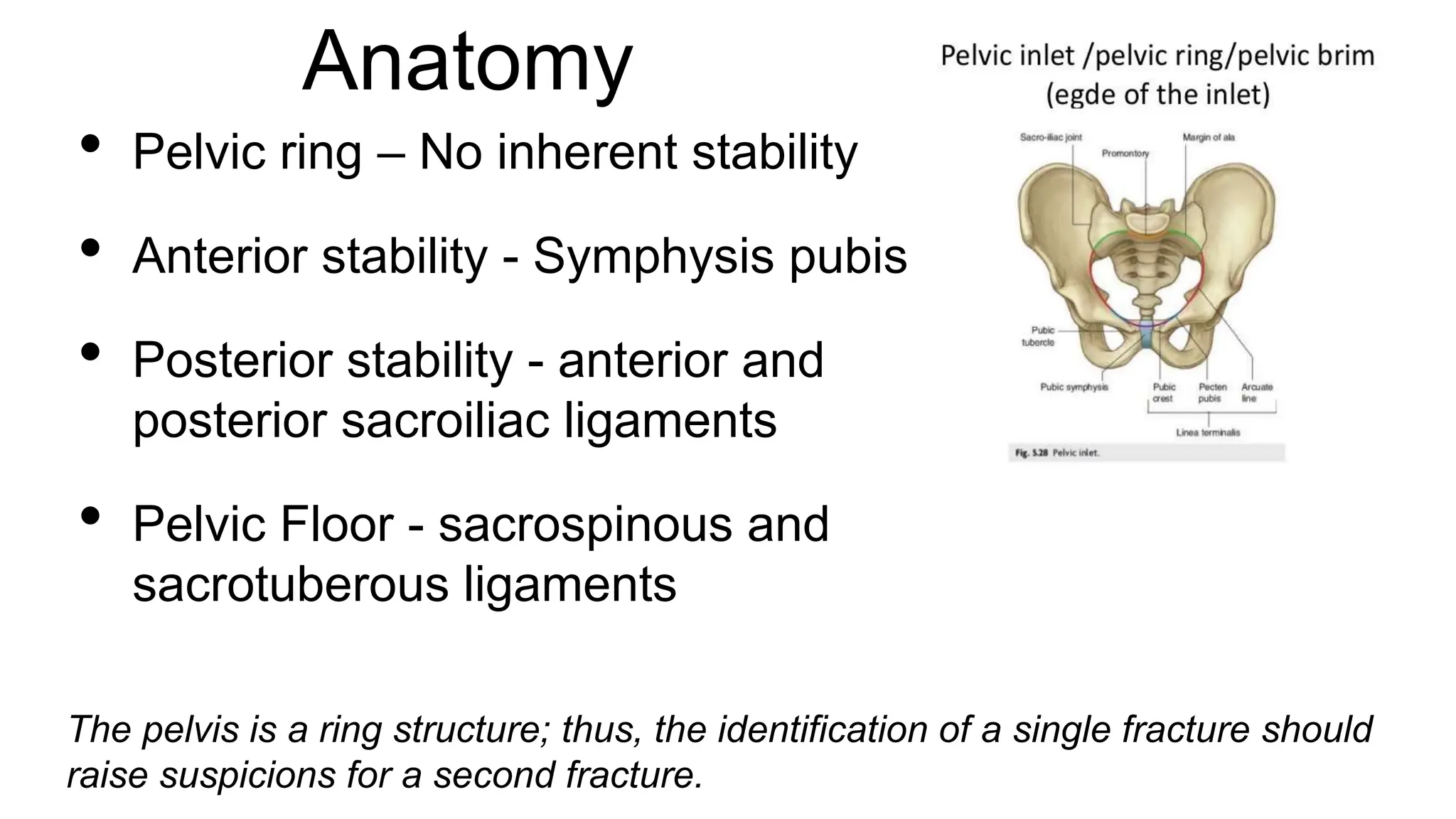
Anatomy
• Pelvic ring – No inherent stability
• Anterior stability - Symphysis pubis
• Posterior stability - anterior and
posterior sacroiliac ligaments
• Pelvic Floor - sacrospinous and
sacrotuberous ligaments
The pelvis is a ring structure; thus, the identification of a single fracture should
raise suspicions for a second fracture.
Classification
• Young-Burgess classification
• More useful in the ED as it is based on mechanism of injury.
• Mechanisms
• Lateral compression
• Anterior-posterior compression
• Vertical shear
• Combined mechanical injury
Classification
• Tile classification
• Based on pelvic stability and useful for guiding pelvic
reconstruction.
• Type A, Rotationally and vertically stable
• Type B, rotationally unstable, vertically stable
• Type C, rotationally and vertically unstable
eFAST
• Free fluid
• Hepato renal pouch
• Perisplenic space
• Pelvis
• Liver and kidney normal
Rule of DPA
• Rule out a false negative FAST scan in a
hemodynamically unstable patient
• Performed above the umbilicus in patients with
suspected pelvic fractures to avoid aspirating a
pelvic hematoma
• A positive result is the aspiration of 10 mL of frank
blood or GI contents
Further management
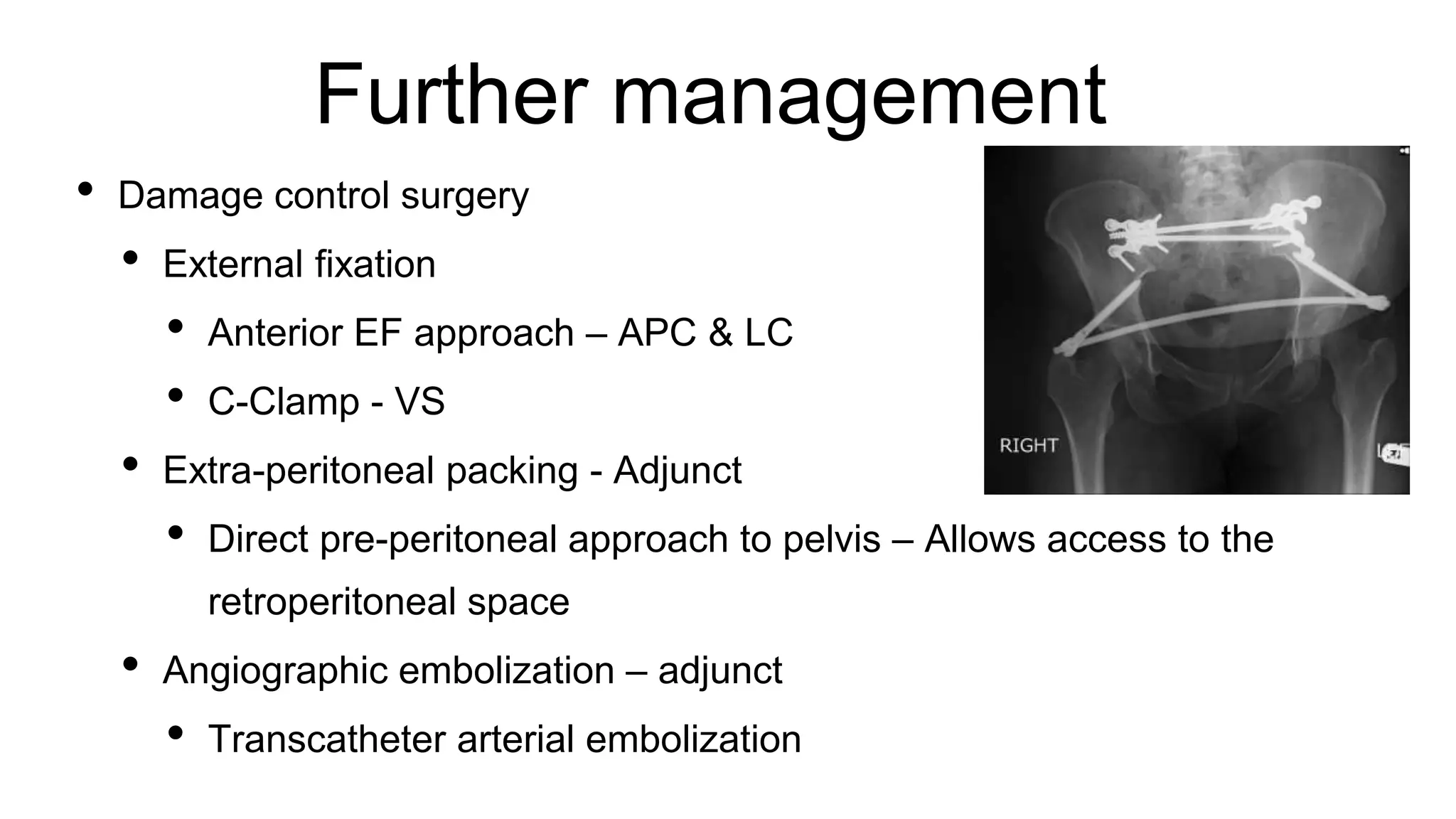
• Damage control surgery
• External fixation
• Anterior EF approach – APC & LC
• C-Clamp - VS
• Extra-peritoneal packing - Adjunct
• Direct pre-peritoneal approach to pelvis – Allows access to the
retroperitoneal space
• Angiographic embolization – adjunct
• Transcatheter arterial embolization
• If patient hemodynamically stable
• Arrange CT abdomen and pelvis with IV contrast
• 30% of posterior injuries can be missed on plain radiographs.
• Soft tissue may be evaluated to detect hematoma formation,
active arterial bleeding
• Rule out intra-abdominal and retroperitoneal injury
• Characterize the type and severity of pelvic injury
• Angiography
• Identify arterial injury and to guide embolization
CT
Findings
• Evidence of bowel perforation
• Retroperitoneal hematoma
• Linear splenic laceration
• Extra-peritoneal bladder rupture
• Unstable pelvic fracture
• No evidence of pelvic vessel injury with
active bleeding
Supportive care
• Analgesia
• Broad spectrum antibiotics
• IV Cefuroxime
• IV Metronidazole
• Tetanus prophylaxis
• Skin traction – 3Kg
Associated Injuries & management
• Should evaluated under anaesthesia in OR
• Rectal injury – 5%
• Intestinal injury - up to 5%
• Require faecal Diversion colostomy
• Pre-sacral drainage and perineal debridement
• Bladder and urethral injury (5-20%)
• Bladder: intra- and/or extraperitoneal
• Cystoscopy
• Extra – Catheter drainage
• Urethral injury – Posterior urethra
• Retrograde urethrogram
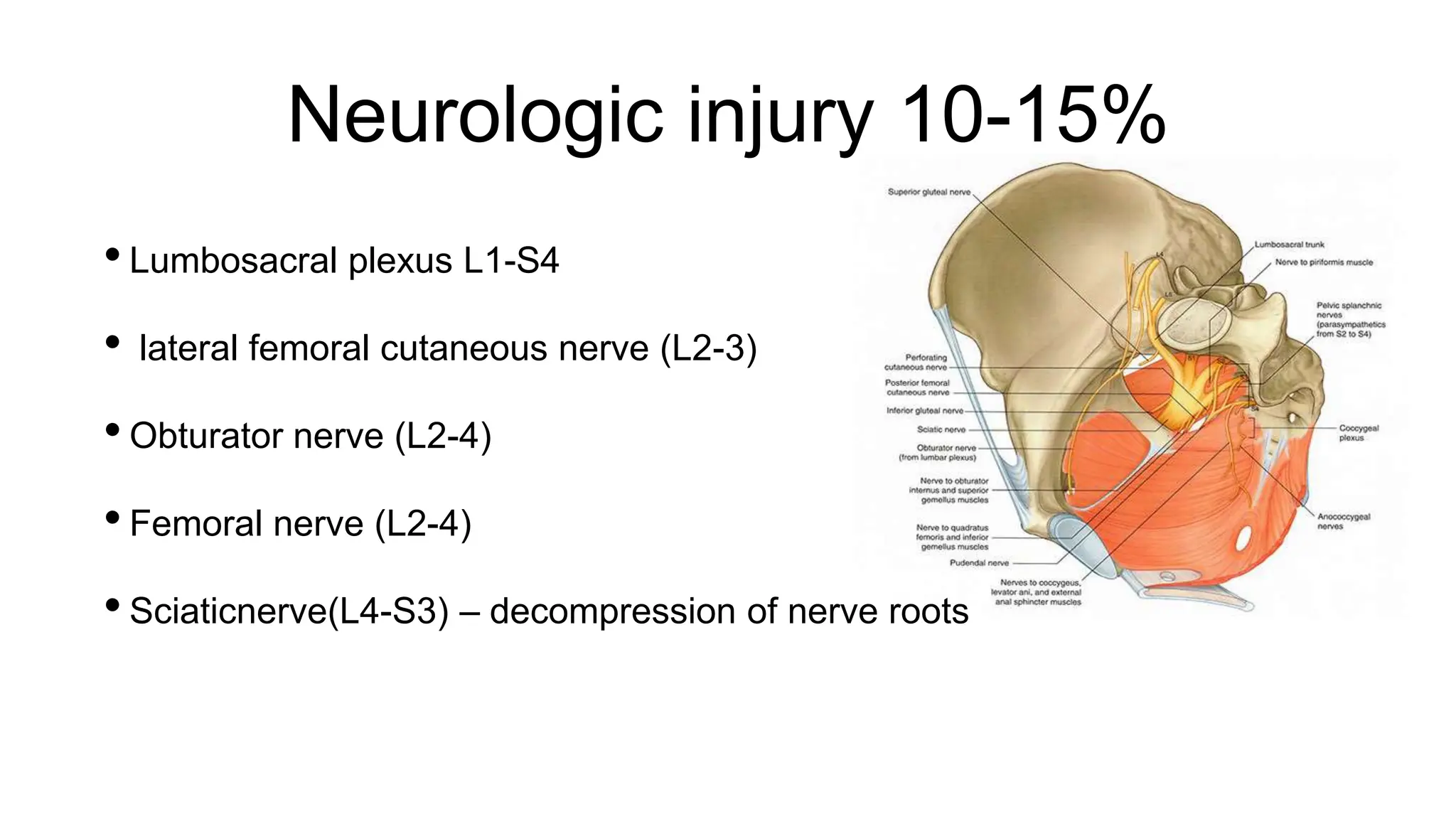
Neurologic injury 10-15%
•Lumbosacral plexus L1-S4
• lateral femoral cutaneous nerve (L2-3)
•Obturator nerve (L2-4)
•Femoral nerve (L2-4)
•Sciaticnerve(L4-S3) – decompression of nerve roots
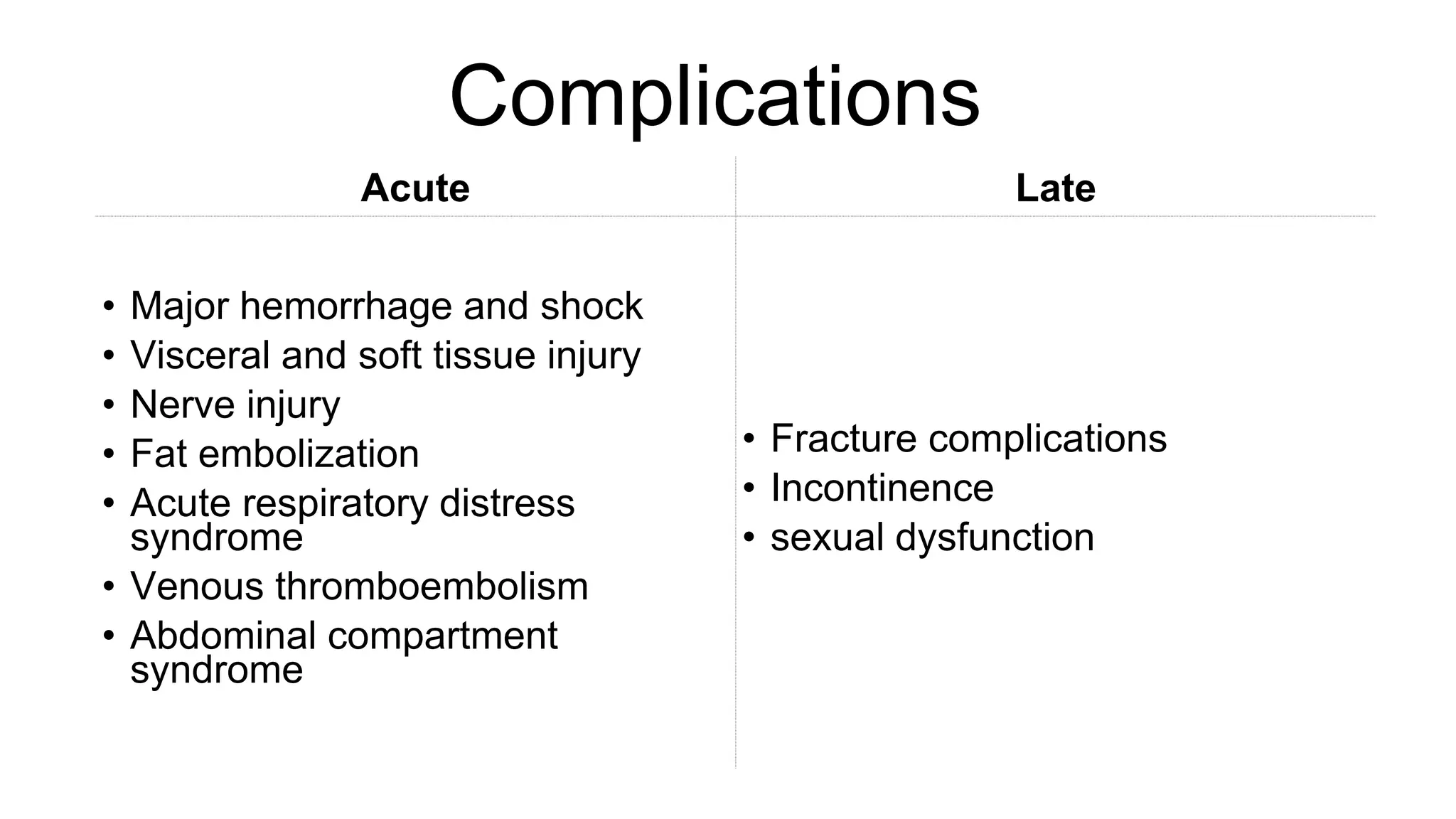
Complications
Acute Late
• Major hemorrhage and shock
• Visceral and soft tissue injury
• Nerve injury
• Fat embolization
• Acute respiratory distress
syndrome
• Venous thromboembolism
• Abdominal compartment
syndrome
• Fracture complications
• Incontinence
• sexual dysfunction
Disposition
• Operating theatre
• Interventional radiology suite
• Intensive care unit
Definitive Management
• Surgical fixation
• Stabilise disrupted ring
• Early mobilisation
• Prevent deformity
• Minimize long term disability
• Gold standard- open method
• Percutaneous methods are evolving
Anaesthetic considerations
• Pre op assessment- multidisciplinary team
• IV access, positioning is affected by other injuries
• Urological injuries- catheterisation, chest drains, EVD
• Blood- 4-6U DT, intraoperative cell salvage
• Metabolic derangements- coagulopathy, electrolyte imbalance
• Critical care after surgery
• Multimodal analgsia
• Thromboprophylaxis- mechanical- ASAP, Chemical- HD stable and clotting parameters
stabilised
References
1. AAOS3.pdf
2. ATLS 10th Edition Student Manual.pdf
3. RCEM-Trauma-ibook.pdf
4. https://litfl.com/pelvic-trauma/
5. https://www.bjaed.org/article/S2058-5349(18)30050-
7/fulltext
Thank you

Pelvic Fracture managemnt- Case based discussion .pptx

  • 1.
    Pelvic fractures Dr KTDPriyadarshani Registrar in Emergency Medicine National Hospital-Kandy 2024/01/17
  • 2.
    Objectives • Initial assessmentand management • Epidemiology • Anatomy • Classifications • Management • Complications
  • 3.
    Case • Age -39 Years old male • Timing - at 5 pm • Mechanism – MB rider collided with a lorry • Injury • Perineal laceration, unstable pelvis, externally rotated LL • Blood at the meatus • Signs – SPO2 100% on oxygen 10L/min, BP 80/50 mmHg, HR 130/min, GCS 15/15, Agitated • Treatment received – Fluid resuscitation up-to 6L of NS at LH
  • 4.
    Epidemiology • Men in40s • Diversity in associated visceral and soft-tissue injuries • Mortality – • All type of pelvic fractures – 5-30% • Closed pelvic fracture and hypotension - 10-42% • Open pelvic fracture – 50%
  • 5.
    Important considerations • Highenergy mechanisms, such as: • Motor vehicle crashes • Collisions with pedestrians • Falls from height • Major hemorrhage, which can be difficult to control • Other associated injuries • Intra-abdominal organs (28%), including aortic injury • Hollow viscus injury (13%) • Genitourinary injury • Rectal injury (up to 5%)
  • 6.
    Initial assessment • ATLSapproach • Receive the patient • AT MIST • Triage • Activate trauma call • Trauma surgeons, • Orthopedic surgeons, • interventional radiologists or vascular surgeons, • anesthetist, • Blood bank, • theatre staff.
  • 7.
    Primary survey • Airwaywith C-spine immobilization • Jaw thrust • Manual in-line stabilization • Breathing • Assess RR, auscultate, SPO2 • NRBM oxygen with 10-15 l/min • Circulation • PR, BP, CRFT • Supra diaphragmatic intravenous (IV) access. • Blood for FBC, Gr & DT – 4-8 Units, PT/INR, APTT, VBG, S.Ca, fibrinogen and ROTEM • Activate massive transfusion protocol+ IV tranexemic • Hemostatic resuscitation • Permissive hypotension – Target SBP 90mmHg, MAP 50 mmHg • Analgesia
  • 9.
    Rapid hemorrhage control •Look for obvious bleeding • The floor (external hemorrhage), and four more, chest, abdomen, pelvis, and long bones. • Mechanical stabilization of the pelvic ring and external counter pressure. • Internal rotation of the lower limbs • Pelvic binder • REBOA with real-time fluoroscopy or under USS guidance • HD unstable - zone III of the aorta, or just above the aortic bifurcation
  • 10.
    Major site ofhemorrhage •Surfaces of fractured bones •Pelvic venous plexus – 90% •Pelvic arterial injury – 10% •Extra-pelvic sources (present in 30% of pelvic fractures) •Bleeding into the retroperitonal space upto 5L.
  • 11.
    Pelvic binder •Apply atthe level of the greater trochanters of the femur. •Tie the patient’s ankles together. • Pelvic splints • Improvise - Bed sheet, Kocher clamps, towel clips • Sam splint • T-pod •Caution • Should be applied before intubation • Exclude lateral compression pattern • Skin breakdown and ulceration in 24 hour
  • 12.
    Following resuscitation • A-talking, rational • B- RR 36, SPO2 100% on RA • C- PR 127, BP 124/80 • D – GCS 15/15
  • 13.
    • Primary surveyadjuncts • AP pelvis XR • EFAST • Disability • GCS / AVPU • Pupils • Exposure • Skin and soft tissue injury - open injury, Ecchymosis • Palpate on bony fragments, echchymisis, tenderness • Urethral injury- ecchymosis or hematoma of the scrotum or perineum, blood at urethral meatus, gross hematuria • Log roll – DRE, spine tenderness • DRE- sphincter tone, prostrate, palpable fracture, blood • VE- fractures, mucosal integrity, blood
  • 14.
    Secondary Survey • Headto toe secondary survey & adjuncts • Head injury – NCCT brain with C-spine • Abdomen – Distention, tenderness • LL – length discrepancy, Malrotation • Distal neuro vascular status
  • 15.
  • 16.
    Injuries • Open bookpelvic fracture • APC III - Anterior symphyseal widening ≥ 25 mm, disruption of anterior and posterior SI, sacrospinous, and sacrotuberous ligaments & vertical fracture of pubic rami • R/ Neck of the femur fracture • R/ Acetabular fracture • Open wound - Perineal laceration
  • 17.
    Anatomy • Pelvic ring– No inherent stability • Anterior stability - Symphysis pubis • Posterior stability - anterior and posterior sacroiliac ligaments • Pelvic Floor - sacrospinous and sacrotuberous ligaments The pelvis is a ring structure; thus, the identification of a single fracture should raise suspicions for a second fracture.
  • 18.
    Classification • Young-Burgess classification •More useful in the ED as it is based on mechanism of injury. • Mechanisms • Lateral compression • Anterior-posterior compression • Vertical shear • Combined mechanical injury
  • 20.
    Classification • Tile classification •Based on pelvic stability and useful for guiding pelvic reconstruction. • Type A, Rotationally and vertically stable • Type B, rotationally unstable, vertically stable • Type C, rotationally and vertically unstable
  • 22.
    eFAST • Free fluid •Hepato renal pouch • Perisplenic space • Pelvis • Liver and kidney normal
  • 23.
    Rule of DPA •Rule out a false negative FAST scan in a hemodynamically unstable patient • Performed above the umbilicus in patients with suspected pelvic fractures to avoid aspirating a pelvic hematoma • A positive result is the aspiration of 10 mL of frank blood or GI contents
  • 24.
    Further management • Damagecontrol surgery • External fixation • Anterior EF approach – APC & LC • C-Clamp - VS • Extra-peritoneal packing - Adjunct • Direct pre-peritoneal approach to pelvis – Allows access to the retroperitoneal space • Angiographic embolization – adjunct • Transcatheter arterial embolization
  • 25.
    • If patienthemodynamically stable • Arrange CT abdomen and pelvis with IV contrast • 30% of posterior injuries can be missed on plain radiographs. • Soft tissue may be evaluated to detect hematoma formation, active arterial bleeding • Rule out intra-abdominal and retroperitoneal injury • Characterize the type and severity of pelvic injury • Angiography • Identify arterial injury and to guide embolization
  • 26.
  • 27.
    Findings • Evidence ofbowel perforation • Retroperitoneal hematoma • Linear splenic laceration • Extra-peritoneal bladder rupture • Unstable pelvic fracture • No evidence of pelvic vessel injury with active bleeding
  • 28.
    Supportive care • Analgesia •Broad spectrum antibiotics • IV Cefuroxime • IV Metronidazole • Tetanus prophylaxis • Skin traction – 3Kg
  • 29.
    Associated Injuries &management • Should evaluated under anaesthesia in OR • Rectal injury – 5% • Intestinal injury - up to 5% • Require faecal Diversion colostomy • Pre-sacral drainage and perineal debridement • Bladder and urethral injury (5-20%) • Bladder: intra- and/or extraperitoneal • Cystoscopy • Extra – Catheter drainage • Urethral injury – Posterior urethra • Retrograde urethrogram
  • 30.
    Neurologic injury 10-15% •Lumbosacralplexus L1-S4 • lateral femoral cutaneous nerve (L2-3) •Obturator nerve (L2-4) •Femoral nerve (L2-4) •Sciaticnerve(L4-S3) – decompression of nerve roots
  • 31.
    Complications Acute Late • Majorhemorrhage and shock • Visceral and soft tissue injury • Nerve injury • Fat embolization • Acute respiratory distress syndrome • Venous thromboembolism • Abdominal compartment syndrome • Fracture complications • Incontinence • sexual dysfunction
  • 32.
    Disposition • Operating theatre •Interventional radiology suite • Intensive care unit
  • 33.
    Definitive Management • Surgicalfixation • Stabilise disrupted ring • Early mobilisation • Prevent deformity • Minimize long term disability • Gold standard- open method • Percutaneous methods are evolving
  • 34.
    Anaesthetic considerations • Preop assessment- multidisciplinary team • IV access, positioning is affected by other injuries • Urological injuries- catheterisation, chest drains, EVD • Blood- 4-6U DT, intraoperative cell salvage • Metabolic derangements- coagulopathy, electrolyte imbalance • Critical care after surgery • Multimodal analgsia • Thromboprophylaxis- mechanical- ASAP, Chemical- HD stable and clotting parameters stabilised
  • 35.
    References 1. AAOS3.pdf 2. ATLS10th Edition Student Manual.pdf 3. RCEM-Trauma-ibook.pdf 4. https://litfl.com/pelvic-trauma/ 5. https://www.bjaed.org/article/S2058-5349(18)30050- 7/fulltext
  • 36.

Editor's Notes

  • #10 Resuscitative endovascular balloon occlusion of aorta