PECTIN
 Pectin, in general, is a group of polysaccharides
found in nature in the primary cell walls of all
seed bearing plants and are invariably located
in the middle lamella.
 One of the richest sources of pectin is lemon
or orange rind which contains about 30% of
this polysaccharide.
 Pectin is naturally found in a number of plants :
lemon peel, orange peel, apple pomace, carrots,
sunflower-heads, guava, mangoes and papaya.
 Biological Sources
 Pectin is the purified admixture of
polysaccharides, obtained by carrying out the
hydrolysis in an acidic medium of the inner
part of the rind of citrus peels,:
 Citrus limon (or Lemon) and Citrus
aurantium belonging to the family Rutaceae,
or from apple family: Rosaceae.
 Geographical Source
 Lemon and oranges - India, Africa and other
tropical countries.
 Apple - Himalayas, California
 The specific method of preparation of pectin is
solely guided by the source of raw material i.e.,
lemon/orange rind or apple pomace.
 In general, the preserved or freshly obtained lemon
peels are gently boiled with approximately 20 times
its weight of fresh water maintained duly at 90ºC for
a duration of 30 minutes.
 The effective pH (3.5 to 4.0) must be maintained
with food grade lactic acid/citric acid/tartaric acid
to achieve maximum extraction.
 Once the boiling is completed the peels are
mildly squeezed to obtain the liquid portion
which is then subjected to centrifugation to
result into a clear solution.
 From this resulting solution both proteins and
starch contents are suitably removed by
enzymatic hydrolysis.
 The remaining solution is warmed to
deactivate the added enzymes. The slightly
coloured solution is effectively decolourized
with activated carbon OR activated charcoal.

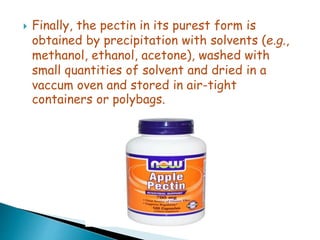
 Finally, the pectin in its purest form is
obtained by precipitation with solvents (e.g.,
methanol, ethanol, acetone), washed with
small quantities of solvent and dried in a
vaccum oven and stored in air-tight
containers or polybags.
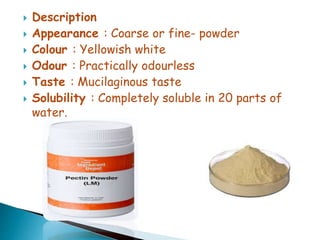
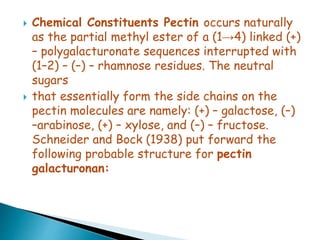
 Description
 Appearance : Coarse or fine- powder
 Colour : Yellowish white
 Odour : Practically odourless
 Taste : Mucilaginous taste
 Solubility : Completely soluble in 20 parts of
water.
 Chemical Constituents Pectin occurs naturally
as the partial methyl ester of a (1→4) linked (+)
– polygalacturonate sequences interrupted with
(1–2) – (–) – rhamnose residues. The neutral
sugars
 that essentially form the side chains on the
pectin molecules are namely: (+) – galactose, (–)
–arabinose, (+) – xylose, and (–) – fructose.
Schneider and Bock (1938) put forward the
following probable structure for pectin
galacturonan:
 Chemical Tests
 1. A 10% (w/v) solution gives rise to a solid gel
on cooling.
 2. A transparent gel or semigel results by the
interaction of 5 ml of 1% solution of pectin with
1 ml of 2% solution of KOH and subsequently
setting aside the mixture at an ambient
temperature for 15 minutes.
 The resulting gel on acidification with dilute
HCl and shaking yields a voluminous and
gelatinous colourless precipitate which on
warming turns into white and flocculent.
 Uses
 1. It is employed mostly as an intestinal
demulscent. It is believed that the unchanged
molecules of polygalacturonic acids may exert
an adsorbent action in the internal layers of
the intestine, thereby producing a protective
action along with Kaolin to prevent and control
diarrhoea.
 2. As a pharmaceutical aid pectin is used
frequently as an emulsifying agent and also as a
gelling agent preferably in an acidic medium.
 3. It is employed extensively in the preparation
of jellies and similar food products e.g., jams,
sauces, ketchups.
 4. Pectin in the form of pastes exerts a
bacteriostatic activity and hence, is used
frequently in the treatment of ulcers and deep
wounds.
Pectin

Pectin

  • 1.
  • 2.
     Pectin, ingeneral, is a group of polysaccharides found in nature in the primary cell walls of all seed bearing plants and are invariably located in the middle lamella.  One of the richest sources of pectin is lemon or orange rind which contains about 30% of this polysaccharide.  Pectin is naturally found in a number of plants : lemon peel, orange peel, apple pomace, carrots, sunflower-heads, guava, mangoes and papaya.
  • 3.
     Biological Sources Pectin is the purified admixture of polysaccharides, obtained by carrying out the hydrolysis in an acidic medium of the inner part of the rind of citrus peels,:  Citrus limon (or Lemon) and Citrus aurantium belonging to the family Rutaceae, or from apple family: Rosaceae.
  • 4.
     Geographical Source Lemon and oranges - India, Africa and other tropical countries.  Apple - Himalayas, California
  • 5.
     The specificmethod of preparation of pectin is solely guided by the source of raw material i.e., lemon/orange rind or apple pomace.  In general, the preserved or freshly obtained lemon peels are gently boiled with approximately 20 times its weight of fresh water maintained duly at 90ºC for a duration of 30 minutes.  The effective pH (3.5 to 4.0) must be maintained with food grade lactic acid/citric acid/tartaric acid to achieve maximum extraction.
  • 6.
     Once theboiling is completed the peels are mildly squeezed to obtain the liquid portion which is then subjected to centrifugation to result into a clear solution.  From this resulting solution both proteins and starch contents are suitably removed by enzymatic hydrolysis.  The remaining solution is warmed to deactivate the added enzymes. The slightly coloured solution is effectively decolourized with activated carbon OR activated charcoal. 
  • 7.
     Finally, thepectin in its purest form is obtained by precipitation with solvents (e.g., methanol, ethanol, acetone), washed with small quantities of solvent and dried in a vaccum oven and stored in air-tight containers or polybags.
  • 8.
     Description  Appearance: Coarse or fine- powder  Colour : Yellowish white  Odour : Practically odourless  Taste : Mucilaginous taste  Solubility : Completely soluble in 20 parts of water.
  • 9.
     Chemical ConstituentsPectin occurs naturally as the partial methyl ester of a (1→4) linked (+) – polygalacturonate sequences interrupted with (1–2) – (–) – rhamnose residues. The neutral sugars  that essentially form the side chains on the pectin molecules are namely: (+) – galactose, (–) –arabinose, (+) – xylose, and (–) – fructose. Schneider and Bock (1938) put forward the following probable structure for pectin galacturonan:
  • 10.
     Chemical Tests 1. A 10% (w/v) solution gives rise to a solid gel on cooling.  2. A transparent gel or semigel results by the interaction of 5 ml of 1% solution of pectin with 1 ml of 2% solution of KOH and subsequently setting aside the mixture at an ambient temperature for 15 minutes.  The resulting gel on acidification with dilute HCl and shaking yields a voluminous and gelatinous colourless precipitate which on warming turns into white and flocculent.
  • 11.
     Uses  1.It is employed mostly as an intestinal demulscent. It is believed that the unchanged molecules of polygalacturonic acids may exert an adsorbent action in the internal layers of the intestine, thereby producing a protective action along with Kaolin to prevent and control diarrhoea.  2. As a pharmaceutical aid pectin is used frequently as an emulsifying agent and also as a gelling agent preferably in an acidic medium.  3. It is employed extensively in the preparation of jellies and similar food products e.g., jams, sauces, ketchups.
  • 12.
     4. Pectinin the form of pastes exerts a bacteriostatic activity and hence, is used frequently in the treatment of ulcers and deep wounds.