“  The Growth Acceleration  of Microorganism  In Yoghurt  by the Extract of Asparagus ”
Introduction Asparagus is an essentially economic plant of Thailand. It  contains  many useful substances, one of them is a  special kind of carbohydrate called Inulin that is being promoted as a supplement to feed the good bacteria: lactobacillus species in our guts.   We can find lactobacillus   in not only the large intestine but also the yoghurt. If Inulin is added into yoghurt, it can support the growth of bacteria to cause lactic acid produced rapidly and to effect the period of yoghurt fermentation decreases.
To study the growth acceleration of Microorganism in Yoghurt by the extract of Asparagus To learn the method of Yoghurt fermentation To   study the property of the extract of Asparagus Purpose
The extract of Asparagus can accelerate the growth of Microorganism in Yoghurt that effect the period of fermentation to decrease  Hypothesis
Dependent Variable: The concentration of the extract of Asparagus Independent Variable:   The period of time for the fermentation of Yoghurt  Controlled Variable:   Volume of milk and starter culture, Brand of milk and starter culture, Period and Temperature of incubation  Variable
Binomial name:  Asparagus officinalis Asparagus officinalis  is native to maritime areas around the Mediterranean. The 'leaves' are in fact needle-like cladodes (modified stems) in the axils of scale leaves. Male and female flowers are normally borne on separate plants, The fruit is a small red berry . Asparagus is low in calories, contains no fat or cholesterol, and is very low in sodium.  Asparagus  ( Asparagus officinalis ) Asparagus http :// www . ics . uci . edu / ~eppstein / pix / tanaka2 / Asparagus - m . jpg
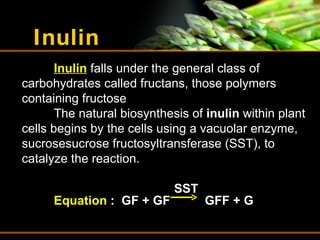
Inulin  falls under the general class of carbohydrates called fructans, those polymers containing fructose  The natural biosynthesis of  inulin  within plant cells begins by the cells using a vacuolar enzyme, sucrosesucrose fructosyltransferase  ( SST ) , to catalyze the reaction.    SST Equation   :   GF + GF  GFF + G Inulin
Figure 1 :  Chemical Structure of sucrose  ( left ) ,  inulin ( center ) , oligofructose  ( right )   Inulin
It also increases  calcium  absorption and possibly  magnesium  absorption Inulin  is indigestible by human  enzymes   It can help lowering blood cholesterol and glucose levels   Promoting intestinal  bacteria , which help regulating the activity of  disease-causing bacteria.  Properties of Inulin
Figure 2  :   Pathogenic microflora suppression, from Roberfroid et al .  1998 and Rolfe 1981   Property of Inulin
Group 1 :   Controlled group (10 bottles) Group 2 :   1 mg/ml group (10 bottles) Group 3 :   2.5 mg/ml group (10 bottles) Group 4 :   5 mg/ml group (10 bottles) Experimental groups Materials and methods
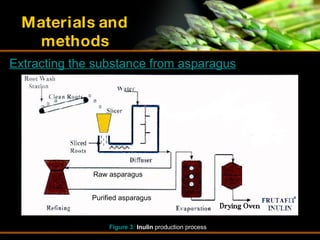
Extracting the substance from asparagus Figure   3 :   Inulin  production process   Materials and methods Raw asparagus  Purified asparagus
Materials and methods Cleaned asparagus
Materials and methods Crushed asparagus
Materials and methods Evaporator
Materials and methods Exact of asparagus
Making yoghurt for experiment Materials and methods 1.  Heat the milk to boiling point and  Continue simmering on a low gas for about 5-10 minutes
Materials and methods 2.  Pour the milk into the glass jar
Materials and methods 3.  Add asparagus extracting solution  1 ml in 10 bottles, 2.5 ml in 10 bottles and 5 ml in 10 bottles
Materials and methods 4.  Add 5 ml of natural yoghurt to the milk in the jar and stir the mixture
Materials and methods 5.  Incubate in the oven at temperature 44°C
Test label 1 form each group (5 ml, 2.5 ml, 1ml and control) to label 10 Note number of pH meter Compare  Δ pH Testing pH Materials and methods
Divide yoghurt 1 ml from 10 bottles of each group (10 ml per group) Titrate   with phenolphthalein and 0.1 M NaOH 2 drops of phenolphthalei n Titrate with 0.1 M NaOH until the yogurt turn to be pink at the end point Finding the quantity of lactic acid Materials and methods
Chart (Line) :  Changes of pH in Yoghurt fermentation at 0-6 hours Result Δ
Chart (column) :  Changes of pH in Yoghurt fermentation at 0-6 hours Result
Chart (Line) :  Changes of lactic acid in Yoghurt fermentation  at 0-6 hours Result
Chart (column) :  Changes of lactic in Yoghurt fermentation at 0-6 hours Result
Conclusion The study of making yoghurt by adding 1 mg/ml, 2.5 mg/ml and 5 mg/ml   of the asparagus extract into  yoghurt was checked the result at the 0, 1 st ,2 nd ,3 rd ,4 th ,5 th  and 6 th   hours.   From the experiment,  Δ pH of the controlled group,  1 mg/ml, 2.5 mg/ml and 5 mg/ml are 2.002, 2.057, 2.043 and 1.895, respectively. Besides, the amount of lactic acid from the  controlled group,  1 mg/ml, 2.5 mg/ml and 5 mg/ml are 0.0815 mol, 0.09 mol, 0.087 mol and 0.0755 mol, respectively.  So, 1 mg/ml  of asparagus extract is best accelerate the growth of  microorganism in yoghurt that have an effect on the decreasing period of fermentation.
Available[online]:  http :// 72.14.235.104 / search?q = cache : XLS9ZjKfxC0J : members . shaw . ca / duncancrow / inulin_review . html + inulin + asparagus + ste m&hl = th&ct = clnk&cd = 27&gl = th  Duncan Crow , 2000 .  Inulin - A  Comprehensive Scientific Review Available [online] :  http://72.14.235.104/search?q=cache:m6DPpF9iqdYJ:en.wikip edia.org/wiki/Inulin+inulin+property&hl=th&ct=clnk&cd=9&gl=th  Wikipedia,  2005 .  Inulin Pinmanee Kwanmuang and Paljit Anukul , 2548.  Study on Fermentation  of Tomato yogurt , Kasetsart University K. Tuitemwong, D.Y.C fung and P.tuitemwong, 2537. Acceleration of  Yoghurt Fermentation by Bacterial membrane fraction  Biocatalysts. Kasetsart University Reference
We would like to express grateful thanks to all person whose help, care and encouragement lead to our accomplishment. The following order of appearance does not necessarily imply the level of importance. - Mahidol Wittayanusorn School   - Aj. Aree Sakyim, advisor   - Aj. Sataporn Wantanawijarn   Acknowledgement

Inulin

  • 1.
    “ TheGrowth Acceleration of Microorganism In Yoghurt by the Extract of Asparagus ”
  • 2.
    Introduction Asparagus isan essentially economic plant of Thailand. It contains many useful substances, one of them is a special kind of carbohydrate called Inulin that is being promoted as a supplement to feed the good bacteria: lactobacillus species in our guts. We can find lactobacillus in not only the large intestine but also the yoghurt. If Inulin is added into yoghurt, it can support the growth of bacteria to cause lactic acid produced rapidly and to effect the period of yoghurt fermentation decreases.
  • 3.
    To study thegrowth acceleration of Microorganism in Yoghurt by the extract of Asparagus To learn the method of Yoghurt fermentation To study the property of the extract of Asparagus Purpose
  • 4.
    The extract ofAsparagus can accelerate the growth of Microorganism in Yoghurt that effect the period of fermentation to decrease Hypothesis
  • 5.
    Dependent Variable: Theconcentration of the extract of Asparagus Independent Variable: The period of time for the fermentation of Yoghurt Controlled Variable: Volume of milk and starter culture, Brand of milk and starter culture, Period and Temperature of incubation Variable
  • 6.
    Binomial name: Asparagus officinalis Asparagus officinalis is native to maritime areas around the Mediterranean. The 'leaves' are in fact needle-like cladodes (modified stems) in the axils of scale leaves. Male and female flowers are normally borne on separate plants, The fruit is a small red berry . Asparagus is low in calories, contains no fat or cholesterol, and is very low in sodium. Asparagus ( Asparagus officinalis ) Asparagus http :// www . ics . uci . edu / ~eppstein / pix / tanaka2 / Asparagus - m . jpg
  • 7.
    Inulin fallsunder the general class of carbohydrates called fructans, those polymers containing fructose The natural biosynthesis of inulin within plant cells begins by the cells using a vacuolar enzyme, sucrosesucrose fructosyltransferase ( SST ) , to catalyze the reaction. SST Equation : GF + GF GFF + G Inulin
  • 8.
    Figure 1 : Chemical Structure of sucrose ( left ) , inulin ( center ) , oligofructose ( right ) Inulin
  • 9.
    It also increases calcium absorption and possibly magnesium absorption Inulin is indigestible by human enzymes It can help lowering blood cholesterol and glucose levels Promoting intestinal bacteria , which help regulating the activity of disease-causing bacteria. Properties of Inulin
  • 10.
    Figure 2 : Pathogenic microflora suppression, from Roberfroid et al . 1998 and Rolfe 1981 Property of Inulin
  • 11.
    Group 1 : Controlled group (10 bottles) Group 2 : 1 mg/ml group (10 bottles) Group 3 : 2.5 mg/ml group (10 bottles) Group 4 : 5 mg/ml group (10 bottles) Experimental groups Materials and methods
  • 12.
    Extracting the substancefrom asparagus Figure 3 : Inulin production process Materials and methods Raw asparagus Purified asparagus
  • 13.
    Materials and methodsCleaned asparagus
  • 14.
    Materials and methodsCrushed asparagus
  • 15.
  • 16.
    Materials and methodsExact of asparagus
  • 17.
    Making yoghurt forexperiment Materials and methods 1. Heat the milk to boiling point and Continue simmering on a low gas for about 5-10 minutes
  • 18.
    Materials and methods2. Pour the milk into the glass jar
  • 19.
    Materials and methods3. Add asparagus extracting solution 1 ml in 10 bottles, 2.5 ml in 10 bottles and 5 ml in 10 bottles
  • 20.
    Materials and methods4. Add 5 ml of natural yoghurt to the milk in the jar and stir the mixture
  • 21.
    Materials and methods5. Incubate in the oven at temperature 44°C
  • 22.
    Test label 1form each group (5 ml, 2.5 ml, 1ml and control) to label 10 Note number of pH meter Compare Δ pH Testing pH Materials and methods
  • 23.
    Divide yoghurt 1ml from 10 bottles of each group (10 ml per group) Titrate with phenolphthalein and 0.1 M NaOH 2 drops of phenolphthalei n Titrate with 0.1 M NaOH until the yogurt turn to be pink at the end point Finding the quantity of lactic acid Materials and methods
  • 24.
    Chart (Line) : Changes of pH in Yoghurt fermentation at 0-6 hours Result Δ
  • 25.
    Chart (column) : Changes of pH in Yoghurt fermentation at 0-6 hours Result
  • 26.
    Chart (Line) : Changes of lactic acid in Yoghurt fermentation at 0-6 hours Result
  • 27.
    Chart (column) : Changes of lactic in Yoghurt fermentation at 0-6 hours Result
  • 28.
    Conclusion The studyof making yoghurt by adding 1 mg/ml, 2.5 mg/ml and 5 mg/ml of the asparagus extract into yoghurt was checked the result at the 0, 1 st ,2 nd ,3 rd ,4 th ,5 th and 6 th hours. From the experiment, Δ pH of the controlled group, 1 mg/ml, 2.5 mg/ml and 5 mg/ml are 2.002, 2.057, 2.043 and 1.895, respectively. Besides, the amount of lactic acid from the controlled group, 1 mg/ml, 2.5 mg/ml and 5 mg/ml are 0.0815 mol, 0.09 mol, 0.087 mol and 0.0755 mol, respectively. So, 1 mg/ml of asparagus extract is best accelerate the growth of microorganism in yoghurt that have an effect on the decreasing period of fermentation.
  • 29.
    Available[online]: http:// 72.14.235.104 / search?q = cache : XLS9ZjKfxC0J : members . shaw . ca / duncancrow / inulin_review . html + inulin + asparagus + ste m&hl = th&ct = clnk&cd = 27&gl = th Duncan Crow , 2000 . Inulin - A Comprehensive Scientific Review Available [online] : http://72.14.235.104/search?q=cache:m6DPpF9iqdYJ:en.wikip edia.org/wiki/Inulin+inulin+property&hl=th&ct=clnk&cd=9&gl=th Wikipedia, 2005 . Inulin Pinmanee Kwanmuang and Paljit Anukul , 2548. Study on Fermentation of Tomato yogurt , Kasetsart University K. Tuitemwong, D.Y.C fung and P.tuitemwong, 2537. Acceleration of Yoghurt Fermentation by Bacterial membrane fraction Biocatalysts. Kasetsart University Reference
  • 30.
    We would liketo express grateful thanks to all person whose help, care and encouragement lead to our accomplishment. The following order of appearance does not necessarily imply the level of importance. - Mahidol Wittayanusorn School - Aj. Aree Sakyim, advisor - Aj. Sataporn Wantanawijarn Acknowledgement