
STARCH
BY
Dr. Jitendra Patel
Associate Professor
AIPS, Hyderabad, India.
Synonyms
1. Amylum.
Biological Source
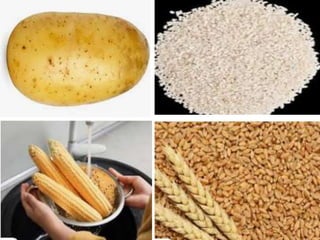
• Starch consists of polysaccharide granules
obtained from the grains of maize (Zea mays
Linn.); rice (Oryza sativa Linn.); or wheat
(Triticum aestivum Linn.); belonging to family
Gramineae or from the tubers of potato
(Solanum tuberosum Linn.), family Solanaceae.
Geographical Source
• Most of tropical, as well as, sub-tropical
countries prepare starch commercially.
Preparation of Starch
• Depending upon the raw material
to be used for processing or type of
the starch to be produced, different
processes are used for the
commercial manufacture of starch.
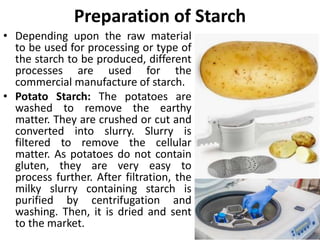
• Potato Starch: The potatoes are
washed to remove the earthy
matter. They are crushed or cut and
converted into slurry. Slurry is
filtered to remove the cellular
matter. As potatoes do not contain
gluten, they are very easy to
process further. After filtration, the
milky slurry containing starch is
purified by centrifugation and
washing. Then, it is dried and sent
to the market.
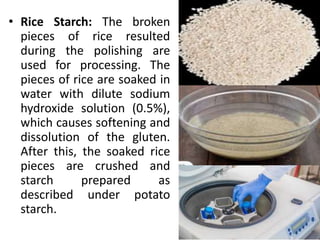
• Rice Starch: The broken
pieces of rice resulted
during the polishing are
used for processing. The
pieces of rice are soaked in
water with dilute sodium
hydroxide solution (0.5%),
which causes softening and
dissolution of the gluten.
After this, the soaked rice
pieces are crushed and
starch prepared as
described under potato
starch.
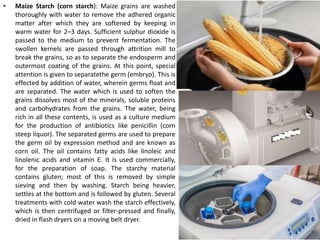
• Maize Starch (corn starch): Maize grains are washed
thoroughly with water to remove the adhered organic
matter after which they are softened by keeping in
warm water for 2–3 days. Sufficient sulphur dioxide is
passed to the medium to prevent fermentation. The
swollen kernels are passed through attrition mill to
break the grains, so as to separate the endosperm and
outermost coating of the grains. At this point, special
attention is given to separatethe germ (embryo). This is
effected by addition of water, wherein germs float and
are separated. The water which is used to soften the
grains dissolves most of the minerals, soluble proteins
and carbohydrates from the grains. The water, being
rich in all these contents, is used as a culture medium
for the production of antibiotics like penicillin (corn
steep liquor). The separated germs are used to prepare
the germ oil by expression method and are known as
corn oil. The oil contains fatty acids like linoleic and
linolenic acids and vitamin E. It is used commercially,
for the preparation of soap. The starchy material
contains gluten; most of this is removed by simple
sieving and then by washing. Starch being heavier,
settles at the bottom and is followed by gluten. Several
treatments with cold water wash the starch effectively,
which is then centrifuged or filter-pressed and finally,
dried in flash dryers on a moving belt dryer.
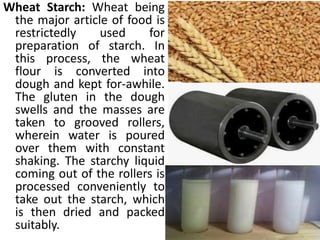
Wheat Starch: Wheat being
the major article of food is
restrictedly used for
preparation of starch. In
this process, the wheat
flour is converted into
dough and kept for-awhile.
The gluten in the dough
swells and the masses are
taken to grooved rollers,
wherein water is poured
over them with constant
shaking. The starchy liquid
coming out of the rollers is
processed conveniently to
take out the starch, which
is then dried and packed
suitably.
Description
Colour Rice and maize grains are white, while wheat is
cream coloured and potato is slightly yellowish
Odour Odourless
Taste Mucilaginous
Shape Starch occurs as fine powder or irregular, angular
masses readily reducible to powder
Chemical constituents
• Starch contains chemically two different
polysaccharides, such as amylose (β-amylose)
and amylopectin (α-amylose), in the proportion
of 1:2.
• Amylose is water soluble and amylopectin is
water insoluble, but swells in water and is
responsible for the gelatinizing property of the
starch.
• Amylose gives blue colour with iodine, while
amylopectin yields bluish black colouration.
Chemical Tests
1. Boil 1 g of starch with 15 ml of water and cool. The
translucent viscous jelly is produced.
2. The above jelly turns deep blue by the addition of
solution of iodine. The blue colour disappears on
warming and reappears on cooling.
Uses
• Starch is used as a nutritive, demulcent, protective
and as an absorbent.
• Starch is used in the preparation of dusting talcum
powder for application over the skin.
• It is used as antidote in iodine poisoning, as a
disintegrating agent in pills and tablets, and as
diluents in dry extracts of crude drug.
• It is a diagnostic aid in the identification of crude
drugs.
• Glycerine of starch is used as an emollient and as a
base for suppositories.
• Starch is also a starting material for the commercial
manufacture of liquid glucose, dextrose and dextrin.
• Starch is industrially used for the sizing of paper and
cloth.
Thank You

STARCH - Pharmacognostic Details

  • 1.
    STARCH BY Dr. Jitendra Patel AssociateProfessor AIPS, Hyderabad, India.
  • 3.
  • 4.
    Biological Source • Starchconsists of polysaccharide granules obtained from the grains of maize (Zea mays Linn.); rice (Oryza sativa Linn.); or wheat (Triticum aestivum Linn.); belonging to family Gramineae or from the tubers of potato (Solanum tuberosum Linn.), family Solanaceae.
  • 5.
    Geographical Source • Mostof tropical, as well as, sub-tropical countries prepare starch commercially.
  • 6.
    Preparation of Starch •Depending upon the raw material to be used for processing or type of the starch to be produced, different processes are used for the commercial manufacture of starch. • Potato Starch: The potatoes are washed to remove the earthy matter. They are crushed or cut and converted into slurry. Slurry is filtered to remove the cellular matter. As potatoes do not contain gluten, they are very easy to process further. After filtration, the milky slurry containing starch is purified by centrifugation and washing. Then, it is dried and sent to the market.
  • 7.
    • Rice Starch:The broken pieces of rice resulted during the polishing are used for processing. The pieces of rice are soaked in water with dilute sodium hydroxide solution (0.5%), which causes softening and dissolution of the gluten. After this, the soaked rice pieces are crushed and starch prepared as described under potato starch.
  • 8.
    • Maize Starch(corn starch): Maize grains are washed thoroughly with water to remove the adhered organic matter after which they are softened by keeping in warm water for 2–3 days. Sufficient sulphur dioxide is passed to the medium to prevent fermentation. The swollen kernels are passed through attrition mill to break the grains, so as to separate the endosperm and outermost coating of the grains. At this point, special attention is given to separatethe germ (embryo). This is effected by addition of water, wherein germs float and are separated. The water which is used to soften the grains dissolves most of the minerals, soluble proteins and carbohydrates from the grains. The water, being rich in all these contents, is used as a culture medium for the production of antibiotics like penicillin (corn steep liquor). The separated germs are used to prepare the germ oil by expression method and are known as corn oil. The oil contains fatty acids like linoleic and linolenic acids and vitamin E. It is used commercially, for the preparation of soap. The starchy material contains gluten; most of this is removed by simple sieving and then by washing. Starch being heavier, settles at the bottom and is followed by gluten. Several treatments with cold water wash the starch effectively, which is then centrifuged or filter-pressed and finally, dried in flash dryers on a moving belt dryer.
  • 9.
    Wheat Starch: Wheatbeing the major article of food is restrictedly used for preparation of starch. In this process, the wheat flour is converted into dough and kept for-awhile. The gluten in the dough swells and the masses are taken to grooved rollers, wherein water is poured over them with constant shaking. The starchy liquid coming out of the rollers is processed conveniently to take out the starch, which is then dried and packed suitably.
  • 10.
    Description Colour Rice andmaize grains are white, while wheat is cream coloured and potato is slightly yellowish Odour Odourless Taste Mucilaginous Shape Starch occurs as fine powder or irregular, angular masses readily reducible to powder
  • 11.
    Chemical constituents • Starchcontains chemically two different polysaccharides, such as amylose (β-amylose) and amylopectin (α-amylose), in the proportion of 1:2. • Amylose is water soluble and amylopectin is water insoluble, but swells in water and is responsible for the gelatinizing property of the starch. • Amylose gives blue colour with iodine, while amylopectin yields bluish black colouration.
  • 12.
    Chemical Tests 1. Boil1 g of starch with 15 ml of water and cool. The translucent viscous jelly is produced. 2. The above jelly turns deep blue by the addition of solution of iodine. The blue colour disappears on warming and reappears on cooling.
  • 13.
    Uses • Starch isused as a nutritive, demulcent, protective and as an absorbent. • Starch is used in the preparation of dusting talcum powder for application over the skin. • It is used as antidote in iodine poisoning, as a disintegrating agent in pills and tablets, and as diluents in dry extracts of crude drug. • It is a diagnostic aid in the identification of crude drugs. • Glycerine of starch is used as an emollient and as a base for suppositories. • Starch is also a starting material for the commercial manufacture of liquid glucose, dextrose and dextrin. • Starch is industrially used for the sizing of paper and cloth.
  • 14.