DEPARTMENT OF FOOD ENGINEERING
UNIVERSITY OF AGRICULTURE, FAISALABAD
Food Gels
o A gel is a form of matter intermediate between a solid and a liquid
o Gels are soft solids present in high moisture foods of almost all origins (jams,
jellies, confectionery, dairy products etc.)
o Gels have ability to structure water in semi solid structures, having immense
technological importance in food processing
o Gelled agar may contain as much as 998 parts of water and only two parts of
polymer and yet stand against gravity
o Continuous network of interconnected material becomes swollen with a high
proportion of liquid
o Uptake of water is affected by interaction energy and polymer entropy
2
Food Gels
o The reverse phenomena “syneresis” is the expulsion of liquid from gel
generally regarded as defect in food gels
o Gels in which liquid phase is an aqueous solution are called hydrogels; those
in which liquid has been removed are called aerogels
o Researchers around the world have developed some gels known as intelligent
gels which absorb or expel water in response to temperature, pH, electric
fields etc.
UNIVERSITY OF AGRICULTURE FAISALABAD – UAF 3
Classification of gels
o Gels are classified according to cross-linking mechanism
o Cross-links may be strong covalent bonds or weak bonds including
electrostatic, ion bridging, hydrophobic, hydrogen bonds and van der Waal’s
forces
o Fishing nets or branched three dimensional networks: built from linear flexible
chains linked by covalent bonds; exhibit rubbery consistency
o Thermo-reversible physical gels: formed by partial crystallization of chains or
conformational coil to helix transitions
o Range from soft and highly deformable to hard and brittle
o Egg box structures: formed by junction zones linked by ionic complexation in
which a divalent cation bridges two strands of polymer 4
Classification of gels
o Particle or colloidal gels: consisting of strands of more or less spherical
aggregates ordered into a string of beads or cluster arrangement
o Other classifications can be based on
o Composition of network or phases present; single or mixed
o Role of heat in gel formation; thermotropic or thermoreversible
o Light transmission; transluscent or opaque
UNIVERSITY OF AGRICULTURE FAISALABAD – UAF 5
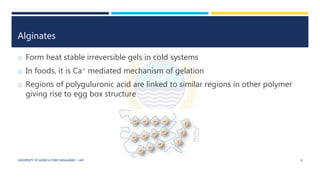
Alginates
o Form heat stable irreversible gels in cold systems
o In foods, it is Ca+ mediated mechanism of gelation
o Regions of polyguluronic acid are linked to similar regions in other polymer
giving rise to egg box structure
UNIVERSITY OF AGRICULTURE FAISALABAD – UAF 6
Agar
o In hot solutions agarose molecules tend to behave as stiffened coils
o Process involves first the formation of bundles of double or single helices in
an order disorder phenomena involving polymer associations
UNIVERSITY OF AGRICULTURE FAISALABAD – UAF 7
Carrageenans
o Structurally they are closely related to agar
o Linkage pattern introduces a twist in the molecule giving rise to helical
structures
o Ability to gel is based on the association of helical chains into double helices
o Because of anionic nature, require counter ions to gel which may be Ca or K
UNIVERSITY OF AGRICULTURE FAISALABAD – UAF 8
Gelatin
o Obtained from collagen by controlled acid or alkaline hydrolysis
o Gelling properties are derived from triple helical molecular structure
o Swells in contact with cold or warm water and at temperatures above its
melting point gets dissolved
o On cooling molecules reform into triple helices giving rise to a transparent
and elastic gel
o Groups of triple helices align themselves in a parallel array forming micro-
crystallites
UNIVERSITY OF AGRICULTURE FAISALABAD – UAF 9
Whey protein
o Gelation is induced by heating and process is reversible
o Mostly are particle gels in which units of forming the network are protein
aggregates (0.5-2 um)
o Gelation appears to involve a series of transitions from the native proteins,
aggregation of unfolded molecules, strand formation from aggregates and
association of aggregates into a network
UNIVERSITY OF AGRICULTURE FAISALABAD – UAF 10
Starch
o On heating in excess water, swell and imbibe enough liquid to reach several
times their dry weight; gelatinization process
o Crystalline portion of granule melts, amylose leaches out of granule
o On cooling free amylose becomes ordered into microcrystalline regions
surrounding swollen granules; thus forming a gel
o Actually, it is a composite gel of amylose matrices filled with swollen granules
o Gelling mechanism and microstructure become more complicated if both
amylose and amylopectin are present in aqueous phase
UNIVERSITY OF AGRICULTURE FAISALABAD – UAF 11
Pectin
o Generally classified as low (LMP) and high methoxyl (HMP) pectin each having
its own gelation mechanism
o In HMP gels junction zones are aggregates of chains of various sizes
promoted by hydrogen bonding and hydrophobic interactions
o Gelation is favored by presence of sugar and low pH conditions
o LMP have structure similar to alginates; gel by calcium bridging mechanism
UNIVERSITY OF AGRICULTURE FAISALABAD – UAF 12
Mixed gels
o Several food gels include more than one type of gel-forming materials in their
formulation
o A blend of gelling polymers sometimes provides superior properties than a
single component
o Most of the high moisture structured foods can be regarded as combination
of gel matrices with embedded microstructural elements
UNIVERSITY OF AGRICULTURE FAISALABAD – UAF 13
Mixed gels
UNIVERSITY OF AGRICULTURE FAISALABAD – UAF 14
Structure property relationships-transport properties
o Transport properties of gels are similar to liquids
o Diffusion of small solutes occurs largely in aqueous phase and is affected by
the steric and electrostatic hindrances of strands
o Diffusivity is lower for large solutes and molecules carrying charges opposite
to those of polymeric chains and when small pores are present
o Sieve effect provided by the network is useful in molecular separations
UNIVERSITY OF AGRICULTURE FAISALABAD – UAF 15
Structure property relationships-transport properties
o Thermal conductivity of gels having low total solids is similar to that of water
o Thermal conductivity of filled gels decreases with volume fraction of dispersed
phase
UNIVERSITY OF AGRICULTURE FAISALABAD – UAF 16
Structure property relationships-viscoelastic properties
o Since gels are viscoelastic, they are best characterized in terms of mechanical
response to oscillatory shear under small deformations
o Storage modulus G’ is the measure of solid like behavior and is related to
polymeric connectivity of network
o G’ varies as a power function (close to 2 for strong concentrated gels) of
concentration of gelling agent
o The same square dependence is observed for the elastic modulus E (E = kc2)
for gelatin gels
UNIVERSITY OF AGRICULTURE FAISALABAD – UAF 17
Structure property relationships-mechanical properties
o Mechanically assayed through small and large deformations
o Former mode aims at simulating small forces acting during handling of
products
o The later represent the action of mastication or cutting
o Some gels fail in brittle fracture under small deformations but most of them
show a yield stress; dissipating energy
o In filled gels, gel strength increases above a critical phase volume of the filler;
especially when there is good interaction between filler and matrix
UNIVERSITY OF AGRICULTURE FAISALABAD – UAF 18
Gel microstructure
o Gels are difficult to study with microscopy because of risks of artifacts during
sample preparation
o The high proportion of water in gels makes dehydration without collapse
difficult
o Molecular nature of some networks requires high resolution
o In-spite of such problems, most food gels are usually examined by both light
and electron microscopy
o Solutions of globular proteins form transparent or opaque heat set gels
depending on ionic strength and pH
o low ionic strength and isoelectric point render gel transparent; due to thinner
strandsUNIVERSITY OF AGRICULTURE FAISALABAD – UAF 19
Gel microstructure
o Opaque gels are of particulate nature
o The size of pores in fine stranded gels may be on the order of nm
o In particulate gels, size is in the range of 10-100 um
o Microscopy is a powerful tool to study the phase separated gels
UNIVERSITY OF AGRICULTURE FAISALABAD – UAF 20
Gel microrheology
o A number of techniques are available to characterize the microrheology
o particle tracking rheology,
o diffusing wave spectroscopy,
o laser particle tracking (optical tweezers),
o magnetic tweezers, atomic force microscopy,
o piezorheometer,
o quasi-elastic light scattering
UNIVERSITY OF AGRICULTURE FAISALABAD – UAF 21
Gel microrheology
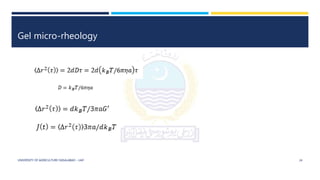
o Particle tracking microrheology (also termed as video particle tracking
microrheology) is an emerging passive micro-rheological technique
o Particles (tracers) are incorporated into the gel structure through different
means
o No external driving force is applied; the Brownian motion of embedded
particles (called tracers) is used to probe local dynamics of soft material
o The diffusive motions of these embedded particles can be recorded
simultaneously using either fluorescence or bright field microscopy,
o The information of each of the individual particle trajectories is kept in record
UNIVERSITY OF AGRICULTURE FAISALABAD – UAF 22
Gel micro-rheology
UNIVERSITY OF AGRICULTURE FAISALABAD – UAF 23
Gel micro-rheology
UNIVERSITY OF AGRICULTURE FAISALABAD – UAF 24

Food gels

  • 1.
    DEPARTMENT OF FOODENGINEERING UNIVERSITY OF AGRICULTURE, FAISALABAD
  • 2.
    Food Gels o Agel is a form of matter intermediate between a solid and a liquid o Gels are soft solids present in high moisture foods of almost all origins (jams, jellies, confectionery, dairy products etc.) o Gels have ability to structure water in semi solid structures, having immense technological importance in food processing o Gelled agar may contain as much as 998 parts of water and only two parts of polymer and yet stand against gravity o Continuous network of interconnected material becomes swollen with a high proportion of liquid o Uptake of water is affected by interaction energy and polymer entropy 2
  • 3.
    Food Gels o Thereverse phenomena “syneresis” is the expulsion of liquid from gel generally regarded as defect in food gels o Gels in which liquid phase is an aqueous solution are called hydrogels; those in which liquid has been removed are called aerogels o Researchers around the world have developed some gels known as intelligent gels which absorb or expel water in response to temperature, pH, electric fields etc. UNIVERSITY OF AGRICULTURE FAISALABAD – UAF 3
  • 4.
    Classification of gels oGels are classified according to cross-linking mechanism o Cross-links may be strong covalent bonds or weak bonds including electrostatic, ion bridging, hydrophobic, hydrogen bonds and van der Waal’s forces o Fishing nets or branched three dimensional networks: built from linear flexible chains linked by covalent bonds; exhibit rubbery consistency o Thermo-reversible physical gels: formed by partial crystallization of chains or conformational coil to helix transitions o Range from soft and highly deformable to hard and brittle o Egg box structures: formed by junction zones linked by ionic complexation in which a divalent cation bridges two strands of polymer 4
  • 5.
    Classification of gels oParticle or colloidal gels: consisting of strands of more or less spherical aggregates ordered into a string of beads or cluster arrangement o Other classifications can be based on o Composition of network or phases present; single or mixed o Role of heat in gel formation; thermotropic or thermoreversible o Light transmission; transluscent or opaque UNIVERSITY OF AGRICULTURE FAISALABAD – UAF 5
  • 6.
    Alginates o Form heatstable irreversible gels in cold systems o In foods, it is Ca+ mediated mechanism of gelation o Regions of polyguluronic acid are linked to similar regions in other polymer giving rise to egg box structure UNIVERSITY OF AGRICULTURE FAISALABAD – UAF 6
  • 7.
    Agar o In hotsolutions agarose molecules tend to behave as stiffened coils o Process involves first the formation of bundles of double or single helices in an order disorder phenomena involving polymer associations UNIVERSITY OF AGRICULTURE FAISALABAD – UAF 7
  • 8.
    Carrageenans o Structurally theyare closely related to agar o Linkage pattern introduces a twist in the molecule giving rise to helical structures o Ability to gel is based on the association of helical chains into double helices o Because of anionic nature, require counter ions to gel which may be Ca or K UNIVERSITY OF AGRICULTURE FAISALABAD – UAF 8
  • 9.
    Gelatin o Obtained fromcollagen by controlled acid or alkaline hydrolysis o Gelling properties are derived from triple helical molecular structure o Swells in contact with cold or warm water and at temperatures above its melting point gets dissolved o On cooling molecules reform into triple helices giving rise to a transparent and elastic gel o Groups of triple helices align themselves in a parallel array forming micro- crystallites UNIVERSITY OF AGRICULTURE FAISALABAD – UAF 9
  • 10.
    Whey protein o Gelationis induced by heating and process is reversible o Mostly are particle gels in which units of forming the network are protein aggregates (0.5-2 um) o Gelation appears to involve a series of transitions from the native proteins, aggregation of unfolded molecules, strand formation from aggregates and association of aggregates into a network UNIVERSITY OF AGRICULTURE FAISALABAD – UAF 10
  • 11.
    Starch o On heatingin excess water, swell and imbibe enough liquid to reach several times their dry weight; gelatinization process o Crystalline portion of granule melts, amylose leaches out of granule o On cooling free amylose becomes ordered into microcrystalline regions surrounding swollen granules; thus forming a gel o Actually, it is a composite gel of amylose matrices filled with swollen granules o Gelling mechanism and microstructure become more complicated if both amylose and amylopectin are present in aqueous phase UNIVERSITY OF AGRICULTURE FAISALABAD – UAF 11
  • 12.
    Pectin o Generally classifiedas low (LMP) and high methoxyl (HMP) pectin each having its own gelation mechanism o In HMP gels junction zones are aggregates of chains of various sizes promoted by hydrogen bonding and hydrophobic interactions o Gelation is favored by presence of sugar and low pH conditions o LMP have structure similar to alginates; gel by calcium bridging mechanism UNIVERSITY OF AGRICULTURE FAISALABAD – UAF 12
  • 13.
    Mixed gels o Severalfood gels include more than one type of gel-forming materials in their formulation o A blend of gelling polymers sometimes provides superior properties than a single component o Most of the high moisture structured foods can be regarded as combination of gel matrices with embedded microstructural elements UNIVERSITY OF AGRICULTURE FAISALABAD – UAF 13
  • 14.
    Mixed gels UNIVERSITY OFAGRICULTURE FAISALABAD – UAF 14
  • 15.
    Structure property relationships-transportproperties o Transport properties of gels are similar to liquids o Diffusion of small solutes occurs largely in aqueous phase and is affected by the steric and electrostatic hindrances of strands o Diffusivity is lower for large solutes and molecules carrying charges opposite to those of polymeric chains and when small pores are present o Sieve effect provided by the network is useful in molecular separations UNIVERSITY OF AGRICULTURE FAISALABAD – UAF 15
  • 16.
    Structure property relationships-transportproperties o Thermal conductivity of gels having low total solids is similar to that of water o Thermal conductivity of filled gels decreases with volume fraction of dispersed phase UNIVERSITY OF AGRICULTURE FAISALABAD – UAF 16
  • 17.
    Structure property relationships-viscoelasticproperties o Since gels are viscoelastic, they are best characterized in terms of mechanical response to oscillatory shear under small deformations o Storage modulus G’ is the measure of solid like behavior and is related to polymeric connectivity of network o G’ varies as a power function (close to 2 for strong concentrated gels) of concentration of gelling agent o The same square dependence is observed for the elastic modulus E (E = kc2) for gelatin gels UNIVERSITY OF AGRICULTURE FAISALABAD – UAF 17
  • 18.
    Structure property relationships-mechanicalproperties o Mechanically assayed through small and large deformations o Former mode aims at simulating small forces acting during handling of products o The later represent the action of mastication or cutting o Some gels fail in brittle fracture under small deformations but most of them show a yield stress; dissipating energy o In filled gels, gel strength increases above a critical phase volume of the filler; especially when there is good interaction between filler and matrix UNIVERSITY OF AGRICULTURE FAISALABAD – UAF 18
  • 19.
    Gel microstructure o Gelsare difficult to study with microscopy because of risks of artifacts during sample preparation o The high proportion of water in gels makes dehydration without collapse difficult o Molecular nature of some networks requires high resolution o In-spite of such problems, most food gels are usually examined by both light and electron microscopy o Solutions of globular proteins form transparent or opaque heat set gels depending on ionic strength and pH o low ionic strength and isoelectric point render gel transparent; due to thinner strandsUNIVERSITY OF AGRICULTURE FAISALABAD – UAF 19
  • 20.
    Gel microstructure o Opaquegels are of particulate nature o The size of pores in fine stranded gels may be on the order of nm o In particulate gels, size is in the range of 10-100 um o Microscopy is a powerful tool to study the phase separated gels UNIVERSITY OF AGRICULTURE FAISALABAD – UAF 20
  • 21.
    Gel microrheology o Anumber of techniques are available to characterize the microrheology o particle tracking rheology, o diffusing wave spectroscopy, o laser particle tracking (optical tweezers), o magnetic tweezers, atomic force microscopy, o piezorheometer, o quasi-elastic light scattering UNIVERSITY OF AGRICULTURE FAISALABAD – UAF 21
  • 22.
    Gel microrheology o Particletracking microrheology (also termed as video particle tracking microrheology) is an emerging passive micro-rheological technique o Particles (tracers) are incorporated into the gel structure through different means o No external driving force is applied; the Brownian motion of embedded particles (called tracers) is used to probe local dynamics of soft material o The diffusive motions of these embedded particles can be recorded simultaneously using either fluorescence or bright field microscopy, o The information of each of the individual particle trajectories is kept in record UNIVERSITY OF AGRICULTURE FAISALABAD – UAF 22
  • 23.
    Gel micro-rheology UNIVERSITY OFAGRICULTURE FAISALABAD – UAF 23
  • 24.
    Gel micro-rheology UNIVERSITY OFAGRICULTURE FAISALABAD – UAF 24