PCBs in Building Materials:
An Emerging Health Issue in
         Schools
   Craig A. Calvert, Ph.D., C-CHO
             ACS NERM
           October 9, 2009
Outline
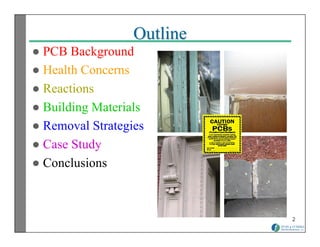
PCB Background
Health Concerns
Reactions
Building Materials
Removal Strategies
Case Study
Conclusions


                          2
What Are PCBs?
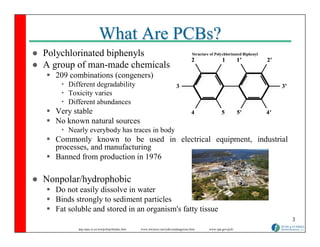
Polychlorinated biphenyls                                                          Structure of Polychlorinated Biphenyl
                                                                                  22                11         1’
                                                                                                                1’         2’
                                                                                                                            2’
A group of man-made chemicals
  209 combinations (congeners)
      Different degradability                                           33                                                       3’
                                                                                                                                  3’
      Toxicity varies
      Different abundances
  Very stable                                                                     44                55         5’
                                                                                                                5’         4’
                                                                                                                            4’
  No known natural sources
      Nearly everybody has traces in body
  Commonly known to be used in electrical equipment, industrial
  processes, and manufacturing
  Banned from production in 1976

Nonpolar/hydrophobic
  Do not easily dissolve in water
  Binds strongly to sediment particles
  Fat soluble and stored in an organism's fatty tissue
                                                                                                                                       3
         dep.state.ct.us/wst/pcb/pcbindex.htm   www.trwnews.net/isdioxindangerous.htm       www.epa.gov/pcb/
Synthesis
 Commercial products mixtures
           Aroclors most common in US
 Various methods
                    Chlorinate biphenyl
                    Modified Suzuki coupling reaction


Bromo- or Iodobenzene                                    Boronic Acid


                                                                                                                                             4
 Kania-Korwel I, Parkin S, Robertson LW, Lehmler HJ. “Synthesis of polychlorinated biphenyls and their metabolites with a modified Suzuki-
 coupling.” Chemosphere. 2004 Aug;56(8):735-44
Properties of PCBs


                     5
Brief History
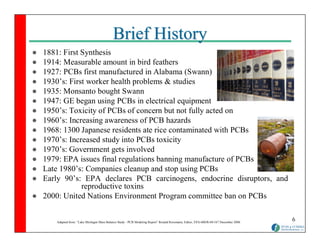
1881: First Synthesis
1914: Measurable amount in bird feathers
1927: PCBs first manufactured in Alabama (Swann)
1930’s: First worker health problems & studies
1935: Monsanto bought Swann
1947: GE began using PCBs in electrical equipment
1950’s: Toxicity of PCBs of concern but not fully acted on
1960’s: Increasing awareness of PCB hazards
1968: 1300 Japanese residents ate rice contaminated with PCBs
1970’s: Increased study into PCBs toxicity
1970’s: Government gets involved
1979: EPA issues final regulations banning manufacture of PCBs
Late 1980’s: Companies cleanup and stop using PCBs
Early 90’s: EPA declares PCB carcinogens, endocrine disruptors, and
            reproductive toxins
2000: United Nations Environment Program committee ban on PCBs


   Adapted from: “Lake Michigan Mass Balance Study - PCB Modeling Report” Ronald Rossmann, Editor, EPA-600/R-04/167 December 2006
                                                                                                                                    6
PCB Uses


           7
Health Concerns
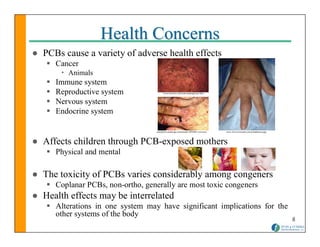
PCBs cause a variety of adverse health effects
   Cancer
      Animals
   Immune system
   Reproductive system                www.trwnews.net/isdioxindangerous.htm


   Nervous system
   Endocrine system

                                emedicine.medscape.com/article/1093801-overview   www.foxriverwatch.com/jointdisease.jpg


Affects children through PCB-exposed mothers
   Physical and mental

The toxicity of PCBs varies considerably among congeners
   Coplanar PCBs, non-ortho, generally are most toxic congeners
Health effects may be interrelated
   Alterations in one system may have significant implications for the
   other systems of the body
                                                                                                                           8
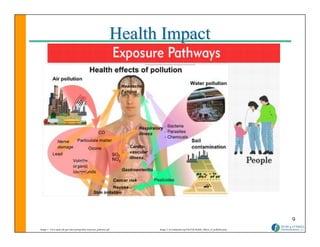
Health Impact


                                                                                                                                              9
Image 1: www.atsdr.cdc.gov/sites/springvalley/exposure_pathways.gif     Image 2: en.wikipedia.org/wiki/File:Health_effects_of_pollution.png
Regulations
EPA 40 CFR part 761 (§761)
  Marking
  Manufacture
  Processing
  Distribution
  Use
  Storage
  Disposal
PCBs in caulking and sealant materials was never
authorized by EPA
  Use is not authorized
  Highly unlikely to be authorized
Caulk containing 50 ppm PCB must be removed
  Testing “may be advisable” (EPA Nov. 2003)
                                                   10
Media Coverage
Doherty High Worcester MA
  2 incidents
Yorktown School District PCB Contamination
  French Hill Elementary School
  Ben Franklin Elementary School
New York City
  Citywide concern


                                             11
Building Materials


                     12
Structures


             13
Remediation Steps
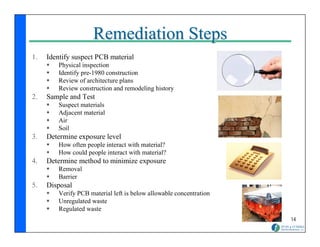
1.   Identify suspect PCB material
         Physical inspection
         Identify pre-1980 construction
         Review of architecture plans
         Review construction and remodeling history
2.   Sample and Test
         Suspect materials
         Adjacent material
         Air
         Soil
3.   Determine exposure level
         How often people interact with material?
         How could people interact with material?
4.   Determine method to minimize exposure
         Removal
         Barrier
5.   Disposal
         Verify PCB material left is below allowable concentration
         Unregulated waste
         Regulated waste
                                                                     14
Harvard Study
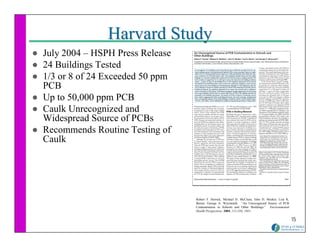
July 2004 – HSPH Press Release
24 Buildings Tested
1/3 or 8 of 24 Exceeded 50 ppm
PCB
Up to 50,000 ppm PCB
Caulk Unrecognized and
Widespread Source of PCBs
Recommends Routine Testing of
Caulk


                                 Robert F. Herrick, Michael D. McClean, John D. Meeker, Lisa K.
                                 Baxter, George A. Weymouth. “An Unrecognized Source of PCB
                                 Contamination in Schools and Other Buildings.” Environmental
                                 Health Perspectives. 2004, 112 (10), 1051.

                                                                                                  15
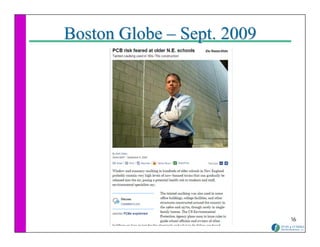
Boston Globe – Sept. 2009


                            16
UMASS Amherst Lederle Building
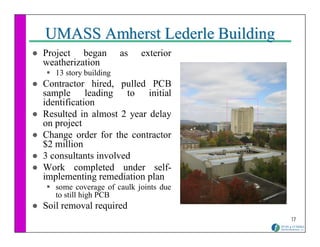
Project began          as   exterior
weatherization
   13 story building
Contractor hired, pulled PCB
sample leading to initial
identification
Resulted in almost 2 year delay
on project
Change order for the contractor
$2 million
3 consultants involved
Work completed under self-
implementing remediation plan
   some coverage of caulk joints due
   to still high PCB
Soil removal required
                                       17
Bronx – Sept. 2009
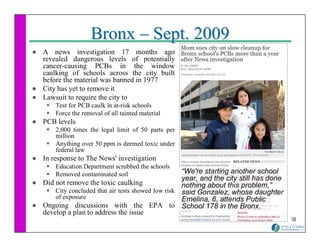
A news investigation 17 months ago
revealed dangerous levels of potentially
cancer-causing PCBs in the window
caulking of schools across the city built
before the material was banned in 1977
City has yet to remove it
Lawsuit to require the city to
    Test for PCB caulk in at-risk schools
    Force the removal of all tainted material
PCB levels
    2,000 times the legal limit of 50 parts per
    million
    Anything over 50 ppm is deemed toxic under
    federal law
In response to The News' investigation
    Education Department scrubbed the schools
    Removed contaminated soil                     “We're starting another school
                                                  year, and the city still has done
Did not remove the toxic caulking                 nothing about this problem,”
    City concluded that air tests showed low risk said Gonzalez, whose daughter
    of exposure                                   Emelina, 6, attends Public
Ongoing discussions with the EPA to School 178 in the Bronx.
develop a plan to address the issue
                                                                                      18
Case Study – Overview
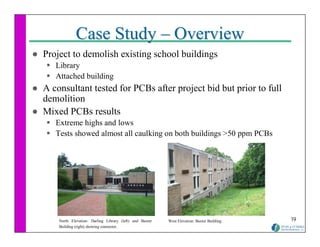
Project to demolish existing school buildings
   Library
   Attached building
A consultant tested for PCBs after project bid but prior to full
demolition
Mixed PCBs results
   Extreme highs and lows
   Tests showed almost all caulking on both buildings >50 ppm PCBs


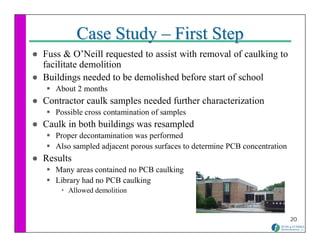
    North Elevation: Darling Library (left) and Baxter   West Elevation: Baxter Building.   19
    Building (right) showing connector.
Case Study – First Step
Fuss & O’Neill requested to assist with removal of caulking to
facilitate demolition
Buildings needed to be demolished before start of school
   About 2 months
Contractor caulk samples needed further characterization
   Possible cross contamination of samples
Caulk in both buildings was resampled
   Proper decontamination was performed
   Also sampled adjacent porous surfaces to determine PCB concentration
Results
   Many areas contained no PCB caulking
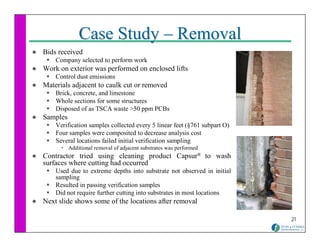
   Library had no PCB caulking
      Allowed demolition


                                                                          20
Case Study – Removal
Bids received
    Company selected to perform work
Work on exterior was performed on enclosed lifts
    Control dust emissions
Materials adjacent to caulk cut or removed
    Brick, concrete, and limestone
    Whole sections for some structures
    Disposed of as TSCA waste >50 ppm PCBs
Samples
    Verification samples collected every 5 linear feet (§761 subpart O)
    Four samples were composited to decrease analysis cost
    Several locations failed initial verification sampling
          Additional removal of adjacent substrates was performed
Contractor tried using cleaning product Capsur® to wash
surfaces where cutting had occurred
    Used due to extreme depths into substrate not observed in initial
    sampling
    Resulted in passing verification samples
    Did not require further cutting into substrates in most locations
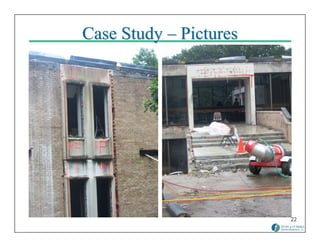
Next slide shows some of the locations after removal

                                                                          21
Case Study – Pictures


                        22
Case Study – Results
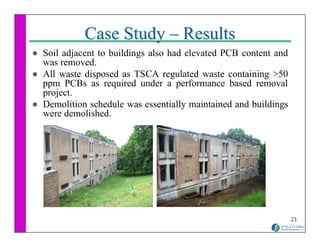
Soil adjacent to buildings also had elevated PCB content and
was removed.
All waste disposed as TSCA regulated waste containing >50
ppm PCBs as required under a performance based removal
project.
Demolition schedule was essentially maintained and buildings
were demolished.


                                                               23
Caulk
Caulk is a suspected PCB-containing material and
should be routinely tested for PCBs prior to
disturbance.
Caulk is a significant PCB exposure risk.
PCB-containing caulk must be removed and disposed
of as PCB waste upon discovery.
State agencies and private businesses have begun to
develop guidelines for testing and removal of PCB-
containing caulk.
Currently testing caulk for PCBs is not required by
law but “may be advisable.”

                                                      24
Project Implementation
Each project is site specific
   Concentration levels
   Materials present
   History of the building.
Which plan depends on
   Time
   Budget
   Logistics
       Area occupied?
Time for completion is weeks to months to years
Although not required to test, addressing the problem
internally can avoid bad public relations.
Once one contaminated area is remediated, other areas should
be considered.
                                                               25
26
www.epa.gov/pcbsincaulk/


                           27
Contact

Craig Calvert
   146 Hartford Road
   Manchester, CT 06040
   (860) 646-2469 x5571
ccalvert@fando.com


   Questions?


                             28

Pcbs Bldg Materials

  • 1.
    PCBs in BuildingMaterials: An Emerging Health Issue in Schools Craig A. Calvert, Ph.D., C-CHO ACS NERM October 9, 2009
  • 2.
    Outline PCB Background Health Concerns Reactions BuildingMaterials Removal Strategies Case Study Conclusions 2
  • 3.
    What Are PCBs? Polychlorinatedbiphenyls Structure of Polychlorinated Biphenyl 22 11 1’ 1’ 2’ 2’ A group of man-made chemicals 209 combinations (congeners) Different degradability 33 3’ 3’ Toxicity varies Different abundances Very stable 44 55 5’ 5’ 4’ 4’ No known natural sources Nearly everybody has traces in body Commonly known to be used in electrical equipment, industrial processes, and manufacturing Banned from production in 1976 Nonpolar/hydrophobic Do not easily dissolve in water Binds strongly to sediment particles Fat soluble and stored in an organism's fatty tissue 3 dep.state.ct.us/wst/pcb/pcbindex.htm www.trwnews.net/isdioxindangerous.htm www.epa.gov/pcb/
  • 4.
    Synthesis Commercial productsmixtures Aroclors most common in US Various methods Chlorinate biphenyl Modified Suzuki coupling reaction Bromo- or Iodobenzene Boronic Acid 4 Kania-Korwel I, Parkin S, Robertson LW, Lehmler HJ. “Synthesis of polychlorinated biphenyls and their metabolites with a modified Suzuki- coupling.” Chemosphere. 2004 Aug;56(8):735-44
  • 5.
  • 6.
    Brief History 1881: FirstSynthesis 1914: Measurable amount in bird feathers 1927: PCBs first manufactured in Alabama (Swann) 1930’s: First worker health problems & studies 1935: Monsanto bought Swann 1947: GE began using PCBs in electrical equipment 1950’s: Toxicity of PCBs of concern but not fully acted on 1960’s: Increasing awareness of PCB hazards 1968: 1300 Japanese residents ate rice contaminated with PCBs 1970’s: Increased study into PCBs toxicity 1970’s: Government gets involved 1979: EPA issues final regulations banning manufacture of PCBs Late 1980’s: Companies cleanup and stop using PCBs Early 90’s: EPA declares PCB carcinogens, endocrine disruptors, and reproductive toxins 2000: United Nations Environment Program committee ban on PCBs Adapted from: “Lake Michigan Mass Balance Study - PCB Modeling Report” Ronald Rossmann, Editor, EPA-600/R-04/167 December 2006 6
  • 7.
  • 8.
    Health Concerns PCBs causea variety of adverse health effects Cancer Animals Immune system Reproductive system www.trwnews.net/isdioxindangerous.htm Nervous system Endocrine system emedicine.medscape.com/article/1093801-overview www.foxriverwatch.com/jointdisease.jpg Affects children through PCB-exposed mothers Physical and mental The toxicity of PCBs varies considerably among congeners Coplanar PCBs, non-ortho, generally are most toxic congeners Health effects may be interrelated Alterations in one system may have significant implications for the other systems of the body 8
  • 9.
    Health Impact 9 Image 1: www.atsdr.cdc.gov/sites/springvalley/exposure_pathways.gif Image 2: en.wikipedia.org/wiki/File:Health_effects_of_pollution.png
  • 10.
    Regulations EPA 40 CFRpart 761 (§761) Marking Manufacture Processing Distribution Use Storage Disposal PCBs in caulking and sealant materials was never authorized by EPA Use is not authorized Highly unlikely to be authorized Caulk containing 50 ppm PCB must be removed Testing “may be advisable” (EPA Nov. 2003) 10
  • 11.
    Media Coverage Doherty HighWorcester MA 2 incidents Yorktown School District PCB Contamination French Hill Elementary School Ben Franklin Elementary School New York City Citywide concern 11
  • 12.
  • 13.
  • 14.
    Remediation Steps 1. Identify suspect PCB material Physical inspection Identify pre-1980 construction Review of architecture plans Review construction and remodeling history 2. Sample and Test Suspect materials Adjacent material Air Soil 3. Determine exposure level How often people interact with material? How could people interact with material? 4. Determine method to minimize exposure Removal Barrier 5. Disposal Verify PCB material left is below allowable concentration Unregulated waste Regulated waste 14
  • 15.
    Harvard Study July 2004– HSPH Press Release 24 Buildings Tested 1/3 or 8 of 24 Exceeded 50 ppm PCB Up to 50,000 ppm PCB Caulk Unrecognized and Widespread Source of PCBs Recommends Routine Testing of Caulk Robert F. Herrick, Michael D. McClean, John D. Meeker, Lisa K. Baxter, George A. Weymouth. “An Unrecognized Source of PCB Contamination in Schools and Other Buildings.” Environmental Health Perspectives. 2004, 112 (10), 1051. 15
  • 16.
    Boston Globe –Sept. 2009 16
  • 17.
    UMASS Amherst LederleBuilding Project began as exterior weatherization 13 story building Contractor hired, pulled PCB sample leading to initial identification Resulted in almost 2 year delay on project Change order for the contractor $2 million 3 consultants involved Work completed under self- implementing remediation plan some coverage of caulk joints due to still high PCB Soil removal required 17
  • 18.
    Bronx – Sept.2009 A news investigation 17 months ago revealed dangerous levels of potentially cancer-causing PCBs in the window caulking of schools across the city built before the material was banned in 1977 City has yet to remove it Lawsuit to require the city to Test for PCB caulk in at-risk schools Force the removal of all tainted material PCB levels 2,000 times the legal limit of 50 parts per million Anything over 50 ppm is deemed toxic under federal law In response to The News' investigation Education Department scrubbed the schools Removed contaminated soil “We're starting another school year, and the city still has done Did not remove the toxic caulking nothing about this problem,” City concluded that air tests showed low risk said Gonzalez, whose daughter of exposure Emelina, 6, attends Public Ongoing discussions with the EPA to School 178 in the Bronx. develop a plan to address the issue 18
  • 19.
    Case Study –Overview Project to demolish existing school buildings Library Attached building A consultant tested for PCBs after project bid but prior to full demolition Mixed PCBs results Extreme highs and lows Tests showed almost all caulking on both buildings >50 ppm PCBs North Elevation: Darling Library (left) and Baxter West Elevation: Baxter Building. 19 Building (right) showing connector.
  • 20.
    Case Study –First Step Fuss & O’Neill requested to assist with removal of caulking to facilitate demolition Buildings needed to be demolished before start of school About 2 months Contractor caulk samples needed further characterization Possible cross contamination of samples Caulk in both buildings was resampled Proper decontamination was performed Also sampled adjacent porous surfaces to determine PCB concentration Results Many areas contained no PCB caulking Library had no PCB caulking Allowed demolition 20
  • 21.
    Case Study –Removal Bids received Company selected to perform work Work on exterior was performed on enclosed lifts Control dust emissions Materials adjacent to caulk cut or removed Brick, concrete, and limestone Whole sections for some structures Disposed of as TSCA waste >50 ppm PCBs Samples Verification samples collected every 5 linear feet (§761 subpart O) Four samples were composited to decrease analysis cost Several locations failed initial verification sampling Additional removal of adjacent substrates was performed Contractor tried using cleaning product Capsur® to wash surfaces where cutting had occurred Used due to extreme depths into substrate not observed in initial sampling Resulted in passing verification samples Did not require further cutting into substrates in most locations Next slide shows some of the locations after removal 21
  • 22.
    Case Study –Pictures 22
  • 23.
    Case Study –Results Soil adjacent to buildings also had elevated PCB content and was removed. All waste disposed as TSCA regulated waste containing >50 ppm PCBs as required under a performance based removal project. Demolition schedule was essentially maintained and buildings were demolished. 23
  • 24.
    Caulk Caulk is asuspected PCB-containing material and should be routinely tested for PCBs prior to disturbance. Caulk is a significant PCB exposure risk. PCB-containing caulk must be removed and disposed of as PCB waste upon discovery. State agencies and private businesses have begun to develop guidelines for testing and removal of PCB- containing caulk. Currently testing caulk for PCBs is not required by law but “may be advisable.” 24
  • 25.
    Project Implementation Each projectis site specific Concentration levels Materials present History of the building. Which plan depends on Time Budget Logistics Area occupied? Time for completion is weeks to months to years Although not required to test, addressing the problem internally can avoid bad public relations. Once one contaminated area is remediated, other areas should be considered. 25
  • 26.
  • 27.
  • 28.
    Contact Craig Calvert 146 Hartford Road Manchester, CT 06040 (860) 646-2469 x5571 ccalvert@fando.com Questions? 28