POLYCHLORINATED
BIPHENYLS
PREPARED BY,
PRABHA CHANDRASEKHARAN
M.Phil Biosciences
Mahatma Gandhi University
INTRODUCTION
 PCBs are a family of chemical compounds formed by the addition of
chlorine to biphenyl (C12H10).
 There are 10 substitution positions where chlorine may be added, leading to
a possible 209 unique chemical compounds termed congeners.
 A polychlorinated biphenyl (PCB) is an organic chlorine compound with the
formula C12H10-nCln where n= 1 to 10.
 Congeners have been assigned numbers (1209) and are also classified by
the positions occupied by chlorine.
 E.g. Congener 1 : Chlorobiphenyl
Congener 101 : Pentachlorobiphenyl
Congener 209 : Decachlorobiphenyl
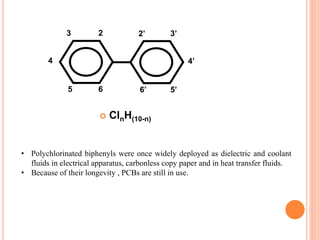
 ClnH(10-n)
23
4
5 6
3’2’
4’
6’ 5’
• Polychlorinated biphenyls were once widely deployed as dielectric and coolant
fluids in electrical apparatus, carbonless copy paper and in heat transfer fluids.
• Because of their longevity , PCBs are still in use.
 Developed in 1929
 PCBs were typically manufactured as a mixture of congeners, created
through the progressive chlorination of biphenyl until a target chlorine
content (percentage by weight) was obtained and the mixture has
characteristic physical-chemical properties.
 One of the most common mixtures was Arochlor 1254, which contained
54% chlorine by weight.
 Once released to the environment, mixtures undergo diagenesis, changing
the congener balance and making it difficult to determine their origin
 PCBs have physical properties ranging from oily liquids to waxy solids.
 Due to their non-flammability, chemical stability, high boiling point and
electrical insulating properties, they were used in a variety of industrial
and commercial applications including electrical, heat transfer, and
hydraulic equipment; as plasticizers in paints, plastics and rubber
products and in pigments, dyes and carbonless copy paper.
 Insoluble in water ; solubility decreases with increasing chlorination.
 PCB’s are either oily liquids or solids, some exist as a vapor in air.
 Colorless to light yellow
 PCB’s have no smell or taste
 Extremely stable, withstanding temperatures of up to 1,600°F (870°C).
 PCB’s are fire-resistant and an electrical insulator.
 More than 1.5 billion pounds of PCBs were manufactured in the U.S.
before they were banned under the Toxic Substances Control Act of
1976.
 According to the U.S. Environmental Protection Agency (EPA) PCBs
cause cancer in animals and are probable human carcinogens.
 PCBs have been demonstrated to cause a variety of adverse health
effects, including cancer and disruption of the endocrine, nervous, and
reproductive systems.
 It has a potency factor for toxicity more than 4 times that of arsenic.
 World production of PCBs since 1930 is estimated at one million tons.
 Although the manufacture of PCB ceased in 1979 under TSCA, some
750 million pounds remained in use as of the mid-1980s, largely in
electrical equipment.
 PCBs enter the environment through effluent discharge, incineration and
leakage.
SOURCES
 Run off
 Poorly maintained hazardous waste sites
containing PCBs
 Burning of wastes in municipal or industrial
incinerators
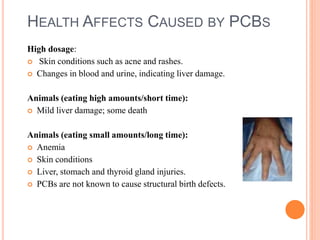
HEALTH AFFECTS CAUSED BY PCBS
High dosage:
 Skin conditions such as acne and rashes.
 Changes in blood and urine, indicating liver damage.
Animals (eating high amounts/short time):
 Mild liver damage; some death
Animals (eating small amounts/long time):
 Anemia
 Skin conditions
 Liver, stomach and thyroid gland injuries.
 PCBs are not known to cause structural birth defects.
PCBs are a health hazard. Children are particularly
susceptible to the health effects of PCBs.
Consuming water with high levels of PCBs over time
can cause health effects such as:
• Acne and rashes
• Liver and kidney dysfunction
• Depression and fatigue
• Nose and lung irritation
• Increased risk of cancer
• Developmental problems in children
PCBS AFFECT ON CHILDREN
 Mothers exposed to high levels of PCBs in the workplace or ate
large amounts of contaminated fish.
 Babies weigh less than other babies with mothers not exposed to
PCBs.
 Problems with motor skills and decreased short term memory.
 Immune system complications
 Infants most likely exposed through breast milk.
CAN PCBS CAUSE CANCER?
 Studies show, workers exposed to high doses of PCBs can develop
certain kinds of cancers including liver and biliary tract cancer,
immune, reproductive and endocrine systems.
 PCBs have been linked to activation of oncogenes and inactivation
of tumor suppressing genes
 Rats that ate food with high doses of PCBs for two years developed
liver cancer.
 The EPA and the International Agency for Research on Cancer
(IARC) have determined PCBs to be carcinogenic to humans.
PCBS IN THE ENVIRONMENT
 PCBs entered air, water and soil during their manufacture,
use and disposal.
 Accidental spills and leaks during their transport, and from
leaks or fires in products containing PCBs.
 Still released from hazardous waste sites; illegal or
improper disposal of industrial waste; leaks from old
appliances.
 PCBs are not readily biodegradable
 In water, stick to organic particles and bottom sediments;
binds strongly to soil.
 PCBs are consumed by small organisms and fish in water.
REDUCE THE RISK OF EXPOSURE TO
PCBS
 Avoid eating the fish and fish-eating wildlife that have been
issued advisory warnings about PCB-contamination.
 Avoid children playing with old appliances, electrical
equipment, or transformers that might contain PCBs.
 Discourage children from playing in the dirt near
hazardous waste sites, eating dirt and putting dirty hands,
toys and other objects in mouth.
 If exposed to PCBs in the workplace, they could be
brought home on clothes, body or tools. Shower before
leaving; keep work clothes and tools separate from clean
items.
GOVERNMENT RECOMMENDATIONS
 The Environmental Protection Agency (EPA) has a limit
of 0.0005 mg of PCBs pr liter of drinking water.
 Spills and accidental releases of 1 pound or more of
PCBs into the environment must be reported to EPA.
 FDA requires infant food, dairy products, fish and
shellfish, poultry and red meat contain no more than 0.2-
3 parts of PCBs per million parts of food.
 Many states have established fish and wildlife
consumption advisories for PCBs.
 When do PCBs in drinking water become a health
concern?
 The federal government has established the safe drinking
water standard (also called maximum contaminant level)
for PCBs as 500 ppt (parts per trillion).
 It is unsafe to drink water with higher concentrations of
PCBs.
CURRENT ISSUE WITH PCBS
 Studies done at the University of Rochester have
linked PCBs to Parkinson’s disease- a progressive
neurological disorder that affects about 1% of
Americans over 60.
 PCBs degrade nerve pathways associated with
Parkinson’s.
 Exposure caused by PCBs found in the food chain,
inhaled, and an additive in pesticides.
INCIDENCE
 Polychlorinated Biphenyl Transformer Incident -- New
Mexico
On June 17, 1985, a transformer located in the basement of the
New Mexico State Highway Department building in Santa Fe
was found to have overheated and released an oily mist
containing polychlorinated biphenyls (PCBs) and their pyrolysis
by-products. The transformer contained 245 gallons of askarel,
most of which was vented from the transformer. The askarel was
tested for PCBs, and the result was interpreted as negative.
Therefore, clean-up began under the assumption that PCBs
were not present. By that afternoon, however, a laboratory
identified PCBs in an askarel fluid sample from the site. By that
time, the three-story building had been extensively
contaminated, compounded in part by the clean-up efforts.
THE BELGIAN PCB/DIOXIN INCIDENT
 The Belgian PCB incident occurred at the end of January
1999 when a mixture of polychlorinated biphenyls (PCBs)
contaminated with dioxins was accidentally added to a
stock of recycled fat used in the production of animal
feeds. Although signs of poultry poisoning were noticed
by February, 1999, the source and the extent of the
contamination were discovered only in May 1999, when it
appeared that more than 2500 farms could have been
supplied with contaminated feeds. This resulted in a
major food crisis, which rapidly extended to the whole
country and could be resolved only by the
implementation of a large PCB/dioxin food monitoring
program.
Thank You…

Polychlorinated biphenyls

  • 1.
  • 3.
    INTRODUCTION  PCBs area family of chemical compounds formed by the addition of chlorine to biphenyl (C12H10).  There are 10 substitution positions where chlorine may be added, leading to a possible 209 unique chemical compounds termed congeners.  A polychlorinated biphenyl (PCB) is an organic chlorine compound with the formula C12H10-nCln where n= 1 to 10.  Congeners have been assigned numbers (1209) and are also classified by the positions occupied by chlorine.  E.g. Congener 1 : Chlorobiphenyl Congener 101 : Pentachlorobiphenyl Congener 209 : Decachlorobiphenyl
  • 4.
     ClnH(10-n) 23 4 5 6 3’2’ 4’ 6’5’ • Polychlorinated biphenyls were once widely deployed as dielectric and coolant fluids in electrical apparatus, carbonless copy paper and in heat transfer fluids. • Because of their longevity , PCBs are still in use.
  • 5.
     Developed in1929  PCBs were typically manufactured as a mixture of congeners, created through the progressive chlorination of biphenyl until a target chlorine content (percentage by weight) was obtained and the mixture has characteristic physical-chemical properties.  One of the most common mixtures was Arochlor 1254, which contained 54% chlorine by weight.  Once released to the environment, mixtures undergo diagenesis, changing the congener balance and making it difficult to determine their origin
  • 6.
     PCBs havephysical properties ranging from oily liquids to waxy solids.  Due to their non-flammability, chemical stability, high boiling point and electrical insulating properties, they were used in a variety of industrial and commercial applications including electrical, heat transfer, and hydraulic equipment; as plasticizers in paints, plastics and rubber products and in pigments, dyes and carbonless copy paper.  Insoluble in water ; solubility decreases with increasing chlorination.  PCB’s are either oily liquids or solids, some exist as a vapor in air.  Colorless to light yellow  PCB’s have no smell or taste  Extremely stable, withstanding temperatures of up to 1,600°F (870°C).  PCB’s are fire-resistant and an electrical insulator.
  • 7.
     More than1.5 billion pounds of PCBs were manufactured in the U.S. before they were banned under the Toxic Substances Control Act of 1976.  According to the U.S. Environmental Protection Agency (EPA) PCBs cause cancer in animals and are probable human carcinogens.  PCBs have been demonstrated to cause a variety of adverse health effects, including cancer and disruption of the endocrine, nervous, and reproductive systems.  It has a potency factor for toxicity more than 4 times that of arsenic.  World production of PCBs since 1930 is estimated at one million tons.  Although the manufacture of PCB ceased in 1979 under TSCA, some 750 million pounds remained in use as of the mid-1980s, largely in electrical equipment.  PCBs enter the environment through effluent discharge, incineration and leakage.
  • 8.
    SOURCES  Run off Poorly maintained hazardous waste sites containing PCBs  Burning of wastes in municipal or industrial incinerators
  • 9.
    HEALTH AFFECTS CAUSEDBY PCBS High dosage:  Skin conditions such as acne and rashes.  Changes in blood and urine, indicating liver damage. Animals (eating high amounts/short time):  Mild liver damage; some death Animals (eating small amounts/long time):  Anemia  Skin conditions  Liver, stomach and thyroid gland injuries.  PCBs are not known to cause structural birth defects.
  • 10.
    PCBs are ahealth hazard. Children are particularly susceptible to the health effects of PCBs. Consuming water with high levels of PCBs over time can cause health effects such as: • Acne and rashes • Liver and kidney dysfunction • Depression and fatigue • Nose and lung irritation • Increased risk of cancer • Developmental problems in children
  • 11.
    PCBS AFFECT ONCHILDREN  Mothers exposed to high levels of PCBs in the workplace or ate large amounts of contaminated fish.  Babies weigh less than other babies with mothers not exposed to PCBs.  Problems with motor skills and decreased short term memory.  Immune system complications  Infants most likely exposed through breast milk.
  • 12.
    CAN PCBS CAUSECANCER?  Studies show, workers exposed to high doses of PCBs can develop certain kinds of cancers including liver and biliary tract cancer, immune, reproductive and endocrine systems.  PCBs have been linked to activation of oncogenes and inactivation of tumor suppressing genes  Rats that ate food with high doses of PCBs for two years developed liver cancer.  The EPA and the International Agency for Research on Cancer (IARC) have determined PCBs to be carcinogenic to humans.
  • 13.
    PCBS IN THEENVIRONMENT  PCBs entered air, water and soil during their manufacture, use and disposal.  Accidental spills and leaks during their transport, and from leaks or fires in products containing PCBs.  Still released from hazardous waste sites; illegal or improper disposal of industrial waste; leaks from old appliances.  PCBs are not readily biodegradable  In water, stick to organic particles and bottom sediments; binds strongly to soil.  PCBs are consumed by small organisms and fish in water.
  • 14.
    REDUCE THE RISKOF EXPOSURE TO PCBS  Avoid eating the fish and fish-eating wildlife that have been issued advisory warnings about PCB-contamination.  Avoid children playing with old appliances, electrical equipment, or transformers that might contain PCBs.  Discourage children from playing in the dirt near hazardous waste sites, eating dirt and putting dirty hands, toys and other objects in mouth.  If exposed to PCBs in the workplace, they could be brought home on clothes, body or tools. Shower before leaving; keep work clothes and tools separate from clean items.
  • 15.
    GOVERNMENT RECOMMENDATIONS  TheEnvironmental Protection Agency (EPA) has a limit of 0.0005 mg of PCBs pr liter of drinking water.  Spills and accidental releases of 1 pound or more of PCBs into the environment must be reported to EPA.  FDA requires infant food, dairy products, fish and shellfish, poultry and red meat contain no more than 0.2- 3 parts of PCBs per million parts of food.  Many states have established fish and wildlife consumption advisories for PCBs.
  • 16.
     When doPCBs in drinking water become a health concern?  The federal government has established the safe drinking water standard (also called maximum contaminant level) for PCBs as 500 ppt (parts per trillion).  It is unsafe to drink water with higher concentrations of PCBs.
  • 17.
    CURRENT ISSUE WITHPCBS  Studies done at the University of Rochester have linked PCBs to Parkinson’s disease- a progressive neurological disorder that affects about 1% of Americans over 60.  PCBs degrade nerve pathways associated with Parkinson’s.  Exposure caused by PCBs found in the food chain, inhaled, and an additive in pesticides.
  • 18.
    INCIDENCE  Polychlorinated BiphenylTransformer Incident -- New Mexico On June 17, 1985, a transformer located in the basement of the New Mexico State Highway Department building in Santa Fe was found to have overheated and released an oily mist containing polychlorinated biphenyls (PCBs) and their pyrolysis by-products. The transformer contained 245 gallons of askarel, most of which was vented from the transformer. The askarel was tested for PCBs, and the result was interpreted as negative. Therefore, clean-up began under the assumption that PCBs were not present. By that afternoon, however, a laboratory identified PCBs in an askarel fluid sample from the site. By that time, the three-story building had been extensively contaminated, compounded in part by the clean-up efforts.
  • 19.
    THE BELGIAN PCB/DIOXININCIDENT  The Belgian PCB incident occurred at the end of January 1999 when a mixture of polychlorinated biphenyls (PCBs) contaminated with dioxins was accidentally added to a stock of recycled fat used in the production of animal feeds. Although signs of poultry poisoning were noticed by February, 1999, the source and the extent of the contamination were discovered only in May 1999, when it appeared that more than 2500 farms could have been supplied with contaminated feeds. This resulted in a major food crisis, which rapidly extended to the whole country and could be resolved only by the implementation of a large PCB/dioxin food monitoring program.
  • 20.