2,3,7,8-TETRACHLORODIBENZO-
                                para-DIOXIN,
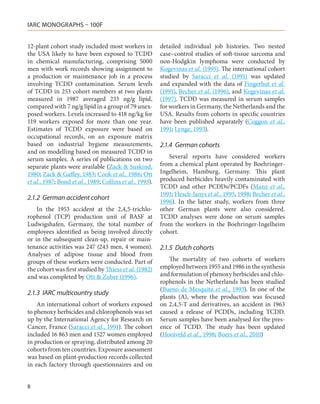
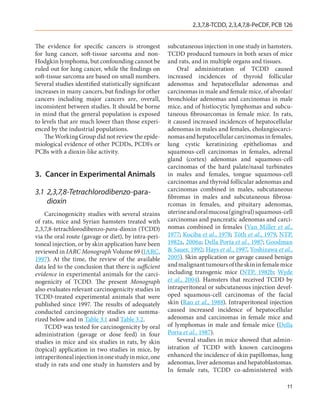
     2,3,4,7,8-PENTACHLORODIBENZOFURAN,
      AND 3,3′,4,4′,5-PENTACHLOROBIPHENYL
Two of these agents (2,3,7,8-tetrachlorodibenzo-para-dioxin and 2,3,4,7,8-pentachloro-
dibenzofuran were specifically considered by previous IARC Working Groups in 1977, 1987,
and 1997 (IARC, 1977, 1987, 1997). The Working Group in 1987 reviewed polychlorinated
biphenyls, but did not specifically consider 3,3′,4,4′,5-pentachlorobiphenyl. Since the
previous evaluations new data have become available, which have been incorporated in
this Monograph and taken into consideration in the present evaluation.


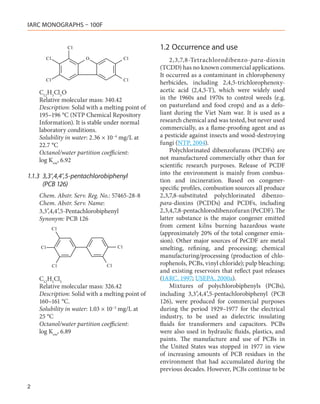
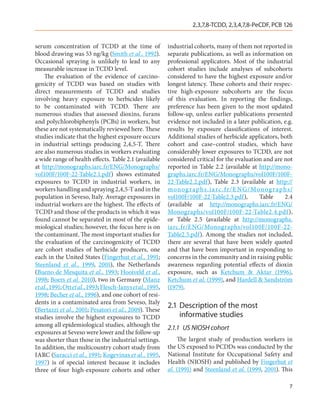
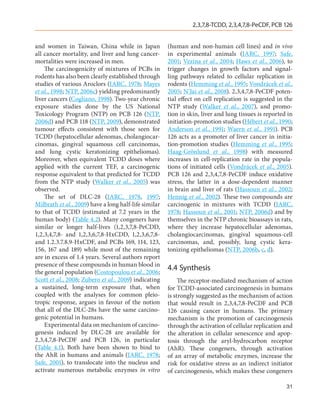
1.	 Exposure Data                                    Description: Colourless to white crystalline
                                                     solid
                                                     Solubility: Insoluble in water; slightly
1.1	 Identification of the agents                    soluble in n-octanol and methanol; and
   From NTP (2006a, b, c)                            soluble in other organic solvents (e.g.
                                                     dichlorobenzene, chlorobenzene, benzene,
1.1.1	2,3,7,8-Tetrachlorodibenzo-para-dioxin         chloroform, and acetone)
      (2,3,7,8-TCDD, TCDD)                           Octanol/water partition coefficient:
    Chem. Abstr. Serv. Reg. No.: 1746-01-6           log Kow, 6.80
    Chem. Abstr. Serv. Name:
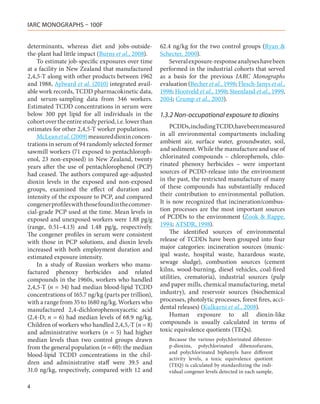
    2,3,7,8-Tetrachlorodibenzo[b,e][1,4]dioxin   1.1.2	2,3,4,7,8-pentachlorodibenzofuran
    Synonyms: 2,3,7,8-TCDD; TCDD; dioxin;              (2,3,4,7,8-PeCDF)
    tetradioxin                                      Chem. Abstr. Serv. Reg. No.: 57117-31-4
    Cl              O             Cl                 Chem. Abstr. Serv. Name:
                                                     2,3,4,7,8-Pentachlorodibenzofuran
                                                     Synonym: 2,3,4,7,8-PeCDF;
    Cl              O             Cl                 2,3,4,7,8-penta-CDF

    C12H4Cl4O2
    Relative molecular mass: 321.98

                                                                                                1
IARC MONOGRAPHS – 100F


                    Cl                           1.2	Occurrence and use
          Cl             O              Cl           2,3,7,8-Tetrachlorodibenzo-para-dioxin
                                                 (TCDD) has no known commercial applications.
                                                 It occurred as a contaminant in chlorophenoxy
          Cl                            Cl
                                                 herbicides, including 2,4,5-trichlorophenoxy-
    C12H3Cl5O                                    acetic acid (2,4,5-T), which were widely used
    Relative molecular mass: 340.42              in the 1960s and 1970s to control weeds (e.g.
    Description: Solid with a melting point of   on pastureland and food crops) and as a defo-
    195–196 °C (NTP Chemical Repository          liant during the Viet Nam war. It is used as a
    Information). It is stable under normal      research chemical and was tested, but never used
    laboratory conditions.                       commercially, as a flame-proofing agent and as
    Solubility in water: 2.36 × 10⁻⁴ mg/L at     a pesticide against insects and wood-destroying
    22.7 °C                                      fungi (NTP, 2004).
    Octanol/water partition coefficient:             Polychlorinated dibenzofurans (PCDFs) are
    log Kow, 6.92                                not manufactured commercially other than for
                                                 scientific research purposes. Release of PCDF
                                                 into the environment is mainly from combus-
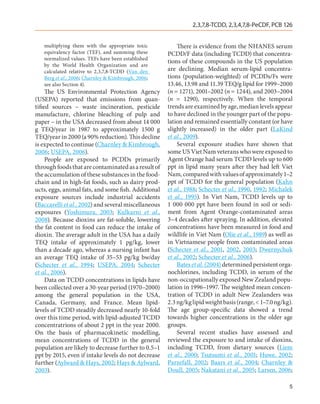
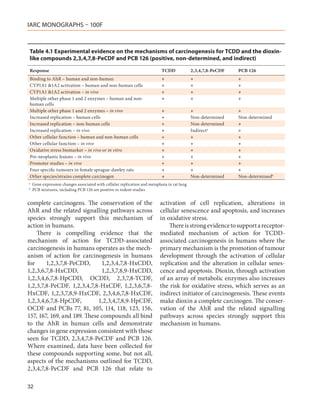
1.1.3	3,3′,4,4′,5-pentachlorobiphenyl
                                                 tion and incineration. Based on congener-
      (PCB 126)
                                                 specific profiles, combustion sources all produce
    Chem. Abstr. Serv. Reg. No.: 57465-28-8      2,3,7,8-substituted polychlorinated dibenzo-
    Chem. Abstr. Serv. Name:                     para-dioxins (PCDDs) and PCDFs, including
    3,3′,4,4′,5-Pentachlorobiphenyl              2,3,4,7,8-pentachlorodibenzofuran (PeCDF). The
    Synonym: PCB 126                             latter substance is the major congener emitted
               Cl
                                                 from cement kilns burning hazardous waste
                                                 (approximately 20% of the total congener emis-
                                                 sion). Other major sources of PeCDF are metal
     Cl                            Cl            smelting, refining, and processing; chemical
                                                 manufacturing/processing (production of chlo-
               Cl             Cl                 rophenols, PCBs, vinyl chloride); pulp bleaching;
                                                 and existing reservoirs that reflect past releases
    C12H5Cl5                                     (IARC, 1997; USEPA, 2000a).
    Relative molecular mass: 326.42                  Mixtures of polychlorobiphenyls (PCBs),
    Description: Solid with a melting point of   including 3,3′,4,4′,5-pentachlorobiphenyl (PCB
    160–161 °C.                                  126), were produced for commercial purposes
    Solubility in water: 1.03 × 10⁻³ mg/L at     during the period 1929–1977 for the electrical
    25 °C                                        industry, to be used as dielectric insulating
    Octanol/water partition coefficient:         fluids for transformers and capacitors. PCBs
    log Kow, 6.89                                were also used in hydraulic fluids, plastics, and
                                                 paints. The manufacture and use of PCBs in
                                                 the United States was stopped in 1977 in view
                                                 of increasing amounts of PCB residues in the
                                                 environment that had accumulated during the
                                                 previous decades. However, PCBs continue to be

2
2,3,7,8-TCDD, 2,3,4,7,8-PeCDF, PCB 126


released into the environment through the use         lipid]. Available data suggest that these levels have
and disposal of products containing PCBs, as          decreased three- to fivefold since the late 1970s,
by-products during the manufacture of certain         when the development of gas chromatography/
organic chemicals, and during combustion of           mass spectrometry methodology permitted
some waste materials (USEPA, 2000a). Due to           these extremely low concentrations of TCDD in
their lipophilic nature (log Kow, 6.5–7.7) and        tissues and in the environment to be measured
resistance to biodegradation, specific PCBs bio-      accurately for the first time. Similarly, since the
concentrate and bio-accumulate in the environ-        mid-1980s, mean tissue concentrations of total
ment. PCBs are widespread in their distribution       TCDD in the general population have decreased
and are found in virtually all environmental          by two- to threefold. Human exposures related
compartments including air, soil, water, sedi-        to occupation or accidents have led to tissue
ment, and biota (USEPA, 2000b).                       concentrations of TCDD up to several orders
                                                      of magnitude higher than background levels
                                                      (IARC, 1997).
1.3	Human exposure
     Polychlorinated        dibenzo-para-dioxins      1.3.1 Occupational exposure to dioxins
(PCDDs), including TCDD, are formed as inad-
                                                          Because TCDD has never been intentionally
vertent by-products during the production of
                                                      manufactured for large-scale commercial use,
chlorophenols and chlorophenoxy herbicides,
                                                      estimates of the numbers of workers exposed in
and have been detected as contaminants in
                                                      the past are not available. From the US National
these products. TCDD may also be produced
                                                      Occupational Exposure Survey (1981–1983), it
in thermal processes such as incineration, in
                                                      was estimated that approximately 14 workers
metal-processing, and in the bleaching of paper
                                                      were potentially exposed to TCDD in the USA
pulp with free chlorine. The relative amounts of
                                                      (NIOSH, 1990). Historical occupational expo-
the TCDD congeners produced depend on the
                                                      sures to TCDD have been reviewed (IARC, 1997).
production or incineration process and vary
                                                          In a series of studies, Collins et al. (2006,
widely (IARC, 1997).
                                                      2007, 2008) examined concentrations of TCDD
     PCDDs are ubiquitous in soil, sediments and
                                                      in serum from 375 workers in Michigan who had
air. Excluding occupational or accidental expo-
                                                      been exposed in the past (26–62 years before)
sures, most human exposure to TCDD occurs
                                                      to trichlorophenol and/or pentachlorophenol.
as a result of eating meat, milk, eggs, fish and
                                                      Workers exposed only to trichlorophenol had
related products, as TCDD is persistent in the
                                                      mean lipid-adjusted TCDD levels of 15.9 ppt,
environment and accumulates in animal fat.
                                                      compared with 6.5 ppt in unexposed workers and
Occupational exposures to TCDD at higher
                                                      3.3 ppt in community controls. Those exposed
levels have occurred since the 1940s as a result of
                                                      to pentachlorophenol only had mean TCDD
production and use of chlorophenols and chlo-
                                                      concentrations of 8.0 ppt; workers exposed to
rophenoxy herbicides. Even higher exposures
                                                      both chemicals had mean TCDD levels of 13.9
have occurred sporadically in relation to acci-
                                                      ppt; and tradesmen with plant-wide responsi-
dents in these industries (IARC, 1997).
                                                      bilities had mean levels of 20.7 ppt. A follow-
     Mean background levels of TCDD in human
                                                      up study to evaluate the influence of various
tissues are in the range of 2–3 ng/kg (parts per
                                                      factors on TCDD concentrations in serum of 412
trillion; ppt) fat [because PCDDs are stored in
                                                      workers exposed to penta- and trichlorophenol,
fat tissue, body burdens of PCDDs are often
                                                      showed that age and body fat were important
expressed as concentration in lipid, e.g. 100 ppt

                                                                                                         3
IARC MONOGRAPHS – 100F


determinants, whereas diet and jobs-outside-           62.4 ng/kg for the two control groups (Ryan &
the-plant had little impact (Burns et al., 2008).      Schecter, 2000).
    To estimate job-specific exposures over time           Several exposure-response analyses have been
at a facility in New Zealand that manufactured         performed in the industrial cohorts that served
2,4,5-T along with other products between 1962         as a basis for the previous IARC Monographs
and 1988, Aylward et al. (2010) integrated avail-      evaluation (Becher et al., 1998; Flesch-Janys et al.,
able work records, TCDD pharmacokinetic data,          1998; Hooiveld et al., 1998; Steenland et al., 1999,
and serum-sampling data from 346 workers.              2004; Crump et al., 2003).
Estimated TCDD concentrations in serum were
below 300 ppt lipid for all individuals in the         1.3.2 Non-occupational exposure to dioxins
cohort over the entire study period, i.e. lower than
estimates for other 2,4,5-T worker populations.             PCDDs, including TCDD, have been measured
    McLean et al. (2009) measured dioxin concen-       in all environmental compartments including
trations in serum of 94 randomly selected former       ambient air, surface water, groundwater, soil,
sawmill workers (71 exposed to pentachloroph-          and sediment. While the manufacture and use of
enol, 23 non-exposed) in New Zealand, twenty           chlorinated compounds – chlorophenols, chlo-
years after the use of pentachlorophenol (PCP)         rinated phenoxy herbicides – were important
had ceased. The authors compared age-adjusted          sources of PCDD-release into the environment
dioxin levels in the exposed and non-exposed           in the past, the restricted manufacture of many
groups, examined the effect of duration and            of these compounds has substantially reduced
intensity of the exposure to PCP, and compared         their contribution to environmental pollution.
congener profiles with those found in the commer-      It is now recognized that incineration/combus-
cial-grade PCP used at the time. Mean levels in        tion processes are the most important sources
exposed and unexposed workers were 1.88 pg/g           of PCDDs to the environment (Zook & Rappe,
(range, 0.51–4.13) and 1.48 pg/g, respectively.        1994; ATSDR, 1998).
The congener profiles in serum were consistent              The identified sources of environmental
with those in PCP solutions, and dioxin levels         release of TCDDs have been grouped into four
increased with both employment duration and            major categories: incineration sources (munic-
estimated exposure intensity.                          ipal waste, hospital waste, hazardous waste,
    In a study of Russian workers who manu-            sewage sludge), combustion sources (cement
factured phenoxy herbicides and related                kilns, wood-burning, diesel vehicles, coal-fired
compounds in the 1960s, workers who handled            utilities, crematoria), industrial sources (pulp
2,4,5-T (n = 34) had median blood-lipid TCDD           and paper mills, chemical manufacturing, metal
concentrations of 165.7 ng/kg (parts per trillion),    industry), and reservoir sources (biochemical
with a range from 35 to 1680 ng/kg. Workers who        processes, photolytic processes, forest fires, acci-
manufactured 2,4-dichlorophenoxyacetic acid            dental releases) (Kulkarni et al., 2008).
(2,4-D; n = 6) had median levels of 68.9 ng/kg.             Human exposure to all dioxin-like
Children of workers who handled 2,4,5,-T (n = 8)       compounds is usually calculated in terms of
and administrative workers (n  =  5) had higher        toxic equivalence quotients (TEQs).
median levels than two control groups drawn               Because the various polychlorinated dibenzo-
from the general population (n = 60): the median          p-dioxins, polychlorinated dibenzofurans,
                                                          and polychlorinated biphenyls have different
blood-lipid TCDD concentrations in the chil-
                                                          activity levels, a toxic equivalence quotient
dren and administrative staff were 39.5 and               (TEQ) is calculated by standardizing the indi-
31.0 ng/kg, respectively, compared with 12 and            vidual congener levels detected in each sample,

4
2,3,7,8-TCDD, 2,3,4,7,8-PeCDF, PCB 126


   multiplying them with the appropriate toxic            There is evidence from the NHANES serum
   equivalency factor (TEF), and summing these        PCDD/F data (including TCDD) that concentra-
   normalized values. TEFs have been established
                                                      tions of these compounds in the US population
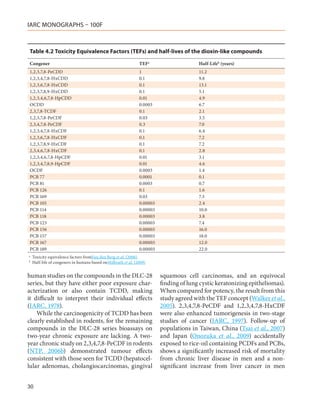
   by the World Health Organization and are
   calculated relative to 2,3,7,8-TCDD (Van den       are declining. Median serum-lipid concentra-
   Berg et al., 2006; Charnley & Kimbrough, 2006;     tions (population-weighted) of PCDDs/Fs were
   see also Section 4).                               13.46, 13.98 and 11.39 TEQ/g lipid for 1999–2000
     The US Environmental Protection Agency           (n = 1271), 2001–2002 (n = 1244), and 2003–2004
(USEPA) reported that emissions from quan-            (n  =  1290), respectively. When the temporal
tified sources – waste incineration, pesticide        trends are examined by age, median levels appear
manufacture, chlorine bleaching of pulp and           to have declined in the younger part of the popu-
paper – in the USA decreased from about 14 000        lation and remained essentially constant (or have
g TEQ/year in 1987 to approximately 1500 g            slightly increased) in the older part (LaKind
TEQ/year in 2000 (a 90% reduction). This decline      et al., 2009).
is expected to continue (Charnley & Kimbrough,            Several exposure studies have shown that
2006; USEPA, 2006).                                   some US Viet Nam veterans who were exposed to
     People are exposed to PCDDs primarily            Agent Orange had serum TCDD levels up to 600
through foods that are contaminated as a result of    ppt in lipid many years after they had left Viet
the accumulation of these substances in the food-     Nam, compared with values of approximately 1–2
chain and in high-fat foods, such as dairy prod-      ppt of TCDD for the general population (Kahn
ucts, eggs, animal fats, and some fish. Additional    et al., 1988; Schecter et al., 1990, 1992; Michalek
exposure sources include industrial accidents         et al., 1995). In Viet Nam, TCDD levels up to
(Baccarelli et al., 2002) and several miscellaneous   1  000  000 ppt have been found in soil or sedi-
exposures (Yoshimura, 2003; Kulkarni et al.,          ment from Agent Orange-contaminated areas
2008). Because dioxins are fat-soluble, lowering      3–4 decades after spraying. In addition, elevated
the fat content in food can reduce the intake of      concentrations have been measured in food and
dioxin. The average adult in the USA has a daily      wildlife in Viet Nam (Olie et al., 1989) as well as
TEQ intake of approximately 1 pg/kg, lower            in Vietnamese people from contaminated areas
than a decade ago, whereas a nursing infant has       (Schecter et al., 2001, 2002, 2003; Dwernychuk
an average TEQ intake of 35–53 pg/kg bw/day           et al., 2002; Schecter et al., 2006).
(Schecter et al., 1994; USEPA, 2004; Schecter             Bates et al. (2004) determined persistent orga-
et al., 2006).                                        nochlorines, including TCDD, in serum of the
     Data on TCDD concentrations in lipids have       non-occupationally exposed New Zealand popu-
been collected over a 30-year period (1970–2000)      lation in 1996–1997. The weighted mean concen-
among the general population in the USA,              tration of TCDD in adult New Zealanders was
Canada, Germany, and France. Mean lipid-              2.3 ng/kg lipid weight basis (range, < 1–7.0 ng/kg).
levels of TCDD steadily decreased nearly 10-fold      The age group-specific data showed a trend
over this time period, with lipid-adjusted TCDD       towards higher concentrations in the older age
concentratrions of about 2 ppt in the year 2000.      groups.
On the basis of pharmacokinetic modelling,                Several recent studies have assessed and
mean concentrations of TCDD in the general            reviewed the exposure to and intake of dioxins,
population are likely to decrease further to 0.5–1    including TCDD, from dietary sources (Liem
ppt by 2015, even if intake levels do not decrease    et al., 2000; Tsutsumi et al., 2001; Huwe, 2002;
further (Aylward & Hays, 2002; Hays & Aylward,        Parzefall, 2002; Baars et al., 2004; Charnley &
2003).                                                Doull, 2005; Nakatani et al., 2005; Larsen, 2006;

                                                                                                        5
IARC MONOGRAPHS – 100F


Sasamoto et al., 2006; Gies et al., 2007; Todaka       European tissue samples, PeCDF levels are on
et al., 2008).                                         average 13 ppt TEQ (lipid-adjusted) and repre-
                                                       sent approximately 36% of the TEQ contributed
1.3.3 Human exposure to polychlorinated                by PCDDs and PCDFs. PeCDF is the highest
      dibenzofurans, polychlorinated                   contributor of the PCDF class of DLCs to the
      biphenyls and dioxin-like compounds              total TEQ, based on both intake levels and tissue
                                                       concentrations.
     Due to high lipophilicity and low solubility in       The majority (90%) of ambient human expo-
aqueous media, polychlorinated dibenzofurans           sure to dioxin-like compounds occurs through
(PCDFs) accumulate in the fat tissue of animals.       the ingestion of food containing PCB residues.
The highest concentrations of PCDFs are found          Levels of PCB 126 in food range from 0.05 to
in fish, meat, eggs, and dairy products (Schecter      0.83 pg/g. Human exposure to all dioxin-like
et al., 1994; USEPA, 2000b). This results in           compounds is usually calculated in terms of toxic
widespread exposure of the general population          equivalents (TEQs). On a TEQ basis, it is esti-
to PCDFs and related dioxin-like compounds,            mated that humans are exposed via food to 22 pg
with an estimated 90% of human exposure due            TEQ/day (for a 70-kg person) from dioxin-like
to ingestion of contaminated food, and a small         PCBs of which PCB 126 (13 pg/day) accounts for
fraction via inhalation and dermal absorption.         60% of the TEQ intake. Bioaccumulation of PCBs
     Human exposure to all dioxin-like                 results in persistent levels of these substances in
compounds is usually calculated in terms of            human tissues. With an average concentration of
TEQs (see definition above). Adult daily intake        12 pg TEQ/g lipid, PCB 126 accounts for approxi-
of dioxin-like compounds including PCDDs,              mately half of the PCB TEQ in human tissues
PCDFs and dioxin-like PCBs from all sources            (USEPA, 2000b).
is estimated to be approximately 70pg TEQ/day,
where TEQ reflects the potency-adjusted amount
of all dioxin-like compounds. The intake from all      2.	 Cancer in Humans
sources of PCDDs and PCDFs is estimated to be
45pg TEQ/day and intake from dioxin-like PCBs              Human exposures related to occupation or
is 25pg TEQ/day. Approximately 90% of the daily        accidents have led to tissue concentrations of
intake is from food sources (40pg TEQ/day for          2,3,7,8-tetrachlorodibenzo-para-dioxin (TCDD)
PCDDs and PCDFs and 22pg TEQ/day for dioxin-           that are 10–100-fold higher than average back-
like PCBs). Intake of PeCDF from food is approx-       ground levels in the 1980s. The highest expo-
imately 6.6 pg per day and represents 16% of the       sures occurred in industrial cohorts of workers
total intake of PCDDs and PCDFs on a TEQ basis.        producing phenoxy herbicides and chloroph-
This level of exposure together with the long half-    enols, while exposure to professional sprayers
life of dioxin-like compounds in humans leads to       of these compounds was considerably lower. It
persistent body burdens in humans in the range         has been shown that TCDD levels in professional
of 25 pg TEQ/g lipid (USEPA, 2000b). Depending         applicators increase considerably above back-
upon dietary practice and proximity to specific        ground only after several years of spraying of
sources of exposure, some populations may have         TCDD-contaminated chemicals. For example, in
higher exposure or body burdens. In contrast to        the most heavily exposed applicators of 2,4,5-T
the general population, several specific groups        in New Zealand, who applied this chemical
may have been exposed to much higher levels of         for at least 180 months, the estimated mean
PeCDF as a result of occupational exposure. In

6
2,3,7,8-TCDD, 2,3,4,7,8-PeCDF, PCB 126


serum concentration of TCDD at the time of                   industrial cohorts, many of them not reported in
blood drawing was 53 ng/kg (Smith et al., 1992).             separate publications, as well as information on
Occasional spraying is unlikely to lead to any               professional applicators. Most of the industrial
measurable increase in TCDD level.                           cohort studies include analyses of subcohorts
    The evaluation of the evidence of carcino-               considered to have the highest exposure and/or
genicity of TCDD was based on studies with                   longest latency. These cohorts and their respec-
direct measurements of TCDD and studies                      tive high-exposure subcohorts are the focus
involving heavy exposure to herbicides likely                of this evaluation. In reporting the findings,
to be contaminated with TCDD. There are                      preference has been given to the most updated
numerous studies that assessed dioxins, furans               follow-up, unless earlier publications presented
and polychlorobiphenyls (PCBs) in workers, but               evidence not included in a later publication, e.g.
these are not systematically reviewed here. These            results by exposure classifications of interest.
studies indicate that the highest exposure occurs            Additional studies of herbicide applicators, both
in industrial settings producing 2,4,5-T. There              cohort and case–control studies, which have
are also numerous studies in workers evaluating              considerably lower exposures to TCDD, are not
a wide range of health effects. Table 2.1 (available         considered critical for the evaluation and are not
at http://monographs.iarc.fr/ENG/Monographs/                 reported in Table  2.2 (available at http://mono-
vol100F/100F-22-Table2.1.pdf) shows estimated                graphs.iarc.fr/ENG/Monographs/vol100F/100F-
exposures to TCDD in industrial workers, in                  22-Table2.2.pdf), Table  2.3 (available at http://
workers handling and spraying 2,4,5-T and in the             mono g r aph s . i a rc . f r/ E NG/ Mono g r a ph s /
population in Seveso, Italy. Average exposures in            vol100F/100F-22-Table2.3.pdf),         Table     2.4
industrial workers are the highest. The effects of           (available at http://monographs.iarc.fr/ENG/
TCDD and those of the products in which it was               Monographs/vol100F/100F-22-Table2.4.pdf ),
found cannot be separated in most of the epide-              or Table  2.5 (available at http://monographs.
miological studies; however, the focus here is on            iarc.fr/ENG/Monographs/vol100F/100F-22-
the contaminant. The most important studies for              Table2.5.pdf). Among the studies not included,
the evaluation of the carcinogenicity of TCDD                there are several that have been widely quoted
are cohort studies of herbicide producers, one               and that have been important in responding to
each in the United States (Fingerhut et al., 1991;           concerns in the community and in raising public
Steenland et al., 1999, 2001), the Netherlands               awareness regarding potential effects of dioxin
(Bueno de Mesquita et al., 1993; Hooiveld et al.,            exposure, such as Ketchum & Aktar (1996),
1998; Boers et al. 2010), two in Germany (Manz               Ketchum et al. (1999), and Hardell & Sandström
et al., 1991; Ott et al., 1993; Flesch-Janys et al., 1995,   (1979).
1998; Becher et al., 1996), and one cohort of resi-
dents in a contaminated area from Seveso, Italy
(Bertazzi et al., 2001; Pesatori et al., 2009). These
                                                             2.1	Description of the most
studies involve the highest exposures to TCDD                    informative studies
among all epidemiological studies, although the              2.1.1	 US NIOSH cohort
exposures at Seveso were lower and the follow-up
was shorter than those in the industrial settings.               The largest study of production workers in
In addition, the multicountry cohort study from              the US exposed to PCDDs was conducted by the
IARC (Saracci et al., 1991; Kogevinas et al., 1995,          National Institute for Occupational Safety and
1997) is of special interest because it includes             Health (NIOSH) and published by Fingerhut et
three of four high-exposure cohorts and other                al. (1991) and Steenland et al. (1999, 2001). This

                                                                                                                 7
IARC MONOGRAPHS – 100F


12-plant cohort study included most workers in            detailed individual job histories. Two nested
the USA likely to have been exposed to TCDD               case–control studies of soft-tissue sarcoma and
in chemical manufacturing, comprising 5000                non-Hodgkin lymphoma were conducted by
men with work records showing assignment to               Kogevinas et al. (1995). The international cohort
a production or maintenance job in a process              studied by Saracci et al. (1991) was updated
involving TCDD contamination. Serum levels                and expanded with the data of Fingerhut et al.
of TCDD in 253 cohort members at two plants               (1991), Becher et al. (1996), and Kogevinas et al.
measured in 1987 averaged 233 ng/g lipid,                 (1997). TCDD was measured in serum samples
compared with 7 ng/g lipid in a group of 79 unex-         for workers in Germany, the Netherlands and the
posed workers. Levels increased to 418 ng/kg for          USA. Results from cohorts in specific countries
119 workers exposed for more than one year.               have been published separately (Coggon et al.,
Estimates of TCDD exposure were based on                  1991; Lynge, 1993).
occupational records, on an exposure matrix
based on industrial hygiene measurements,                 2.1.4	 German cohorts
and on modelling based on measured TCDD in
serum samples. A series of publications on two               Several reports have considered workers
separate plants were available (Zack & Suskind,           from a chemical plant operated by Boehringer-
1980; Zack & Gaffey, 1983; Cook et al., 1986; Ott         Ingelheim, Hamburg, Germany. This plant
et al., 1987; Bond et al., 1989; Collins et al., 1993).   produced herbicides heavily contaminated with
                                                          TCDD and other PCDDs/PCDFs (Manz et al.,
                                                          1991; Flesch-Janys et al., 1995, 1998; Becher et al.,
2.1.2	 German accident cohort
                                                          1996). In the latter study, workers from three
    In the 1953 accident at the 2,4,5-trichlo-            other German plants were also considered.
rophenol (TCP) production unit of BASF at                 TCDD analyses were done on serum samples
Ludwigshafen, Germany, the total number of                from the workers in the Boehringer-Ingelheim
employees identified as being involved directly           cohort.
or in the subsequent clean-up, repair or main-
tenance activities was 247 (243 men, 4 women).            2.1.5	 Dutch cohorts
Analyses of adipose tissue and blood from
groups of these workers were conducted. Part of              The mortality of two cohorts of workers
the cohort was first studied by Thiess et al. (1982)      employed between 1955 and 1986 in the synthesis
and was completed by Ott & Zober (1996).                  and formulation of phenoxy herbicides and chlo-
                                                          rophenols in the Netherlands has been studied
                                                          (Bueno de Mesquita et al., 1993). In one of the
2.1.3	 IARC multicountry study
                                                          plants (A), where the production was focused
    An international cohort of workers exposed            on 2,4,5-T and derivatives, an accident in 1963
to phenoxy herbicides and chlorophenols was set           caused a release of PCDDs, including TCDD.
up by the International Agency for Research on            Serum samples have been analysed for the pres-
Cancer, France (Saracci et al., 1991). The cohort         ence of TCDD. The study has been updated
included 16 863 men and 1527 women employed               (Hooiveld et al., 1998; Boers et al., 2010)
in production or spraying, distributed among 20
cohorts from ten countries. Exposure assessment
was based on plant-production records collected
in each factory through questionnaires and on


8
2,3,7,8-TCDD, 2,3,4,7,8-PeCDF, PCB 126


2.1.6 Seveso population exposed during an             (NIOSH, Boehringer-Ingelheim, Germany, and
      industrial accident                             BASF, Germany) found a statistically significant
                                                      (P  =  0.02) trend in total cancer mortality with
    On 10 July 1976, a runaway reaction led to        increasing exposure to dioxin (Crump et al.,
a blow-out of a TCP-production reactor at the         2003). The trend tests show an increase in total
ICMESA plant at Seveso, ltaly. The chemical cloud     cancers at cumulative TEQ – a metric TCDD-like
that was released from the reactor contained a        compounds that is defined here as the amount
substantial amount of TCDD. The contaminated          of TCDD that would produce the same toxicity
area was subdivided into Zones A and B, and           as a mixture of TCDD-like compounds – serum
Zone R in descending order of TCDD contami-           levels that would result from lifetime intake of
nation in the soil. The mortality and cancer inci-    7 pg TEQ/kg body weight/day. A linear dose–
dence in the population of Seveso exposed during      response provided a good fit to the combined
this industrial accident were investigated. The       data. There was no overall increase of cancer in the
exposed and referent populations were followed-       population in Seveso, with only minor increases
up as if they belonged to a unique cohort, blind      observed for all-cancer mortality and incidence
to the exposure status of the subjects. The follow-   at 15 or more years since the accident in the most
up after 20 years was > 99% successful (Bertazzi      heavily exposed zones. [The overall increase iden-
et al., 2001; Pesatori et al., 2009)                  tified in all industrial cohorts, and the positive
                                                      trends with increased exposure that are based on
2.2	All cancers                                       internal comparisons, reinforce an overall posi-
                                                      tive association between all cancers combined
    An increased risk for all cancers combined        and exposure to TCDD, making it less likely that
was found in the industrial cohort studies cited      the increase is explained by confounding, either
above in the USA, Germany, and the Netherlands        by smoking or by other exposures to carcinogens
and to a lesser extent in the international cohort    in the industrial setting.]
(see Table  2.2, online). The magnitude of the
increase is generally small. It is higher in subco-
horts considered to have the heaviest TCDD            2.3	Cancer of the lung
exposure, e.g. the chloracne subcohort in the              An increased risk for lung cancer was observed
NIOSH study. Furthermore, statistically signifi-      in the industrial cohort studies, especially in the
cant positive dose–response trends for all cancers    more highly exposed subcohorts (see Table 2.3,
combined were present in the NIOSH cohort and         online). The relative risk for lung cancer in the
in the largest and most heavily exposed German        highly exposed subcohorts was around 1.5 in
cohort. A positive trend (P = 0.05) was also seen     several studies. [It is possible that relative risks
in the smaller German cohort where an accident        of this order for lung cancer could result from
occurred with release of large amounts of TCDD.       confounding by smoking, but this would only
However, the positive trend in this cohort was        be the case if there were a pronounced differ-
limited to smokers. Cumulative dose in these          ence in smoking habits between the exposed and
trend analyses was estimated by combining             the referent populations, a difference that seems
data from TCDD concentrations in blood and            unlikely. Therefore, confounding by smoking
information on job categories, work processes         can probably not explain all the excess risk for
and calendar time of exposure. A metanal-             lung cancer, although it could explain part of it.
ysis of data from three cohorts occupation-           It is also possible that other occupational carcin-
ally exposed to TCDD and related compounds            ogens, many of which would affect the lung, are

                                                                                                        9
IARC MONOGRAPHS – 100F


causing some confounding.] In Seveso, increased       were mostly non-significant and below 2 (see
mortality and cancer incidence for lung cancer        Table  2.5, online). A case–control study nested
was observed at more than 15 years since the          in the IARC cohort provided weak evidence of
accident.                                             a dose–response relationship with estimated
                                                      exposure to TCDD. [Although it is plausible that
                                                      other chemicals cause non-Hodgkin lymphoma,
2.4	Soft-tissue sarcoma                               strong potential confounding factors are not
    An association between soft-tissue sarcoma        known. The lack of complete consistency among
and spraying of phenoxy herbicides was first          the cohorts and the weak effect detected in most
suggested by results from case–control studies        of the positive studies, however, caution against
in Umea, Sweden (Hardell & Sandström, 1979).          a causal interpretation of the findings.]
Exposure to TCDD in these and other commu-
nity-based case–control studies is, however, not      2.6	Other cancers
accurately estimated. An excess risk for soft-
tissue sarcoma, based on a small number of                Increased risks for several other malignant
deaths, has been reported in the largest industrial   neoplasms have been sporadically reported
cohorts, specifically those of NIOSH and IARC         among workers exposed to TCDD, and at
(see Table  2.4, online). In both, the mortality      Seveso. Most notable are risks for breast and
ratios (SMRs) tended to be higher among the           rectal cancers and myeloid leukaemia in Seveso,
most exposed subcohorts. Incidence data for           bladder cancer in the NIOSH and Dutch cohorts,
soft-tissue sarcoma were generally not available.     multiple myeloma in the NIOSH cohort, cancers
A dose–response relationship, with estimated          of the oral cavity and pharynx in the German
exposure to TCDD, was found in a case–control         cohorts, genital cancers in the Dutch cohort, and
study nested in the IARC cohort; however, strong      kidney cancer in the IARC cohort. [The avail-
positive trends were also found with exposure         able results are not fully consistent, and several
estimates for 2,4-dichlorophenoxyacetic acid          studies have not reported the results for each
(2,4-D) and 2,4,5-trichlorophenoxyacetic acid         individual cancer site.]
(2,4,5-T). In Seveso, there were no cases of soft-
tissue sarcoma in the most heavily contaminated
Zones A and B. [Soft-tissue sarcomas are subject
                                                      2.7	Synthesis
to serious misclassification on death certificates.        Overall, the strongest evidence for the carci-
Although it is unlikely that this occurs differ-      nogenicity of TCDD is for all cancers combined,
entially in the exposed and the referent popula-      rather than for any specific site. The relative risk for
tions, re-classification of a few cases would have    all cancers combined in the most highly exposed
important consequences on results based on            and longer-latency subcohorts is around 1.4. In
small numbers.]                                       dose–response analyses, higher relative risks are
                                                      observed for the groups with the highest meas-
2.5	Non-Hodgkin lymphoma                              ured and modelled exposure to TCDD. While
                                                      this relative risk for all neoplasms does not appear
    An increased risk for non-Hodgkin lymphoma        likely to be explained by confounding, particu-
was found in most of the populations studied          larly since dose–response was typically based
in the four industrial cohort studies and in the      on internal comparisons among workers of the
Seveso population, although the relative risks        same cohort, this possibility cannot be excluded.


10
2,3,7,8-TCDD, 2,3,4,7,8-PeCDF, PCB 126


The evidence for specific cancers is strongest         subcutaneous injection in one study in hamsters.
for lung cancer, soft-tissue sarcoma and non-          TCDD produced tumours in both sexes of mice
Hodgkin lymphoma, but confounding cannot be            and rats, and in multiple organs and tissues.
ruled out for lung cancer, while the findings on           Oral administration of TCDD caused
soft-tissue sarcoma are based on small numbers.        increased incidences of thyroid follicular
Several studies identified statistically significant   adenomas and hepatocellular adenomas and
increases in many cancers, but findings for other      carcinomas in male and female mice, of alveolar/
cancers including major cancers are, overall,          bronchiolar adenomas and carcinomas in male
inconsistent between studies. It should be borne       mice, and of histiocytic lymphomas and subcu-
in mind that the general population is exposed         taneous fibrosarcomas in female mice. In rats,
to levels that are much lower than those experi-       it caused increased incidences of hepatocellular
enced by the industrial populations.                   adenomas in males and females, cholangiocarci-
    The Working Group did not review the epide-        nomas and hepatocellular carcinomas in females,
miological evidence of other PCDDs, PCDFs or           lung cystic keratinizing epitheliomas and
PCBs with a dioxin-like activity.                      squamous-cell carcinomas in females, adrenal
                                                       gland (cortex) adenomas and squamous-cell
                                                       carcinomas of the hard palate/nasal turbinates
3.	 Cancer in Experimental Animals                     in males and females, tongue squamous-cell
                                                       carcinomas and thyroid follicular adenomas and
3.1	2,3,7,8-Tetrachlorodibenzo-para-                   carcinomas combined in males, subcutaneous
                                                       fibromas in males and subcutaneous fibrosa-
    dioxin                                             rcomas in females, and pituitary adenomas,
    Carcinogenicity studies with several strains       uterine and oral mucosa (gingival) squamous-cell
of rats, mice and Syrian hamsters treated with         carcinomas and pancreatic adenomas and carci-
2,3,7,8-tetrachlorodibenzo-para-dioxin (TCDD)          nomas combined in females (Van Miller et al.,
via the oral route (gavage or diet), by intra-peri-    1977; Kociba et al., 1978; Tóth et al., 1979, NTP,
toneal injection, or by skin application have been     1982a, 2006a; Della Porta et al., 1987; Goodman
reviewed in IARC Monograph Volume 69 (IARC,            & Sauer, 1992; Hays et al., 1997, Yoshizawa et al.,
1997). At the time, the review of the available        2005). Skin application or gavage caused benign
data led to the conclusion that there is sufficient    and malignant tumours of the skin in female mice
evidence in experimental animals for the carci-        including transgenic mice (NTP, 1982b; Wyde
nogenicity of TCDD. The present Monograph              et al., 2004). Hamsters that received TCDD by
also evaluates relevant carcinogenicity studies in     intraperitoneal or subcutaneous injection devel-
TCDD-treated experimental animals that were            oped squamous-cell carcinomas of the facial
published since 1997. The results of adequately        skin (Rao et al., 1988). Intraperitoneal injection
conducted carcinogenicity studies are summa-           caused increased incidence of hepatocellular
rized below and in Table 3.1 and Table 3.2.            adenomas and carcinomas in female mice and
    TCDD was tested for carcinogenicity by oral        of lymphomas in male and female mice (Della
administration (gavage or dose feed) in four           Porta et al., 1987).
studies in mice and six studies in rats, by skin           Several studies in mice showed that admin-
(topical) application in two studies in mice, by       istration of TCDD with known carcinogens
intraperitoneal injection in one study in mice, one    enhanced the incidence of skin papillomas, lung
study in rats and one study in hamsters and by         adenomas, liver adenomas and hepatoblastomas.
                                                       In female rats, TCDD co-administered with

                                                                                                       11
12
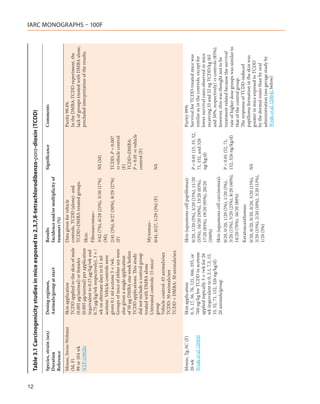
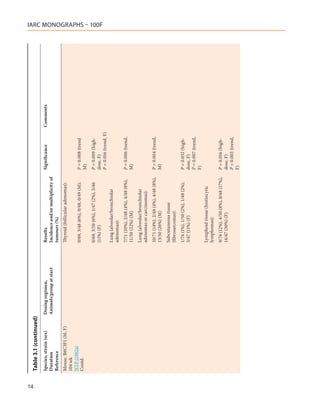
     Table 3.1 Carcinogenicity studies in mice exposed to 2,3,7,8-tetrachlorodibenzo-para-dioxin (TCDD)

     Species, strain (sex)   Dosing regimen,                       Results                               Significance            Comments
     Duration                Animals/group at start                Incidence and/or multiplicity of
     Reference                                                     tumours (%)
     Mouse, Swiss-Webster    Skin application                      Data given for vehicle                                        Purity 99.4%
     (M, F)                  TCDD applied to the skin of male      controls, TCDD (alone)- and                                   In the DMBA-TCDD experiment, the
     99 or 104 wk            (0.001 µg/animal) or females          TCDD+DMBA-treated groups.                                     lack of groups treated with DMBA alone,
     NTP (1982b)             (0.005 µg/animal) per application     Skin:                                                         precluded interpretation of the results.
                             (equivalent to 0.15 µg/kg/wk and
                                                                   Fibrosarcomas–
                             0.75 µg/kg/wk respectively), 3 × /
                                                                                                                                                                             IARC MONOGRAPHS – 100F


                             wk on alternate days in 0.1 ml        3/42 (7%), 6/28 (21%), 5/30 (17%)     NS (M)
                             acetone. Vehicle controls were        (M);
                             given 0.1 ml acetone 3 × /wk.         2/41 (5%), 8/27 (30%), 8/29 (27%)     TCDD: P = 0.007
                             Groups of mice of either sex were     (F)                                   vs vehicle control
                             also given a single application                                             (F)
                             of 50 µg DMBA one week before                                               TCDD+DMBA:
                             TCDD applications. This study                                               P = 0.01 vs vehicle
                             did not include a control group                                             control (F)
                             treated with DMBA alone
                                                                   Myxomas–
                             Untreated controls: 15 mice/
                             group                                 0/41, 0/27, 1/29 (3%) (F)             NS
                             Vehicle-control: 45 animals/sex
                             TCDD: 30 animals/sex
                             TCDD + DMBA: 30 animals/sex

     Mouse, Tg.AC (F)        Skin application                      Skin (squamous cell papillomas):                              Purity 99%
     26 wk                   0, 5, 17, 36, 76, 121, 166, 355, or   0/20, 1/20 (5%), 3/20 (15%), 11/20    P < 0.01 (15, 33, 52,   Survival for TCDD-treated mice was
     Wyde et al. (2004)      760 ng/kg bw TCDD in acetone          (55%), 10/20 (50%), 13/20 (65%),      71, 152, and 326        similar as in the controls, except for
                             applied topically 3 × /wk for 26      17/20 (85%), 19/20 (95%), 20/20       ng/kg/d)                lower survival rates observed in mice
                             wk (equivalent to 0, 2.1, 7.3, 15,    (100%)                                                        receiving 33 and 52 ng TCDD/kg (65
                             33, 52, 71, 152, 326 ng/kg/d)                                                                       and 50%, respectively) vs controls (85%);
                             20 animals/group                      Skin (squamous cell carcinomas):                              however, this was thought not to be
                                                                   0/20, 0/20, 1/20 (5%), 1/20 (5%),   P < 0.01 (52, 71,         treatment-related because the survival
                                                                   3/20 (15%), 5/20 (25%), 8/20 (40%), 152, 326 ng/kg/d)         rate of higher dose groups was similar to
                                                                   14/20 (70%), 16/20 (80%)                                      that of the control group.
                                                                   Keratoacanthomas:                                             The response of TCDD-induced
                                                                                                                                 papilloma formation in the skin was
                                                                   0/20, 0/20, 0/20, 0/20, 3/20 (15%),   NS
                                                                                                                                 greater in mice exposed to TCDD
                                                                   3/20 (15%), 2/20 (10%), 3/20 (15%),
                                                                                                                                 by the dermal route than by oral
                                                                   1/20 (5%)
                                                                                                                                 administration (see gavage study by
                                                                                                                                 Wyde et al. (2004), below)
Table 3.1 (continued)
     Species, strain (sex)     Dosing regimen,                    Results                               Significance           Comments
     Duration                  Animals/group at start             Incidence and/or multiplicity of
     Reference                                                    tumours (%)
     Mouse, Swiss/H/Riop (M) Gavage                               Liver (tumours):                                             Purity NR
     Lifetime                0, 0.007, 0.7, 7.0 µg/kg bw in       7/38 (18%), 13/44 (29%), 21/44        P < 0.01 (0.7 µg/      Tumour type NR
     Tóth et al. (1979)      sunflower oil, once/wk for 1 yr.     (48%), 13/43 (30%)                    kg)                    Average lifespan decreased considerably
                             Controls received sunflower oil                                                                   in the 7.0-µg/kg dose group (428
                             45 animals/group                                                                                  d) compared with controls (588 d).
                                                                                                                               [Mortality-adjusted analysis was not
                                                                                                                               performed and, therefore, the tumour
                                                                                                                               incidence in the high-dose group may
                                                                                                                               have been underestimated.]
     Mouse, B6C3F1 (M, F)      Gavage                             Liver (hepatocellular adenomas):                             Purity 99.4%
     104 wk                    0.01, 0.05, 0.5 µg/kg bw 2x/wk                                                                  Toxic hepatitis:
     NTP (1982a)               (M) or 0.04, 0.2, 2.0 µg/kg bw                                                                  1/73, 5/49, 3/49, 44/50 (M);
                                                                  7/73 (9%), 3/49 (6%), 5/49 (10%),     P = 0.024 (trend,
                               2x/wk (F) as a suspension in 9:1                                                                0/73, 1/50, 2/48, 34/47 (F)
                                                                  10/50 (20%) (M);                      M)
                               corn-oil/acetone at a volume of
                               0.05 ml/100 g bw, for 104 wk       2/73 (3%), 4/50 (8%), 4/48 (8%),
                               Vehicle controls: 75 mice/sex      5/47 (11%) (F)
                               Untreated controls: 25 mice/sex
                                                                  Liver (hepatocellular carcinomas):
                               TCDD: 50 mice/sex

                                                                  8/73 (11%), 9/49 (18%), 8/49 (16%),   P = 0.002 (M)
                                                                  17/50 (34%) (M);                      P = 0.002 (trend,
                                                                                                        M)
                                                                  1/73 (1%), 2/50 (4%), 2/48 (4%),      P = 0.014 (F)
                                                                  6/47 (13%) (F)                        P = 0.008 (trend,
                                                                                                        F)
                                                                  Liver (hepatocellular adenomas or
                                                                  carcinomas):
                                                                  15/73 (20%), 12/49 (24%), 13/49       P < 0.001 (high-
                                                                  (26%), 27/50 (54%) (M);               dose M)
                                                                                                        P < 0.001 (trend,
                                                                                                        M)
                                                                  3/73, (4%), 6/50 (12%), 3/48 (6%),    P < 0.005 (high-
                                                                  11/47 (23%) (F)                       dose F)
                                                                                                        P < 0.002 (trend, F)
                                                                                                                                                                         2,3,7,8-TCDD, 2,3,4,7,8-PeCDF, PCB 126


13
14
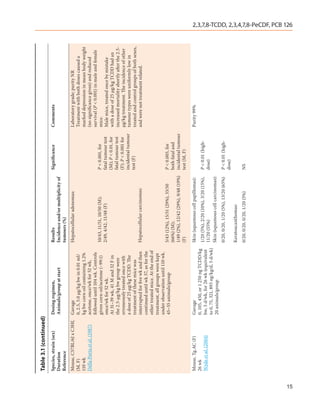
     Table 3.1 (continued)
     Species, strain (sex)   Dosing regimen,          Results                              Significance           Comments
     Duration                Animals/group at start   Incidence and/or multiplicity of
     Reference                                        tumours (%)
     Mouse, B6C3F1 (M, F)                             Thyroid (follicular adenomas):
     104 wk
     NTP (1982a)
                                                      0/69, 3/48 (6%), 0/48, 0/49 (M);     P = 0.008 (trend
     Contd.
                                                                                           M)
                                                      0/69, 3/50 (6%), 1/47 (2%), 5/46     P = 0.009 (high-
                                                      (11%) (F)                            dose, F)
                                                                                                                             IARC MONOGRAPHS – 100F


                                                                                           P = 0.016 (trend, F)
                                                      Lung (alveolar/bronchiolar
                                                      adenomas):
                                                      7/71 (10%), 2/48 (4%), 4/48 (8%),    P = 0.006 (trend,
                                                      11/50 (22%) (M)                      M)
                                                      Lung (alveolar/bronchiolar
                                                      adenomas or carcinomas):
                                                      10/71 (14%), 2/48 (4%), 4/48 (8%),   P = 0.004 (trend,
                                                      13/50 (26%) (M)                      M)
                                                      Subcutaneous tissue
                                                      (fibrosarcomas):
                                                      1/74 (1%), 1/50 (2%), 1/48 (2%),     P = 0.032 (high-
                                                      5/47 (11%) (F)                       dose, F)
                                                                                           P = 0.007 (trend,
                                                                                           F)
                                                      Lymphoid tissue (histiocytic
                                                      lymphomas):
                                                      9/74 (12%), 4/50 (8%), 8/48 (17%),   P = 0.016 (high-
                                                      14/47 (30%) (F)                      dose, F)
                                                                                           P = 0.003 (trend,
                                                                                           F)
Table 3.1 (continued)
     Species, strain (sex)       Dosing regimen,                       Results                              Significance         Comments
     Duration                    Animals/group at start                Incidence and/or multiplicity of
     Reference                                                         tumours (%)
     Mouse, C57BL/6J x C3Hf,     Gavage                                Hepatocellular adenomas:                                  Laboratory grade; purity NR
     (M, F)                      0, 2.5, 5.0 µg/kg bw in 0.01 ml/                                                                Treatment with both doses caused a
     110 wk                      kg bw corn-oil containing 1.2%                                                                  marked depression in mean body weight
     Della Porta et al. (1987)   acetone, once/wk for 52 wk,                                                                     (no significance given) and reduced
                                 followed until 104 wk. Controls                                                                 survival (P < 0.001) in male and female
                                 given corn-oil/acetone (~99:1)        10/43, 11/51, 10/50 (M);             P < 0.001, for       mice.
                                 once/wk for 52 wk.                    2/49, 4/42, 11/48 (F)                fatal tumour test    Male mice, treated once by mistake
                                 At 31–39 wk, 41 M and 32 F in                                              (M); P < 0.01, for   with a dose of 25 µg/kg TCDD had an
                                 the 2.5-µg/kg bw group were                                                fatal tumour test    increased mortality shortly after the 2.5-
                                 erroneously treated once with                                              (F); P < 0.001 for   µg/kg treatment. The incidence of other
                                 a dose of 25 µg/kg TCDD. The                                               incidental tumour    tumour types were uniformly low in
                                 treatment of these mice was                                                test (F)             treated and control groups of both sexes,
                                 interrupted for five wk and then      Hepatocellular carcinomas:                                and were not treatment related.
                                 continued until wk 57, as for the
                                 other treated mice. At the end of
                                 treatment, all groups were kept
                                 under observation until 110 wk.
                                 45–55 animals/group                   5/43 (12%), 15/51 (29%), 33/50       P < 0.005, for
                                                                       (66%) (M);                           both fatal and
                                                                       1/49 (2%), 12/42 (29%), 9/48 (19%)   incidental tumour
                                                                       (F)                                  test (M, F)

     Mouse, Tg.AC (F)            Gavage                                Skin (squamous cell papillomas):                          Purity 99%
     26 wk                       0, 105, 450, or 1 250 ng TCDD/kg
                                                                       1/20 (5%), 2/20 (10%), 3/20 (15%),   P < 0.01 (high-
     Wyde et al. (2004)          bw, 5 d/wk, for 26 wk (equivalent
                                                                       11/20 (55%)                          dose)
                                 to 0, 75, 321, 893 ng/kg/d, 5 d/wk)
                                 20 animals/group                      Skin (squamous cell carcinomas):
                                                                       0/20, 0/20, 1/20 (5%), 13/20 (65%)   P < 0.01 (high-
                                                                                                            dose)
                                                                       Keratoacanthomas:
                                                                       0/20, 0/20, 0/20, 1/20 (5%)          NS
                                                                                                                                                                              2,3,7,8-TCDD, 2,3,4,7,8-PeCDF, PCB 126


15
16
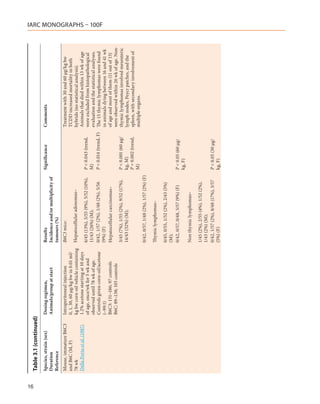
     Table 3.1 (continued)
     Species, strain (sex)       Dosing regimen,                     Results                                Significance           Comments
     Duration                    Animals/group at start              Incidence and/or multiplicity of
     Reference                                                       tumours (%)
     Mouse, immature B6C3        Intraperitoneal injection           B6C3 mice:                                                    Treatment with 30 and 60 µg/kg bw
     and B6C (M, F)              0, 1, 30, 60 µg/kg bw in 0.01 ml/                                                                 TCDD increased mortality in both
     78 wk                       kg bw corn-oil vehicle containing   Hepatocellular adenomas–                                      hybrids (no statistical analysis).
     Della Porta et al. (1987)   1.2% acetone starting at 10 days                                                                  Animals that died within 13 wk of age
                                 of age, once/wk for 5 wk and        6/45 (13%), 5/55 (9%), 5/52 (10%),     P < 0.043 (trend,      were excluded from histopathological
                                 observed until 78 wk of age.        11/43 (26%) (M);                       M)                     evaluation and the statistical analyses.
                                 Controls given corn-oil/acetone     0/42, 1/57 (2%), 1/48 (2%), 5/56       P < 0.014 (trend, F)   The 15 thymic lymphomas were found
                                                                                                                                                                              IARC MONOGRAPHS – 100F


                                 (~99:1)                             (9%) (F)                                                      in animals dying between 16 and 41 wk
                                 B6C3: 151–186; 97 controls          Hepatocellular carcinomas–                                    of age and most of them (11 out of 15)
                                 B6C: 89–138; 105 controls                                                                         were observed within 26 wk of age. Non-
                                                                     3/45 (7%), 1/55 (2%), 9/52 (17%),      P < 0.001 (60 µg/      thymic lymphomas involved mesenteric
                                                                     14/43 (32%) (M);                       kg, M)                 lymph nodes, Peycr patches, and the
                                                                                                            P = 0.002 (trend,      spleen, with secondary involvement of
                                                                                                            M)                     multiple organs.
                                                                     0/42, 0/57, 1/48 (2%), 1/57 (2%) (F)

                                                                     Thymic lymphomas–

                                                                     0/45, 0/55, 1/52 (2%), 2/43 (5%)
                                                                     (M);
                                                                     0/42, 0/57, 0/48, 5/57 (9%) (F)        P < 0.05 (60 µg/
                                                                                                            kg, F)
                                                                     Non thymic lymphomas–

                                                                     1/45 (2%), 2/55 (4%), 1/52 (2%),
                                                                     1/43 (2%) (M);
                                                                     0/42, 1/57 (2%), 8/48 (17%), 3/57      P < 0.05 (30 µg/
                                                                     (5%) (F)                               kg, F)
Table 3.1 (continued)
     Species, strain (sex)           Dosing regimen,                          Results                                  Significance            Comments
     Duration                        Animals/group at start                   Incidence and/or multiplicity of
     Reference                                                                tumours (%)
     Mouse, immature B6C3                                                     B6C mice:
     and B6C (M, F)
     78 wk                                                                    Hepatocellular adenomas–
     Della Porta et al. (1987)
     Contd.                                                                   1/32 (3%), 2/54 (4%), 1/27 (4%),         NS
                                                                              0/30 (M)
                                                                              Thymic lymphomas–

                                                                              0/32, 0/54, 2/27 (7%), 2/30 (7%)         P < 0.05 (trend,
                                                                              (M);                                     M, F)
                                                                              0/48, 0/57, 1/39 (3%), 2/38 (5%) (F)
                                                                              Non thymic lymphomas–

                                                                              0/32, 0/54, 1/27 (4%), 2/30 (7%)         P < 0.05 (trend,
                                                                              (M);                                     M, F)
                                                                              1/48 (2%), 3/57 (5%), 5/39 (13%),
                                                                              3/38 (8%) (F)
     bw, body weight; d, day or days; DMBA, 7,12-dimethylbenz[a]anthracene; F, female; M, male; NR, not reported; NS, not significant; vs, versus; wk, week or weeks; yr, year or years
                                                                                                                                                                                          2,3,7,8-TCDD, 2,3,4,7,8-PeCDF, PCB 126


17
18
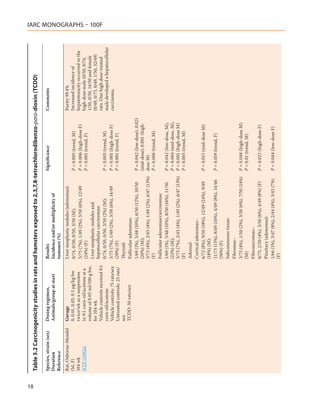
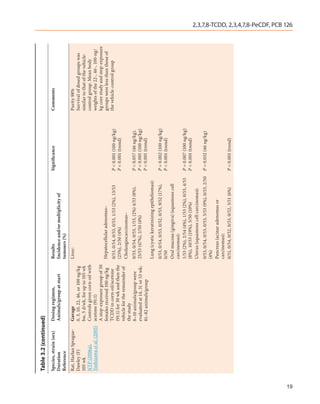
     Table 3.2 Carcinogenicity studies in rats and hamsters exposed to 2,3,7,8-tetrachlorodibenzo-para-dioxin (TCDD)

     Species, strain (sex)   Dosing regimen,                 Results                                       Significance                  Comments
     Duration                Animals/group at start          Incidence and/or multiplicity of
     Reference                                               tumours (%)
     Rat, Osborne-Mendel     Gavage                          Liver neoplastic nodules (adenomas):                                        Purity 99.4%
     (M, F)                  0, 0.01, 0.05, 0.5 µg/kg bw     0/74, 0/50, 0/50, 3/50 (M);                   P < 0.005 (trend, M)          Increased incidence of
     104 wk                  twice/wk as a suspension        5/75 (7%), 1/49 (2%), 3/50 (6%), 12/49        P = 0.006 (high-dose F)       hepatotoxicity occurred in the
     NTP (1982a)             in 9:1 corn-oil/acetone at a    (24%) (F)                                     P < 0.001 (trend, F)          high-dose male (0/50, 0/74,
                             volume of 0.05 ml/100 g bw,                                                                                 1/50, 0/50, 14/50 and female
                                                             Liver neoplastic nodules and
                             for 104 wk                                                                                                  (0/49, 0/75, 0/49, 1/50, 32/49)
                                                             hepatocellular carcinomas:
                                                                                                                                                                           IARC MONOGRAPHS – 100F


                             Vehicle controls received 9:1                                                                               rats. One high dose-treated
                             corn-oil/acetone                0/74, 0/50, 0/50, 3/50 (2%) (M);              P < 0.005 (trend, M)          male developed a hepatocellular
                             Vehicle controls: 75 rats/sex   5/75 (7%), 1/49 (2%), 3/50 (6%), 14/49        P = 0.001 (high-dose F)       carcinoma.
                             Untreated controls: 25 rats/    (29%) (F)                                     P < 0.001 (trend, F)
                             sex                             Thyroid:
                             TCDD: 50 rats/sex               Follicular adenomas:
                                                             1/69 (1%), 5/48 (10%), 6/50 (12%), 10/50      P = 0.042 (low-dose), 0.021
                                                             (20%) (M);                                    (mid-dose), 0.001 (high-
                                                             3/73 (4%), 2/45 (4%), 1/49 (2%), 6/47 (13%)   dose M)
                                                             (F)                                           P < 0.006 (trend, M)
                                                             Follicular adenomas/carcinomas:
                                                             1/69 (1%), 5/48 (10%), 8/50 (16%), 11/50      P = 0.042 (low-dose, M),
                                                             (22%) (M);                                    P = 0.004 (mid-dose, M),
                                                             5/73 (7%), 2/45 (4%), 1/49 (2%), 6/47 (13%)   P < 0.001 (high-dose M)
                                                             (F)                                           P < 0.005 (trend, M)
                                                             Adrenal:
                                                             Cortical adenomas–
                                                             6/72 (8%), 9/50 (18%), 12/49 (24%), 9/49      P = 0.015 (mid-dose M)
                                                             (18%) (M);
                                                             11/73 (15%), 8/49 (16%), 4/49 (8%), 14/46     P = 0.019 (trend, F)
                                                             (30%) (F)
                                                             Subcutaneous tissue:
                                                             Fibromas–
                                                             3/75 (4%), 1/50 (2%), 3/50 (6%), 7/50 (14%)   P = 0.048 (high-dose M)
                                                             (M)                                           P < 0.01 (trend, M)
                                                             Fibrosarcomas–
                                                             0/75, 2/50 (4%), 3/50 (6%), 4/49 (8%) (F)     P = 0.023 (high-dose F)
                                                             Pituitary (adenomas):
                                                             1/66 (1%), 5/47 (8%), 2/44 (4%), 3/43 (7%)    P = 0.044 (low-dose F)
                                                             (F)
Table 3.2 (continued)
     Species, strain (sex)     Dosing regimen,                  Results                                         Significance            Comments
     Duration                  Animals/group at start           Incidence and/or multiplicity of
     Reference                                                  tumours (%)
     Rat, Harlan Sprague-      Gavage                           Liver:                                                                  Purity 98%
     Dawley (F)                0, 3, 10, 22, 46, or 100 ng/kg                                                                           Survival of dosed groups was
     105 wk                    bw, 5 d/wk, for up to 105 wk                                                                             similar to that of the vehicle-
     NTP (2006a),              Controls given corn-oil with                                                                             control group. Mean body
     Yoshizawa et al. (2005)   acetone (91:1)                                                                                           weights of the 22-, 46-, 100-ng/
                               A stop-exposure group of 50                                                                              kg core study and stop-exposure
                               females received 100 ng/kg       Hepatocellular adenomas–                                                groups were less than those of
                               TCDD in corn-oil/acetone         0/53, 0/54, 0/53, 0/53, 1/53 (2%), 13/53        P < 0.001 (100 ng/kg)   the vehicle-control group
                               (91:1) for 30 wk and then the    (25%), 2/50 (4%)                                P < 0.001 (trend)
                               vehicle for the remainder of
                                                                Cholangiocarcinomas–
                               the study
                               8–10 animals/group were          0/53, 0/54, 0/53, 1/53, (2%) 4/53 (8%),         P < 0.057 (46 ng/kg).
                               evaluated at 14, 31 or 53 wk;    25/53 (47%), 2/50 (4%)                          P < 0.001 (100 ng/kg)
                               81–82 animals/group                                                              P < 0.001 (trend)
                                                                Lung (cystic keratinizing epitheliomas):
                                                                0/53, 0/54, 0/53, 0/52, 0/53, 9/52 (17%),       P = 0.002 (100 ng/kg)
                                                                0/50                                            P < 0.001 (trend)
                                                                Oral mucosa (gingiva) (squamous cell
                                                                carcinomas):
                                                                1/53 (2%), 2/54 (4%), 1/53 (2%), 0/53, 4/53     P = 0.007 (100 ng/kg)
                                                                (8%), 10/53 (19%), 5/50 (10%)                   P < 0.001 (trend)
                                                                Uterus (squamous cell carcinomas):
                                                                0/53, 0/54, 0/53, 0/53, 5/53 (9%), 0/53, 2/50   P = 0.032 (46 ng/kg)
                                                                (4%)
                                                                Pancreas (acinar adenomas or
                                                                carcinomas):
                                                                0/51, 0/54, 0/52, 0/53, 0/52, 3/51 (6%)         P < 0.001 (trend)
                                                                                                                                                                           2,3,7,8-TCDD, 2,3,4,7,8-PeCDF, PCB 126


19
20
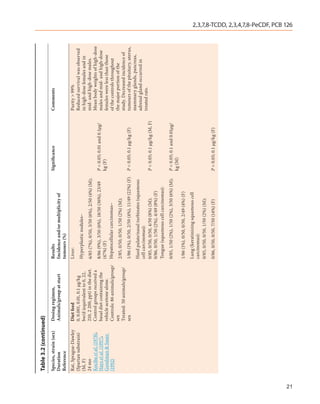
     Table 3.2 (continued)
     Species, strain (sex)   Dosing regimen,                  Results                                     Significance       Comments
     Duration                Animals/group at start           Incidence and/or multiplicity of
     Reference                                                tumours (%)
     Rats, Sprague-Dawley    Diet                             Total tumours:                                                 All animals given 50, 500
     (M)                     Rats were placed on diet         Diet (ppt)                                                     and 1 000 ppb died between
     95 wk                   containing 0, 1, 5, 50, 500                                                  a                  the second and fourth wk on
                                                              0/10, 0/10, 5/10 (50%)a, 3/10 (30%), 4/10       [P = 0.0325]
     Van Miller et al.       ppt or 1, 5, 50, 500, or 1 000   (40%)                                                          study. At the end of the study,
     (1977)                  ppb suspended in acetone                                                                        4/10, 8/10, 6/10, 6/10 and 5/10
                                                              Diet (ppb)
                             and dissolved in corn                                                                           rats were alive in the 0, 1, 5,
                                                              1 ppb–4/10 (40%)
                             oil, for 78 wk after which                                                                      50 and 500 ppt treated rats,
                                                                                                                                                                   IARC MONOGRAPHS – 100F


                                                                                                          b
                             feeding with basal diet was      5 ppb–7/10 (70%)b                               [P = 0.0031]   respectively. No animals were
                             continued. A control group                                                                      alive in the 1- and 5-ppb groups.
                             was maintained on the basal                                                                     Food intake in these groups was
                             diet. At 65 wk, laparotomies                                                                    significantly less than that of the
                             were performed on all            Neoplasms included                                             controls and the animals had
                             animals and biopsies taken       5 ppt: 1 ear duct carcinoma, 1                                 acute toxicity. Weight gain was
                             from all tumours observed.       lymphocytic leukaemia, 1 renal                                 significantly different from that
                             Surviving rats were              adenocarcinoma, 1 malignant                                    of the controls only in the 5-ppb
                             sacrificed at 95 wk.             histiocytoma (peritoneal), 1                                   group. Neoplasms of the liver
                             10 animals/group                 angiosarcoma (skin), 1 Leydig-cell                             occurred only in animals fed 1
                                                              adenoma (testes)                                               or 5 ppb TCDD.
                                                              50 ppt: 1 fibrosarcoma (muscle),
                                                              1 squamous cell tumour (skin), 1
                                                              astrocytoma (brain)

                                                              500 ppt: 1 fibroma (striated muscle), 1
                                                              carcinoma (skin), 1 adenocarcinoma
                                                              (kidney), 1 sclerosing seminoma (testes)

                                                              1 ppb–1 cholangiocarcinoma, 1
                                                              angiosarcoma (skin), 1 glioblastoma
                                                              (brain), 2 malignant histiocytomas
                                                              (peritoneal)
                                                              5 ppb–4 squamous cell tumours
                                                              (lung), 4 neoplastic nodules (liver), 2
                                                              cholangiocarcinomas
Table 3.2 (continued)
     Species, strain (sex)   Dosing regimen,                 Results                                       Significance                 Comments
     Duration                Animals/group at start          Incidence and/or multiplicity of
     Reference                                               tumours (%)
     Rat, Sprague-Dawley     Diet feed                       Liver:                                                                     Purity > 99%
     (Spartan substrain)     0, 0.001, 0.01, 0.1 µg/kg                                                                                  Reduced survivaI was observed
                                                             Hyperplastic nodules–
     (M, F)                  bw/d (equivalent to 0, 22,                                                                                 in high-dose females and in
     24 mo                   210, 2 200, ppt) in the diet.   6/85 (7%), 0/50, 3/50 (6%), 2/50 (4%) (M);                                 mid- and high-dose males.
     Kociba et al. (1978),   Control groups received a                                                                                  Mean body weights of high-dose
     Hays et al. (1997),     basal diet containing the       8/86 (9%), 3/50 (6%), 18/50 (36%), 23/49      P < 0.05; 0.01 and 0.1µg/    males and mid- and high-dose
     Goodman & Sauer         vehicle acetone alone.          (47%) (F)                                     kg (F)                       femaIes were less than those
     (1992)                  Controls: 86 animals/group/     Hepatocellular carcinomas–                                                 of the controls throughout
                             sex                             2/85, 0/50, 0/50, 1/50 (2%) (M);                                           the major portion of the
                             Treated: 50 animals/group/                                                                                 study. Decreased incidence of
                             sex                             1/86 (1%), 0/50, 2/50 (4%), 11/49 (22%) (F)   P < 0.05; 0.1 µg/kg (F)      tumours of the pituitary, uterus,
                                                                                                                                        mammary glands, pancreas,
                                                             Hard palate/nasal turbinates (squamous
                                                                                                                                        adrenal gland occurred in
                                                             cell carcinomas):
                                                                                                                                        treated rats.
                                                             0/85, 0/50, 0/50, 4/50 (8%) (M);              P < 0.05; 0.1 µg/kg (M, F)
                                                             0/86, 0/50, 1/50 (2%), 4/49 (8%) (F)
                                                             Tongue (squamous cell carcinomas):
                                                             0/85, 1/50 (2%), 1/50 (2%), 3/50 (6%) (M);    P < 0.05; 0.1 and 0.01µg/
                                                                                                           kg (M)
                                                             1/86 (1%), 0/50, 0/50, 2/49 (4%) (F)
                                                             Lung (keratinizing squamous cell
                                                             carcinomas):
                                                             0/85, 0/50, 0/50, 1/50 (2%) (M);
                                                             0/86, 0/50, 0/50, 7/50 (14%) (F)              P < 0.05; 0.1 µg/kg (F)
                                                                                                                                                                            2,3,7,8-TCDD, 2,3,4,7,8-PeCDF, PCB 126


21
22
     Table 3.2 (continued)
     Species, strain (sex)        Dosing regimen,                     Results                                           Significance                       Comments
     Duration                     Animals/group at start              Incidence and/or multiplicity of
     Reference                                                        tumours (%)
     Hamster, Syrian              Intraperitoneal injection           Skin (squamous-cell carcinomas):                                                     Purity NR
     Golden (M)                   0, 100 µg/kg bw TCDD in             Dioxane alone–0/12                                                                   6/24 animals injected with 100
     12–13 mo                     dioxane as 6 injections at 4                                                                                             µg/kg died before completion of
     Rao et al. (1988)            wk intervals (once every 4                                                                                               the 6-dose schedule of TCDD
                                  wk). An additional group                                                                                                 due to intestinal adhesions
                                  received 2 injections of 100        100 µg/kg TCDD, 6 doses–4/18 (21%)                [NS]                               along with obstruction and
                                  µg/kg TCDD. Controls                100 µg/kg TCDD, 2 doses–0/20                                                         peritonitis
                                                                                                                                                                                             IARC MONOGRAPHS – 100F


                                  received corresponding
                                  amounts of dioxane alone.
                                  12–24 animals/group
                                  Subcutaneous injection              Skin (squamous cell carcinomas):                                                     Purity NR
                                  0, 50 or 100 µg/kg bw TCDD          Dioxane alone–0/10                                                                   4/17 injected with 100 µg/
                                  in dioxane as 6 injections at                                                                                            kg died before completion of
                                  4-wk intervals (once every                                                                                               the 6-dose schedule of TCDD
                                  4 wk). Controls received                                                                                                 due to marked pulmonary and
                                  corresponding amounts of                                                                                                 hepatic congestion. Tumours
                                  dioxane alone.                      50 µg/kg TCDD–0/10                                [NS]                               were moderately differentiated
                                  10 or 17 animals/group              100 µg/kg TCDD–3/14 (21%)                                                            squamous-cell carcinomas that
                                                                                                                                                           developed exclusively in the
                                                                                                                                                           facial skin

     d, day or days; F, female; M, male; mo, month or months; NR, not reported; NS, not significant; ppb, part per billion; ppt, part per trillion; wk, week or weeks
Table 3.3 Studies on 2,3,7,8-tetrachlorodibenzo-para-dioxin (TCDD) administered with known carcinogens or modifying
     factors

     Species, strain (sex),     Known carcinogen            Route of       Interval            Dose and frequency                          Route of                Tumour
     duration, reference                                    administration                     (times per week/number of weeks)            administration          promotion
     Liver tumour
     promotion
     Han/Wistar rats (F)        30 mg/kg bw NDEA            i.p.                35 d           170 μg/kg bw TCDD/weekly/20 wk              s.c.                    +
     Duration (NR)              Starting 5 wk after PH                                         Purity > 99%
     Viluksela et al. (2000)
     Mammary gland
     tumour promotion
     SD rats (F)                30 mg/kg bw DMBA in         oral                N/A            1 μg/kg bw TCDD in sesame oil in            oral                    +
     Brown et al. (1998)        sesame oil (to 50-d-old                                        pregnant F on Day 15 p.c.
                                offspring)
     Ovarian tumour
     promotion
     SD rats (F)                175 mg/kg bw NDEA           i.p.                14 d           1.75 µg/kg bw TCDD in corn oil,             oral                    +
     Davis et al. (2000)        in saline                                                      twice/wk for 60 wk
                                175 mg/kg bw NDEA           i.p.                18 wk          1.75 µg/kg bw TCDD in corn oil,             oral                    +
                                in saline                                                      twice/wk for 30 wk followed by
                                                                                               vehicle for 16 wk
     bw, body weight; d, day or days; DMBA, 7,12-dimethylbenz[a]anthracene; F, female; i.p., intraperitoneal injection; M, male; mo, month or months; N/A, not applicable; NDEA,
     N-nitrosodiethylamine; NR, not reported; p.c., post-conception; PH, partial hepatectomy; s.c., subcutaneous injection; SD, Sprague-Dawley; wk, week or weeks
                                                                                                                                                                                   2,3,7,8-TCDD, 2,3,4,7,8-PeCDF, PCB 126


23
24
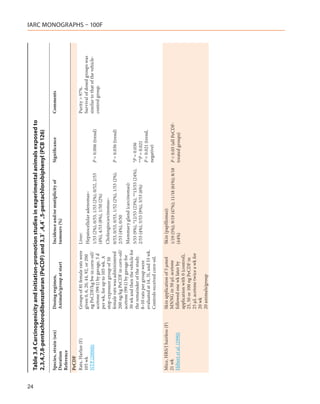
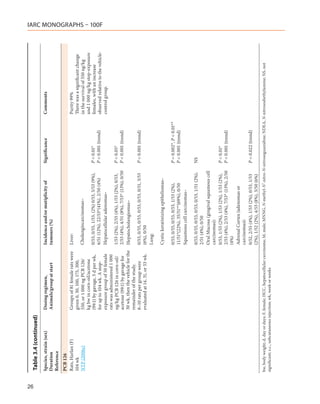
     Table 3.4 Carcinogenicity and initiation-promotion studies in experimental animals exposed to
     2,3,4,7,8-pentachlorodibenzofuran (PeCDF) and 3,3′,4,4′,5-pentachlorobiphenyl (PCB 126)

     Species, strain (sex)      Dosing regimen,                   Incidence and/or mutiplicity of            Significance           Comments
     Duration                   Animals/group at start            tumours (%)
     Reference
     PeCDF
     Rats, Harlan (F)           Groups of 81 female rats were     Liver:                                                            Purity > 97%.
     105 wk                     given 0, 6, 20, 44, 92, or 200    Hepatocellular adenomas–                                          Survival of dosed groups was
     NTP (2006b)                ng PeCDF/kg bw in corn-oil/                                                                         similar to that of the vehicle-
                                                                  1/53 (2%), 0/53, 1/53 (2%), 0/52, 2/53     P = 0.006 (trend)
                                acetone (99:1) by gavage, 5 d                                                                       control group.
                                                                                                                                                                      IARC MONOGRAPHS – 100F


                                                                  (4%), 4/53 (8%), 1/50 (2%)
                                per wk, for up to 105 wk. A
                                stop-exposure group of 50         Cholangiocarcinomas–
                                female rats was administered      0/53, 0/53, 0/53, 1/52 (2%), 1/53 (2%),    P = 0.036 (trend)
                                200 ng/kg PeCDF in corn-oil/      2/53 (4%), 0/50
                                acetone (99:1) by gavage for      Mammary gland (carcinomas):
                                30 wk and then the vehicle for
                                the remainder of the study.       5/53 (9%), *12/53 (23%), **13/53 (24%),    *P = 0.036
                                8–10 rats per group were          2/53 (4%), 5/53 (9%), 3/53 (6%)            **P = 0.021
                                evaluated at 14, 31, and 53 wk.                                              P = 0.021 (trend,
                                Controls received corn-oil.                                                  negative)

     Mice, HRS/J hairless (F)   Skin application of 5 µmol        Skin (papillomas):
     21 wk                      MNNG in 50 µL acetone             1/19 (5%); 9/19 (47%); 11/18 (61%); 8/18   P < 0.05 (all PeCDF-
     Hébert et al. (1990)       followed one wk later by          (44%)                                      treated groups)
                                application with 0 (control),
                                25, 50 or 100 ng PeCDF in
                                25 µL acetone twice a wk for
                                20 wk
                                20 animals/group
Table 3.4 (continued)
     Species, strain (sex)       Dosing regimen,                   Incidence and/or mutiplicity of              Significance           Comments
     Duration                    Animals/group at start            tumours (%)
     Reference
     Rats, Wistar (M)            50 mg/L NDEA in the               Liver hyperplastic nodules + HCC:                                   Purity > 99%.
     up to 24 wk                 drinking-water for 4 wk           16 wk                                                               Tumour incidence was not given.
     Nishizumi & Masuda (1986)   followed by weekly s.c.           high-dose, 3.3/rat; control, 0.3/rat         P < 0.05
                                 injections of olive oil
                                                                   20 wk
                                 (control), 10 or 100 µg
                                 PeCDF/kg bw until end of          high-dose, 3.3/rat; control, 0.5/rat         P < 0.05
                                 experimental wks 16, 20 or 24     24 wk
                                 12 animals/group                  low-dose, 17.0/rat; high-dose, 24.3/rat;     P < 0.05 (mid-dose);
                                                                   control, 3.0/rat                             P < 0.01 (high-dose)
                                                                   Liver tumours at 24 wk
                                                                   HCC:
                                                                   high-dose, 2.5/rat; control, 0.3/rat         P < 0.05
     Rats, Sprague-Dawley (F)    70% partial hepatectomy           Gamma-GT positive focal hepatic              P < 0.05 (mid-dose
     25 wk                       30 mg/kg bw NDEA by               lesions in the liver (as%): control, 0.15;   and high-dose)
     Waern et al. (1991)         intraperitioneal injection        low-dose, 0.25; mid-dose, 0.5; high-
                                 followed 5 wk later by 0          dose, 0.5
                                 (control), 0.16, 0.64 or 2.6 µg
                                 PeCDF/kg bw (weekly s.c.
                                 injections) for 20 wk
                                 10 animals/group
                                                                   Number/liver: control, 2000; low-dose, P < 0.05 (mid-dose
                                                                   2 500; mid-dose, 3 500; high-dose,     and high-dose)
                                                                   4 000
                                                                                                                                                                         2,3,7,8-TCDD, 2,3,4,7,8-PeCDF, PCB 126


25
26
     Table 3.4 (continued)
     Species, strain (sex)           Dosing regimen,                    Incidence and/or mutiplicity of            Significance              Comments
     Duration                        Animals/group at start             tumours (%)
     Reference
     PCB 126
     Rats, Harlan (F)                Groups of 81 female rats were      Liver:                                                               Purity 99%
     104 wk                          given 0, 30, 100, 175, 300,                                                                             There was a significant change
     NTP (2006c)                     550, or 1 000 ng PCB 126/          Cholangiocarcinomas–                                                 in the survival of 550 ng/kg
                                     kg bw in corn-oil/acetone                                                                               and 1 000 ng/kg stop-exposure
                                     (99:1) by gavage, 5 d per wk,      0/53, 0/55, 1/53, (2%) 0/53, 5/53 (9%),    P < 0.01*                 females, with an increase
                                                                        6/51 (12%), 22/53*(41%), 2/50 (4%)         P < 0.001 (trend)
                                                                                                                                                                                 IARC MONOGRAPHS – 100F


                                     for up to 104 wk. A stop-                                                                               observed relative to the vehicle-
                                     exposure group of 50 female        Hepatocellular adenomas–                                             control group.
                                     rats was administered 1 000
                                     ng/kg PCB 126 in corn-oil/         1/53 (2%), 2/55 (4%), 1/53 (2%), 0/53,     P < 0.05*
                                     acetone (99:1) by gavage for       2/53 (4%), 4/51 (8%), 7/53* (13%), 0/50    P < 0.001 (trend)
                                     30 wk, then the vehicle for the    Hepatocholangiomas–
                                     remainder of the study.
                                     8–10 rats per group were           0/53, 0/55, 0/53, 0/53, 0/53, 0/51, 3/53   P < 0.001 (trend)
                                     evaluated at 14, 31, or 53 wk.     (6%), 0/50
                                                                        Lung:

                                                                        Cystic keratinizing epitheliomas–

                                                                        0/53, 0/55, 0/53, 0/53, 1/53 (2%),         P = 0.002*, P < 0.01**
                                                                        11/51*(22%), 35/51**(69%), 0/50            P < 0.001 (trend)
                                                                        Squamous cell carcinomas–

                                                                        0/53, 0/55, 0/53, 0/53, 0/53, 1/51 (2%),   NS
                                                                        2/51 (4%), 0/50
                                                                        Oral Mucosa (gingival squamous cell
                                                                        carcinomas):
                                                                        0/53, 1/55 (2%), 1/53 (2%), 1/53 (2%),     P < 0.01*
                                                                        2/53 (4%), 2/53 (4%), 7/53* (13%), 2/50    P < 0.001 (trend)
                                                                        (4%)
                                                                        Adrenal Cortex (adenomas or
                                                                        carcinomas):
                                                                        0/52, 2/55 (4%), 1/53 (2%), 0/53, 1/53     P = 0.022 (trend)
                                                                        (2%), 1/52 (2%), 4/53 (8%), 3/50 (6%)
     bw, body weight; d, day or days; F, female; HCC, hepatocellular carcinoma; M, male; MNNG, N-methyl-N’-nitro-N-nitrosoguanidine; NDEA, N-nitrosodiethylamine; NS, not
     significant; s.c., subcutaneous injection; wk, week or weeks
2,3,7,8-TCDD, 2,3,4,7,8-PeCDF, PCB 126


various nitrosamines enhanced the incidence         epitheliomas, and oral mucosa (gingiva) squa-
of focal hepatic lesions. In one study, TCDD        mous-cell carcinomas in female rats (Walker
enhanced the incidence of lung carcinomas in        et al., 2005; NTP, 2006c).
ovariectomized female rats following admin-
istration of N-nitrosodiethylamine (NDEA)
(IARC, 1997). In two more recent studies in         4.	 Other Relevant Data
female rats, TCDD given orally or subcutane-
ously enhanced the carcinogenicity of previ-        4.1	AhR receptor activation
ously administered NDEA (Davis et al., 2000;
Viluksela et al., 2000). In another study, the          Most, if not all of the effects of TCDD are
oral administration of TCDD to pregnant rats        related to its binding to and activation of the
increased       7,12-dimethylbenz[a]anthracene-     aryl hydrocarbon receptor (AhR), a member of
induced mammary-gland tumours in offspring          the basic helix–loop–helix/Per-Arnt-Sim family
(Brown et al., 1998; see Table 3.3).                of transcription factors. This receptor was first
                                                    identified in mouse liver (Poland et al., 1976)
3.2	Dioxin-like compounds                           where it showed high affinity towards TCDD.
                                                    Further studies found that AhR is expressed in
3.2.1	2,3,4,7,8-Pentachlorodibenzofuran             most mammalian tissues and that many other
                                                    halogenated aromatic compounds can bind this
    Oral administration of 2,3,4,7,8-pentachlo-     receptor, including the coplanar polychlorinated
rodibenzofuran (PeCDF) resulted in significant      biphenyls and the polychlorinated dibenzodi-
dose-dependent trends for increased incidence       oxins and dibenzofurans. It is generally proposed
of cholangiocarcinomas and hepatocellular           that the toxic and carcinogenic effects of dioxin
adenomas (Walker et al., 2005; NTP, 2006b). (see    and other halogenated compounds are due to their
Table 3.4)                                          high affinity to AhR, and to the sustained pleio-
    Skin application of PeCDF after a single        tropic response from a battery of genes – many
dose of N-methyl-N′-nitro-N-nitrosoguanidine        of which encode drug-metabolizing enzymes –
resulted in an increased incidence of skin papil-   that follows the receptor-ligand complex forma-
lomas in mice (Hébert et al., 1990). Subcutaneous   tion (Mandal, 2005; Walker, 2007). Much of the
injections of PeCDF after oral treatment with       research in the three decades since the discovery
NDEA resulted in an increased multiplicity of       of the AhR has focused on dissecting this pleio-
hepatocellular carcinomas and liver hyperplastic    tropic response to fully understand the mecha-
nodules in male rats (Nishizumi & Masuda, 1986).    nisms involved in dioxin-mediated toxicity.
Subcutaneous injections of PeCDF after a single         The free AhR resides in the cytoplasm as
intraperitoneal injection of NDEA increased the     an inactive complex containing a heat-shock
number of focal hepatic lesions in female rats      protein dimer, Hsp90, XAP2 and p23 (Meyer
(Waern et al., 1991).                               et al., 1998). When the AhR binds to a ligand,
                                                    XAP2 is released and, through a conformational
3.2.2	3,3′,4,4′,5-Pentachlorobiphenyl               change, the complex is moved to the nucleus
   Oral administration of 3,3′,4,4′,5-pentachlo-    where the Hsp90 dimer dissociates and the
robiphenyl (PCB 126) resulted in significantly      AhR-nuclear-translocator (ARNT) binds to the
increased incidence of hepatocellular adenomas,     PAS domains of the receptor. The activated AhR/
cholangiocarcinomas, lung cystic keratinizing       ARNT complex forms a heterodimer that is then
                                                    capable of binding to the 5′-regulatory region

                                                                                                  27
IARC MONOGRAPHS – 100F


of dioxin-responsive genes (Mimura & Fujii-              mutations (Stohs et al., 1990; Tritscher et al.,
Kuriyama, 2003). The primary targets following           1996; Shertzer et al., 1998; Yoshida & Ogawa,
activation of AhR include genes encoding many            2000; Thornton et al., 2001; Nebert et al., 2004;
phase-I and phase-II metabolic enzymes (e.g.             Knerr et al., 2006; Schlezinger et al., 2006; Lin
CYP1A1, CYP1A2, CYP1B1, NQO1, UGT1A2,                    et al., 2007; Green et al., 2008). TCDD may also
GSTA1 and ALDH3A1) (Nebert et al., 2000;                 enhance – although it sometimes inhibits – the
Schwarz & Appel, 2005). However, through                 progression and invasiveness of initiated tumours
direct and indirect pathways, TCDD is able to            (Marlowe & Puga, 2005; Peng et al., 2009), but
alter the expressions of a much larger number of         this topic will not be discussed in detail here.
genes (Martinez et al., 2002; Dere et al., 2006;             The primary mechanism by which TCDD is
Pastorelli et al., 2006; Schwanekamp et al., 2006).      thought to cause cancer is by altering the cellular
In addition, there is cross-talk with several            ability to proliferate, migrate, apoptose, senesce
other receptor-mediated systems including the            and terminally differentiate (Safe, 2001; Marlowe
estrogen receptor (Safe & Wormke, 2003) and the          & Puga, 2005; Ray & Swanson, 2009) in a multi-
retinoic-acid receptor β (Lu et al., 1994; Berkers       step process focused on the accumulation of
et al., 1995; Toyoshiba et al., 2004).                   mutations and/or heritable epigenetic changes.
    Despite the strong conservation of the AhR           Chemicals that inhibit apoptosis and increase
across species, gene polymorphisms, differences          proliferation usually increase cancer risk as
in co-activators and differences in downstream           well. TCDD has been shown to increase cellular
signalling following activation are all likely to        proliferation both in vivo and in vitro in several
modulate TCDD carcinogenicity (Ema et al.,               tissues (Maronpot et al., 1993; Barrett, 1995; Dere
1994; Tuomisto et al., 1999). These factors could        et al., 2006) possibly through interactions with
explain the interindividual differences observed         protein-kinase C signalling (Barrett, 1995), inhi-
in the magnitude of the carcinogenic response            bition of senescence (Ray & Swanson, 2009) or
after exposure to TCDD. For example, different           activation of growth-signalling factors (Kohn,
AhR polymorphisms triggered a threefold differ-          1995). In initiation-promotion models, TCDD
ence in EROD activity in human lymphocytes               expanded the populations of preneoplastic
(Smart & Daly, 2000).                                    foci in rat liver (Dragan et al., 1992; Maronpot
                                                         et al., 1993; Tritscher et al., 1995) and promoted
                                                         carcinogenesis in liver, skin and lung in rodents
4.2	Mechanisms of carcinogenicity                        (DiGiovanni et al., 1977; Hébert et al., 1990;
     TCDD is not directly genotoxic and the              Lucier et al., 1991; Dragan et al., 1992; Beebe
tumorigenic activity is likely to be due to a fairly     et al., 1995; Tritscher et al., 1995; Tritscher et al.,
long half-life, especially in humans, resulting in       2000).
a sustained activation of the AhR. TCDD half-                Finally, TCDD may upregulate drug-metab-
life in the human body is estimated at 7.2 years         olizing enzymes, thus increasing the presence of
(Milbrath et al., 2009); long half-life in the envi-     highly reactive intermediates that form during
ronment and the ability to bio-accumulate in the         metabolic activation and/or transformation of
food-chain are also reported (IARC, 1997). The           several key hormones. For example, CYP1A1,
sustained downstream signalling may trigger an           CYP1A2 and CYP1B1 induction is a major
adaptive biochemical and physiological response          source of reactive oxygen species (ROS) forma-
in the cell that can promote carcinogenesis              tion in hepatocytes and this has been linked to
(Biegel & Safe, 1990; Lu et al., 1994; Berkers et al.,   the decoupling of the P450 catalytic cycle (Nebert
1995; Schwarz & Appel, 2005), also by inducing           et al., 2004; Knerr et al., 2006; Schlezinger et al.,

28
2,3,7,8-TCDD, 2,3,4,7,8-PeCDF, PCB 126


2006; Green et al., 2008). A hormonal linkage         DLCs (DLC-28) listed in Table 4.2 that produce
with estrogen has been demonstrated through           a TCDD-like response in human cell lines (Endo
the increase in 8-oxo-deoxyguanosine (a marker        et al., 2003), in animal and primary human cells,
of oxidative stress) in the liver of intact female    and in animal and human tissue (Vezina et al.,
rats compared with rats that are ovariectomized       2004; Silkworth et al., 2005; Kopec et al., 2008;
before exposure to TCDD (Tritscher et al., 1996).     N’Jai et al., 2008).
TCDD may induce prolonged oxidative stress,               DLCs co-occur in virtually every environ-
and consequent DNA damage and mutations,              mental compartment where they are found, and
also in several other strains of rats and mice,       assessment of their potential effect on human risk
and in cell lines (Stohs et al., 1990; Shertzer       can be complicated. Public health authorities (in
et al., 1998; Yoshida & Ogawa, 2000; Thornton         particular WHO expert panels) have developed
et al., 2001; Wyde et al., 2001; Lin et al., 2007).   the toxicity equivalence factor (TEF) method-
TCDD is a complete carcinogen in mice and rats        ology for measuring the potency of DLCs, with
in multiple strains (IARC, 1997; NTP, 2006a); see     TCDD as the index chemical. Exposures are
Section 3).                                           calculated as a simple weighted sum of the indi-
    TCDD thus may both promote and initiate           vidual amounts multiplied by their individual
carcinogenesis through indirect oxidative stress,     TEFs to yield the equivalent dose in units of
leading some to refer to dioxin as an activator of    TCDD exposure. Only the compounds of the
carcinogenesis and to adopt initiation-promotion      DLC-28 series have TEF values > 0 (Table 4.2),
models to better explain the toxicity of TCDD         all of the remaining congeners have TEF = 0.
and better fit pre-neoplastic and neoplastic              WHO recently evaluated TEFs (Van den
data (Portier & Kohn, 1996; Portier et al., 1996;     Berg et al., 2006) thus reviewing much of the
Luebeck et al., 2000).                                literature on DLCs (Haws et al., 2006), namely
                                                      189 studies with over 1000 targets used for anal-
                                                      ysis. For every compound, there is at least one
4.3	Dioxin-like compounds                             in vitro study showing AhR binding and one
    As noted above, the carcinogenicity of            showing 7-ethoxyresorufin-O-dethylase activity,
TCDD is tied to a sustained, pleiotropic              which is associated with an increase in CYP1A1
response following exposure to dioxin. The 17         activity. Congeners 1,2,3,7,8-PeCDD, 2,3,7,8-
laterally-substituted (2,3,7,8-substituted) poly-     TCDF, 2,3,4,7,8-PeCDF, and PCB-77, -126, and
chlorinated dibenzodioxins (PCDD-Ls), the             -169 have a very broad spectrum of information
coplanar polychlorinated biphenyls (CP-PCBs)          both in animal and in human cells, demon-
and the 17 laterally-substituted polychlorinated      strating activity consistent with the mechanisms
dibenzofurans (PCDF-Ls) are all structurally          described earlier. In addition, for PCB-81 there
and toxicologically inter-related halogenated         are nine studies in human cell lines showing the
aromatic hydrocarbons referred to as dioxin-          same alterations in gene expression and enzyme
like compounds (DLCs). They potentially induce        activity as reported for TCDD.
pleiotropic responses in cells very similar to            Congeners                 1,2,3,7,8-pentaCDD,
those induced by TCDD (IARC, 1978, 1987, 1997;        1,2,3,4,6,7,8-heptaCDD, a mixture of 1,2,3,6,7,8-
Vezina et al., 2004) as they are all able to bind     and 1,2,3,7,8,9-hexaCDD, and a mixture of
to the AhR. Binding affinity is different among       PCDDs have been studied in two-stage experi-
DLCs, with some of them having so little binding      mental models (IARC, 1978) and shown to
affinity that there is almost no information on       enhance the carcinogenic potential of known
their biological impact. We focus here on the 28      carcinogens just like TCDD. There are some

                                                                                                     29
IARC MONOGRAPHS – 100F


Table 4.2 Toxicity Equivalence Factors (TEFs) and half-lives of the dioxin-like compounds

Congener                                                         TEFa                     Half-Lifeb (years)
1,2,3,7,8-PeCDD                                                  1                        11.2
1,2,3,4,7,8-HxCDD                                                0.1                      9.8
1,2,3,6,7,8-HxCDD                                                0.1                      13.1
1,2,3,7,8,9-HxCDD                                                0.1                      5.1
1,2,3,4,6,7,8-HpCDD                                              0.01                     4.9
OCDD                                                             0.0003                   6.7
2,3,7,8-TCDF                                                     0.1                      2.1
1,2,3,7,8-PeCDF                                                  0.03                     3.5
2,3,4,7,8-PeCDF                                                  0.3                      7.0
1,2,3,4,7,8-HxCDF                                                0.1                      6.4
1,2,3,6,7,8-HxCDF                                                0.1                      7.2
1,2,3,7,8,9-HxCDF                                                0.1                      7.2
2,3,4,6,7,8-HxCDF                                                0.1                      2.8
1,2,3,4,6,7,8-HpCDF                                              0.01                     3.1
1,2,3,4,7,8,9-HpCDF                                              0.01                     4.6
OCDF                                                             0.0003                   1.4
PCB 77                                                           0.0001                   0.1
PCB 81                                                           0.0003                   0.7
PCB 126                                                          0.1                      1.6
PCB 169                                                          0.03                     7.3
PCB 105                                                          0.00003                  2.4
PCB 114                                                          0.00003                  10.0
PCB 118                                                          0.00003                  3.8
PCB 123                                                          0.00003                  7.4
PCB 156                                                          0.00003                  16.0
PCB 157                                                          0.00003                  18.0
PCB 167                                                          0.00003                  12.0
PCB 189                                                          0.00003                  22.0
a
    	 Toxicity equivalence factors fromVan den Berg et al. (2006)
b
    	 Half-life of congeners in humans based onMilbrath et al. (2009)


human studies on the compounds in the DLC-28                               squamous cell carcinomas, and an equivocal
series, but they have either poor exposure char-                           finding of lung cystic keratonizing epitheliomas).
acterization or also contain TCDD, making                                  When compared for potency, the result from this
it difficult to interpret their individual effects                         study agreed with the TEF concept (Walker et al.,
(IARC, 1978).                                                              2005). 2,3,4,7,8-PeCDF and 1,2,3,4,7,8-HxCDF
    While the carcinogenicity of TCDD has been                             were also enhanced tumorigenesis in two-stage
clearly established in rodents, for the remaining                          studies of cancer (IARC, 1997). Follow-up of
compounds in the DLC-28 series bioassays on                                populations in Taiwan, China (Tsai et al., 2007)
two-year chronic exposure are lacking. A two-                              and Japan (Onozuka et al., 2009) accidentally
year chronic study on 2,3,4,7,8-PeCDF in rodents                           exposed to rice-oil containing PCDFs and PCBs,
(NTP, 2006b) demonstrated tumour effects                                   shows a significantly increased risk of mortality
consistent with those seen for TCDD (hepatocel-                            from chronic liver disease in men and a non-
lular adenomas, cholangiocarcinomas, gingival                              significant increase from liver cancer in men


30
2,3,7,8-TCDD, 2,3,4,7,8-PeCDF, PCB 126


and women in Taiwan, China while in Japan              (human and non-human cell lines) and in vivo
all cancer mortality, and liver and lung cancer-       in experimental animals (IARC, 1997; Safe,
mortalities were increased in men.                     2001; Vezina et al., 2004; Haws et al., 2006), to
    The carcinogenicity of mixtures of PCBs in         trigger changes in growth factors and signal-
rodents has also been clearly established through      ling pathways related to cellular replication in
studies of various Aroclors (IARC, 1978; Mayes         rodents (Hemming et al., 1995; Vondrácek et al.,
et al., 1998; NTP, 2006c) yielding predominantly       2005; N’Jai et al., 2008). 2,3,4,7,8-PeCDF poten-
liver cancers (Cogliano, 1998). Two-year chronic       tial effect on cell replication is suggested in the
exposure studies done by the US National               NTP study (Walker et al., 2007), and promo-
Toxicology Program (NTP) on PCB 126 (NTP,              tion in skin, liver and lung tissues is reported in
2006d) and PCB 118 (NTP, 2009), demonstrated           initiation-promotion studies (Hébert et al., 1990;
tumour effects consistent with those seen for          Anderson et al., 1991; Waern et al., 1991). PCB
TCDD (hepatocellular adenomas, cholangiocar-           126 acts as a promoter of liver cancer in initia-
cinomas, gingival squamous cell carcinomas,            tion-promotion studies (Hemming et al., 1995;
and lung cystic keratonizing epitheliomas).            Haag-Grönlund et al., 1998) with measured
Moreover, when equivalent TCDD doses where             increases in cell-replication rate in the popula-
applied with the current TEF, a carcinogenic           tions of initiated cells (Vondrácek et al., 2005).
response equivalent to that predicted for TCDD         PCB 126 and 2,3,4,7,8-PeCDF induce oxidative
from the NTP study (Walker et al., 2005) was           stress, the latter in a dose-dependent manner
observed.                                              in brain and liver of rats (Hassoun et al., 2002;
    The set of DLC-28 (IARC, 1978, 1997;               Hennig et al., 2002). These two compounds are
Milbrath et al., 2009) have a long half-life similar   carcinogenic in mixtures with TCDD (IARC,
to that of TCDD (estimated at 7.2  years in the        1978; Hassoun et al., 2001; NTP, 2006d) and by
human body) (Table 4.2). Many congeners have           themselves in the NTP chronic bioassays in rats,
similar or longer half-lives (1,2,3,7,8-PeCDD,         where they increase hepatocellular adenomas,
1,2,3,4,7,8- and 1,2,3,6,7,8-HxCDD, 1,2,3,6,7,8-       cholangiocarcinomas, gingival squamous-cell
and 1.2.3.7.8.9-HxCDF, and PCBs 169, 114, 123,         carcinomas, and, possibly, lung cystic kera-
156, 167 and 189) while most of the remaining          tonizing epitheliomas (NTP, 2006b, c, d).
are in excess of 1.4 years. Several authors report
presence of these compounds in human blood in
the general population (Costopoulou et al., 2006;
                                                       4.4	Synthesis
Scott et al., 2008; Zubero et al., 2009) indicating         The receptor-mediated mechanism of action
a sustained, long-term exposure that, when             for TCDD-associated carcinogenesis in humans
coupled with the analyses for common pleio-            is strongly suggested as the mechanism of action
tropic response, argues in favour of the notion        that would result in 2,3,4,7,8-PeCDF and PCB
that all of the DLC-28s have the same carcino-         126 causing cancer in humans. The primary
genic potential in humans.                             mechanism is the promotion of carcinogenesis
    Experimental data on mechanism of carcino-         through the activation of cellular replication and
genesis induced by DLC-28 are available for            the alteration in cellular senescence and apop-
2,3,4,7,8-PeCDF and PCB 126, in particular             tosis through the aryl-hydrocarbon receptor
(Table  4.1), Both have been shown to bind to          (AhR). These congeners, through activation
the AhR in humans and animals (IARC, 1978;             of an array of metabolic enzymes, increase the
Safe, 2001), to translocate into the nucleus and       risk for oxidative stress as an indirect initiator
activate numerous metabolic enzymes in vitro           of carcinogenesis, which makes these congeners

                                                                                                       31
IARC MONOGRAPHS – 100F


Table 4.1 Experimental evidence on the mechanisms of carcinogenesis for TCDD and the dioxin-
like compounds 2,3,4,7,8-PeCDF and PCB 126 (positive, non-determined, and indirect)

Response                                                                      TCDD              2,3,4,7,8-PeCDF   PCB 126
Binding to AhR – human and non-human                                          +                 +                 +
CYP1A1 &1A2 activation – human and non-human cells                            +                 +                 +
CYP1A1 &1A2 activation – in vivo                                              +                 +                 +
Multiple other phase 1 and 2 enzymes – human and non-                         +                 +                 +
human cells
Multiple other phase 1 and 2 enzymes – in vivo                                +                 +                 +
Increased replication – human cells                                           +                 Non-determined    Non-determined
Increased replication – non-human cells                                       +                 Non-determined    +
Increased replication – in vivo                                               +                 Indirecta         +
Other cellular function – human and non-human cells                           +                 +                 +
Other cellular function – in vivo                                             +                 +                 +
Oxidative stress biomarker – in vivo or in vitro                              +                 +                 +
Pre-neoplastic lesions – in vivo                                              +                 +                 +
Promoter studies – in vivo                                                    +                 +                 +
Four specific tumours in female sprague-dawley rats                           +                 +                 +
Other species/strains complete carcinogen                                     +                 Non-determined    Non-determinedb
a
    	 Gene expression changes associated with cellular replication and metaplasia in rat lung
b
    	 PCB mixtures, including PCB 126 are positive in rodent studies


complete carcinogens. The conservation of the                                activation of cell replication, alterations in
AhR and the related signalling pathways across                               cellular senescence and apoptosis, and increases
species strongly support this mechanism of                                   in oxidative stress.
action in humans.                                                                There is strong evidence to support a receptor-
    There is compelling evidence that the                                    mediated mechanism of action for TCDD-
mechanism of action for TCDD-associated                                      associated carcinogenesis in humans where the
carcinogenesis in humans operates as the mech-                               primary mechanism is the promotion of tumour
anism of action for carcinogenesis in humans                                 development through the activation of cellular
for     1,2,3,7,8-PeCDD,      1,2,3,4,7,8-HxCDD,                             replication and the alteration in cellular senes-
1,2,3,6,7,8-HxCDD,            1,2,3,7,8,9-HxCDD,                             cence and apoptosis. Dioxin, through activation
1,2,3,4,6,7,8-HpCDD, OCDD, 2,3,7,8-TCDF,                                     of an array of metabolic enzymes also increases
1,2,3,7,8-PeCDF, 1,2,3,4,7,8-HxCDF, 1,2,3,6,7,8-                             the risk for oxidative stress, which serves as an
HxCDF, 1,2,3,7,8,9-HxCDF, 2,3,4,6,7,8-HxCDF,                                 indirect initiator of carcinogenesis. These events
1,2,3,4,6,7,8-HpCDF,         1,2,3,4,7,8,9-HpCDF,                            make dioxin a complete carcinogen. The conser-
OCDF and PCBs 77, 81, 105, 114, 118, 123, 156,                               vation of the AhR and the related signalling
157, 167, 169, and 189. These compounds all bind                             pathways across species strongly support this
to the AhR in human cells and demonstrate                                    mechanism in humans.
changes in gene expression consistent with those
seen for TCDD, 2,3,4,7,8-PeCDF and PCB 126.
Where examined, data have been collected for
these compounds supporting some, but not all,
aspects of the mechanisms outlined for TCDD,
2,3,4,7,8-PeCDF and PCB 126 that relate to

32
2,3,7,8-TCDD, 2,3,4,7,8-PeCDF, PCB 126


5.	Evaluation                                             There is strong evidence to support
                                                      a      receptor-mediated       mechanism      for
    There is sufficient evidence in humans for        2,3,4,7,8-pentachlorodibenzofuran-           and
the carcinogenicity of 2,3,7,8-tetrachlorod-          3,3′ ,4,4′ ,5-pentachlorobiphenyl-associated
ibenzo-para-dioxin. The strongest evidence in         carcinogenesis in humans based upon evidence
humans for the carcinogenicity of 2,3,7,8-tetra-      of carcinogenicity in experimental animals
chlorodibenzo-para-dioxin is for all cancers          and upon extensive evidence showing activity
combined.                                             identical to 2,3,7,8-tetrachlorodibenzo-para-
    There is limited evidence in humans for a         dioxin (TCDD) for every step of the mechanism
causal association of 2,3,7,8-tetrachlorodibenzo-     described for TCDD-associated carcinogenesis
para-dioxin with soft-tissue sarcoma, non-            in humans including receptor binding, gene
Hodgkin lymphoma and cancer of the lung.              expression, protein-activity changes, cellular
    There is sufficient evidence in experi-           replication, oxidative stress, promotion in initi-
mental animals for the carcinogenicity of             ation-promotion studies and complete carcino-
2,3,7,8-tetrachlorodibenzo-para-dioxin.               genesis in laboratory animals.
    There is sufficient evidence in experi-
mental animals for the carcinogenicity of
2,3,4,7,8-pentachlorodibenzofuran.                    References
    There is sufficient evidence in experi-
mental animals for the carcinogenicity of             Anderson LM, Beebe LE, Fox SD et al. (1991). Promotion
                                                        of mouse lung tumors by bioaccumulated polychlo-
3,3′,4,4′,5-pentachlorobiphenyl.                        rinated aromatic hydrocarbons. Exp Lung Res, 17:
    There is strong evidence to support a receptor-     455–471. PMID:1904809
mediated mechanism that operates in humans            ATSDR (1998). Toxicological Profile for Chlorinated
                                                        Dibenzo-p-dioxins. Atlanta, GA, pp. 21.
for carcinogenesis associated with 2,3,7,8-tetra-     Aylward LL, Bodner KM, Collins JJ et al. (2010). TCDD
chlorodibenzo-para-dioxin, where the primary            exposure estimation for workers at a New Zealand
mechanism is the promotion of tumour devel-             2,4,5-T manufacturing facility based on serum
opment through modification of cell replication         sampling data. J Expo Sci Environ Epidemiol, 20:
                                                        417–426.
and apoptosis, with a secondary mechanism             Aylward LL & Hays SM (2002). Temporal trends in human
related to increases of oxidative stress causing        TCDD body burden: Decreases over three decades and
DNA damage. The conservation of the aryl                implications for exposure levels. J Expo Anal Environ
hydrocarbon receptor and the related signalling         Epidemiol, 12: 319–328. doi:10.1038/sj.jea.7500233
                                                      Baars AJ, Bakker MI, Baumann RA et  al. (2004).
pathways and responses across species, including        Dioxins, dioxin-like PCBs and non-dioxin-like PCBs
humans, add additional strength to the notion           in foodstuffs: occurrence and dietary intake in The
that this mechanism is active in humans.                Netherlands. Toxicol Lett, 151: 51–61. doi:10.1016/j.
                                                        toxlet.2004.01.028 PMID:15177640
    2,3,7,8-Tetrachlorodibenzo-para-dioxin is         Baccarelli A, Mocarelli P, Patterson DG Jr et  al. (2002).
carcinogenic to humans (Group 1).                       Immunologic effects of dioxin: new results from Seveso
    2,3,4,7,8-Pentachlorodibenzofuran is carci-         and comparison with other studies. Environ Health
nogenic to humans (Group 1).                            Perspect, 110: 1169–1173. PMID:12460794
                                                      Barrett JC (1995). Mechanisms for species differences
    3,3′,4,4′,5-Pentachlorobiphenyl is carcino-         in receptor-mediated carcinogenesis. Mutat Res, 333:
genic to humans (Group 1).                              189–202. PMID:8538627
    In making the second and third overall            Bates MN, Buckland SJ, Garrett N et al. (2004). Persistent
                                                        organochlorines in the serum of the non-occupation-
evaluations, the Working Group considered the           ally exposed New Zealand population. Chemosphere,
following mechanistic arguments:


                                                                                                             33
IARC MONOGRAPHS – 100F


   54: 1431–1443. doi:10.1016/j.chemosphere.2003.09.040       Charnley G & Kimbrough RD (2006). Overview of expo-
   PMID:14659945                                                sure, toxicity, and risks to children from current levels
Becher H, Flesch-Janys D, Kauppinen T et  al. (1996).           of 2,3,7,8-tetrachlorodibenzo-p-dioxin and related
   Cancer mortality in German male workers exposed to           compounds in the USA. Food Chem Toxicol, 44:
   phenoxy herbicides and dioxins. Cancer Causes Control,       601–615. doi:10.1016/j.fct.2005.08.004 PMID:16176855
   7: 312–321. doi:10.1007/BF00052936 PMID:8734824            Coggon D, Pannett B, Winter P (1991). Mortality and
Becher H, Steindorf K, Flesch-Janys D (1998). Quantitative      incidence of cancer at four factories making phenoxy
   cancer risk assessment for dioxins using an occupa-          herbicides. Br J Ind Med, 48: 173–178. PMID:2015208
   tional cohort. Environ Health Perspect, 106: Suppl         Cogliano VJ (1998). Assessing the cancer risk from
   2)663–670. doi:10.2307/3433817 PMID:9599714                  environmental PCBs. Environ Health Perspect, 106:
Beebe LE, Fornwald LW, Diwan BA et  al. (1995).                 317–323. PMID:9618347
   Promotion of N-nitrosodiethylamine-initiated hepato-       Collins JJ, Bodner K, Haidar S et al. (2008). Chlorinated
   cellular tumors and hepatoblastomas by 2,3,7,8-tetra-        dibenzo-p-dioxins, dibenzofurans, and biphenyl
   chlorodibenzo-p-dioxin or Aroclor 1254 in C57BL/6,           profiles of workers with trichlorophenol and
   DBA/2, and B6D2F1 mice. Cancer Res, 55: 4875–4880.           pentachlorophenol exposures. Chemosphere, 73:
   PMID:7585523                                                 S284–S289.        doi:10.1016/j.chemosphere.2007.12.034
Berkers JA, Hassing I, Spenkelink B et  al. (1995).             PMID:18442847
   Interactive effects of 2,3,7,8-tetrachlorodibenzo-p-       Collins JJ, Bodner KM, Wilken M et  al. (2007). Serum
   dioxin and retinoids on proliferation and differentia-       concentrations of chlorinated dibenzo-p-dioxins and
   tion in cultured human keratinocytes: quantification         dibenzofurans among former Michigan trichloroph-
   of cross-linked envelope formation. Arch Toxicol, 69:        enol and pentachlorophenol workers. J Expo Sci Environ
   368–378. PMID:7495374                                        Epidemiol, 17: 541–548. doi:10.1038/sj.jes.7500558
Bertazzi PA, Consonni D, Bachetti S et  al. (2001).             PMID:17426737
   Health effects of dioxin exposure: a 20-year mortality     Collins JJ, Budinsky RA, Burns CJ et  al. (2006). Serum
   study. Am J Epidemiol, 153: 1031–1044. doi:10.1093/          dioxin levels in former chlorophenol workers. J
   aje/153.11.1031 PMID:11390319                                Expo Sci Environ Epidemiol, 16: 76–84. doi:10.1038/
Biegel L & Safe S (1990). Effects of 2,3,7,8-tetrachlorod-      sj.jea.7500439 PMID:16015278
   ibenzo-p-dioxin (TCDD) on cell growth and the secre-       Collins JJ, Strauss ME, Levinskas GJ, Conner PR (1993).
   tion of the estrogen-induced 34-, 52- and 160-kDa            The mortality experience of workers exposed to
   proteins in human breast cancer cells. J Steroid Biochem     2,3,7,8-tetrachlorodibenzo-p-dioxin in a trichlo-
   Mol Biol, 37: 725–732. PMID:2278856                          rophenol process accident. Epidemiology, 4: 7–13.
Boers D, Portengen L, Bueno-de-Mesquita HB et  al.              PMID:8420584
   (2010). Cause-specific mortality of Dutch chloroph-        Cook RR, Bond GG, Olson RA et al. (1986). Evaluation
   enoxy herbicide manufacturing workers. Occup                 of the mortalty experience of workers exposed to the
   Environ Med, 67: 24–31. doi:10.1136/oem.2008.044222          chlorinated dioxins. Chemosphere, 15: 1769–1776.
   PMID:19736176                                                doi:10.1016/0045-6535(86)90466-2
Bond GG, McLaren EA, Lipps TE, Cook RR (1989).                Costopoulou D, Vassiliadou I, Papadopoulos A et al. (2006).
   Update of mortality among chemical workers with              Levels of dioxins, furans and PCBs in human serum
   potential exposure to the higher chlorinated dioxins.        and milk of people living in Greece. Chemosphere, 65:
   J Occup Med, 31: 121–123. PMID:2709162                       1462–1469. PMID:16765419
Brown NM, Manzolillo PA, Zhang J-X et  al. (1998).            Crump KS, Canady R, Kogevinas M (2003). Meta-analysis
   Prenatal TCDD and predisposition to mammary cancer           of dioxin cancer dose response for three occupa-
   in the rat. Carcinogenesis, 19: 1623–1629. doi:10.1093/      tional cohorts. Environ Health Perspect, 111: 681–687.
   carcin/19.9.1623 PMID:9771934                                PMID:12727594
Bueno de Mesquita HB, Doornbos G, Van der Kuip DAM            Davis BJ, McCurdy EA, Miller BD et al. (2000). Ovarian
   et al. (1993). Occupational exposure to phenoxy herbi-       tumors in rats induced by chronic 2,3,7,8-tetrachlorod-
   cides and chlorophenols and cancer mortality in The          ibenzo-p-dioxin treatment. Cancer Res, 60: 5414–5419.
   Netherlands. Am J Ind Med, 23: 289–300. doi:10.1002/         PMID:11034082
   ajim.4700230206 PMID:8427257                               Della Porta G, Dragani TA, Sozzi G (1987). Carcinogenic
Burns CJ, Collins JJ, Budinsky RA et al. (2008). Factors        effects of infantile and long-term 2,3,7,8-tetrachlorod-
   related to dioxin and furan body levels among Michigan       ibenzo-p-dioxin treatment in the mouse. Tumori, 73:
   workers. Environ Res, 106: 250–256. doi:10.1016/j.           99–107. PMID:3576718
   envres.2007.10.010 PMID:18054905                           Dere E, Boverhof DR, Burgoon LD, Zacharewski TR
Charnley G & Doull J (2005). Human exposure to dioxins          (2006). In vivo-in vitro toxicogenomic comparison of
   from food, 1999–2002. Food Chem Toxicol, 43: 671–679.        TCDD-elicited gene expression in Hepa1c1c7 mouse
   doi:10.1016/j.fct.2005.01.006 PMID:15778006

34
2,3,7,8-TCDD, 2,3,4,7,8-PeCDF, PCB 126


   hepatoma cells and C57BL/6 hepatic tissue. BMC                of dioxin-like polychlorinated biphenyls. Mutagenesis,
   Genomics, 7: 80 PMID:16611356                                 23: 457–463. PMID:18583386
DiGiovanni J, Viaje A, Berry DL et  al. (1977). Tumor-         Haag-Grönlund M, Johansson N, Fransson-Steen R et al.
   initiating ability of 2,3,7,8-tetrachlorodibenzo-p-           (1998). Interactive effects of three structurally different
   dioxin (TCDD) and Arochlor 1254 in the two-stage              polychlorinated biphenyls in a rat liver tumor promo-
   system of mouse skin carcinogenesis. Bull Environ             tion bioassay. Toxicol Appl Pharmacol, 152: 153–165.
   Contam Toxicol, 18: 552–557. PMID:412534                      PMID:9772211
Dragan YP, Xu XH, Goldsworthy TL et  al. (1992).               Hardell L & Sandström A (1979). Case-control study: soft-
   Characterization of the promotion of altered hepatic foci     tissue sarcomas and exposure to phenoxyacetic acids or
   by 2,3,7,8-tetrachlorodibenzo-p-dioxin in the female          chlorophenols. Br J Cancer, 39: 711–717. PMID:444410
   rat. Carcinogenesis, 13: 1389–1395. PMID:1354083            Hassoun EA, Li F, Abushaban A, Stohs SJ (2001).
Dwernychuk LW, Cau HD, Hatfield CT et  al. (2002).               Production of superoxide anion, lipid peroxidation and
   Dioxin reservoirs in southern Viet Nam – a legacy of          DNA damage in the hepatic and brain tissues of rats
   Agent Orange. Chemosphere, 47: 117–137. doi:10.1016/          after subchronic exposure to mixtures of TCDD and its
   S0045-6535(01)00300-9 PMID:11993628                           congeners. J Appl Toxicol, 21: 211–219. PMID:11404832
Ema M, Ohe N, Suzuki M et  al. (1994). Dioxin binding          Hassoun EA, Wang H, Abushaban A, Stohs SJ (2002).
   activities of polymorphic forms of mouse and human            Induction of oxidative stress in the tissues of rats after
   arylhydrocarbon receptors. J Biol Chem, 269: 27337–           chronic exposure to TCDD, 2,3,4,7,8-pentachlorod-
   27343. PMID:7961644                                           ibenzofuran, and 3,3′,4,4′,5-pentachlorobiphenyl. J
Endo F, Monsees TK, Akaza H et  al. (2003). Effects of           Toxicol Environ Health A, 65: 825–842. PMID:12079609
   single non-ortho, mono-ortho, and di-ortho chlorin-         Haws LC, Su SH, Harris M et al. (2006). Development of
   ated biphenyls on cell functions and proliferation of the     a refined database of mammalian relative potency esti-
   human prostatic carcinoma cell line, LNCaP. Reprod            mates for dioxin-like compounds. Toxicol Sci, 89: 4–30.
   Toxicol, 17: 229–236. PMID:12642156                           PMID:16120753
Fingerhut MA, Halperin WE, Marlow DA et  al. (1991).           Hays SM & Aylward LL (2003). Dioxin risks in perspec-
   Cancer mortality in workers exposed to 2,3,7,8-tetra-         tive: past, present, and future. Regul Toxicol Pharmacol,
   chlorodibenzo-p-dioxin. N Engl J Med, 324: 212–218.           37:     202–217.      doi:10.1016/S0273-2300(02)00044-2
   PMID:1985242                                                  PMID:12726754
Flesch-Janys D, Berger J, Gurn P et al. (1995). Exposure       Hays SM, Aylward LL, Karch NJ, Paustenbach DJ (1997).
   to polychlorinated dioxins and furans (PCDD/F)                The relative susceptibility of animals and humans to
   and mortality in a cohort of workers from a herbi-            the carcinogenic hazard posed by exposure to TCDD:
   cide-producing plant in Hamburg, Federal Republic             an analysis using standard and internal measures of
   of Germany. Am J Epidemiol, 142: 1165–1175.                   dose. Chemosphere, 34: 1507–1522. doi:10.1016/S0045-
   PMID:7485063                                                  6535(97)00447-5 PMID:9134683
Flesch-Janys D, Steindorf K, Gurn P, Becher H (1998).          Hébert CD, Harris MW, Elwell MR, Birnbaum LS
   Estimation of the cumulated exposure to polychlo-             (1990). Relative toxicity and tumor-promoting ability
   rinated dibenzo-p-dioxins/furans and standardized             of 2,3,7,8-tetrachlorodibenzo-p-dioxin (TCDD),
   mortality ratio analysis of cancer mortality by dose          2,3,4,7,8-pentachlorodibenzofuran         (PCDF),      and
   in an occupationally exposed cohort. Environ Health           1,2,3,4,7,8-hexachlorodibenzofuran (HCDF) in hair-
   Perspect, 106: Suppl 2655–662. doi:10.2307/3433816            less mice. Toxicology and Applied Pharmacology,
   PMID:9599713                                                  102: 362–377. doi:10.1016/0041-008X(90)90033-Q
Gies A, Neumeier G, Rappolder M, Konietzka R (2007).             PMID:2300974
   Risk assessment of dioxins and dioxin-like PCBs in food     Hemming H, Bager Y, Flodström S et  al. (1995). Liver
   – comments by the German Federal Environmental                tumour promoting activity of 3,4,5,3′,4′-pentachlo-
   Agency. Chemosphere, 67: S344–S349. doi:10.1016/j.            robiphenyl and its interaction with 2,3,7,8-tetrachlo-
   chemosphere.2006.05.128 PMID:17223171                         rodibenzo-p-dioxin. Eur J Pharmacol, 292: 241–249.
Goodman DG & Sauer RM (1992). Hepatotoxicity                     PMID:7796862
   and carcinogenicity in female Sprague-Dawley rats           Hennig B, Hammock BD, Slim R et al. (2002). PCB-induced
   treated with 2,3,7,8-tetrachlorodibenzo-p-dioxin              oxidative stress in endothelial cells: modulation by
   (TCDD): a pathology working group reevaluation.               nutrients. Int J Hyg Environ Health, 205: 95–102.
   Regulatory Toxicology and Pharmacology, 15: 245–252.          PMID:12018021
   doi:10.1016/0273-2300(92)90036-9 PMID:1509118               Hooiveld M, Heederik DJJ, Kogevinas M et  al. (1998).
Green RM, Hodges NJ, Chipman JK et al. (2008). Reactive          Second follow-up of a Dutch cohort occupation-
   oxygen species from the uncoupling of human cyto-             ally exposed to phenoxy herbicides, chlorophenols,
   chrome P450 1B1 may contribute to the carcinogenicity         and contaminants. Am J Epidemiol, 147: 891–901.
                                                                 PMID:9583720

                                                                                                                         35
IARC MONOGRAPHS – 100F


Huwe JK (2002). Dioxins in food: a modern agricul-              hepatic effects of PCB126 and TCDD in immature,
  tural perspective. J Agric Food Chem, 50: 1739–1750.          ovariectomized C57BL/6 mice. Toxicol Sci, 102: 61–75.
  doi:10.1021/jf011265f PMID:11902908                           PMID:18042819
IARC (1977). Some fumigants, the herbicides 2,4-D and        Kulkarni PS, Crespo JG, Afonso CAM (2008). Dioxins
  2,4,5-T, chlorinated dibenzodioxins and miscellaneous         sources and current remediation technologies –
  industrial chemicals. IARC Monogr Eval Carcinog Risk          a review. Environ Int, 34: 139–153. doi:10.1016/j.
  Chem Man, 15: 1–354. PMID:330387                              envint.2007.07.009 PMID:17826831
IARC (1978). Polychlorinated biphenyls and polybro-          LaKind JS, Hays SM, Aylward LL, Naiman DQ (2009).
  minated biphenyls. IARC Monogr Eval Carcinog Risk             Perspective on serum dioxin levels in the United States:
  Chem Hum, 18: 1–124. PMID:215509                              an evaluation of the NHANES data. J Expo Sci Environ
IARC (1987). Overall evaluations of carcinogenicity: an         Epidemiol, 19: 435–441. doi:10.1038/jes.2008.63
  updating of IARC Monographs volumes 1 to 42. IARC             PMID:18854873
  Monogr Eval Carcinog Risks Hum Suppl, 7: 1–440.            Larsen JC (2006). Risk assessments of polychlorin-
  PMID:3482203                                                  ated dibenzo-p-dioxins, polychlorinated dibenzo-
IARC (1997). Polychlorinated dibenzo-para-dioxins and           furans, and dioxin-like polychlorinated biphenyls in
  polychlorinated dibenzofurans. IARC Monogr Eval               food. Mol Nutr Food Res, 50: 885–896. doi:10.1002/
  Carcinog Risks Hum, 69: 1–631. PMID:9379504                   mnfr.200500247 PMID:17009211
Kahn PC, Gochfeld M, Nygren M et  al. (1988). Dioxins        Liem AK, Fürst P, Rappe C (2000). Exposure of popula-
  and dibenzofurans in blood and adipose tissue                 tions to dioxins and related compounds. Food Addit
  of Agent Orange-exposed Vietnam veterans and                  Contam, 17: 241–259. doi:10.1080/026520300283324
  matched controls. JAMA, 259: 1661–1667. doi:10.1001/          PMID:10912239
  jama.259.11.1661 PMID:3343772                              Lin PH, Lin CH, Huang CC et  al. (2007).
Ketchum NS, Aktar FZ (1996). The Air Force health               2,3,7,8-Tetrachlorodibenzo-p-dioxin (TCDD) induces
  study: an epidemiologie investigation of health effects       oxidative stress, DNA strand breaks, and poly(ADP-
  in air force personnel following exposure to herbicides,      ribose) polymerase-1 activation in human breast
  mortality update 1996. (Interim Technical Report AL/          carcinoma cell lines. Toxicol Lett, 172: 146–158.
  AO-TR-1996-0068). Brooks Air Force Base, Texas:               PMID:17669606
  Arstrong Laboratory                                        Lu Y, Wang X, Safe S (1994). Interaction of 2,3,7,8-tetra-
Ketchum NS, Michalek JE, Burton JE (1999). Serum dioxin         chlorodibenzo-p-dioxin and retinoic acid in MCF-7
  and cancer in veterans of Operation Ranch Hand. Am J          human breast cancer cells. Toxicol Appl Pharmacol,
  Epidemiol, 149: 630–639. PMID:10192310                        127: 1–8. PMID:8048042
Knerr S, Schaefer J, Both S et  al. (2006).                  Lucier GW, Tritscher A, Goldsworthy T et  al. (1991).
  2,3,7,8-Tetrachlorodibenzo-p-dioxin induced cyto-             Ovarian hormones enhance 2,3,7,8-tetrachlorod-
  chrome P450s alter the formation of reactive oxygen           ibenzo-p-dioxin-mediated increases in cell prolifera-
  species in liver cells. Mol Nutr Food Res, 50: 378–384.       tion and preneoplastic foci in a two-stage model for
  PMID:16534750                                                 rat hepatocarcinogenesis. Cancer Res, 51: 1391–1397.
Kociba RJ, Keyes DG, Beyer JE et  al. (1978). Results of        PMID:1671757
  a two-year chronic toxicity and oncogenicity study         Luebeck EG, Buchmann A, Stinchcombe S et al. (2000).
  of 2,3,7,8-tetrachlorodibenzo-p-dioxin in rats.               Effects of 2,3,7,8-tetrachlorodibenzo-p-dioxin on initi-
  Toxicology and Applied Pharmacology, 46: 279–303.             ation and promotion of GST-P-positive foci in rat liver:
  doi:10.1016/0041-008X(78)90075-3 PMID:734660                  A quantitative analysis of experimental data using a
Kogevinas M, Becher H, Benn T et  al. (1997). Cancer            stochastic model. Toxicol Appl Pharmacol, 167: 63–73.
  mortality in workers exposed to phenoxy herbicides,           PMID:10936080
  chlorophenols, and dioxins. An expanded and updated        Lynge E (1993). Cancer in phenoxy herbicide manufac-
  international cohort study. Am J Epidemiol, 145: 1061–        turing workers in Denmark, 1947–87–an update.
  1075. PMID:9199536                                            Cancer Causes Control, 4: 261–272. PMID:8318642
Kogevinas M, Kauppinen T, Winkelmann R et al. (1995).        Mandal PK (2005). Dioxin: a review of its environmental
  Soft tissue sarcoma and non-Hodgkin’s lymphoma                effects and its aryl hydrocarbon receptor biology. J
  in workers exposed to phenoxy herbicides, chloroph-           Comp Physiol B, 175: 221–230. doi:10.1007/s00360-005-
  enols, and dioxins: two nested case-control studies.          0483-3 PMID:15900503
  Epidemiology, 6: 396–402. PMID:7548348                     Manz A, Berger J, Dwyer JH et al. (1991). Cancer mortality
Kohn MC (1995). Biochemical mechanisms and cancer               among workers in chemical plant contaminated
  risk assessment models for dioxin. Toxicology, 102:           with dioxin. Lancet, 338: 959–964. doi:10.1016/0140-
  133–138. PMID:7482548                                         6736(91)91835-I PMID:1681339
Kopec AK, Boverhof DR, Burgoon LD et  al. (2008).
  Comparative toxicogenomic examination of the

36
2,3,7,8-TCDD, 2,3,4,7,8-PeCDF, PCB 126


Marlowe JL & Puga A (2005). Aryl hydrocarbon receptor,           battery in the oxidative stress response, cell cycle
  cell cycle regulation, toxicity, and tumorigenesis. J Cell     control, and apoptosis. Biochem Pharmacol, 59: 65–85.
  Biochem, 96: 1174–1184. PMID:16211578                          PMID:10605936
Maronpot RR, Foley JF, Takahashi K et al. (1993). Dose         NIOSH (1990). National Occupational Exposure Survey
  response for TCDD promotion of hepatocarcinogenesis            (1981-83). Cincinnati, OH: National Institute for
  in rats initiated with DEN: histologic, biochemical, and       Occupational Safety and Health. Available at http://
  cell proliferation endpoints. Environ Health Perspect,         www.cdc.gov/noes/noes3/empl0003.html
  101: 634–642. PMID:8143597                                   Nishizumi M & Masuda Y (1986). Enhancing
Martinez JM, Afshari CA, Bushel PR et  al. (2002).               effect of 2,3,4,7,8-pentachlorodibenzofuran and
  Differential toxicogenomic responses to 2,3,7,8-tetra-         1,2,3,4,7,8-hexachlorodibenzofuran on diethylnit-
  chlorodibenzo-p-dioxin in malignant and nonma-                 rosamine hepatocarcinogenesis in rats. Cancer Lett,
  lignant human airway epithelial cells. Toxicol Sci, 69:        33:      333–339.     doi:10.1016/0304-3835(86)90073-X
  409–423. PMID:12377990                                         PMID:3802062
Mayes BA, McConnell EE, Neal BH et  al. (1998).                NTP       (1982a).     Carcinogenesis       Bioassay    of
  Comparative carcinogenicity in Sprague-Dawley rats             2,3,7,8-Tetrachlorodibenzo-p-dioxin (CAS No. 1746–
  of the polychlorinated biphenyl mixtures Aroclors              01–6) in Osborne-Mendel Rats and B6C3F1 Mice
  1016, 1242, 1254, and 1260. Toxicol Sci, 41: 62–76.            (Gavage Study). Natl Toxicol Program Tech Rep Ser, 209:
  PMID:9520342                                                   1–195. PMID:12778226
McLean D, Eng A, Walls C et  al. (2009). Serum dioxin          NTP       (1982b).     Carcinogenesis       Bioassay    of
  levels in former New Zealand sawmill workers twenty            2,3,7,8-Tetrachlorodibenzo-p-dioxin         (CAS     No.
  years after exposure to pentachlorophenol (PCP)                1746–01–6) in Swiss-Webster Mice (Dermal Study).
  ceased. Chemosphere, 74: 962–967. doi:10.1016/j.chem-          Natl Toxicol Program Tech Rep Ser, 201: 1–113.
  osphere.2008.10.017 PMID:19036402                              PMID:12778178
Meyer BK, Pray-Grant MG, Vanden Heuvel JP, Perdew              NTP       (2004).     2,3,7,8-Tetrachlorodibenzo-p-dioxin
  GH (1998). Hepatitis B virus X-associated protein 2 is         (TDCC); “dioxin” Rep Carcinog, 11: 241–243.
  a subunit of the unliganded aryl hydrocarbon receptor          PMID:21089974.
  core complex and exhibits transcriptional enhancer           NTP (2006a). NTP technical report on the toxicology and
  activity. Mol Cell Biol, 18: 978–988. PMID:9447995             carcinogenesis studies of 2,3,7,8-tetrachlorodibenzo-p-
Michalek JE, Wolfe WH, Miner JC et al. (1995). Indices of        dioxin (TCDD) (CAS No. 1746–01–6) in female Harlan
  TCDD exposure and TCDD body burden in veterans of              Sprague-Dawley rats (Gavage Studies). Natl Toxicol
  Operation Ranch Hand. J Expo Anal Environ Epidemiol,           Program Tech Rep Ser, 521: 4–232. PMID:16835633
  5: 209–223. PMID:7492907                                     NTP (2006b). Toxicology and carcinogenesis studies of
Milbrath MO, Wenger Y, Chang CW et  al. (2009).                  2,3,4,7,8-pentachlorodibenzofuran (PeCDF) (Cas No.
  Apparent half-lives of dioxins, furans, and polychlorin-       57117–31–4) in female Harlan Sprague-Dawley rats
  ated biphenyls as a function of age, body fat, smoking         (gavage studies). Natl Toxicol Program Tech Rep Ser,
  status, and breast-feeding. Environ Health Perspect,           525: 1–198. PMID:17160103
  117: 417–425. PMID:19337517                                  NTP (2006c). NTP toxicology and carcinogenesis studies
Mimura J & Fujii-Kuriyama Y (2003). Functional role              of 3,3′,4,4′,5-pentachlorobiphenyl (PCB 126) (CAS No.
  of AhR in the expression of toxic effects by TCDD.             57465–28–8) in female Harlan Sprague-Dawley rats
  Biochim Biophys Acta, 1619: 263–268. PMID:12573486             (Gavage Studies). Natl Toxicol Program Tech Rep Ser,
N’Jai A, Boverhof DR, Dere E et al. (2008). Comparative          520: 4–246. PMID:16628245
  temporal toxicogenomic analysis of TCDD- and TCDF-           NTP (2006d). Toxicology and Carcinogenesis Studies
  mediated hepatic effects in immature female C57BL/6            of a Mixture of 2,3,7,8-Tetrachlorodibenzo-
  mice. Toxicol Sci, 103: 285–297. PMID:18343893                 p-Dioxin        (TCDD)       (Cas     No.     1746-01-6),
Nakatani T, Okazaki K, Ogaki S et  al. (2005).                   2,3,4,7,8-Pentachlorodibenzofuran (PeCDF) (Cas No.
  Polychlorinated dibenzo-p-dioxins, polychlorinated             57117-31-4), and 3,3’,4,4’,5-Pentachlorobiphenyl (PCB
  dibenzofurans, and coplanar polychlorinated biphe-             126) (Cas No. 57465-28-8) in Female Harlan Sprague-
  nyls in human milk in Osaka City, Japan. Arch Environ          Dawley Rats (gavage studies) National Toxicology
  Contam Toxicol, 49: 131–140. doi:10.1007/s00244-004-           Program Technical Report Series, 526: 1–180.
  0051-y PMID:15983863                                         NTP (2009). NTP toxicology and carcinogenesis studies
Nebert DW, Dalton TP, Okey AB, Gonzalez FJ (2004).               of 2,3’,4,4’,5-pentachlorobiphenyl (PCB 118) (CAS
  Role of aryl hydrocarbon receptor-mediated induction           No. 31508-00-6) in female Harlan Sprague-Dawley
  of the CYP1 enzymes in environmental toxicity and              rats (Gavage Studies) National Toxicology Program
  cancer. J Biol Chem, 279: 23847–23850. PMID:15028720           Technical Report Series, 5591-174
Nebert DW, Roe AL, Dieter MZ et  al. (2000). Role of           Olie K, Schecter A, Constable J et al. (1989). Chlorinated
  the aromatic hydrocarbon receptor and [Ah] gene                dioxin and dibenzofuran levels in food and wildlife

                                                                                                                       37
IARC MONOGRAPHS – 100F


  samples in the North and South of Vietnam. Chemosphere,          promoting event? Biochem Pharmacol, 77: 681–688.
  19: 493–496. doi:10.1016/0045-6535(89)90357-3                    PMID:19100242
Onozuka D, Yoshimura T, Kaneko S, Furue M (2009).               Ryan JJ & Schecter A (2000). Exposure of Russian phenoxy
  Mortality after exposure to polychlorinated biphenyls            herbicide producers to dioxins. J Occup Environ Med,
  and polychlorinated dibenzofurans: a 40-year follow-             42: 861–870. doi:10.1097/00043764-200009000-00003
  up study of Yusho patients. Am J Epidemiol, 169: 86–95.          PMID:10998761
  PMID:18974082                                                 Safe S (2001). Molecular biology of the Ah receptor
Ott MG, Messerer P, Zober A (1993). Assessment of past             and its role in carcinogenesis. Toxicol Lett, 120: 1–7.
  occupational exposure to 2,3,7,8-tetrachlorodibenzo-             PMID:11323156
  p-dioxin using blood lipid analyses. Int Arch Occup           Safe S & Wormke M (2003). Inhibitory aryl hydrocarbon
  Environ Health, 65: 1–8. doi:10.1007/BF00586050                  receptor-estrogen receptor alpha cross-talk and
  PMID:8354568                                                     mechanisms of action. Chem Res Toxicol, 16: 807–816.
Ott MG, Olson RA, Cook RR, Bond GG (1987). Cohort                  PMID:12870882
  mortality study of chemical workers with potential            Saracci R, Kogevinas M, Bertazzi PA et al. (1991). Cancer
  exposure to the higher chlorinated dioxins. J Occup              mortality in workers exposed to chlorophenoxy herbi-
  Med, 29: 422–429. PMID:2439670                                   cides and chlorophenols. Lancet, 338: 1027–1032.
Ott MG & Zober A (1996). Cause specific mortality and              doi:10.1016/0140-6736(91)91898-5 PMID:1681353
  cancer incidence among employees exposed to TCDD              Sasamoto T, Ushio F, Kikutani N et al. (2006). Estimation
  after a 1953 reactor accident. Occup Environ Med, 53:            of 1999–2004 dietary daily intake of PCDDs, PCDFs and
  606–612. doi:10.1136/oem.53.9.606 PMID:8882118                   dioxin-like PCBs by a total diet study in metropolitan
Parzefall W (2002). Risk assessment of dioxin contamina-           Tokyo, Japan. Chemosphere, 64: 634–641. doi:10.1016/j.
  tion in human food. Food Chem Toxicol, 40: 1185–1189.            chemosphere.2005.10.057 PMID:16376969
  doi:10.1016/S0278-6915(02)00059-5 PMID:12067582               Schecter A, Birnbaum L, Ryan JJ, Constable JD (2006).
Pastorelli R, Carpi D, Campagna R et al. (2006). Differential      Dioxins: an overview. Environ Res, 101: 419–428.
  expression profiling of the hepatic proteome in a rat            doi:10.1016/j.envres.2005.12.003 PMID:16445906
  model of dioxin resistance: correlation with genomic          Schecter A, Dai LC, Päpke O et al. (2001). Recent dioxin
  and transcriptomic analyses Molecular & Cellular                 contamination from Agent Orange in residents of
  Proteomics, 5 (5): 882–894.                                      a southern Vietnam city. J Occup Environ Med, 43:
Peng TL, Chen J, Mao W et al. (2009). Aryl hydrocarbon             435–443.       doi:10.1097/00043764-200105000-00002
  receptor pathway activation enhances gastric cancer              PMID:11382178
  cell invasiveness likely through a c-Jun-dependent            Schecter A, McGee H, Stanley J, Boggess K (1992). Dioxin,
  induction of matrix metalloproteinase-9. BMC Cell                dibenzofuran, and PCB including coplanar PCB levels
  Biol, 10: 27 PMID:19371443                                       in the blood of Vietnam veterans in the Michigan
Pesatori AC, Consonni D, Rubagotti M et  al. (2009).               Agent Orange Study. Chemosphere, 25: 205–208.
  Cancer incidence in the population exposed to dioxin             doi:10.1016/0045-6535(92)90514-R
  after the “Seveso accident”: twenty years of follow-          Schecter A, Pavuk M, Constable JD et  al. (2002). A
  up. Environ Health, 8: 39 doi:10.1186/1476-069X-8-39             follow-up: high level of dioxin contamination in
  PMID:19754930                                                    Vietnamese from agent orange, three decades
Poland A, Glover E, Kende AS (1976). Stereospecific, high          after the end of spraying. J Occup Environ Med, 44:
  affinity binding of 2,3,7,8-tetrachlorodibenzo-p-dioxin          218–220.       doi:10.1097/00043764-200203000-00003
  by hepatic cytosol. Evidence that the binding species is         PMID:11911020
  receptor for induction of aryl hydrocarbon hydroxy-           Schecter A, Quynh HT, Pavuk M et  al. (2003). Food
  lase. J Biol Chem, 251: 4936–4946. PMID:956169                   as a source of dioxin exposure in the residents of
Portier C & Kohn M (1996). A biologically-based model for          Bien Hoa City, Vietnam. J Occup Environ Med, 45:
  the carcinogenic effects of TCDD in female Sprague-              781–788.       doi:10.1097/01.jom.0000085786.50835.71
  Dawley rats. Organohalogen Compounds, 29:: 222–227.              PMID:12915779
Portier CJ, Sherman CD, Kohn M et al. (1996). Modeling          Schecter A, Ryan JJ, Constable JD et al. (1990). Partitioning
  the number and size of hepatic focal lesions following           of 2,3,7,8-chlorinated dibenzo-p-dioxins and dibenzo-
  exposure to TCDD. Toxicol Appl Pharmacol, 138:                   furans between adipose tissue and plasma lipid of 20
  20–30. PMID:8658509                                              Massachusetts Vietnam veterans. Chemosphere, 20:
Rao MS, Subbarao V, Prasad JD, Scarpelli DG (1988).                951–958. doi:10.1016/0045-6535(90)90205-8
  Carcinogenicity of 2,3,7,8-tetrachlorodibenzo-p-              Schecter A, Startin J, Wright C et  al. (1994). Congener-
  dioxin in the Syrian golden hamster. Carcinogenesis, 9:          specific levels of dioxins and dibenzofurans in
  1677–1679. doi:10.1093/carcin/9.9.1677 PMID:3409472              U.S. food and estimated daily dioxin toxic equiva-
Ray S & Swanson HI (2009). Activation of the aryl hydro-           lent intake. Environ Health Perspect, 102: 962–966.
  carbon receptor by TCDD inhibits senescence: a tumor             doi:10.2307/3431919 PMID:9738211

38
2,3,7,8-TCDD, 2,3,4,7,8-PeCDF, PCB 126


Schlezinger JJ, Struntz WD, Goldstone JV, Stegeman                AG on November 17, 1953. Am J Ind Med, 3: 179–189.
   JJ (2006). Uncoupling of cytochrome P450 1A and                doi:10.1002/ajim.4700030209 PMID:6215858
   stimulation of reactive oxygen species production by        Thornton AS, Oda Y, Stuart GR et al. (2001). Mutagenicity
   co-planar polychlorinated biphenyl congeners. Aquat            of TCDD in Big Blue transgenic rats. Mutat Res, 478:
   Toxicol, 77: 422–432. PMID:16500718                            45–50. PMID:11406168
Schwanekamp JA, Sartor MA, Karyala S et  al. (2006).           Todaka T, Hirakawa H, Kajiwara J et  al. (2008).
   Genome-wide analyses show that nuclear and cyto-               Concentrations of polychlorinated dibenzo-p-dioxins,
   plasmic RNA levels are differentially affected by dioxin.      polychlorinated dibenzofurans, and dioxin-like poly-
   Biochim Biophys Acta, 1759: 388–402. PMID:16962184             chlorinated biphenyls in blood and breast milk collected
Schwarz M & Appel KE (2005). Carcinogenic risks of                from 60 mothers in Sapporo City, Japan. Chemosphere,
   dioxin: mechanistic considerations. Regul Toxicol              72: 1152–1158. doi:10.1016/j.chemosphere.2008.03.050
   Pharmacol, 43: 19–34. PMID:16054739                            PMID:18474391
Scott LLF, Unice KM, Scott P et  al. (2008). Addendum          Tóth K, Somfai-Relle S, Sugár J, Bence J (1979).
   to: Evaluation of PCDD/F and dioxin-like PCB serum             Carcinogenicity testing of herbicide 2,4,5-trichloroph-
   concentration data from the 2001–2002 National Health          enoxyethanol containing dioxin and of pure dioxin in
   and Nutrition Examination Survey of the United States          Swiss mice. Nature, 278: 548–549. doi:10.1038/278548a0
   population. J Expo Sci Environ Epidemiol, 18: 524–532.         PMID:431718
   PMID:18368012                                               Toyoshiba H, Yamanaka T, Sone H et  al. (2004). Gene
Shertzer HG, Nebert DW, Puga A et  al. (1998). Dioxin             interaction network suggests dioxin induces a signifi-
   causes a sustained oxidative stress response in the            cant linkage between aryl hydrocarbon receptor and
   mouse. Biochem Biophys Res Commun, 253: 44–48.                 retinoic acid receptor beta. Environ Health Perspect,
   PMID:9875217                                                   112: 1217–1224. PMID:15345368
Silkworth JB, Koganti A, Illouz K et al. (2005). Comparison    Tritscher AM, Clark GC, Sewall C et al. (1995). Persistence
   of TCDD and PCB CYP1A induction sensitivities in               of TCDD-induced hepatic cell proliferation and growth
   fresh hepatocytes from human donors, sprague-dawley            of enzyme altered foci after chronic exposure followed
   rats, and rhesus monkeys and HepG2 cells. Toxicol Sci,         by cessation of treatment in DEN initiated female rats.
   87: 508–519. PMID:16049271                                     Carcinogenesis, 16: 2807–2811. PMID:7586202
Smart J & Daly AK (2000). Variation in induced CYP1A1          Tritscher AM, Mahler J, Portier CJ et al. (2000). Induction
   levels: relationship to CYP1A1, Ah receptor and                of lung lesions in female rats following chronic expo-
   GSTM1 polymorphisms. Pharmacogenetics, 10: 11–24.              sure to 2,3,7,8-tetrachlorodibenzo-p-dioxin. Toxicol
   PMID:10739168                                                  Pathol, 28: 761–769. PMID:11127289
Smith AH, Patterson DG Jr, Warner ML et  al. (1992).           Tritscher AM, Seacat AM, Yager JD et al. (1996). Increased
   Serum 2,3,7,8-tetrachlorodibenzo-p-dioxin levels of            oxidative DNA damage in livers of 2,3,7,8-tetrachlo-
   New Zealand pesticide applicators and their impli-             rodibenzo-p-dioxin treated intact but not ovariect-
   cation for cancer hypotheses. J Natl Cancer Inst, 84:          omized rats. Cancer Lett, 98: 219–225. PMID:8556712
   104–108. doi:10.1093/jnci/84.2.104 PMID:1735875             Tsai PC, Ko YC, Huang W et  al. (2007). Increased liver
Steenland K, Bertazzi P, Baccarelli A, Kogevinas M (2004).        and lupus mortalities in 24-year follow-up of the
   Dioxin revisited: developments since the 1997 IARC             Taiwanese people highly exposed to polychlorinated
   classification of dioxin as a human carcinogen. Environ        biphenyls and dibenzofurans. Sci Total Environ, 374:
   Health Perspect, 112: 1265–1268. PMID:15345337                 216–222. PMID:17257654
Steenland K, Deddens J, Piacitelli L (2001). Risk assess-      Tsutsumi T, Yanagi T, Nakamura M et al. (2001). Update
   ment for 2,3,7,8-tetrachlorodibenzo-p-dioxin (TCDD)            of daily intake of PCDDs, PCDFs, and dioxin-like
   based on an epidemiologic study. Am J Epidemiol, 154:          PCBs from food in Japan. Chemosphere, 45: 1129–1137.
   451–458. doi:10.1093/aje/154.5.451 PMID:11532787               doi:10.1016/S0045-6535(01)00151-5 PMID:11695626
Steenland K, Piacitelli L, Deddens J et al. (1999). Cancer,    Tuomisto JT, Viluksela M, Pohjanvirta R, Tuomisto J
   heart disease, and diabetes in workers exposed to              (1999). The AH receptor and a novel gene determine
   2,3,7,8-tetrachlorodibenzo-p-dioxin. J Natl Cancer Inst,       acute toxic responses to TCDD: segregation of the
   91: 779–786. doi:10.1093/jnci/91.9.779 PMID:10328108           resistant alleles to different rat lines. Toxicol Appl
Stohs SJ, Shara MA, Alsharif NZ et  al. (1990).                   Pharmacol, 155: 71–81. PMID:10036220
   2,3,7,8-Tetrachlorodibenzo-p-dioxin-induced oxida-          USEPA (2000a). Exposure and Human Health Reassessment
   tive stress in female rats. Toxicol Appl Pharmacol, 106:       of 2,3,7,8-Tetrachlorodiobenzo-p-dioxin (TCDD) and
   126–135. PMID:2251677                                          Related Compounds (September 2000 Draft). Part I:
Thiess AM, Frentzel-Beyme R, Link R (1982). Mortality             Estimating Exposure to dioxin-like compounds. Volume
   study of persons exposed to dioxin in a trichloro-             2: Sources of dioxin-like compounds in the United
   phenol-process accident that occurred in the BASF              States. EPA/600/P-00/001 Bb. U.S. Environmental
                                                                  Protection Agency, Washington, DC: National Center

                                                                                                                       39
IARC MONOGRAPHS – 100F


   for Environmental Assessment, Office of Research and       Walker NJ, Crockett PW, Nyska A et  al. (2005). Dose-
   Development.                                                 additive carcinogenicity of a defined mixture of
USEPA (2000b). Exposure and Human Health Reassessment           “dioxin-like compounds”. Environ Health Perspect,
   of 2,3,7,8-Tetrachlorodiobenzo-p-dioxin (TCDD) and           113: 43–48. PMID:15626646
   Related Compounds (September 2000 Draft). Part I:          Walker NJ, Yoshizawa K, Miller RA et al. (2007). Pulmonary
   Estimating Exposure to dioxin-like compounds. Volume         lesions in female Harlan Sprague-Dawley rats following
   3: Properties, environmental levels and background           two-year oral treatment with dioxin-like compounds.
   exposures. EPA/600/P-00/001 Bc. U.S. Environmental           Toxicol Pathol, 35: 880–889. PMID:18098034
   Protection Agency, Washington, DC: National Center         Wyde ME, Braen AP, Hejtmancik M et  al. (2004). Oral
   for Environmental Assessment, Office of Research and         and dermal exposure to 2,3,7,8-tetrachlorodibenzo-
   Development.                                                 p-dioxin (TCDD) induces cutaneous papillomas and
USEPA (2004). Exposure and human health reassess-               squamous cell carcinomas in female hemizygous
   ment of 2,3,7,8-tetrachlorodibenzo-p-dioxin and              Tg.AC transgenic mice. Toxicological Sciences, 82:
   related compounds. National Academy of Sciences              34–45. doi:10.1093/toxsci/kfh233 PMID:15282402
   Review Draft. Washington, DC: National Center for          Wyde ME, Wong VA, Kim AH et al. (2001). Induction of
   Environmental Assessment, Office of Research and             hepatic 8-oxo-deoxyguanosine adducts by 2,3,7,8-tetra-
   Development. Available at http://www.epa.gov/ncea/           chlorodibenzo-p-dioxin in Sprague-Dawley rats is
   pdfs/dioxin/nas-review                                       female-specific and estrogen-dependent. Chem Res
USEPA (2006). An Inventory of Sources and Environmental         Toxicol, 14: 849–855. PMID:11453731
   Releases of Dioxin-Like Compounds in the United States     Yoshida R & Ogawa Y (2000). Oxidative stress induced by
   for the Years 1987, 1995, and 2000. Washington, DC:          2,3,7,8-tetrachlorodibenzo-p-dioxin: an application of
   National Center for Environmental Assessment, Office         oxidative stress markers to cancer risk assessment of
   of Research and Development. Available at http://www.        dioxins. Ind Health, 38: 5–14. PMID:10680305
   epa.gov/ncea/pdfs/dioxin/                                  Yoshimura T (2003). Yusho in Japan. Ind Health, 41:
Van den Berg M, Birnbaum LS, Denison M et al. (2006).           139–148. doi:10.2486/indhealth.41.139 PMID:12916743
   The 2005 World Health Organization reevaluation of         Yoshizawa K, Walker NJ, Jokinen MP et al. (2005). Gingival
   human and Mammalian toxic equivalency factors for            carcinogenicity in female Harlan Sprague-Dawley rats
   dioxins and dioxin-like compounds. Toxicol Sci, 93:          following two-year oral treatment with 2,3,7,8-tetra-
   223–241. PMID:16829543                                       chlorodibenzo-p-dioxin and dioxin-like compounds.
Van Miller JP, Lalich JJ, Allen JR (1977). lncreased inci-      Toxicological Sciences, 83: 64–77. doi:10.1093/toxsci/
   dence of neoplasms in rats exposed to low levels of          kfi016 PMID:15509667
   2,3,7, 8-tetrachlorodibenzo-p-dioxin. Chemosphere, 9:      Zack JA, Gaffey WR (1983). A mortality study of workers
   537–544. doi:10.1016/0045-6535(77)90107-2                    employed at the Monsanto Company plant in Nitro,
Vezina CM, Walker NJ, Olson JR (2004). Subchronic expo-         West Virginia. In: Human and Environmental Risks of
   sure to TCDD, PeCDF, PCB126, and PCB153: effect on           Chlorinated Dioxins and Related Compounds. Tucker
   hepatic gene expression. Environ Health Perspect, 112:       R, Young A, Grey A, editors. New York: Plenum Press,
   1636–1644. PMID:15598615                                     pp. 575–591
Viluksela M, Bager Y, Tuomisto JT et  al. (2000). Liver       Zack JA & Suskind RR (1980). The mortality experi-
   tumor-promoting activity of 2,3,7,8-tetrachlorod-            ence of workers exposed to tetrachlorodibenzodioxin
   ibenzo-p-dioxin (TCDD) in TCDD-sensitive and                 in a trichlorophenol process accident. J Occup Med,
   TCDD-resistant rat strains. Cancer Res, 60: 6911–6920.       22: 11–14. doi:10.1097/00043764-198001000-00005
   PMID:11156390                                                PMID:6444441
Vondrácek J, Machala M, Bryja V et al. (2005). Aryl hydro-    Zook DR, Rappe C (1994) Environmental sources,
   carbon receptor-activating polychlorinated biphenyls         distribution, and fate of polychlorinated dibenzodi-
   and their hydroxylated metabolites induce cell prolif-       oxins, dibenzofurans, and related organochlorines.
   eration in contact-inhibited rat liver epithelial cells.     In: Schecter, A., ed., Dioxins and Health. New York,
   Toxicol Sci, 83: 53–63. PMID:15483185                        Plenum Press, pp. 80-113
Waern F, Flodström S, Busk L et al. (1991). Relative liver    Zubero MB, Ibarluzea JM, Aurrekoetxea JJ et al. (2009).
   tumour promoting activity and toxicity of some poly-         Serum levels of polychlorinated dibenzodioxins
   chlorinated dibenzo-p-dioxin- and dibenzofuran-              and dibenzofurans and PCBs in the general popula-
   congeners in female Sprague-Dawley rats. Pharmacol           tion living near an urban waste treatment plant in
   Toxicol, 69: 450–458. doi:10.1111/j.1600-0773.1991.          Biscay, Basque Country. Chemosphere, 76: 784–791.
   tb01328.x PMID:1766921                                       PMID:19482333
Walker NJ (2007). Unraveling the complexities of the
   mechanism of action of dioxins. Toxicol Sci, 95:
   297–299. PMID:17297723

40

Dioxin like 100_f-27

  • 1.
    2,3,7,8-TETRACHLORODIBENZO- para-DIOXIN, 2,3,4,7,8-PENTACHLORODIBENZOFURAN, AND 3,3′,4,4′,5-PENTACHLOROBIPHENYL Two of these agents (2,3,7,8-tetrachlorodibenzo-para-dioxin and 2,3,4,7,8-pentachloro- dibenzofuran were specifically considered by previous IARC Working Groups in 1977, 1987, and 1997 (IARC, 1977, 1987, 1997). The Working Group in 1987 reviewed polychlorinated biphenyls, but did not specifically consider 3,3′,4,4′,5-pentachlorobiphenyl. Since the previous evaluations new data have become available, which have been incorporated in this Monograph and taken into consideration in the present evaluation. 1. Exposure Data Description: Colourless to white crystalline solid Solubility: Insoluble in water; slightly 1.1 Identification of the agents soluble in n-octanol and methanol; and From NTP (2006a, b, c) soluble in other organic solvents (e.g. dichlorobenzene, chlorobenzene, benzene, 1.1.1 2,3,7,8-Tetrachlorodibenzo-para-dioxin chloroform, and acetone) (2,3,7,8-TCDD, TCDD) Octanol/water partition coefficient: Chem. Abstr. Serv. Reg. No.: 1746-01-6 log Kow, 6.80 Chem. Abstr. Serv. Name: 2,3,7,8-Tetrachlorodibenzo[b,e][1,4]dioxin 1.1.2 2,3,4,7,8-pentachlorodibenzofuran Synonyms: 2,3,7,8-TCDD; TCDD; dioxin; (2,3,4,7,8-PeCDF) tetradioxin Chem. Abstr. Serv. Reg. No.: 57117-31-4 Cl O Cl Chem. Abstr. Serv. Name: 2,3,4,7,8-Pentachlorodibenzofuran Synonym: 2,3,4,7,8-PeCDF; Cl O Cl 2,3,4,7,8-penta-CDF C12H4Cl4O2 Relative molecular mass: 321.98 1
  • 2.
    IARC MONOGRAPHS –100F Cl 1.2 Occurrence and use Cl O Cl 2,3,7,8-Tetrachlorodibenzo-para-dioxin (TCDD) has no known commercial applications. It occurred as a contaminant in chlorophenoxy Cl Cl herbicides, including 2,4,5-trichlorophenoxy- C12H3Cl5O acetic acid (2,4,5-T), which were widely used Relative molecular mass: 340.42 in the 1960s and 1970s to control weeds (e.g. Description: Solid with a melting point of on pastureland and food crops) and as a defo- 195–196 °C (NTP Chemical Repository liant during the Viet Nam war. It is used as a Information). It is stable under normal research chemical and was tested, but never used laboratory conditions. commercially, as a flame-proofing agent and as Solubility in water: 2.36 × 10⁻⁴ mg/L at a pesticide against insects and wood-destroying 22.7 °C fungi (NTP, 2004). Octanol/water partition coefficient: Polychlorinated dibenzofurans (PCDFs) are log Kow, 6.92 not manufactured commercially other than for scientific research purposes. Release of PCDF into the environment is mainly from combus- 1.1.3 3,3′,4,4′,5-pentachlorobiphenyl tion and incineration. Based on congener- (PCB 126) specific profiles, combustion sources all produce Chem. Abstr. Serv. Reg. No.: 57465-28-8 2,3,7,8-substituted polychlorinated dibenzo- Chem. Abstr. Serv. Name: para-dioxins (PCDDs) and PCDFs, including 3,3′,4,4′,5-Pentachlorobiphenyl 2,3,4,7,8-pentachlorodibenzofuran (PeCDF). The Synonym: PCB 126 latter substance is the major congener emitted Cl from cement kilns burning hazardous waste (approximately 20% of the total congener emis- sion). Other major sources of PeCDF are metal Cl Cl smelting, refining, and processing; chemical manufacturing/processing (production of chlo- Cl Cl rophenols, PCBs, vinyl chloride); pulp bleaching; and existing reservoirs that reflect past releases C12H5Cl5 (IARC, 1997; USEPA, 2000a). Relative molecular mass: 326.42 Mixtures of polychlorobiphenyls (PCBs), Description: Solid with a melting point of including 3,3′,4,4′,5-pentachlorobiphenyl (PCB 160–161 °C. 126), were produced for commercial purposes Solubility in water: 1.03 × 10⁻³ mg/L at during the period 1929–1977 for the electrical 25 °C industry, to be used as dielectric insulating Octanol/water partition coefficient: fluids for transformers and capacitors. PCBs log Kow, 6.89 were also used in hydraulic fluids, plastics, and paints. The manufacture and use of PCBs in the United States was stopped in 1977 in view of increasing amounts of PCB residues in the environment that had accumulated during the previous decades. However, PCBs continue to be 2
  • 3.
    2,3,7,8-TCDD, 2,3,4,7,8-PeCDF, PCB126 released into the environment through the use lipid]. Available data suggest that these levels have and disposal of products containing PCBs, as decreased three- to fivefold since the late 1970s, by-products during the manufacture of certain when the development of gas chromatography/ organic chemicals, and during combustion of mass spectrometry methodology permitted some waste materials (USEPA, 2000a). Due to these extremely low concentrations of TCDD in their lipophilic nature (log Kow, 6.5–7.7) and tissues and in the environment to be measured resistance to biodegradation, specific PCBs bio- accurately for the first time. Similarly, since the concentrate and bio-accumulate in the environ- mid-1980s, mean tissue concentrations of total ment. PCBs are widespread in their distribution TCDD in the general population have decreased and are found in virtually all environmental by two- to threefold. Human exposures related compartments including air, soil, water, sedi- to occupation or accidents have led to tissue ment, and biota (USEPA, 2000b). concentrations of TCDD up to several orders of magnitude higher than background levels (IARC, 1997). 1.3 Human exposure Polychlorinated dibenzo-para-dioxins 1.3.1 Occupational exposure to dioxins (PCDDs), including TCDD, are formed as inad- Because TCDD has never been intentionally vertent by-products during the production of manufactured for large-scale commercial use, chlorophenols and chlorophenoxy herbicides, estimates of the numbers of workers exposed in and have been detected as contaminants in the past are not available. From the US National these products. TCDD may also be produced Occupational Exposure Survey (1981–1983), it in thermal processes such as incineration, in was estimated that approximately 14 workers metal-processing, and in the bleaching of paper were potentially exposed to TCDD in the USA pulp with free chlorine. The relative amounts of (NIOSH, 1990). Historical occupational expo- the TCDD congeners produced depend on the sures to TCDD have been reviewed (IARC, 1997). production or incineration process and vary In a series of studies, Collins et al. (2006, widely (IARC, 1997). 2007, 2008) examined concentrations of TCDD PCDDs are ubiquitous in soil, sediments and in serum from 375 workers in Michigan who had air. Excluding occupational or accidental expo- been exposed in the past (26–62 years before) sures, most human exposure to TCDD occurs to trichlorophenol and/or pentachlorophenol. as a result of eating meat, milk, eggs, fish and Workers exposed only to trichlorophenol had related products, as TCDD is persistent in the mean lipid-adjusted TCDD levels of 15.9 ppt, environment and accumulates in animal fat. compared with 6.5 ppt in unexposed workers and Occupational exposures to TCDD at higher 3.3 ppt in community controls. Those exposed levels have occurred since the 1940s as a result of to pentachlorophenol only had mean TCDD production and use of chlorophenols and chlo- concentrations of 8.0 ppt; workers exposed to rophenoxy herbicides. Even higher exposures both chemicals had mean TCDD levels of 13.9 have occurred sporadically in relation to acci- ppt; and tradesmen with plant-wide responsi- dents in these industries (IARC, 1997). bilities had mean levels of 20.7 ppt. A follow- Mean background levels of TCDD in human up study to evaluate the influence of various tissues are in the range of 2–3 ng/kg (parts per factors on TCDD concentrations in serum of 412 trillion; ppt) fat [because PCDDs are stored in workers exposed to penta- and trichlorophenol, fat tissue, body burdens of PCDDs are often showed that age and body fat were important expressed as concentration in lipid, e.g. 100 ppt 3
  • 4.
    IARC MONOGRAPHS –100F determinants, whereas diet and jobs-outside- 62.4 ng/kg for the two control groups (Ryan & the-plant had little impact (Burns et al., 2008). Schecter, 2000). To estimate job-specific exposures over time Several exposure-response analyses have been at a facility in New Zealand that manufactured performed in the industrial cohorts that served 2,4,5-T along with other products between 1962 as a basis for the previous IARC Monographs and 1988, Aylward et al. (2010) integrated avail- evaluation (Becher et al., 1998; Flesch-Janys et al., able work records, TCDD pharmacokinetic data, 1998; Hooiveld et al., 1998; Steenland et al., 1999, and serum-sampling data from 346 workers. 2004; Crump et al., 2003). Estimated TCDD concentrations in serum were below 300 ppt lipid for all individuals in the 1.3.2 Non-occupational exposure to dioxins cohort over the entire study period, i.e. lower than estimates for other 2,4,5-T worker populations. PCDDs, including TCDD, have been measured McLean et al. (2009) measured dioxin concen- in all environmental compartments including trations in serum of 94 randomly selected former ambient air, surface water, groundwater, soil, sawmill workers (71 exposed to pentachloroph- and sediment. While the manufacture and use of enol, 23 non-exposed) in New Zealand, twenty chlorinated compounds – chlorophenols, chlo- years after the use of pentachlorophenol (PCP) rinated phenoxy herbicides – were important had ceased. The authors compared age-adjusted sources of PCDD-release into the environment dioxin levels in the exposed and non-exposed in the past, the restricted manufacture of many groups, examined the effect of duration and of these compounds has substantially reduced intensity of the exposure to PCP, and compared their contribution to environmental pollution. congener profiles with those found in the commer- It is now recognized that incineration/combus- cial-grade PCP used at the time. Mean levels in tion processes are the most important sources exposed and unexposed workers were 1.88 pg/g of PCDDs to the environment (Zook & Rappe, (range, 0.51–4.13) and 1.48 pg/g, respectively. 1994; ATSDR, 1998). The congener profiles in serum were consistent The identified sources of environmental with those in PCP solutions, and dioxin levels release of TCDDs have been grouped into four increased with both employment duration and major categories: incineration sources (munic- estimated exposure intensity. ipal waste, hospital waste, hazardous waste, In a study of Russian workers who manu- sewage sludge), combustion sources (cement factured phenoxy herbicides and related kilns, wood-burning, diesel vehicles, coal-fired compounds in the 1960s, workers who handled utilities, crematoria), industrial sources (pulp 2,4,5-T (n = 34) had median blood-lipid TCDD and paper mills, chemical manufacturing, metal concentrations of 165.7 ng/kg (parts per trillion), industry), and reservoir sources (biochemical with a range from 35 to 1680 ng/kg. Workers who processes, photolytic processes, forest fires, acci- manufactured 2,4-dichlorophenoxyacetic acid dental releases) (Kulkarni et al., 2008). (2,4-D; n = 6) had median levels of 68.9 ng/kg. Human exposure to all dioxin-like Children of workers who handled 2,4,5,-T (n = 8) compounds is usually calculated in terms of and administrative workers (n  =  5) had higher toxic equivalence quotients (TEQs). median levels than two control groups drawn Because the various polychlorinated dibenzo- from the general population (n = 60): the median p-dioxins, polychlorinated dibenzofurans, and polychlorinated biphenyls have different blood-lipid TCDD concentrations in the chil- activity levels, a toxic equivalence quotient dren and administrative staff were 39.5 and (TEQ) is calculated by standardizing the indi- 31.0 ng/kg, respectively, compared with 12 and vidual congener levels detected in each sample, 4
  • 5.
    2,3,7,8-TCDD, 2,3,4,7,8-PeCDF, PCB126 multiplying them with the appropriate toxic There is evidence from the NHANES serum equivalency factor (TEF), and summing these PCDD/F data (including TCDD) that concentra- normalized values. TEFs have been established tions of these compounds in the US population by the World Health Organization and are calculated relative to 2,3,7,8-TCDD (Van den are declining. Median serum-lipid concentra- Berg et al., 2006; Charnley & Kimbrough, 2006; tions (population-weighted) of PCDDs/Fs were see also Section 4). 13.46, 13.98 and 11.39 TEQ/g lipid for 1999–2000 The US Environmental Protection Agency (n = 1271), 2001–2002 (n = 1244), and 2003–2004 (USEPA) reported that emissions from quan- (n  =  1290), respectively. When the temporal tified sources – waste incineration, pesticide trends are examined by age, median levels appear manufacture, chlorine bleaching of pulp and to have declined in the younger part of the popu- paper – in the USA decreased from about 14 000 lation and remained essentially constant (or have g TEQ/year in 1987 to approximately 1500 g slightly increased) in the older part (LaKind TEQ/year in 2000 (a 90% reduction). This decline et al., 2009). is expected to continue (Charnley & Kimbrough, Several exposure studies have shown that 2006; USEPA, 2006). some US Viet Nam veterans who were exposed to People are exposed to PCDDs primarily Agent Orange had serum TCDD levels up to 600 through foods that are contaminated as a result of ppt in lipid many years after they had left Viet the accumulation of these substances in the food- Nam, compared with values of approximately 1–2 chain and in high-fat foods, such as dairy prod- ppt of TCDD for the general population (Kahn ucts, eggs, animal fats, and some fish. Additional et al., 1988; Schecter et al., 1990, 1992; Michalek exposure sources include industrial accidents et al., 1995). In Viet Nam, TCDD levels up to (Baccarelli et al., 2002) and several miscellaneous 1  000  000 ppt have been found in soil or sedi- exposures (Yoshimura, 2003; Kulkarni et al., ment from Agent Orange-contaminated areas 2008). Because dioxins are fat-soluble, lowering 3–4 decades after spraying. In addition, elevated the fat content in food can reduce the intake of concentrations have been measured in food and dioxin. The average adult in the USA has a daily wildlife in Viet Nam (Olie et al., 1989) as well as TEQ intake of approximately 1 pg/kg, lower in Vietnamese people from contaminated areas than a decade ago, whereas a nursing infant has (Schecter et al., 2001, 2002, 2003; Dwernychuk an average TEQ intake of 35–53 pg/kg bw/day et al., 2002; Schecter et al., 2006). (Schecter et al., 1994; USEPA, 2004; Schecter Bates et al. (2004) determined persistent orga- et al., 2006). nochlorines, including TCDD, in serum of the Data on TCDD concentrations in lipids have non-occupationally exposed New Zealand popu- been collected over a 30-year period (1970–2000) lation in 1996–1997. The weighted mean concen- among the general population in the USA, tration of TCDD in adult New Zealanders was Canada, Germany, and France. Mean lipid- 2.3 ng/kg lipid weight basis (range, < 1–7.0 ng/kg). levels of TCDD steadily decreased nearly 10-fold The age group-specific data showed a trend over this time period, with lipid-adjusted TCDD towards higher concentrations in the older age concentratrions of about 2 ppt in the year 2000. groups. On the basis of pharmacokinetic modelling, Several recent studies have assessed and mean concentrations of TCDD in the general reviewed the exposure to and intake of dioxins, population are likely to decrease further to 0.5–1 including TCDD, from dietary sources (Liem ppt by 2015, even if intake levels do not decrease et al., 2000; Tsutsumi et al., 2001; Huwe, 2002; further (Aylward & Hays, 2002; Hays & Aylward, Parzefall, 2002; Baars et al., 2004; Charnley & 2003). Doull, 2005; Nakatani et al., 2005; Larsen, 2006; 5
  • 6.
    IARC MONOGRAPHS –100F Sasamoto et al., 2006; Gies et al., 2007; Todaka European tissue samples, PeCDF levels are on et al., 2008). average 13 ppt TEQ (lipid-adjusted) and repre- sent approximately 36% of the TEQ contributed 1.3.3 Human exposure to polychlorinated by PCDDs and PCDFs. PeCDF is the highest dibenzofurans, polychlorinated contributor of the PCDF class of DLCs to the biphenyls and dioxin-like compounds total TEQ, based on both intake levels and tissue concentrations. Due to high lipophilicity and low solubility in The majority (90%) of ambient human expo- aqueous media, polychlorinated dibenzofurans sure to dioxin-like compounds occurs through (PCDFs) accumulate in the fat tissue of animals. the ingestion of food containing PCB residues. The highest concentrations of PCDFs are found Levels of PCB 126 in food range from 0.05 to in fish, meat, eggs, and dairy products (Schecter 0.83 pg/g. Human exposure to all dioxin-like et al., 1994; USEPA, 2000b). This results in compounds is usually calculated in terms of toxic widespread exposure of the general population equivalents (TEQs). On a TEQ basis, it is esti- to PCDFs and related dioxin-like compounds, mated that humans are exposed via food to 22 pg with an estimated 90% of human exposure due TEQ/day (for a 70-kg person) from dioxin-like to ingestion of contaminated food, and a small PCBs of which PCB 126 (13 pg/day) accounts for fraction via inhalation and dermal absorption. 60% of the TEQ intake. Bioaccumulation of PCBs Human exposure to all dioxin-like results in persistent levels of these substances in compounds is usually calculated in terms of human tissues. With an average concentration of TEQs (see definition above). Adult daily intake 12 pg TEQ/g lipid, PCB 126 accounts for approxi- of dioxin-like compounds including PCDDs, mately half of the PCB TEQ in human tissues PCDFs and dioxin-like PCBs from all sources (USEPA, 2000b). is estimated to be approximately 70pg TEQ/day, where TEQ reflects the potency-adjusted amount of all dioxin-like compounds. The intake from all 2. Cancer in Humans sources of PCDDs and PCDFs is estimated to be 45pg TEQ/day and intake from dioxin-like PCBs Human exposures related to occupation or is 25pg TEQ/day. Approximately 90% of the daily accidents have led to tissue concentrations of intake is from food sources (40pg TEQ/day for 2,3,7,8-tetrachlorodibenzo-para-dioxin (TCDD) PCDDs and PCDFs and 22pg TEQ/day for dioxin- that are 10–100-fold higher than average back- like PCBs). Intake of PeCDF from food is approx- ground levels in the 1980s. The highest expo- imately 6.6 pg per day and represents 16% of the sures occurred in industrial cohorts of workers total intake of PCDDs and PCDFs on a TEQ basis. producing phenoxy herbicides and chloroph- This level of exposure together with the long half- enols, while exposure to professional sprayers life of dioxin-like compounds in humans leads to of these compounds was considerably lower. It persistent body burdens in humans in the range has been shown that TCDD levels in professional of 25 pg TEQ/g lipid (USEPA, 2000b). Depending applicators increase considerably above back- upon dietary practice and proximity to specific ground only after several years of spraying of sources of exposure, some populations may have TCDD-contaminated chemicals. For example, in higher exposure or body burdens. In contrast to the most heavily exposed applicators of 2,4,5-T the general population, several specific groups in New Zealand, who applied this chemical may have been exposed to much higher levels of for at least 180 months, the estimated mean PeCDF as a result of occupational exposure. In 6
  • 7.
    2,3,7,8-TCDD, 2,3,4,7,8-PeCDF, PCB126 serum concentration of TCDD at the time of industrial cohorts, many of them not reported in blood drawing was 53 ng/kg (Smith et al., 1992). separate publications, as well as information on Occasional spraying is unlikely to lead to any professional applicators. Most of the industrial measurable increase in TCDD level. cohort studies include analyses of subcohorts The evaluation of the evidence of carcino- considered to have the highest exposure and/or genicity of TCDD was based on studies with longest latency. These cohorts and their respec- direct measurements of TCDD and studies tive high-exposure subcohorts are the focus involving heavy exposure to herbicides likely of this evaluation. In reporting the findings, to be contaminated with TCDD. There are preference has been given to the most updated numerous studies that assessed dioxins, furans follow-up, unless earlier publications presented and polychlorobiphenyls (PCBs) in workers, but evidence not included in a later publication, e.g. these are not systematically reviewed here. These results by exposure classifications of interest. studies indicate that the highest exposure occurs Additional studies of herbicide applicators, both in industrial settings producing 2,4,5-T. There cohort and case–control studies, which have are also numerous studies in workers evaluating considerably lower exposures to TCDD, are not a wide range of health effects. Table 2.1 (available considered critical for the evaluation and are not at http://monographs.iarc.fr/ENG/Monographs/ reported in Table  2.2 (available at http://mono- vol100F/100F-22-Table2.1.pdf) shows estimated graphs.iarc.fr/ENG/Monographs/vol100F/100F- exposures to TCDD in industrial workers, in 22-Table2.2.pdf), Table  2.3 (available at http:// workers handling and spraying 2,4,5-T and in the mono g r aph s . i a rc . f r/ E NG/ Mono g r a ph s / population in Seveso, Italy. Average exposures in vol100F/100F-22-Table2.3.pdf), Table  2.4 industrial workers are the highest. The effects of (available at http://monographs.iarc.fr/ENG/ TCDD and those of the products in which it was Monographs/vol100F/100F-22-Table2.4.pdf ), found cannot be separated in most of the epide- or Table  2.5 (available at http://monographs. miological studies; however, the focus here is on iarc.fr/ENG/Monographs/vol100F/100F-22- the contaminant. The most important studies for Table2.5.pdf). Among the studies not included, the evaluation of the carcinogenicity of TCDD there are several that have been widely quoted are cohort studies of herbicide producers, one and that have been important in responding to each in the United States (Fingerhut et al., 1991; concerns in the community and in raising public Steenland et al., 1999, 2001), the Netherlands awareness regarding potential effects of dioxin (Bueno de Mesquita et al., 1993; Hooiveld et al., exposure, such as Ketchum & Aktar (1996), 1998; Boers et al. 2010), two in Germany (Manz Ketchum et al. (1999), and Hardell & Sandström et al., 1991; Ott et al., 1993; Flesch-Janys et al., 1995, (1979). 1998; Becher et al., 1996), and one cohort of resi- dents in a contaminated area from Seveso, Italy (Bertazzi et al., 2001; Pesatori et al., 2009). These 2.1 Description of the most studies involve the highest exposures to TCDD informative studies among all epidemiological studies, although the 2.1.1 US NIOSH cohort exposures at Seveso were lower and the follow-up was shorter than those in the industrial settings. The largest study of production workers in In addition, the multicountry cohort study from the US exposed to PCDDs was conducted by the IARC (Saracci et al., 1991; Kogevinas et al., 1995, National Institute for Occupational Safety and 1997) is of special interest because it includes Health (NIOSH) and published by Fingerhut et three of four high-exposure cohorts and other al. (1991) and Steenland et al. (1999, 2001). This 7
  • 8.
    IARC MONOGRAPHS –100F 12-plant cohort study included most workers in detailed individual job histories. Two nested the USA likely to have been exposed to TCDD case–control studies of soft-tissue sarcoma and in chemical manufacturing, comprising 5000 non-Hodgkin lymphoma were conducted by men with work records showing assignment to Kogevinas et al. (1995). The international cohort a production or maintenance job in a process studied by Saracci et al. (1991) was updated involving TCDD contamination. Serum levels and expanded with the data of Fingerhut et al. of TCDD in 253 cohort members at two plants (1991), Becher et al. (1996), and Kogevinas et al. measured in 1987 averaged 233 ng/g lipid, (1997). TCDD was measured in serum samples compared with 7 ng/g lipid in a group of 79 unex- for workers in Germany, the Netherlands and the posed workers. Levels increased to 418 ng/kg for USA. Results from cohorts in specific countries 119 workers exposed for more than one year. have been published separately (Coggon et al., Estimates of TCDD exposure were based on 1991; Lynge, 1993). occupational records, on an exposure matrix based on industrial hygiene measurements, 2.1.4 German cohorts and on modelling based on measured TCDD in serum samples. A series of publications on two Several reports have considered workers separate plants were available (Zack & Suskind, from a chemical plant operated by Boehringer- 1980; Zack & Gaffey, 1983; Cook et al., 1986; Ott Ingelheim, Hamburg, Germany. This plant et al., 1987; Bond et al., 1989; Collins et al., 1993). produced herbicides heavily contaminated with TCDD and other PCDDs/PCDFs (Manz et al., 1991; Flesch-Janys et al., 1995, 1998; Becher et al., 2.1.2 German accident cohort 1996). In the latter study, workers from three In the 1953 accident at the 2,4,5-trichlo- other German plants were also considered. rophenol (TCP) production unit of BASF at TCDD analyses were done on serum samples Ludwigshafen, Germany, the total number of from the workers in the Boehringer-Ingelheim employees identified as being involved directly cohort. or in the subsequent clean-up, repair or main- tenance activities was 247 (243 men, 4 women). 2.1.5 Dutch cohorts Analyses of adipose tissue and blood from groups of these workers were conducted. Part of The mortality of two cohorts of workers the cohort was first studied by Thiess et al. (1982) employed between 1955 and 1986 in the synthesis and was completed by Ott & Zober (1996). and formulation of phenoxy herbicides and chlo- rophenols in the Netherlands has been studied (Bueno de Mesquita et al., 1993). In one of the 2.1.3 IARC multicountry study plants (A), where the production was focused An international cohort of workers exposed on 2,4,5-T and derivatives, an accident in 1963 to phenoxy herbicides and chlorophenols was set caused a release of PCDDs, including TCDD. up by the International Agency for Research on Serum samples have been analysed for the pres- Cancer, France (Saracci et al., 1991). The cohort ence of TCDD. The study has been updated included 16 863 men and 1527 women employed (Hooiveld et al., 1998; Boers et al., 2010) in production or spraying, distributed among 20 cohorts from ten countries. Exposure assessment was based on plant-production records collected in each factory through questionnaires and on 8
  • 9.
    2,3,7,8-TCDD, 2,3,4,7,8-PeCDF, PCB126 2.1.6 Seveso population exposed during an (NIOSH, Boehringer-Ingelheim, Germany, and industrial accident BASF, Germany) found a statistically significant (P  =  0.02) trend in total cancer mortality with On 10 July 1976, a runaway reaction led to increasing exposure to dioxin (Crump et al., a blow-out of a TCP-production reactor at the 2003). The trend tests show an increase in total ICMESA plant at Seveso, ltaly. The chemical cloud cancers at cumulative TEQ – a metric TCDD-like that was released from the reactor contained a compounds that is defined here as the amount substantial amount of TCDD. The contaminated of TCDD that would produce the same toxicity area was subdivided into Zones A and B, and as a mixture of TCDD-like compounds – serum Zone R in descending order of TCDD contami- levels that would result from lifetime intake of nation in the soil. The mortality and cancer inci- 7 pg TEQ/kg body weight/day. A linear dose– dence in the population of Seveso exposed during response provided a good fit to the combined this industrial accident were investigated. The data. There was no overall increase of cancer in the exposed and referent populations were followed- population in Seveso, with only minor increases up as if they belonged to a unique cohort, blind observed for all-cancer mortality and incidence to the exposure status of the subjects. The follow- at 15 or more years since the accident in the most up after 20 years was > 99% successful (Bertazzi heavily exposed zones. [The overall increase iden- et al., 2001; Pesatori et al., 2009) tified in all industrial cohorts, and the positive trends with increased exposure that are based on 2.2 All cancers internal comparisons, reinforce an overall posi- tive association between all cancers combined An increased risk for all cancers combined and exposure to TCDD, making it less likely that was found in the industrial cohort studies cited the increase is explained by confounding, either above in the USA, Germany, and the Netherlands by smoking or by other exposures to carcinogens and to a lesser extent in the international cohort in the industrial setting.] (see Table  2.2, online). The magnitude of the increase is generally small. It is higher in subco- horts considered to have the heaviest TCDD 2.3 Cancer of the lung exposure, e.g. the chloracne subcohort in the An increased risk for lung cancer was observed NIOSH study. Furthermore, statistically signifi- in the industrial cohort studies, especially in the cant positive dose–response trends for all cancers more highly exposed subcohorts (see Table 2.3, combined were present in the NIOSH cohort and online). The relative risk for lung cancer in the in the largest and most heavily exposed German highly exposed subcohorts was around 1.5 in cohort. A positive trend (P = 0.05) was also seen several studies. [It is possible that relative risks in the smaller German cohort where an accident of this order for lung cancer could result from occurred with release of large amounts of TCDD. confounding by smoking, but this would only However, the positive trend in this cohort was be the case if there were a pronounced differ- limited to smokers. Cumulative dose in these ence in smoking habits between the exposed and trend analyses was estimated by combining the referent populations, a difference that seems data from TCDD concentrations in blood and unlikely. Therefore, confounding by smoking information on job categories, work processes can probably not explain all the excess risk for and calendar time of exposure. A metanal- lung cancer, although it could explain part of it. ysis of data from three cohorts occupation- It is also possible that other occupational carcin- ally exposed to TCDD and related compounds ogens, many of which would affect the lung, are 9
  • 10.
    IARC MONOGRAPHS –100F causing some confounding.] In Seveso, increased were mostly non-significant and below 2 (see mortality and cancer incidence for lung cancer Table  2.5, online). A case–control study nested was observed at more than 15 years since the in the IARC cohort provided weak evidence of accident. a dose–response relationship with estimated exposure to TCDD. [Although it is plausible that other chemicals cause non-Hodgkin lymphoma, 2.4 Soft-tissue sarcoma strong potential confounding factors are not An association between soft-tissue sarcoma known. The lack of complete consistency among and spraying of phenoxy herbicides was first the cohorts and the weak effect detected in most suggested by results from case–control studies of the positive studies, however, caution against in Umea, Sweden (Hardell & Sandström, 1979). a causal interpretation of the findings.] Exposure to TCDD in these and other commu- nity-based case–control studies is, however, not 2.6 Other cancers accurately estimated. An excess risk for soft- tissue sarcoma, based on a small number of Increased risks for several other malignant deaths, has been reported in the largest industrial neoplasms have been sporadically reported cohorts, specifically those of NIOSH and IARC among workers exposed to TCDD, and at (see Table  2.4, online). In both, the mortality Seveso. Most notable are risks for breast and ratios (SMRs) tended to be higher among the rectal cancers and myeloid leukaemia in Seveso, most exposed subcohorts. Incidence data for bladder cancer in the NIOSH and Dutch cohorts, soft-tissue sarcoma were generally not available. multiple myeloma in the NIOSH cohort, cancers A dose–response relationship, with estimated of the oral cavity and pharynx in the German exposure to TCDD, was found in a case–control cohorts, genital cancers in the Dutch cohort, and study nested in the IARC cohort; however, strong kidney cancer in the IARC cohort. [The avail- positive trends were also found with exposure able results are not fully consistent, and several estimates for 2,4-dichlorophenoxyacetic acid studies have not reported the results for each (2,4-D) and 2,4,5-trichlorophenoxyacetic acid individual cancer site.] (2,4,5-T). In Seveso, there were no cases of soft- tissue sarcoma in the most heavily contaminated Zones A and B. [Soft-tissue sarcomas are subject 2.7 Synthesis to serious misclassification on death certificates. Overall, the strongest evidence for the carci- Although it is unlikely that this occurs differ- nogenicity of TCDD is for all cancers combined, entially in the exposed and the referent popula- rather than for any specific site. The relative risk for tions, re-classification of a few cases would have all cancers combined in the most highly exposed important consequences on results based on and longer-latency subcohorts is around 1.4. In small numbers.] dose–response analyses, higher relative risks are observed for the groups with the highest meas- 2.5 Non-Hodgkin lymphoma ured and modelled exposure to TCDD. While this relative risk for all neoplasms does not appear An increased risk for non-Hodgkin lymphoma likely to be explained by confounding, particu- was found in most of the populations studied larly since dose–response was typically based in the four industrial cohort studies and in the on internal comparisons among workers of the Seveso population, although the relative risks same cohort, this possibility cannot be excluded. 10
  • 11.
    2,3,7,8-TCDD, 2,3,4,7,8-PeCDF, PCB126 The evidence for specific cancers is strongest subcutaneous injection in one study in hamsters. for lung cancer, soft-tissue sarcoma and non- TCDD produced tumours in both sexes of mice Hodgkin lymphoma, but confounding cannot be and rats, and in multiple organs and tissues. ruled out for lung cancer, while the findings on Oral administration of TCDD caused soft-tissue sarcoma are based on small numbers. increased incidences of thyroid follicular Several studies identified statistically significant adenomas and hepatocellular adenomas and increases in many cancers, but findings for other carcinomas in male and female mice, of alveolar/ cancers including major cancers are, overall, bronchiolar adenomas and carcinomas in male inconsistent between studies. It should be borne mice, and of histiocytic lymphomas and subcu- in mind that the general population is exposed taneous fibrosarcomas in female mice. In rats, to levels that are much lower than those experi- it caused increased incidences of hepatocellular enced by the industrial populations. adenomas in males and females, cholangiocarci- The Working Group did not review the epide- nomas and hepatocellular carcinomas in females, miological evidence of other PCDDs, PCDFs or lung cystic keratinizing epitheliomas and PCBs with a dioxin-like activity. squamous-cell carcinomas in females, adrenal gland (cortex) adenomas and squamous-cell carcinomas of the hard palate/nasal turbinates 3. Cancer in Experimental Animals in males and females, tongue squamous-cell carcinomas and thyroid follicular adenomas and 3.1 2,3,7,8-Tetrachlorodibenzo-para- carcinomas combined in males, subcutaneous fibromas in males and subcutaneous fibrosa- dioxin rcomas in females, and pituitary adenomas, Carcinogenicity studies with several strains uterine and oral mucosa (gingival) squamous-cell of rats, mice and Syrian hamsters treated with carcinomas and pancreatic adenomas and carci- 2,3,7,8-tetrachlorodibenzo-para-dioxin (TCDD) nomas combined in females (Van Miller et al., via the oral route (gavage or diet), by intra-peri- 1977; Kociba et al., 1978; Tóth et al., 1979, NTP, toneal injection, or by skin application have been 1982a, 2006a; Della Porta et al., 1987; Goodman reviewed in IARC Monograph Volume 69 (IARC, & Sauer, 1992; Hays et al., 1997, Yoshizawa et al., 1997). At the time, the review of the available 2005). Skin application or gavage caused benign data led to the conclusion that there is sufficient and malignant tumours of the skin in female mice evidence in experimental animals for the carci- including transgenic mice (NTP, 1982b; Wyde nogenicity of TCDD. The present Monograph et al., 2004). Hamsters that received TCDD by also evaluates relevant carcinogenicity studies in intraperitoneal or subcutaneous injection devel- TCDD-treated experimental animals that were oped squamous-cell carcinomas of the facial published since 1997. The results of adequately skin (Rao et al., 1988). Intraperitoneal injection conducted carcinogenicity studies are summa- caused increased incidence of hepatocellular rized below and in Table 3.1 and Table 3.2. adenomas and carcinomas in female mice and TCDD was tested for carcinogenicity by oral of lymphomas in male and female mice (Della administration (gavage or dose feed) in four Porta et al., 1987). studies in mice and six studies in rats, by skin Several studies in mice showed that admin- (topical) application in two studies in mice, by istration of TCDD with known carcinogens intraperitoneal injection in one study in mice, one enhanced the incidence of skin papillomas, lung study in rats and one study in hamsters and by adenomas, liver adenomas and hepatoblastomas. In female rats, TCDD co-administered with 11
  • 12.
    12 Table 3.1 Carcinogenicity studies in mice exposed to 2,3,7,8-tetrachlorodibenzo-para-dioxin (TCDD) Species, strain (sex) Dosing regimen, Results Significance Comments Duration Animals/group at start Incidence and/or multiplicity of Reference tumours (%) Mouse, Swiss-Webster Skin application Data given for vehicle Purity 99.4% (M, F) TCDD applied to the skin of male controls, TCDD (alone)- and In the DMBA-TCDD experiment, the 99 or 104 wk (0.001 µg/animal) or females TCDD+DMBA-treated groups. lack of groups treated with DMBA alone, NTP (1982b) (0.005 µg/animal) per application Skin: precluded interpretation of the results. (equivalent to 0.15 µg/kg/wk and Fibrosarcomas– 0.75 µg/kg/wk respectively), 3 × / IARC MONOGRAPHS – 100F wk on alternate days in 0.1 ml 3/42 (7%), 6/28 (21%), 5/30 (17%) NS (M) acetone. Vehicle controls were (M); given 0.1 ml acetone 3 × /wk. 2/41 (5%), 8/27 (30%), 8/29 (27%) TCDD: P = 0.007 Groups of mice of either sex were (F) vs vehicle control also given a single application (F) of 50 µg DMBA one week before TCDD+DMBA: TCDD applications. This study P = 0.01 vs vehicle did not include a control group control (F) treated with DMBA alone Myxomas– Untreated controls: 15 mice/ group 0/41, 0/27, 1/29 (3%) (F) NS Vehicle-control: 45 animals/sex TCDD: 30 animals/sex TCDD + DMBA: 30 animals/sex Mouse, Tg.AC (F) Skin application Skin (squamous cell papillomas): Purity 99% 26 wk 0, 5, 17, 36, 76, 121, 166, 355, or 0/20, 1/20 (5%), 3/20 (15%), 11/20 P < 0.01 (15, 33, 52, Survival for TCDD-treated mice was Wyde et al. (2004) 760 ng/kg bw TCDD in acetone (55%), 10/20 (50%), 13/20 (65%), 71, 152, and 326 similar as in the controls, except for applied topically 3 × /wk for 26 17/20 (85%), 19/20 (95%), 20/20 ng/kg/d) lower survival rates observed in mice wk (equivalent to 0, 2.1, 7.3, 15, (100%) receiving 33 and 52 ng TCDD/kg (65 33, 52, 71, 152, 326 ng/kg/d) and 50%, respectively) vs controls (85%); 20 animals/group Skin (squamous cell carcinomas): however, this was thought not to be 0/20, 0/20, 1/20 (5%), 1/20 (5%), P < 0.01 (52, 71, treatment-related because the survival 3/20 (15%), 5/20 (25%), 8/20 (40%), 152, 326 ng/kg/d) rate of higher dose groups was similar to 14/20 (70%), 16/20 (80%) that of the control group. Keratoacanthomas: The response of TCDD-induced papilloma formation in the skin was 0/20, 0/20, 0/20, 0/20, 3/20 (15%), NS greater in mice exposed to TCDD 3/20 (15%), 2/20 (10%), 3/20 (15%), by the dermal route than by oral 1/20 (5%) administration (see gavage study by Wyde et al. (2004), below)
  • 13.
    Table 3.1 (continued) Species, strain (sex) Dosing regimen, Results Significance Comments Duration Animals/group at start Incidence and/or multiplicity of Reference tumours (%) Mouse, Swiss/H/Riop (M) Gavage Liver (tumours): Purity NR Lifetime 0, 0.007, 0.7, 7.0 µg/kg bw in 7/38 (18%), 13/44 (29%), 21/44 P < 0.01 (0.7 µg/ Tumour type NR Tóth et al. (1979) sunflower oil, once/wk for 1 yr. (48%), 13/43 (30%) kg) Average lifespan decreased considerably Controls received sunflower oil in the 7.0-µg/kg dose group (428 45 animals/group d) compared with controls (588 d). [Mortality-adjusted analysis was not performed and, therefore, the tumour incidence in the high-dose group may have been underestimated.] Mouse, B6C3F1 (M, F) Gavage Liver (hepatocellular adenomas): Purity 99.4% 104 wk 0.01, 0.05, 0.5 µg/kg bw 2x/wk Toxic hepatitis: NTP (1982a) (M) or 0.04, 0.2, 2.0 µg/kg bw 1/73, 5/49, 3/49, 44/50 (M); 7/73 (9%), 3/49 (6%), 5/49 (10%), P = 0.024 (trend, 2x/wk (F) as a suspension in 9:1 0/73, 1/50, 2/48, 34/47 (F) 10/50 (20%) (M); M) corn-oil/acetone at a volume of 0.05 ml/100 g bw, for 104 wk 2/73 (3%), 4/50 (8%), 4/48 (8%), Vehicle controls: 75 mice/sex 5/47 (11%) (F) Untreated controls: 25 mice/sex Liver (hepatocellular carcinomas): TCDD: 50 mice/sex 8/73 (11%), 9/49 (18%), 8/49 (16%), P = 0.002 (M) 17/50 (34%) (M); P = 0.002 (trend, M) 1/73 (1%), 2/50 (4%), 2/48 (4%), P = 0.014 (F) 6/47 (13%) (F) P = 0.008 (trend, F) Liver (hepatocellular adenomas or carcinomas): 15/73 (20%), 12/49 (24%), 13/49 P < 0.001 (high- (26%), 27/50 (54%) (M); dose M) P < 0.001 (trend, M) 3/73, (4%), 6/50 (12%), 3/48 (6%), P < 0.005 (high- 11/47 (23%) (F) dose F) P < 0.002 (trend, F) 2,3,7,8-TCDD, 2,3,4,7,8-PeCDF, PCB 126 13
  • 14.
    14 Table 3.1 (continued) Species, strain (sex) Dosing regimen, Results Significance Comments Duration Animals/group at start Incidence and/or multiplicity of Reference tumours (%) Mouse, B6C3F1 (M, F) Thyroid (follicular adenomas): 104 wk NTP (1982a) 0/69, 3/48 (6%), 0/48, 0/49 (M); P = 0.008 (trend Contd. M) 0/69, 3/50 (6%), 1/47 (2%), 5/46 P = 0.009 (high- (11%) (F) dose, F) IARC MONOGRAPHS – 100F P = 0.016 (trend, F) Lung (alveolar/bronchiolar adenomas): 7/71 (10%), 2/48 (4%), 4/48 (8%), P = 0.006 (trend, 11/50 (22%) (M) M) Lung (alveolar/bronchiolar adenomas or carcinomas): 10/71 (14%), 2/48 (4%), 4/48 (8%), P = 0.004 (trend, 13/50 (26%) (M) M) Subcutaneous tissue (fibrosarcomas): 1/74 (1%), 1/50 (2%), 1/48 (2%), P = 0.032 (high- 5/47 (11%) (F) dose, F) P = 0.007 (trend, F) Lymphoid tissue (histiocytic lymphomas): 9/74 (12%), 4/50 (8%), 8/48 (17%), P = 0.016 (high- 14/47 (30%) (F) dose, F) P = 0.003 (trend, F)
  • 15.
    Table 3.1 (continued) Species, strain (sex) Dosing regimen, Results Significance Comments Duration Animals/group at start Incidence and/or multiplicity of Reference tumours (%) Mouse, C57BL/6J x C3Hf, Gavage Hepatocellular adenomas: Laboratory grade; purity NR (M, F) 0, 2.5, 5.0 µg/kg bw in 0.01 ml/ Treatment with both doses caused a 110 wk kg bw corn-oil containing 1.2% marked depression in mean body weight Della Porta et al. (1987) acetone, once/wk for 52 wk, (no significance given) and reduced followed until 104 wk. Controls survival (P < 0.001) in male and female given corn-oil/acetone (~99:1) 10/43, 11/51, 10/50 (M); P < 0.001, for mice. once/wk for 52 wk. 2/49, 4/42, 11/48 (F) fatal tumour test Male mice, treated once by mistake At 31–39 wk, 41 M and 32 F in (M); P < 0.01, for with a dose of 25 µg/kg TCDD had an the 2.5-µg/kg bw group were fatal tumour test increased mortality shortly after the 2.5- erroneously treated once with (F); P < 0.001 for µg/kg treatment. The incidence of other a dose of 25 µg/kg TCDD. The incidental tumour tumour types were uniformly low in treatment of these mice was test (F) treated and control groups of both sexes, interrupted for five wk and then Hepatocellular carcinomas: and were not treatment related. continued until wk 57, as for the other treated mice. At the end of treatment, all groups were kept under observation until 110 wk. 45–55 animals/group 5/43 (12%), 15/51 (29%), 33/50 P < 0.005, for (66%) (M); both fatal and 1/49 (2%), 12/42 (29%), 9/48 (19%) incidental tumour (F) test (M, F) Mouse, Tg.AC (F) Gavage Skin (squamous cell papillomas): Purity 99% 26 wk 0, 105, 450, or 1 250 ng TCDD/kg 1/20 (5%), 2/20 (10%), 3/20 (15%), P < 0.01 (high- Wyde et al. (2004) bw, 5 d/wk, for 26 wk (equivalent 11/20 (55%) dose) to 0, 75, 321, 893 ng/kg/d, 5 d/wk) 20 animals/group Skin (squamous cell carcinomas): 0/20, 0/20, 1/20 (5%), 13/20 (65%) P < 0.01 (high- dose) Keratoacanthomas: 0/20, 0/20, 0/20, 1/20 (5%) NS 2,3,7,8-TCDD, 2,3,4,7,8-PeCDF, PCB 126 15
  • 16.
    16 Table 3.1 (continued) Species, strain (sex) Dosing regimen, Results Significance Comments Duration Animals/group at start Incidence and/or multiplicity of Reference tumours (%) Mouse, immature B6C3 Intraperitoneal injection B6C3 mice: Treatment with 30 and 60 µg/kg bw and B6C (M, F) 0, 1, 30, 60 µg/kg bw in 0.01 ml/ TCDD increased mortality in both 78 wk kg bw corn-oil vehicle containing Hepatocellular adenomas– hybrids (no statistical analysis). Della Porta et al. (1987) 1.2% acetone starting at 10 days Animals that died within 13 wk of age of age, once/wk for 5 wk and 6/45 (13%), 5/55 (9%), 5/52 (10%), P < 0.043 (trend, were excluded from histopathological observed until 78 wk of age. 11/43 (26%) (M); M) evaluation and the statistical analyses. Controls given corn-oil/acetone 0/42, 1/57 (2%), 1/48 (2%), 5/56 P < 0.014 (trend, F) The 15 thymic lymphomas were found IARC MONOGRAPHS – 100F (~99:1) (9%) (F) in animals dying between 16 and 41 wk B6C3: 151–186; 97 controls Hepatocellular carcinomas– of age and most of them (11 out of 15) B6C: 89–138; 105 controls were observed within 26 wk of age. Non- 3/45 (7%), 1/55 (2%), 9/52 (17%), P < 0.001 (60 µg/ thymic lymphomas involved mesenteric 14/43 (32%) (M); kg, M) lymph nodes, Peycr patches, and the P = 0.002 (trend, spleen, with secondary involvement of M) multiple organs. 0/42, 0/57, 1/48 (2%), 1/57 (2%) (F) Thymic lymphomas– 0/45, 0/55, 1/52 (2%), 2/43 (5%) (M); 0/42, 0/57, 0/48, 5/57 (9%) (F) P < 0.05 (60 µg/ kg, F) Non thymic lymphomas– 1/45 (2%), 2/55 (4%), 1/52 (2%), 1/43 (2%) (M); 0/42, 1/57 (2%), 8/48 (17%), 3/57 P < 0.05 (30 µg/ (5%) (F) kg, F)
  • 17.
    Table 3.1 (continued) Species, strain (sex) Dosing regimen, Results Significance Comments Duration Animals/group at start Incidence and/or multiplicity of Reference tumours (%) Mouse, immature B6C3 B6C mice: and B6C (M, F) 78 wk Hepatocellular adenomas– Della Porta et al. (1987) Contd. 1/32 (3%), 2/54 (4%), 1/27 (4%), NS 0/30 (M) Thymic lymphomas– 0/32, 0/54, 2/27 (7%), 2/30 (7%) P < 0.05 (trend, (M); M, F) 0/48, 0/57, 1/39 (3%), 2/38 (5%) (F) Non thymic lymphomas– 0/32, 0/54, 1/27 (4%), 2/30 (7%) P < 0.05 (trend, (M); M, F) 1/48 (2%), 3/57 (5%), 5/39 (13%), 3/38 (8%) (F) bw, body weight; d, day or days; DMBA, 7,12-dimethylbenz[a]anthracene; F, female; M, male; NR, not reported; NS, not significant; vs, versus; wk, week or weeks; yr, year or years 2,3,7,8-TCDD, 2,3,4,7,8-PeCDF, PCB 126 17
  • 18.
    18 Table 3.2 Carcinogenicity studies in rats and hamsters exposed to 2,3,7,8-tetrachlorodibenzo-para-dioxin (TCDD) Species, strain (sex) Dosing regimen, Results Significance Comments Duration Animals/group at start Incidence and/or multiplicity of Reference tumours (%) Rat, Osborne-Mendel Gavage Liver neoplastic nodules (adenomas): Purity 99.4% (M, F) 0, 0.01, 0.05, 0.5 µg/kg bw 0/74, 0/50, 0/50, 3/50 (M); P < 0.005 (trend, M) Increased incidence of 104 wk twice/wk as a suspension 5/75 (7%), 1/49 (2%), 3/50 (6%), 12/49 P = 0.006 (high-dose F) hepatotoxicity occurred in the NTP (1982a) in 9:1 corn-oil/acetone at a (24%) (F) P < 0.001 (trend, F) high-dose male (0/50, 0/74, volume of 0.05 ml/100 g bw, 1/50, 0/50, 14/50 and female Liver neoplastic nodules and for 104 wk (0/49, 0/75, 0/49, 1/50, 32/49) hepatocellular carcinomas: IARC MONOGRAPHS – 100F Vehicle controls received 9:1 rats. One high dose-treated corn-oil/acetone 0/74, 0/50, 0/50, 3/50 (2%) (M); P < 0.005 (trend, M) male developed a hepatocellular Vehicle controls: 75 rats/sex 5/75 (7%), 1/49 (2%), 3/50 (6%), 14/49 P = 0.001 (high-dose F) carcinoma. Untreated controls: 25 rats/ (29%) (F) P < 0.001 (trend, F) sex Thyroid: TCDD: 50 rats/sex Follicular adenomas: 1/69 (1%), 5/48 (10%), 6/50 (12%), 10/50 P = 0.042 (low-dose), 0.021 (20%) (M); (mid-dose), 0.001 (high- 3/73 (4%), 2/45 (4%), 1/49 (2%), 6/47 (13%) dose M) (F) P < 0.006 (trend, M) Follicular adenomas/carcinomas: 1/69 (1%), 5/48 (10%), 8/50 (16%), 11/50 P = 0.042 (low-dose, M), (22%) (M); P = 0.004 (mid-dose, M), 5/73 (7%), 2/45 (4%), 1/49 (2%), 6/47 (13%) P < 0.001 (high-dose M) (F) P < 0.005 (trend, M) Adrenal: Cortical adenomas– 6/72 (8%), 9/50 (18%), 12/49 (24%), 9/49 P = 0.015 (mid-dose M) (18%) (M); 11/73 (15%), 8/49 (16%), 4/49 (8%), 14/46 P = 0.019 (trend, F) (30%) (F) Subcutaneous tissue: Fibromas– 3/75 (4%), 1/50 (2%), 3/50 (6%), 7/50 (14%) P = 0.048 (high-dose M) (M) P < 0.01 (trend, M) Fibrosarcomas– 0/75, 2/50 (4%), 3/50 (6%), 4/49 (8%) (F) P = 0.023 (high-dose F) Pituitary (adenomas): 1/66 (1%), 5/47 (8%), 2/44 (4%), 3/43 (7%) P = 0.044 (low-dose F) (F)
  • 19.
    Table 3.2 (continued) Species, strain (sex) Dosing regimen, Results Significance Comments Duration Animals/group at start Incidence and/or multiplicity of Reference tumours (%) Rat, Harlan Sprague- Gavage Liver: Purity 98% Dawley (F) 0, 3, 10, 22, 46, or 100 ng/kg Survival of dosed groups was 105 wk bw, 5 d/wk, for up to 105 wk similar to that of the vehicle- NTP (2006a), Controls given corn-oil with control group. Mean body Yoshizawa et al. (2005) acetone (91:1) weights of the 22-, 46-, 100-ng/ A stop-exposure group of 50 kg core study and stop-exposure females received 100 ng/kg Hepatocellular adenomas– groups were less than those of TCDD in corn-oil/acetone 0/53, 0/54, 0/53, 0/53, 1/53 (2%), 13/53 P < 0.001 (100 ng/kg) the vehicle-control group (91:1) for 30 wk and then the (25%), 2/50 (4%) P < 0.001 (trend) vehicle for the remainder of Cholangiocarcinomas– the study 8–10 animals/group were 0/53, 0/54, 0/53, 1/53, (2%) 4/53 (8%), P < 0.057 (46 ng/kg). evaluated at 14, 31 or 53 wk; 25/53 (47%), 2/50 (4%) P < 0.001 (100 ng/kg) 81–82 animals/group P < 0.001 (trend) Lung (cystic keratinizing epitheliomas): 0/53, 0/54, 0/53, 0/52, 0/53, 9/52 (17%), P = 0.002 (100 ng/kg) 0/50 P < 0.001 (trend) Oral mucosa (gingiva) (squamous cell carcinomas): 1/53 (2%), 2/54 (4%), 1/53 (2%), 0/53, 4/53 P = 0.007 (100 ng/kg) (8%), 10/53 (19%), 5/50 (10%) P < 0.001 (trend) Uterus (squamous cell carcinomas): 0/53, 0/54, 0/53, 0/53, 5/53 (9%), 0/53, 2/50 P = 0.032 (46 ng/kg) (4%) Pancreas (acinar adenomas or carcinomas): 0/51, 0/54, 0/52, 0/53, 0/52, 3/51 (6%) P < 0.001 (trend) 2,3,7,8-TCDD, 2,3,4,7,8-PeCDF, PCB 126 19
  • 20.
    20 Table 3.2 (continued) Species, strain (sex) Dosing regimen, Results Significance Comments Duration Animals/group at start Incidence and/or multiplicity of Reference tumours (%) Rats, Sprague-Dawley Diet Total tumours: All animals given 50, 500 (M) Rats were placed on diet Diet (ppt) and 1 000 ppb died between 95 wk containing 0, 1, 5, 50, 500 a the second and fourth wk on 0/10, 0/10, 5/10 (50%)a, 3/10 (30%), 4/10 [P = 0.0325] Van Miller et al. ppt or 1, 5, 50, 500, or 1 000 (40%) study. At the end of the study, (1977) ppb suspended in acetone 4/10, 8/10, 6/10, 6/10 and 5/10 Diet (ppb) and dissolved in corn rats were alive in the 0, 1, 5, 1 ppb–4/10 (40%) oil, for 78 wk after which 50 and 500 ppt treated rats, IARC MONOGRAPHS – 100F b feeding with basal diet was 5 ppb–7/10 (70%)b [P = 0.0031] respectively. No animals were continued. A control group alive in the 1- and 5-ppb groups. was maintained on the basal Food intake in these groups was diet. At 65 wk, laparotomies significantly less than that of the were performed on all Neoplasms included controls and the animals had animals and biopsies taken 5 ppt: 1 ear duct carcinoma, 1 acute toxicity. Weight gain was from all tumours observed. lymphocytic leukaemia, 1 renal significantly different from that Surviving rats were adenocarcinoma, 1 malignant of the controls only in the 5-ppb sacrificed at 95 wk. histiocytoma (peritoneal), 1 group. Neoplasms of the liver 10 animals/group angiosarcoma (skin), 1 Leydig-cell occurred only in animals fed 1 adenoma (testes) or 5 ppb TCDD. 50 ppt: 1 fibrosarcoma (muscle), 1 squamous cell tumour (skin), 1 astrocytoma (brain) 500 ppt: 1 fibroma (striated muscle), 1 carcinoma (skin), 1 adenocarcinoma (kidney), 1 sclerosing seminoma (testes) 1 ppb–1 cholangiocarcinoma, 1 angiosarcoma (skin), 1 glioblastoma (brain), 2 malignant histiocytomas (peritoneal) 5 ppb–4 squamous cell tumours (lung), 4 neoplastic nodules (liver), 2 cholangiocarcinomas
  • 21.
    Table 3.2 (continued) Species, strain (sex) Dosing regimen, Results Significance Comments Duration Animals/group at start Incidence and/or multiplicity of Reference tumours (%) Rat, Sprague-Dawley Diet feed Liver: Purity > 99% (Spartan substrain) 0, 0.001, 0.01, 0.1 µg/kg Reduced survivaI was observed Hyperplastic nodules– (M, F) bw/d (equivalent to 0, 22, in high-dose females and in 24 mo 210, 2 200, ppt) in the diet. 6/85 (7%), 0/50, 3/50 (6%), 2/50 (4%) (M); mid- and high-dose males. Kociba et al. (1978), Control groups received a Mean body weights of high-dose Hays et al. (1997), basal diet containing the 8/86 (9%), 3/50 (6%), 18/50 (36%), 23/49 P < 0.05; 0.01 and 0.1µg/ males and mid- and high-dose Goodman & Sauer vehicle acetone alone. (47%) (F) kg (F) femaIes were less than those (1992) Controls: 86 animals/group/ Hepatocellular carcinomas– of the controls throughout sex 2/85, 0/50, 0/50, 1/50 (2%) (M); the major portion of the Treated: 50 animals/group/ study. Decreased incidence of sex 1/86 (1%), 0/50, 2/50 (4%), 11/49 (22%) (F) P < 0.05; 0.1 µg/kg (F) tumours of the pituitary, uterus, mammary glands, pancreas, Hard palate/nasal turbinates (squamous adrenal gland occurred in cell carcinomas): treated rats. 0/85, 0/50, 0/50, 4/50 (8%) (M); P < 0.05; 0.1 µg/kg (M, F) 0/86, 0/50, 1/50 (2%), 4/49 (8%) (F) Tongue (squamous cell carcinomas): 0/85, 1/50 (2%), 1/50 (2%), 3/50 (6%) (M); P < 0.05; 0.1 and 0.01µg/ kg (M) 1/86 (1%), 0/50, 0/50, 2/49 (4%) (F) Lung (keratinizing squamous cell carcinomas): 0/85, 0/50, 0/50, 1/50 (2%) (M); 0/86, 0/50, 0/50, 7/50 (14%) (F) P < 0.05; 0.1 µg/kg (F) 2,3,7,8-TCDD, 2,3,4,7,8-PeCDF, PCB 126 21
  • 22.
    22 Table 3.2 (continued) Species, strain (sex) Dosing regimen, Results Significance Comments Duration Animals/group at start Incidence and/or multiplicity of Reference tumours (%) Hamster, Syrian Intraperitoneal injection Skin (squamous-cell carcinomas): Purity NR Golden (M) 0, 100 µg/kg bw TCDD in Dioxane alone–0/12 6/24 animals injected with 100 12–13 mo dioxane as 6 injections at 4 µg/kg died before completion of Rao et al. (1988) wk intervals (once every 4 the 6-dose schedule of TCDD wk). An additional group due to intestinal adhesions received 2 injections of 100 100 µg/kg TCDD, 6 doses–4/18 (21%) [NS] along with obstruction and µg/kg TCDD. Controls 100 µg/kg TCDD, 2 doses–0/20 peritonitis IARC MONOGRAPHS – 100F received corresponding amounts of dioxane alone. 12–24 animals/group Subcutaneous injection Skin (squamous cell carcinomas): Purity NR 0, 50 or 100 µg/kg bw TCDD Dioxane alone–0/10 4/17 injected with 100 µg/ in dioxane as 6 injections at kg died before completion of 4-wk intervals (once every the 6-dose schedule of TCDD 4 wk). Controls received due to marked pulmonary and corresponding amounts of hepatic congestion. Tumours dioxane alone. 50 µg/kg TCDD–0/10 [NS] were moderately differentiated 10 or 17 animals/group 100 µg/kg TCDD–3/14 (21%) squamous-cell carcinomas that developed exclusively in the facial skin d, day or days; F, female; M, male; mo, month or months; NR, not reported; NS, not significant; ppb, part per billion; ppt, part per trillion; wk, week or weeks
  • 23.
    Table 3.3 Studieson 2,3,7,8-tetrachlorodibenzo-para-dioxin (TCDD) administered with known carcinogens or modifying factors Species, strain (sex), Known carcinogen Route of Interval Dose and frequency Route of Tumour duration, reference administration (times per week/number of weeks) administration promotion Liver tumour promotion Han/Wistar rats (F) 30 mg/kg bw NDEA i.p. 35 d 170 μg/kg bw TCDD/weekly/20 wk s.c. + Duration (NR) Starting 5 wk after PH Purity > 99% Viluksela et al. (2000) Mammary gland tumour promotion SD rats (F) 30 mg/kg bw DMBA in oral N/A 1 μg/kg bw TCDD in sesame oil in oral + Brown et al. (1998) sesame oil (to 50-d-old pregnant F on Day 15 p.c. offspring) Ovarian tumour promotion SD rats (F) 175 mg/kg bw NDEA i.p. 14 d 1.75 µg/kg bw TCDD in corn oil, oral + Davis et al. (2000) in saline twice/wk for 60 wk 175 mg/kg bw NDEA i.p. 18 wk 1.75 µg/kg bw TCDD in corn oil, oral + in saline twice/wk for 30 wk followed by vehicle for 16 wk bw, body weight; d, day or days; DMBA, 7,12-dimethylbenz[a]anthracene; F, female; i.p., intraperitoneal injection; M, male; mo, month or months; N/A, not applicable; NDEA, N-nitrosodiethylamine; NR, not reported; p.c., post-conception; PH, partial hepatectomy; s.c., subcutaneous injection; SD, Sprague-Dawley; wk, week or weeks 2,3,7,8-TCDD, 2,3,4,7,8-PeCDF, PCB 126 23
  • 24.
    24 Table 3.4 Carcinogenicity and initiation-promotion studies in experimental animals exposed to 2,3,4,7,8-pentachlorodibenzofuran (PeCDF) and 3,3′,4,4′,5-pentachlorobiphenyl (PCB 126) Species, strain (sex) Dosing regimen, Incidence and/or mutiplicity of Significance Comments Duration Animals/group at start tumours (%) Reference PeCDF Rats, Harlan (F) Groups of 81 female rats were Liver: Purity > 97%. 105 wk given 0, 6, 20, 44, 92, or 200 Hepatocellular adenomas– Survival of dosed groups was NTP (2006b) ng PeCDF/kg bw in corn-oil/ similar to that of the vehicle- 1/53 (2%), 0/53, 1/53 (2%), 0/52, 2/53 P = 0.006 (trend) acetone (99:1) by gavage, 5 d control group. IARC MONOGRAPHS – 100F (4%), 4/53 (8%), 1/50 (2%) per wk, for up to 105 wk. A stop-exposure group of 50 Cholangiocarcinomas– female rats was administered 0/53, 0/53, 0/53, 1/52 (2%), 1/53 (2%), P = 0.036 (trend) 200 ng/kg PeCDF in corn-oil/ 2/53 (4%), 0/50 acetone (99:1) by gavage for Mammary gland (carcinomas): 30 wk and then the vehicle for the remainder of the study. 5/53 (9%), *12/53 (23%), **13/53 (24%), *P = 0.036 8–10 rats per group were 2/53 (4%), 5/53 (9%), 3/53 (6%) **P = 0.021 evaluated at 14, 31, and 53 wk. P = 0.021 (trend, Controls received corn-oil. negative) Mice, HRS/J hairless (F) Skin application of 5 µmol Skin (papillomas): 21 wk MNNG in 50 µL acetone 1/19 (5%); 9/19 (47%); 11/18 (61%); 8/18 P < 0.05 (all PeCDF- Hébert et al. (1990) followed one wk later by (44%) treated groups) application with 0 (control), 25, 50 or 100 ng PeCDF in 25 µL acetone twice a wk for 20 wk 20 animals/group
  • 25.
    Table 3.4 (continued) Species, strain (sex) Dosing regimen, Incidence and/or mutiplicity of Significance Comments Duration Animals/group at start tumours (%) Reference Rats, Wistar (M) 50 mg/L NDEA in the Liver hyperplastic nodules + HCC: Purity > 99%. up to 24 wk drinking-water for 4 wk 16 wk Tumour incidence was not given. Nishizumi & Masuda (1986) followed by weekly s.c. high-dose, 3.3/rat; control, 0.3/rat P < 0.05 injections of olive oil 20 wk (control), 10 or 100 µg PeCDF/kg bw until end of high-dose, 3.3/rat; control, 0.5/rat P < 0.05 experimental wks 16, 20 or 24 24 wk 12 animals/group low-dose, 17.0/rat; high-dose, 24.3/rat; P < 0.05 (mid-dose); control, 3.0/rat P < 0.01 (high-dose) Liver tumours at 24 wk HCC: high-dose, 2.5/rat; control, 0.3/rat P < 0.05 Rats, Sprague-Dawley (F) 70% partial hepatectomy Gamma-GT positive focal hepatic P < 0.05 (mid-dose 25 wk 30 mg/kg bw NDEA by lesions in the liver (as%): control, 0.15; and high-dose) Waern et al. (1991) intraperitioneal injection low-dose, 0.25; mid-dose, 0.5; high- followed 5 wk later by 0 dose, 0.5 (control), 0.16, 0.64 or 2.6 µg PeCDF/kg bw (weekly s.c. injections) for 20 wk 10 animals/group Number/liver: control, 2000; low-dose, P < 0.05 (mid-dose 2 500; mid-dose, 3 500; high-dose, and high-dose) 4 000 2,3,7,8-TCDD, 2,3,4,7,8-PeCDF, PCB 126 25
  • 26.
    26 Table 3.4 (continued) Species, strain (sex) Dosing regimen, Incidence and/or mutiplicity of Significance Comments Duration Animals/group at start tumours (%) Reference PCB 126 Rats, Harlan (F) Groups of 81 female rats were Liver: Purity 99% 104 wk given 0, 30, 100, 175, 300, There was a significant change NTP (2006c) 550, or 1 000 ng PCB 126/ Cholangiocarcinomas– in the survival of 550 ng/kg kg bw in corn-oil/acetone and 1 000 ng/kg stop-exposure (99:1) by gavage, 5 d per wk, 0/53, 0/55, 1/53, (2%) 0/53, 5/53 (9%), P < 0.01* females, with an increase 6/51 (12%), 22/53*(41%), 2/50 (4%) P < 0.001 (trend) IARC MONOGRAPHS – 100F for up to 104 wk. A stop- observed relative to the vehicle- exposure group of 50 female Hepatocellular adenomas– control group. rats was administered 1 000 ng/kg PCB 126 in corn-oil/ 1/53 (2%), 2/55 (4%), 1/53 (2%), 0/53, P < 0.05* acetone (99:1) by gavage for 2/53 (4%), 4/51 (8%), 7/53* (13%), 0/50 P < 0.001 (trend) 30 wk, then the vehicle for the Hepatocholangiomas– remainder of the study. 8–10 rats per group were 0/53, 0/55, 0/53, 0/53, 0/53, 0/51, 3/53 P < 0.001 (trend) evaluated at 14, 31, or 53 wk. (6%), 0/50 Lung: Cystic keratinizing epitheliomas– 0/53, 0/55, 0/53, 0/53, 1/53 (2%), P = 0.002*, P < 0.01** 11/51*(22%), 35/51**(69%), 0/50 P < 0.001 (trend) Squamous cell carcinomas– 0/53, 0/55, 0/53, 0/53, 0/53, 1/51 (2%), NS 2/51 (4%), 0/50 Oral Mucosa (gingival squamous cell carcinomas): 0/53, 1/55 (2%), 1/53 (2%), 1/53 (2%), P < 0.01* 2/53 (4%), 2/53 (4%), 7/53* (13%), 2/50 P < 0.001 (trend) (4%) Adrenal Cortex (adenomas or carcinomas): 0/52, 2/55 (4%), 1/53 (2%), 0/53, 1/53 P = 0.022 (trend) (2%), 1/52 (2%), 4/53 (8%), 3/50 (6%) bw, body weight; d, day or days; F, female; HCC, hepatocellular carcinoma; M, male; MNNG, N-methyl-N’-nitro-N-nitrosoguanidine; NDEA, N-nitrosodiethylamine; NS, not significant; s.c., subcutaneous injection; wk, week or weeks
  • 27.
    2,3,7,8-TCDD, 2,3,4,7,8-PeCDF, PCB126 various nitrosamines enhanced the incidence epitheliomas, and oral mucosa (gingiva) squa- of focal hepatic lesions. In one study, TCDD mous-cell carcinomas in female rats (Walker enhanced the incidence of lung carcinomas in et al., 2005; NTP, 2006c). ovariectomized female rats following admin- istration of N-nitrosodiethylamine (NDEA) (IARC, 1997). In two more recent studies in 4. Other Relevant Data female rats, TCDD given orally or subcutane- ously enhanced the carcinogenicity of previ- 4.1 AhR receptor activation ously administered NDEA (Davis et al., 2000; Viluksela et al., 2000). In another study, the Most, if not all of the effects of TCDD are oral administration of TCDD to pregnant rats related to its binding to and activation of the increased 7,12-dimethylbenz[a]anthracene- aryl hydrocarbon receptor (AhR), a member of induced mammary-gland tumours in offspring the basic helix–loop–helix/Per-Arnt-Sim family (Brown et al., 1998; see Table 3.3). of transcription factors. This receptor was first identified in mouse liver (Poland et al., 1976) 3.2 Dioxin-like compounds where it showed high affinity towards TCDD. Further studies found that AhR is expressed in 3.2.1 2,3,4,7,8-Pentachlorodibenzofuran most mammalian tissues and that many other halogenated aromatic compounds can bind this Oral administration of 2,3,4,7,8-pentachlo- receptor, including the coplanar polychlorinated rodibenzofuran (PeCDF) resulted in significant biphenyls and the polychlorinated dibenzodi- dose-dependent trends for increased incidence oxins and dibenzofurans. It is generally proposed of cholangiocarcinomas and hepatocellular that the toxic and carcinogenic effects of dioxin adenomas (Walker et al., 2005; NTP, 2006b). (see and other halogenated compounds are due to their Table 3.4) high affinity to AhR, and to the sustained pleio- Skin application of PeCDF after a single tropic response from a battery of genes – many dose of N-methyl-N′-nitro-N-nitrosoguanidine of which encode drug-metabolizing enzymes – resulted in an increased incidence of skin papil- that follows the receptor-ligand complex forma- lomas in mice (Hébert et al., 1990). Subcutaneous tion (Mandal, 2005; Walker, 2007). Much of the injections of PeCDF after oral treatment with research in the three decades since the discovery NDEA resulted in an increased multiplicity of of the AhR has focused on dissecting this pleio- hepatocellular carcinomas and liver hyperplastic tropic response to fully understand the mecha- nodules in male rats (Nishizumi & Masuda, 1986). nisms involved in dioxin-mediated toxicity. Subcutaneous injections of PeCDF after a single The free AhR resides in the cytoplasm as intraperitoneal injection of NDEA increased the an inactive complex containing a heat-shock number of focal hepatic lesions in female rats protein dimer, Hsp90, XAP2 and p23 (Meyer (Waern et al., 1991). et al., 1998). When the AhR binds to a ligand, XAP2 is released and, through a conformational 3.2.2 3,3′,4,4′,5-Pentachlorobiphenyl change, the complex is moved to the nucleus Oral administration of 3,3′,4,4′,5-pentachlo- where the Hsp90 dimer dissociates and the robiphenyl (PCB 126) resulted in significantly AhR-nuclear-translocator (ARNT) binds to the increased incidence of hepatocellular adenomas, PAS domains of the receptor. The activated AhR/ cholangiocarcinomas, lung cystic keratinizing ARNT complex forms a heterodimer that is then capable of binding to the 5′-regulatory region 27
  • 28.
    IARC MONOGRAPHS –100F of dioxin-responsive genes (Mimura & Fujii- mutations (Stohs et al., 1990; Tritscher et al., Kuriyama, 2003). The primary targets following 1996; Shertzer et al., 1998; Yoshida & Ogawa, activation of AhR include genes encoding many 2000; Thornton et al., 2001; Nebert et al., 2004; phase-I and phase-II metabolic enzymes (e.g. Knerr et al., 2006; Schlezinger et al., 2006; Lin CYP1A1, CYP1A2, CYP1B1, NQO1, UGT1A2, et al., 2007; Green et al., 2008). TCDD may also GSTA1 and ALDH3A1) (Nebert et al., 2000; enhance – although it sometimes inhibits – the Schwarz & Appel, 2005). However, through progression and invasiveness of initiated tumours direct and indirect pathways, TCDD is able to (Marlowe & Puga, 2005; Peng et al., 2009), but alter the expressions of a much larger number of this topic will not be discussed in detail here. genes (Martinez et al., 2002; Dere et al., 2006; The primary mechanism by which TCDD is Pastorelli et al., 2006; Schwanekamp et al., 2006). thought to cause cancer is by altering the cellular In addition, there is cross-talk with several ability to proliferate, migrate, apoptose, senesce other receptor-mediated systems including the and terminally differentiate (Safe, 2001; Marlowe estrogen receptor (Safe & Wormke, 2003) and the & Puga, 2005; Ray & Swanson, 2009) in a multi- retinoic-acid receptor β (Lu et al., 1994; Berkers step process focused on the accumulation of et al., 1995; Toyoshiba et al., 2004). mutations and/or heritable epigenetic changes. Despite the strong conservation of the AhR Chemicals that inhibit apoptosis and increase across species, gene polymorphisms, differences proliferation usually increase cancer risk as in co-activators and differences in downstream well. TCDD has been shown to increase cellular signalling following activation are all likely to proliferation both in vivo and in vitro in several modulate TCDD carcinogenicity (Ema et al., tissues (Maronpot et al., 1993; Barrett, 1995; Dere 1994; Tuomisto et al., 1999). These factors could et al., 2006) possibly through interactions with explain the interindividual differences observed protein-kinase C signalling (Barrett, 1995), inhi- in the magnitude of the carcinogenic response bition of senescence (Ray & Swanson, 2009) or after exposure to TCDD. For example, different activation of growth-signalling factors (Kohn, AhR polymorphisms triggered a threefold differ- 1995). In initiation-promotion models, TCDD ence in EROD activity in human lymphocytes expanded the populations of preneoplastic (Smart & Daly, 2000). foci in rat liver (Dragan et al., 1992; Maronpot et al., 1993; Tritscher et al., 1995) and promoted carcinogenesis in liver, skin and lung in rodents 4.2 Mechanisms of carcinogenicity (DiGiovanni et al., 1977; Hébert et al., 1990; TCDD is not directly genotoxic and the Lucier et al., 1991; Dragan et al., 1992; Beebe tumorigenic activity is likely to be due to a fairly et al., 1995; Tritscher et al., 1995; Tritscher et al., long half-life, especially in humans, resulting in 2000). a sustained activation of the AhR. TCDD half- Finally, TCDD may upregulate drug-metab- life in the human body is estimated at 7.2 years olizing enzymes, thus increasing the presence of (Milbrath et al., 2009); long half-life in the envi- highly reactive intermediates that form during ronment and the ability to bio-accumulate in the metabolic activation and/or transformation of food-chain are also reported (IARC, 1997). The several key hormones. For example, CYP1A1, sustained downstream signalling may trigger an CYP1A2 and CYP1B1 induction is a major adaptive biochemical and physiological response source of reactive oxygen species (ROS) forma- in the cell that can promote carcinogenesis tion in hepatocytes and this has been linked to (Biegel & Safe, 1990; Lu et al., 1994; Berkers et al., the decoupling of the P450 catalytic cycle (Nebert 1995; Schwarz & Appel, 2005), also by inducing et al., 2004; Knerr et al., 2006; Schlezinger et al., 28
  • 29.
    2,3,7,8-TCDD, 2,3,4,7,8-PeCDF, PCB126 2006; Green et al., 2008). A hormonal linkage DLCs (DLC-28) listed in Table 4.2 that produce with estrogen has been demonstrated through a TCDD-like response in human cell lines (Endo the increase in 8-oxo-deoxyguanosine (a marker et al., 2003), in animal and primary human cells, of oxidative stress) in the liver of intact female and in animal and human tissue (Vezina et al., rats compared with rats that are ovariectomized 2004; Silkworth et al., 2005; Kopec et al., 2008; before exposure to TCDD (Tritscher et al., 1996). N’Jai et al., 2008). TCDD may induce prolonged oxidative stress, DLCs co-occur in virtually every environ- and consequent DNA damage and mutations, mental compartment where they are found, and also in several other strains of rats and mice, assessment of their potential effect on human risk and in cell lines (Stohs et al., 1990; Shertzer can be complicated. Public health authorities (in et al., 1998; Yoshida & Ogawa, 2000; Thornton particular WHO expert panels) have developed et al., 2001; Wyde et al., 2001; Lin et al., 2007). the toxicity equivalence factor (TEF) method- TCDD is a complete carcinogen in mice and rats ology for measuring the potency of DLCs, with in multiple strains (IARC, 1997; NTP, 2006a); see TCDD as the index chemical. Exposures are Section 3). calculated as a simple weighted sum of the indi- TCDD thus may both promote and initiate vidual amounts multiplied by their individual carcinogenesis through indirect oxidative stress, TEFs to yield the equivalent dose in units of leading some to refer to dioxin as an activator of TCDD exposure. Only the compounds of the carcinogenesis and to adopt initiation-promotion DLC-28 series have TEF values > 0 (Table 4.2), models to better explain the toxicity of TCDD all of the remaining congeners have TEF = 0. and better fit pre-neoplastic and neoplastic WHO recently evaluated TEFs (Van den data (Portier & Kohn, 1996; Portier et al., 1996; Berg et al., 2006) thus reviewing much of the Luebeck et al., 2000). literature on DLCs (Haws et al., 2006), namely 189 studies with over 1000 targets used for anal- ysis. For every compound, there is at least one 4.3 Dioxin-like compounds in vitro study showing AhR binding and one As noted above, the carcinogenicity of showing 7-ethoxyresorufin-O-dethylase activity, TCDD is tied to a sustained, pleiotropic which is associated with an increase in CYP1A1 response following exposure to dioxin. The 17 activity. Congeners 1,2,3,7,8-PeCDD, 2,3,7,8- laterally-substituted (2,3,7,8-substituted) poly- TCDF, 2,3,4,7,8-PeCDF, and PCB-77, -126, and chlorinated dibenzodioxins (PCDD-Ls), the -169 have a very broad spectrum of information coplanar polychlorinated biphenyls (CP-PCBs) both in animal and in human cells, demon- and the 17 laterally-substituted polychlorinated strating activity consistent with the mechanisms dibenzofurans (PCDF-Ls) are all structurally described earlier. In addition, for PCB-81 there and toxicologically inter-related halogenated are nine studies in human cell lines showing the aromatic hydrocarbons referred to as dioxin- same alterations in gene expression and enzyme like compounds (DLCs). They potentially induce activity as reported for TCDD. pleiotropic responses in cells very similar to Congeners 1,2,3,7,8-pentaCDD, those induced by TCDD (IARC, 1978, 1987, 1997; 1,2,3,4,6,7,8-heptaCDD, a mixture of 1,2,3,6,7,8- Vezina et al., 2004) as they are all able to bind and 1,2,3,7,8,9-hexaCDD, and a mixture of to the AhR. Binding affinity is different among PCDDs have been studied in two-stage experi- DLCs, with some of them having so little binding mental models (IARC, 1978) and shown to affinity that there is almost no information on enhance the carcinogenic potential of known their biological impact. We focus here on the 28 carcinogens just like TCDD. There are some 29
  • 30.
    IARC MONOGRAPHS –100F Table 4.2 Toxicity Equivalence Factors (TEFs) and half-lives of the dioxin-like compounds Congener TEFa Half-Lifeb (years) 1,2,3,7,8-PeCDD 1 11.2 1,2,3,4,7,8-HxCDD 0.1 9.8 1,2,3,6,7,8-HxCDD 0.1 13.1 1,2,3,7,8,9-HxCDD 0.1 5.1 1,2,3,4,6,7,8-HpCDD 0.01 4.9 OCDD 0.0003 6.7 2,3,7,8-TCDF 0.1 2.1 1,2,3,7,8-PeCDF 0.03 3.5 2,3,4,7,8-PeCDF 0.3 7.0 1,2,3,4,7,8-HxCDF 0.1 6.4 1,2,3,6,7,8-HxCDF 0.1 7.2 1,2,3,7,8,9-HxCDF 0.1 7.2 2,3,4,6,7,8-HxCDF 0.1 2.8 1,2,3,4,6,7,8-HpCDF 0.01 3.1 1,2,3,4,7,8,9-HpCDF 0.01 4.6 OCDF 0.0003 1.4 PCB 77 0.0001 0.1 PCB 81 0.0003 0.7 PCB 126 0.1 1.6 PCB 169 0.03 7.3 PCB 105 0.00003 2.4 PCB 114 0.00003 10.0 PCB 118 0.00003 3.8 PCB 123 0.00003 7.4 PCB 156 0.00003 16.0 PCB 157 0.00003 18.0 PCB 167 0.00003 12.0 PCB 189 0.00003 22.0 a Toxicity equivalence factors fromVan den Berg et al. (2006) b Half-life of congeners in humans based onMilbrath et al. (2009) human studies on the compounds in the DLC-28 squamous cell carcinomas, and an equivocal series, but they have either poor exposure char- finding of lung cystic keratonizing epitheliomas). acterization or also contain TCDD, making When compared for potency, the result from this it difficult to interpret their individual effects study agreed with the TEF concept (Walker et al., (IARC, 1978). 2005). 2,3,4,7,8-PeCDF and 1,2,3,4,7,8-HxCDF While the carcinogenicity of TCDD has been were also enhanced tumorigenesis in two-stage clearly established in rodents, for the remaining studies of cancer (IARC, 1997). Follow-up of compounds in the DLC-28 series bioassays on populations in Taiwan, China (Tsai et al., 2007) two-year chronic exposure are lacking. A two- and Japan (Onozuka et al., 2009) accidentally year chronic study on 2,3,4,7,8-PeCDF in rodents exposed to rice-oil containing PCDFs and PCBs, (NTP, 2006b) demonstrated tumour effects shows a significantly increased risk of mortality consistent with those seen for TCDD (hepatocel- from chronic liver disease in men and a non- lular adenomas, cholangiocarcinomas, gingival significant increase from liver cancer in men 30
  • 31.
    2,3,7,8-TCDD, 2,3,4,7,8-PeCDF, PCB126 and women in Taiwan, China while in Japan (human and non-human cell lines) and in vivo all cancer mortality, and liver and lung cancer- in experimental animals (IARC, 1997; Safe, mortalities were increased in men. 2001; Vezina et al., 2004; Haws et al., 2006), to The carcinogenicity of mixtures of PCBs in trigger changes in growth factors and signal- rodents has also been clearly established through ling pathways related to cellular replication in studies of various Aroclors (IARC, 1978; Mayes rodents (Hemming et al., 1995; Vondrácek et al., et al., 1998; NTP, 2006c) yielding predominantly 2005; N’Jai et al., 2008). 2,3,4,7,8-PeCDF poten- liver cancers (Cogliano, 1998). Two-year chronic tial effect on cell replication is suggested in the exposure studies done by the US National NTP study (Walker et al., 2007), and promo- Toxicology Program (NTP) on PCB 126 (NTP, tion in skin, liver and lung tissues is reported in 2006d) and PCB 118 (NTP, 2009), demonstrated initiation-promotion studies (Hébert et al., 1990; tumour effects consistent with those seen for Anderson et al., 1991; Waern et al., 1991). PCB TCDD (hepatocellular adenomas, cholangiocar- 126 acts as a promoter of liver cancer in initia- cinomas, gingival squamous cell carcinomas, tion-promotion studies (Hemming et al., 1995; and lung cystic keratonizing epitheliomas). Haag-Grönlund et al., 1998) with measured Moreover, when equivalent TCDD doses where increases in cell-replication rate in the popula- applied with the current TEF, a carcinogenic tions of initiated cells (Vondrácek et al., 2005). response equivalent to that predicted for TCDD PCB 126 and 2,3,4,7,8-PeCDF induce oxidative from the NTP study (Walker et al., 2005) was stress, the latter in a dose-dependent manner observed. in brain and liver of rats (Hassoun et al., 2002; The set of DLC-28 (IARC, 1978, 1997; Hennig et al., 2002). These two compounds are Milbrath et al., 2009) have a long half-life similar carcinogenic in mixtures with TCDD (IARC, to that of TCDD (estimated at 7.2  years in the 1978; Hassoun et al., 2001; NTP, 2006d) and by human body) (Table 4.2). Many congeners have themselves in the NTP chronic bioassays in rats, similar or longer half-lives (1,2,3,7,8-PeCDD, where they increase hepatocellular adenomas, 1,2,3,4,7,8- and 1,2,3,6,7,8-HxCDD, 1,2,3,6,7,8- cholangiocarcinomas, gingival squamous-cell and 1.2.3.7.8.9-HxCDF, and PCBs 169, 114, 123, carcinomas, and, possibly, lung cystic kera- 156, 167 and 189) while most of the remaining tonizing epitheliomas (NTP, 2006b, c, d). are in excess of 1.4 years. Several authors report presence of these compounds in human blood in the general population (Costopoulou et al., 2006; 4.4 Synthesis Scott et al., 2008; Zubero et al., 2009) indicating The receptor-mediated mechanism of action a sustained, long-term exposure that, when for TCDD-associated carcinogenesis in humans coupled with the analyses for common pleio- is strongly suggested as the mechanism of action tropic response, argues in favour of the notion that would result in 2,3,4,7,8-PeCDF and PCB that all of the DLC-28s have the same carcino- 126 causing cancer in humans. The primary genic potential in humans. mechanism is the promotion of carcinogenesis Experimental data on mechanism of carcino- through the activation of cellular replication and genesis induced by DLC-28 are available for the alteration in cellular senescence and apop- 2,3,4,7,8-PeCDF and PCB 126, in particular tosis through the aryl-hydrocarbon receptor (Table  4.1), Both have been shown to bind to (AhR). These congeners, through activation the AhR in humans and animals (IARC, 1978; of an array of metabolic enzymes, increase the Safe, 2001), to translocate into the nucleus and risk for oxidative stress as an indirect initiator activate numerous metabolic enzymes in vitro of carcinogenesis, which makes these congeners 31
  • 32.
    IARC MONOGRAPHS –100F Table 4.1 Experimental evidence on the mechanisms of carcinogenesis for TCDD and the dioxin- like compounds 2,3,4,7,8-PeCDF and PCB 126 (positive, non-determined, and indirect) Response TCDD 2,3,4,7,8-PeCDF PCB 126 Binding to AhR – human and non-human + + + CYP1A1 &1A2 activation – human and non-human cells + + + CYP1A1 &1A2 activation – in vivo + + + Multiple other phase 1 and 2 enzymes – human and non- + + + human cells Multiple other phase 1 and 2 enzymes – in vivo + + + Increased replication – human cells + Non-determined Non-determined Increased replication – non-human cells + Non-determined + Increased replication – in vivo + Indirecta + Other cellular function – human and non-human cells + + + Other cellular function – in vivo + + + Oxidative stress biomarker – in vivo or in vitro + + + Pre-neoplastic lesions – in vivo + + + Promoter studies – in vivo + + + Four specific tumours in female sprague-dawley rats + + + Other species/strains complete carcinogen + Non-determined Non-determinedb a Gene expression changes associated with cellular replication and metaplasia in rat lung b PCB mixtures, including PCB 126 are positive in rodent studies complete carcinogens. The conservation of the activation of cell replication, alterations in AhR and the related signalling pathways across cellular senescence and apoptosis, and increases species strongly support this mechanism of in oxidative stress. action in humans. There is strong evidence to support a receptor- There is compelling evidence that the mediated mechanism of action for TCDD- mechanism of action for TCDD-associated associated carcinogenesis in humans where the carcinogenesis in humans operates as the mech- primary mechanism is the promotion of tumour anism of action for carcinogenesis in humans development through the activation of cellular for 1,2,3,7,8-PeCDD, 1,2,3,4,7,8-HxCDD, replication and the alteration in cellular senes- 1,2,3,6,7,8-HxCDD, 1,2,3,7,8,9-HxCDD, cence and apoptosis. Dioxin, through activation 1,2,3,4,6,7,8-HpCDD, OCDD, 2,3,7,8-TCDF, of an array of metabolic enzymes also increases 1,2,3,7,8-PeCDF, 1,2,3,4,7,8-HxCDF, 1,2,3,6,7,8- the risk for oxidative stress, which serves as an HxCDF, 1,2,3,7,8,9-HxCDF, 2,3,4,6,7,8-HxCDF, indirect initiator of carcinogenesis. These events 1,2,3,4,6,7,8-HpCDF, 1,2,3,4,7,8,9-HpCDF, make dioxin a complete carcinogen. The conser- OCDF and PCBs 77, 81, 105, 114, 118, 123, 156, vation of the AhR and the related signalling 157, 167, 169, and 189. These compounds all bind pathways across species strongly support this to the AhR in human cells and demonstrate mechanism in humans. changes in gene expression consistent with those seen for TCDD, 2,3,4,7,8-PeCDF and PCB 126. Where examined, data have been collected for these compounds supporting some, but not all, aspects of the mechanisms outlined for TCDD, 2,3,4,7,8-PeCDF and PCB 126 that relate to 32
  • 33.
    2,3,7,8-TCDD, 2,3,4,7,8-PeCDF, PCB126 5. Evaluation There is strong evidence to support a receptor-mediated mechanism for There is sufficient evidence in humans for 2,3,4,7,8-pentachlorodibenzofuran- and the carcinogenicity of 2,3,7,8-tetrachlorod- 3,3′ ,4,4′ ,5-pentachlorobiphenyl-associated ibenzo-para-dioxin. The strongest evidence in carcinogenesis in humans based upon evidence humans for the carcinogenicity of 2,3,7,8-tetra- of carcinogenicity in experimental animals chlorodibenzo-para-dioxin is for all cancers and upon extensive evidence showing activity combined. identical to 2,3,7,8-tetrachlorodibenzo-para- There is limited evidence in humans for a dioxin (TCDD) for every step of the mechanism causal association of 2,3,7,8-tetrachlorodibenzo- described for TCDD-associated carcinogenesis para-dioxin with soft-tissue sarcoma, non- in humans including receptor binding, gene Hodgkin lymphoma and cancer of the lung. expression, protein-activity changes, cellular There is sufficient evidence in experi- replication, oxidative stress, promotion in initi- mental animals for the carcinogenicity of ation-promotion studies and complete carcino- 2,3,7,8-tetrachlorodibenzo-para-dioxin. genesis in laboratory animals. There is sufficient evidence in experi- mental animals for the carcinogenicity of 2,3,4,7,8-pentachlorodibenzofuran. References There is sufficient evidence in experi- mental animals for the carcinogenicity of Anderson LM, Beebe LE, Fox SD et al. (1991). Promotion of mouse lung tumors by bioaccumulated polychlo- 3,3′,4,4′,5-pentachlorobiphenyl. rinated aromatic hydrocarbons. Exp Lung Res, 17: There is strong evidence to support a receptor- 455–471. PMID:1904809 mediated mechanism that operates in humans ATSDR (1998). Toxicological Profile for Chlorinated Dibenzo-p-dioxins. Atlanta, GA, pp. 21. for carcinogenesis associated with 2,3,7,8-tetra- Aylward LL, Bodner KM, Collins JJ et al. (2010). TCDD chlorodibenzo-para-dioxin, where the primary exposure estimation for workers at a New Zealand mechanism is the promotion of tumour devel- 2,4,5-T manufacturing facility based on serum opment through modification of cell replication sampling data. J Expo Sci Environ Epidemiol, 20: 417–426. and apoptosis, with a secondary mechanism Aylward LL & Hays SM (2002). Temporal trends in human related to increases of oxidative stress causing TCDD body burden: Decreases over three decades and DNA damage. The conservation of the aryl implications for exposure levels. J Expo Anal Environ hydrocarbon receptor and the related signalling Epidemiol, 12: 319–328. doi:10.1038/sj.jea.7500233 Baars AJ, Bakker MI, Baumann RA et  al. (2004). pathways and responses across species, including Dioxins, dioxin-like PCBs and non-dioxin-like PCBs humans, add additional strength to the notion in foodstuffs: occurrence and dietary intake in The that this mechanism is active in humans. Netherlands. Toxicol Lett, 151: 51–61. doi:10.1016/j. toxlet.2004.01.028 PMID:15177640 2,3,7,8-Tetrachlorodibenzo-para-dioxin is Baccarelli A, Mocarelli P, Patterson DG Jr et  al. (2002). carcinogenic to humans (Group 1). Immunologic effects of dioxin: new results from Seveso 2,3,4,7,8-Pentachlorodibenzofuran is carci- and comparison with other studies. Environ Health nogenic to humans (Group 1). Perspect, 110: 1169–1173. PMID:12460794 Barrett JC (1995). Mechanisms for species differences 3,3′,4,4′,5-Pentachlorobiphenyl is carcino- in receptor-mediated carcinogenesis. Mutat Res, 333: genic to humans (Group 1). 189–202. PMID:8538627 In making the second and third overall Bates MN, Buckland SJ, Garrett N et al. (2004). Persistent organochlorines in the serum of the non-occupation- evaluations, the Working Group considered the ally exposed New Zealand population. Chemosphere, following mechanistic arguments: 33
  • 34.
    IARC MONOGRAPHS –100F 54: 1431–1443. doi:10.1016/j.chemosphere.2003.09.040 Charnley G & Kimbrough RD (2006). Overview of expo- PMID:14659945 sure, toxicity, and risks to children from current levels Becher H, Flesch-Janys D, Kauppinen T et  al. (1996). of 2,3,7,8-tetrachlorodibenzo-p-dioxin and related Cancer mortality in German male workers exposed to compounds in the USA. Food Chem Toxicol, 44: phenoxy herbicides and dioxins. Cancer Causes Control, 601–615. doi:10.1016/j.fct.2005.08.004 PMID:16176855 7: 312–321. doi:10.1007/BF00052936 PMID:8734824 Coggon D, Pannett B, Winter P (1991). Mortality and Becher H, Steindorf K, Flesch-Janys D (1998). Quantitative incidence of cancer at four factories making phenoxy cancer risk assessment for dioxins using an occupa- herbicides. Br J Ind Med, 48: 173–178. PMID:2015208 tional cohort. Environ Health Perspect, 106: Suppl Cogliano VJ (1998). Assessing the cancer risk from 2)663–670. doi:10.2307/3433817 PMID:9599714 environmental PCBs. Environ Health Perspect, 106: Beebe LE, Fornwald LW, Diwan BA et  al. (1995). 317–323. PMID:9618347 Promotion of N-nitrosodiethylamine-initiated hepato- Collins JJ, Bodner K, Haidar S et al. (2008). Chlorinated cellular tumors and hepatoblastomas by 2,3,7,8-tetra- dibenzo-p-dioxins, dibenzofurans, and biphenyl chlorodibenzo-p-dioxin or Aroclor 1254 in C57BL/6, profiles of workers with trichlorophenol and DBA/2, and B6D2F1 mice. Cancer Res, 55: 4875–4880. pentachlorophenol exposures. Chemosphere, 73: PMID:7585523 S284–S289. doi:10.1016/j.chemosphere.2007.12.034 Berkers JA, Hassing I, Spenkelink B et  al. (1995). PMID:18442847 Interactive effects of 2,3,7,8-tetrachlorodibenzo-p- Collins JJ, Bodner KM, Wilken M et  al. (2007). Serum dioxin and retinoids on proliferation and differentia- concentrations of chlorinated dibenzo-p-dioxins and tion in cultured human keratinocytes: quantification dibenzofurans among former Michigan trichloroph- of cross-linked envelope formation. Arch Toxicol, 69: enol and pentachlorophenol workers. J Expo Sci Environ 368–378. PMID:7495374 Epidemiol, 17: 541–548. doi:10.1038/sj.jes.7500558 Bertazzi PA, Consonni D, Bachetti S et  al. (2001). PMID:17426737 Health effects of dioxin exposure: a 20-year mortality Collins JJ, Budinsky RA, Burns CJ et  al. (2006). Serum study. Am J Epidemiol, 153: 1031–1044. doi:10.1093/ dioxin levels in former chlorophenol workers. J aje/153.11.1031 PMID:11390319 Expo Sci Environ Epidemiol, 16: 76–84. doi:10.1038/ Biegel L & Safe S (1990). Effects of 2,3,7,8-tetrachlorod- sj.jea.7500439 PMID:16015278 ibenzo-p-dioxin (TCDD) on cell growth and the secre- Collins JJ, Strauss ME, Levinskas GJ, Conner PR (1993). tion of the estrogen-induced 34-, 52- and 160-kDa The mortality experience of workers exposed to proteins in human breast cancer cells. J Steroid Biochem 2,3,7,8-tetrachlorodibenzo-p-dioxin in a trichlo- Mol Biol, 37: 725–732. PMID:2278856 rophenol process accident. Epidemiology, 4: 7–13. Boers D, Portengen L, Bueno-de-Mesquita HB et  al. PMID:8420584 (2010). Cause-specific mortality of Dutch chloroph- Cook RR, Bond GG, Olson RA et al. (1986). Evaluation enoxy herbicide manufacturing workers. Occup of the mortalty experience of workers exposed to the Environ Med, 67: 24–31. doi:10.1136/oem.2008.044222 chlorinated dioxins. Chemosphere, 15: 1769–1776. PMID:19736176 doi:10.1016/0045-6535(86)90466-2 Bond GG, McLaren EA, Lipps TE, Cook RR (1989). Costopoulou D, Vassiliadou I, Papadopoulos A et al. (2006). Update of mortality among chemical workers with Levels of dioxins, furans and PCBs in human serum potential exposure to the higher chlorinated dioxins. and milk of people living in Greece. Chemosphere, 65: J Occup Med, 31: 121–123. PMID:2709162 1462–1469. PMID:16765419 Brown NM, Manzolillo PA, Zhang J-X et  al. (1998). Crump KS, Canady R, Kogevinas M (2003). Meta-analysis Prenatal TCDD and predisposition to mammary cancer of dioxin cancer dose response for three occupa- in the rat. Carcinogenesis, 19: 1623–1629. doi:10.1093/ tional cohorts. Environ Health Perspect, 111: 681–687. carcin/19.9.1623 PMID:9771934 PMID:12727594 Bueno de Mesquita HB, Doornbos G, Van der Kuip DAM Davis BJ, McCurdy EA, Miller BD et al. (2000). Ovarian et al. (1993). Occupational exposure to phenoxy herbi- tumors in rats induced by chronic 2,3,7,8-tetrachlorod- cides and chlorophenols and cancer mortality in The ibenzo-p-dioxin treatment. Cancer Res, 60: 5414–5419. Netherlands. Am J Ind Med, 23: 289–300. doi:10.1002/ PMID:11034082 ajim.4700230206 PMID:8427257 Della Porta G, Dragani TA, Sozzi G (1987). Carcinogenic Burns CJ, Collins JJ, Budinsky RA et al. (2008). Factors effects of infantile and long-term 2,3,7,8-tetrachlorod- related to dioxin and furan body levels among Michigan ibenzo-p-dioxin treatment in the mouse. Tumori, 73: workers. Environ Res, 106: 250–256. doi:10.1016/j. 99–107. PMID:3576718 envres.2007.10.010 PMID:18054905 Dere E, Boverhof DR, Burgoon LD, Zacharewski TR Charnley G & Doull J (2005). Human exposure to dioxins (2006). In vivo-in vitro toxicogenomic comparison of from food, 1999–2002. Food Chem Toxicol, 43: 671–679. TCDD-elicited gene expression in Hepa1c1c7 mouse doi:10.1016/j.fct.2005.01.006 PMID:15778006 34
  • 35.
    2,3,7,8-TCDD, 2,3,4,7,8-PeCDF, PCB126 hepatoma cells and C57BL/6 hepatic tissue. BMC of dioxin-like polychlorinated biphenyls. Mutagenesis, Genomics, 7: 80 PMID:16611356 23: 457–463. PMID:18583386 DiGiovanni J, Viaje A, Berry DL et  al. (1977). Tumor- Haag-Grönlund M, Johansson N, Fransson-Steen R et al. initiating ability of 2,3,7,8-tetrachlorodibenzo-p- (1998). Interactive effects of three structurally different dioxin (TCDD) and Arochlor 1254 in the two-stage polychlorinated biphenyls in a rat liver tumor promo- system of mouse skin carcinogenesis. Bull Environ tion bioassay. Toxicol Appl Pharmacol, 152: 153–165. Contam Toxicol, 18: 552–557. PMID:412534 PMID:9772211 Dragan YP, Xu XH, Goldsworthy TL et  al. (1992). Hardell L & Sandström A (1979). Case-control study: soft- Characterization of the promotion of altered hepatic foci tissue sarcomas and exposure to phenoxyacetic acids or by 2,3,7,8-tetrachlorodibenzo-p-dioxin in the female chlorophenols. Br J Cancer, 39: 711–717. PMID:444410 rat. Carcinogenesis, 13: 1389–1395. PMID:1354083 Hassoun EA, Li F, Abushaban A, Stohs SJ (2001). Dwernychuk LW, Cau HD, Hatfield CT et  al. (2002). Production of superoxide anion, lipid peroxidation and Dioxin reservoirs in southern Viet Nam – a legacy of DNA damage in the hepatic and brain tissues of rats Agent Orange. Chemosphere, 47: 117–137. doi:10.1016/ after subchronic exposure to mixtures of TCDD and its S0045-6535(01)00300-9 PMID:11993628 congeners. J Appl Toxicol, 21: 211–219. PMID:11404832 Ema M, Ohe N, Suzuki M et  al. (1994). Dioxin binding Hassoun EA, Wang H, Abushaban A, Stohs SJ (2002). activities of polymorphic forms of mouse and human Induction of oxidative stress in the tissues of rats after arylhydrocarbon receptors. J Biol Chem, 269: 27337– chronic exposure to TCDD, 2,3,4,7,8-pentachlorod- 27343. PMID:7961644 ibenzofuran, and 3,3′,4,4′,5-pentachlorobiphenyl. J Endo F, Monsees TK, Akaza H et  al. (2003). Effects of Toxicol Environ Health A, 65: 825–842. PMID:12079609 single non-ortho, mono-ortho, and di-ortho chlorin- Haws LC, Su SH, Harris M et al. (2006). Development of ated biphenyls on cell functions and proliferation of the a refined database of mammalian relative potency esti- human prostatic carcinoma cell line, LNCaP. Reprod mates for dioxin-like compounds. Toxicol Sci, 89: 4–30. Toxicol, 17: 229–236. PMID:12642156 PMID:16120753 Fingerhut MA, Halperin WE, Marlow DA et  al. (1991). Hays SM & Aylward LL (2003). Dioxin risks in perspec- Cancer mortality in workers exposed to 2,3,7,8-tetra- tive: past, present, and future. Regul Toxicol Pharmacol, chlorodibenzo-p-dioxin. N Engl J Med, 324: 212–218. 37: 202–217. doi:10.1016/S0273-2300(02)00044-2 PMID:1985242 PMID:12726754 Flesch-Janys D, Berger J, Gurn P et al. (1995). Exposure Hays SM, Aylward LL, Karch NJ, Paustenbach DJ (1997). to polychlorinated dioxins and furans (PCDD/F) The relative susceptibility of animals and humans to and mortality in a cohort of workers from a herbi- the carcinogenic hazard posed by exposure to TCDD: cide-producing plant in Hamburg, Federal Republic an analysis using standard and internal measures of of Germany. Am J Epidemiol, 142: 1165–1175. dose. Chemosphere, 34: 1507–1522. doi:10.1016/S0045- PMID:7485063 6535(97)00447-5 PMID:9134683 Flesch-Janys D, Steindorf K, Gurn P, Becher H (1998). Hébert CD, Harris MW, Elwell MR, Birnbaum LS Estimation of the cumulated exposure to polychlo- (1990). Relative toxicity and tumor-promoting ability rinated dibenzo-p-dioxins/furans and standardized of 2,3,7,8-tetrachlorodibenzo-p-dioxin (TCDD), mortality ratio analysis of cancer mortality by dose 2,3,4,7,8-pentachlorodibenzofuran (PCDF), and in an occupationally exposed cohort. Environ Health 1,2,3,4,7,8-hexachlorodibenzofuran (HCDF) in hair- Perspect, 106: Suppl 2655–662. doi:10.2307/3433816 less mice. Toxicology and Applied Pharmacology, PMID:9599713 102: 362–377. doi:10.1016/0041-008X(90)90033-Q Gies A, Neumeier G, Rappolder M, Konietzka R (2007). PMID:2300974 Risk assessment of dioxins and dioxin-like PCBs in food Hemming H, Bager Y, Flodström S et  al. (1995). Liver – comments by the German Federal Environmental tumour promoting activity of 3,4,5,3′,4′-pentachlo- Agency. Chemosphere, 67: S344–S349. doi:10.1016/j. robiphenyl and its interaction with 2,3,7,8-tetrachlo- chemosphere.2006.05.128 PMID:17223171 rodibenzo-p-dioxin. Eur J Pharmacol, 292: 241–249. Goodman DG & Sauer RM (1992). Hepatotoxicity PMID:7796862 and carcinogenicity in female Sprague-Dawley rats Hennig B, Hammock BD, Slim R et al. (2002). PCB-induced treated with 2,3,7,8-tetrachlorodibenzo-p-dioxin oxidative stress in endothelial cells: modulation by (TCDD): a pathology working group reevaluation. nutrients. Int J Hyg Environ Health, 205: 95–102. Regulatory Toxicology and Pharmacology, 15: 245–252. PMID:12018021 doi:10.1016/0273-2300(92)90036-9 PMID:1509118 Hooiveld M, Heederik DJJ, Kogevinas M et  al. (1998). Green RM, Hodges NJ, Chipman JK et al. (2008). Reactive Second follow-up of a Dutch cohort occupation- oxygen species from the uncoupling of human cyto- ally exposed to phenoxy herbicides, chlorophenols, chrome P450 1B1 may contribute to the carcinogenicity and contaminants. Am J Epidemiol, 147: 891–901. PMID:9583720 35
  • 36.
    IARC MONOGRAPHS –100F Huwe JK (2002). Dioxins in food: a modern agricul- hepatic effects of PCB126 and TCDD in immature, tural perspective. J Agric Food Chem, 50: 1739–1750. ovariectomized C57BL/6 mice. Toxicol Sci, 102: 61–75. doi:10.1021/jf011265f PMID:11902908 PMID:18042819 IARC (1977). Some fumigants, the herbicides 2,4-D and Kulkarni PS, Crespo JG, Afonso CAM (2008). Dioxins 2,4,5-T, chlorinated dibenzodioxins and miscellaneous sources and current remediation technologies – industrial chemicals. IARC Monogr Eval Carcinog Risk a review. Environ Int, 34: 139–153. doi:10.1016/j. Chem Man, 15: 1–354. PMID:330387 envint.2007.07.009 PMID:17826831 IARC (1978). Polychlorinated biphenyls and polybro- LaKind JS, Hays SM, Aylward LL, Naiman DQ (2009). minated biphenyls. IARC Monogr Eval Carcinog Risk Perspective on serum dioxin levels in the United States: Chem Hum, 18: 1–124. PMID:215509 an evaluation of the NHANES data. J Expo Sci Environ IARC (1987). Overall evaluations of carcinogenicity: an Epidemiol, 19: 435–441. doi:10.1038/jes.2008.63 updating of IARC Monographs volumes 1 to 42. IARC PMID:18854873 Monogr Eval Carcinog Risks Hum Suppl, 7: 1–440. Larsen JC (2006). Risk assessments of polychlorin- PMID:3482203 ated dibenzo-p-dioxins, polychlorinated dibenzo- IARC (1997). Polychlorinated dibenzo-para-dioxins and furans, and dioxin-like polychlorinated biphenyls in polychlorinated dibenzofurans. IARC Monogr Eval food. Mol Nutr Food Res, 50: 885–896. doi:10.1002/ Carcinog Risks Hum, 69: 1–631. PMID:9379504 mnfr.200500247 PMID:17009211 Kahn PC, Gochfeld M, Nygren M et  al. (1988). Dioxins Liem AK, Fürst P, Rappe C (2000). Exposure of popula- and dibenzofurans in blood and adipose tissue tions to dioxins and related compounds. Food Addit of Agent Orange-exposed Vietnam veterans and Contam, 17: 241–259. doi:10.1080/026520300283324 matched controls. JAMA, 259: 1661–1667. doi:10.1001/ PMID:10912239 jama.259.11.1661 PMID:3343772 Lin PH, Lin CH, Huang CC et  al. (2007). Ketchum NS, Aktar FZ (1996). The Air Force health 2,3,7,8-Tetrachlorodibenzo-p-dioxin (TCDD) induces study: an epidemiologie investigation of health effects oxidative stress, DNA strand breaks, and poly(ADP- in air force personnel following exposure to herbicides, ribose) polymerase-1 activation in human breast mortality update 1996. (Interim Technical Report AL/ carcinoma cell lines. Toxicol Lett, 172: 146–158. AO-TR-1996-0068). Brooks Air Force Base, Texas: PMID:17669606 Arstrong Laboratory Lu Y, Wang X, Safe S (1994). Interaction of 2,3,7,8-tetra- Ketchum NS, Michalek JE, Burton JE (1999). Serum dioxin chlorodibenzo-p-dioxin and retinoic acid in MCF-7 and cancer in veterans of Operation Ranch Hand. Am J human breast cancer cells. Toxicol Appl Pharmacol, Epidemiol, 149: 630–639. PMID:10192310 127: 1–8. PMID:8048042 Knerr S, Schaefer J, Both S et  al. (2006). Lucier GW, Tritscher A, Goldsworthy T et  al. (1991). 2,3,7,8-Tetrachlorodibenzo-p-dioxin induced cyto- Ovarian hormones enhance 2,3,7,8-tetrachlorod- chrome P450s alter the formation of reactive oxygen ibenzo-p-dioxin-mediated increases in cell prolifera- species in liver cells. Mol Nutr Food Res, 50: 378–384. tion and preneoplastic foci in a two-stage model for PMID:16534750 rat hepatocarcinogenesis. Cancer Res, 51: 1391–1397. Kociba RJ, Keyes DG, Beyer JE et  al. (1978). Results of PMID:1671757 a two-year chronic toxicity and oncogenicity study Luebeck EG, Buchmann A, Stinchcombe S et al. (2000). of 2,3,7,8-tetrachlorodibenzo-p-dioxin in rats. Effects of 2,3,7,8-tetrachlorodibenzo-p-dioxin on initi- Toxicology and Applied Pharmacology, 46: 279–303. ation and promotion of GST-P-positive foci in rat liver: doi:10.1016/0041-008X(78)90075-3 PMID:734660 A quantitative analysis of experimental data using a Kogevinas M, Becher H, Benn T et  al. (1997). Cancer stochastic model. Toxicol Appl Pharmacol, 167: 63–73. mortality in workers exposed to phenoxy herbicides, PMID:10936080 chlorophenols, and dioxins. An expanded and updated Lynge E (1993). Cancer in phenoxy herbicide manufac- international cohort study. Am J Epidemiol, 145: 1061– turing workers in Denmark, 1947–87–an update. 1075. PMID:9199536 Cancer Causes Control, 4: 261–272. PMID:8318642 Kogevinas M, Kauppinen T, Winkelmann R et al. (1995). Mandal PK (2005). Dioxin: a review of its environmental Soft tissue sarcoma and non-Hodgkin’s lymphoma effects and its aryl hydrocarbon receptor biology. J in workers exposed to phenoxy herbicides, chloroph- Comp Physiol B, 175: 221–230. doi:10.1007/s00360-005- enols, and dioxins: two nested case-control studies. 0483-3 PMID:15900503 Epidemiology, 6: 396–402. PMID:7548348 Manz A, Berger J, Dwyer JH et al. (1991). Cancer mortality Kohn MC (1995). Biochemical mechanisms and cancer among workers in chemical plant contaminated risk assessment models for dioxin. Toxicology, 102: with dioxin. Lancet, 338: 959–964. doi:10.1016/0140- 133–138. PMID:7482548 6736(91)91835-I PMID:1681339 Kopec AK, Boverhof DR, Burgoon LD et  al. (2008). Comparative toxicogenomic examination of the 36
  • 37.
    2,3,7,8-TCDD, 2,3,4,7,8-PeCDF, PCB126 Marlowe JL & Puga A (2005). Aryl hydrocarbon receptor, battery in the oxidative stress response, cell cycle cell cycle regulation, toxicity, and tumorigenesis. J Cell control, and apoptosis. Biochem Pharmacol, 59: 65–85. Biochem, 96: 1174–1184. PMID:16211578 PMID:10605936 Maronpot RR, Foley JF, Takahashi K et al. (1993). Dose NIOSH (1990). National Occupational Exposure Survey response for TCDD promotion of hepatocarcinogenesis (1981-83). Cincinnati, OH: National Institute for in rats initiated with DEN: histologic, biochemical, and Occupational Safety and Health. Available at http:// cell proliferation endpoints. Environ Health Perspect, www.cdc.gov/noes/noes3/empl0003.html 101: 634–642. PMID:8143597 Nishizumi M & Masuda Y (1986). Enhancing Martinez JM, Afshari CA, Bushel PR et  al. (2002). effect of 2,3,4,7,8-pentachlorodibenzofuran and Differential toxicogenomic responses to 2,3,7,8-tetra- 1,2,3,4,7,8-hexachlorodibenzofuran on diethylnit- chlorodibenzo-p-dioxin in malignant and nonma- rosamine hepatocarcinogenesis in rats. Cancer Lett, lignant human airway epithelial cells. Toxicol Sci, 69: 33: 333–339. doi:10.1016/0304-3835(86)90073-X 409–423. PMID:12377990 PMID:3802062 Mayes BA, McConnell EE, Neal BH et  al. (1998). NTP (1982a). Carcinogenesis Bioassay of Comparative carcinogenicity in Sprague-Dawley rats 2,3,7,8-Tetrachlorodibenzo-p-dioxin (CAS No. 1746– of the polychlorinated biphenyl mixtures Aroclors 01–6) in Osborne-Mendel Rats and B6C3F1 Mice 1016, 1242, 1254, and 1260. Toxicol Sci, 41: 62–76. (Gavage Study). Natl Toxicol Program Tech Rep Ser, 209: PMID:9520342 1–195. PMID:12778226 McLean D, Eng A, Walls C et  al. (2009). Serum dioxin NTP (1982b). Carcinogenesis Bioassay of levels in former New Zealand sawmill workers twenty 2,3,7,8-Tetrachlorodibenzo-p-dioxin (CAS No. years after exposure to pentachlorophenol (PCP) 1746–01–6) in Swiss-Webster Mice (Dermal Study). ceased. Chemosphere, 74: 962–967. doi:10.1016/j.chem- Natl Toxicol Program Tech Rep Ser, 201: 1–113. osphere.2008.10.017 PMID:19036402 PMID:12778178 Meyer BK, Pray-Grant MG, Vanden Heuvel JP, Perdew NTP (2004). 2,3,7,8-Tetrachlorodibenzo-p-dioxin GH (1998). Hepatitis B virus X-associated protein 2 is (TDCC); “dioxin” Rep Carcinog, 11: 241–243. a subunit of the unliganded aryl hydrocarbon receptor PMID:21089974. core complex and exhibits transcriptional enhancer NTP (2006a). NTP technical report on the toxicology and activity. Mol Cell Biol, 18: 978–988. PMID:9447995 carcinogenesis studies of 2,3,7,8-tetrachlorodibenzo-p- Michalek JE, Wolfe WH, Miner JC et al. (1995). Indices of dioxin (TCDD) (CAS No. 1746–01–6) in female Harlan TCDD exposure and TCDD body burden in veterans of Sprague-Dawley rats (Gavage Studies). Natl Toxicol Operation Ranch Hand. J Expo Anal Environ Epidemiol, Program Tech Rep Ser, 521: 4–232. PMID:16835633 5: 209–223. PMID:7492907 NTP (2006b). Toxicology and carcinogenesis studies of Milbrath MO, Wenger Y, Chang CW et  al. (2009). 2,3,4,7,8-pentachlorodibenzofuran (PeCDF) (Cas No. Apparent half-lives of dioxins, furans, and polychlorin- 57117–31–4) in female Harlan Sprague-Dawley rats ated biphenyls as a function of age, body fat, smoking (gavage studies). Natl Toxicol Program Tech Rep Ser, status, and breast-feeding. Environ Health Perspect, 525: 1–198. PMID:17160103 117: 417–425. PMID:19337517 NTP (2006c). NTP toxicology and carcinogenesis studies Mimura J & Fujii-Kuriyama Y (2003). Functional role of 3,3′,4,4′,5-pentachlorobiphenyl (PCB 126) (CAS No. of AhR in the expression of toxic effects by TCDD. 57465–28–8) in female Harlan Sprague-Dawley rats Biochim Biophys Acta, 1619: 263–268. PMID:12573486 (Gavage Studies). Natl Toxicol Program Tech Rep Ser, N’Jai A, Boverhof DR, Dere E et al. (2008). Comparative 520: 4–246. PMID:16628245 temporal toxicogenomic analysis of TCDD- and TCDF- NTP (2006d). Toxicology and Carcinogenesis Studies mediated hepatic effects in immature female C57BL/6 of a Mixture of 2,3,7,8-Tetrachlorodibenzo- mice. Toxicol Sci, 103: 285–297. PMID:18343893 p-Dioxin (TCDD) (Cas No. 1746-01-6), Nakatani T, Okazaki K, Ogaki S et  al. (2005). 2,3,4,7,8-Pentachlorodibenzofuran (PeCDF) (Cas No. Polychlorinated dibenzo-p-dioxins, polychlorinated 57117-31-4), and 3,3’,4,4’,5-Pentachlorobiphenyl (PCB dibenzofurans, and coplanar polychlorinated biphe- 126) (Cas No. 57465-28-8) in Female Harlan Sprague- nyls in human milk in Osaka City, Japan. Arch Environ Dawley Rats (gavage studies) National Toxicology Contam Toxicol, 49: 131–140. doi:10.1007/s00244-004- Program Technical Report Series, 526: 1–180. 0051-y PMID:15983863 NTP (2009). NTP toxicology and carcinogenesis studies Nebert DW, Dalton TP, Okey AB, Gonzalez FJ (2004). of 2,3’,4,4’,5-pentachlorobiphenyl (PCB 118) (CAS Role of aryl hydrocarbon receptor-mediated induction No. 31508-00-6) in female Harlan Sprague-Dawley of the CYP1 enzymes in environmental toxicity and rats (Gavage Studies) National Toxicology Program cancer. J Biol Chem, 279: 23847–23850. PMID:15028720 Technical Report Series, 5591-174 Nebert DW, Roe AL, Dieter MZ et  al. (2000). Role of Olie K, Schecter A, Constable J et al. (1989). Chlorinated the aromatic hydrocarbon receptor and [Ah] gene dioxin and dibenzofuran levels in food and wildlife 37
  • 38.
    IARC MONOGRAPHS –100F samples in the North and South of Vietnam. Chemosphere, promoting event? Biochem Pharmacol, 77: 681–688. 19: 493–496. doi:10.1016/0045-6535(89)90357-3 PMID:19100242 Onozuka D, Yoshimura T, Kaneko S, Furue M (2009). Ryan JJ & Schecter A (2000). Exposure of Russian phenoxy Mortality after exposure to polychlorinated biphenyls herbicide producers to dioxins. J Occup Environ Med, and polychlorinated dibenzofurans: a 40-year follow- 42: 861–870. doi:10.1097/00043764-200009000-00003 up study of Yusho patients. Am J Epidemiol, 169: 86–95. PMID:10998761 PMID:18974082 Safe S (2001). Molecular biology of the Ah receptor Ott MG, Messerer P, Zober A (1993). Assessment of past and its role in carcinogenesis. Toxicol Lett, 120: 1–7. occupational exposure to 2,3,7,8-tetrachlorodibenzo- PMID:11323156 p-dioxin using blood lipid analyses. Int Arch Occup Safe S & Wormke M (2003). Inhibitory aryl hydrocarbon Environ Health, 65: 1–8. doi:10.1007/BF00586050 receptor-estrogen receptor alpha cross-talk and PMID:8354568 mechanisms of action. Chem Res Toxicol, 16: 807–816. Ott MG, Olson RA, Cook RR, Bond GG (1987). Cohort PMID:12870882 mortality study of chemical workers with potential Saracci R, Kogevinas M, Bertazzi PA et al. (1991). Cancer exposure to the higher chlorinated dioxins. J Occup mortality in workers exposed to chlorophenoxy herbi- Med, 29: 422–429. PMID:2439670 cides and chlorophenols. Lancet, 338: 1027–1032. Ott MG & Zober A (1996). Cause specific mortality and doi:10.1016/0140-6736(91)91898-5 PMID:1681353 cancer incidence among employees exposed to TCDD Sasamoto T, Ushio F, Kikutani N et al. (2006). Estimation after a 1953 reactor accident. Occup Environ Med, 53: of 1999–2004 dietary daily intake of PCDDs, PCDFs and 606–612. doi:10.1136/oem.53.9.606 PMID:8882118 dioxin-like PCBs by a total diet study in metropolitan Parzefall W (2002). Risk assessment of dioxin contamina- Tokyo, Japan. Chemosphere, 64: 634–641. doi:10.1016/j. tion in human food. Food Chem Toxicol, 40: 1185–1189. chemosphere.2005.10.057 PMID:16376969 doi:10.1016/S0278-6915(02)00059-5 PMID:12067582 Schecter A, Birnbaum L, Ryan JJ, Constable JD (2006). Pastorelli R, Carpi D, Campagna R et al. (2006). Differential Dioxins: an overview. Environ Res, 101: 419–428. expression profiling of the hepatic proteome in a rat doi:10.1016/j.envres.2005.12.003 PMID:16445906 model of dioxin resistance: correlation with genomic Schecter A, Dai LC, Päpke O et al. (2001). Recent dioxin and transcriptomic analyses Molecular & Cellular contamination from Agent Orange in residents of Proteomics, 5 (5): 882–894. a southern Vietnam city. J Occup Environ Med, 43: Peng TL, Chen J, Mao W et al. (2009). Aryl hydrocarbon 435–443. doi:10.1097/00043764-200105000-00002 receptor pathway activation enhances gastric cancer PMID:11382178 cell invasiveness likely through a c-Jun-dependent Schecter A, McGee H, Stanley J, Boggess K (1992). Dioxin, induction of matrix metalloproteinase-9. BMC Cell dibenzofuran, and PCB including coplanar PCB levels Biol, 10: 27 PMID:19371443 in the blood of Vietnam veterans in the Michigan Pesatori AC, Consonni D, Rubagotti M et  al. (2009). Agent Orange Study. Chemosphere, 25: 205–208. Cancer incidence in the population exposed to dioxin doi:10.1016/0045-6535(92)90514-R after the “Seveso accident”: twenty years of follow- Schecter A, Pavuk M, Constable JD et  al. (2002). A up. Environ Health, 8: 39 doi:10.1186/1476-069X-8-39 follow-up: high level of dioxin contamination in PMID:19754930 Vietnamese from agent orange, three decades Poland A, Glover E, Kende AS (1976). Stereospecific, high after the end of spraying. J Occup Environ Med, 44: affinity binding of 2,3,7,8-tetrachlorodibenzo-p-dioxin 218–220. doi:10.1097/00043764-200203000-00003 by hepatic cytosol. Evidence that the binding species is PMID:11911020 receptor for induction of aryl hydrocarbon hydroxy- Schecter A, Quynh HT, Pavuk M et  al. (2003). Food lase. J Biol Chem, 251: 4936–4946. PMID:956169 as a source of dioxin exposure in the residents of Portier C & Kohn M (1996). A biologically-based model for Bien Hoa City, Vietnam. J Occup Environ Med, 45: the carcinogenic effects of TCDD in female Sprague- 781–788. doi:10.1097/01.jom.0000085786.50835.71 Dawley rats. Organohalogen Compounds, 29:: 222–227. PMID:12915779 Portier CJ, Sherman CD, Kohn M et al. (1996). Modeling Schecter A, Ryan JJ, Constable JD et al. (1990). Partitioning the number and size of hepatic focal lesions following of 2,3,7,8-chlorinated dibenzo-p-dioxins and dibenzo- exposure to TCDD. Toxicol Appl Pharmacol, 138: furans between adipose tissue and plasma lipid of 20 20–30. PMID:8658509 Massachusetts Vietnam veterans. Chemosphere, 20: Rao MS, Subbarao V, Prasad JD, Scarpelli DG (1988). 951–958. doi:10.1016/0045-6535(90)90205-8 Carcinogenicity of 2,3,7,8-tetrachlorodibenzo-p- Schecter A, Startin J, Wright C et  al. (1994). Congener- dioxin in the Syrian golden hamster. Carcinogenesis, 9: specific levels of dioxins and dibenzofurans in 1677–1679. doi:10.1093/carcin/9.9.1677 PMID:3409472 U.S. food and estimated daily dioxin toxic equiva- Ray S & Swanson HI (2009). Activation of the aryl hydro- lent intake. Environ Health Perspect, 102: 962–966. carbon receptor by TCDD inhibits senescence: a tumor doi:10.2307/3431919 PMID:9738211 38
  • 39.
    2,3,7,8-TCDD, 2,3,4,7,8-PeCDF, PCB126 Schlezinger JJ, Struntz WD, Goldstone JV, Stegeman AG on November 17, 1953. Am J Ind Med, 3: 179–189. JJ (2006). Uncoupling of cytochrome P450 1A and doi:10.1002/ajim.4700030209 PMID:6215858 stimulation of reactive oxygen species production by Thornton AS, Oda Y, Stuart GR et al. (2001). Mutagenicity co-planar polychlorinated biphenyl congeners. Aquat of TCDD in Big Blue transgenic rats. Mutat Res, 478: Toxicol, 77: 422–432. PMID:16500718 45–50. PMID:11406168 Schwanekamp JA, Sartor MA, Karyala S et  al. (2006). Todaka T, Hirakawa H, Kajiwara J et  al. (2008). Genome-wide analyses show that nuclear and cyto- Concentrations of polychlorinated dibenzo-p-dioxins, plasmic RNA levels are differentially affected by dioxin. polychlorinated dibenzofurans, and dioxin-like poly- Biochim Biophys Acta, 1759: 388–402. PMID:16962184 chlorinated biphenyls in blood and breast milk collected Schwarz M & Appel KE (2005). Carcinogenic risks of from 60 mothers in Sapporo City, Japan. Chemosphere, dioxin: mechanistic considerations. Regul Toxicol 72: 1152–1158. doi:10.1016/j.chemosphere.2008.03.050 Pharmacol, 43: 19–34. PMID:16054739 PMID:18474391 Scott LLF, Unice KM, Scott P et  al. (2008). Addendum Tóth K, Somfai-Relle S, Sugár J, Bence J (1979). to: Evaluation of PCDD/F and dioxin-like PCB serum Carcinogenicity testing of herbicide 2,4,5-trichloroph- concentration data from the 2001–2002 National Health enoxyethanol containing dioxin and of pure dioxin in and Nutrition Examination Survey of the United States Swiss mice. Nature, 278: 548–549. doi:10.1038/278548a0 population. J Expo Sci Environ Epidemiol, 18: 524–532. PMID:431718 PMID:18368012 Toyoshiba H, Yamanaka T, Sone H et  al. (2004). Gene Shertzer HG, Nebert DW, Puga A et  al. (1998). Dioxin interaction network suggests dioxin induces a signifi- causes a sustained oxidative stress response in the cant linkage between aryl hydrocarbon receptor and mouse. Biochem Biophys Res Commun, 253: 44–48. retinoic acid receptor beta. Environ Health Perspect, PMID:9875217 112: 1217–1224. PMID:15345368 Silkworth JB, Koganti A, Illouz K et al. (2005). Comparison Tritscher AM, Clark GC, Sewall C et al. (1995). Persistence of TCDD and PCB CYP1A induction sensitivities in of TCDD-induced hepatic cell proliferation and growth fresh hepatocytes from human donors, sprague-dawley of enzyme altered foci after chronic exposure followed rats, and rhesus monkeys and HepG2 cells. Toxicol Sci, by cessation of treatment in DEN initiated female rats. 87: 508–519. PMID:16049271 Carcinogenesis, 16: 2807–2811. PMID:7586202 Smart J & Daly AK (2000). Variation in induced CYP1A1 Tritscher AM, Mahler J, Portier CJ et al. (2000). Induction levels: relationship to CYP1A1, Ah receptor and of lung lesions in female rats following chronic expo- GSTM1 polymorphisms. Pharmacogenetics, 10: 11–24. sure to 2,3,7,8-tetrachlorodibenzo-p-dioxin. Toxicol PMID:10739168 Pathol, 28: 761–769. PMID:11127289 Smith AH, Patterson DG Jr, Warner ML et  al. (1992). Tritscher AM, Seacat AM, Yager JD et al. (1996). Increased Serum 2,3,7,8-tetrachlorodibenzo-p-dioxin levels of oxidative DNA damage in livers of 2,3,7,8-tetrachlo- New Zealand pesticide applicators and their impli- rodibenzo-p-dioxin treated intact but not ovariect- cation for cancer hypotheses. J Natl Cancer Inst, 84: omized rats. Cancer Lett, 98: 219–225. PMID:8556712 104–108. doi:10.1093/jnci/84.2.104 PMID:1735875 Tsai PC, Ko YC, Huang W et  al. (2007). Increased liver Steenland K, Bertazzi P, Baccarelli A, Kogevinas M (2004). and lupus mortalities in 24-year follow-up of the Dioxin revisited: developments since the 1997 IARC Taiwanese people highly exposed to polychlorinated classification of dioxin as a human carcinogen. Environ biphenyls and dibenzofurans. Sci Total Environ, 374: Health Perspect, 112: 1265–1268. PMID:15345337 216–222. PMID:17257654 Steenland K, Deddens J, Piacitelli L (2001). Risk assess- Tsutsumi T, Yanagi T, Nakamura M et al. (2001). Update ment for 2,3,7,8-tetrachlorodibenzo-p-dioxin (TCDD) of daily intake of PCDDs, PCDFs, and dioxin-like based on an epidemiologic study. Am J Epidemiol, 154: PCBs from food in Japan. Chemosphere, 45: 1129–1137. 451–458. doi:10.1093/aje/154.5.451 PMID:11532787 doi:10.1016/S0045-6535(01)00151-5 PMID:11695626 Steenland K, Piacitelli L, Deddens J et al. (1999). Cancer, Tuomisto JT, Viluksela M, Pohjanvirta R, Tuomisto J heart disease, and diabetes in workers exposed to (1999). The AH receptor and a novel gene determine 2,3,7,8-tetrachlorodibenzo-p-dioxin. J Natl Cancer Inst, acute toxic responses to TCDD: segregation of the 91: 779–786. doi:10.1093/jnci/91.9.779 PMID:10328108 resistant alleles to different rat lines. Toxicol Appl Stohs SJ, Shara MA, Alsharif NZ et  al. (1990). Pharmacol, 155: 71–81. PMID:10036220 2,3,7,8-Tetrachlorodibenzo-p-dioxin-induced oxida- USEPA (2000a). Exposure and Human Health Reassessment tive stress in female rats. Toxicol Appl Pharmacol, 106: of 2,3,7,8-Tetrachlorodiobenzo-p-dioxin (TCDD) and 126–135. PMID:2251677 Related Compounds (September 2000 Draft). Part I: Thiess AM, Frentzel-Beyme R, Link R (1982). Mortality Estimating Exposure to dioxin-like compounds. Volume study of persons exposed to dioxin in a trichloro- 2: Sources of dioxin-like compounds in the United phenol-process accident that occurred in the BASF States. EPA/600/P-00/001 Bb. U.S. Environmental Protection Agency, Washington, DC: National Center 39
  • 40.
    IARC MONOGRAPHS –100F for Environmental Assessment, Office of Research and Walker NJ, Crockett PW, Nyska A et  al. (2005). Dose- Development. additive carcinogenicity of a defined mixture of USEPA (2000b). Exposure and Human Health Reassessment “dioxin-like compounds”. Environ Health Perspect, of 2,3,7,8-Tetrachlorodiobenzo-p-dioxin (TCDD) and 113: 43–48. PMID:15626646 Related Compounds (September 2000 Draft). Part I: Walker NJ, Yoshizawa K, Miller RA et al. (2007). Pulmonary Estimating Exposure to dioxin-like compounds. Volume lesions in female Harlan Sprague-Dawley rats following 3: Properties, environmental levels and background two-year oral treatment with dioxin-like compounds. exposures. EPA/600/P-00/001 Bc. U.S. Environmental Toxicol Pathol, 35: 880–889. PMID:18098034 Protection Agency, Washington, DC: National Center Wyde ME, Braen AP, Hejtmancik M et  al. (2004). Oral for Environmental Assessment, Office of Research and and dermal exposure to 2,3,7,8-tetrachlorodibenzo- Development. p-dioxin (TCDD) induces cutaneous papillomas and USEPA (2004). Exposure and human health reassess- squamous cell carcinomas in female hemizygous ment of 2,3,7,8-tetrachlorodibenzo-p-dioxin and Tg.AC transgenic mice. Toxicological Sciences, 82: related compounds. National Academy of Sciences 34–45. doi:10.1093/toxsci/kfh233 PMID:15282402 Review Draft. Washington, DC: National Center for Wyde ME, Wong VA, Kim AH et al. (2001). Induction of Environmental Assessment, Office of Research and hepatic 8-oxo-deoxyguanosine adducts by 2,3,7,8-tetra- Development. Available at http://www.epa.gov/ncea/ chlorodibenzo-p-dioxin in Sprague-Dawley rats is pdfs/dioxin/nas-review female-specific and estrogen-dependent. Chem Res USEPA (2006). An Inventory of Sources and Environmental Toxicol, 14: 849–855. PMID:11453731 Releases of Dioxin-Like Compounds in the United States Yoshida R & Ogawa Y (2000). Oxidative stress induced by for the Years 1987, 1995, and 2000. Washington, DC: 2,3,7,8-tetrachlorodibenzo-p-dioxin: an application of National Center for Environmental Assessment, Office oxidative stress markers to cancer risk assessment of of Research and Development. Available at http://www. dioxins. Ind Health, 38: 5–14. PMID:10680305 epa.gov/ncea/pdfs/dioxin/ Yoshimura T (2003). Yusho in Japan. Ind Health, 41: Van den Berg M, Birnbaum LS, Denison M et al. (2006). 139–148. doi:10.2486/indhealth.41.139 PMID:12916743 The 2005 World Health Organization reevaluation of Yoshizawa K, Walker NJ, Jokinen MP et al. (2005). Gingival human and Mammalian toxic equivalency factors for carcinogenicity in female Harlan Sprague-Dawley rats dioxins and dioxin-like compounds. Toxicol Sci, 93: following two-year oral treatment with 2,3,7,8-tetra- 223–241. PMID:16829543 chlorodibenzo-p-dioxin and dioxin-like compounds. Van Miller JP, Lalich JJ, Allen JR (1977). lncreased inci- Toxicological Sciences, 83: 64–77. doi:10.1093/toxsci/ dence of neoplasms in rats exposed to low levels of kfi016 PMID:15509667 2,3,7, 8-tetrachlorodibenzo-p-dioxin. Chemosphere, 9: Zack JA, Gaffey WR (1983). A mortality study of workers 537–544. doi:10.1016/0045-6535(77)90107-2 employed at the Monsanto Company plant in Nitro, Vezina CM, Walker NJ, Olson JR (2004). Subchronic expo- West Virginia. In: Human and Environmental Risks of sure to TCDD, PeCDF, PCB126, and PCB153: effect on Chlorinated Dioxins and Related Compounds. Tucker hepatic gene expression. Environ Health Perspect, 112: R, Young A, Grey A, editors. New York: Plenum Press, 1636–1644. PMID:15598615 pp. 575–591 Viluksela M, Bager Y, Tuomisto JT et  al. (2000). Liver Zack JA & Suskind RR (1980). The mortality experi- tumor-promoting activity of 2,3,7,8-tetrachlorod- ence of workers exposed to tetrachlorodibenzodioxin ibenzo-p-dioxin (TCDD) in TCDD-sensitive and in a trichlorophenol process accident. J Occup Med, TCDD-resistant rat strains. Cancer Res, 60: 6911–6920. 22: 11–14. doi:10.1097/00043764-198001000-00005 PMID:11156390 PMID:6444441 Vondrácek J, Machala M, Bryja V et al. (2005). Aryl hydro- Zook DR, Rappe C (1994) Environmental sources, carbon receptor-activating polychlorinated biphenyls distribution, and fate of polychlorinated dibenzodi- and their hydroxylated metabolites induce cell prolif- oxins, dibenzofurans, and related organochlorines. eration in contact-inhibited rat liver epithelial cells. In: Schecter, A., ed., Dioxins and Health. New York, Toxicol Sci, 83: 53–63. PMID:15483185 Plenum Press, pp. 80-113 Waern F, Flodström S, Busk L et al. (1991). Relative liver Zubero MB, Ibarluzea JM, Aurrekoetxea JJ et al. (2009). tumour promoting activity and toxicity of some poly- Serum levels of polychlorinated dibenzodioxins chlorinated dibenzo-p-dioxin- and dibenzofuran- and dibenzofurans and PCBs in the general popula- congeners in female Sprague-Dawley rats. Pharmacol tion living near an urban waste treatment plant in Toxicol, 69: 450–458. doi:10.1111/j.1600-0773.1991. Biscay, Basque Country. Chemosphere, 76: 784–791. tb01328.x PMID:1766921 PMID:19482333 Walker NJ (2007). Unraveling the complexities of the mechanism of action of dioxins. Toxicol Sci, 95: 297–299. PMID:17297723 40