PCB training
What is a PCB?
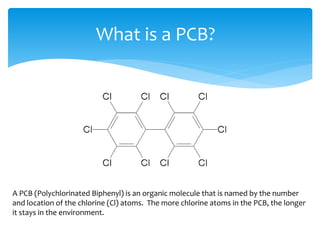
A PCB (Polychlorinated Biphenyl) is an organic molecule that is named by the number
and location of the chlorine (Cl) atoms. The more chlorine atoms in the PCB, the longer
it stays in the environment.
Aceclor
Adkarel
ALC
Apirolio
Apirorlio
Arochlor
Arochlors
Aroclor
Aroclors
Arubren
Asbestol
ASK
Askael
Askarel
Auxol
Bakola
Biphenyl, chlorinated
Chlophen
Chloretol
Chlorextol
Chlorinated biphenyl
Chlorinated diphenyl
Chlorinol
Chlorobiphenyl
Chlorodiphenyl
Chlorphen
Chorextol
Chorinol
Clophen
Clophenharz
Cloresil
Clorinal
Clorphen
Decachlorodiphenyl
Delor
Delorene Diaclor
Dicolor
Diconal
Diphenyl, chlorinated
DK
Duconal
Dykanol
Educarel
EEC-18
Elaol
Electrophenyl
Elemex
Elinol
Eucarel
Fenchlor
Fenclor
Fenocloro
Gilotherm
Hydol
Hyrol
Hyvol
Inclor
Inerteen
Inertenn
Kanechlor
Kaneclor
Kennechlor
Kenneclor
Leromoll
Magvar
MCS 1489
Montar
Nepolin
No-Flamol
NoFlamol
Non-Flamol
Olex-sf-d
Orophene PCB
PCB's
PCBs
Pheaoclor
Phenochlor
Phenoclor
Plastivar
Polychlorinated biphenyl
Polychlorinated biphenyls
Polychlorinated diphenyl
Polychlorinated diphenyls
Polychlorobiphenyl
Polychlorodiphenyl
Prodelec
Pydraul
Pyraclor
Pyralene
Pyranol
Pyroclor
Pyronol
Saf-T-Kuhl
Saf-T-Kohl
Santosol
Santotherm
Santothern
Santovac
Solvol
Sorol
Soval
Sovol
Sovtol
Terphenychlore
Therminal
Therminol
Turbinol
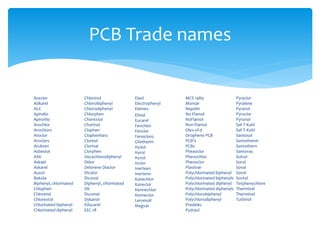
PCB Trade names
• ODORLESS
• TASTELESS
• CLEAR TO PALE-YELLOW VISCOUS LIQUID (THE MORE
CHLORINATED THEY ARE, THE MORE YELLOW THE LIQUID)
• LOW WATER SOLUBILITY (DO NOT MIX WELL WITH WATER)
• LOW VAPOR PRESSURE AT ROOM TEMPERATURE
• HIGHLY SOLUBLE WITH ORGANIC SOLVENTS, OILS AND FATS
• VERY HIGH THERMAL CONDUCTIVITY
• HIGH FLASH POINT (170-380°C)
• RELATIVELY INERT (DO NOT REACT WITH OTHER SUBSTANCES
EASILY)
Physical and Chemical Properties
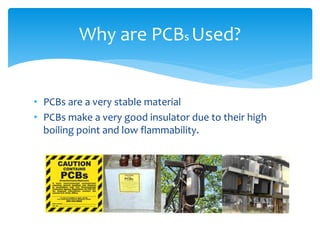
• PCBs are a very stable material
• PCBs make a very good insulator due to their high
boiling point and low flammability.
Why are PCBs Used?
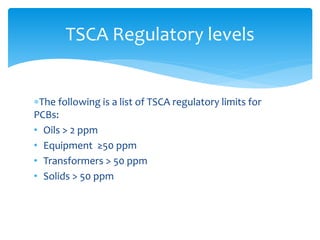
The following is a list of TSCA regulatory limits for
PCBs:
• Oils > 2 ppm
• Equipment ≥50 ppm
• Transformers > 50 ppm
• Solids > 50 ppm
TSCA Regulatory levels
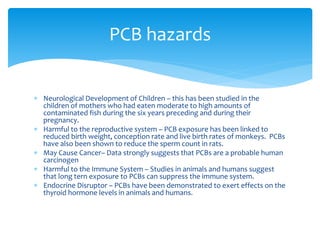
 Neurological Development of Children – this has been studied in the
children of mothers who had eaten moderate to high amounts of
contaminated fish during the six years preceding and during their
pregnancy.
 Harmful to the reproductive system – PCB exposure has been linked to
reduced birth weight, conception rate and live birth rates of monkeys. PCBs
have also been shown to reduce the sperm count in rats.
 May Cause Cancer– Data strongly suggests that PCBs are a probable human
carcinogen
 Harmful to the Immune System – Studies in animals and humans suggest
that long tern exposure to PCBs can suppress the immune system.
 Endocrine Disruptor – PCBs have been demonstrated to exert effects on the
thyroid hormone levels in animals and humans.
PCB hazards
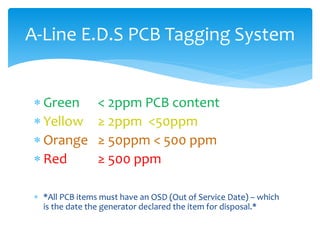
 Green < 2ppm PCB content
 Yellow ≥ 2ppm <50ppm
 Orange ≥ 50ppm < 500 ppm
 Red ≥ 500 ppm
 *All PCB items must have an OSD (Out of Service Date) – which
is the date the generator declared the item for disposal.*
A-Line E.D.S PCB Tagging System
 Capacitors – small – contains less then 3 lbs of dielectric fluid
- large – contains more than 3 lbs of dielectric fluid
 PCB Container – any package, can, bottle, bag, barrel, drum, tank or other device
that contains PCBs or PCB Articles and whose surface(s) has been in direct
contact with PCBs.
 PCB Article – any manufactured item , other than a PCB container, that contains
PCBs and whose surface(s) has/have been in direct contact with PCBs.
 PCB Solid – wood, PPE, gravel, dirt or debris contaminated with PCBs
 Ballast – fluorescent light ballast that includes a capacitor containing 0.1kg or less
of dielectric.
 Transformer – Non-PCB – contains <50 ppm PCB
 - PCB contaminated – liquid or non-liquid material containing PCBs
at concentrations ≥ 50ppm and < 500ppm, a liquid where there is insufficient
material to analyze, or a non-porous surface with a concentration of >10 µg/cm2
and <100 µg/cm2 when measured by a wipe test.
-PCB containing– any transformer >500 ppm PCB
Common PCB items
 Spill – the intentional or unintentional release (spill, leak or
other uncontrolled discharge) that results in any quantity
of PCBs running off or about to run off the external surface
of the equipment or other PCB source, as well as the
contamination resulting from those releases.
 There are two types of spills
• High Level Spill
• Low Level Spill
PCB spills
 Any concentration of spill that involves 1 pound or more of PCBs by weight (ie - 270
gallons or more of untested mineral oil)
 High concentration PCB – PCBs that contain ≥500 ppm PCBs, or materials which the
EPA requires to be assumed to contain 500 ppm in the absence of testing.
Procedure:
 Within 24 hours after the Responsible party was notified:
• Notify the EPA regional office and the NRC (National Response Center).
• Cordon off and restrict an area with any visible trace plus a 3-foot buffer with visible
signs to avoid the area minimizing the spread of contamination.
• Record and document the area of visible contamination
• Initiate cleanup of all visible traces of the fluid on hard surfaces and initiate removal of
all visible traces of the spill on soil and other media, such as grave, sand, oyster shells,
etc.
• If there are insufficient visible traces of PCBs at the spill site, a statistically based
sampling scheme will be used to identify the boundaries of the spill.
High Level Spill
• High-contact solid surfaces, shall be cleaned to 10µg/100cm2, as
measured by standard wipe tests.
• Low-contact, indoor, impervious solid surfaces will be
decontaminated to 10µg/100cm2
• Place spill materials in DOT 55-gallon drums, if possible, for
shipment
• Any spills involving fire will be handled by the Waterloo Fire
Department.
• Restore emergency response equipment to pre-emergency
conditions.
• Spill coordinator completes any necessary paperwork and
follows up with the NRC within 15 days of notification.
High level spill (cont)
 Spills involving less than 1 pound of PCBs by weight (less than 270 gallons of untested mineral
oil)
 Low-concentration PCBs are tested and found to contain less than 500ppm PCBs, or are
materials which the EPA requires to be assumed to be at concentrations below 500 ppm (i.e.,
untested mineral oil dielectric fluid)
Procedure:
• Double wash and rinse solid surfaces.
• All soil within the spill area must be excavated then backfilled with clean soil within 48 hours
of when the responsible party was aware/notified of the spill
• Ideally, all spill material should be placed in 55-gallon drums
• Any spills involving fire will be handled by the Waterloo fire Department
• Clean and restore any emergency response equipment to pre-emergency response conditions
• Spill coordinator completes any necessary paperwork and/or notifications
Low level spill
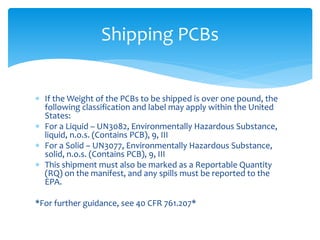
 If the Weight of the PCBs to be shipped is over one pound, the
following classification and label may apply within the United
States:
 For a Liquid – UN3082, Environmentally Hazardous Substance,
liquid, n.o.s. (Contains PCB), 9, III
 For a Solid – UN3077, Environmentally Hazardous Substance,
solid, n.o.s. (Contains PCB), 9, III
 This shipment must also be marked as a Reportable Quantity
(RQ) on the manifest, and any spills must be reported to the
EPA.
*For further guidance, see 40 CFR 761.207*
Shipping PCBs
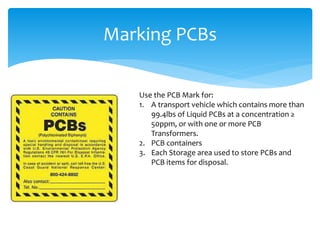
Marking PCBs
Use the PCB Mark for:
1. A transport vehicle which contains more than
99.4lbs of Liquid PCBs at a concentration ≥
50ppm, or with one or more PCB
Transformers.
2. PCB containers
3. Each Storage area used to store PCBs and
PCB items for disposal.
 PCBs are most likely to enter your body through absorption
through the skin.
Depending on your job duties you could be wearing the following:
 Safety Shoes
 Safety Glasses
 Full Face Respirator
 Tyvek Suit
 Fire Resistant Clothing
 Neoprene, Buty,l or Viton Gloves (Nitrile Gloves may be used for
low level PCBs or minimal contact with PCBs)
 Lineman or leather gloves
PPE
 Permits – a Hazmat certificate and any local permits need to be
obtained or on file.
 In-transit event – Any incidents involving PCB spills need to be
cleaned up immediately. All trucks are equipped with a spill kit.
It the spill kit is not enough to adequately clean up the spill, a
HazMat team will need to be called. Any spills need to be
relayed immediately to your supervisor.
 Load Securing – All loads must be secured to prevent movement
and loadshift during transport.
 Facility check-in – When you get to your destination, check in
with your supervisor, or follow the protocol that has been
established for that load.
Transportation
1. Liquid – Oils and oily waters may be sampled directly for PCB concentration
2. Solid – soils and other materials that can be crushed to sample PCB
concentration
3. Wipe – Specially treated wipes are rubbed across a non-porous surface
(such as metal) then the wipe is tested for PCB concentration
*Employees must read the SOPs and be trained before they can take
samples*
Sample types
1. Untested – All liquids that come in without a concentration from analytical tests or
liquids that have test results over 12 months old. These fluids should be handled as if
they are a high PCB level until test results are obtained or verified
2. <2ppm PCB - If this is Bulk Oil, place directly in <2ppm PCB tank, if the liquid is not bulk
or in a unit, place in the Inventory Control Holding area until the unit can be drained or
the liquid can be put in the appropriate <2ppm PCB storage
3. 2-49ppm PCB – If this is Bulk Oil, place directly in 2-49 PPM PCB tank, if the liquid is not
bulk or in a unit, place in the Inventory Control Holding area until the unit can be
drained or the liquid can be put in the appropriate 2-49ppm PCB storage
4. 50+ppm PCB – If this is Bulk Oil, Place in drums in PCB storage area, if the liquid is not
bulk or in a unit, place in the Inventory Control Holding area until the unit can be
drained or the liquid can be put into drums in the PCB Storage Area
Handling PCB Liquids
 Untested - All equipment that comes in without a concentration from analytical tests
or equipment that has test results over 12 months old. This equipment should be
handled as if they are a high PCB level until test results are obtained or verified.
 < 50ppm PCB –
a) Drain oil to appropriate bulk tank.
b) ferrous and non-ferrous materials processed to mill specifications and sent for
recycling
c) Debris is disposed of as non-hazardous
50-499ppm PCB
a) Drain oil to appropriate bulk tank
b) Retrofill the equipment
c) Dismantle unit into basic components (core – treat in scrap metal recovery oven, tank
– triple flush, after wipe samples meet <10µg PCB per 100cm2 then recycle to
specifications, non-recyclable – package and sent to TSCA approved landfill, bushing –
send to bushing holding area.
Handling PCB equipment
 500+ppm PCB
a) Drain oil into drums and move to inventory control for shipment to
a TSCA approved incineration facility
b) Flush unit with approved solvent (if applicable), by filling the unit
with approved solvent and allowing the unit to remain filled for 18
hours then drain the oil and solvent into drums. Move the drums to
the inventory control area for shipment to a TSCA approved
incineration facility
c) Move the unit to inventory control for shipment to a TSCA approved
facility
OR
Move unit to inventory control for shipment to a TSCA approved
facility.
Handling PCB equipment (cont.)
 Once PCB levels are known by lab verification or the
customer, segregate the drum by proper item type:
• Capacitors, Soil and solid debris, oil <50-499ppm PCB and
oil <500ppm PCB are packaged for shipment to TSCA
approved incinerator.
• Oil/water<50ppm PCB, oil <2ppm PCB and oil <2-49ppm
PCB are transferred to the appropriate bulk tanks, then the
drum is down sized to recycle specs
• Equipment return to Inventory Control for distribution to
proper process area.
Drum Handling

Pcb training 2012 orientation

  • 1.
  • 2.
    What is aPCB? A PCB (Polychlorinated Biphenyl) is an organic molecule that is named by the number and location of the chlorine (Cl) atoms. The more chlorine atoms in the PCB, the longer it stays in the environment.
  • 3.
    Aceclor Adkarel ALC Apirolio Apirorlio Arochlor Arochlors Aroclor Aroclors Arubren Asbestol ASK Askael Askarel Auxol Bakola Biphenyl, chlorinated Chlophen Chloretol Chlorextol Chlorinated biphenyl Chlorinateddiphenyl Chlorinol Chlorobiphenyl Chlorodiphenyl Chlorphen Chorextol Chorinol Clophen Clophenharz Cloresil Clorinal Clorphen Decachlorodiphenyl Delor Delorene Diaclor Dicolor Diconal Diphenyl, chlorinated DK Duconal Dykanol Educarel EEC-18 Elaol Electrophenyl Elemex Elinol Eucarel Fenchlor Fenclor Fenocloro Gilotherm Hydol Hyrol Hyvol Inclor Inerteen Inertenn Kanechlor Kaneclor Kennechlor Kenneclor Leromoll Magvar MCS 1489 Montar Nepolin No-Flamol NoFlamol Non-Flamol Olex-sf-d Orophene PCB PCB's PCBs Pheaoclor Phenochlor Phenoclor Plastivar Polychlorinated biphenyl Polychlorinated biphenyls Polychlorinated diphenyl Polychlorinated diphenyls Polychlorobiphenyl Polychlorodiphenyl Prodelec Pydraul Pyraclor Pyralene Pyranol Pyroclor Pyronol Saf-T-Kuhl Saf-T-Kohl Santosol Santotherm Santothern Santovac Solvol Sorol Soval Sovol Sovtol Terphenychlore Therminal Therminol Turbinol PCB Trade names
  • 4.
    • ODORLESS • TASTELESS •CLEAR TO PALE-YELLOW VISCOUS LIQUID (THE MORE CHLORINATED THEY ARE, THE MORE YELLOW THE LIQUID) • LOW WATER SOLUBILITY (DO NOT MIX WELL WITH WATER) • LOW VAPOR PRESSURE AT ROOM TEMPERATURE • HIGHLY SOLUBLE WITH ORGANIC SOLVENTS, OILS AND FATS • VERY HIGH THERMAL CONDUCTIVITY • HIGH FLASH POINT (170-380°C) • RELATIVELY INERT (DO NOT REACT WITH OTHER SUBSTANCES EASILY) Physical and Chemical Properties
  • 5.
    • PCBs area very stable material • PCBs make a very good insulator due to their high boiling point and low flammability. Why are PCBs Used?
  • 6.
    The following isa list of TSCA regulatory limits for PCBs: • Oils > 2 ppm • Equipment ≥50 ppm • Transformers > 50 ppm • Solids > 50 ppm TSCA Regulatory levels
  • 7.
     Neurological Developmentof Children – this has been studied in the children of mothers who had eaten moderate to high amounts of contaminated fish during the six years preceding and during their pregnancy.  Harmful to the reproductive system – PCB exposure has been linked to reduced birth weight, conception rate and live birth rates of monkeys. PCBs have also been shown to reduce the sperm count in rats.  May Cause Cancer– Data strongly suggests that PCBs are a probable human carcinogen  Harmful to the Immune System – Studies in animals and humans suggest that long tern exposure to PCBs can suppress the immune system.  Endocrine Disruptor – PCBs have been demonstrated to exert effects on the thyroid hormone levels in animals and humans. PCB hazards
  • 8.
     Green <2ppm PCB content  Yellow ≥ 2ppm <50ppm  Orange ≥ 50ppm < 500 ppm  Red ≥ 500 ppm  *All PCB items must have an OSD (Out of Service Date) – which is the date the generator declared the item for disposal.* A-Line E.D.S PCB Tagging System
  • 9.
     Capacitors –small – contains less then 3 lbs of dielectric fluid - large – contains more than 3 lbs of dielectric fluid  PCB Container – any package, can, bottle, bag, barrel, drum, tank or other device that contains PCBs or PCB Articles and whose surface(s) has been in direct contact with PCBs.  PCB Article – any manufactured item , other than a PCB container, that contains PCBs and whose surface(s) has/have been in direct contact with PCBs.  PCB Solid – wood, PPE, gravel, dirt or debris contaminated with PCBs  Ballast – fluorescent light ballast that includes a capacitor containing 0.1kg or less of dielectric.  Transformer – Non-PCB – contains <50 ppm PCB  - PCB contaminated – liquid or non-liquid material containing PCBs at concentrations ≥ 50ppm and < 500ppm, a liquid where there is insufficient material to analyze, or a non-porous surface with a concentration of >10 µg/cm2 and <100 µg/cm2 when measured by a wipe test. -PCB containing– any transformer >500 ppm PCB Common PCB items
  • 10.
     Spill –the intentional or unintentional release (spill, leak or other uncontrolled discharge) that results in any quantity of PCBs running off or about to run off the external surface of the equipment or other PCB source, as well as the contamination resulting from those releases.  There are two types of spills • High Level Spill • Low Level Spill PCB spills
  • 11.
     Any concentrationof spill that involves 1 pound or more of PCBs by weight (ie - 270 gallons or more of untested mineral oil)  High concentration PCB – PCBs that contain ≥500 ppm PCBs, or materials which the EPA requires to be assumed to contain 500 ppm in the absence of testing. Procedure:  Within 24 hours after the Responsible party was notified: • Notify the EPA regional office and the NRC (National Response Center). • Cordon off and restrict an area with any visible trace plus a 3-foot buffer with visible signs to avoid the area minimizing the spread of contamination. • Record and document the area of visible contamination • Initiate cleanup of all visible traces of the fluid on hard surfaces and initiate removal of all visible traces of the spill on soil and other media, such as grave, sand, oyster shells, etc. • If there are insufficient visible traces of PCBs at the spill site, a statistically based sampling scheme will be used to identify the boundaries of the spill. High Level Spill
  • 12.
    • High-contact solidsurfaces, shall be cleaned to 10µg/100cm2, as measured by standard wipe tests. • Low-contact, indoor, impervious solid surfaces will be decontaminated to 10µg/100cm2 • Place spill materials in DOT 55-gallon drums, if possible, for shipment • Any spills involving fire will be handled by the Waterloo Fire Department. • Restore emergency response equipment to pre-emergency conditions. • Spill coordinator completes any necessary paperwork and follows up with the NRC within 15 days of notification. High level spill (cont)
  • 13.
     Spills involvingless than 1 pound of PCBs by weight (less than 270 gallons of untested mineral oil)  Low-concentration PCBs are tested and found to contain less than 500ppm PCBs, or are materials which the EPA requires to be assumed to be at concentrations below 500 ppm (i.e., untested mineral oil dielectric fluid) Procedure: • Double wash and rinse solid surfaces. • All soil within the spill area must be excavated then backfilled with clean soil within 48 hours of when the responsible party was aware/notified of the spill • Ideally, all spill material should be placed in 55-gallon drums • Any spills involving fire will be handled by the Waterloo fire Department • Clean and restore any emergency response equipment to pre-emergency response conditions • Spill coordinator completes any necessary paperwork and/or notifications Low level spill
  • 14.
     If theWeight of the PCBs to be shipped is over one pound, the following classification and label may apply within the United States:  For a Liquid – UN3082, Environmentally Hazardous Substance, liquid, n.o.s. (Contains PCB), 9, III  For a Solid – UN3077, Environmentally Hazardous Substance, solid, n.o.s. (Contains PCB), 9, III  This shipment must also be marked as a Reportable Quantity (RQ) on the manifest, and any spills must be reported to the EPA. *For further guidance, see 40 CFR 761.207* Shipping PCBs
  • 15.
    Marking PCBs Use thePCB Mark for: 1. A transport vehicle which contains more than 99.4lbs of Liquid PCBs at a concentration ≥ 50ppm, or with one or more PCB Transformers. 2. PCB containers 3. Each Storage area used to store PCBs and PCB items for disposal.
  • 16.
     PCBs aremost likely to enter your body through absorption through the skin. Depending on your job duties you could be wearing the following:  Safety Shoes  Safety Glasses  Full Face Respirator  Tyvek Suit  Fire Resistant Clothing  Neoprene, Buty,l or Viton Gloves (Nitrile Gloves may be used for low level PCBs or minimal contact with PCBs)  Lineman or leather gloves PPE
  • 17.
     Permits –a Hazmat certificate and any local permits need to be obtained or on file.  In-transit event – Any incidents involving PCB spills need to be cleaned up immediately. All trucks are equipped with a spill kit. It the spill kit is not enough to adequately clean up the spill, a HazMat team will need to be called. Any spills need to be relayed immediately to your supervisor.  Load Securing – All loads must be secured to prevent movement and loadshift during transport.  Facility check-in – When you get to your destination, check in with your supervisor, or follow the protocol that has been established for that load. Transportation
  • 18.
    1. Liquid –Oils and oily waters may be sampled directly for PCB concentration 2. Solid – soils and other materials that can be crushed to sample PCB concentration 3. Wipe – Specially treated wipes are rubbed across a non-porous surface (such as metal) then the wipe is tested for PCB concentration *Employees must read the SOPs and be trained before they can take samples* Sample types
  • 19.
    1. Untested –All liquids that come in without a concentration from analytical tests or liquids that have test results over 12 months old. These fluids should be handled as if they are a high PCB level until test results are obtained or verified 2. <2ppm PCB - If this is Bulk Oil, place directly in <2ppm PCB tank, if the liquid is not bulk or in a unit, place in the Inventory Control Holding area until the unit can be drained or the liquid can be put in the appropriate <2ppm PCB storage 3. 2-49ppm PCB – If this is Bulk Oil, place directly in 2-49 PPM PCB tank, if the liquid is not bulk or in a unit, place in the Inventory Control Holding area until the unit can be drained or the liquid can be put in the appropriate 2-49ppm PCB storage 4. 50+ppm PCB – If this is Bulk Oil, Place in drums in PCB storage area, if the liquid is not bulk or in a unit, place in the Inventory Control Holding area until the unit can be drained or the liquid can be put into drums in the PCB Storage Area Handling PCB Liquids
  • 20.
     Untested -All equipment that comes in without a concentration from analytical tests or equipment that has test results over 12 months old. This equipment should be handled as if they are a high PCB level until test results are obtained or verified.  < 50ppm PCB – a) Drain oil to appropriate bulk tank. b) ferrous and non-ferrous materials processed to mill specifications and sent for recycling c) Debris is disposed of as non-hazardous 50-499ppm PCB a) Drain oil to appropriate bulk tank b) Retrofill the equipment c) Dismantle unit into basic components (core – treat in scrap metal recovery oven, tank – triple flush, after wipe samples meet <10µg PCB per 100cm2 then recycle to specifications, non-recyclable – package and sent to TSCA approved landfill, bushing – send to bushing holding area. Handling PCB equipment
  • 21.
     500+ppm PCB a)Drain oil into drums and move to inventory control for shipment to a TSCA approved incineration facility b) Flush unit with approved solvent (if applicable), by filling the unit with approved solvent and allowing the unit to remain filled for 18 hours then drain the oil and solvent into drums. Move the drums to the inventory control area for shipment to a TSCA approved incineration facility c) Move the unit to inventory control for shipment to a TSCA approved facility OR Move unit to inventory control for shipment to a TSCA approved facility. Handling PCB equipment (cont.)
  • 22.
     Once PCBlevels are known by lab verification or the customer, segregate the drum by proper item type: • Capacitors, Soil and solid debris, oil <50-499ppm PCB and oil <500ppm PCB are packaged for shipment to TSCA approved incinerator. • Oil/water<50ppm PCB, oil <2ppm PCB and oil <2-49ppm PCB are transferred to the appropriate bulk tanks, then the drum is down sized to recycle specs • Equipment return to Inventory Control for distribution to proper process area. Drum Handling