Setting the Bar: Safety
Education at Princeton
      University
        Robin M. Izzo
   Associate Director, EHS
     Princeton University
Princeton Profile
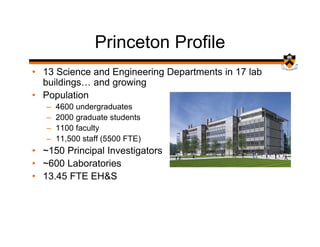
• 13 Science and Engineering Departments in 17 lab
  buildings… and growing
• Population
   –   4600 undergraduates
   –   2000 graduate students
   –   1100 faculty
   –   11,500 staff (5500 FTE)
• ~150 Principal Investigators
• ~600 Laboratories
• 13.45 FTE EH&S
Policy on Lab Safety Training
All individuals working in Princeton
  University laboratories, paid or unpaid,
  including faculty, staff, students and
  visitors, must attend Laboratory Safety
  Training provided by Environmental Health
  and Safety. Attendance at similar
  laboratory safety training provided by other
  institutions does not satisfy this
  requirement.
Undergraduates
• Undergraduate course labs
  – EHS reviews all lab manuals
  – T.A.s receive Train the Trainer
    • Lab Safety
    • Managing risk-accepting students
    • Escalation process
  – Hazards and precautions written
    into procedures
Science Majors

• Declare major junior year
• Junior core labs
  – Chemistry
  – Molecular Biology
  – Physics
  – Chemical & Biological Engineering
  – Electrical Engineering
  – Mechanical and Aerospace Engineering
Core Lab Training
• All undergrads receive same level of
  training as graduate students, faculty and
  staff
• Conducted as a lab class or
  mandatory evening meetings
• Purpose
  – Undergraduate majors will work
    independently
     • Junior Project, Senior Thesis
     • Work study
Others
• Any student working or studying in a
  research laboratory MUST attend full Lab
  Safety Training
  – Often unsupervised
  – Change from teaching lab to research lab
    • No TA feeding safety information
    • Hazards not always spelled out
    • Learn to conduct a hazard assessment and
      determine appropriate safety requirements
Princeton Lab Safety Training
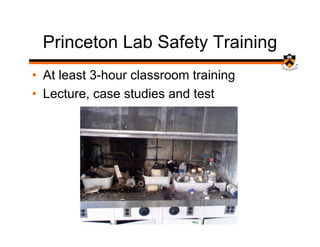
• At least 3-hour classroom training
• Lecture, case studies and test
Princeton Lab Safety Training
• Safety Culture at Princeton University
• Raising Safety Concerns
• Risk Assessment, Risk Acceptance
• Emergency Procedures
• References and Resources; how to use
  them
• Risk Assessment
• Health Hazards
Princeton Lab Safety Training
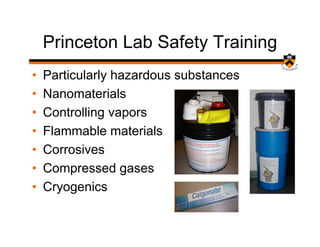
•   Particularly hazardous substances
•   Nanomaterials
•   Controlling vapors
•   Flammable materials
•   Corrosives
•   Compressed gases
•   Cryogenics
Princeton Lab Safety Training
•   Electrical Safety
•   Pressure vessels
•   Ergonomics
•   Engineering controls and PPE
•   Shipping chemicals and samples
•   Hazardous waste minimization
•   Hazardous waste management
Princeton Lab Safety Training
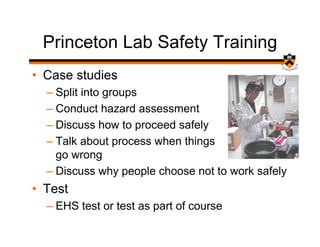
• Case studies
  – Split into groups
  – Conduct hazard assessment
  – Discuss how to proceed safely
  – Talk about process when things
    go wrong
  – Discuss why people choose not to work safely
• Test
  – EHS test or test as part of course
In-Lab Training
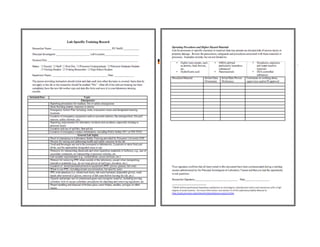
• PI or Lab Manager conducts additional
  training
  –   General issues recommended by EHS
  –   Other issues specified by the lab
  –   Specific equipment
  –   SOPs for unusually hazardous materials
  –   For equipment and SOPs
       • Document instruction
       • Document proficiency demonstrated
       • Specify requirements for prior approval, supervision,
         working alone
Graduate Students
• All receive Lab Safety Training
• School of Engineering and Applied
  Sciences
  – 6 week non-credit course
  – Mandatory for all students except strict theory
    students (who will not be allowed in labs)
  – General lab safety plus
    • Fire extinguisher training
    • Physical hazards
    • Laser safety
Art Students
•   Specialized safety training
•   Chemical safety
•   Media-specific issues
•   Environmental impact
•   Mandatory for all visual arts majors
Reinforcing Training
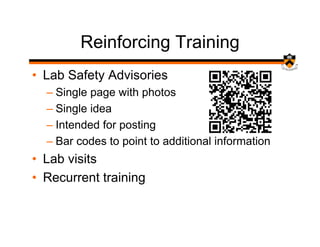
• Lab Safety Advisories
  – Single page with photos
  – Single idea
  – Intended for posting
  – Bar codes to point to additional information
• Lab visits
• Recurrent training
In a Nutshell
• Undergraduate science
  majors should have same
  base of information as
  graduate students and
  staff
• FUTURE: Web modules
  and short videos to
  complement classroom
  training
Questions?

Setting the bar

  • 1.
    Setting the Bar:Safety Education at Princeton University Robin M. Izzo Associate Director, EHS Princeton University
  • 2.
    Princeton Profile • 13Science and Engineering Departments in 17 lab buildings… and growing • Population – 4600 undergraduates – 2000 graduate students – 1100 faculty – 11,500 staff (5500 FTE) • ~150 Principal Investigators • ~600 Laboratories • 13.45 FTE EH&S
  • 3.
    Policy on LabSafety Training All individuals working in Princeton University laboratories, paid or unpaid, including faculty, staff, students and visitors, must attend Laboratory Safety Training provided by Environmental Health and Safety. Attendance at similar laboratory safety training provided by other institutions does not satisfy this requirement.
  • 4.
    Undergraduates • Undergraduate courselabs – EHS reviews all lab manuals – T.A.s receive Train the Trainer • Lab Safety • Managing risk-accepting students • Escalation process – Hazards and precautions written into procedures
  • 5.
    Science Majors • Declaremajor junior year • Junior core labs – Chemistry – Molecular Biology – Physics – Chemical & Biological Engineering – Electrical Engineering – Mechanical and Aerospace Engineering
  • 6.
    Core Lab Training •All undergrads receive same level of training as graduate students, faculty and staff • Conducted as a lab class or mandatory evening meetings • Purpose – Undergraduate majors will work independently • Junior Project, Senior Thesis • Work study
  • 7.
    Others • Any studentworking or studying in a research laboratory MUST attend full Lab Safety Training – Often unsupervised – Change from teaching lab to research lab • No TA feeding safety information • Hazards not always spelled out • Learn to conduct a hazard assessment and determine appropriate safety requirements
  • 8.
    Princeton Lab SafetyTraining • At least 3-hour classroom training • Lecture, case studies and test
  • 9.
    Princeton Lab SafetyTraining • Safety Culture at Princeton University • Raising Safety Concerns • Risk Assessment, Risk Acceptance • Emergency Procedures • References and Resources; how to use them • Risk Assessment • Health Hazards
  • 10.
    Princeton Lab SafetyTraining • Particularly hazardous substances • Nanomaterials • Controlling vapors • Flammable materials • Corrosives • Compressed gases • Cryogenics
  • 11.
    Princeton Lab SafetyTraining • Electrical Safety • Pressure vessels • Ergonomics • Engineering controls and PPE • Shipping chemicals and samples • Hazardous waste minimization • Hazardous waste management
  • 12.
    Princeton Lab SafetyTraining • Case studies – Split into groups – Conduct hazard assessment – Discuss how to proceed safely – Talk about process when things go wrong – Discuss why people choose not to work safely • Test – EHS test or test as part of course
  • 13.
    In-Lab Training • PIor Lab Manager conducts additional training – General issues recommended by EHS – Other issues specified by the lab – Specific equipment – SOPs for unusually hazardous materials – For equipment and SOPs • Document instruction • Document proficiency demonstrated • Specify requirements for prior approval, supervision, working alone
  • 15.
    Graduate Students • Allreceive Lab Safety Training • School of Engineering and Applied Sciences – 6 week non-credit course – Mandatory for all students except strict theory students (who will not be allowed in labs) – General lab safety plus • Fire extinguisher training • Physical hazards • Laser safety
  • 16.
    Art Students • Specialized safety training • Chemical safety • Media-specific issues • Environmental impact • Mandatory for all visual arts majors
  • 17.
    Reinforcing Training • LabSafety Advisories – Single page with photos – Single idea – Intended for posting – Bar codes to point to additional information • Lab visits • Recurrent training
  • 18.
    In a Nutshell •Undergraduate science majors should have same base of information as graduate students and staff • FUTURE: Web modules and short videos to complement classroom training
  • 19.