Using the PjBL instructional approach to
teach mobile app development to K-12 students: theory
and practice
Project-Based Learning (PjBL)
Viviane Vladimirschi
MDDE 803
Assignment # 2 – Instructional approach presentation
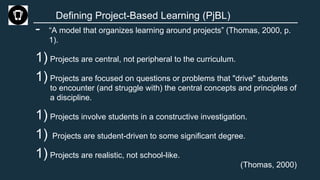
Defining Project-Based Learning (PjBL)
- “A model that organizes learning around projects” (Thomas, 2000, p.
1).
1) Projects are central, not peripheral to the curriculum.
1) Projects are focused on questions or problems that "drive" students
to encounter (and struggle with) the central concepts and principles of
a discipline.
1) Projects involve students in a constructive investigation.
1) Projects are student-driven to some significant degree.
1) Projects are realistic, not school-like.
(Thomas, 2000)
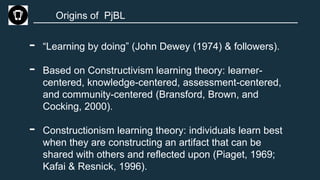
Origins of PjBL
- “Learning by doing” (John Dewey (1974) & followers).
- Based on Constructivism learning theory: learner-
centered, knowledge-centered, assessment-centered,
and community-centered (Bransford, Brown, and
Cocking, 2000).
- Constructionism learning theory: individuals learn best
when they are constructing an artifact that can be
shared with others and reflected upon (Piaget, 1969;
Kafai & Resnick, 1996).
Benefits to the PjBL instructional approach
- “Students gain knowledge and skills through different
activities and in a variety of domains” (Tamim, & Grant, 2013,
p. 73).
- Enables students to develop dispositions or tendencies to act
in a certain manner in addition to developing feelings such as
self-esteem and confidence (Katz & Chard, 1992).
- The production of artifacts that represent answers to that
question have the potential to motivate students and help
them better understand subject matter content (Blumenfeld et
al., 1991).
Common features for implementing PjBL
 An introduction to "set the stage" or anchor the activity;
 A task, guiding question or driving question;
 A process or investigation that results in the creation of one or
more sharable artifacts;
 Resources, such as subject-matter experts, textbooks and
hypertext links;
 Scaffolding, such as teacher conferences to help learners assess
their progress, computer-based questioning and project
templates;
 Collaborations, including teams, peer reviews and external
content specialists; and
 Opportunities for reflection and transfer, such as classroom
debriefing sessions, journal entries and extension activities.
Grant (2002)
Challenges faced by Educators
Teachers need to be open to its constructivist nature;
Need to be skilled in taking a student-centered
approach with their students;
Need to have the motivation and the abilities to adopt a
new instructional strategy;
Need to be confident in managing the PjBL activities.
Tamin and Grant (2013)
Implementing PjBL in a K-12 Blended Learning Environment
Teaching mobile app development to K-12 students: course
objectives
 Develop critical thinking, creative thinking, collaboration and
communication skills
 Develop information literacy, media & technology skills
 Develop life skills (future career opportunities)
 Find real solutions to real problems
 Learn how things work by creating digital content; learning by
doing
 Learn how to develop a mobile app using Titanium
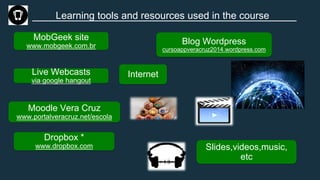
MobGeek site
www.mobgeek.com.br
Learning tools and resources used in the course
Live Webcasts
via google hangout
Moodle Vera Cruz
www.portalveracruz.net/escola
Dropbox *
www.dropbox.com
Blog Wordpress
cursoappveracruz2014.wordpress.com
Internet
Slides,videos,music,
etc
References & Credits
Beldarrain, Y. (2006). Distance education trends: Integrating new technologies to foster student interaction and collaboration. Distance education, 27(2), 139-153.
Blumenfeld, P. C., Soloway, E., Marx, R. W., Krajcik, J. S., Guzdial, M., & Palincsar, A. (1991). Motivating project-based learning: Sustaining the doing, supporting the learning.
Educational psychologist, 26(3-4), 369-398.
Bransford, J.D., Brown, A.L., & Cocking, R.R. (2000). How People Learn: Brain, Mind, Experience, and School. Washington, DC: National Academy Press.
Dodge, B. (1995). WebQuests: a technique for Internet-based learning. Distance educator, 1(2), 10-13.
Dewey, J. (1974). My pedagogical creed. In R. D. Archambault (Ed.), John Dewey on education: Selected writings (pp. 427-439). Chicago: University of Chicago Press.
(Original work published 1897)
Grant, M. M. (2002). Getting a grip on project-based learning: Theory, cases and recommendations. Meridian: A middle school computer technologies journal, 5(1), 83.
Retrieved from http://www.ncsu.edu/meridian/win2002/514/project-based.pdf
Kafai, Y., & Resnick, M. (1996) (Eds.). Constructionism in practice: Designing, thinking and learning in a digital world. Mahwah, NJ: Lawrence Erlbaum.
Katz, L. G., & Chard, S. D. (1992). The project approach. (ERIC Document Reproduction Service No. ED340518).
Piaget, J. (1969) Science of education and the psychology of the child. New York: Viking.
Tamim, S. R., & Grant, M. M. (2013). Definitions and uses: Case study of teachers implementing project-based learning. Interdisciplinary Journal of Problem-based Learning,
7(2), 3.
Thomas, J. W. (2000). A review of PBL. Retrieved from http://www.bie.org/ research/study/review_of_project_based_learning_2000/
Zafirov, C. (2013). New Challenges for the Project Based Learning in the Digital Age. Trakia Journal of Sciences, 11(3), 299.

Project-Based Learning

  • 1.
    Using the PjBLinstructional approach to teach mobile app development to K-12 students: theory and practice Project-Based Learning (PjBL) Viviane Vladimirschi MDDE 803 Assignment # 2 – Instructional approach presentation
  • 2.
    Defining Project-Based Learning(PjBL) - “A model that organizes learning around projects” (Thomas, 2000, p. 1). 1) Projects are central, not peripheral to the curriculum. 1) Projects are focused on questions or problems that "drive" students to encounter (and struggle with) the central concepts and principles of a discipline. 1) Projects involve students in a constructive investigation. 1) Projects are student-driven to some significant degree. 1) Projects are realistic, not school-like. (Thomas, 2000)
  • 3.
    Origins of PjBL -“Learning by doing” (John Dewey (1974) & followers). - Based on Constructivism learning theory: learner- centered, knowledge-centered, assessment-centered, and community-centered (Bransford, Brown, and Cocking, 2000). - Constructionism learning theory: individuals learn best when they are constructing an artifact that can be shared with others and reflected upon (Piaget, 1969; Kafai & Resnick, 1996).
  • 4.
    Benefits to thePjBL instructional approach - “Students gain knowledge and skills through different activities and in a variety of domains” (Tamim, & Grant, 2013, p. 73). - Enables students to develop dispositions or tendencies to act in a certain manner in addition to developing feelings such as self-esteem and confidence (Katz & Chard, 1992). - The production of artifacts that represent answers to that question have the potential to motivate students and help them better understand subject matter content (Blumenfeld et al., 1991).
  • 5.
    Common features forimplementing PjBL  An introduction to "set the stage" or anchor the activity;  A task, guiding question or driving question;  A process or investigation that results in the creation of one or more sharable artifacts;  Resources, such as subject-matter experts, textbooks and hypertext links;  Scaffolding, such as teacher conferences to help learners assess their progress, computer-based questioning and project templates;  Collaborations, including teams, peer reviews and external content specialists; and  Opportunities for reflection and transfer, such as classroom debriefing sessions, journal entries and extension activities. Grant (2002)
  • 6.
    Challenges faced byEducators Teachers need to be open to its constructivist nature; Need to be skilled in taking a student-centered approach with their students; Need to have the motivation and the abilities to adopt a new instructional strategy; Need to be confident in managing the PjBL activities. Tamin and Grant (2013)
  • 7.
    Implementing PjBL ina K-12 Blended Learning Environment
  • 8.
    Teaching mobile appdevelopment to K-12 students: course objectives  Develop critical thinking, creative thinking, collaboration and communication skills  Develop information literacy, media & technology skills  Develop life skills (future career opportunities)  Find real solutions to real problems  Learn how things work by creating digital content; learning by doing  Learn how to develop a mobile app using Titanium
  • 9.
    MobGeek site www.mobgeek.com.br Learning toolsand resources used in the course Live Webcasts via google hangout Moodle Vera Cruz www.portalveracruz.net/escola Dropbox * www.dropbox.com Blog Wordpress cursoappveracruz2014.wordpress.com Internet Slides,videos,music, etc
  • 10.
    References & Credits Beldarrain,Y. (2006). Distance education trends: Integrating new technologies to foster student interaction and collaboration. Distance education, 27(2), 139-153. Blumenfeld, P. C., Soloway, E., Marx, R. W., Krajcik, J. S., Guzdial, M., & Palincsar, A. (1991). Motivating project-based learning: Sustaining the doing, supporting the learning. Educational psychologist, 26(3-4), 369-398. Bransford, J.D., Brown, A.L., & Cocking, R.R. (2000). How People Learn: Brain, Mind, Experience, and School. Washington, DC: National Academy Press. Dodge, B. (1995). WebQuests: a technique for Internet-based learning. Distance educator, 1(2), 10-13. Dewey, J. (1974). My pedagogical creed. In R. D. Archambault (Ed.), John Dewey on education: Selected writings (pp. 427-439). Chicago: University of Chicago Press. (Original work published 1897) Grant, M. M. (2002). Getting a grip on project-based learning: Theory, cases and recommendations. Meridian: A middle school computer technologies journal, 5(1), 83. Retrieved from http://www.ncsu.edu/meridian/win2002/514/project-based.pdf Kafai, Y., & Resnick, M. (1996) (Eds.). Constructionism in practice: Designing, thinking and learning in a digital world. Mahwah, NJ: Lawrence Erlbaum. Katz, L. G., & Chard, S. D. (1992). The project approach. (ERIC Document Reproduction Service No. ED340518). Piaget, J. (1969) Science of education and the psychology of the child. New York: Viking. Tamim, S. R., & Grant, M. M. (2013). Definitions and uses: Case study of teachers implementing project-based learning. Interdisciplinary Journal of Problem-based Learning, 7(2), 3. Thomas, J. W. (2000). A review of PBL. Retrieved from http://www.bie.org/ research/study/review_of_project_based_learning_2000/ Zafirov, C. (2013). New Challenges for the Project Based Learning in the Digital Age. Trakia Journal of Sciences, 11(3), 299.