Project Based
Learning (PBL)
Jammu University
2 Year B.Ed.
Paper 202/3
Sem: II
This work is licensed under a Creative Commons Attribution-ShareAlike 4.0 International
License.
Project Based Learning (PBL)
Project Based Learning is a teaching method in
which students gain knowledge and skills by
working for an extended period of time to
investigate and respond to an engaging and
complex question, problem, or challenge.
Project-based learning (PBL) is a student-
centered pedagogy that involves a dynamic
classroom approach in which students acquire a
deeper knowledge through active exploration of
real-world challenges and problems. Students
learn about a subject by working for an extended
period of time to investigate and respond to a
complex question, challenge, or problem.
Definitions:
 It is a style of active learning and inquiry-based
learning.
 PBL contrasts with paper-based, rote memorization, or
teacher-led instruction that simply presents established
facts or portrays a smooth path to knowledge by
instead posing questions, problems or scenarios.
 Thomas Markham (2011): Project-Based Learning
(PBL) integrates knowing and doing. Students learn
knowledge and elements of the core curriculum, but
also apply what they know to solve authentic
problems and produce results that matter. PBL
refocuses education on the student, not the curriculum.
These cannot be taught out of a textbook, but must be
activated through experience."
Structure
PBL emphasizes long-term, interdisciplinary and
student-centered learning activities.
Students organize their own work and manage
their own time in a project-based class.
Project-based instruction differs from traditional
inquiry by its emphasis on students' collaborative
or individual artifact construction to represent
what is being learned.
Project-based learning also gives students the
opportunity to explore problems and challenges
that have real-world applications, increasing the
possibility of long-term retention of skills and
concepts.
Essential elements of PBL
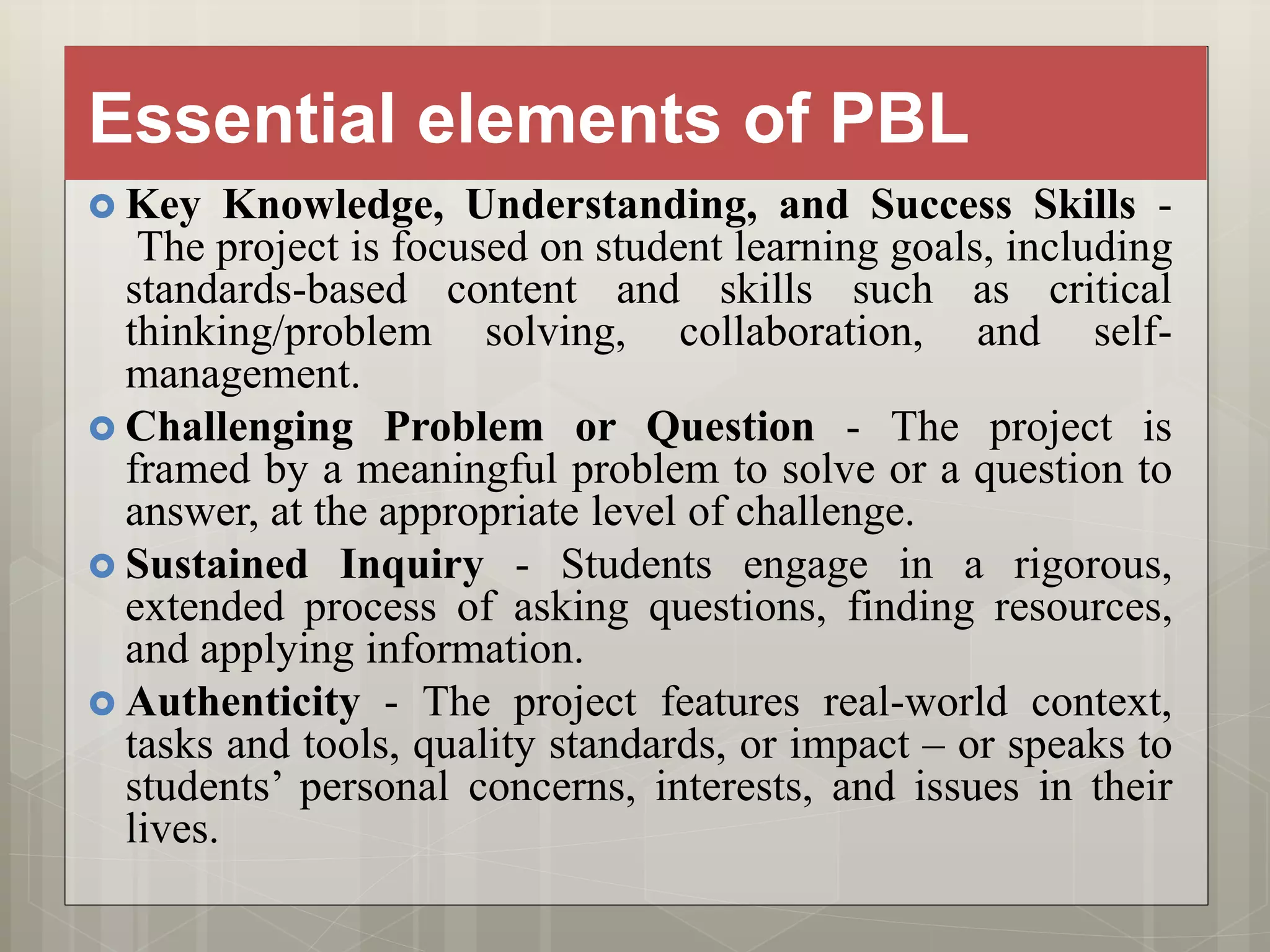
 Key Knowledge, Understanding, and Success Skills -
The project is focused on student learning goals, including
standards-based content and skills such as critical
thinking/problem solving, collaboration, and self-
management.
 Challenging Problem or Question - The project is
framed by a meaningful problem to solve or a question to
answer, at the appropriate level of challenge.
 Sustained Inquiry - Students engage in a rigorous,
extended process of asking questions, finding resources,
and applying information.
 Authenticity - The project features real-world context,
tasks and tools, quality standards, or impact – or speaks to
students’ personal concerns, interests, and issues in their
lives.
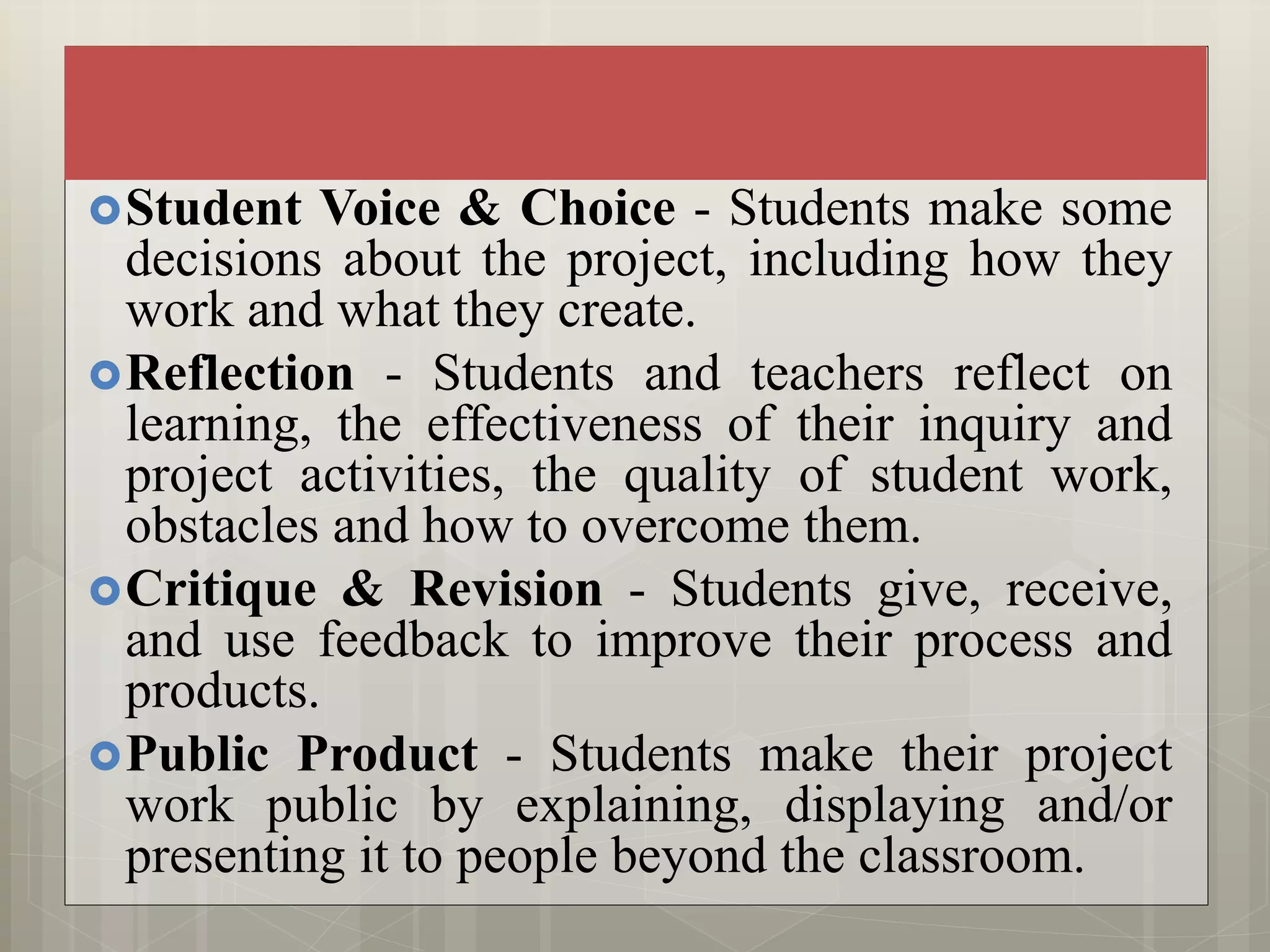
Student Voice & Choice - Students make some
decisions about the project, including how they
work and what they create.
Reflection - Students and teachers reflect on
learning, the effectiveness of their inquiry and
project activities, the quality of student work,
obstacles and how to overcome them.
Critique & Revision - Students give, receive,
and use feedback to improve their process and
products.
Public Product - Students make their project
work public by explaining, displaying and/or
presenting it to people beyond the classroom.
Characteristics of Project-based
Learning:
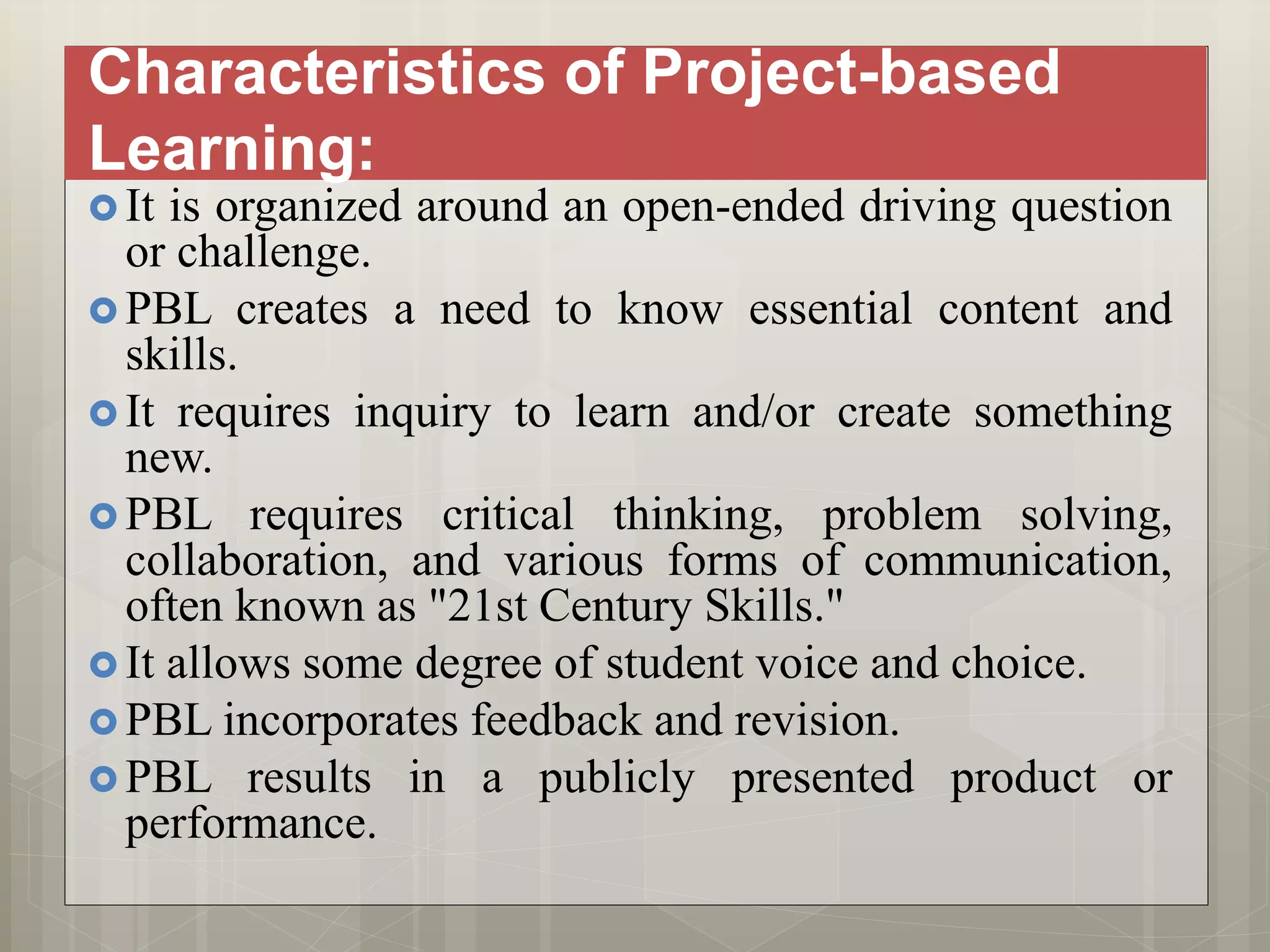
 It is organized around an open-ended driving question
or challenge.
 PBL creates a need to know essential content and
skills.
 It requires inquiry to learn and/or create something
new.
 PBL requires critical thinking, problem solving,
collaboration, and various forms of communication,
often known as "21st Century Skills."
 It allows some degree of student voice and choice.
 PBL incorporates feedback and revision.
 PBL results in a publicly presented product or
performance.
Elements
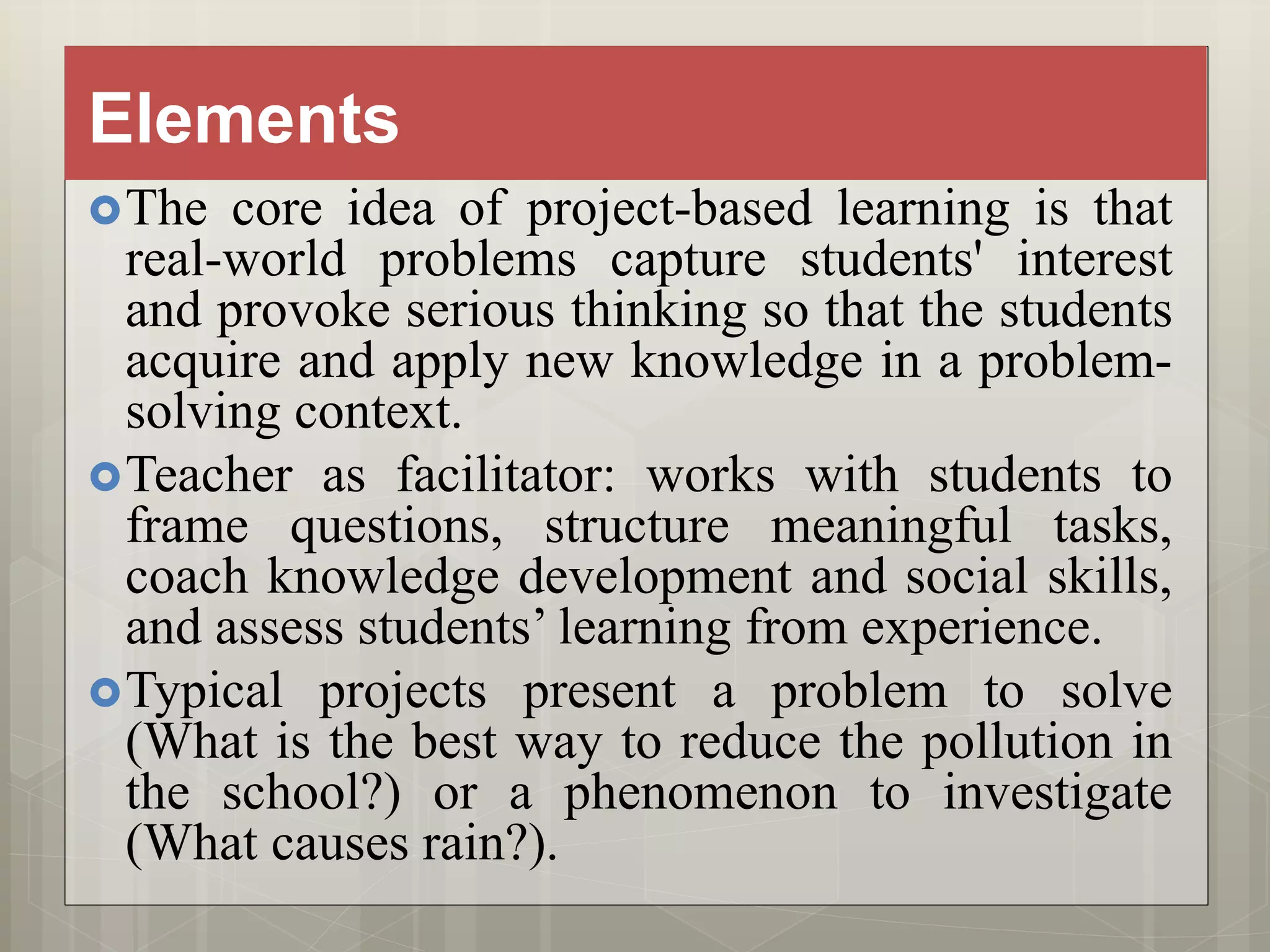
The core idea of project-based learning is that
real-world problems capture students' interest
and provoke serious thinking so that the students
acquire and apply new knowledge in a problem-
solving context.
Teacher as facilitator: works with students to
frame questions, structure meaningful tasks,
coach knowledge development and social skills,
and assess students’ learning from experience.
Typical projects present a problem to solve
(What is the best way to reduce the pollution in
the school?) or a phenomenon to investigate
(What causes rain?).
Roles
Student/s:
Determine their projects, encouraged to take
full responsibility for their learning.
This makes PBL a constructivist learning
method.
Students work together.
Use technology to communicate actively with
teacher and peers others.
The student is makes choices on obtaining,
displaying, or manipulating information.
Every student has the opportunity to get
involved either individually or as a group.
Student role is to ask questions, build
knowledge, and determine a real-world
solution to the issue/question presented.
Students must collaborate to expand their
skills and engage in focused communication.
Think rationally to solve problems.
PBL forces students to take ownership of their
success.
 Instructor role:
 As a facilitator.
 They develop an atmosphere of shared responsibility while
having the overall control of learning.
 Regulate student success with intermittent, transitional
goals to ensure student projects remain focused and
students have a deep understanding of the concepts being
investigated.
 The students are accountable to the goals through feedback
and assessments.
 The ongoing assessment and feedback to ensure the
student stays within the scope of the question and the core
standards the project.
 Evaluates the finished product and learning that it
demonstrates
Eight Features of Project-Based Learning
 Engages students in complex, real-world
issues and problems; where possible, the
students select and define issues or problems
that are meaningful to them.
 Requires students to use inquiry, research,
planning skills, critical thinking, and
problem-solving skills as they complete the
project
 Requires students to learn and apply content-
specific skills/standards and knowledge in a
variety of contexts as they work on the
project
 Provides opportunities for students to learn
and practice interpersonal skills as they work
in cooperative teams and, whenever possible,
with adults in workplaces or the community
 Gives students practice in using the array of
skills needed for their adult lives and careers
(how to allocate time/resources; individual
responsibility, interpersonal skills, learning
through experience, etc.)
 Includes expectations regarding
accomplishments/learning outcomes; these
are linked to the learning standards and
outcomes for the school/state and are stated at
the beginning of the project.
 Incorporates reflection activities that lead
students to think critically about their
experiences and to link those experiences to
specific learning standards
 Ends with a presentation or product that
demonstrates learning and is assessed; the
criteria could be decided upon by the
students.
Advantages of PBL
More important than learning content, students
need to learn to work in a community, thereby
taking on social responsibilities.
The most significant contributions of PBL have
been in schools in marginalized areas where,
when students take responsibility, or ownership,
for their learning, their self-esteem increases.
It also helps to create better work habits and
attitudes toward learning.
Although students do work in groups, they also
become more independent because they are
receiving little instruction from the teacher.
With Project-Based Learning students also learn
skills that are essential in higher education.
The students learn more than just finding
answers, PBL allows them to expand their minds
and think beyond what they normally would.
Students have to find answers to questions and
combine them using critically thinking skills to
come up with answers.
Technology allows learners to search in more
useful ways, along with getting more rapid
results.
Shortcomings of PBL
Unfocused and underdeveloped lessons can
result in the wasting of precious class time.
Lecture-style instruction can convey the same
knowledge in less class time.
Instructors can be misled into thinking that as
long as a student is engaged and doing, they
are learning.
If the project does not remain on task and
content driven the student will not be
successful in learning the material.
Complex projects need to be on track while
attending to students' individual learning needs.
A frequent criticism of PBL is that when students
work in groups some will sit back and let the
others do all the work.
PBL may be inappropriate in mathematics, as
mathematics is primarily skill-based at the
elementary level.
Not easy to measure success using standard
measurement tools.
In PBL there is also a certain tendency for the
creation of the final product of the project to
become the driving force in classroom activities.

PROJECT BASED LEARNING.pdf

  • 1.
    Project Based Learning (PBL) JammuUniversity 2 Year B.Ed. Paper 202/3 Sem: II This work is licensed under a Creative Commons Attribution-ShareAlike 4.0 International License.
  • 2.
    Project Based Learning(PBL) Project Based Learning is a teaching method in which students gain knowledge and skills by working for an extended period of time to investigate and respond to an engaging and complex question, problem, or challenge. Project-based learning (PBL) is a student- centered pedagogy that involves a dynamic classroom approach in which students acquire a deeper knowledge through active exploration of real-world challenges and problems. Students learn about a subject by working for an extended period of time to investigate and respond to a complex question, challenge, or problem.
  • 3.
    Definitions:  It isa style of active learning and inquiry-based learning.  PBL contrasts with paper-based, rote memorization, or teacher-led instruction that simply presents established facts or portrays a smooth path to knowledge by instead posing questions, problems or scenarios.  Thomas Markham (2011): Project-Based Learning (PBL) integrates knowing and doing. Students learn knowledge and elements of the core curriculum, but also apply what they know to solve authentic problems and produce results that matter. PBL refocuses education on the student, not the curriculum. These cannot be taught out of a textbook, but must be activated through experience."
  • 4.
    Structure PBL emphasizes long-term,interdisciplinary and student-centered learning activities. Students organize their own work and manage their own time in a project-based class. Project-based instruction differs from traditional inquiry by its emphasis on students' collaborative or individual artifact construction to represent what is being learned. Project-based learning also gives students the opportunity to explore problems and challenges that have real-world applications, increasing the possibility of long-term retention of skills and concepts.
  • 5.
    Essential elements ofPBL  Key Knowledge, Understanding, and Success Skills - The project is focused on student learning goals, including standards-based content and skills such as critical thinking/problem solving, collaboration, and self- management.  Challenging Problem or Question - The project is framed by a meaningful problem to solve or a question to answer, at the appropriate level of challenge.  Sustained Inquiry - Students engage in a rigorous, extended process of asking questions, finding resources, and applying information.  Authenticity - The project features real-world context, tasks and tools, quality standards, or impact – or speaks to students’ personal concerns, interests, and issues in their lives.
  • 6.
    Student Voice &Choice - Students make some decisions about the project, including how they work and what they create. Reflection - Students and teachers reflect on learning, the effectiveness of their inquiry and project activities, the quality of student work, obstacles and how to overcome them. Critique & Revision - Students give, receive, and use feedback to improve their process and products. Public Product - Students make their project work public by explaining, displaying and/or presenting it to people beyond the classroom.
  • 7.
    Characteristics of Project-based Learning: It is organized around an open-ended driving question or challenge.  PBL creates a need to know essential content and skills.  It requires inquiry to learn and/or create something new.  PBL requires critical thinking, problem solving, collaboration, and various forms of communication, often known as "21st Century Skills."  It allows some degree of student voice and choice.  PBL incorporates feedback and revision.  PBL results in a publicly presented product or performance.
  • 8.
    Elements The core ideaof project-based learning is that real-world problems capture students' interest and provoke serious thinking so that the students acquire and apply new knowledge in a problem- solving context. Teacher as facilitator: works with students to frame questions, structure meaningful tasks, coach knowledge development and social skills, and assess students’ learning from experience. Typical projects present a problem to solve (What is the best way to reduce the pollution in the school?) or a phenomenon to investigate (What causes rain?).
  • 9.
    Roles Student/s: Determine their projects,encouraged to take full responsibility for their learning. This makes PBL a constructivist learning method. Students work together. Use technology to communicate actively with teacher and peers others. The student is makes choices on obtaining, displaying, or manipulating information.
  • 10.
    Every student hasthe opportunity to get involved either individually or as a group. Student role is to ask questions, build knowledge, and determine a real-world solution to the issue/question presented. Students must collaborate to expand their skills and engage in focused communication. Think rationally to solve problems. PBL forces students to take ownership of their success.
  • 11.
     Instructor role: As a facilitator.  They develop an atmosphere of shared responsibility while having the overall control of learning.  Regulate student success with intermittent, transitional goals to ensure student projects remain focused and students have a deep understanding of the concepts being investigated.  The students are accountable to the goals through feedback and assessments.  The ongoing assessment and feedback to ensure the student stays within the scope of the question and the core standards the project.  Evaluates the finished product and learning that it demonstrates
  • 12.
    Eight Features ofProject-Based Learning  Engages students in complex, real-world issues and problems; where possible, the students select and define issues or problems that are meaningful to them.  Requires students to use inquiry, research, planning skills, critical thinking, and problem-solving skills as they complete the project
  • 13.
     Requires studentsto learn and apply content- specific skills/standards and knowledge in a variety of contexts as they work on the project  Provides opportunities for students to learn and practice interpersonal skills as they work in cooperative teams and, whenever possible, with adults in workplaces or the community
  • 14.
     Gives studentspractice in using the array of skills needed for their adult lives and careers (how to allocate time/resources; individual responsibility, interpersonal skills, learning through experience, etc.)  Includes expectations regarding accomplishments/learning outcomes; these are linked to the learning standards and outcomes for the school/state and are stated at the beginning of the project.
  • 15.
     Incorporates reflectionactivities that lead students to think critically about their experiences and to link those experiences to specific learning standards  Ends with a presentation or product that demonstrates learning and is assessed; the criteria could be decided upon by the students.
  • 16.
    Advantages of PBL Moreimportant than learning content, students need to learn to work in a community, thereby taking on social responsibilities. The most significant contributions of PBL have been in schools in marginalized areas where, when students take responsibility, or ownership, for their learning, their self-esteem increases. It also helps to create better work habits and attitudes toward learning. Although students do work in groups, they also become more independent because they are receiving little instruction from the teacher.
  • 17.
    With Project-Based Learningstudents also learn skills that are essential in higher education. The students learn more than just finding answers, PBL allows them to expand their minds and think beyond what they normally would. Students have to find answers to questions and combine them using critically thinking skills to come up with answers. Technology allows learners to search in more useful ways, along with getting more rapid results.
  • 18.
    Shortcomings of PBL Unfocusedand underdeveloped lessons can result in the wasting of precious class time. Lecture-style instruction can convey the same knowledge in less class time. Instructors can be misled into thinking that as long as a student is engaged and doing, they are learning. If the project does not remain on task and content driven the student will not be successful in learning the material.
  • 19.
    Complex projects needto be on track while attending to students' individual learning needs. A frequent criticism of PBL is that when students work in groups some will sit back and let the others do all the work. PBL may be inappropriate in mathematics, as mathematics is primarily skill-based at the elementary level. Not easy to measure success using standard measurement tools. In PBL there is also a certain tendency for the creation of the final product of the project to become the driving force in classroom activities.