LEARNING
PROJECT-BASED
GROUP 4
ACTIVITY
Identify if the given statement is a Problem-Based
Learning or Project-Based Learning.
Use the emoji if it is a Problem-Based Learning
and if itis a Project-Based Learning.
CHOOSE ME!
Identify if the given statement is a Problem-Based
Learning or Project-Based Learning.
Addressing Food Insecurity in Our Community
1.
Designing a Sustainable School Garden
2.
Saving Water at School
3.
Creating a Community Cookbook
4.
Community Garden Project
5.
Use the emoji if it is a Problem-Based Learning
and if itis a Project-Based Learning.
CONTENT
01
02
03
04
OBJECTIVES
DEFINITION OF PROJECT-BASED LEARNING
CHARACTERISTICS
EXAMPLE
05 BENEFITS
06
07
ISSUES AND CHALLENGES
DIFFERENCES
OBJECTIVES
discuss the salient features of problem-based learning and
project-based learning and their application to the attainment
of learning competencies and learning outcomes;
analyze how technologies for teaching and learning can be
maximized in problem-based learning and project-based
learning;
At the end of the lesson, you are expected to:
and share some performance standards from the Curriculum
Guide that can employ problem-based learning and project-
based learning.
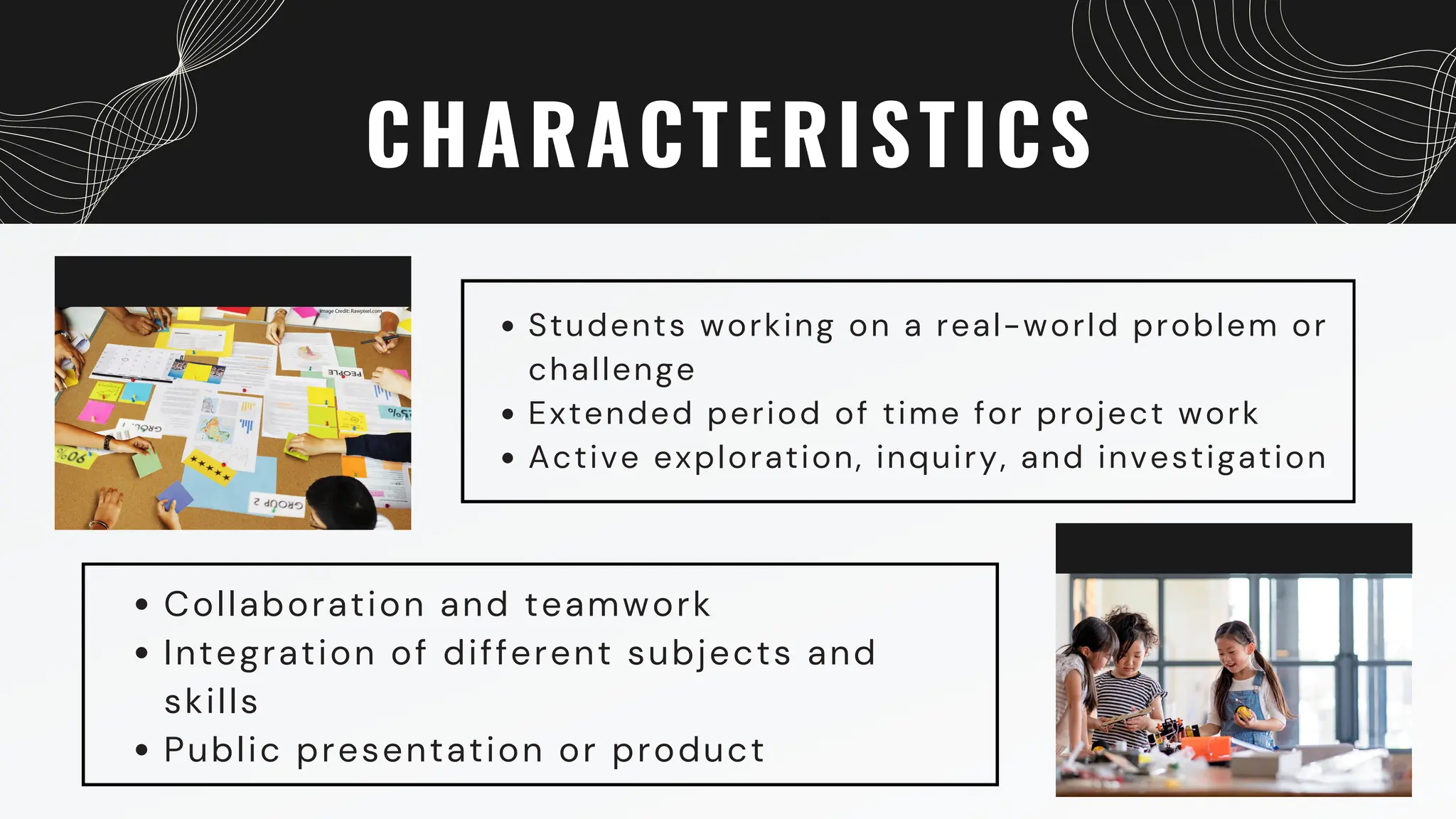
PROJECT-BASED LEARNING
An approach but has evolved as a teaching method
that engages learners in a series of planned tasks
resulting to the generation of solutions to real-
world problems.
Student-centered approach
Based on John Dewey's principle of learning by
doing and Vygotsky's constructivist theory of
learning that advocates social construction of
knowledge.
A collaborative learning activity where learners
work on an authentic task guided by an open-
ended question.
CHARACTERISTICS
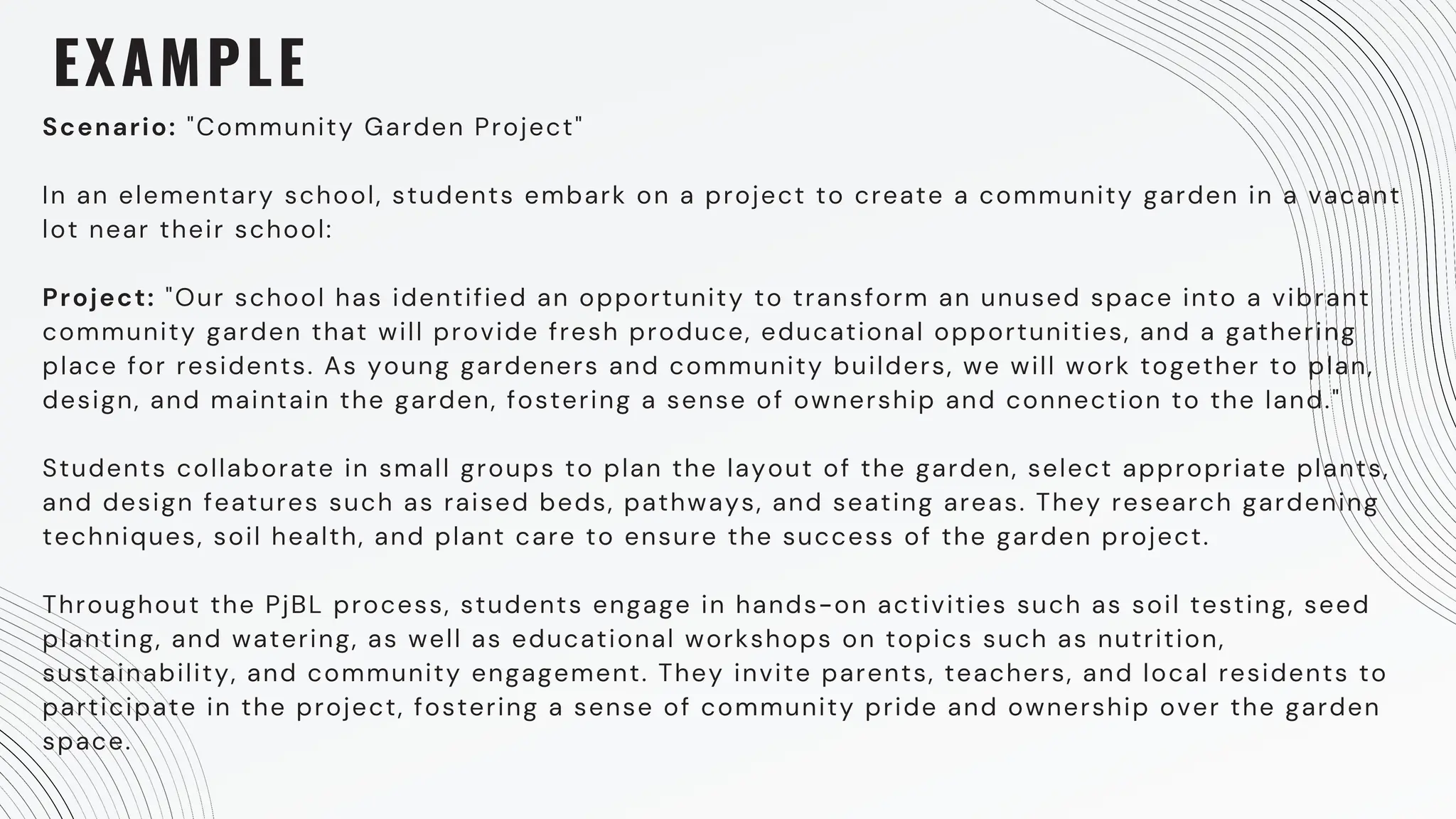
Students working on a real-world problem or
challenge
Extended period of time for project work
Active exploration, inquiry, and investigation
Collaboration and teamwork
Integration of different subjects and
skills
Public presentation or product
EXAMPLE
Scenario: "Community Garden Project"
In an elementary school, students embark on a project to create a community garden in a vacant
lot near their school:
Project: "Our school has identified an opportunity to transform an unused space into a vibrant
community garden that will provide fresh produce, educational opportunities, and a gathering
place for residents. As young gardeners and community builders, we will work together to plan,
design, and maintain the garden, fostering a sense of ownership and connection to the land."
Students collaborate in small groups to plan the layout of the garden, select appropriate plants,
and design features such as raised beds, pathways, and seating areas. They research gardening
techniques, soil health, and plant care to ensure the success of the garden project.
Throughout the PjBL process, students engage in hands-on activities such as soil testing, seed
planting, and watering, as well as educational workshops on topics such as nutrition,
sustainability, and community engagement. They invite parents, teachers, and local residents to
participate in the project, fostering a sense of community pride and ownership over the garden
space.
1. Research
methodology skills
(Tiwari, Arya, &
Bansal, 2017).
BENEFITS
2. Oral communicative
competence (Bakar,
Noordin, & Rali, 2019).
3. Development of
life skills (Wurdinger
& Qureshi, 2015).
1. RESEARCH METHODOLOGY SKILLS (TIWARI, ARYA, &
BANSAL, 2017).
Using student feedback questionnaire given to 99 students,
it was revealed that students knowledge of the topic taken,
searching review for the topic, communication skills, data
collection skills, and analytical and presentation skills were
enhanced. The teachers also perceived that PrBL could
cause 100% enhancement of knowledge on the various
components of research methodology, update of the
knowledge on a particular topic, and increase in interaction
with students.
2. ORAL COMMUNICATIVE COMPETENCE (BAKAR, NOORDIN,
& RALI, 2019).
The researchers investigated the effectiveness of using PrBL.
activities in the improvement of oral communicative
competencies of 44 Malaysian English language learners.
The study revealed a significant improvement in the
learners' overall oral communicative competence after a 12-
week intervention lessons using PrBL as a strategy. They also
concluded that PrBL as a teaching strategy is effective and
is recommended as suitable English language teaching
strategy especially for learners with low proficiency in the
English language.
3. DEVELOPMENT OF LIFE SKILLS (WURDINGER & QURESHI,
2015).
The study employed mixed-method to examine the
development of life skills through PrBL. Their findings
revealed that after taking the PBL course, there was a
significant difference in the mean scores for the following
life skills: responsibility, problem solving, self-direction,
communication, and creativity skills. it was concluded that
PrBL indeed promotes further development of life skills.
1. Time Management: Allocating
sufficient time for project work
while covering the curriculum.
ISSUES AND
CHALLENGES
2. Assessment: Designing
effective assessment strategies
for measuring student learning.
3. Student Engagement: Ensuring
all students are actively engaged
and find the project meaningful.
ISSUES AND
CHALLENGES
4. Group Dynamics: Managing
group work and resolving
conflicts within teams.
5. Resource Constraints: Dealing
with limited access to resources
and materials.
ISSUES AND
CHALLENGES
6. Curriculum Integration:
Aligning projects with academic
standards and learning
objectives.
7. Teacher Training and Support:
Providing teachers with adequate
training and ongoing support.
ISSUES AND
CHALLENGES
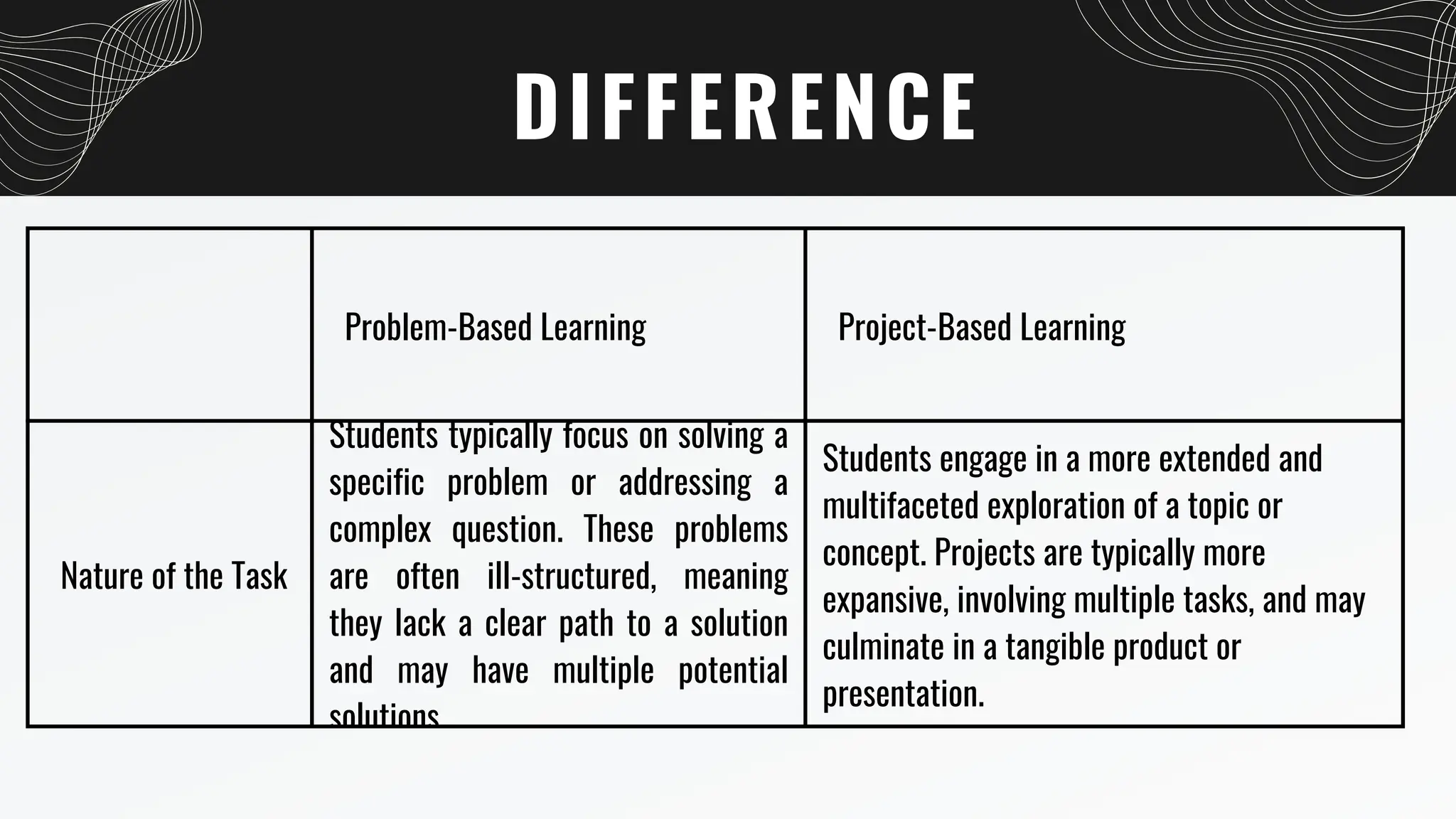
Problem-Based Learning Project-Based Learning
Nature of the Task
Students typically focus on solving a
specific problem or addressing a
complex question. These problems
are often ill-structured, meaning
they lack a clear path to a solution
and may have multiple potential
solutions
Students engage in a more extended and
multifaceted exploration of a topic or
concept. Projects are typically more
expansive, involving multiple tasks, and may
culminate in a tangible product or
presentation.
DIFFERENCE
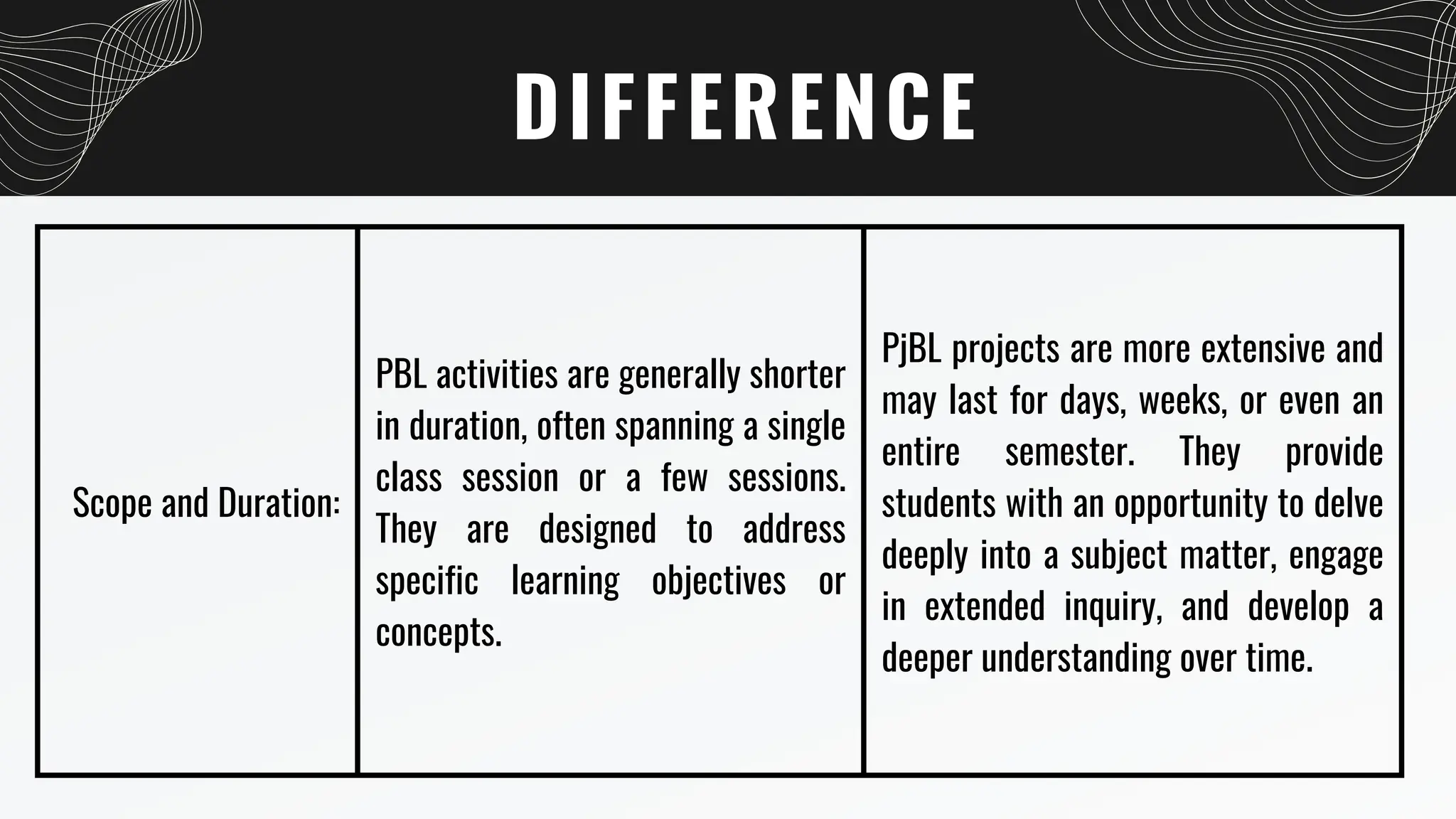
Scope and Duration:
PBL activities are generally shorter
in duration, often spanning a single
class session or a few sessions.
They are designed to address
specific learning objectives or
concepts.
PjBL projects are more extensive and
may last for days, weeks, or even an
entire semester. They provide
students with an opportunity to delve
deeply into a subject matter, engage
in extended inquiry, and develop a
deeper understanding over time.
DIFFERENCE
Structure
and
Guidance:
PBL often involves providing
students with a problem scenario
or casestudy and allowing them to
work independently or in small
groups to identify solutions or
approaches.
PjBL projects are typically more structured,
with clear guidelines, milestones, and
checkpoints. Teachers may provide more
scaffolding and support throughout the
project, guiding students through the
process and providing feedback along the
way.
DIFFERENCE
FACILITATING PROJECT-BASED LEARNING
This guide from Edutopia (2007) "How Does Project Learning Work?",
outlines key elements for understanding the process of planning and
undertaking project-based learning:
1. Start with the essential question: Use a real-world topic and devise a
question that poses a real-life situation or problem that students can tackle.
2. Design a plan for the project: Engage students in decision making so that
they have a sense of ownership from the outset; select activities that
support the question and utilise the curriculum; recognise what materials
and resources are available to support students.
3. Create a schedule: Design a Limeline for project components. This will
have some flexibility but is important to keep students on track.
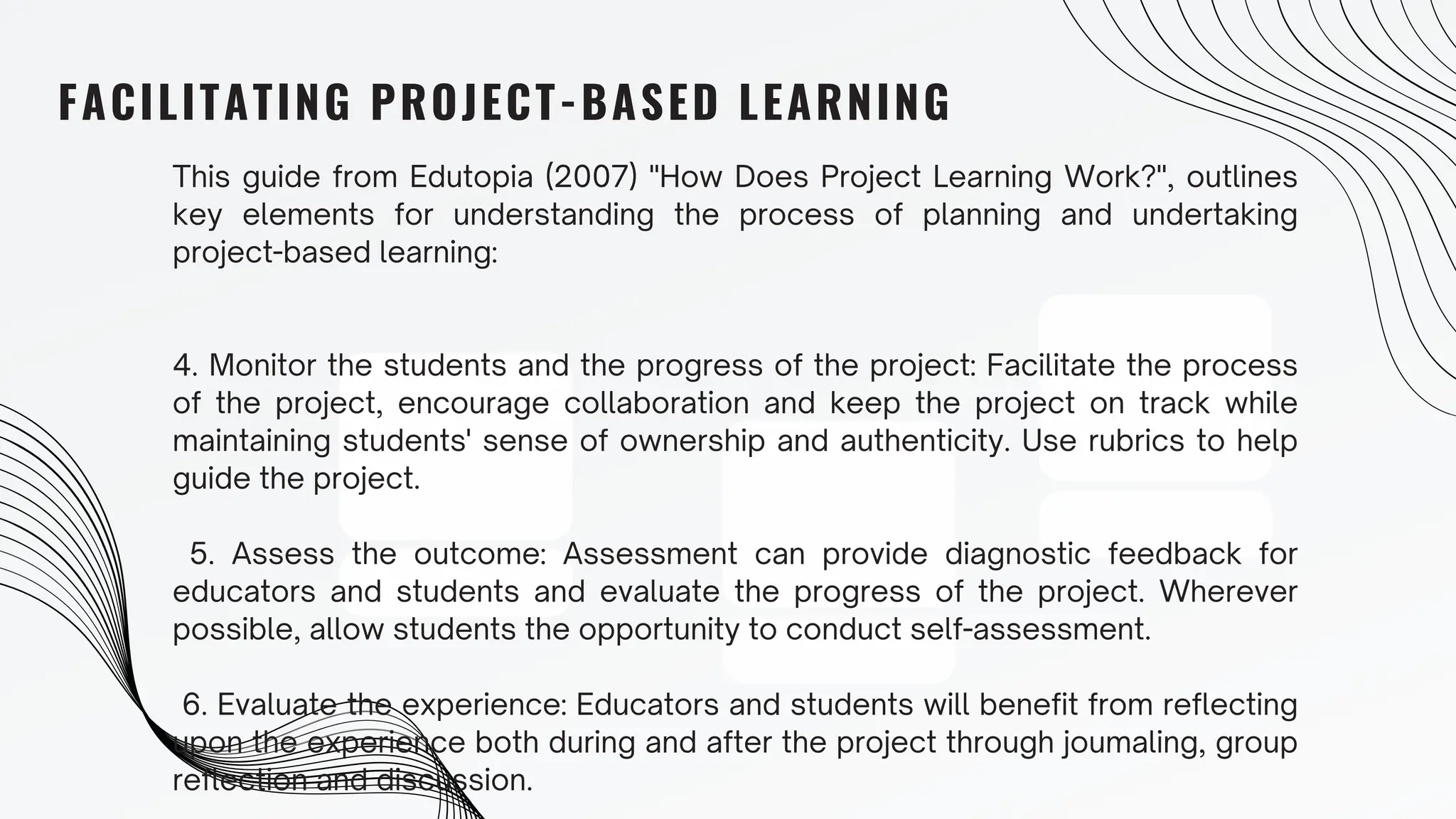
FACILITATING PROJECT-BASED LEARNING
This guide from Edutopia (2007) "How Does Project Learning Work?", outlines
key elements for understanding the process of planning and undertaking
project-based learning:
4. Monitor the students and the progress of the project: Facilitate the process
of the project, encourage collaboration and keep the project on track while
maintaining students' sense of ownership and authenticity. Use rubrics to help
guide the project.
5. Assess the outcome: Assessment can provide diagnostic feedback for
educators and students and evaluate the progress of the project. Wherever
possible, allow students the opportunity to conduct self-assessment.
6. Evaluate the experience: Educators and students will benefit from reflecting
upon the experience both during and after the project through joumaling, group
reflection and discussion.
GROUP 4
THANK'S FOR
LISTENING
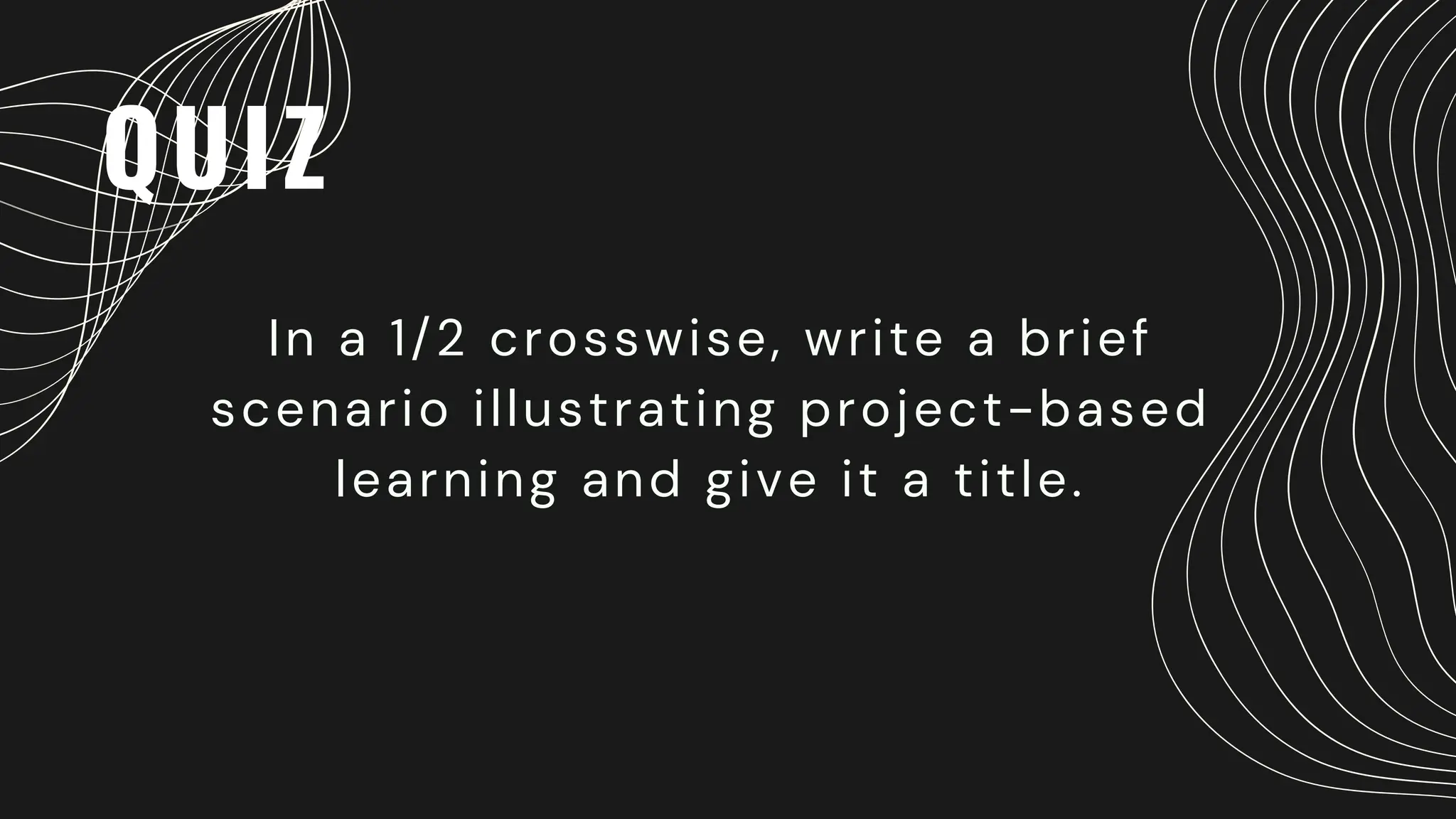
QUIZ
In a 1/2 crosswise, write a brief
scenario illustrating project-based
learning and give it a title.

TTL100E_GROUP PROJECT BASED LEARNING -4-ppt.pdf

  • 1.
  • 2.
  • 3.
    Identify if thegiven statement is a Problem-Based Learning or Project-Based Learning. Use the emoji if it is a Problem-Based Learning and if itis a Project-Based Learning. CHOOSE ME!
  • 4.
    Identify if thegiven statement is a Problem-Based Learning or Project-Based Learning. Addressing Food Insecurity in Our Community 1. Designing a Sustainable School Garden 2. Saving Water at School 3. Creating a Community Cookbook 4. Community Garden Project 5. Use the emoji if it is a Problem-Based Learning and if itis a Project-Based Learning.
  • 5.
    CONTENT 01 02 03 04 OBJECTIVES DEFINITION OF PROJECT-BASEDLEARNING CHARACTERISTICS EXAMPLE 05 BENEFITS 06 07 ISSUES AND CHALLENGES DIFFERENCES
  • 6.
    OBJECTIVES discuss the salientfeatures of problem-based learning and project-based learning and their application to the attainment of learning competencies and learning outcomes; analyze how technologies for teaching and learning can be maximized in problem-based learning and project-based learning; At the end of the lesson, you are expected to: and share some performance standards from the Curriculum Guide that can employ problem-based learning and project- based learning.
  • 7.
    PROJECT-BASED LEARNING An approachbut has evolved as a teaching method that engages learners in a series of planned tasks resulting to the generation of solutions to real- world problems. Student-centered approach Based on John Dewey's principle of learning by doing and Vygotsky's constructivist theory of learning that advocates social construction of knowledge. A collaborative learning activity where learners work on an authentic task guided by an open- ended question.
  • 8.
    CHARACTERISTICS Students working ona real-world problem or challenge Extended period of time for project work Active exploration, inquiry, and investigation Collaboration and teamwork Integration of different subjects and skills Public presentation or product
  • 9.
    EXAMPLE Scenario: "Community GardenProject" In an elementary school, students embark on a project to create a community garden in a vacant lot near their school: Project: "Our school has identified an opportunity to transform an unused space into a vibrant community garden that will provide fresh produce, educational opportunities, and a gathering place for residents. As young gardeners and community builders, we will work together to plan, design, and maintain the garden, fostering a sense of ownership and connection to the land." Students collaborate in small groups to plan the layout of the garden, select appropriate plants, and design features such as raised beds, pathways, and seating areas. They research gardening techniques, soil health, and plant care to ensure the success of the garden project. Throughout the PjBL process, students engage in hands-on activities such as soil testing, seed planting, and watering, as well as educational workshops on topics such as nutrition, sustainability, and community engagement. They invite parents, teachers, and local residents to participate in the project, fostering a sense of community pride and ownership over the garden space.
  • 10.
    1. Research methodology skills (Tiwari,Arya, & Bansal, 2017). BENEFITS 2. Oral communicative competence (Bakar, Noordin, & Rali, 2019). 3. Development of life skills (Wurdinger & Qureshi, 2015).
  • 11.
    1. RESEARCH METHODOLOGYSKILLS (TIWARI, ARYA, & BANSAL, 2017). Using student feedback questionnaire given to 99 students, it was revealed that students knowledge of the topic taken, searching review for the topic, communication skills, data collection skills, and analytical and presentation skills were enhanced. The teachers also perceived that PrBL could cause 100% enhancement of knowledge on the various components of research methodology, update of the knowledge on a particular topic, and increase in interaction with students.
  • 12.
    2. ORAL COMMUNICATIVECOMPETENCE (BAKAR, NOORDIN, & RALI, 2019). The researchers investigated the effectiveness of using PrBL. activities in the improvement of oral communicative competencies of 44 Malaysian English language learners. The study revealed a significant improvement in the learners' overall oral communicative competence after a 12- week intervention lessons using PrBL as a strategy. They also concluded that PrBL as a teaching strategy is effective and is recommended as suitable English language teaching strategy especially for learners with low proficiency in the English language.
  • 13.
    3. DEVELOPMENT OFLIFE SKILLS (WURDINGER & QURESHI, 2015). The study employed mixed-method to examine the development of life skills through PrBL. Their findings revealed that after taking the PBL course, there was a significant difference in the mean scores for the following life skills: responsibility, problem solving, self-direction, communication, and creativity skills. it was concluded that PrBL indeed promotes further development of life skills.
  • 14.
    1. Time Management:Allocating sufficient time for project work while covering the curriculum. ISSUES AND CHALLENGES 2. Assessment: Designing effective assessment strategies for measuring student learning.
  • 15.
    3. Student Engagement:Ensuring all students are actively engaged and find the project meaningful. ISSUES AND CHALLENGES 4. Group Dynamics: Managing group work and resolving conflicts within teams.
  • 16.
    5. Resource Constraints:Dealing with limited access to resources and materials. ISSUES AND CHALLENGES 6. Curriculum Integration: Aligning projects with academic standards and learning objectives.
  • 17.
    7. Teacher Trainingand Support: Providing teachers with adequate training and ongoing support. ISSUES AND CHALLENGES
  • 18.
    Problem-Based Learning Project-BasedLearning Nature of the Task Students typically focus on solving a specific problem or addressing a complex question. These problems are often ill-structured, meaning they lack a clear path to a solution and may have multiple potential solutions Students engage in a more extended and multifaceted exploration of a topic or concept. Projects are typically more expansive, involving multiple tasks, and may culminate in a tangible product or presentation. DIFFERENCE
  • 19.
    Scope and Duration: PBLactivities are generally shorter in duration, often spanning a single class session or a few sessions. They are designed to address specific learning objectives or concepts. PjBL projects are more extensive and may last for days, weeks, or even an entire semester. They provide students with an opportunity to delve deeply into a subject matter, engage in extended inquiry, and develop a deeper understanding over time. DIFFERENCE
  • 20.
    Structure and Guidance: PBL often involvesproviding students with a problem scenario or casestudy and allowing them to work independently or in small groups to identify solutions or approaches. PjBL projects are typically more structured, with clear guidelines, milestones, and checkpoints. Teachers may provide more scaffolding and support throughout the project, guiding students through the process and providing feedback along the way. DIFFERENCE
  • 21.
    FACILITATING PROJECT-BASED LEARNING Thisguide from Edutopia (2007) "How Does Project Learning Work?", outlines key elements for understanding the process of planning and undertaking project-based learning: 1. Start with the essential question: Use a real-world topic and devise a question that poses a real-life situation or problem that students can tackle. 2. Design a plan for the project: Engage students in decision making so that they have a sense of ownership from the outset; select activities that support the question and utilise the curriculum; recognise what materials and resources are available to support students. 3. Create a schedule: Design a Limeline for project components. This will have some flexibility but is important to keep students on track.
  • 22.
    FACILITATING PROJECT-BASED LEARNING Thisguide from Edutopia (2007) "How Does Project Learning Work?", outlines key elements for understanding the process of planning and undertaking project-based learning: 4. Monitor the students and the progress of the project: Facilitate the process of the project, encourage collaboration and keep the project on track while maintaining students' sense of ownership and authenticity. Use rubrics to help guide the project. 5. Assess the outcome: Assessment can provide diagnostic feedback for educators and students and evaluate the progress of the project. Wherever possible, allow students the opportunity to conduct self-assessment. 6. Evaluate the experience: Educators and students will benefit from reflecting upon the experience both during and after the project through joumaling, group reflection and discussion.
  • 23.
  • 24.
    QUIZ In a 1/2crosswise, write a brief scenario illustrating project-based learning and give it a title.