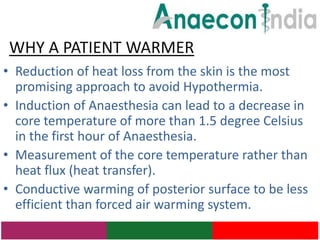
PATIENT WARMING
     SYSTEM:
        by
   Sarthak Jain
WHY A PATIENT WARMER
• Reduction of heat loss from the skin is the most
  promising approach to avoid Hypothermia.
• Induction of Anaesthesia can lead to a decrease in
  core temperature of more than 1.5 degree Celsius
  in the first hour of Anaesthesia.
• Measurement of the core temperature rather than
  heat flux (heat transfer).
• Conductive warming of posterior surface to be less
  efficient than forced air warming system.
HYPOTHERMIA - CONSEQUENCES
• Intra operative disturbance in coagulations.
• Raises post operative oxygen consumption due to
  shivering.
• Cardiac Morbidity
• Wound Infection
• Prolonged hospital stay
RISKS
•   Thermal Burns.
•   Active warming of ischemic areas to be avoided.
•   Post operative patient discomfort.
•   Bacterial Infection in the environment.
BLANKET USAGE
• Upper body blankets:
• During abdominal surgery and lower limb surgery.
• Covered area is 0.54sqm. Or 15-20% of body
  surface.
• Lower body blankets:
• During upper limb surgery and chest surgery.
• Covered are is 0.35sqm.
• Access blankets for specialised surgeries.
•   Full body blankets: (Non woven laminated fabric)
•   General purpose.
•   Paediatric blankets:
•   Used in neonatal and paediatric patients.
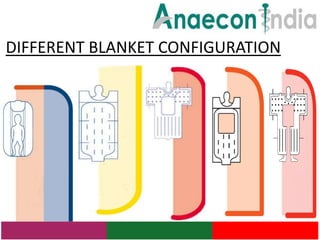
DIFFERENT BLANKET CONFIGURATION
COCOON: ADVANTAGES
• 1000 hours life HEPA filter
• Air pickup from sides
• Status Indicator
• Hose Cover
• Rapid induction of heat transfer
• Blankets with uniform micro porous holes
(26 holes/cm)
• Multi size and multi compatible blankets
THANKYOU


   www.anaeconindia.com
        Follow us on :
www.facebook.com/AnaeconIndia

Patient warming

  • 1.
    PATIENT WARMING SYSTEM: by Sarthak Jain
  • 2.
    WHY A PATIENTWARMER • Reduction of heat loss from the skin is the most promising approach to avoid Hypothermia. • Induction of Anaesthesia can lead to a decrease in core temperature of more than 1.5 degree Celsius in the first hour of Anaesthesia. • Measurement of the core temperature rather than heat flux (heat transfer). • Conductive warming of posterior surface to be less efficient than forced air warming system.
  • 3.
    HYPOTHERMIA - CONSEQUENCES •Intra operative disturbance in coagulations. • Raises post operative oxygen consumption due to shivering. • Cardiac Morbidity • Wound Infection • Prolonged hospital stay
  • 4.
    RISKS • Thermal Burns. • Active warming of ischemic areas to be avoided. • Post operative patient discomfort. • Bacterial Infection in the environment.
  • 5.
    BLANKET USAGE • Upperbody blankets: • During abdominal surgery and lower limb surgery. • Covered area is 0.54sqm. Or 15-20% of body surface. • Lower body blankets: • During upper limb surgery and chest surgery. • Covered are is 0.35sqm. • Access blankets for specialised surgeries.
  • 6.
    Full body blankets: (Non woven laminated fabric) • General purpose. • Paediatric blankets: • Used in neonatal and paediatric patients.
  • 7.
  • 8.
    COCOON: ADVANTAGES • 1000hours life HEPA filter • Air pickup from sides • Status Indicator • Hose Cover • Rapid induction of heat transfer • Blankets with uniform micro porous holes (26 holes/cm) • Multi size and multi compatible blankets
  • 9.
    THANKYOU www.anaeconindia.com Follow us on : www.facebook.com/AnaeconIndia