Patent ductus
arteriosus
Presented by
V. Pravallika
M.sc (N)
Lecturer
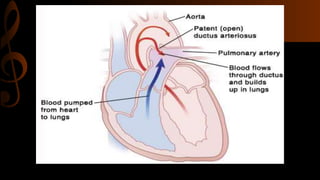
It is the persistent vascular connection between the
pulmonary artery and the aorta. functionally, the closure of
ductus arteriosus [which is normally present in fetal life]
occurs soon after birth. when ductus arteriosus remains
patent and open after birth, the blood flows in the ductus
from the aorta to the pulmonary artery due to higher
pressure in the aorta
Patent Ductus Arteriosus (PDA) is common in preterm
infants who weigh less than 1.5kg. it is the common type
in female baby and occurs approximately 11 percent of
CHDs.
Pathophysiology
In PDA, there is left to right shunt as blood flows from aorta
(higher pressure) to pulmonary artery (lower pressure)
leasing to pulmonary overload. thus oxygenated blood of
systemic circulation flows back to pulmonary circulation
resulting in increased vascular pressure in the pulmonary tree
and volume load on left heart in severe degree of PDA,
pulmonary vascular disease and pulmonary hypertension
may occur.
Clinical manifestations
• depends upon the size of ductus and its patency.
• Small and moderate size PDA are usually asymptomatic.
• Symptomatic cases manifested with
- tachypnea
- bounding pulse
- Corrigan pulsation in the neck
- dyspnea
- frequent respiratory infections
- there is increased systolic pressure and low diastolic pressure with wide pulse
pressure
- pericardial pain, hoarseness of voice, feeding difficulties, slow weight gain or
growth failure and CCF are common features of a child with PDA
Diagnostic evaluation
• History of illness and physical examination
• Auscultation of heart sound reveals continuous murmur (machinery murmur) heard at
second left intercostal space or below the left clavicle or lower down, i.e a left sternal
border. They may be paradoxical splitting of P2
• Chest X-ray
• 2D echocardiogram with Doppler study and color flow mapping and cardiac
catheterization can also be done to detect the extent of problems.
• ECG reveals left arterial dilation and left ventricular hypertrophy.
Management
Medical management:
• In symptomatic patient with PDA, Indomethacin,0.1 to 0.25
mg/kg/dose/I/V - over 30 minutes very slowly administered,
every 12 to 24 hours for 3 doses, for pharmacological closure of
ductus arteriosus. Antiprostaglandin agents, aspirin, ibuprofen
and mefanaic acid can also be used
- Supportive care is provided with rest, adequate intake of
calorie for weight gain and promotion of normal growth
and development with routine care. Emotional support to
the parents are essential.
- Conservative management of CCF and other associated
complications should be done with appropriate treatment
Surgical management
• Transection or ligation of patent ductus arteriosus via a lateral
thoracotomy, a closed heart intervention is performed. It is done
preferably between 3 and 10 years of age in asymptomatic patients and in
symptomatic patients, it should be done irrespective of age and in the
presence of pulmonary hypertension. The result of surgery is excellent.
Preoperative and post operative care for thoracic surgery to be provided
with all precautions.
Complications
• A child with PDA can have complications like CCF,
• infective endocarditis,
• pulmonary hypertension and pulmonary vascular occlusive
disease.
• Rarely, calcification of ductus,
• thromboembolism,
• rheumatic heart disease and
• eisenmenger syndrome may develop.
THE END

Patent ductus arteriosus

  • 1.
    Patent ductus arteriosus Presented by V.Pravallika M.sc (N) Lecturer
  • 2.
    It is thepersistent vascular connection between the pulmonary artery and the aorta. functionally, the closure of ductus arteriosus [which is normally present in fetal life] occurs soon after birth. when ductus arteriosus remains patent and open after birth, the blood flows in the ductus from the aorta to the pulmonary artery due to higher pressure in the aorta
  • 3.
    Patent Ductus Arteriosus(PDA) is common in preterm infants who weigh less than 1.5kg. it is the common type in female baby and occurs approximately 11 percent of CHDs.
  • 5.
  • 6.
    In PDA, thereis left to right shunt as blood flows from aorta (higher pressure) to pulmonary artery (lower pressure) leasing to pulmonary overload. thus oxygenated blood of systemic circulation flows back to pulmonary circulation resulting in increased vascular pressure in the pulmonary tree and volume load on left heart in severe degree of PDA, pulmonary vascular disease and pulmonary hypertension may occur.
  • 7.
    Clinical manifestations • dependsupon the size of ductus and its patency. • Small and moderate size PDA are usually asymptomatic. • Symptomatic cases manifested with - tachypnea - bounding pulse - Corrigan pulsation in the neck - dyspnea - frequent respiratory infections - there is increased systolic pressure and low diastolic pressure with wide pulse pressure - pericardial pain, hoarseness of voice, feeding difficulties, slow weight gain or growth failure and CCF are common features of a child with PDA
  • 8.
    Diagnostic evaluation • Historyof illness and physical examination • Auscultation of heart sound reveals continuous murmur (machinery murmur) heard at second left intercostal space or below the left clavicle or lower down, i.e a left sternal border. They may be paradoxical splitting of P2 • Chest X-ray • 2D echocardiogram with Doppler study and color flow mapping and cardiac catheterization can also be done to detect the extent of problems. • ECG reveals left arterial dilation and left ventricular hypertrophy.
  • 9.
    Management Medical management: • Insymptomatic patient with PDA, Indomethacin,0.1 to 0.25 mg/kg/dose/I/V - over 30 minutes very slowly administered, every 12 to 24 hours for 3 doses, for pharmacological closure of ductus arteriosus. Antiprostaglandin agents, aspirin, ibuprofen and mefanaic acid can also be used
  • 10.
    - Supportive careis provided with rest, adequate intake of calorie for weight gain and promotion of normal growth and development with routine care. Emotional support to the parents are essential. - Conservative management of CCF and other associated complications should be done with appropriate treatment
  • 11.
    Surgical management • Transectionor ligation of patent ductus arteriosus via a lateral thoracotomy, a closed heart intervention is performed. It is done preferably between 3 and 10 years of age in asymptomatic patients and in symptomatic patients, it should be done irrespective of age and in the presence of pulmonary hypertension. The result of surgery is excellent. Preoperative and post operative care for thoracic surgery to be provided with all precautions.
  • 12.
    Complications • A childwith PDA can have complications like CCF, • infective endocarditis, • pulmonary hypertension and pulmonary vascular occlusive disease. • Rarely, calcification of ductus, • thromboembolism, • rheumatic heart disease and • eisenmenger syndrome may develop.
  • 13.