PPaatteenntt DDuuccttuuss AArrtteerriioossuuss 
Dr. Shamshuddin Patel Sr.
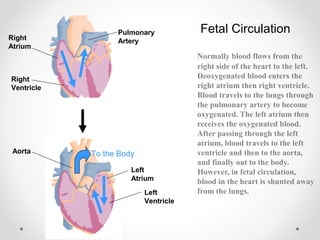
Normally blood flows from the 
right side of the heart to the left. 
Deoxygenated blood enters the 
right atrium then right ventricle. 
Blood travels to the lungs through 
the pulmonary artery to become 
oxygenated. The left atrium then 
receives the oxygenated blood. 
After passing through the left 
atrium, blood travels to the left 
ventricle and then to the aorta, 
and finally out to the body. 
However, in fetal circulation, 
blood in the heart is shunted away 
from the lungs. 
To the Body 
Right 
Atrium 
Right 
Ventricle 
Pulmonary 
Artery 
Aorta 
Left 
Atrium 
Left 
Ventricle 
Fetal Circulation
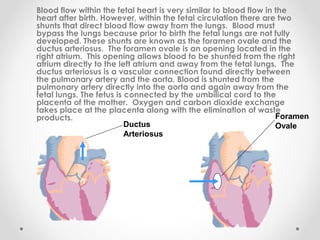
Blood flow within the fetal heart is very similar to blood flow in the 
heart after birth. However, within the fetal circulation there are two 
shunts that direct blood flow away from the lungs. Blood must 
bypass the lungs because prior to birth the fetal lungs are not fully 
developed. These shunts are known as the foramen ovale and the 
ductus arteriosus. The foramen ovale is an opening located in the 
right atrium. This opening allows blood to be shunted from the right 
atrium directly to the left atrium and away from the fetal lungs. The 
ductus arteriosus is a vascular connection found directly between 
the pulmonary artery and the aorta. Blood is shunted from the 
pulmonary artery directly into the aorta and again away from the 
fetal lungs. The fetus is connected by the umbilical cord to the 
placenta of the mother. Oxygen and carbon dioxide exchange 
takes place at the placenta along with the elimination of waste 
products. 
Ductus 
Arteriosus 
Foramen 
Ovale
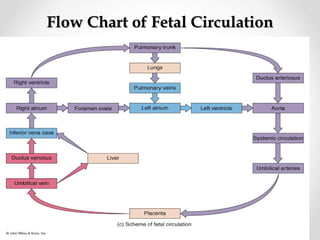
FFllooww CChhaarrtt ooff FFeettaall CCiirrccuullaattiioonn
WWhhaatt MMaajjoorr CChhaannggeess iinn IInnffaanntt 
CCiirrccuullaattiioonn ooccccuurr ffoolllloowwiinngg bbiirrtthh?? 
• Lungs: 
o Lungs expand 
o PaO2↑’s Pulmonary vasodilatation 
o Drop in pulmonary vascular resistance. 
• Systemic Circulation: 
o Resistance ↑’s with placental removal 
• PDA: 
o flow reverses to L R shunting 
o Begins to functionally close due to ↑ PaO2, and decreased PGE2 levels
PPhhyyssiioollooggyy 
• Ductus Arteriosus closes within few hours after birth. 
• It occurs by 2 phases: Functional Closure and 
Anatomical Closure 
• Functional Closure: Occurs in 1st few hours of life. It 
occurs by vasoconstriction of DA. This depends on 
balance between Dilating and Contracting forces. 
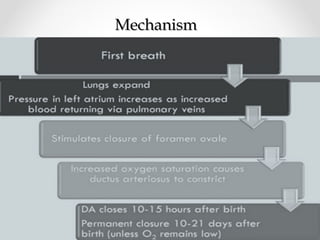
o Mechanism: After delivery, increased PO2 and increased intrinsic tone of 
DA causes DA constriction. 
• After Birth, Factors causing DA constriction: 
o Increased O2 
o Decreased BP due to Decreased Pulmonary Vascular Resistance 
o Decreased PGE2 due to Decreased placental PG synthesis and increased 
removal of PG by lungs.
Anatomical Closure: 
it occurs due to : 
Initial Vasoconstriction of DA, causes DA wall Ischemia, which leads to loss of 
smooth muscle cells from tunica media along with increased local 
production of growth factors like Vascular Endothelial GF and Transforming 
GF-B.
HHIISSTTOOLLOOGGYY 
The smooth muscular layer fibers are 
arranged in cylindrical layers spiraling in 
opposite directions. 
There is increased mucoid substance in the 
intimal layer.
MMeecchhaanniissmm
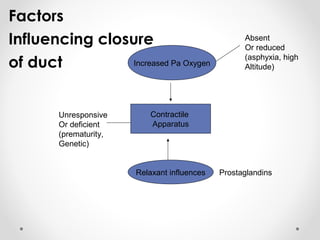
Factors 
Influencing closure 
of duct 
Increased Pa Oxygen 
Contractile 
Apparatus 
Absent 
Or reduced 
(asphyxia, high 
Altitude) 
Relaxant influences Prostaglandins 
Unresponsive 
Or deficient 
(prematurity, 
Genetic)
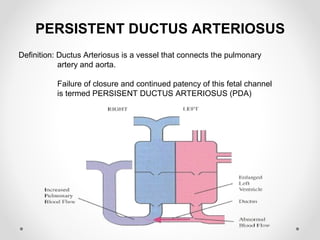
PERSISTENT DUCTUS ARTERIOSUS 
Definition: Ductus Arteriosus is a vessel that connects the pulmonary 
artery and aorta. 
Failure of closure and continued patency of this fetal channel 
is termed PERSISENT DUCTUS ARTERIOSUS (PDA)
IInncciiddeennccee 
 1/2000 births 
 5% to 10% of CHD 
 With silent PDA ,Incidence is 1:500 
 F>M(2:1)
EEttiioollooggiicc ffaaccttoorrss 
• Sporadic 
• Multifocal (genetic + environmental + low 
O2(Asphyxia),rubella(First 4 weeks)/chemicals) 
 Chromosomal aberrations : Trisomy 21 
 Single-gene mutations : Holt-Oram syndrome/ Char 
syndrome(TFAP2B mutations ) 
 X-linked mutations
FFaaccttoorrss wwiitthh iinnccrreeaasseedd iinncciiddeennccee 
Prematurity: Inversely related to gestational age. 
Found in approx. 45% of infants <1750gm 
80% of infants <1000gm 
RDS: Correlated with severity of RDS. After surfactant 
treatment increased risk of clinically symptomatic 
PDA 
Fluid overload 
Asphyxia
FFaaccttoorrss wwiitthh ddeeccrreeaasseedd iinncciiddeennccee 
Antenatal steroid administration 
IUGR 
Prolonged rupture of membranes
NNaattuurraall HHiissttoorryy 
• Spontaneous closure may be delayed until 3 
months of life, after which the closure rate is less 
than 0.6%/Year 
• Silent PDA remain undetected for life 
• Premature : Closure could be delayed up to 1 year 
and more PDA 
• Sibling :1% and 5% 
• Parents:3% 
• Persistent patency of the ductus arteriosus following 
birth is inversely related to gestational age. 
• This may be due to the smaller amount of muscular 
tissue in the media with lower intrinsic tone, and 
lower responsiveness to oxygen but higher 
sensitivity to the vasodilating effects of 
prostaglandin E2 and nitric oxide.
RReeooppeenniinngg ooff aa CCoonnssttrriicctteedd DDuuccttuuss 
• Before true anatomic closure occurs, the 
functionally closed Ductus may be dilated by a 
reduced arterial Po2 or an increased PGE2 
concentration. The reopening of the constricted 
Ductus may occur in asphyxia and various 
pulmonary diseases (as hypoxia and acidosis relax 
ductal tissues).
PPaatthhoopphhyyssiioollooggyy 
 Small PDA : Asymptomatic throughout life. Accidental detection 
by ECHO for murmur 
 Moderate PDA: Compensate well throughout childhood and may 
remain completely asymptomatic in early adulthood but will 
eventually present with exercise intolerance and symptoms 
related to left ventricular 
failure, usually starting in the third decade. 
 Moderate to large: Large volume of blood leads to the very early 
development of pulmonary congestion, decreased lung 
compliance, and failure of the left ventricle, often presenting 
within weeks after birth with failure to thrive, recurrent pulmonary 
infections, and even death. Pulmonary overcirculation remains 
uncorrected, the arteriolar medial hypertrophy, intimal 
proliferation, and eventual obliteration of pulmonary arterioles 
and capillaries will lead to an irreversible marked increase in 
pulmonary arterial pressure. When pulmonary vascular resistance 
exceeds the systemic vascular resistance, ductal shunting is 
reversed and becomes right to left (Eisenmenger syndrome)

CClliinniiccaall MMaanniiffeessttaattiioonnss 
• A small patent ductus does not usually have any 
symptoms associated with it. 
• A large PDA will result in heart failure. Retardation of 
physical growth may be a major manifestation in 
infants with large shunts. 
• A large PDA will result in striking physical signs 
attributable to the wide pulse pressure, most 
prominently, bounding peripheral arterial pulses. 
• The heart is normal in size when the ductus is small, 
but moderately or grossly enlarged in cases with a 
large communication. 
• The apical impulse is prominent and, with cardiac 
enlargement, it is heaving.
CClliinniiccaall MMaanniiffeessttaattiioonnss 
• A thrill, maximal in the 2nd left interspace, is often 
present and may radiate toward the left clavicle, 
down the left sternal border, or toward the apex. It is 
usually systolic but may also be palpated 
throughout the cardiac cycle. 
• The classical continuous murmur is described as 
being like machinery or rolling thunder in quality. It 
begins soon after onset of the 1st sound, reaches 
maximal intensity at the end of systole, and wanes 
in late diastole. It may be localized to the 2nd left 
intercostal space or radiate down the left sternal 
border or to the left clavicle. When pulmonary 
vascular resistance is increased, the diastolic 
component of the murmur may be less prominent or 
absent
Model Case 
• Called to the bedside of a 5 day old 25 week infant 
with worsening respiratory distress. He is requiring 
higher O2 settings and continues to have multiple 
desaturations despite increased ventilator settings
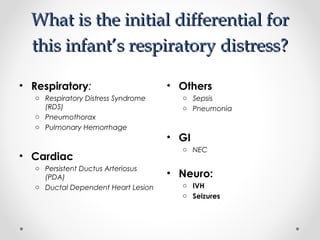
What iiss tthhee iinniittiiaall ddiiffffeerreennttiiaall ffoorr 
tthhiiss iinnffaanntt’’ss rreessppiirraattoorryy ddiissttrreessss?? 
• Respiratory: 
o Respiratory Distress Syndrome 
(RDS) 
o Pneumothorax 
o Pulmonary Hemorrhage 
• Cardiac 
o Persistent Ductus Arteriosus 
(PDA) 
o Ductal Dependent Heart Lesion 
• Others 
o Sepsis 
o Pneumonia 
• GI 
o NEC 
• Neuro: 
o IVH 
o Seizures
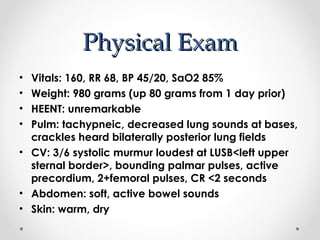
PPhhyyssiiccaall EExxaamm 
• Vitals: 160, RR 68, BP 45/20, SaO2 85% 
• Weight: 980 grams (up 80 grams from 1 day prior) 
• HEENT: unremarkable 
• Pulm: tachypneic, decreased lung sounds at bases, 
crackles heard bilaterally posterior lung fields 
• CV: 3/6 systolic murmur loudest at LUSB<left upper 
sternal border>, bounding palmar pulses, active 
precordium, 2+femoral pulses, CR <2 seconds 
• Abdomen: soft, active bowel sounds 
• Skin: warm, dry
WWhhaatt iiss tthhee lliikkeellyy ccaauussee ooff tthhiiss 
iinnffaannttss rreessppiirraattoorryy ddiissttrreessss?? 
A. Respiratory Distress Syndrome 
B. PDA 
C. Sepsis 
D. NEC
What is tthhee lliikkeellyy ccaauussee ooff tthhiiss 
iinnffaannttss rreessppiirraattoorryy ddiissttrreessss?? 
A. Respiratory Distress Syndrome 
B. PDA 
C. Sepsis 
D. NEC
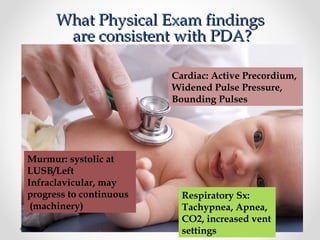
WWhhaatt PPhhyyssiiccaall EExxaamm ffiinnddiinnggss 
aarree ccoonnssiisstteenntt wwiitthh PPDDAA?? 
Murmur: systolic at 
LUSB/Left 
Infraclavicular, may 
progress to continuous 
(machinery) 
Cardiac: Active Precordium, 
Widened Pulse Pressure, 
Bounding Pulses 
Respiratory Sx: 
Tachypnea, Apnea, 
CO2, increased vent 
settings
What ffuurrtthheerr ddiiaaggnnoossttiicc ssttuuddiieess 
ccoouulldd bbee ddoonnee ttoo ccoonnffiirrmm tthhiiss?? 
• CXR 
• Echocardiogram
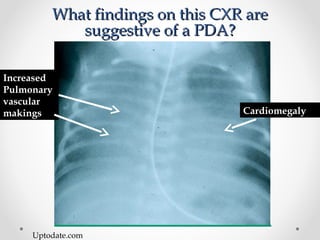
WWhhaatt ffiinnddiinnggss oonn tthhiiss CCXXRR aarree 
ssuuggggeessttiivvee ooff aa PPDDAA?? 
Increased 
Pulmonary 
vascular 
makings Cardiomegaly 
Uptodate.com
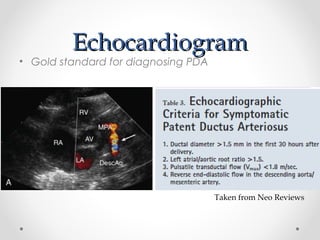
EEcchhooccaarrddiiooggrraamm 
• Gold standard for diagnosing PDA 
Taken from Neo Reviews
WWhhiicchh IInnffaannttss aarree aatt 
ggrreeaatteesstt rriisskk?? 
• The Youngest: risk increases with decreasing 
gestational age 
• The Smallest: 80% of ELBW infants (BW <1000g) with a 
murmur progress to large persistent PDAs
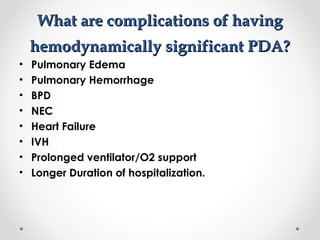
WWhhaatt aarree ccoommpplliiccaattiioonnss ooff hhaavviinngg 
hheemmooddyynnaammiiccaallllyy ssiiggnniiffiiccaanntt PPDDAA?? 
• Pulmonary Edema 
• Pulmonary Hemorrhage 
• BPD 
• NEC 
• Heart Failure 
• IVH 
• Prolonged ventilator/O2 support 
• Longer Duration of hospitalization.
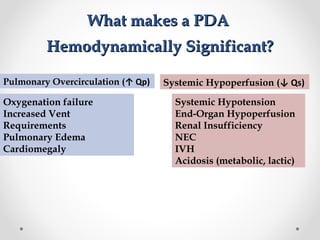
WWhhaatt mmaakkeess aa PPDDAA 
HHeemmooddyynnaammiiccaallllyy SSiiggnniiffiiccaanntt?? 
Pulmonary Overcirculation (↑ Qp) Systemic Hypoperfusion (↓ Qs) 
Systemic Hypotension 
End-Organ Hypoperfusion 
Renal Insufficiency 
NEC 
IVH 
Acidosis (metabolic, lactic) 
Oxygenation failure 
Increased Vent 
Requirements 
Pulmonary Edema 
Cardiomegaly
WWhhaatt aarree tthhrreeee mmaaiinn 
ooppttiioonnss ffoorr ttrreeaattmmeenntt?? 
1. Conservative/Supportive Management 
2. Pharmacotherapy 
3. Surgery
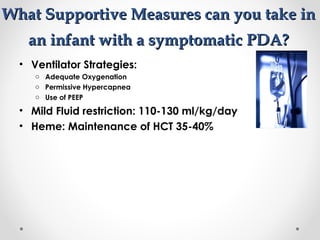
WWhhaatt SSuuppppoorrttiivvee MMeeaassuurreess ccaann yyoouu ttaakkee iinn 
aann iinnffaanntt wwiitthh aa ssyymmppttoommaattiicc PPDDAA?? 
• Ventilator Strategies: 
o Adequate Oxygenation 
o Permissive Hypercapnea 
o Use of PEEP 
• Mild Fluid restriction: 110-130 ml/kg/day 
• Heme: Maintenance of HCT 35-40%
PPhhaarrmmaaccootthheerraappyy 
• What 2 agents are typically used? 
o Indomethacin 
o Ibuprofen
IInnddoommeetthhaacciinn • MOA: 
o Cyclooxygenase inhibitor 
o COX enzyme necessary for generating PGE2 (potent vasodilator) 
• Adverse-Effects: 
o reduces cerebral, gastrointestinal, and renal blood flow 
o Decreased urine output 
o Platelet dysfunction 
• Would you continue/start feeds on this infant? 
o given concern for increased risk of NEC many neonatologists hold feeds 
during indomethacin therapy
Prophylactic: 
Timing: usually within 1st 24 hours of life. 
Indication: All infant <1250gm birth weight who have 
respiratory distress. 
Therapeutic: 
Timing: usually within 1st 14 days of life. 
Indications: 
1. If there is any clinical sign of PDA In preterm baby. 
2. There are signs of overt failure or congestive cardiac failure. 
3. Re-treatment after failure of the first course indomethacin. 
4. Recurrence of PDA after first course of indomethacin.
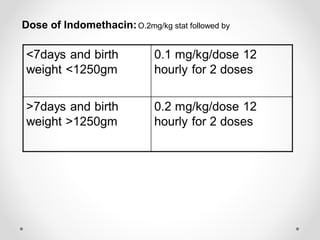
Dose of Indomethacin: O.2mg/kg stat followed by
IIbbuupprrooffeenn 
Dose: 
Initial dose of 10mg/kg followed at 24 hour 
intervals by two doses of 5mg/kg. 
As Ibuprofen has less Adverse effect than 
Indomethacin, So Ibuprofen is superior than 
Indomethacin.
WWhhaatt aarree ssoommee ccoonnttrraaiinnddiiccaattiioonnss ttoo 
iinnddoommeetthhaacciinn?? 
 Proven/ suspected infection 
 Active bleeding 
 e.g. IVH, NEC 
 Thrombocytopenia and/or coagulation defects 
 Necrotizing enterocolitis 
 Severe Renal Impairment 
 Congenital heart disease with ductal dependent 
lesion
CCoommpplliiccaattiioonnss ttoo wwaattcchh ffoorr…… 
• What are you going to instruct the Nurse to notify you 
about in this patient? 
o Decreased Urine Output 
• Indocin should be held if UrineOutPut < 1 ml/kg/h 
o Abdominal Changes 
o Signs/Sx of bleeding 
• Are there any labs you would like to check before/after 
starting indomethacin? 
o CBC: to check platelets 
o BMP: to check BUN and Creatinine
After ttwwoo ttrriiaallss ooff iinnddoommeetthhaacciinn yyoouurr 
ppaattiieenntt ssttiillll hhaass aa ssyymmppttoommaattiicc PPDDAA 
wwhhaatt nneexxtt sstteeppss mmiigghhtt yyoouu ttaakkee?? 
• Continue supportive therapy through ventilator and 
fluid management 
• If infant continues to require high ventilator support 
and echo demonstrates a large PDA consider 
surgical ligation
SSuurrggiiccaall LLiiggaattiioonn • Indications? 
o Persistent Symptomatic PDA after 1-2 trials of Indomethacin or Motrin 
o Contraindication to Indomethacin or Motrin 
• Complications? 
o recurrent laryngeal nerve paralysis 
o blood pressure fluctuations 
o respiratory compromise 
o infection 
o intraventricular hemorrhage 
o chylothorax 
o BPD 
o Death 
• Timing: After 6months of age. 
• Procedure: ligation and division of ductus via 
thoracotomy.
SSuurrggiiccaall LLiiggaattiioonn 
• Long Term Outcomes 
o Current studies do not demonstrate that ligation 
decreases incidence of BPD 
o Some data to suggest infants that have surgical ligation 
are at greater risk for neurocognitive delays 
• Surgery should only be used for infants that have 
failed medical management and are symptomatic
RReeffeerreenncceess:: 
• Chorne N, Leonard C, Piecuch R, Clyman RI. Patent 
ductus arteriosus and its treatment as risk factors for 
neonatal and neurodevelopmental morbidity. Pediatrics. 
2007;119(6):1165. 
• Gien, J. Controversied in the Management of Patent 
Ductus Arteriosus. Neoreviews 2008: 9, 477-482 
• Masalli, R. Optimal Fluid Management in Premature 
Infants with PDA. Neoreviews 2010; 11: 495-502 
• Philips , Joseph B. Management of patent ductus 
arteriosus in premature infants. UptoDate ( 
www.uptodate.com) 
• Phillips, J. Pathophysiology, clinical manifestations, and 
diagnosis of patent ductus arteriosus in premature 
infants. UptoDate (www.uptodate.com) 
• Nelson Text Book of Pediatrics

Patent Ductus Arteriosus

  • 1.
  • 2.
    Normally blood flowsfrom the right side of the heart to the left. Deoxygenated blood enters the right atrium then right ventricle. Blood travels to the lungs through the pulmonary artery to become oxygenated. The left atrium then receives the oxygenated blood. After passing through the left atrium, blood travels to the left ventricle and then to the aorta, and finally out to the body. However, in fetal circulation, blood in the heart is shunted away from the lungs. To the Body Right Atrium Right Ventricle Pulmonary Artery Aorta Left Atrium Left Ventricle Fetal Circulation
  • 3.
    Blood flow withinthe fetal heart is very similar to blood flow in the heart after birth. However, within the fetal circulation there are two shunts that direct blood flow away from the lungs. Blood must bypass the lungs because prior to birth the fetal lungs are not fully developed. These shunts are known as the foramen ovale and the ductus arteriosus. The foramen ovale is an opening located in the right atrium. This opening allows blood to be shunted from the right atrium directly to the left atrium and away from the fetal lungs. The ductus arteriosus is a vascular connection found directly between the pulmonary artery and the aorta. Blood is shunted from the pulmonary artery directly into the aorta and again away from the fetal lungs. The fetus is connected by the umbilical cord to the placenta of the mother. Oxygen and carbon dioxide exchange takes place at the placenta along with the elimination of waste products. Ductus Arteriosus Foramen Ovale
  • 4.
    FFllooww CChhaarrtt ooffFFeettaall CCiirrccuullaattiioonn
  • 5.
    WWhhaatt MMaajjoorr CChhaannggeessiinn IInnffaanntt CCiirrccuullaattiioonn ooccccuurr ffoolllloowwiinngg bbiirrtthh?? • Lungs: o Lungs expand o PaO2↑’s Pulmonary vasodilatation o Drop in pulmonary vascular resistance. • Systemic Circulation: o Resistance ↑’s with placental removal • PDA: o flow reverses to L R shunting o Begins to functionally close due to ↑ PaO2, and decreased PGE2 levels
  • 6.
    PPhhyyssiioollooggyy • DuctusArteriosus closes within few hours after birth. • It occurs by 2 phases: Functional Closure and Anatomical Closure • Functional Closure: Occurs in 1st few hours of life. It occurs by vasoconstriction of DA. This depends on balance between Dilating and Contracting forces. o Mechanism: After delivery, increased PO2 and increased intrinsic tone of DA causes DA constriction. • After Birth, Factors causing DA constriction: o Increased O2 o Decreased BP due to Decreased Pulmonary Vascular Resistance o Decreased PGE2 due to Decreased placental PG synthesis and increased removal of PG by lungs.
  • 7.
    Anatomical Closure: itoccurs due to : Initial Vasoconstriction of DA, causes DA wall Ischemia, which leads to loss of smooth muscle cells from tunica media along with increased local production of growth factors like Vascular Endothelial GF and Transforming GF-B.
  • 8.
    HHIISSTTOOLLOOGGYY The smoothmuscular layer fibers are arranged in cylindrical layers spiraling in opposite directions. There is increased mucoid substance in the intimal layer.
  • 9.
  • 10.
    Factors Influencing closure of duct Increased Pa Oxygen Contractile Apparatus Absent Or reduced (asphyxia, high Altitude) Relaxant influences Prostaglandins Unresponsive Or deficient (prematurity, Genetic)
  • 11.
    PERSISTENT DUCTUS ARTERIOSUS Definition: Ductus Arteriosus is a vessel that connects the pulmonary artery and aorta. Failure of closure and continued patency of this fetal channel is termed PERSISENT DUCTUS ARTERIOSUS (PDA)
  • 13.
    IInncciiddeennccee  1/2000births  5% to 10% of CHD  With silent PDA ,Incidence is 1:500  F>M(2:1)
  • 14.
    EEttiioollooggiicc ffaaccttoorrss •Sporadic • Multifocal (genetic + environmental + low O2(Asphyxia),rubella(First 4 weeks)/chemicals)  Chromosomal aberrations : Trisomy 21  Single-gene mutations : Holt-Oram syndrome/ Char syndrome(TFAP2B mutations )  X-linked mutations
  • 15.
    FFaaccttoorrss wwiitthh iinnccrreeaasseeddiinncciiddeennccee Prematurity: Inversely related to gestational age. Found in approx. 45% of infants <1750gm 80% of infants <1000gm RDS: Correlated with severity of RDS. After surfactant treatment increased risk of clinically symptomatic PDA Fluid overload Asphyxia
  • 16.
    FFaaccttoorrss wwiitthh ddeeccrreeaasseeddiinncciiddeennccee Antenatal steroid administration IUGR Prolonged rupture of membranes
  • 17.
    NNaattuurraall HHiissttoorryy •Spontaneous closure may be delayed until 3 months of life, after which the closure rate is less than 0.6%/Year • Silent PDA remain undetected for life • Premature : Closure could be delayed up to 1 year and more PDA • Sibling :1% and 5% • Parents:3% • Persistent patency of the ductus arteriosus following birth is inversely related to gestational age. • This may be due to the smaller amount of muscular tissue in the media with lower intrinsic tone, and lower responsiveness to oxygen but higher sensitivity to the vasodilating effects of prostaglandin E2 and nitric oxide.
  • 18.
    RReeooppeenniinngg ooff aaCCoonnssttrriicctteedd DDuuccttuuss • Before true anatomic closure occurs, the functionally closed Ductus may be dilated by a reduced arterial Po2 or an increased PGE2 concentration. The reopening of the constricted Ductus may occur in asphyxia and various pulmonary diseases (as hypoxia and acidosis relax ductal tissues).
  • 19.
    PPaatthhoopphhyyssiioollooggyy  SmallPDA : Asymptomatic throughout life. Accidental detection by ECHO for murmur  Moderate PDA: Compensate well throughout childhood and may remain completely asymptomatic in early adulthood but will eventually present with exercise intolerance and symptoms related to left ventricular failure, usually starting in the third decade.  Moderate to large: Large volume of blood leads to the very early development of pulmonary congestion, decreased lung compliance, and failure of the left ventricle, often presenting within weeks after birth with failure to thrive, recurrent pulmonary infections, and even death. Pulmonary overcirculation remains uncorrected, the arteriolar medial hypertrophy, intimal proliferation, and eventual obliteration of pulmonary arterioles and capillaries will lead to an irreversible marked increase in pulmonary arterial pressure. When pulmonary vascular resistance exceeds the systemic vascular resistance, ductal shunting is reversed and becomes right to left (Eisenmenger syndrome)
  • 20.
    CClliinniiccaall MMaanniiffeessttaattiioonnss •A small patent ductus does not usually have any symptoms associated with it. • A large PDA will result in heart failure. Retardation of physical growth may be a major manifestation in infants with large shunts. • A large PDA will result in striking physical signs attributable to the wide pulse pressure, most prominently, bounding peripheral arterial pulses. • The heart is normal in size when the ductus is small, but moderately or grossly enlarged in cases with a large communication. • The apical impulse is prominent and, with cardiac enlargement, it is heaving.
  • 21.
    CClliinniiccaall MMaanniiffeessttaattiioonnss •A thrill, maximal in the 2nd left interspace, is often present and may radiate toward the left clavicle, down the left sternal border, or toward the apex. It is usually systolic but may also be palpated throughout the cardiac cycle. • The classical continuous murmur is described as being like machinery or rolling thunder in quality. It begins soon after onset of the 1st sound, reaches maximal intensity at the end of systole, and wanes in late diastole. It may be localized to the 2nd left intercostal space or radiate down the left sternal border or to the left clavicle. When pulmonary vascular resistance is increased, the diastolic component of the murmur may be less prominent or absent
  • 22.
    Model Case •Called to the bedside of a 5 day old 25 week infant with worsening respiratory distress. He is requiring higher O2 settings and continues to have multiple desaturations despite increased ventilator settings
  • 23.
    What iiss tthheeiinniittiiaall ddiiffffeerreennttiiaall ffoorr tthhiiss iinnffaanntt’’ss rreessppiirraattoorryy ddiissttrreessss?? • Respiratory: o Respiratory Distress Syndrome (RDS) o Pneumothorax o Pulmonary Hemorrhage • Cardiac o Persistent Ductus Arteriosus (PDA) o Ductal Dependent Heart Lesion • Others o Sepsis o Pneumonia • GI o NEC • Neuro: o IVH o Seizures
  • 24.
    PPhhyyssiiccaall EExxaamm •Vitals: 160, RR 68, BP 45/20, SaO2 85% • Weight: 980 grams (up 80 grams from 1 day prior) • HEENT: unremarkable • Pulm: tachypneic, decreased lung sounds at bases, crackles heard bilaterally posterior lung fields • CV: 3/6 systolic murmur loudest at LUSB<left upper sternal border>, bounding palmar pulses, active precordium, 2+femoral pulses, CR <2 seconds • Abdomen: soft, active bowel sounds • Skin: warm, dry
  • 25.
    WWhhaatt iiss tthheelliikkeellyy ccaauussee ooff tthhiiss iinnffaannttss rreessppiirraattoorryy ddiissttrreessss?? A. Respiratory Distress Syndrome B. PDA C. Sepsis D. NEC
  • 26.
    What is tthheelliikkeellyy ccaauussee ooff tthhiiss iinnffaannttss rreessppiirraattoorryy ddiissttrreessss?? A. Respiratory Distress Syndrome B. PDA C. Sepsis D. NEC
  • 27.
    WWhhaatt PPhhyyssiiccaall EExxaammffiinnddiinnggss aarree ccoonnssiisstteenntt wwiitthh PPDDAA?? Murmur: systolic at LUSB/Left Infraclavicular, may progress to continuous (machinery) Cardiac: Active Precordium, Widened Pulse Pressure, Bounding Pulses Respiratory Sx: Tachypnea, Apnea, CO2, increased vent settings
  • 28.
    What ffuurrtthheerr ddiiaaggnnoossttiiccssttuuddiieess ccoouulldd bbee ddoonnee ttoo ccoonnffiirrmm tthhiiss?? • CXR • Echocardiogram
  • 29.
    WWhhaatt ffiinnddiinnggss oonntthhiiss CCXXRR aarree ssuuggggeessttiivvee ooff aa PPDDAA?? Increased Pulmonary vascular makings Cardiomegaly Uptodate.com
  • 30.
    EEcchhooccaarrddiiooggrraamm • Goldstandard for diagnosing PDA Taken from Neo Reviews
  • 31.
    WWhhiicchh IInnffaannttss aarreeaatt ggrreeaatteesstt rriisskk?? • The Youngest: risk increases with decreasing gestational age • The Smallest: 80% of ELBW infants (BW <1000g) with a murmur progress to large persistent PDAs
  • 32.
    WWhhaatt aarree ccoommpplliiccaattiioonnssooff hhaavviinngg hheemmooddyynnaammiiccaallllyy ssiiggnniiffiiccaanntt PPDDAA?? • Pulmonary Edema • Pulmonary Hemorrhage • BPD • NEC • Heart Failure • IVH • Prolonged ventilator/O2 support • Longer Duration of hospitalization.
  • 33.
    WWhhaatt mmaakkeess aaPPDDAA HHeemmooddyynnaammiiccaallllyy SSiiggnniiffiiccaanntt?? Pulmonary Overcirculation (↑ Qp) Systemic Hypoperfusion (↓ Qs) Systemic Hypotension End-Organ Hypoperfusion Renal Insufficiency NEC IVH Acidosis (metabolic, lactic) Oxygenation failure Increased Vent Requirements Pulmonary Edema Cardiomegaly
  • 34.
    WWhhaatt aarree tthhrreeeemmaaiinn ooppttiioonnss ffoorr ttrreeaattmmeenntt?? 1. Conservative/Supportive Management 2. Pharmacotherapy 3. Surgery
  • 35.
    WWhhaatt SSuuppppoorrttiivvee MMeeaassuurreessccaann yyoouu ttaakkee iinn aann iinnffaanntt wwiitthh aa ssyymmppttoommaattiicc PPDDAA?? • Ventilator Strategies: o Adequate Oxygenation o Permissive Hypercapnea o Use of PEEP • Mild Fluid restriction: 110-130 ml/kg/day • Heme: Maintenance of HCT 35-40%
  • 36.
    PPhhaarrmmaaccootthheerraappyy • What2 agents are typically used? o Indomethacin o Ibuprofen
  • 37.
    IInnddoommeetthhaacciinn • MOA: o Cyclooxygenase inhibitor o COX enzyme necessary for generating PGE2 (potent vasodilator) • Adverse-Effects: o reduces cerebral, gastrointestinal, and renal blood flow o Decreased urine output o Platelet dysfunction • Would you continue/start feeds on this infant? o given concern for increased risk of NEC many neonatologists hold feeds during indomethacin therapy
  • 38.
    Prophylactic: Timing: usuallywithin 1st 24 hours of life. Indication: All infant <1250gm birth weight who have respiratory distress. Therapeutic: Timing: usually within 1st 14 days of life. Indications: 1. If there is any clinical sign of PDA In preterm baby. 2. There are signs of overt failure or congestive cardiac failure. 3. Re-treatment after failure of the first course indomethacin. 4. Recurrence of PDA after first course of indomethacin.
  • 39.
    Dose of Indomethacin:O.2mg/kg stat followed by
  • 40.
    IIbbuupprrooffeenn Dose: Initialdose of 10mg/kg followed at 24 hour intervals by two doses of 5mg/kg. As Ibuprofen has less Adverse effect than Indomethacin, So Ibuprofen is superior than Indomethacin.
  • 41.
    WWhhaatt aarree ssoommeeccoonnttrraaiinnddiiccaattiioonnss ttoo iinnddoommeetthhaacciinn??  Proven/ suspected infection  Active bleeding  e.g. IVH, NEC  Thrombocytopenia and/or coagulation defects  Necrotizing enterocolitis  Severe Renal Impairment  Congenital heart disease with ductal dependent lesion
  • 42.
    CCoommpplliiccaattiioonnss ttoo wwaattcchhffoorr…… • What are you going to instruct the Nurse to notify you about in this patient? o Decreased Urine Output • Indocin should be held if UrineOutPut < 1 ml/kg/h o Abdominal Changes o Signs/Sx of bleeding • Are there any labs you would like to check before/after starting indomethacin? o CBC: to check platelets o BMP: to check BUN and Creatinine
  • 43.
    After ttwwoo ttrriiaallssooff iinnddoommeetthhaacciinn yyoouurr ppaattiieenntt ssttiillll hhaass aa ssyymmppttoommaattiicc PPDDAA wwhhaatt nneexxtt sstteeppss mmiigghhtt yyoouu ttaakkee?? • Continue supportive therapy through ventilator and fluid management • If infant continues to require high ventilator support and echo demonstrates a large PDA consider surgical ligation
  • 44.
    SSuurrggiiccaall LLiiggaattiioonn •Indications? o Persistent Symptomatic PDA after 1-2 trials of Indomethacin or Motrin o Contraindication to Indomethacin or Motrin • Complications? o recurrent laryngeal nerve paralysis o blood pressure fluctuations o respiratory compromise o infection o intraventricular hemorrhage o chylothorax o BPD o Death • Timing: After 6months of age. • Procedure: ligation and division of ductus via thoracotomy.
  • 45.
    SSuurrggiiccaall LLiiggaattiioonn •Long Term Outcomes o Current studies do not demonstrate that ligation decreases incidence of BPD o Some data to suggest infants that have surgical ligation are at greater risk for neurocognitive delays • Surgery should only be used for infants that have failed medical management and are symptomatic
  • 46.
    RReeffeerreenncceess:: • ChorneN, Leonard C, Piecuch R, Clyman RI. Patent ductus arteriosus and its treatment as risk factors for neonatal and neurodevelopmental morbidity. Pediatrics. 2007;119(6):1165. • Gien, J. Controversied in the Management of Patent Ductus Arteriosus. Neoreviews 2008: 9, 477-482 • Masalli, R. Optimal Fluid Management in Premature Infants with PDA. Neoreviews 2010; 11: 495-502 • Philips , Joseph B. Management of patent ductus arteriosus in premature infants. UptoDate ( www.uptodate.com) • Phillips, J. Pathophysiology, clinical manifestations, and diagnosis of patent ductus arteriosus in premature infants. UptoDate (www.uptodate.com) • Nelson Text Book of Pediatrics

Editor's Notes

  • #28 Widened pulse pressure that is greater than 25 mmHg or if the difference between the systolic and diastolic blood pressure (BP) exceeds half of the value of the systolic BP