2015 WINTER WEBINAR SERIES
PASTURE MANAGEMENT FOR SMALL
RUMINANT PRODUCERS
PART III:
PASTURE AND GRAZING MANAGEMENT
SUSAN SCHOENIAN & JEFF SEMLER – UNIVERSITY OF MARYLAND EXTENSION
PASTURE MANAGEMENT FOR SMALL RUMINANT
PRODUCERS
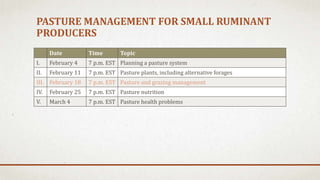
Date Time Topic
I. February 4 7 p.m. EST Planning a pasture system
II. February 11 7 p.m. EST Pasture plants, including alternative forages
III. February 18 7 p.m. EST Pasture and grazing management
IV. February 25 7 p.m. EST Pasture nutrition
V. March 4 7 p.m. EST Pasture health problems
INSTRUCTORS
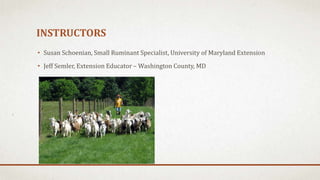
• Susan Schoenian, Small Ruminant Specialist, University of Maryland Extension
• Jeff Semler, Extension Educator – Washington County, MD
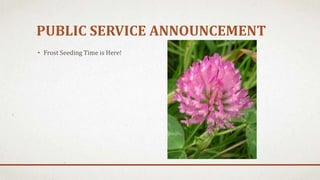
PUBLIC SERVICE ANNOUNCEMENT
• Frost Seeding Time is Here!
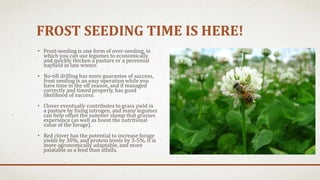
FROST SEEDING TIME IS HERE!
• Frost-seeding is one form of over-seeding, in
which you can use legumes to economically
and quickly thicken a pasture or a perennial
hayfield in late winter.
• No-till drilling has more guarantee of success,
frost seeding is an easy operation while you
have time in the off season, and if managed
correctly and timed properly, has good
likelihood of success.
• Clover eventually contributes to grass yield in
a pasture by fixing nitrogen, and many legumes
can help offset the summer slump that grasses
experience (as well as boost the nutritional
value of the forage).
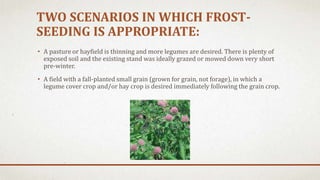
• Red clover has the potential to increase forage
yields by 30%, and protein levels by 3-5%. It is
more agronomically adaptable, and more
palatable as a feed than alfalfa.
TWO SCENARIOS IN WHICH FROST-
SEEDING IS APPROPRIATE:
• A pasture or hayfield is thinning and more legumes are desired. There is plenty of
exposed soil and the existing stand was ideally grazed or mowed down very short
pre-winter.
• A field with a fall-planted small grain (grown for grain, not forage), in which a
legume cover crop and/or hay crop is desired immediately following the grain crop.
WHEN ESTABLISHING A CROP IN AN EXISTING
CROP SO YOU NEED TO MAKE SURE:
• There is little competition from the existing stand and plenty of exposed soil.
• Weather conditions are right: ground is frozen solid in the morning to drive or walk
over while broadcasting, and thaws in the afternoon.
• Soil conditions are hospitable to new seedlings.
• Alfalfas and grasses are often not as successfully frost-seeded, because the seed is
larger and doesn't work through as easily into the soil surface.
PASTURE AND GRAZING
MANAGEMENT
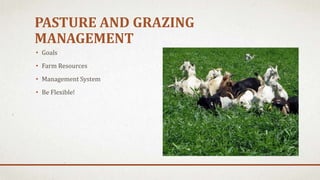
• Goals
• Farm Resources
• Management System
• Be Flexible!
COMMON MYTHS ABOUT PASTURE
AND GRAZING MANAGEMENT
• My animals will starve
• My animals will under achieve
• I won’t have to feed hay
• It is hard work
• My animals don’t want to graze
• Fencing is expensive
• I don’t have enough land
PASTURE AND GRAZING
MANAGEMENT
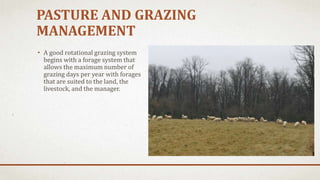
• A good rotational grazing system
begins with a forage system that
allows the maximum number of
grazing days per year with forages
that are suited to the land, the
livestock, and the manager.
TAKE INVENTORY
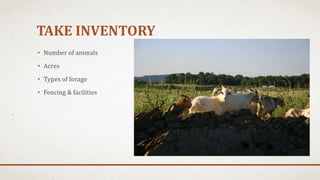
• Number of animals
• Acres
• Types of forage
• Fencing & facilities
FENCES & FACILITIES
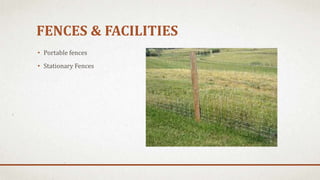
• Portable fences
• Stationary Fences
FENCES & FACILITIES
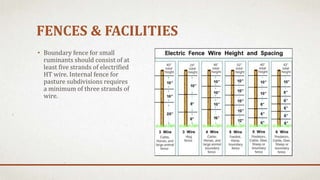
• Boundary fence for small
ruminants should consist of at
least five strands of electrified
HT wire. Internal fence for
pasture subdivisions requires
a minimum of three strands of
wire.
FENCES & FACILITIES
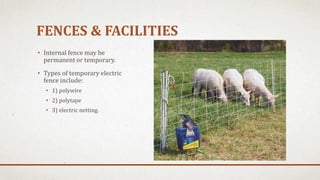
• Internal fence may be
permanent or temporary.
• Types of temporary electric
fence include:
• 1) polywire
• 2) polytape
• 3) electric netting.
FENCES & FACILITIES
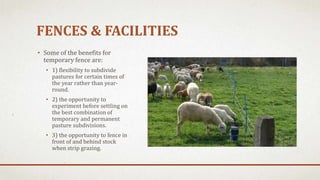
• Some of the benefits for
temporary fence are:
• 1) flexibility to subdivide
pastures for certain times of
the year rather than year-
round.
• 2) the opportunity to
experiment before settling on
the best combination of
temporary and permanent
pasture subdivisions.
• 3) the opportunity to fence in
front of and behind stock
when strip grazing.
FENCES & FACILITIES
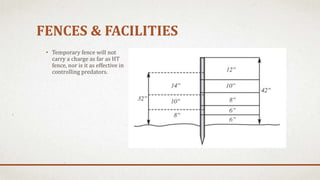
• Temporary fence will not
carry a charge as far as HT
fence, nor is it as effective in
controlling predators.
FENCES & FACILITIES
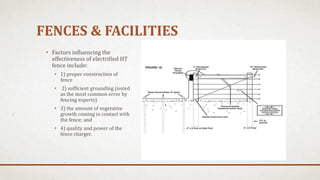
• Factors influencing the
effectiveness of electrified HT
fence include:
• 1) proper construction of
fence
• 2) sufficient grounding (noted
as the most common error by
fencing experts)
• 3) the amount of vegetative
growth coming in contact with
the fence; and
• 4) quality and power of the
fence charger.
FENCES & FACILITIES
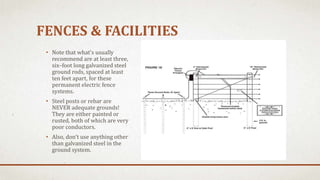
• Note that what's usually
recommend are at least three,
six–foot long galvanized steel
ground rods, spaced at least
ten feet apart, for these
permanent electric fence
systems.
• Steel posts or rebar are
NEVER adequate grounds!
They are either painted or
rusted, both of which are very
poor conductors.
• Also, don't use anything other
than galvanized steel in the
ground system.
FENCES & FACILITIES
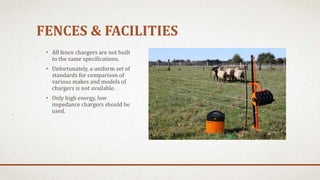
• All fence chargers are not built
to the same specifications.
• Unfortunately, a uniform set of
standards for comparison of
various makes and models of
chargers is not available.
• Only high energy, low
impedance chargers should be
used.
FENCES & FACILITIES
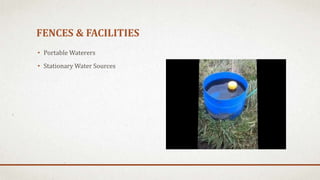
• Portable Waterers
• Stationary Water Sources
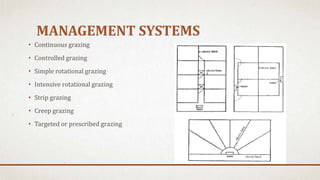
MANAGEMENT SYSTEMS
• Continuous grazing
• Controlled grazing
• Simple rotational grazing
• Intensive rotational grazing
• Strip grazing
• Creep grazing
• Targeted or prescribed grazing
CONTINUOUS GRAZING
• Usually results in poorer forage quality
and quantity.
• Pastures are usually grazed unevenly
by livestock, as livestock overgraze the
plants they like and undergraze the
plants they don't like.
• Manure is distributed unevenly.
• Stocking rates are usually lower.
• Weeds and other undesirable plants
usually persist.
• Continuous grazing is a one-pasture
system in which livestock have
unrestricted access to the pasture area
throughout the grazing season.
• It is a simple system to implement and
manage, with minimal capital
investment and movement of animals.
• If sufficient forage is available,
continuous grazing often results in a
higher individual animal performance
than other grazing systems.
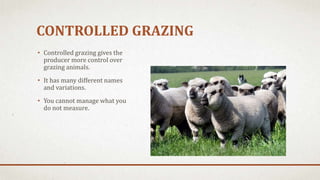
CONTROLLED GRAZING
• Controlled grazing gives the
producer more control over
grazing animals.
• It has many different names
and variations.
• You cannot manage what you
do not measure.
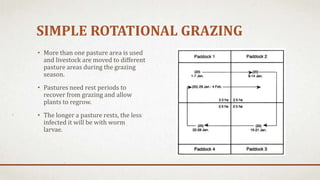
SIMPLE ROTATIONAL GRAZING
• More than one pasture area is used
and livestock are moved to different
pasture areas during the grazing
season.
• Pastures need rest periods to
recover from grazing and allow
plants to regrow.
• The longer a pasture rests, the less
infected it will be with worm
larvae.
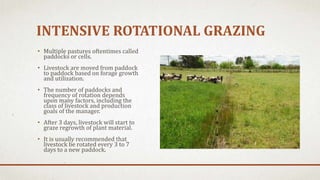
INTENSIVE ROTATIONAL GRAZING
• Multiple pastures oftentimes called
paddocks or cells.
• Livestock are moved from paddock
to paddock based on forage growth
and utilization.
• The number of paddocks and
frequency of rotation depends
upon many factors, including the
class of livestock and production
goals of the manager.
• After 3 days, livestock will start to
graze regrowth of plant material.
• It is usually recommended that
livestock be rotated every 3 to 7
days to a new paddock.
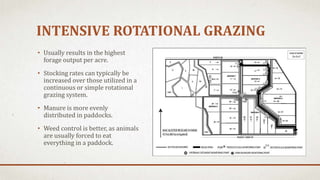
INTENSIVE ROTATIONAL GRAZING
• Usually results in the highest
forage output per acre.
• Stocking rates can typically be
increased over those utilized in a
continuous or simple rotational
grazing system.
• Manure is more evenly
distributed in paddocks.
• Weed control is better, as animals
are usually forced to eat
everything in a paddock.
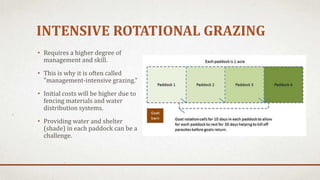
INTENSIVE ROTATIONAL GRAZING
• Requires a higher degree of
management and skill.
• This is why it is often called
"management-intensive grazing."
• Initial costs will be higher due to
fencing materials and water
distribution systems.
• Providing water and shelter
(shade) in each paddock can be a
challenge.
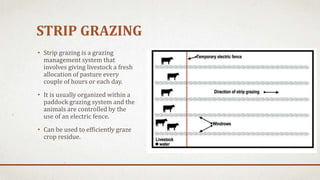
STRIP GRAZING
• Strip grazing is a grazing
management system that
involves giving livestock a fresh
allocation of pasture every
couple of hours or each day.
• It is usually organized within a
paddock grazing system and the
animals are controlled by the
use of an electric fence.
• Can be used to efficiently graze
crop residue.
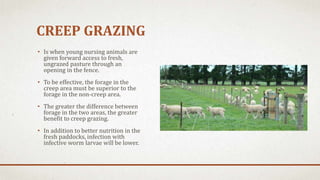
CREEP GRAZING
• Is when young nursing animals are
given forward access to fresh,
ungrazed pasture through an
opening in the fence.
• To be effective, the forage in the
creep area must be superior to the
forage in the non-creep area.
• The greater the difference between
forage in the two areas, the greater
benefit to creep grazing.
• In addition to better nutrition in the
fresh paddocks, infection with
infective worm larvae will be lower.
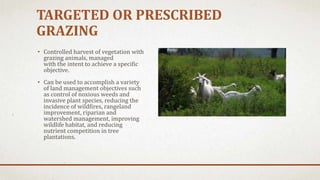
TARGETED OR PRESCRIBED
GRAZING
• Controlled harvest of vegetation with
grazing animals, managed
with the intent to achieve a specific
objective.
• Can be used to accomplish a variety
of land management objectives such
as control of noxious weeds and
invasive plant species, reducing the
incidence of wildfires, rangeland
improvement, riparian and
watershed management, improving
wildlife habitat, and reducing
nutrient competition in tree
plantations.
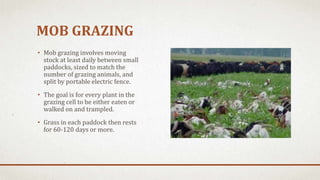
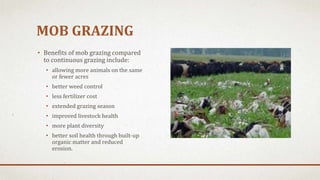
MOB GRAZING
• Mob grazing involves moving
stock at least daily between small
paddocks, sized to match the
number of grazing animals, and
split by portable electric fence.
• The goal is for every plant in the
grazing cell to be either eaten or
walked on and trampled.
• Grass in each paddock then rests
for 60-120 days or more.
MOB GRAZING
• Benefits of mob grazing compared
to continuous grazing include:
• allowing more animals on the same
or fewer acres
• better weed control
• less fertilizer cost
• extended grazing season
• improved livestock health
• more plant diversity
• better soil health through built-up
organic matter and reduced
erosion.
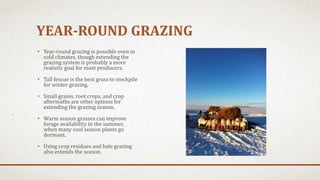
YEAR-ROUND GRAZING
• Year-round grazing is possible even in
cold climates, though extending the
grazing system is probably a more
realistic goal for most producers.
• Tall fescue is the best grass to stockpile
for winter grazing.
• Small grains, root crops, and crop
aftermaths are other options for
extending the grazing season.
• Warm season grasses can improve
forage availability in the summer,
when many cool season plants go
dormant.
• Using crop residues and bale grazing
also extends the season.
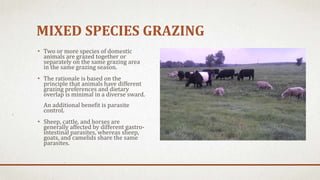
MIXED SPECIES GRAZING
• Two or more species of domestic
animals are grazed together or
separately on the same grazing area
in the same grazing season.
• The rationale is based on the
principle that animals have different
grazing preferences and dietary
overlap is minimal in a diverse sward.
An additional benefit is parasite
control.
• Sheep, cattle, and horses are
generally affected by different gastro-
intestinal parasites, whereas sheep,
goats, and camelids share the same
parasites.
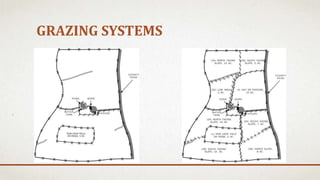
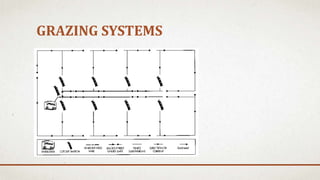
GRAZING SYSTEMS
GRAZING SYSTEMS
QUESTIONS?
Jeff Semler
jsemler@umd.edu
Susan Schoenian
sschoen@umd.edu
NEXT WEBINAR
WEDNESDAY, FEB 25
7 PM EST
TOPIC
PASTURE
NUTRITION
REFERENCES
• http://www.sheep101.info/201/grazingsystems.html
• http://www.thisland.illinois.edu/60ways/60ways_10.html
• http://www.extension.org/pages/11002/labor-efficient-pasture-
management#.VOX3tC7Gqao
• https://pubs.ext.vt.edu/410/410-366/410-366_pdf.pdf
• http://pubs.ext.vt.edu/442/442-130/442-130_pdf.pdf
• http://www.cultivatingsuccess.org/instructors/SSFR%20Readings%202011/11.3_
PaddockDesign.pdf
REFERENCES
• http://www.extension.umn.edu/agriculture/dairy/grazing-systems/grazing-
systems-handbook.pdf
• http://www2.ca.uky.edu/agc/pubs/id/id74/id74.pdf

Pasture and grazing management

  • 1.
    2015 WINTER WEBINARSERIES PASTURE MANAGEMENT FOR SMALL RUMINANT PRODUCERS PART III: PASTURE AND GRAZING MANAGEMENT SUSAN SCHOENIAN & JEFF SEMLER – UNIVERSITY OF MARYLAND EXTENSION
  • 2.
    PASTURE MANAGEMENT FORSMALL RUMINANT PRODUCERS Date Time Topic I. February 4 7 p.m. EST Planning a pasture system II. February 11 7 p.m. EST Pasture plants, including alternative forages III. February 18 7 p.m. EST Pasture and grazing management IV. February 25 7 p.m. EST Pasture nutrition V. March 4 7 p.m. EST Pasture health problems
  • 3.
    INSTRUCTORS • Susan Schoenian,Small Ruminant Specialist, University of Maryland Extension • Jeff Semler, Extension Educator – Washington County, MD
  • 4.
    PUBLIC SERVICE ANNOUNCEMENT •Frost Seeding Time is Here!
  • 5.
    FROST SEEDING TIMEIS HERE! • Frost-seeding is one form of over-seeding, in which you can use legumes to economically and quickly thicken a pasture or a perennial hayfield in late winter. • No-till drilling has more guarantee of success, frost seeding is an easy operation while you have time in the off season, and if managed correctly and timed properly, has good likelihood of success. • Clover eventually contributes to grass yield in a pasture by fixing nitrogen, and many legumes can help offset the summer slump that grasses experience (as well as boost the nutritional value of the forage). • Red clover has the potential to increase forage yields by 30%, and protein levels by 3-5%. It is more agronomically adaptable, and more palatable as a feed than alfalfa.
  • 6.
    TWO SCENARIOS INWHICH FROST- SEEDING IS APPROPRIATE: • A pasture or hayfield is thinning and more legumes are desired. There is plenty of exposed soil and the existing stand was ideally grazed or mowed down very short pre-winter. • A field with a fall-planted small grain (grown for grain, not forage), in which a legume cover crop and/or hay crop is desired immediately following the grain crop.
  • 7.
    WHEN ESTABLISHING ACROP IN AN EXISTING CROP SO YOU NEED TO MAKE SURE: • There is little competition from the existing stand and plenty of exposed soil. • Weather conditions are right: ground is frozen solid in the morning to drive or walk over while broadcasting, and thaws in the afternoon. • Soil conditions are hospitable to new seedlings. • Alfalfas and grasses are often not as successfully frost-seeded, because the seed is larger and doesn't work through as easily into the soil surface.
  • 8.
    PASTURE AND GRAZING MANAGEMENT •Goals • Farm Resources • Management System • Be Flexible!
  • 9.
    COMMON MYTHS ABOUTPASTURE AND GRAZING MANAGEMENT • My animals will starve • My animals will under achieve • I won’t have to feed hay • It is hard work • My animals don’t want to graze • Fencing is expensive • I don’t have enough land
  • 10.
    PASTURE AND GRAZING MANAGEMENT •A good rotational grazing system begins with a forage system that allows the maximum number of grazing days per year with forages that are suited to the land, the livestock, and the manager.
  • 11.
    TAKE INVENTORY • Numberof animals • Acres • Types of forage • Fencing & facilities
  • 12.
    FENCES & FACILITIES •Portable fences • Stationary Fences
  • 13.
    FENCES & FACILITIES •Boundary fence for small ruminants should consist of at least five strands of electrified HT wire. Internal fence for pasture subdivisions requires a minimum of three strands of wire.
  • 14.
    FENCES & FACILITIES •Internal fence may be permanent or temporary. • Types of temporary electric fence include: • 1) polywire • 2) polytape • 3) electric netting.
  • 15.
    FENCES & FACILITIES •Some of the benefits for temporary fence are: • 1) flexibility to subdivide pastures for certain times of the year rather than year- round. • 2) the opportunity to experiment before settling on the best combination of temporary and permanent pasture subdivisions. • 3) the opportunity to fence in front of and behind stock when strip grazing.
  • 16.
    FENCES & FACILITIES •Temporary fence will not carry a charge as far as HT fence, nor is it as effective in controlling predators.
  • 17.
    FENCES & FACILITIES •Factors influencing the effectiveness of electrified HT fence include: • 1) proper construction of fence • 2) sufficient grounding (noted as the most common error by fencing experts) • 3) the amount of vegetative growth coming in contact with the fence; and • 4) quality and power of the fence charger.
  • 18.
    FENCES & FACILITIES •Note that what's usually recommend are at least three, six–foot long galvanized steel ground rods, spaced at least ten feet apart, for these permanent electric fence systems. • Steel posts or rebar are NEVER adequate grounds! They are either painted or rusted, both of which are very poor conductors. • Also, don't use anything other than galvanized steel in the ground system.
  • 19.
    FENCES & FACILITIES •All fence chargers are not built to the same specifications. • Unfortunately, a uniform set of standards for comparison of various makes and models of chargers is not available. • Only high energy, low impedance chargers should be used.
  • 20.
    FENCES & FACILITIES •Portable Waterers • Stationary Water Sources
  • 21.
    MANAGEMENT SYSTEMS • Continuousgrazing • Controlled grazing • Simple rotational grazing • Intensive rotational grazing • Strip grazing • Creep grazing • Targeted or prescribed grazing
  • 22.
    CONTINUOUS GRAZING • Usuallyresults in poorer forage quality and quantity. • Pastures are usually grazed unevenly by livestock, as livestock overgraze the plants they like and undergraze the plants they don't like. • Manure is distributed unevenly. • Stocking rates are usually lower. • Weeds and other undesirable plants usually persist. • Continuous grazing is a one-pasture system in which livestock have unrestricted access to the pasture area throughout the grazing season. • It is a simple system to implement and manage, with minimal capital investment and movement of animals. • If sufficient forage is available, continuous grazing often results in a higher individual animal performance than other grazing systems.
  • 23.
    CONTROLLED GRAZING • Controlledgrazing gives the producer more control over grazing animals. • It has many different names and variations. • You cannot manage what you do not measure.
  • 24.
    SIMPLE ROTATIONAL GRAZING •More than one pasture area is used and livestock are moved to different pasture areas during the grazing season. • Pastures need rest periods to recover from grazing and allow plants to regrow. • The longer a pasture rests, the less infected it will be with worm larvae.
  • 25.
    INTENSIVE ROTATIONAL GRAZING •Multiple pastures oftentimes called paddocks or cells. • Livestock are moved from paddock to paddock based on forage growth and utilization. • The number of paddocks and frequency of rotation depends upon many factors, including the class of livestock and production goals of the manager. • After 3 days, livestock will start to graze regrowth of plant material. • It is usually recommended that livestock be rotated every 3 to 7 days to a new paddock.
  • 26.
    INTENSIVE ROTATIONAL GRAZING •Usually results in the highest forage output per acre. • Stocking rates can typically be increased over those utilized in a continuous or simple rotational grazing system. • Manure is more evenly distributed in paddocks. • Weed control is better, as animals are usually forced to eat everything in a paddock.
  • 27.
    INTENSIVE ROTATIONAL GRAZING •Requires a higher degree of management and skill. • This is why it is often called "management-intensive grazing." • Initial costs will be higher due to fencing materials and water distribution systems. • Providing water and shelter (shade) in each paddock can be a challenge.
  • 28.
    STRIP GRAZING • Stripgrazing is a grazing management system that involves giving livestock a fresh allocation of pasture every couple of hours or each day. • It is usually organized within a paddock grazing system and the animals are controlled by the use of an electric fence. • Can be used to efficiently graze crop residue.
  • 29.
    CREEP GRAZING • Iswhen young nursing animals are given forward access to fresh, ungrazed pasture through an opening in the fence. • To be effective, the forage in the creep area must be superior to the forage in the non-creep area. • The greater the difference between forage in the two areas, the greater benefit to creep grazing. • In addition to better nutrition in the fresh paddocks, infection with infective worm larvae will be lower.
  • 30.
    TARGETED OR PRESCRIBED GRAZING •Controlled harvest of vegetation with grazing animals, managed with the intent to achieve a specific objective. • Can be used to accomplish a variety of land management objectives such as control of noxious weeds and invasive plant species, reducing the incidence of wildfires, rangeland improvement, riparian and watershed management, improving wildlife habitat, and reducing nutrient competition in tree plantations.
  • 31.
    MOB GRAZING • Mobgrazing involves moving stock at least daily between small paddocks, sized to match the number of grazing animals, and split by portable electric fence. • The goal is for every plant in the grazing cell to be either eaten or walked on and trampled. • Grass in each paddock then rests for 60-120 days or more.
  • 32.
    MOB GRAZING • Benefitsof mob grazing compared to continuous grazing include: • allowing more animals on the same or fewer acres • better weed control • less fertilizer cost • extended grazing season • improved livestock health • more plant diversity • better soil health through built-up organic matter and reduced erosion.
  • 33.
    YEAR-ROUND GRAZING • Year-roundgrazing is possible even in cold climates, though extending the grazing system is probably a more realistic goal for most producers. • Tall fescue is the best grass to stockpile for winter grazing. • Small grains, root crops, and crop aftermaths are other options for extending the grazing season. • Warm season grasses can improve forage availability in the summer, when many cool season plants go dormant. • Using crop residues and bale grazing also extends the season.
  • 34.
    MIXED SPECIES GRAZING •Two or more species of domestic animals are grazed together or separately on the same grazing area in the same grazing season. • The rationale is based on the principle that animals have different grazing preferences and dietary overlap is minimal in a diverse sward. An additional benefit is parasite control. • Sheep, cattle, and horses are generally affected by different gastro- intestinal parasites, whereas sheep, goats, and camelids share the same parasites.
  • 35.
  • 36.
  • 37.
  • 38.
    NEXT WEBINAR WEDNESDAY, FEB25 7 PM EST TOPIC PASTURE NUTRITION
  • 39.
    REFERENCES • http://www.sheep101.info/201/grazingsystems.html • http://www.thisland.illinois.edu/60ways/60ways_10.html •http://www.extension.org/pages/11002/labor-efficient-pasture- management#.VOX3tC7Gqao • https://pubs.ext.vt.edu/410/410-366/410-366_pdf.pdf • http://pubs.ext.vt.edu/442/442-130/442-130_pdf.pdf • http://www.cultivatingsuccess.org/instructors/SSFR%20Readings%202011/11.3_ PaddockDesign.pdf
  • 40.