Fodder Crops
• FODDER CROPS are crops that are cultivated
primarily for animal feed. By extension,
natural grasslands and pastures are included
whether they are cultivated or not.
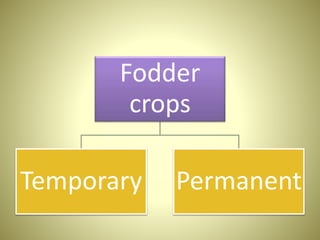
Fodder
crops
Temporary Permanent
Temporary fodder crops
• Temporary crops that are grown intensively
with multiple cuttings per year include three
major groups of fodder:
• 1. Grasses, including cereals that are
harvested green;
• 2. Legumes, including pulses that are
harvested green; and
• 3. Root crops that are cultivated for fodder.
• 4. Trees fodder.
Permanent Fodder crops
• Permanent fodder crops relate to land used
permanently (for five years or more) for
herbaceous forage crops, either cultivated or
growing wild (i.e. wild prairie or grazing land),
and may include some parts of forest land if it
is used for grazing.
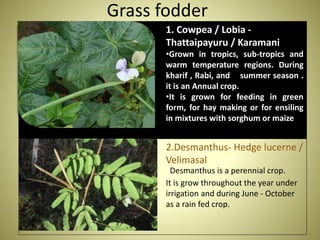
Grass fodder
1. Cowpea / Lobia -
Thattaipayuru / Karamani
•Grown in tropics, sub-tropics and
warm temperature regions. During
kharif , Rabi, and summer season .
it is an Annual crop.
•It is grown for feeding in green
form, for hay making or for ensiling
in mixtures with sorghum or maize
2.Desmanthus- Hedge lucerne /
Velimasal
Desmanthus is a perennial crop.
It is grow throughout the year under
irrigation and during June - October
as a rain fed crop.
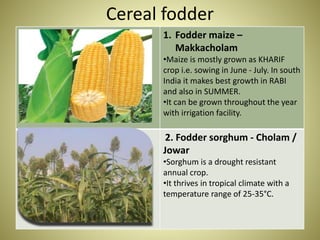
Cereal fodder
1. Fodder maize –
Makkacholam
•Maize is mostly grown as KHARIF
crop i.e. sowing in June - July. In south
India it makes best growth in RABI
and also in SUMMER.
•It can be grown throughout the year
with irrigation facility.
2. Fodder sorghum - Cholam /
Jowar
•Sorghum is a drought resistant
annual crop.
•It thrives in tropical climate with a
temperature range of 25-35°C.
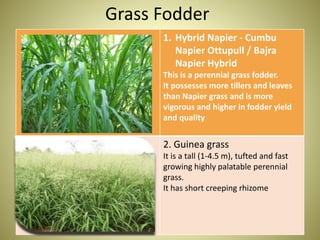
Grass Fodder
1. Hybrid Napier - Cumbu
Napier Ottupull / Bajra
Napier Hybrid
This is a perennial grass fodder.
It possesses more tillers and leaves
than Napier grass and is more
vigorous and higher in fodder yield
and quality
2. Guinea grass
It is a tall (1-4.5 m), tufted and fast
growing highly palatable perennial
grass.
It has short creeping rhizome
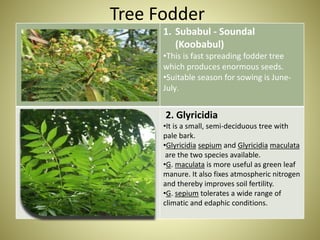
Tree Fodder
1. Subabul - Soundal
(Koobabul)
•This is fast spreading fodder tree
which produces enormous seeds.
•Suitable season for sowing is June-
July.
2. Glyricidia
•It is a small, semi-deciduous tree with
pale bark.
•Glyricidia sepium and Glyricidia maculata
are the two species available.
•G. maculata is more useful as green leaf
manure. It also fixes atmospheric nitrogen
and thereby improves soil fertility.
•G. sepium tolerates a wide range of
climatic and edaphic conditions.
THANK YOU

Fodder crops

  • 1.
  • 2.
    • FODDER CROPSare crops that are cultivated primarily for animal feed. By extension, natural grasslands and pastures are included whether they are cultivated or not.
  • 3.
  • 4.
    Temporary fodder crops •Temporary crops that are grown intensively with multiple cuttings per year include three major groups of fodder: • 1. Grasses, including cereals that are harvested green; • 2. Legumes, including pulses that are harvested green; and • 3. Root crops that are cultivated for fodder. • 4. Trees fodder.
  • 5.
    Permanent Fodder crops •Permanent fodder crops relate to land used permanently (for five years or more) for herbaceous forage crops, either cultivated or growing wild (i.e. wild prairie or grazing land), and may include some parts of forest land if it is used for grazing.
  • 6.
    Grass fodder 1. Cowpea/ Lobia - Thattaipayuru / Karamani •Grown in tropics, sub-tropics and warm temperature regions. During kharif , Rabi, and summer season . it is an Annual crop. •It is grown for feeding in green form, for hay making or for ensiling in mixtures with sorghum or maize 2.Desmanthus- Hedge lucerne / Velimasal Desmanthus is a perennial crop. It is grow throughout the year under irrigation and during June - October as a rain fed crop.
  • 7.
    Cereal fodder 1. Foddermaize – Makkacholam •Maize is mostly grown as KHARIF crop i.e. sowing in June - July. In south India it makes best growth in RABI and also in SUMMER. •It can be grown throughout the year with irrigation facility. 2. Fodder sorghum - Cholam / Jowar •Sorghum is a drought resistant annual crop. •It thrives in tropical climate with a temperature range of 25-35°C.
  • 8.
    Grass Fodder 1. HybridNapier - Cumbu Napier Ottupull / Bajra Napier Hybrid This is a perennial grass fodder. It possesses more tillers and leaves than Napier grass and is more vigorous and higher in fodder yield and quality 2. Guinea grass It is a tall (1-4.5 m), tufted and fast growing highly palatable perennial grass. It has short creeping rhizome
  • 9.
    Tree Fodder 1. Subabul- Soundal (Koobabul) •This is fast spreading fodder tree which produces enormous seeds. •Suitable season for sowing is June- July. 2. Glyricidia •It is a small, semi-deciduous tree with pale bark. •Glyricidia sepium and Glyricidia maculata are the two species available. •G. maculata is more useful as green leaf manure. It also fixes atmospheric nitrogen and thereby improves soil fertility. •G. sepium tolerates a wide range of climatic and edaphic conditions.
  • 10.