GRAZING SYSTEMS AND
MANGMENT
Grazing
• Grazing has two distinct meanings.
• First, grazing is a method of feeding in which
a herbivore feeds on plants such as grasses, or
other multicellular organisms such as algae.
• Second, grazing is a method of agriculture in
which domestic livestock are used to convert
grass and other forage into meat, milk and
other products.
Grazing Systems / GrazingTypes
• An extremely important concept in creating grazing
system is to select the appropriate season of grazing
or rest:
• Grazing period =The season and number of days
during which a pasture is grazed.
• Deferment = A delay of grazing (or a period of non-
grazing) in a pasture until the key forage species set
seed and seeds mature.
• Rest = A period of non-grazing for a full year.
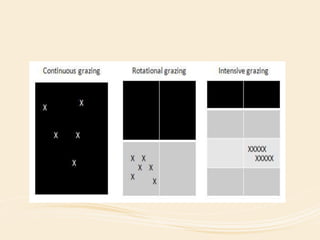
1.Continuous Grazing
• a specific unit of land throughout the whole grazing
season or year, repeated year-after-year.
• is a one-pasture system in which livestock have
unrestricted access to the pasture area throughout the
grazing season.
• It is a simple system to implement and manage, with
minimal capital investment and movement of animals.
• If sufficient forage is available, continuous grazing often
results in a higher individual animal performance than
other grazing systems.
• However, continuous grazing usually results in poorer
forage quality and quantity.
• Pastures are usually grazed unevenly by
livestock, as livestock overgraze the plants
they like and undergraze the plants they don't
like. .
• Manure is also distributed unevenly.
• Stocking rates are usually lower.
• Weeds and other undesirable plants usually
persist.
2.Simple Rotational Grazing
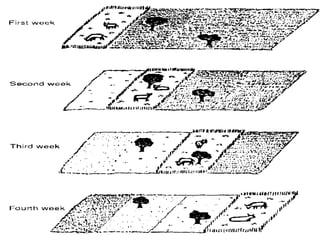
• Simple rotational grazing is a pasture system in which more than one
pasture area is used and livestock are moved to different pasture areas
during the grazing season.
• Pastures need rest periods to recover from grazing and allow plants to
regrow.
• Simple rotational grazing usually increases forage yields and quality.
• Stocking rates can usually be increased.
• Weed control is better.
• On the other hand, fencing costs are higher than with continuous
grazing.
• Each pasture must have access to water and shelter (or shade).
• These systems include:
• Best-pasture system - move livestock to pasture that looks
the "best" in terms of forage availability. Designed for arid
areas where rain may improve forage on one part of a
ranch but not affect another part.
• Seasonal-suitability - movement of livestock to different
areas of range depending on the growth patterns of
different vegetation types - (described above)
• Complementary system - Designed in the central prairies
where animals rely on cultivated or improved pastures for
part of the year and then are moved to native range.
3.Intensive Rotational Grazing
• Intensive rotational grazing is a system with many pastures (at least 7), oftentimes
called paddocks or cells.
• Livestock are moved from paddock to paddock based on forage growth and
utilization.
• The number of paddocks and frequency of rotation depends upon many factors,
including the class of livestock and production goals of the manager.
• After 3 days, livestock will start to graze regrowth of plant material.
• It is usually recommended that livestock be rotated every 3 to 7 days to a new
paddock.
• Intensive rotational grazing usually results in the highest forage output per acre (or
hectare).
• Manure is more evenly distributed in paddocks.
• Weed control is better, as animals are usually forced to eat everything in a paddock.
4.Deferred Rotation
• A deferment is provided to each range unit (or pasture) on
a rotating basis. Requires at least 2 pastures and just 1
herd or flock.
• Designed to increase grazing pressure in a specific pasture
to improve livestock distribution and still provide preferred
species with a period of non-grazing in improve condition.
• Suited for:
• Bunchgrass ranges, mountain coniferous forests, mixed
grass and tall grass prairie.
• Rough topography .
•This system works best where considerable difference in
forage plant palatability exist or patch grazing is a
problem.
5.Rest Rotation Grazing (Hormay System)
• This system allows for a full-year of rest from grazing
for pastures on a rotating basis.
• This system requires at least 3 pastures and 1 herd.
• The rotation sequence for each pasture is usually
defer (fall graze), then rest (no graze), then spring
graze.
• Suited for:
• Land not used for crop production or improved
pasture.
6.Controlled Grazing
• Controlled grazing gives the producer more control over grazing
animals.
• The grazing area can be increased when forage growth is slow or
it can be decreased when forage growth is fast.
• Forage growth is measured by taking the height of the pasture.
• Controlled grazing requires the manager to check pasture
growth daily and have additional land for pasture.
• Advantages of controlled grazing include:
• ° More produced forage is used.
• ° Higher number of animals can be supported.
• ° More meat/milk is produced per unit of land.
7.Strip Grazing
• Strip grazing is a grazing management system that
involves giving livestock a fresh allocation of pasture each
day.
• It is usually organized within a paddock grazing system
and the animals are controlled by the use of an electric
fence.
• Fences are moved once or twice daily to provide fresh
forage.
• This is the most labour-intensive
• Strip grazing also results in the highest quality of feed and
the least waste.
8.Creep Grazing
• Creep grazing is when young nursing animals are
given forward access to fresh, ungrazed pasture
through an opening in the fence.
• To be effective, the forage in the creep area must
be superior to the forage in the non-creep area.
• The greater the difference between forage in the
two areas, the greater benefit to creep grazing.
• In addition to better nutrition in the fresh
paddocks, infection with infective worm larvae
will be lower.
9.Forward Grazing
• is where the pasture is grazed by two groups of
animals.
• The first group to enter the pasture is those with
higher nutritional needs (e.g. ewes with lambs)
and grazes the top of the plants.
• The second group, with lower nutrient
requirements (e.g. dry ewes), grazes what is left
by the first group.
• This allows for higher weaning weights when
forage is limited or where competition between
young stock and dams exist.
10.Year-round Grazing
• Year-round grazing is possible even in cold
climates, though extending the grazing system is
probably a more realistic goal for most
producers.
• Tall fescue is the best grass to stockpile for winter
grazing.
• Small grains, root crops, and crop aftermaths are
other options for extending the grazing season.
• Warm season grasses can improve forage
availability in the summer, when many cool
season plants go dormant.
11.Mixed Species Grazing
• Mixed species grazing is when two or more species of
domestic animals are grazed together or separately on the
same grazing area in the same grazing season.
• The rationale for mixed species grazing is based on the
principle that animals have different grazing preferences
and dietary overlap is minimal in a diverse sward.
• An additional benefit to mixed species grazing is parasite
control.
• Sheep, cattle, and horses are generally affected by
different gastro-intestinal parasites, whereas sheep,
goats, and camelids share the same parasites.
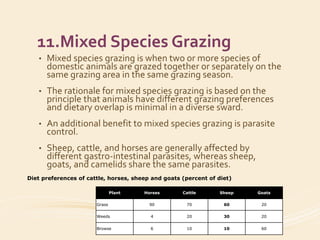
Plant Horses Cattle Sheep Goats
Grass 90 70 60 20
Weeds 4 20 30 20
Browse 6 10 10 60
Diet preferences of cattle, horses, sheep and goats (percent of diet)
12.High intensity/Low Frequency (HILF)
Grazing (1-herd: Multi-pasture)
• This system concentrates animals in a small
area for a short period of time, followed by a
period of rest. Pastures are usually grazed
only once per season.
• Designed to force animals to eat less
palatable plants.
13.Short Duration (SDG) Grazing
• This system is an advanced rotation system
them requires more than 8 pastures (called
paddocks) with very short grazing periods (4-
9 days) followed by shorter rest periods (30-
60 days).
• SDG is basically an extreme HILF with shorter
grazing periods and it is designed so that
pastures are grazed at least twice during the
grazing season.
14.Seasonal Grazing
• Seasonal grazing incorporates “grazing
animals on a particular area for only part of
the year”.
• This allows the land that is not being grazed
to rest and allow for new forage to grow.
15.Targeted or Prescribed Grazing
• Prescribed grazing is the controlled harvest of
vegetation with grazing animals, managed with
the intent to achieve a specific objective.
• Prescribed grazing can be used to accomplish a
variety of land management objectives such as
control of noxious weeds and invasive plant
species, reducing the incidence of wildfires,
rangeland improvement, riparian and watershed
management, improving wildlife habitat, and
reducing nutrient competition in tree plantations.
16.Patch-burn Grazing
• Patch-burn grazing burns a third of a pasture
each year, no matter the size of the pasture.
• This burned patch attracts the grazers (cattle or
bison) which graze the area heavily because of
the fresh grasses that grow in.
• The other patches receive little to no grazing.
During the next two years the next two patches
burn consecutively and then the cycle begins a
new.
• In this way, patches receive two years of rest and
recovery from the heavy grazing.
17.Mob Grazing
• is a form of rotational grazing where large numbers of sheep graze the pasture until
forage is grazed down evenly and closely.
• This is normally used to clean up pastures with coarse, mature forage.
• Mixed grazing is when different types of livestock graze different plants.
• Two or more types of animals graze the paddock at the same time, or follow one
another through the pasture.
• Do not graze sheep with horses.
• • Sheep, goats and cattle do not have the same grazing habits – this can be very
helpful in pasture management.
• • Sheep are more selective than cattle and tend to prefer grazing on forbs
(broadleaved plants).
• • Cattle and sheep will complement each other if grazed on pasture with a high
proportion of forbs and browse.
• • Multi-species grazing can benefit the producer with better economic gains (different
markets), predator protection, and improved range health.
MANGMENT
• Grazing management is when you control the grazing habits of
animals on pasture.
• What animals, how, when, and for how long they graze a
pasture determines the species make-up of the pasture and its
long term viability, how much forage it yields, and how well the
animals perform.
• Overgrazing and undergrazing pastures is detrimental to plant
and animal health, as well as soil and water quality.
• The tools of grazing management are frequency and intensity of
grazing.
• Pasture production and quality are mainly affected by cover
(amount of pasture) and grazing intensity.
• Pasture intake is mainly affected by the amount and quality of
the available pasture offered each day.
• Control the area grazed each day (or rotation length) to
manipulate pasture eaten to meet average pasture cover targets
for the farm
• Estimate the area and pre-grazing cover required for the cows
based on the target grazing residual and adjust after observing
when / if the cows achieve a "consistent, even, grazing height".
• Make management decisions to maximise per cow production
for the season not at any one grazing, the "main course principle
- no dessert"
• Treat pasture as a crop - remove pasture grown since last
grazing and prevent post-grazing height increasing over the
season
• Have pasture cover distributed between paddocks in a feed
wedge to ensure that high quality pasture is offered on all
paddocks

Grazing systems and Managment

  • 1.
  • 2.
    Grazing • Grazing hastwo distinct meanings. • First, grazing is a method of feeding in which a herbivore feeds on plants such as grasses, or other multicellular organisms such as algae. • Second, grazing is a method of agriculture in which domestic livestock are used to convert grass and other forage into meat, milk and other products.
  • 3.
    Grazing Systems /GrazingTypes • An extremely important concept in creating grazing system is to select the appropriate season of grazing or rest: • Grazing period =The season and number of days during which a pasture is grazed. • Deferment = A delay of grazing (or a period of non- grazing) in a pasture until the key forage species set seed and seeds mature. • Rest = A period of non-grazing for a full year.
  • 4.
    1.Continuous Grazing • aspecific unit of land throughout the whole grazing season or year, repeated year-after-year. • is a one-pasture system in which livestock have unrestricted access to the pasture area throughout the grazing season. • It is a simple system to implement and manage, with minimal capital investment and movement of animals. • If sufficient forage is available, continuous grazing often results in a higher individual animal performance than other grazing systems. • However, continuous grazing usually results in poorer forage quality and quantity.
  • 5.
    • Pastures areusually grazed unevenly by livestock, as livestock overgraze the plants they like and undergraze the plants they don't like. . • Manure is also distributed unevenly. • Stocking rates are usually lower. • Weeds and other undesirable plants usually persist.
  • 6.
    2.Simple Rotational Grazing •Simple rotational grazing is a pasture system in which more than one pasture area is used and livestock are moved to different pasture areas during the grazing season. • Pastures need rest periods to recover from grazing and allow plants to regrow. • Simple rotational grazing usually increases forage yields and quality. • Stocking rates can usually be increased. • Weed control is better. • On the other hand, fencing costs are higher than with continuous grazing. • Each pasture must have access to water and shelter (or shade).
  • 7.
    • These systemsinclude: • Best-pasture system - move livestock to pasture that looks the "best" in terms of forage availability. Designed for arid areas where rain may improve forage on one part of a ranch but not affect another part. • Seasonal-suitability - movement of livestock to different areas of range depending on the growth patterns of different vegetation types - (described above) • Complementary system - Designed in the central prairies where animals rely on cultivated or improved pastures for part of the year and then are moved to native range.
  • 9.
    3.Intensive Rotational Grazing •Intensive rotational grazing is a system with many pastures (at least 7), oftentimes called paddocks or cells. • Livestock are moved from paddock to paddock based on forage growth and utilization. • The number of paddocks and frequency of rotation depends upon many factors, including the class of livestock and production goals of the manager. • After 3 days, livestock will start to graze regrowth of plant material. • It is usually recommended that livestock be rotated every 3 to 7 days to a new paddock. • Intensive rotational grazing usually results in the highest forage output per acre (or hectare). • Manure is more evenly distributed in paddocks. • Weed control is better, as animals are usually forced to eat everything in a paddock.
  • 11.
    4.Deferred Rotation • Adeferment is provided to each range unit (or pasture) on a rotating basis. Requires at least 2 pastures and just 1 herd or flock. • Designed to increase grazing pressure in a specific pasture to improve livestock distribution and still provide preferred species with a period of non-grazing in improve condition. • Suited for: • Bunchgrass ranges, mountain coniferous forests, mixed grass and tall grass prairie. • Rough topography . •This system works best where considerable difference in forage plant palatability exist or patch grazing is a problem.
  • 12.
    5.Rest Rotation Grazing(Hormay System) • This system allows for a full-year of rest from grazing for pastures on a rotating basis. • This system requires at least 3 pastures and 1 herd. • The rotation sequence for each pasture is usually defer (fall graze), then rest (no graze), then spring graze. • Suited for: • Land not used for crop production or improved pasture.
  • 13.
    6.Controlled Grazing • Controlledgrazing gives the producer more control over grazing animals. • The grazing area can be increased when forage growth is slow or it can be decreased when forage growth is fast. • Forage growth is measured by taking the height of the pasture. • Controlled grazing requires the manager to check pasture growth daily and have additional land for pasture. • Advantages of controlled grazing include: • ° More produced forage is used. • ° Higher number of animals can be supported. • ° More meat/milk is produced per unit of land.
  • 14.
    7.Strip Grazing • Stripgrazing is a grazing management system that involves giving livestock a fresh allocation of pasture each day. • It is usually organized within a paddock grazing system and the animals are controlled by the use of an electric fence. • Fences are moved once or twice daily to provide fresh forage. • This is the most labour-intensive • Strip grazing also results in the highest quality of feed and the least waste.
  • 15.
    8.Creep Grazing • Creepgrazing is when young nursing animals are given forward access to fresh, ungrazed pasture through an opening in the fence. • To be effective, the forage in the creep area must be superior to the forage in the non-creep area. • The greater the difference between forage in the two areas, the greater benefit to creep grazing. • In addition to better nutrition in the fresh paddocks, infection with infective worm larvae will be lower.
  • 16.
    9.Forward Grazing • iswhere the pasture is grazed by two groups of animals. • The first group to enter the pasture is those with higher nutritional needs (e.g. ewes with lambs) and grazes the top of the plants. • The second group, with lower nutrient requirements (e.g. dry ewes), grazes what is left by the first group. • This allows for higher weaning weights when forage is limited or where competition between young stock and dams exist.
  • 17.
    10.Year-round Grazing • Year-roundgrazing is possible even in cold climates, though extending the grazing system is probably a more realistic goal for most producers. • Tall fescue is the best grass to stockpile for winter grazing. • Small grains, root crops, and crop aftermaths are other options for extending the grazing season. • Warm season grasses can improve forage availability in the summer, when many cool season plants go dormant.
  • 18.
    11.Mixed Species Grazing •Mixed species grazing is when two or more species of domestic animals are grazed together or separately on the same grazing area in the same grazing season. • The rationale for mixed species grazing is based on the principle that animals have different grazing preferences and dietary overlap is minimal in a diverse sward. • An additional benefit to mixed species grazing is parasite control. • Sheep, cattle, and horses are generally affected by different gastro-intestinal parasites, whereas sheep, goats, and camelids share the same parasites. Plant Horses Cattle Sheep Goats Grass 90 70 60 20 Weeds 4 20 30 20 Browse 6 10 10 60 Diet preferences of cattle, horses, sheep and goats (percent of diet)
  • 19.
    12.High intensity/Low Frequency(HILF) Grazing (1-herd: Multi-pasture) • This system concentrates animals in a small area for a short period of time, followed by a period of rest. Pastures are usually grazed only once per season. • Designed to force animals to eat less palatable plants.
  • 20.
    13.Short Duration (SDG)Grazing • This system is an advanced rotation system them requires more than 8 pastures (called paddocks) with very short grazing periods (4- 9 days) followed by shorter rest periods (30- 60 days). • SDG is basically an extreme HILF with shorter grazing periods and it is designed so that pastures are grazed at least twice during the grazing season.
  • 21.
    14.Seasonal Grazing • Seasonalgrazing incorporates “grazing animals on a particular area for only part of the year”. • This allows the land that is not being grazed to rest and allow for new forage to grow.
  • 22.
    15.Targeted or PrescribedGrazing • Prescribed grazing is the controlled harvest of vegetation with grazing animals, managed with the intent to achieve a specific objective. • Prescribed grazing can be used to accomplish a variety of land management objectives such as control of noxious weeds and invasive plant species, reducing the incidence of wildfires, rangeland improvement, riparian and watershed management, improving wildlife habitat, and reducing nutrient competition in tree plantations.
  • 23.
    16.Patch-burn Grazing • Patch-burngrazing burns a third of a pasture each year, no matter the size of the pasture. • This burned patch attracts the grazers (cattle or bison) which graze the area heavily because of the fresh grasses that grow in. • The other patches receive little to no grazing. During the next two years the next two patches burn consecutively and then the cycle begins a new. • In this way, patches receive two years of rest and recovery from the heavy grazing.
  • 24.
    17.Mob Grazing • isa form of rotational grazing where large numbers of sheep graze the pasture until forage is grazed down evenly and closely. • This is normally used to clean up pastures with coarse, mature forage. • Mixed grazing is when different types of livestock graze different plants. • Two or more types of animals graze the paddock at the same time, or follow one another through the pasture. • Do not graze sheep with horses. • • Sheep, goats and cattle do not have the same grazing habits – this can be very helpful in pasture management. • • Sheep are more selective than cattle and tend to prefer grazing on forbs (broadleaved plants). • • Cattle and sheep will complement each other if grazed on pasture with a high proportion of forbs and browse. • • Multi-species grazing can benefit the producer with better economic gains (different markets), predator protection, and improved range health.
  • 25.
  • 26.
    • Grazing managementis when you control the grazing habits of animals on pasture. • What animals, how, when, and for how long they graze a pasture determines the species make-up of the pasture and its long term viability, how much forage it yields, and how well the animals perform. • Overgrazing and undergrazing pastures is detrimental to plant and animal health, as well as soil and water quality. • The tools of grazing management are frequency and intensity of grazing. • Pasture production and quality are mainly affected by cover (amount of pasture) and grazing intensity. • Pasture intake is mainly affected by the amount and quality of the available pasture offered each day.
  • 27.
    • Control thearea grazed each day (or rotation length) to manipulate pasture eaten to meet average pasture cover targets for the farm • Estimate the area and pre-grazing cover required for the cows based on the target grazing residual and adjust after observing when / if the cows achieve a "consistent, even, grazing height". • Make management decisions to maximise per cow production for the season not at any one grazing, the "main course principle - no dessert" • Treat pasture as a crop - remove pasture grown since last grazing and prevent post-grazing height increasing over the season • Have pasture cover distributed between paddocks in a feed wedge to ensure that high quality pasture is offered on all paddocks