The document presents a comprehensive overview of genetic algorithms (GAs), which are search-based optimization techniques inspired by the principles of natural selection and genetics. It outlines their history, key concepts, and components including fitness functions, selection methods, crossover techniques, and the mapping of biological processes to computational problems. Additionally, it highlights the advantages and limitations of GAs, making them suitable for solving complex optimization problems.
OUTLINE
Introduction
Whatare GAs?
Genetic Algorithm History
Basic Idea of Nature Selection.
Basic Genetic Algorithm.
Nature to Computer Mapping.
GA Operators and Parameters:
Advantages of GAs.
Limitations of GAs.
2/1/2021
GENETIC ALGORITHM 2
3.
INTRODUCTION
After scientistbecame disillusioned with classical and nonclassical attempts at modeling
intelligence , they looked in other directions.
Two prominent fields arose, connectionism (neural networking, parallel processing) and
evolutionary computing.
Basic concept- to stimulate process in natural system necessary for evolution.
2/1/2021
GENETIC ALGORITHM 3
4.
WHAT ARE GENETICALGORITHMS?
Genetic Algorithm (GA) is a search-based optimization technique based on the principles of
Genetics and Darwin’s Principle of Natural Selection.
It is frequently used to find optimal or near-optimal solutions to difficult problems which
otherwise would take a lifetime to solve.
GAs are a subset of a much larger branch of computation known as Evolutionary
Computation.
GAs were developed by John Holland (1975).
2/1/2021
GENETIC ALGORITHM 4
5.
GENETIC ALGORITHM: HISTORY
Evolutionary computing-1960 by Reichenberg
Developed by John Holland , university of Michigan-1970.
Got popular in the late 1980’s.
Based on ideas from Darwinian Evolution theory “Survival of the fittest”.
1986-Optimization of a Ten Member plane.
2/1/2021
GENETIC ALGORITHM 5
6.
BIOLOGICAL BACKGROUND
Eachcell of a living organisms contains chromosomes - strings of DNA.
Each chromosome contains a set of genes - blocks of DNA.
Each genes encodes a particular pattern - trait.
Possible settings of traits - alleles
The unique position of the gene in the Chromosome – locus
Complete set of genetic material - genome
A collection of genes - genotype.
A collection of aspects(like eye color)- phenotype.
Reproduction involves recombination of genes from parents.
The fitness of an organism is how much it can reproduce before it dies.
2/1/2021
GENETIC ALGORITHM 6
7.
DARWIN'S THEORY OFEVOLUTION
All life is related and has descended from a common ancestor.
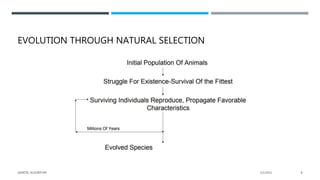
Natural selection – “Survival of the fittest”
Organisms can produce more offspring than their surroundings can support -> natural
struggle to survive.
Organisms whose variations best adapt them to their environments survive, the others die.
Variations are heritable -> can be passed on to the next generation -> i.e., evolution
2/1/2021
GENETIC ALGORITHM 7
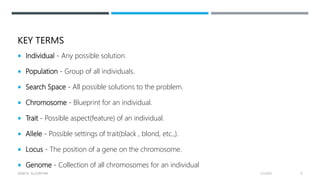
KEY TERMS
Individual- Any possible solution.
Population - Group of all individuals.
Search Space - All possible solutions to the problem.
Chromosome - Blueprint for an individual.
Trait - Possible aspect(feature) of an individual.
Allele - Possible settings of trait(black , blond, etc.,).
Locus - The position of a gene on the chromosome.
Genome - Collection of all chromosomes for an individual
2/1/2021
GENETIC ALGORITHM 9
10.
FUNDAMENTALS OF GENETICALGORITHM
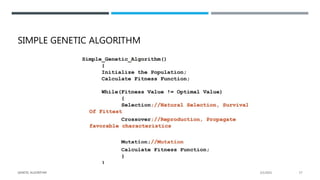
Genetic algorithm mimic the principle of natural genetics and natural selection to construct
search and optimization procedure
Three most important aspects of using GA are:
1. definition of objective function
2. definition and implementation of genetic representation
3. definition and implementation of genetic operators
2/1/2021
GENETIC ALGORITHM 10
11.
GA REQUIREMENTS
Atypical genetic algorithm requires two things to be defined: a genetic representation of the
solution domain and a fitness function to evaluate the solution domain.
A standard representation of the solution is an array of bits. Arrays of other types and
structures can be used in essentially the same way.
Tree like representations are explored in genetic programming.
2/1/2021
GENETIC ALGORITHM 11
12.
BASICS OF GA
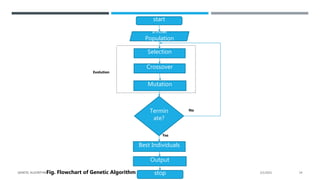
The most common type of genetic algorithm works like this: a population is created with a
group of individuals created randomly.
The individuals in the population are then evaluated.
The evaluation function is provided by the programmer and gives the individuals a score
based on how well they perform at the given task.
Two individuals are then selected based on their fitness, the higher the fitness, the higher the
chance of being selected.
Population of individuals – Individual is feasible solution to problem
2/1/2021
GENETIC ALGORITHM 12
13.
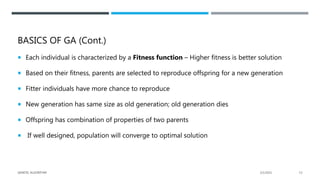
BASICS OF GA(Cont.)
Each individual is characterized by a Fitness function – Higher fitness is better solution
Based on their fitness, parents are selected to reproduce offspring for a new generation
Fitter individuals have more chance to reproduce
New generation has same size as old generation; old generation dies
Offspring has combination of properties of two parents
If well designed, population will converge to optimal solution
2/1/2021
GENETIC ALGORITHM 13
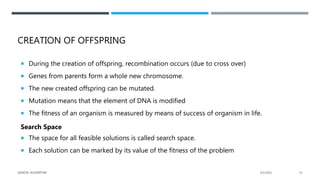
CREATION OF OFFSPRING
During the creation of offspring, recombination occurs (due to cross over)
Genes from parents form a whole new chromosome.
The new created offspring can be mutated.
Mutation means that the element of DNA is modified
The fitness of an organism is measured by means of success of organism in life.
Search Space
The space for all feasible solutions is called search space.
Each solution can be marked by its value of the fitness of the problem
2/1/2021
GENETIC ALGORITHM 15
16.
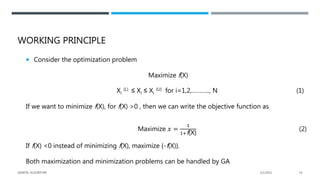
WORKING PRINCIPLE
Considerthe optimization problem
Maximize f(X)
Xi
(L) ≤ Xi ≤ Xi
(U) for i=1,2,……….., N (1)
If we want to minimize f(X), for f(X) >0 , then we can write the objective function as
Maximize 𝑥 =
1
1+f(X)
(2)
If f(X) <0 instead of minimizing f(X), maximize {-f(X)}.
Both maximization and minimization problems can be handled by GA
2/1/2021
GENETIC ALGORITHM 16
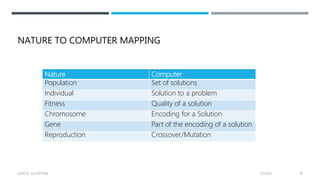
NATURE TO COMPUTERMAPPING
Nature Computer
Population Set of solutions
Individual Solution to a problem
Fitness Quality of a solution
Chromosome Encoding for a Solution
Gene Part of the encoding of a solution
Reproduction Crossover/Mutation
2/1/2021
GENETIC ALGORITHM 18
ENCODING
The processof representing the solution in the form of a string that conveys the necessary
information.
Just as in a chromosome, each gene controls a particular characteristic of the individual,
similarly, each bit in the string represents a characteristic of the solution.
2/1/2021
GENETIC ALGORITHM 20
21.
ENCODING METHODS
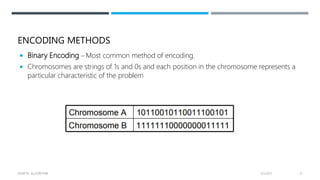
BinaryEncoding – Most common method of encoding.
Chromosomes are strings of 1s and 0s and each position in the chromosome represents a
particular characteristic of the problem
2/1/2021
GENETIC ALGORITHM 21
22.
ENCODING METHODS (Contd.)
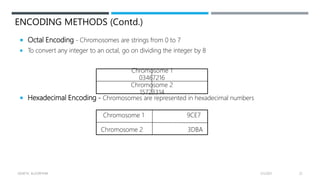
Octal Encoding - Chromosomes are strings from 0 to 7
To convert any integer to an octal, go on dividing the integer by 8
Hexadecimal Encoding - Chromosomes are represented in hexadecimal numbers
Chromosome 1
03467216
Chromosome 2
15723314
Chromosome 1 9CE7
Chromosome 2 3DBA
2/1/2021
GENETIC ALGORITHM 22
23.
ENCODING METHODS (Contd.)
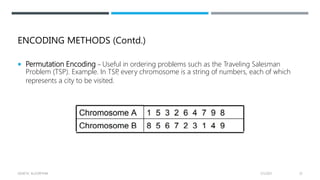
Permutation Encoding – Useful in ordering problems such as the Traveling Salesman
Problem (TSP). Example. In TSP
, every chromosome is a string of numbers, each of which
represents a city to be visited.
2/1/2021
GENETIC ALGORITHM 23
24.
ENCODING METHODS (Contd.)
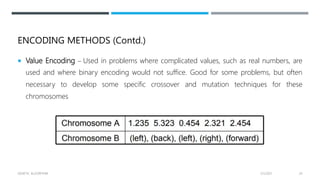
Value Encoding – Used in problems where complicated values, such as real numbers, are
used and where binary encoding would not suffice. Good for some problems, but often
necessary to develop some specific crossover and mutation techniques for these
chromosomes
2/1/2021
GENETIC ALGORITHM 24
25.
ENCODING METHODS (Contd.)
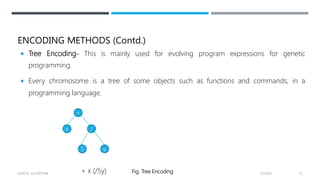
Tree Encoding– This is mainly used for evolving program expressions for genetic
programming.
Every chromosome is a tree of some objects such as functions and commands, in a
programming language.
+ x (/5y) Fig. Tree Encoding
+
/
5 y
x
2/1/2021
GENETIC ALGORITHM 25
26.
FITNESS FUNCTION
GAare usually suitable for solving maximization problems.
Minimization problems are usually transformed into maximization.
A fitness function quantifies the optimality of a solution (chromosome) so that that particular
solution may be ranked against all the other solutions.
A fitness value is assigned to each solution depending on how close it actually is to solving
the problem.
Example. In TSP, f(x) is sum of distances between the cities in solution. The lesser the value,
the fitter the solution is.
2/1/2021
GENETIC ALGORITHM 26
27.
FITNESS FUNCTION (Contd.)
Fitness function F(X) is first derived from the objective function,
Certain genetic operators require that the fitness function be non-negative, certain operators
do not have this requirement
Consider the transformations,
F(X) = f(X) for maximization problem
F(X) = 1/f(X) for minimization problem, if f(X) ≠ 0
F(X) = 1/(1+f(X)), if f(X) =0
The fitness function value of the string is known as string’s fitness
2/1/2021
GENETIC ALGORITHM 27
28.
REPRODUCTION
Reproduction isthe first operator applied on population
Chromosomes are selected from the population to be parents to cross over and produce
offspring.
The best on should survive and create new offspring.
Reproduction operator is sometimes known as the selection operator
The various methods for selecting chromosomes for parent to cross over are:
1. Roulette-wheel selection
2. Boltzmann selection
3. Tournament selection
4. Rank selection
5. Steady-state selection
2/1/2021
GENETIC ALGORITHM 28
29.
ROULETTE –WHEEL SELECTION
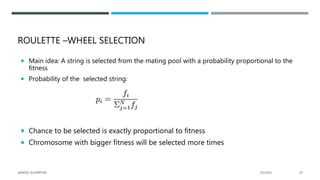
Main idea: A string is selected from the mating pool with a probability proportional to the
fitness
Probability of the selected string:
Chance to be selected is exactly proportional to fitness
Chromosome with bigger fitness will be selected more times
2/1/2021
GENETIC ALGORITHM 29
30.
ROULETTE –WHEEL SELECTION(Contd.)
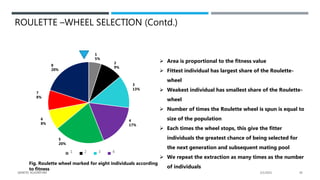
1 2 3 4
1
5%
6
8%
7
8%
2
9%
5
20%
3
13%
4
17%
8
20%
Fig. Roulette wheel marked for eight individuals according
to fitness
Area is proportional to the fitness value
Fittest individual has largest share of the Roulette-
wheel
Weakest individual has smallest share of the Roulette-
wheel
Number of times the Roulette wheel is spun is equal to
size of the population
Each times the wheel stops, this give the fitter
individuals the greatest chance of being selected for
the next generation and subsequent mating pool
We repeat the extraction as many times as the number
of individuals
2/1/2021
GENETIC ALGORITHM 30
31.
BOLTZMANN SELECTION
Simulatedannealing is a method of functional minimization or maximization.
This method simulates the process of slow cooling of molten metal to achieve the minimum function value in a
minimization problem
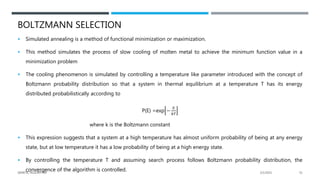
The cooling phenomenon is simulated by controlling a temperature like parameter introduced with the concept of
Boltzmann probability distribution so that a system in thermal equilibrium at a temperature T has its energy
distributed probabilistically according to
P(E) =exp −
𝐸
𝑘𝑇
where k is the Boltzmann constant
This expression suggests that a system at a high temperature has almost uniform probability of being at any energy
state, but at low temperature it has a low probability of being at a high energy state.
By controlling the temperature T and assuming search process follows Boltzmann probability distribution, the
convergence of the algorithm is controlled. 2/1/2021
GENETIC ALGORITHM 31
32.
TOURNAMENT SELECTION
Agroup of n individuals is chosen randomly uniformly from the current population, and the
one with the best fitness is selected.
n is called the tournament size and can be used to vary the selection pressure.
The higher n the higher the pressure to select above average quality individuals.
Several tournaments are held between the individuals of current generation.
Process is repeated as often as desired (usually until the mating pool is filled).
2/1/2021
GENETIC ALGORITHM 32
33.
TOURNAMENT SELECTION(Contd.)
Tournamentsheld between pairs are binary tournament selection.
Deterministic tournament selection selects the best individual (when p=1) in any tournament.
1-way tournament (k=1) selection is equivalent to random selection.
The takeover time for tournament selection is logarithmic to the population size.
2/1/2021
GENETIC ALGORITHM 33
34.
RANK SELECTION
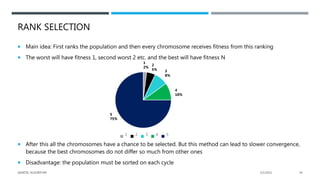
Mainidea: First ranks the population and then every chromosome receives fitness from this ranking
The worst will have fitness 1, second worst 2 etc. and the best will have fitness N
After this all the chromosomes have a chance to be selected. But this method can lead to slower convergence,
because the best chromosomes do not differ so much from other ones
Disadvantage: the population must be sorted on each cycle
1 2 3 4 5
1
2%
2
5% 3
8%
4
10%
5
75%
2/1/2021
GENETIC ALGORITHM 34
35.
STEADY-STATE SELECTION
Biggerpart of chromosome should survive to next generation.
In every generation are selected, a few( good individuals with high fitness for maximization
problem) chromosome, for creating new offspring.
Some (bad with low fitness) chromosomes are removed and new offspring is placed in that
place.
The rest of population survives to new generation
2/1/2021
GENETIC ALGORITHM 35
36.
ELITISM
Main idea:copy the best chromosomes (solutions) to new population before applying
crossover and mutation
When creating a new population by crossover or mutation the best chromosome might be
lost
Forces GAs to retain some number of the best individuals at each generation.
Improves performance
2/1/2021
GENETIC ALGORITHM 36
37.
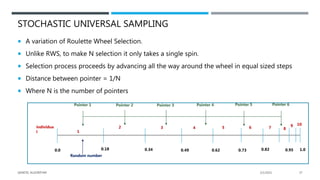
STOCHASTIC UNIVERSAL SAMPLING
A variation of Roulette Wheel Selection.
Unlike RWS, to make N selection it only takes a single spin.
Selection process proceeds by advancing all the way around the wheel in equal sized steps
Distance between pointer = 1/N
Where N is the number of pointers
0.95
9
8
7
6
5
4
3
2
10
individua
l
Pointer 1 Pointer 2 Pointer 3 Pointer 4 Pointer 5 Pointer 6
0.0 0.18 0.34 0.49 0.62 0.73 0.82
1
1.0
Random number
2/1/2021
GENETIC ALGORITHM 37
RECOMBINATION
The primaryobjective of the recombination operator is to emphasize the good solutions and
eliminate the bad solutions in a population, while keeping the population size constant.
“Selects The Best, Discards The Rest”.
“Recombination” is different from “Reproduction”.
Identify the good solutions in a population.
Make multiple copies of the good solutions.
Eliminate bad solutions from the population so that multiple copies of good solutions can be
placed in the population
2/1/2021
GENETIC ALGORITHM 39
40.
CROSSOVER
It isthe process in which two chromosomes (strings) combine their genetic material (bits) to
produce a new offspring which possesses both their characteristics.
Two strings are picked from the mating pool at random to cross over.
The method chosen depends on the Encoding Method
2/1/2021
GENETIC ALGORITHM 40
41.
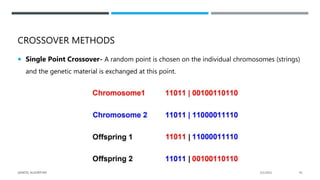
CROSSOVER METHODS
SinglePoint Crossover- A random point is chosen on the individual chromosomes (strings)
and the genetic material is exchanged at this point.
2/1/2021
GENETIC ALGORITHM 41
42.
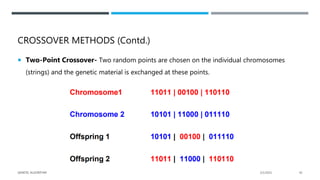
CROSSOVER METHODS (Contd.)
Two-Point Crossover- Two random points are chosen on the individual chromosomes
(strings) and the genetic material is exchanged at these points.
2/1/2021
GENETIC ALGORITHM 42
43.
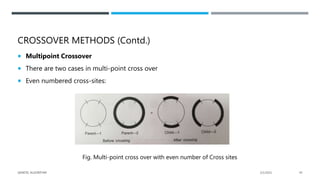
CROSSOVER METHODS (Contd.)
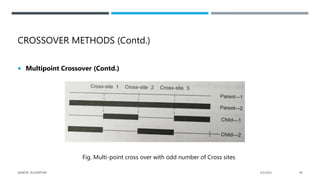
Multipoint Crossover
There are two cases in multi-point cross over
Even numbered cross-sites:
Fig. Multi-point cross over with even number of Cross sites
2/1/2021
GENETIC ALGORITHM 43
44.
CROSSOVER METHODS (Contd.)
Multipoint Crossover (Contd.)
Fig. Multi-point cross over with odd number of Cross sites
2/1/2021
GENETIC ALGORITHM 44
45.
CROSSOVER METHODS (Contd.)
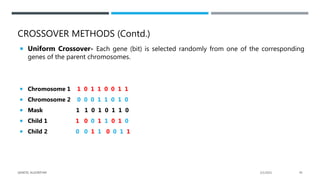
Uniform Crossover- Each gene (bit) is selected randomly from one of the corresponding
genes of the parent chromosomes.
Chromosome 1 1 0 1 1 0 0 1 1
Chromosome 2 0 0 0 1 1 0 1 0
Mask 1 1 0 1 0 1 1 0
Child 1 1 0 0 1 1 0 1 0
Child 2 0 0 1 1 0 0 1 1
2/1/2021
GENETIC ALGORITHM 45
46.
CROSSOVER METHODS (Contd.)
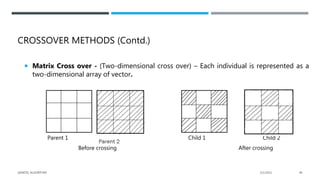
Matrix Cross over - (Two-dimensional cross over) – Each individual is represented as a
two-dimensional array of vector.
Parent 1 Child 1 Child 2
Before crossing After crossing
2/1/2021
GENETIC ALGORITHM 46
47.
CROSSOVER (Contd.)
Crossoverbetween 2 good solutions MAY NOT ALWAYS yield a better or as good a
solution.
Since parents are good, probability of the child being good is high.
If offspring is not good (poor solution), it will be removed in the next iteration during
“Selection”.
2/1/2021
GENETIC ALGORITHM 47
48.
INVERSION AND DELETION
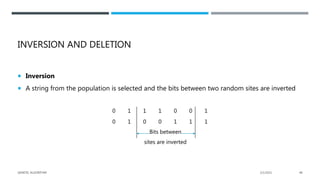
Inversion
A string from the population is selected and the bits between two random sites are inverted
0 1 1 1 0 0 1
0 1 0 0 1 1 1
Bits between
sites are inverted
2/1/2021
GENETIC ALGORITHM 48
49.
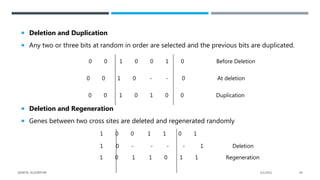
Deletion andDuplication
Any two or three bits at random in order are selected and the previous bits are duplicated.
0 0 1 0 0 1 0 Before Deletion
0 0 1 0 - - 0 At deletion
0 0 1 0 1 0 0 Duplication
Deletion and Regeneration
Genes between two cross sites are deleted and regenerated randomly
1 0 0 1 1 0 1
1 0 - - - - 1 Deletion
1 0 1 1 0 1 1 Regeneration
2/1/2021
GENETIC ALGORITHM 49
50.
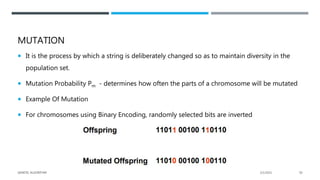
MUTATION
It isthe process by which a string is deliberately changed so as to maintain diversity in the
population set.
Mutation Probability Pm - determines how often the parts of a chromosome will be mutated
Example Of Mutation
For chromosomes using Binary Encoding, randomly selected bits are inverted
2/1/2021
GENETIC ALGORITHM 50
51.
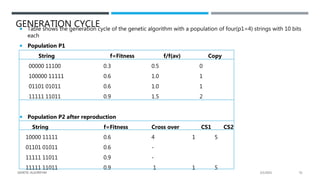
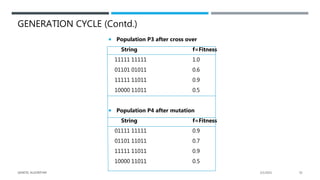
GENERATION CYCLE
Tableshows the generation cycle of the genetic algorithm with a population of four(p1=4) strings with 10 bits
each
Population P1
String f=Fitness f/f(av) Copy
00000 11100 0.3 0.5 0
100000 11111 0.6 1.0 1
01101 01011 0.6 1.0 1
11111 11011 0.9 1.5 2
Population P2 after reproduction
String f=Fitness Cross over CS1 CS2
10000 11111 0.6 4 1 5
01101 01011 0.6 -
11111 11011 0.9 -
11111 11011 0.9 1 1 5
2/1/2021
GENETIC ALGORITHM 51
CONVERGENCE OF GENETICALGORITHM
• Convergence is a phenomenon in evolutionary computation that causes evolution to halt
because precisely every individual in the population is identical.
• Full Convergence might be seen in genetic algorithms using only cross-over.
• Premature convergence is when a population has converged to a single solution, but that
solution is not as high of quality as expected, i.e. the population has gotten stuck.
• However, convergence is not necessarily a negative phenomenon, because populations often
stabilize after a time, in the sense that the best programs all have a common ancestor and
their behavior is very similar/identical both to each other and to that of high fitness programs
from the previous generations.
• Convergence can be avoided with a variety of diversity generating techniques.
2/1/2021
GENETIC ALGORITHM 53
54.
ADVANTAGES OF GAS
Does not require any derivative information (which may not be available for many real-world
problems).
Is faster and more efficient as compared to the traditional methods.
Has very good parallel capabilities.
Optimizes both continuous and discrete functions and also multi-objective problems
Provides a list of “good” solutions and not just a single solution.
Always gets an answer to the problem, which gets better over the time.
Useful when the search space is very large and there are a large number of parameters
involved 2/1/2021
GENETIC ALGORITHM 54
55.
LIMITATIONS OF GAS
Fitness value is calculated repeatedly which might be computationally expensive for some
problems.
Being stochastic, there are no guarantees on the optimality or the quality of the solution.
If not implemented properly, the GA may not converge to the optimal solution
2/1/2021
GENETIC ALGORITHM 55
56.
REFERENCES
1. Sivananda, Deepa,Principles of Soft Computing, 2ndEdn, Wiley India,2014.
2. Rajasekharan and Viajayalakshmipai, Neural Networks, Fuzzy Logic and Genetic Algorithm,
PHI, 2003. (For Unit 5).
2/1/2021
GENETIC ALGORITHM 56