Project
Management
Hirotaka Onishi MD, PhD, MHPE
Dept of International Cooperation for Medical Education
International Research Center for Medical Education
Graduate School of Medicine, University of Tokyo
Project
 Latin verb proicere
 pro : precedence, something that comes
before something else in time
 icere : to throw, to do
 Planned set of interrelated tasks to
be executed over a fixed period and
within certain cost and other limitations.
(http://www.businessdictionary.com/)
Logic Model
(Logical Framework)
 Used for result-based management
 Emphasize causal relationship among
input  activity  output  outcome 
impact
 Identify important assumptions to
possibly affect the success
3
Menu
1. Overview of Logframe
2. Logframe and planning
3. Project management
4
1. OVERVIEW OF LOGFRAME
5
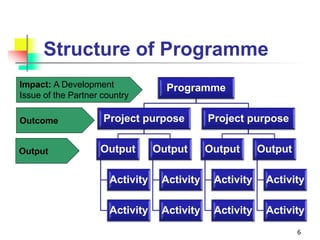
Structure of Programme
Programme
Project purpose
Output
Activity
Activity
Output
Activity
Activity
Project purpose
Output
Activity
Activity
Output
Activity
Activity
6
Impact: A Development
Issue of the Partner country
Outcome
Output
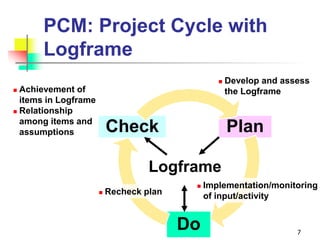
PCM: Project Cycle with
Logframe
Plan
Do
Check
7
 Recheck plan
Logframe
 Implementation/monitoring
of input/activity
 Achievement of
items in Logframe
 Relationship
among items and
assumptions
 Develop and assess
the Logframe
8
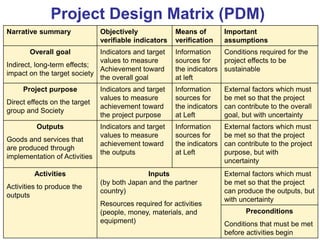
Project Design Matrix (PDM)
Narrative summary Objectively
verifiable indicators
Means of
verification
Important
assumptions
Overall goal
Indirect, long-term effects;
impact on the target society
Indicators and target
values to measure
Achievement toward
the overall goal
Information
sources for
the indicators
at left
Conditions required for the
project effects to be
sustainable
Project purpose
Direct effects on the target
group and Society
Indicators and target
values to measure
achievement toward
the project purpose
Information
sources for
the indicators
at Left
External factors which must
be met so that the project
can contribute to the overall
goal, but with uncertainty
Outputs
Goods and services that
are produced through
implementation of Activities
Indicators and target
values to measure
achievement toward
the outputs
Information
sources for
the indicators
at Left
External factors which must
be met so that the project
can contribute to the project
purpose, but with
uncertainty
Activities
Activities to produce the
outputs
Inputs
(by both Japan and the partner
country)
Resources required for activities
(people, money, materials, and
equipment)
External factors which must
be met so that the project
can produce the outputs, but
with uncertainty
Preconditions
Conditions that must be met
before activities begin
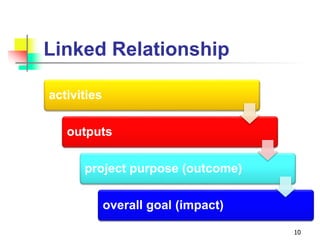
Linked Relationship
activities
outputs
project purpose (outcome)
overall goal (impact)
10
Causal Relationship
= “if-then” relationship
"if" the project purpose is fulfilled,
"then" it will contribute to the overall goal.
11
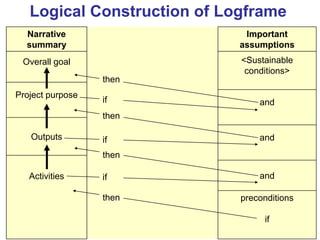
Logical Construction of Logframe
Narrative
summary
Important
assumptions
Overall goal <Sustainable
conditions>
Project purpose
and
Outputs and
Activities and
preconditions
if
then
if
then
if
then
if
then
2. LOGFRAME AND PLANNING
13
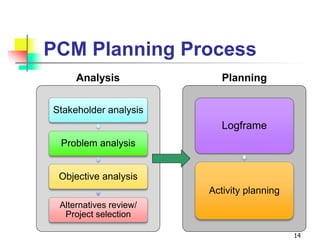
PCM Planning Process
Stakeholder analysis
Problem analysis
Objective analysis
Alternatives review/
Project selection
14
Logframe
Activity planning
Analysis Planning
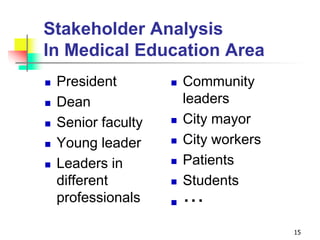
Stakeholder Analysis
In Medical Education Area
 President
 Dean
 Senior faculty
 Young leader
 Leaders in
different
professionals
15
 Community
leaders
 City mayor
 City workers
 Patients
 Students
 ・・・
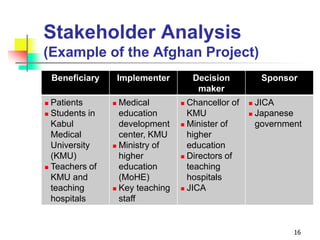
Stakeholder Analysis
(Example of the Afghan Project)
Beneficiary Implementer Decision
maker
Sponsor
 Patients
 Students in
Kabul
Medical
University
(KMU)
 Teachers of
KMU and
teaching
hospitals
 Medical
education
development
center, KMU
 Ministry of
higher
education
(MoHE)
 Key teaching
staff
 Chancellor of
KMU
 Minister of
higher
education
 Directors of
teaching
hospitals
 JICA
 JICA
 Japanese
government
16
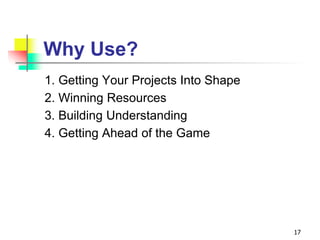
Why Use?
1. Getting Your Projects Into Shape
2. Winning Resources
3. Building Understanding
4. Getting Ahead of the Game
17
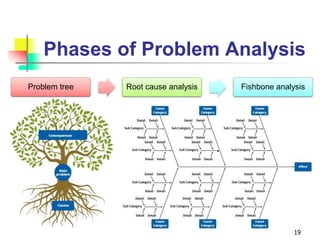
Tools for Problem Analysis
 The problem tree
 Break down many issues into manageable pieces,
causes, main problem and consequences.
 Five ‘whys’ / Root cause analysis
 Ask why each issue happens and moving up to a
root cause.
 The fishbone analysis
 Trace several factors and pursue category
causes. Other detailed causes are connected with
category causes.
18
Phases of Problem Analysis
Problem tree Root cause analysis Fishbone analysis
19
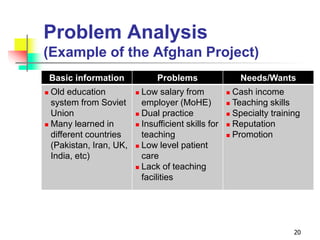
Problem Analysis
(Example of the Afghan Project)
20
Basic information Problems Needs/Wants
 Old education
system from Soviet
Union
 Many learned in
different countries
(Pakistan, Iran, UK,
India, etc)
 Low salary from
employer (MoHE)
 Dual practice
 Insufficient skills for
teaching
 Low level patient
care
 Lack of teaching
facilities
 Cash income
 Teaching skills
 Specialty training
 Reputation
 Promotion
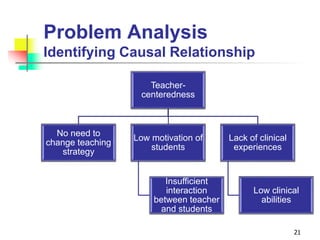
Problem Analysis
Identifying Causal Relationship
Teacher-
centeredness
No need to
change teaching
strategy
Low motivation of
students
Insufficient
interaction
between teacher
and students
Lack of clinical
experiences
Low clinical
abilities
21
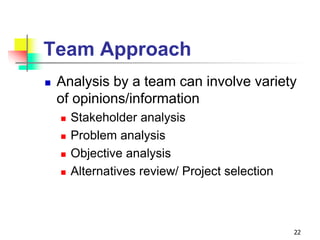
Team Approach
 Analysis by a team can involve variety
of opinions/information
 Stakeholder analysis
 Problem analysis
 Objective analysis
 Alternatives review/ Project selection
22
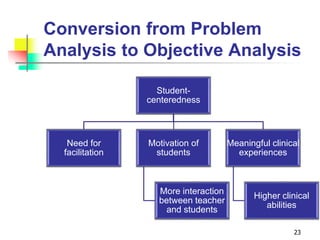
Conversion from Problem
Analysis to Objective Analysis
23
Student-
centeredness
Need for
facilitation
Motivation of
students
More interaction
between teacher
and students
Meaningful clinical
experiences
Higher clinical
abilities
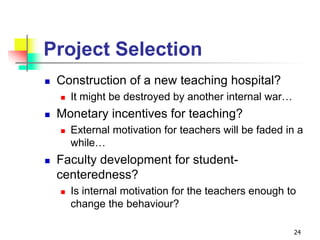
Project Selection
 Construction of a new teaching hospital?
 It might be destroyed by another internal war…
 Monetary incentives for teaching?
 External motivation for teachers will be faded in a
while…
 Faculty development for student-
centeredness?
 Is internal motivation for the teachers enough to
change the behaviour?
24
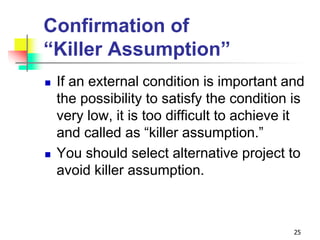
Confirmation of
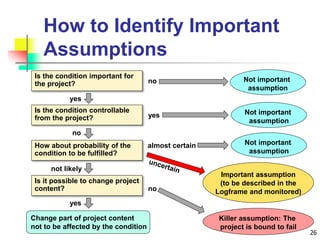
“Killer Assumption”
 If an external condition is important and
the possibility to satisfy the condition is
very low, it is too difficult to achieve it
and called as “killer assumption.”
 You should select alternative project to
avoid killer assumption.
25
How to Identify Important
Assumptions
26
Is the condition important for
the project?
Is the condition controllable
from the project?
How about probability of the
condition to be fulfilled?
Is it possible to change project
content?
Change part of project content
not to be affected by the condition
Not important
assumption
Not important
assumption
Not important
assumption
Killer assumption: The
project is bound to fail
Important assumption
(to be described in the
Logframe and monitored)
no
no
yes
not likely
yes
yes
almost certain
no
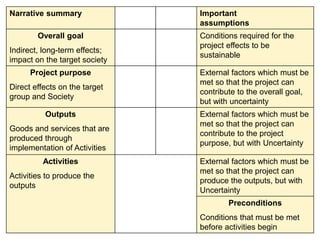
Narrative summary Important
assumptions
Overall goal
Indirect, long-term effects;
impact on the target society
Conditions required for the
project effects to be
sustainable
Project purpose
Direct effects on the target
group and Society
External factors which must be
met so that the project can
contribute to the overall goal,
but with uncertainty
Outputs
Goods and services that are
produced through
implementation of Activities
External factors which must be
met so that the project can
contribute to the project
purpose, but with Uncertainty
Activities
Activities to produce the
outputs
External factors which must be
met so that the project can
produce the outputs, but with
Uncertainty
Preconditions
Conditions that must be met
before activities begin
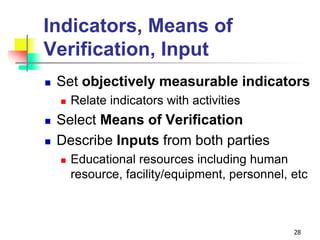
Indicators, Means of
Verification, Input
 Set objectively measurable indicators
 Relate indicators with activities
 Select Means of Verification
 Describe Inputs from both parties
 Educational resources including human
resource, facility/equipment, personnel, etc
28
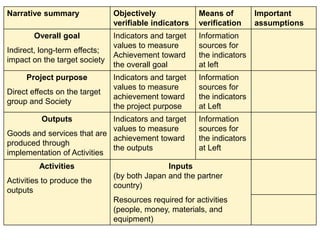
Narrative summary Objectively
verifiable indicators
Means of
verification
Important
assumptions
Overall goal
Indirect, long-term effects;
impact on the target society
Indicators and target
values to measure
Achievement toward
the overall goal
Information
sources for
the indicators
at left
Project purpose
Direct effects on the target
group and Society
Indicators and target
values to measure
achievement toward
the project purpose
Information
sources for
the indicators
at Left
Outputs
Goods and services that are
produced through
implementation of Activities
Indicators and target
values to measure
achievement toward
the outputs
Information
sources for
the indicators
at Left
Activities
Activities to produce the
outputs
Inputs
(by both Japan and the partner
country)
Resources required for activities
(people, money, materials, and
equipment)
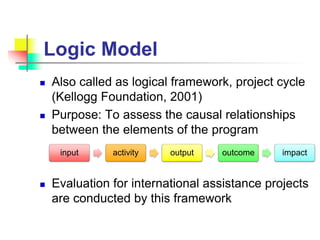
Logic Model
 Also called as logical framework, project cycle
(Kellogg Foundation, 2001)
 Purpose: To assess the causal relationships
between the elements of the program
 Evaluation for international assistance projects
are conducted by this framework
input activity output outcome impact
3. PROJECT MANAGEMENT
31
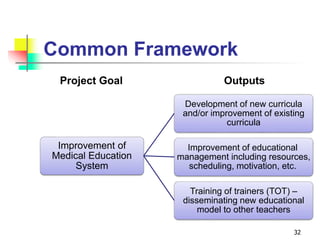
Common Framework
Improvement of
Medical Education
System
Development of new curricula
and/or improvement of existing
curricula
Improvement of educational
management including resources,
scheduling, motivation, etc.
Training of trainers (TOT) –
disseminating new educational
model to other teachers
32
Project Goal Outputs
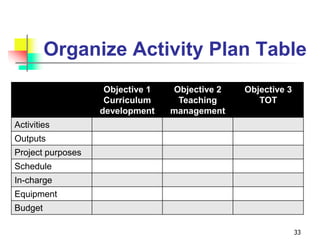
Organize Activity Plan Table
Objective 1
Curriculum
development
Objective 2
Teaching
management
Objective 3
TOT
Activities
Outputs
Project purposes
Schedule
In-charge
Equipment
Budget
33
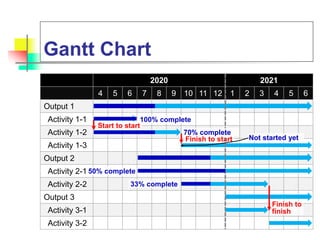
Gantt Chart
2020 2021
4 5 6 7 8 9 10 11 12 1 2 3 4 5 6
Output 1
Activity 1-1
Activity 1-2
Activity 1-3
Output 2
Activity 2-1
Activity 2-2
Output 3
Activity 3-1
Activity 3-2
Start to start
Finish to start
Finish to
finish
100% complete
70% complete
Not started yet
50% complete
33% complete
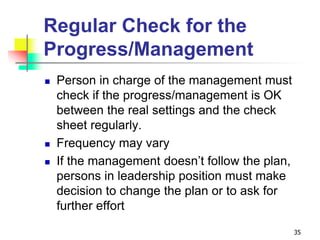
Regular Check for the
Progress/Management
 Person in charge of the management must
check if the progress/management is OK
between the real settings and the check
sheet regularly.
 Frequency may vary
 If the management doesn’t follow the plan,
persons in leadership position must make
decision to change the plan or to ask for
further effort
35
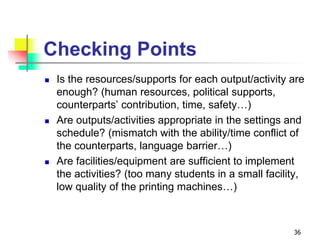
Checking Points
 Is the resources/supports for each output/activity are
enough? (human resources, political supports,
counterparts’ contribution, time, safety…)
 Are outputs/activities appropriate in the settings and
schedule? (mismatch with the ability/time conflict of
the counterparts, language barrier…)
 Are facilities/equipment are sufficient to implement
the activities? (too many students in a small facility,
low quality of the printing machines…)
36

05 Project management

  • 1.
    Project Management Hirotaka Onishi MD,PhD, MHPE Dept of International Cooperation for Medical Education International Research Center for Medical Education Graduate School of Medicine, University of Tokyo
  • 2.
    Project  Latin verbproicere  pro : precedence, something that comes before something else in time  icere : to throw, to do  Planned set of interrelated tasks to be executed over a fixed period and within certain cost and other limitations. (http://www.businessdictionary.com/)
  • 3.
    Logic Model (Logical Framework) Used for result-based management  Emphasize causal relationship among input  activity  output  outcome  impact  Identify important assumptions to possibly affect the success 3
  • 4.
    Menu 1. Overview ofLogframe 2. Logframe and planning 3. Project management 4
  • 5.
    1. OVERVIEW OFLOGFRAME 5
  • 6.
    Structure of Programme Programme Projectpurpose Output Activity Activity Output Activity Activity Project purpose Output Activity Activity Output Activity Activity 6 Impact: A Development Issue of the Partner country Outcome Output
  • 7.
    PCM: Project Cyclewith Logframe Plan Do Check 7  Recheck plan Logframe  Implementation/monitoring of input/activity  Achievement of items in Logframe  Relationship among items and assumptions  Develop and assess the Logframe
  • 8.
  • 9.
    Project Design Matrix(PDM) Narrative summary Objectively verifiable indicators Means of verification Important assumptions Overall goal Indirect, long-term effects; impact on the target society Indicators and target values to measure Achievement toward the overall goal Information sources for the indicators at left Conditions required for the project effects to be sustainable Project purpose Direct effects on the target group and Society Indicators and target values to measure achievement toward the project purpose Information sources for the indicators at Left External factors which must be met so that the project can contribute to the overall goal, but with uncertainty Outputs Goods and services that are produced through implementation of Activities Indicators and target values to measure achievement toward the outputs Information sources for the indicators at Left External factors which must be met so that the project can contribute to the project purpose, but with uncertainty Activities Activities to produce the outputs Inputs (by both Japan and the partner country) Resources required for activities (people, money, materials, and equipment) External factors which must be met so that the project can produce the outputs, but with uncertainty Preconditions Conditions that must be met before activities begin
  • 10.
  • 11.
    Causal Relationship = “if-then”relationship "if" the project purpose is fulfilled, "then" it will contribute to the overall goal. 11
  • 12.
    Logical Construction ofLogframe Narrative summary Important assumptions Overall goal <Sustainable conditions> Project purpose and Outputs and Activities and preconditions if then if then if then if then
  • 13.
    2. LOGFRAME ANDPLANNING 13
  • 14.
    PCM Planning Process Stakeholderanalysis Problem analysis Objective analysis Alternatives review/ Project selection 14 Logframe Activity planning Analysis Planning
  • 15.
    Stakeholder Analysis In MedicalEducation Area  President  Dean  Senior faculty  Young leader  Leaders in different professionals 15  Community leaders  City mayor  City workers  Patients  Students  ・・・
  • 16.
    Stakeholder Analysis (Example ofthe Afghan Project) Beneficiary Implementer Decision maker Sponsor  Patients  Students in Kabul Medical University (KMU)  Teachers of KMU and teaching hospitals  Medical education development center, KMU  Ministry of higher education (MoHE)  Key teaching staff  Chancellor of KMU  Minister of higher education  Directors of teaching hospitals  JICA  JICA  Japanese government 16
  • 17.
    Why Use? 1. GettingYour Projects Into Shape 2. Winning Resources 3. Building Understanding 4. Getting Ahead of the Game 17
  • 18.
    Tools for ProblemAnalysis  The problem tree  Break down many issues into manageable pieces, causes, main problem and consequences.  Five ‘whys’ / Root cause analysis  Ask why each issue happens and moving up to a root cause.  The fishbone analysis  Trace several factors and pursue category causes. Other detailed causes are connected with category causes. 18
  • 19.
    Phases of ProblemAnalysis Problem tree Root cause analysis Fishbone analysis 19
  • 20.
    Problem Analysis (Example ofthe Afghan Project) 20 Basic information Problems Needs/Wants  Old education system from Soviet Union  Many learned in different countries (Pakistan, Iran, UK, India, etc)  Low salary from employer (MoHE)  Dual practice  Insufficient skills for teaching  Low level patient care  Lack of teaching facilities  Cash income  Teaching skills  Specialty training  Reputation  Promotion
  • 21.
    Problem Analysis Identifying CausalRelationship Teacher- centeredness No need to change teaching strategy Low motivation of students Insufficient interaction between teacher and students Lack of clinical experiences Low clinical abilities 21
  • 22.
    Team Approach  Analysisby a team can involve variety of opinions/information  Stakeholder analysis  Problem analysis  Objective analysis  Alternatives review/ Project selection 22
  • 23.
    Conversion from Problem Analysisto Objective Analysis 23 Student- centeredness Need for facilitation Motivation of students More interaction between teacher and students Meaningful clinical experiences Higher clinical abilities
  • 24.
    Project Selection  Constructionof a new teaching hospital?  It might be destroyed by another internal war…  Monetary incentives for teaching?  External motivation for teachers will be faded in a while…  Faculty development for student- centeredness?  Is internal motivation for the teachers enough to change the behaviour? 24
  • 25.
    Confirmation of “Killer Assumption” If an external condition is important and the possibility to satisfy the condition is very low, it is too difficult to achieve it and called as “killer assumption.”  You should select alternative project to avoid killer assumption. 25
  • 26.
    How to IdentifyImportant Assumptions 26 Is the condition important for the project? Is the condition controllable from the project? How about probability of the condition to be fulfilled? Is it possible to change project content? Change part of project content not to be affected by the condition Not important assumption Not important assumption Not important assumption Killer assumption: The project is bound to fail Important assumption (to be described in the Logframe and monitored) no no yes not likely yes yes almost certain no
  • 27.
    Narrative summary Important assumptions Overallgoal Indirect, long-term effects; impact on the target society Conditions required for the project effects to be sustainable Project purpose Direct effects on the target group and Society External factors which must be met so that the project can contribute to the overall goal, but with uncertainty Outputs Goods and services that are produced through implementation of Activities External factors which must be met so that the project can contribute to the project purpose, but with Uncertainty Activities Activities to produce the outputs External factors which must be met so that the project can produce the outputs, but with Uncertainty Preconditions Conditions that must be met before activities begin
  • 28.
    Indicators, Means of Verification,Input  Set objectively measurable indicators  Relate indicators with activities  Select Means of Verification  Describe Inputs from both parties  Educational resources including human resource, facility/equipment, personnel, etc 28
  • 29.
    Narrative summary Objectively verifiableindicators Means of verification Important assumptions Overall goal Indirect, long-term effects; impact on the target society Indicators and target values to measure Achievement toward the overall goal Information sources for the indicators at left Project purpose Direct effects on the target group and Society Indicators and target values to measure achievement toward the project purpose Information sources for the indicators at Left Outputs Goods and services that are produced through implementation of Activities Indicators and target values to measure achievement toward the outputs Information sources for the indicators at Left Activities Activities to produce the outputs Inputs (by both Japan and the partner country) Resources required for activities (people, money, materials, and equipment)
  • 30.
    Logic Model  Alsocalled as logical framework, project cycle (Kellogg Foundation, 2001)  Purpose: To assess the causal relationships between the elements of the program  Evaluation for international assistance projects are conducted by this framework input activity output outcome impact
  • 31.
  • 32.
    Common Framework Improvement of MedicalEducation System Development of new curricula and/or improvement of existing curricula Improvement of educational management including resources, scheduling, motivation, etc. Training of trainers (TOT) – disseminating new educational model to other teachers 32 Project Goal Outputs
  • 33.
    Organize Activity PlanTable Objective 1 Curriculum development Objective 2 Teaching management Objective 3 TOT Activities Outputs Project purposes Schedule In-charge Equipment Budget 33
  • 34.
    Gantt Chart 2020 2021 45 6 7 8 9 10 11 12 1 2 3 4 5 6 Output 1 Activity 1-1 Activity 1-2 Activity 1-3 Output 2 Activity 2-1 Activity 2-2 Output 3 Activity 3-1 Activity 3-2 Start to start Finish to start Finish to finish 100% complete 70% complete Not started yet 50% complete 33% complete
  • 35.
    Regular Check forthe Progress/Management  Person in charge of the management must check if the progress/management is OK between the real settings and the check sheet regularly.  Frequency may vary  If the management doesn’t follow the plan, persons in leadership position must make decision to change the plan or to ask for further effort 35
  • 36.
    Checking Points  Isthe resources/supports for each output/activity are enough? (human resources, political supports, counterparts’ contribution, time, safety…)  Are outputs/activities appropriate in the settings and schedule? (mismatch with the ability/time conflict of the counterparts, language barrier…)  Are facilities/equipment are sufficient to implement the activities? (too many students in a small facility, low quality of the printing machines…) 36

Editor's Notes

  • #7 In project management, projects are the main target. In this regard, a programme is functioning as the umbrella function to integrate multiple projects. Each project has several outputs and each output has several activities. If we see the continuity of the outputs, outcomes and impacts, a project manages outcome-level issues and a programme manages impact-level issues.
  • #8 PCM, project cycle management, is using logframe for the cyclic management of plan, do and check. This is similar to project cycle management, often called PDCA cycle. In the planning stage managers develop and assess the logframe. Then in the doing stage the project is implemented and monitored for inputs and activities. And then, in the checking stage, implementation and planning is checked. Before moving to the next planning stage this cycle itself is also checked.
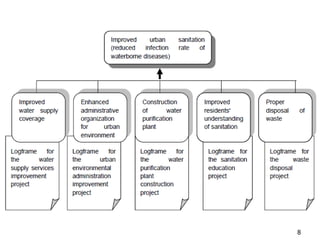
  • #9 This is an example plan for urban sanitation project. Here urban sanitation is a programme and five items are different projects.
  • #10 PDM, project design matrix, is a table sheet for overviewing the items in the project. In the left column, the project purpose is the main target of the project. There are several outputs under the project purpose. Overall goal is a bigger aim of the project, not achievable only by the project. All the overall goal, the project purpose and the outputs have objectively verifiable indicators. Indicators are better to be expressed quantitatively but some indictors might be qualitative ones. Means of verification are information sources for the indicators. Right column is the assumptions to achieve outputs, the project purpose and the overall goal. Activities are broken-down items under outputs. Inputs are resources supplied by both the donner country and the recipient country.
  • #12 Different levels of purposes are connected by if-then relationship.
  • #13 Logframe consists of different levels of in-then connections. If precondtions are satisfied, experts will start activities. If the assumptions for outputs are met, outputs can be achievable. If the assumptions for the project purpose, the project purpose can be achievable.
  • #18 You can use the opinions of your most powerful stakeholders to help define your projects at an early stage. These stakeholders will then more likely support you, and their input can also improve the quality of your project. Gaining support from powerful stakeholders can help you to win more resources, such as people, time or money. This makes it more likely that your projects will be successful. By communicating with your stakeholders early and often, you can ensure that they fully grasp what you’re doing and understand the benefits of your project. This means that they can more actively support you when necessary. Understanding your stakeholders means that you can anticipate and predict their reactions to your project as it develops. This allows you to plan actions that will more likely win their support.
  • #27 In Afghanistan, an important assumption was “another internal war will destroy many buildings in Kabul (the capital of Afghanistan). To avoid the influence from possible internal war, we did not build a hospital there. Possible killer assumption was that all the experts who were trained in Japan would die (like late 1970s in Cambodia) or escape from the country (brain drain).
  • #35 This is an example Gantt Chart. Any project is time-bound, so plan of each activity is described in the table. Some outputs/activities are simultaneously started (Start to start) to support the each other’s progress. Some outputs/activities are consecutively connected (Finish to start) to follow the completion of an output/activity. Other outputs/activities are synchronously finished (Finish to finish). The break line between years of 2020 and 2021 is the current timing. Blue data are the evaluation of completion for each activity. Due to the delay of activity 1-2, activity 1-3 is not started yet. Output 2 is also a bit delayed.