PARTICIPATORY
PLANNING
Reporter:
ALJUN A. DESOYO
LEARNING OBJECTIVES:
* Define Participatory Planning;
* Know the responsible stakeholders in participatory
planning; and
* Recognize the effects of participatory planning in
terms of:
+ Efficiency
+ Conflict
+ Localization
+ Authority and control
What is PLANNING?
- It is the process of thinking about the activities required to
achieve a desired goal. It is the first and foremost activity to
achieve desired results. It involves the creation and
maintenance of a plan, such as psychological aspects that
require conceptual skills.
What is PARTICIPATORY PLANNING?
- An approach in which everyone who has a stake in the
intervention has a voice , either in person or by representation.
FOR EXAMPLE:
A photo taken during the
wrath of Typhoon Ulysses
Rep. Marcoleta on the issue
of Module Reproduction
Video Presentation
WHAT ARE THE ADVANTAGES OF
A PARTICIPATORY PLANNING
APPROACH?
- Participation carries with it feelings of ownership.
- It ensures credibility of the intervention.
- Bringing a broader range of people to the planning
process.
- Avoiding pitfalls caused by ignorance of the realities.
- It involves important players from the outset.
- Providing an opportunity for groups to be heard.
- It teaches skills which last far beyond the planning
process.
- Bringing together community members.
- A participatory planning process builds trust.
- It generally reflects the mission and goals of
organizations.
- It implies respect for everyone in the community.
- Logically, a participatory planning approach should be
effective.
- Finally, it does things the way they should be done.
WHAT ARE THE DISADVANTAGES
OF A PARTICIPATORY PLANNING
APPROACH?
- A participatory process takes longer.
- Members may not agree with the "experts ".
- Lots of education may be needed, both for
community members and the organization.
- One determined individual can wreck the whole
process.
- Difficult to assure that all the right people get to the
table.
- A participatory planning process takes patience and
WHO SHOULD BE INVOLVED IN A
PARTICIPATORY PLANNING
PROCESS?- The "targets of change".
* Members of the target community.
* People whom the target community sees as
significant opinion makers.
The "agents of change”.
* Policy makers.
* Influential people in the community.
* Interested members of the community at large
* Members of the organization itself.
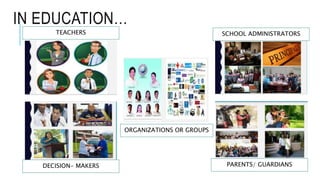
IN EDUCATION…
TEACHERS
DECISION- MAKERS PARENTS/ GUARDIANS
SCHOOL ADMINISTRATORS
ORGANIZATIONS OR GROUPS
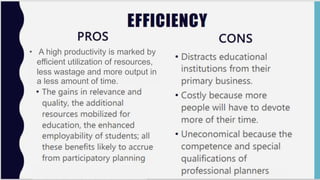
• A high productivity is marked by
efficient utilization of resources,
less wastage and more output in
a less amount of time.
Participatory Planning

Participatory Planning

  • 1.
  • 2.
    LEARNING OBJECTIVES: * DefineParticipatory Planning; * Know the responsible stakeholders in participatory planning; and * Recognize the effects of participatory planning in terms of: + Efficiency + Conflict + Localization + Authority and control
  • 3.
    What is PLANNING? -It is the process of thinking about the activities required to achieve a desired goal. It is the first and foremost activity to achieve desired results. It involves the creation and maintenance of a plan, such as psychological aspects that require conceptual skills. What is PARTICIPATORY PLANNING? - An approach in which everyone who has a stake in the intervention has a voice , either in person or by representation.
  • 4.
    FOR EXAMPLE: A phototaken during the wrath of Typhoon Ulysses Rep. Marcoleta on the issue of Module Reproduction Video Presentation
  • 5.
    WHAT ARE THEADVANTAGES OF A PARTICIPATORY PLANNING APPROACH? - Participation carries with it feelings of ownership. - It ensures credibility of the intervention. - Bringing a broader range of people to the planning process. - Avoiding pitfalls caused by ignorance of the realities. - It involves important players from the outset. - Providing an opportunity for groups to be heard.
  • 6.
    - It teachesskills which last far beyond the planning process. - Bringing together community members. - A participatory planning process builds trust. - It generally reflects the mission and goals of organizations. - It implies respect for everyone in the community. - Logically, a participatory planning approach should be effective. - Finally, it does things the way they should be done.
  • 7.
    WHAT ARE THEDISADVANTAGES OF A PARTICIPATORY PLANNING APPROACH? - A participatory process takes longer. - Members may not agree with the "experts ". - Lots of education may be needed, both for community members and the organization. - One determined individual can wreck the whole process. - Difficult to assure that all the right people get to the table. - A participatory planning process takes patience and
  • 8.
    WHO SHOULD BEINVOLVED IN A PARTICIPATORY PLANNING PROCESS?- The "targets of change". * Members of the target community. * People whom the target community sees as significant opinion makers. The "agents of change”. * Policy makers. * Influential people in the community. * Interested members of the community at large * Members of the organization itself.
  • 9.
    IN EDUCATION… TEACHERS DECISION- MAKERSPARENTS/ GUARDIANS SCHOOL ADMINISTRATORS ORGANIZATIONS OR GROUPS
  • 11.
    • A highproductivity is marked by efficient utilization of resources, less wastage and more output in a less amount of time.