ENVIRONMENT AND
CONFLICT
MANAGEMENT
By –
Sneha sahu
M.Sc. 3rd semester in botany
Content
■ Introduction
■ Definition
■ Collaborative approaches
■ Environmental law policy
■ Initiating a process
■ Conflict assessment
■ Design- stakeholder process
■ Design- public innolment process
■ Working with stakeholder
■ Policy development
■ Communication capicity building
■ Implementation and evaluation
■ Sustaining community relations.
■ Conclusion
Introduction
■ Environmental Conflict Management introduces students to the research
and practice of environmental conflict and provides a step-by-step
step-by-step process for engaging stakeholders and other interested
interested parties in the management of environmental disputes. In each
disputes. In each chapter, authors Dr. Tracylee Clarke and Dr. Tarla Rai
Dr. Tarla Rai Peterson first introduce a specific concept or process step
process step and then provide exercises, worksheets, role-plays, and
role-plays, and brief case studies so students can directly apply what
apply what they are learning.
Conti….
■ The appendix includes six additional extended case studies
for further analysis. In addition to providing practical steps
for understanding and managing conflict, the text identifies
the most relevant laws and policies to help students make
more informed decisions. Students will develop techniques
for public involvement and community outreach, strategies
for effective meeting management, approaches to
negotiating options and methodologies for communicating
concerns and working through differences, and outlines for
implementing and evaluating strategies for sustaining
positive community relation
Definition
Environment- The circumstances, objects, or conditions by which one is
surrounded. 2a : the complex of physical, chemical, and biotic factors (such as
climate, soil, and living things) that act upon an organism or an ecological community
and ultimately determine its form and survival.
conflict- Conflict can be defined as an expressed struggle between
at least two interdependent parties , who perceive that incompatible
goals , scarce resources , or interference from others are preventing
them from achieving their goals
Environmental and natural resource policy decision making is changing. Increasingly citizens
and management agency personnel are seeking ways to "do things differently"; to participate
meaningfully in the decision making process as parties work through policy conflicts. "Doing
things differently" has come to mean doing things collaboratively. Daniels and Walker examine
collaboration in environmental and natural resource policy decision making and conflict
management. They address collaboration by featuring a method "collaborative learning," that
has been designed to address decision making and conflict management needs in complex
and controversial policy settings. As they illustrate, collaborative learning differs in some
significant ways from existing approaches for dealing with policy decision making, public
participation, and conflict management. First, it is a hybrid of systems thinking and alternative
dispute resolution concepts. Second, it is grounded explicitly in experiential, team-or
organizational-and adult learning theories. It is a theory-based framework through which
parties can make progress in the management of controversial environmental policy
situations. They discuss both the theory and technique of collaborative learning and present
cases where it has been applied. This is a professional and teaching tool for scholars,
collaborative approaches
Environmental law and policy
■ Environmental Policy and Law (EPL) is an international,
interdisciplinary journal that facilitates an understanding of
environmental policy and law issues not only by drawing
upon and contributing to the environmental social
sciences, but also linking the health, natural, and computer
sciences. The journal provides an exchange of information
and experience on all legal, administrative, and policy
matters relevant to the human and natural environment in
its widest sense. It covers all aspects included in the
concept of sustainable development.
Initiating a process
■ The Initiating Process Group consists of those processes
performed to define a new project or a new phase of an
existing project by obtaining authorization to start the
project or phase. Within the Initiating processes, the
initial scope is defined and initial financial resources are
committed. Internal and external stakeholders who will
interact and influence the overall outcome of the project
are identified. If not already assigned, the project
manager will be selected. This information is captured in
the project charter and stakeholder register. When the
project charter is approved, the project becomes officially
authorized. Although the project management team may
help write the project charter, this standard ...
Conflict assessment
■ Conflict assessment is the first stage in the process of conflict
management and resolution. Participants (either disputants,
third parties, or both) analyze the conflict including background,
participants, issues, dynamics, and possible solutions. Then
participants decide on a plan of action.
Design- stakeholder process
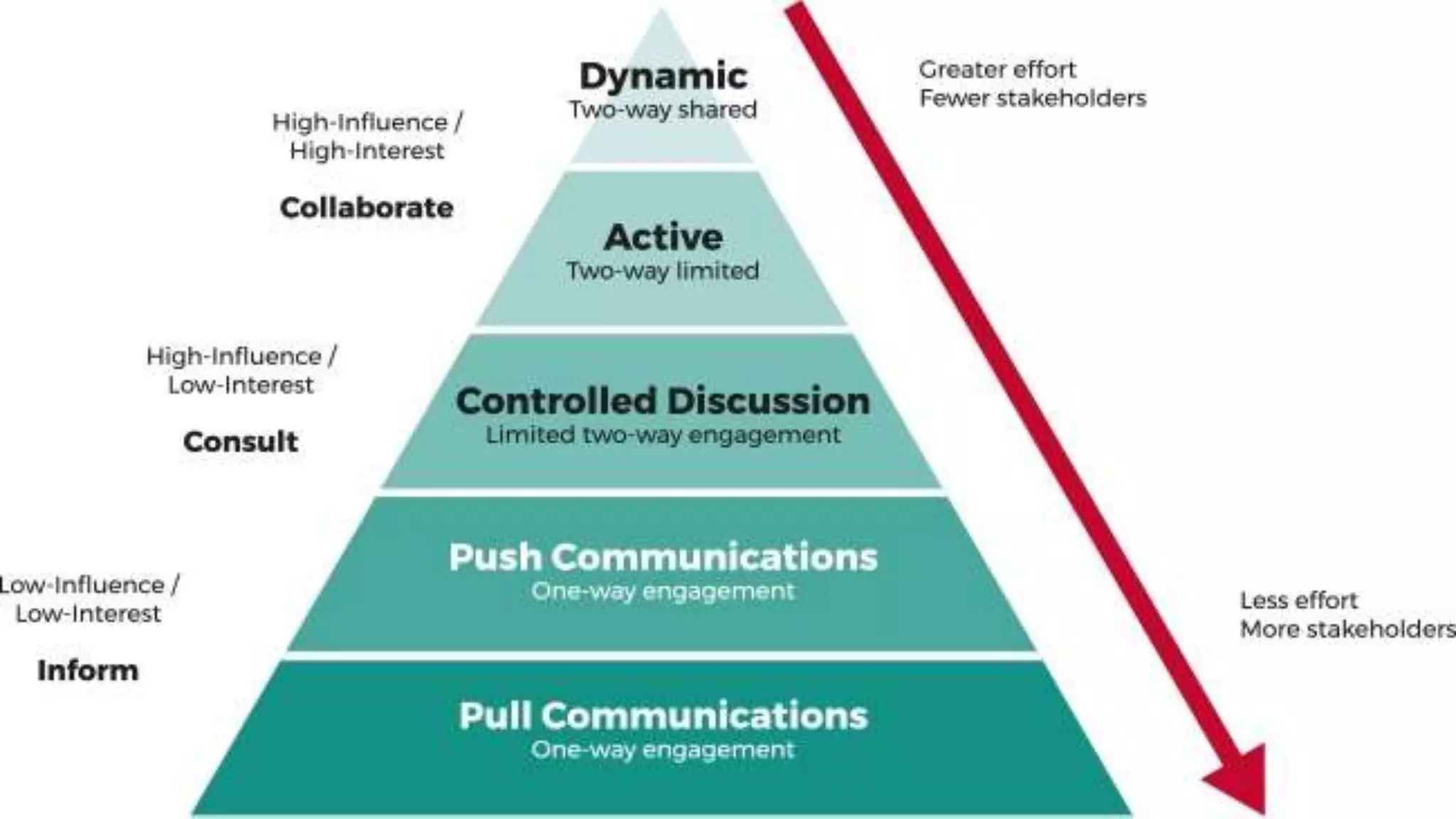
■ The term 'stakeholder' refers to anyone that has
an interest in a project and can influence its
success. It is important to identify stakeholders
in a project as early as possible. They may
include the following; Members of the client
organisation (such as user panels, champions
and department heads
■ Stakeholders are those people, groups, or
individuals who have either the power to affect,
or are affected by the endeavour you’re
engaged with. They range from the head of your
organisation to the man on the street who may
experience the effects of what you set out to do.
Design- public innolment process
■ The purpose of this Theory to Practice article is to present a
systematic, cross-disciplinary, and accessible synthesis of
relevant research and to offer explicit evidence-based
design guidelines to help practitioners design better
participation processes. From the research literature, the
authors glean suggestions for iteratively creating,
managing, and evaluating public participation activities. The
article takes an evidence-based and design science
approach, suggesting that effective public participation
processes are grounded in analyzing the context closely,
identifying the purposes of the participation effort, and
iteratively designing and redesigning the process
accordingly.
Working with stakeholder
■ The more you engage and involve stakeholders, the more you will reduce
and uncover risks on your project. When discussing initial requirements,
project needs, and constraints, stakeholders may bring up issues or
concerns about meeting those things. ... Involving knowledgeable
stakeholders during this process will help
■ The phrase “stakeholder management" implies that these
people can be made to respond positively to a project, but
the truth is that a project manager frequently has no formal
power of authority and therefore has to rely on engagement
to achieve his/her objectives.
Policy development
■ Policy development is an iterative
process designed to produce
continuous improvements in
workplace safety and to provide a
clear indication of the policymaker's
commitment to safety. A workplace's
safety policy forms the foundation of
its larger health and safety program
Communication capicity building
■ Communication capacity” refers to the strength of coverage and reach of messages. The
communication capacity of film and TV refers to the coverage and distribution of film and
TV. “Coverage” means the range of space, and “reach” refers to the degree of reaching
during the transmission of film and TV products.
■ Capacity-building is defined as the process of developing and strengthening the skills,
instincts, abilities, processes and resources that organizations and communities need to
survive, adapt, and thrive in a fast-changing world.
■ This is the on-going work to improve the communications skills and
capacities of WHO staff to help them communicate WHO’s work, health
information, advice and guidance effectively. The function includes face-
to-face and online trainings, and developing tools to guide and support
communications efforts.
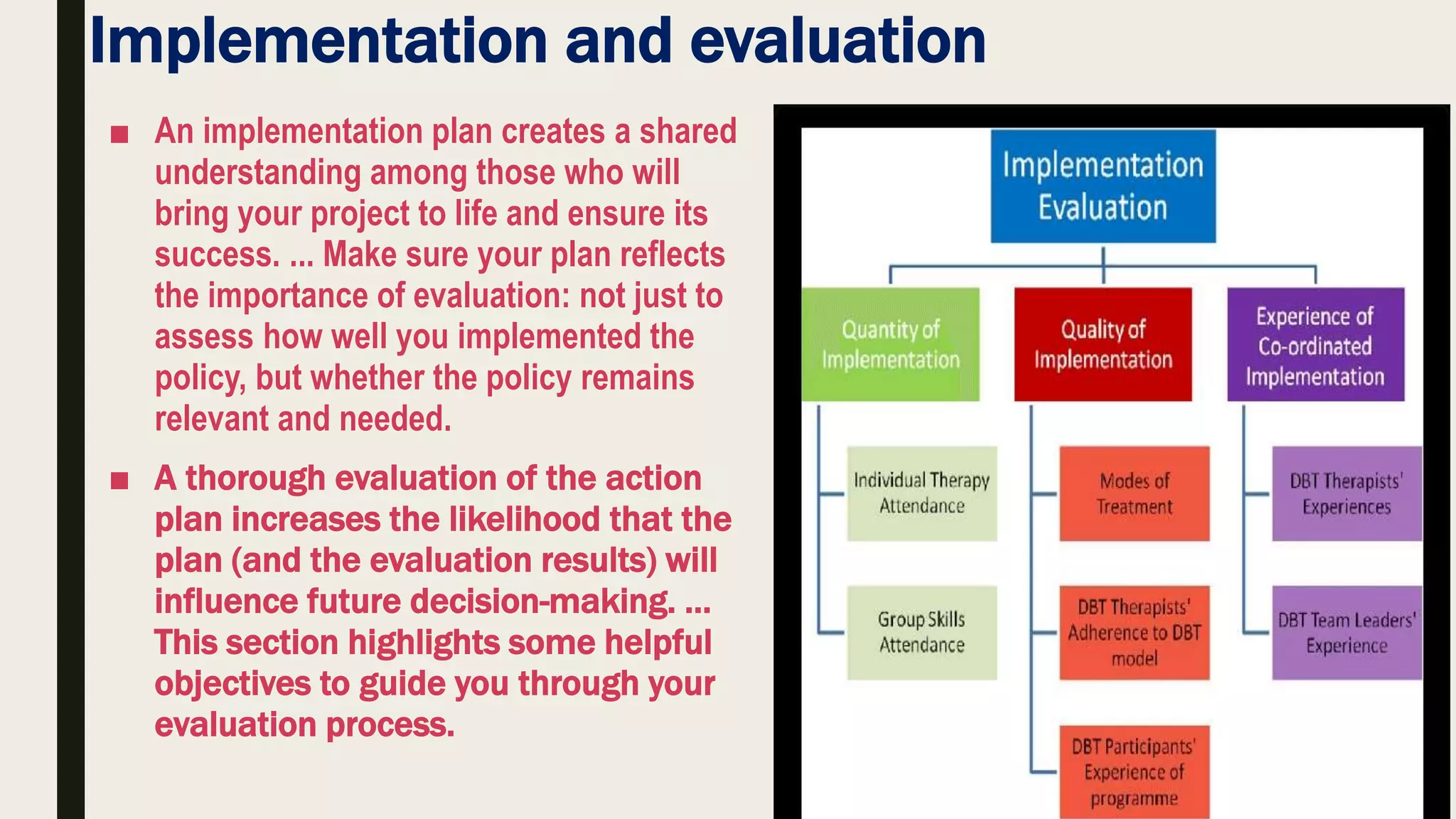
Implementation and evaluation
■ An implementation plan creates a shared
understanding among those who will
bring your project to life and ensure its
success. ... Make sure your plan reflects
the importance of evaluation: not just to
assess how well you implemented the
policy, but whether the policy remains
relevant and needed.
■ A thorough evaluation of the action
plan increases the likelihood that the
plan (and the evaluation results) will
influence future decision-making. …
This section highlights some helpful
objectives to guide you through your
evaluation process.
Sustaining community relations
■ By definition, community relations, an essential function of any successful
business, refers to the various methods companies use to establish and maintain
a mutually beneficial relationship with the communities in which they operate
■ How do you sustain relationships?
■ Pay attention to people. Check in with people when you need to. ...
■ Communicate openly. ...
■ Appreciate each other. ...
■ Extend yourself. ...
■ Volunteer to do some work for their organization (if they are not already in yours). ...
■ Challenge each other to do better. ...
■ Back each other when things get tough
Conclusion
■ Conflicts are normal and a constant process in any organization.
Dealing around these conflicts positively is important. Conflicts
can be both productive and destructive for the organization;
productive conflicts can help you by motivating you in working
better.
Environment and conflict management

Environment and conflict management

  • 1.
    ENVIRONMENT AND CONFLICT MANAGEMENT By – Snehasahu M.Sc. 3rd semester in botany
  • 2.
    Content ■ Introduction ■ Definition ■Collaborative approaches ■ Environmental law policy ■ Initiating a process ■ Conflict assessment ■ Design- stakeholder process ■ Design- public innolment process ■ Working with stakeholder ■ Policy development ■ Communication capicity building ■ Implementation and evaluation ■ Sustaining community relations. ■ Conclusion
  • 3.
    Introduction ■ Environmental ConflictManagement introduces students to the research and practice of environmental conflict and provides a step-by-step step-by-step process for engaging stakeholders and other interested interested parties in the management of environmental disputes. In each disputes. In each chapter, authors Dr. Tracylee Clarke and Dr. Tarla Rai Dr. Tarla Rai Peterson first introduce a specific concept or process step process step and then provide exercises, worksheets, role-plays, and role-plays, and brief case studies so students can directly apply what apply what they are learning.
  • 4.
    Conti…. ■ The appendixincludes six additional extended case studies for further analysis. In addition to providing practical steps for understanding and managing conflict, the text identifies the most relevant laws and policies to help students make more informed decisions. Students will develop techniques for public involvement and community outreach, strategies for effective meeting management, approaches to negotiating options and methodologies for communicating concerns and working through differences, and outlines for implementing and evaluating strategies for sustaining positive community relation
  • 5.
    Definition Environment- The circumstances,objects, or conditions by which one is surrounded. 2a : the complex of physical, chemical, and biotic factors (such as climate, soil, and living things) that act upon an organism or an ecological community and ultimately determine its form and survival. conflict- Conflict can be defined as an expressed struggle between at least two interdependent parties , who perceive that incompatible goals , scarce resources , or interference from others are preventing them from achieving their goals
  • 6.
    Environmental and naturalresource policy decision making is changing. Increasingly citizens and management agency personnel are seeking ways to "do things differently"; to participate meaningfully in the decision making process as parties work through policy conflicts. "Doing things differently" has come to mean doing things collaboratively. Daniels and Walker examine collaboration in environmental and natural resource policy decision making and conflict management. They address collaboration by featuring a method "collaborative learning," that has been designed to address decision making and conflict management needs in complex and controversial policy settings. As they illustrate, collaborative learning differs in some significant ways from existing approaches for dealing with policy decision making, public participation, and conflict management. First, it is a hybrid of systems thinking and alternative dispute resolution concepts. Second, it is grounded explicitly in experiential, team-or organizational-and adult learning theories. It is a theory-based framework through which parties can make progress in the management of controversial environmental policy situations. They discuss both the theory and technique of collaborative learning and present cases where it has been applied. This is a professional and teaching tool for scholars, collaborative approaches
  • 7.
    Environmental law andpolicy ■ Environmental Policy and Law (EPL) is an international, interdisciplinary journal that facilitates an understanding of environmental policy and law issues not only by drawing upon and contributing to the environmental social sciences, but also linking the health, natural, and computer sciences. The journal provides an exchange of information and experience on all legal, administrative, and policy matters relevant to the human and natural environment in its widest sense. It covers all aspects included in the concept of sustainable development.
  • 8.
    Initiating a process ■The Initiating Process Group consists of those processes performed to define a new project or a new phase of an existing project by obtaining authorization to start the project or phase. Within the Initiating processes, the initial scope is defined and initial financial resources are committed. Internal and external stakeholders who will interact and influence the overall outcome of the project are identified. If not already assigned, the project manager will be selected. This information is captured in the project charter and stakeholder register. When the project charter is approved, the project becomes officially authorized. Although the project management team may help write the project charter, this standard ...
  • 9.
    Conflict assessment ■ Conflictassessment is the first stage in the process of conflict management and resolution. Participants (either disputants, third parties, or both) analyze the conflict including background, participants, issues, dynamics, and possible solutions. Then participants decide on a plan of action.
  • 10.
    Design- stakeholder process ■The term 'stakeholder' refers to anyone that has an interest in a project and can influence its success. It is important to identify stakeholders in a project as early as possible. They may include the following; Members of the client organisation (such as user panels, champions and department heads ■ Stakeholders are those people, groups, or individuals who have either the power to affect, or are affected by the endeavour you’re engaged with. They range from the head of your organisation to the man on the street who may experience the effects of what you set out to do.
  • 11.
    Design- public innolmentprocess ■ The purpose of this Theory to Practice article is to present a systematic, cross-disciplinary, and accessible synthesis of relevant research and to offer explicit evidence-based design guidelines to help practitioners design better participation processes. From the research literature, the authors glean suggestions for iteratively creating, managing, and evaluating public participation activities. The article takes an evidence-based and design science approach, suggesting that effective public participation processes are grounded in analyzing the context closely, identifying the purposes of the participation effort, and iteratively designing and redesigning the process accordingly.
  • 13.
    Working with stakeholder ■The more you engage and involve stakeholders, the more you will reduce and uncover risks on your project. When discussing initial requirements, project needs, and constraints, stakeholders may bring up issues or concerns about meeting those things. ... Involving knowledgeable stakeholders during this process will help ■ The phrase “stakeholder management" implies that these people can be made to respond positively to a project, but the truth is that a project manager frequently has no formal power of authority and therefore has to rely on engagement to achieve his/her objectives.
  • 15.
    Policy development ■ Policydevelopment is an iterative process designed to produce continuous improvements in workplace safety and to provide a clear indication of the policymaker's commitment to safety. A workplace's safety policy forms the foundation of its larger health and safety program
  • 16.
    Communication capicity building ■Communication capacity” refers to the strength of coverage and reach of messages. The communication capacity of film and TV refers to the coverage and distribution of film and TV. “Coverage” means the range of space, and “reach” refers to the degree of reaching during the transmission of film and TV products. ■ Capacity-building is defined as the process of developing and strengthening the skills, instincts, abilities, processes and resources that organizations and communities need to survive, adapt, and thrive in a fast-changing world. ■ This is the on-going work to improve the communications skills and capacities of WHO staff to help them communicate WHO’s work, health information, advice and guidance effectively. The function includes face- to-face and online trainings, and developing tools to guide and support communications efforts.
  • 18.
    Implementation and evaluation ■An implementation plan creates a shared understanding among those who will bring your project to life and ensure its success. ... Make sure your plan reflects the importance of evaluation: not just to assess how well you implemented the policy, but whether the policy remains relevant and needed. ■ A thorough evaluation of the action plan increases the likelihood that the plan (and the evaluation results) will influence future decision-making. … This section highlights some helpful objectives to guide you through your evaluation process.
  • 19.
    Sustaining community relations ■By definition, community relations, an essential function of any successful business, refers to the various methods companies use to establish and maintain a mutually beneficial relationship with the communities in which they operate ■ How do you sustain relationships? ■ Pay attention to people. Check in with people when you need to. ... ■ Communicate openly. ... ■ Appreciate each other. ... ■ Extend yourself. ... ■ Volunteer to do some work for their organization (if they are not already in yours). ... ■ Challenge each other to do better. ... ■ Back each other when things get tough
  • 20.
    Conclusion ■ Conflicts arenormal and a constant process in any organization. Dealing around these conflicts positively is important. Conflicts can be both productive and destructive for the organization; productive conflicts can help you by motivating you in working better.