TaMaLaCa
tuttamialacitta’


Small Participated Steps to Urban Micro‐Regenerations
Recount of an experience of participatory planning in the city of Sassari


                                        Paola Idini
                                        P l  Idi i

                                   TaMaLaCa
                      Gruppo di ricerca e azione per la città dei diritti
                 Laboratorio di Analisi e Modelli per la Pianificazione (LaMP)
          Dipartimento di Architettura, Design, Urbanistica dell’Università di Sassari
TaMaLaCa
tuttamialacitta’

Methodological References

Urban Rights in developed countries. 

Urban Quality of Life and the right of every person with its specificities to reach a 
  b      l     f f      d h      h f                   h          f               h
good level of urban quality of life. 


Develop projects and actions starting from people (which are citizens and 
inhabitants) and specificities (of person, of places, of spaces). 


Sen A., 2010; Brown A., Kristiansen A. (2009); Sennet R. (2003).
TaMaLaCa
tuttamialacitta’


Objective: to build together different chances of reconquest of urban
   environments, from specific needs to the common benefit.


Working method: focuses on deny urban rights of one of the most marginal
   group of citizens: children.


We believe that working on children specificities can be a good way to promote
   urban quality of life, to every citizen’s benefit .


Ward C. (1978 ); Paba G. (1998), (2006),(2009).
TaMaLaCa
tuttamialacitta’

Ideas of PaC project
[Periferie al Centro. Bambine e bambini alla conquista della città]


Objective of PaC is: to promoting quality of urban life starting from
  specificities of places and direct contribution of children
                                                     children.


Anchor points of PaC:
A h   i   f P C
•To work on derelict and marginal urban areas
•To work inside schools with school communities
•To activate and develop participatory process without to predetermine results
TaMaLaCa
tuttamialacitta’

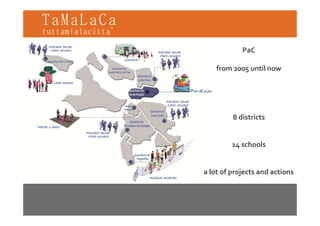
                               PaC

                       from 2005 until now


                            8 districts


                            14 schools


                   a lot of projects and actions
TaMaLaCa
tuttamialacitta’

PortaColori


It contains every PaC fundamental ingredients: a derelict urban area, a school
made by a strengthen and active community, a big wish of change.


PortaColori is the result of a participatory design process with children, teachers
and parents last 5 years.
It is a first realization of a wider project: the reconquest of the elementary school
playground in a critical district of Sassari, called Monte Rosello.
TaMaLaCa
tuttamialacitta’


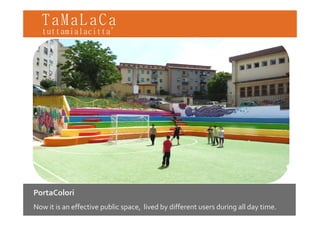
PortaColori
P    C l i
Now it is an effective public space, lived by different users during all day time.
TaMaLaCa
tuttamialacitta’

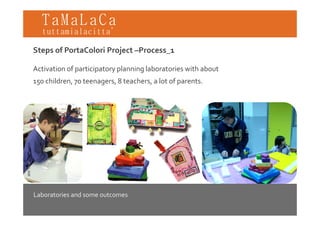
Steps of PortaColori Project –Process_1

Activation of participatory planning laboratories with about
150 children, 70 teenagers, 8 teachers, a lot of parents.


Laboratories and some outcomes
TaMaLaCa
tuttamialacitta’

Steps of PortaColori Project –Process_1


Some children’s wishes:


•   to leave the space free and accessible to everyone (especially to disabled
                  p                               y    ( p       y
    people).
•   to have a welcoming tidy colourful and soft space
              welcoming, tidy, colourful,       space.
•   to have a protected space where “to play and to look at the others playing”
    and where “to stay and to talk with friends”.
               to                       friends
TaMaLaCa
tuttamialacitta’

Steps of PortaColori Project –Process_2

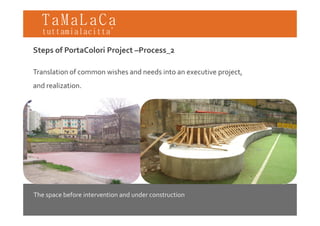
Translation of common wishes and needs into an executive project,
and realization.


The space before intervention and under construction
TaMaLaCa
tuttamialacitta’

Steps of PortaColori Project –Process_2

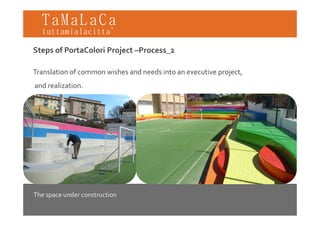
Translation of common wishes and needs into an executive project,
and realization.


The space under construction
TaMaLaCa
tuttamialacitta’

Steps of PortaColori Project –Process_2


Fundamental common criteria of project:


• to build a space that does not communicate any prohibitions. On the contrary it
should invite to fantasy and unconventional use, respecting the safety school
rules.
 u es
• to build a “contagious” space, which can create possibilities of bigger urban
transformations.
transformations

Ward C. (1978 ); Francis M. (1987); Paba G. (1998), (2006),(2009).
TaMaLaCa
tuttamialacitta’

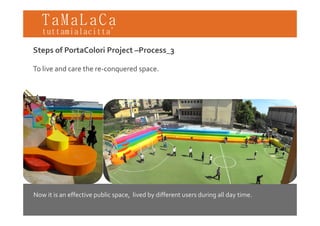
Steps of PortaColori Project –Process_3

To live and care the re‐conquered space.


Now it is an effective public space, lived by different users during all day time.
TaMaLaCa
tuttamialacitta’

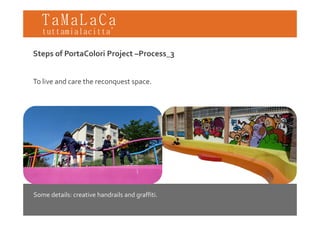
Steps of PortaColori Project –Process_3


To live and care the reconquest space.


Some details: creative handrails and graffiti.
TaMaLaCa
tuttamialacitta’

Conclusions


PortaColori has product different kind of results: urban, social, pedagogical.
It opens the school to the district and the district to the school.
But the best result reached through this small project, it is to demonstrate
                                 g             p j ,
everybody –children, parents, teachers, political representatives, citizens– that it
is possible to work well together to reach common purposes
                                                  purposes,
and to show that it is possible to think and to build together a child‐friendly city,
for children of all ages
                    ages.
Paba G. (2006)
TaMaLaCa
tuttamialacitta’


Future directions


New PaC steps now are moving beyond the border of school spaces
                                                         spaces.
It is an extension of our reasoning with school’s community beyond the wall that
divides school and district
                   district.
Perhaps we would gradually decide together that that wall is unnecessary.


Michelucci G.(1949); Ward  C.(1978).
TaMaLaCa
tuttamialacitta’


          Thank you for your attention
                y       y

                   Paola Idini

Idini - Input2012

  • 1.
    TaMaLaCa tuttamialacitta’ Small Participated Steps to Urban Micro‐Regenerations Recount of an experience of participatory planning in the city of Sassari Paola Idini P l  Idi i TaMaLaCa Gruppo di ricerca e azione per la città dei diritti Laboratorio di Analisi e Modelli per la Pianificazione (LaMP) Dipartimento di Architettura, Design, Urbanistica dell’Università di Sassari
  • 2.
    TaMaLaCa tuttamialacitta’ Methodological References Urban Rights in developed countries.  Urban Quality of Life and the right of every person with its specificities to reach a  b l f f d h h f h f h good level of urban quality of life.  Develop projects and actions starting from people (which are citizens and  inhabitants) and specificities (of person, of places, of spaces).  Sen A., 2010; Brown A., Kristiansen A. (2009); Sennet R. (2003).
  • 3.
    TaMaLaCa tuttamialacitta’ Objective: to buildtogether different chances of reconquest of urban environments, from specific needs to the common benefit. Working method: focuses on deny urban rights of one of the most marginal group of citizens: children. We believe that working on children specificities can be a good way to promote urban quality of life, to every citizen’s benefit . Ward C. (1978 ); Paba G. (1998), (2006),(2009).
  • 4.
    TaMaLaCa tuttamialacitta’ Ideas of PaC project [Periferie alCentro. Bambine e bambini alla conquista della città] Objective of PaC is: to promoting quality of urban life starting from specificities of places and direct contribution of children children. Anchor points of PaC: A h   i   f P C •To work on derelict and marginal urban areas •To work inside schools with school communities •To activate and develop participatory process without to predetermine results
  • 5.
    TaMaLaCa tuttamialacitta’ PaC from 2005 until now 8 districts 14 schools a lot of projects and actions
  • 6.
    TaMaLaCa tuttamialacitta’ PortaColori It contains everyPaC fundamental ingredients: a derelict urban area, a school made by a strengthen and active community, a big wish of change. PortaColori is the result of a participatory design process with children, teachers and parents last 5 years. It is a first realization of a wider project: the reconquest of the elementary school playground in a critical district of Sassari, called Monte Rosello.
  • 7.
    TaMaLaCa tuttamialacitta’ PortaColori P C l i Now it is an effective public space, lived by different users during all day time.
  • 8.
    TaMaLaCa tuttamialacitta’ Steps of PortaColoriProject –Process_1 Activation of participatory planning laboratories with about 150 children, 70 teenagers, 8 teachers, a lot of parents. Laboratories and some outcomes
  • 9.
    TaMaLaCa tuttamialacitta’ Steps of PortaColoriProject –Process_1 Some children’s wishes: • to leave the space free and accessible to everyone (especially to disabled p y ( p y people). • to have a welcoming tidy colourful and soft space welcoming, tidy, colourful, space. • to have a protected space where “to play and to look at the others playing” and where “to stay and to talk with friends”. to friends
  • 10.
    TaMaLaCa tuttamialacitta’ Steps of PortaColoriProject –Process_2 Translation of common wishes and needs into an executive project, and realization. The space before intervention and under construction
  • 11.
    TaMaLaCa tuttamialacitta’ Steps of PortaColoriProject –Process_2 Translation of common wishes and needs into an executive project, and realization. The space under construction
  • 12.
    TaMaLaCa tuttamialacitta’ Steps of PortaColoriProject –Process_2 Fundamental common criteria of project: • to build a space that does not communicate any prohibitions. On the contrary it should invite to fantasy and unconventional use, respecting the safety school rules. u es • to build a “contagious” space, which can create possibilities of bigger urban transformations. transformations Ward C. (1978 ); Francis M. (1987); Paba G. (1998), (2006),(2009).
  • 13.
    TaMaLaCa tuttamialacitta’ Steps of PortaColoriProject –Process_3 To live and care the re‐conquered space. Now it is an effective public space, lived by different users during all day time.
  • 14.
    TaMaLaCa tuttamialacitta’ Steps of PortaColoriProject –Process_3 To live and care the reconquest space. Some details: creative handrails and graffiti.
  • 15.
    TaMaLaCa tuttamialacitta’ Conclusions PortaColori has productdifferent kind of results: urban, social, pedagogical. It opens the school to the district and the district to the school. But the best result reached through this small project, it is to demonstrate g p j , everybody –children, parents, teachers, political representatives, citizens– that it is possible to work well together to reach common purposes purposes, and to show that it is possible to think and to build together a child‐friendly city, for children of all ages ages. Paba G. (2006)
  • 16.
    TaMaLaCa tuttamialacitta’ Future directions New PaCsteps now are moving beyond the border of school spaces spaces. It is an extension of our reasoning with school’s community beyond the wall that divides school and district district. Perhaps we would gradually decide together that that wall is unnecessary. Michelucci G.(1949); Ward  C.(1978).
  • 17.
    TaMaLaCa tuttamialacitta’ Thank you for your attention y y Paola Idini