PARTIALLY CONTAINED DATABASES
Steve Verschaeve
ABOUT ME
•   Sr. SQL Server Consultant at KOHERA
•   Webmaster & board member at SQLUG.BE
•   Co-organiser at SQLServerDays.be
•   Microsoft Extended Expert Team member
•   MCP, MCTS, MCITP, MCT
•   steve@sqlug.be
•   Blog.steveverschaeve.be
•   @sql_lazywriter
AGENDA
•   What is a (partially) contained database
•   Features within/outside Application Model
•   Authentication
•   Collation
•   Identifying database containment
•   Threats against partially contained databases
•   Demos
•   Resources
•   Q&A
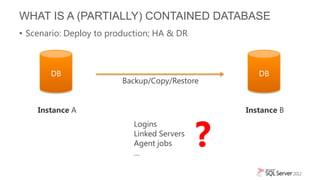
WHAT IS A (PARTIALLY) CONTAINED DATABASE
• Scenario: Deploy to production; HA & DR


       DB                                          DB
                         Backup/Copy/Restore


    Instance A                                  Instance B


                                            ?
                           Logins
                           Linked Servers
                           Agent jobs
                           …
WHAT IS A (PARTIALLY) CONTAINED DATABASE
• Improved dependency management
  • Include all settings + metadata
  • No login authentication at database engine level
  • Isolated from the database engine
  • Improved transition between environments
• Not yet fully contained
• Moving to SQL Azure
 • Fully contained
 • Uncontained features disabled
   by default
• All SQL Server editions
FEATURES WITHIN/OUTSIDE APPLICATION MODEL
Within the Application Model [1]          Outside the Application Model [2]
Contained                                 Non-Contained
System Views                              Catalog Views
sys.indexes, sys.types, …                 sys.servers, sys.server_role_members…

Data Types                                T-SQL
All data types excluding CLR data types   Backup, Restore, Set Ansi_Nulls, …

Dynamic Management Views                  Built-in Functions
sys.dm_db_uncontained_entities            @@servername, loginproperty, …

T-SQL                                     System Functions
Having, Rollback Transaction, …           sys.fn_get_sql, sys.fn_cdc_get_min_lsn, ...

Built-in Functions                        Other
@@rowcount, Getdate, IsNull, …            Linked servers, Full-Text Search, Synonyms, …

System Stored Procedures                  Replication, Change data capture, Change
sp_helptext, sp_columns, sp_addrole, …    tracking
DBCC Statements
CHECKDB, SHOW_STATISTICS, …
ENABLE PARTIALLY CONTAINED DATABASES
• Instance level

  EXEC sys.sp_configure N’contained database authentication’,N’1’;
  GO


• Database level

  CREATE DATABASE [PartialCDB] CONTAINMENT = PARTIAL [NONE];
  GO

• New syntax

  ALTER DATABASE CURRENT ...
DEMO
Enable & Convert non-contained DB to Partial-CDB
AUTHENTICATION
• Contained users connect without server level authenticating
• Contained SQL User with password syntax

 CREATE USER Giselle WITH PASSWORD = ‘xyz’;
 GO


• Multiple users with same name for different
  databases
• Normal users tied to login coexist with
  contained users in same database [1]
DEMO
• Authentication
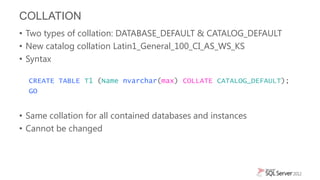
COLLATION
• Two types of collation: DATABASE_DEFAULT & CATALOG_DEFAULT
• New catalog collation Latin1_General_100_CI_AS_WS_KS
• Syntax

  CREATE TABLE T1 (Name nvarchar(max) COLLATE CATALOG_DEFAULT);
  GO


• Same collation for all contained databases and instances
• Cannot be changed
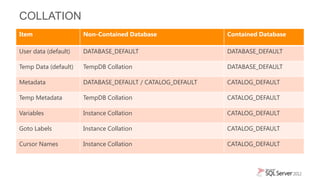
COLLATION
Item                  Non-Contained Database               Contained Database

User data (default)   DATABASE_DEFAULT                     DATABASE_DEFAULT

Temp Data (default)   TempDB Collation                     DATABASE_DEFAULT

Metadata              DATABASE_DEFAULT / CATALOG_DEFAULT   CATALOG_DEFAULT

Temp Metadata         TempDB Collation                     CATALOG_DEFAULT

Variables             Instance Collation                   CATALOG_DEFAULT

Goto Labels           Instance Collation                   CATALOG_DEFAULT

Cursor Names          Instance Collation                   CATALOG_DEFAULT
DEMO
• Collation
IDENTIFYING DATABASE CONTAINMENT
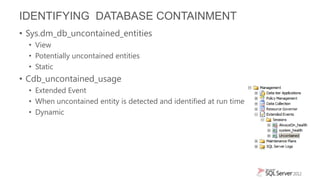
• Sys.dm_db_uncontained_entities
  • View
  • Potentially uncontained entities
  • Static
• Cdb_uncontained_usage
  • Extended Event
  • When uncontained entity is detected and identified at run time
  • Dynamic
DEMO
• Sys.dm_db_uncontained_entities
• Cdb_uncontained_usage
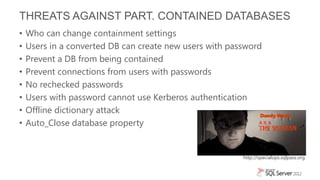
THREATS AGAINST PART. CONTAINED DATABASES
•   Who can change containment settings
•   Users in a converted DB can create new users with password
•   Prevent a DB from being contained
•   Prevent connections from users with passwords
•   No rechecked passwords
•   Users with password cannot use Kerberos authentication
•   Offline dictionary attack
•   Auto_Close database property


                                                         http://specialops.sqlpass.org
RESOURCES
•   SQL Server v.Next(Denali): Contained Databases (Aaron Bertrand)
•   SQL Server 2012: Sometimes Partial Is Preferable (Denny Cherry)
•   Partially Contained Databases (TechNet)
•   SQL Server 2012 Partially Contained Databases (Steve Verschaeve)
•   Contained Database Authentication in depth (Lyudmila Fokina)
Q&A
THANK YOU
steve@sqlug.be
Blog.steveverschaeve.be
@sql_lazywriter
© 2011 Microsoft Corporation. All rights reserved. Microsoft, Windows, Windows Vista and other product names are or may be registered trademarks and/or trademarks in the U.S. and/or other countries.
The information herein is for informational purposes only and represents the current view of Microsoft Corporation as of the date of this presentation. Because Microsoft must respond to changing market
     conditions, it should not be interpreted to be a commitment on the part of Microsoft, and Microsoft cannot guarantee the accuracy of any information provided after the date of this presentation.
                                 MICROSOFT MAKES NO WARRANTIES, EXPRESS, IMPLIED OR STATUTORY, AS TO THE INFORMATION IN THIS PRESENTATION.

Partially Contained Databases

  • 1.
  • 2.
    ABOUT ME • Sr. SQL Server Consultant at KOHERA • Webmaster & board member at SQLUG.BE • Co-organiser at SQLServerDays.be • Microsoft Extended Expert Team member • MCP, MCTS, MCITP, MCT • steve@sqlug.be • Blog.steveverschaeve.be • @sql_lazywriter
  • 3.
    AGENDA • What is a (partially) contained database • Features within/outside Application Model • Authentication • Collation • Identifying database containment • Threats against partially contained databases • Demos • Resources • Q&A
  • 4.
    WHAT IS A(PARTIALLY) CONTAINED DATABASE • Scenario: Deploy to production; HA & DR DB DB Backup/Copy/Restore Instance A Instance B ? Logins Linked Servers Agent jobs …
  • 5.
    WHAT IS A(PARTIALLY) CONTAINED DATABASE • Improved dependency management • Include all settings + metadata • No login authentication at database engine level • Isolated from the database engine • Improved transition between environments • Not yet fully contained • Moving to SQL Azure • Fully contained • Uncontained features disabled by default • All SQL Server editions
  • 6.
    FEATURES WITHIN/OUTSIDE APPLICATIONMODEL Within the Application Model [1] Outside the Application Model [2] Contained Non-Contained System Views Catalog Views sys.indexes, sys.types, … sys.servers, sys.server_role_members… Data Types T-SQL All data types excluding CLR data types Backup, Restore, Set Ansi_Nulls, … Dynamic Management Views Built-in Functions sys.dm_db_uncontained_entities @@servername, loginproperty, … T-SQL System Functions Having, Rollback Transaction, … sys.fn_get_sql, sys.fn_cdc_get_min_lsn, ... Built-in Functions Other @@rowcount, Getdate, IsNull, … Linked servers, Full-Text Search, Synonyms, … System Stored Procedures Replication, Change data capture, Change sp_helptext, sp_columns, sp_addrole, … tracking DBCC Statements CHECKDB, SHOW_STATISTICS, …
  • 7.
    ENABLE PARTIALLY CONTAINEDDATABASES • Instance level EXEC sys.sp_configure N’contained database authentication’,N’1’; GO • Database level CREATE DATABASE [PartialCDB] CONTAINMENT = PARTIAL [NONE]; GO • New syntax ALTER DATABASE CURRENT ...
  • 8.
    DEMO Enable & Convertnon-contained DB to Partial-CDB
  • 9.
    AUTHENTICATION • Contained usersconnect without server level authenticating • Contained SQL User with password syntax CREATE USER Giselle WITH PASSWORD = ‘xyz’; GO • Multiple users with same name for different databases • Normal users tied to login coexist with contained users in same database [1]
  • 10.
  • 11.
    COLLATION • Two typesof collation: DATABASE_DEFAULT & CATALOG_DEFAULT • New catalog collation Latin1_General_100_CI_AS_WS_KS • Syntax CREATE TABLE T1 (Name nvarchar(max) COLLATE CATALOG_DEFAULT); GO • Same collation for all contained databases and instances • Cannot be changed
  • 12.
    COLLATION Item Non-Contained Database Contained Database User data (default) DATABASE_DEFAULT DATABASE_DEFAULT Temp Data (default) TempDB Collation DATABASE_DEFAULT Metadata DATABASE_DEFAULT / CATALOG_DEFAULT CATALOG_DEFAULT Temp Metadata TempDB Collation CATALOG_DEFAULT Variables Instance Collation CATALOG_DEFAULT Goto Labels Instance Collation CATALOG_DEFAULT Cursor Names Instance Collation CATALOG_DEFAULT
  • 13.
  • 14.
    IDENTIFYING DATABASE CONTAINMENT •Sys.dm_db_uncontained_entities • View • Potentially uncontained entities • Static • Cdb_uncontained_usage • Extended Event • When uncontained entity is detected and identified at run time • Dynamic
  • 15.
  • 16.
    THREATS AGAINST PART.CONTAINED DATABASES • Who can change containment settings • Users in a converted DB can create new users with password • Prevent a DB from being contained • Prevent connections from users with passwords • No rechecked passwords • Users with password cannot use Kerberos authentication • Offline dictionary attack • Auto_Close database property http://specialops.sqlpass.org
  • 17.
    RESOURCES • SQL Server v.Next(Denali): Contained Databases (Aaron Bertrand) • SQL Server 2012: Sometimes Partial Is Preferable (Denny Cherry) • Partially Contained Databases (TechNet) • SQL Server 2012 Partially Contained Databases (Steve Verschaeve) • Contained Database Authentication in depth (Lyudmila Fokina)
  • 18.
  • 19.
  • 20.
    © 2011 MicrosoftCorporation. All rights reserved. Microsoft, Windows, Windows Vista and other product names are or may be registered trademarks and/or trademarks in the U.S. and/or other countries. The information herein is for informational purposes only and represents the current view of Microsoft Corporation as of the date of this presentation. Because Microsoft must respond to changing market conditions, it should not be interpreted to be a commitment on the part of Microsoft, and Microsoft cannot guarantee the accuracy of any information provided after the date of this presentation. MICROSOFT MAKES NO WARRANTIES, EXPRESS, IMPLIED OR STATUTORY, AS TO THE INFORMATION IN THIS PRESENTATION.