ICT POLICY
FOR THE
NETWORKED
SOCIETY
POLICY INSPIRATION
ICT POLICY FOR THE
NETWORKED SOCIEY
ITU EVENT BAHRAIN “NEW TRENDS FOR BUILDING AND
FINANCING BROADBAND”: POLICIES & ECONOMICS
ICT POLICY FOR THE NETWORKED SOCIETY | Public | © Ericsson AB 2013 | 2013-09-24 | Page 2
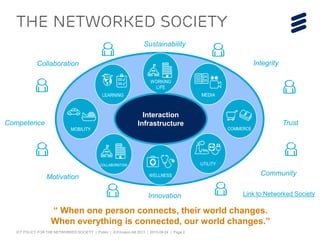
The Networked society
networked society VISION
 Is about new ways to collaborate, CREATE, share
and get informed.
 Is about innovative ways of doing business and
shaping the future.
 Is a renewed policy approach to challenges such
as innovation, job creation, education,
healthcare, governance, climate change AND etc.
“ When one person connects, their world changes.
When everything is connected, our world changes.”
Collaboration
Innovation
Integrity
Community
Trust
Motivation
Competence
Sustainability
Interaction
Infrastructure
Link to Networked Society
ICT POLICY FOR THE NETWORKED SOCIETY | Public | © Ericsson AB 2013 | 2013-09-24 | Page 3
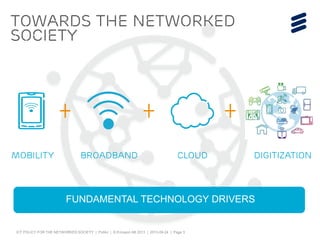
TOWARDS THE NETWORKED
SOCIETY
FUNDAMENTAL TECHNOLOGY DRIVERS
MOBILITY BROADBAND CLOUD DIGITIZATION
ICT POLICY FOR THE NETWORKED SOCIETY | Public | © Ericsson AB 2013 | 2013-09-24 | Page 4
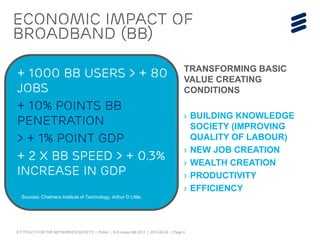
Economic impact of
broadband (BB)
+ 1000 BB USERS > + 80
Jobs
+ 10% POINTS BB
PENETRATION
> + 1% POINT GDP
+ 2 x BB SPEED > + 0.3%
increase in GDP
Sources: Chalmers Institute of Technology, Arthur D Little.
TRANSFORMING BASIC
VALUE CREATING
CONDITIONS
› BUILDING KNOWLEDGE
SOCIETY (IMPROVING
QUALITY OF LABOUR)
› NEW JOB CREATION
› WEALTH CREATION
› PRODUCTIVITY
› EFFICIENCY
ICT POLICY FOR THE NETWORKED SOCIETY | Public | © Ericsson AB 2013 | 2013-09-24 | Page 5
Sources: Chalmers Institute of Technology, Arthur D Little,
OECD Broadband and the Economy, Future of Internet 2008
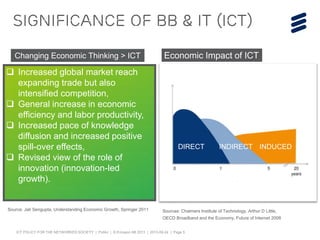
Significance of BB & IT (ICT)
 Increased global market reach
expanding trade but also
intensified competition,
 General increase in economic
efficiency and labor productivity,
 Increased pace of knowledge
diffusion and increased positive
spill-over effects,
 Revised view of the role of
innovation (innovation-led
growth).
Economic Impact of ICTChanging Economic Thinking > ICT
Source: Jati Sengupta, Understanding Economic Growth, Springer 2011
DIRECT INDIRECT INDUCED
ICT POLICY FOR THE NETWORKED SOCIETY | Public | © Ericsson AB 2013 | 2013-09-24 | Page 6
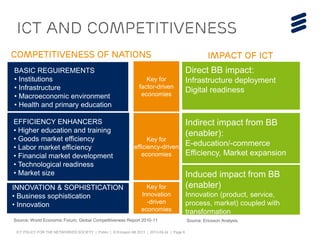
ICT And Competitiveness
Competitiveness of Nations impact of ICT
Source: World Economic Forum, Global Competitiveness Report 2010-11
INNOVATION & SOPHISTICATION
• Business sophistication
• Innovation
EFFICIENCY ENHANCERS
• Higher education and training
• Goods market efficiency
• Labor market efficiency
• Financial market development
• Technological readiness
• Market size
BASIC REGUIREMENTS
• Institutions
• Infrastructure
• Macroeconomic environment
• Health and primary education
Key for
factor-driven
economies
Key for
efficiency-driven
economies
Key for
Innovation
-driven
economies
Direct BB impact:
Infrastructure deployment
Digital readiness
Indirect impact from BB
(enabler):
E-education/-commerce
Efficiency, Market expansion
Induced impact from BB
(enabler)
Innovation (product, service,
process, market) coupled with
transformation
Source: Ericsson Analysis
ICT POLICY FOR THE NETWORKED SOCIETY | Public | © Ericsson AB 2013 | 2013-09-24 | Page 7
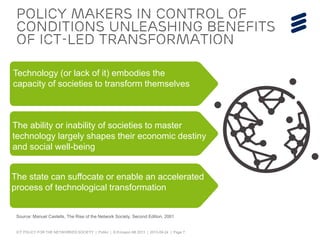
Policy makers in control of
conditions unleashing benefits
of ICT-led transformation
Source: Manuel Castells, The Rise of the Network Society, Second Edition, 2001
Technology (or lack of it) embodies the
capacity of societies to transform themselves
The ability or inability of societies to master
technology largely shapes their economic destiny
and social well-being
The state can suffocate or enable an accelerated
process of technological transformation
ICT POLICY FOR THE NETWORKED SOCIETY | Public | © Ericsson AB 2013 | 2013-09-24 | Page 8
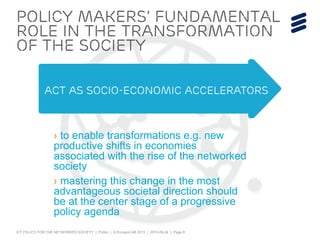
› to enable transformations e.g. new
productive shifts in economies
associated with the rise of the networked
society
› mastering this change in the most
advantageous societal direction should
be at the center stage of a progressive
policy agenda
policy makers’ fundamental
Role in the transformation
of the society
act as socio-economic accelerators
ICT POLICY FOR THE NETWORKED SOCIETY | Public | © Ericsson AB 2013 | 2013-09-24 | Page 9
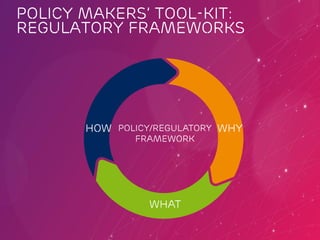
Policy makers’ tool-kit:
Regulatory Frameworks
WHY
WHAT
HOW Policy/Regulatory
Framework
ICT POLICY FOR THE NETWORKED SOCIETY | Public | © Ericsson AB 2013 | 2013-09-24 | Page 10
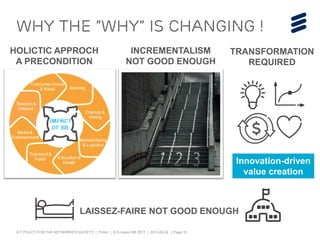
WHY the ”why” is changing !
HOLICTIC APPROCH
A PRECONDITION
TRANSFORMATION
REQUIRED
INCREMENTALISM
NOT GOOD ENOUGH
Innovation-driven
value creation
LAISSEZ-FAIRE NOT GOOD ENOUGH
ICT POLICY FOR THE NETWORKED SOCIETY | Public | © Ericsson AB 2013 | 2013-09-24 | Page 11
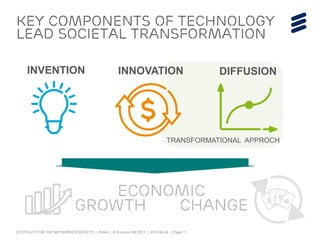
Key COMPONENTS of technology
lead societal transformation
INVENTION INNOVATION DIFFUSION
ECONOMIC
GROWTH CHANGE
TRANSFORMATIONAL APPROCH
ICT POLICY FOR THE NETWORKED SOCIETY | Public | © Ericsson AB 2013 | 2013-09-24 | Page 12
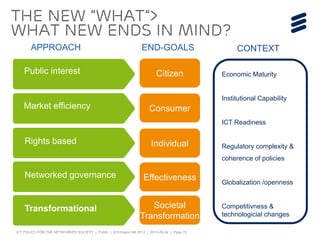
The new “what”>
what New ends in mind?
Public interest
Rights based
Networked governance
Transformational
Consumer
Citizen
Individual
Societal
Transformation
Effectiveness
Market efficiency
APPROACH END-GOALS
Economic Maturity
Institutional Capability
ICT Readiness
Regulatory complexity &
coherence of policies
Globalization /openness
Competitivness &
technologicial changes
CONTEXT
ICT POLICY FOR THE NETWORKED SOCIETY | Public | © Ericsson AB 2013 | 2013-09-24 | Page 13
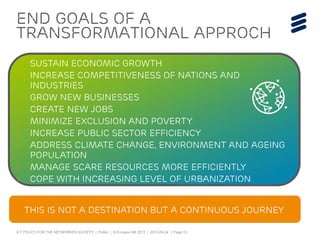
eND GOALS of A
TRANSFORMATIONAL APPROCH
› Sustain economic growth
› Increase competitiveness of nations and
industries
› Grow new businesses
› Create new jobs
› Minimize exclusion and poverty
› Increase public sector efficiency
› Address climate change, environment and ageing
population
› Manage scare resources more efficiently
› Cope with increasing level of urbanization
This is not a destination but a continuous journey
ICT POLICY FOR THE NETWORKED SOCIETY | Public | © Ericsson AB 2013 | 2013-09-24 | Page 14
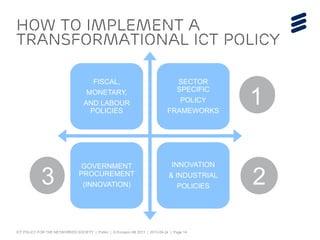
FISCAL,
MONETARY,
AND LABOUR
POLICIES
SECTOR
SPECIFIC
POLICY
FRAMEWORKS
GOVERNMENT
PROCUREMENT
(INNOVATION)
INNOVATION
& INDUSTRIAL
POLICIES
HOW to Implement a
TRANSFORMATIONAL ICT POLICY
1
3 2
ICT POLICY FOR THE NETWORKED SOCIETY | Public | © Ericsson AB 2013 | 2013-09-24 | Page 15
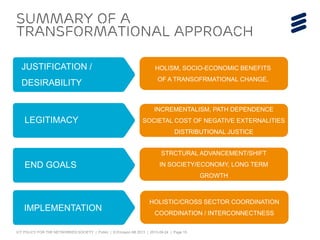
SUMMARY of a
transformational approach
JUSTIFICATION /
DESIRABILITY
LEGITIMACY
END GOALS
HOLISM, SOCIO-ECONOMIC BENEFITS
OF A TRANSOFRMATIONAL CHANGE,
INCREMENTALISM, PATH DEPENDENCE
SOCIETAL COST OF NEGATIVE EXTERNALITIES
DISTRIBUTIONAL JUSTICE
STRCTURAL ADVANCEMENT/SHIFT
IN SOCIETY/ECONOMY, LONG TERM
GROWTH
IMPLEMENTATION
HOLISTIC/CROSS SECTOR COORDINATION
COORDINATION / INTERCONNECTNESS
ICT POLICY FOR THE NETWORKED SOCIETY | Public | © Ericsson AB 2013 | 2013-09-24 | Page 16
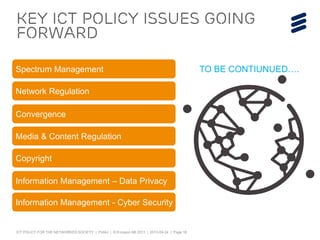
key ICT policy issues going
forward
Convergence
Spectrum Management
Network Regulation
Media & Content Regulation
Copyright
Information Management – Data Privacy
Information Management - Cyber Security
TO BE CONTIUNUED….
ICT POLICY FOR THE NETWORKED SOCIETY | Public | © Ericsson AB 2013 | 2013-09-24 | Page 17
RISK of status-quo > outdated
regulatory framework
› Increased market distortions;
regulatory flight, race to the
bottom, overlapping remits.
› Decreased investments,
innovation and competitiveness.
› Decreased economic and
societal benefits and increased
inequality.
› Delays in societal transformation,
falling behind.
The future of ICT POLICY

Ict policy for networked society

  • 1.
    ICT POLICY FOR THE NETWORKED SOCIETY POLICYINSPIRATION ICT POLICY FOR THE NETWORKED SOCIEY ITU EVENT BAHRAIN “NEW TRENDS FOR BUILDING AND FINANCING BROADBAND”: POLICIES & ECONOMICS
  • 2.
    ICT POLICY FORTHE NETWORKED SOCIETY | Public | © Ericsson AB 2013 | 2013-09-24 | Page 2 The Networked society networked society VISION  Is about new ways to collaborate, CREATE, share and get informed.  Is about innovative ways of doing business and shaping the future.  Is a renewed policy approach to challenges such as innovation, job creation, education, healthcare, governance, climate change AND etc. “ When one person connects, their world changes. When everything is connected, our world changes.” Collaboration Innovation Integrity Community Trust Motivation Competence Sustainability Interaction Infrastructure Link to Networked Society
  • 3.
    ICT POLICY FORTHE NETWORKED SOCIETY | Public | © Ericsson AB 2013 | 2013-09-24 | Page 3 TOWARDS THE NETWORKED SOCIETY FUNDAMENTAL TECHNOLOGY DRIVERS MOBILITY BROADBAND CLOUD DIGITIZATION
  • 4.
    ICT POLICY FORTHE NETWORKED SOCIETY | Public | © Ericsson AB 2013 | 2013-09-24 | Page 4 Economic impact of broadband (BB) + 1000 BB USERS > + 80 Jobs + 10% POINTS BB PENETRATION > + 1% POINT GDP + 2 x BB SPEED > + 0.3% increase in GDP Sources: Chalmers Institute of Technology, Arthur D Little. TRANSFORMING BASIC VALUE CREATING CONDITIONS › BUILDING KNOWLEDGE SOCIETY (IMPROVING QUALITY OF LABOUR) › NEW JOB CREATION › WEALTH CREATION › PRODUCTIVITY › EFFICIENCY
  • 5.
    ICT POLICY FORTHE NETWORKED SOCIETY | Public | © Ericsson AB 2013 | 2013-09-24 | Page 5 Sources: Chalmers Institute of Technology, Arthur D Little, OECD Broadband and the Economy, Future of Internet 2008 Significance of BB & IT (ICT)  Increased global market reach expanding trade but also intensified competition,  General increase in economic efficiency and labor productivity,  Increased pace of knowledge diffusion and increased positive spill-over effects,  Revised view of the role of innovation (innovation-led growth). Economic Impact of ICTChanging Economic Thinking > ICT Source: Jati Sengupta, Understanding Economic Growth, Springer 2011 DIRECT INDIRECT INDUCED
  • 6.
    ICT POLICY FORTHE NETWORKED SOCIETY | Public | © Ericsson AB 2013 | 2013-09-24 | Page 6 ICT And Competitiveness Competitiveness of Nations impact of ICT Source: World Economic Forum, Global Competitiveness Report 2010-11 INNOVATION & SOPHISTICATION • Business sophistication • Innovation EFFICIENCY ENHANCERS • Higher education and training • Goods market efficiency • Labor market efficiency • Financial market development • Technological readiness • Market size BASIC REGUIREMENTS • Institutions • Infrastructure • Macroeconomic environment • Health and primary education Key for factor-driven economies Key for efficiency-driven economies Key for Innovation -driven economies Direct BB impact: Infrastructure deployment Digital readiness Indirect impact from BB (enabler): E-education/-commerce Efficiency, Market expansion Induced impact from BB (enabler) Innovation (product, service, process, market) coupled with transformation Source: Ericsson Analysis
  • 7.
    ICT POLICY FORTHE NETWORKED SOCIETY | Public | © Ericsson AB 2013 | 2013-09-24 | Page 7 Policy makers in control of conditions unleashing benefits of ICT-led transformation Source: Manuel Castells, The Rise of the Network Society, Second Edition, 2001 Technology (or lack of it) embodies the capacity of societies to transform themselves The ability or inability of societies to master technology largely shapes their economic destiny and social well-being The state can suffocate or enable an accelerated process of technological transformation
  • 8.
    ICT POLICY FORTHE NETWORKED SOCIETY | Public | © Ericsson AB 2013 | 2013-09-24 | Page 8 › to enable transformations e.g. new productive shifts in economies associated with the rise of the networked society › mastering this change in the most advantageous societal direction should be at the center stage of a progressive policy agenda policy makers’ fundamental Role in the transformation of the society act as socio-economic accelerators
  • 9.
    ICT POLICY FORTHE NETWORKED SOCIETY | Public | © Ericsson AB 2013 | 2013-09-24 | Page 9 Policy makers’ tool-kit: Regulatory Frameworks WHY WHAT HOW Policy/Regulatory Framework
  • 10.
    ICT POLICY FORTHE NETWORKED SOCIETY | Public | © Ericsson AB 2013 | 2013-09-24 | Page 10 WHY the ”why” is changing ! HOLICTIC APPROCH A PRECONDITION TRANSFORMATION REQUIRED INCREMENTALISM NOT GOOD ENOUGH Innovation-driven value creation LAISSEZ-FAIRE NOT GOOD ENOUGH
  • 11.
    ICT POLICY FORTHE NETWORKED SOCIETY | Public | © Ericsson AB 2013 | 2013-09-24 | Page 11 Key COMPONENTS of technology lead societal transformation INVENTION INNOVATION DIFFUSION ECONOMIC GROWTH CHANGE TRANSFORMATIONAL APPROCH
  • 12.
    ICT POLICY FORTHE NETWORKED SOCIETY | Public | © Ericsson AB 2013 | 2013-09-24 | Page 12 The new “what”> what New ends in mind? Public interest Rights based Networked governance Transformational Consumer Citizen Individual Societal Transformation Effectiveness Market efficiency APPROACH END-GOALS Economic Maturity Institutional Capability ICT Readiness Regulatory complexity & coherence of policies Globalization /openness Competitivness & technologicial changes CONTEXT
  • 13.
    ICT POLICY FORTHE NETWORKED SOCIETY | Public | © Ericsson AB 2013 | 2013-09-24 | Page 13 eND GOALS of A TRANSFORMATIONAL APPROCH › Sustain economic growth › Increase competitiveness of nations and industries › Grow new businesses › Create new jobs › Minimize exclusion and poverty › Increase public sector efficiency › Address climate change, environment and ageing population › Manage scare resources more efficiently › Cope with increasing level of urbanization This is not a destination but a continuous journey
  • 14.
    ICT POLICY FORTHE NETWORKED SOCIETY | Public | © Ericsson AB 2013 | 2013-09-24 | Page 14 FISCAL, MONETARY, AND LABOUR POLICIES SECTOR SPECIFIC POLICY FRAMEWORKS GOVERNMENT PROCUREMENT (INNOVATION) INNOVATION & INDUSTRIAL POLICIES HOW to Implement a TRANSFORMATIONAL ICT POLICY 1 3 2
  • 15.
    ICT POLICY FORTHE NETWORKED SOCIETY | Public | © Ericsson AB 2013 | 2013-09-24 | Page 15 SUMMARY of a transformational approach JUSTIFICATION / DESIRABILITY LEGITIMACY END GOALS HOLISM, SOCIO-ECONOMIC BENEFITS OF A TRANSOFRMATIONAL CHANGE, INCREMENTALISM, PATH DEPENDENCE SOCIETAL COST OF NEGATIVE EXTERNALITIES DISTRIBUTIONAL JUSTICE STRCTURAL ADVANCEMENT/SHIFT IN SOCIETY/ECONOMY, LONG TERM GROWTH IMPLEMENTATION HOLISTIC/CROSS SECTOR COORDINATION COORDINATION / INTERCONNECTNESS
  • 16.
    ICT POLICY FORTHE NETWORKED SOCIETY | Public | © Ericsson AB 2013 | 2013-09-24 | Page 16 key ICT policy issues going forward Convergence Spectrum Management Network Regulation Media & Content Regulation Copyright Information Management – Data Privacy Information Management - Cyber Security TO BE CONTIUNUED….
  • 17.
    ICT POLICY FORTHE NETWORKED SOCIETY | Public | © Ericsson AB 2013 | 2013-09-24 | Page 17 RISK of status-quo > outdated regulatory framework › Increased market distortions; regulatory flight, race to the bottom, overlapping remits. › Decreased investments, innovation and competitiveness. › Decreased economic and societal benefits and increased inequality. › Delays in societal transformation, falling behind.
  • 18.
    The future ofICT POLICY