Survival Analysis and Cox
Regression for Cancer Trials
      Presented at PG Department of Statistics,
      Sardar Patel University January 29, 2013


                     Dr. Bhaswat S. Chakraborty
              Sr. VP & Chair, R&D Core Committee
            Cadila Pharmaceuticals Ltd., Ahmedabad


  1
Part 1: Survival Analysis of
            Cancer CTs


2
Clinical Trials
   Organized scientific efforts to get direct answers from
    relevant patients on important scientific questions on
    (doses and regimens of) actions of drugs (or devices or
    other interventions).
   Questions are mainly about differences or null
   Modern trials (last 40 years or so) are large, multicentre,
    often international and co-operative endeavors
   Ideally, primary objectives are consistent with mechanism
    of action
   Results can be translated to practice
   Would stand the regulatory and scientific scrutiny
3
Cancer Trials (Phases I–IV)
       Highly complex trials involving cytotoxic drugs, moribund patients,
        time dependent and censored variables
       Require prolonged observation of each patient
       Expensive, long term and resource intensive trials
       Heterogeneous patients at various stages of the disease
       Prognostic factors of non-metastasized and metastasized diseases are
        different
       Adverse reactions are usually serious and frequently include death
       Ethical concerns are numerous and very serious
       Trial management is difficult and patient recruitment extremely
        challenging
       Number of stopped trials (by DSMB or FDA) is very high
       Data analysis and interpretation are very difficult by any standard
    5
6
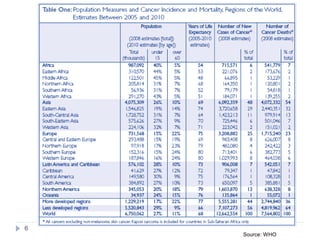
    Source: WHO
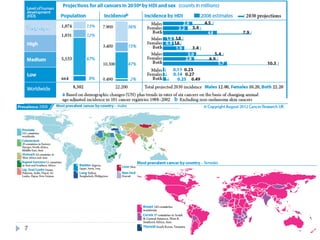
7
India: 2010
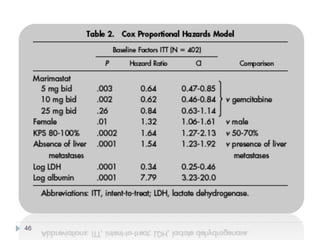
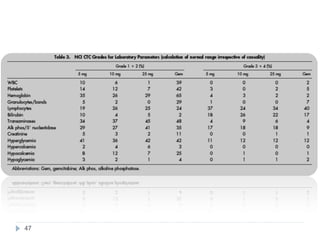
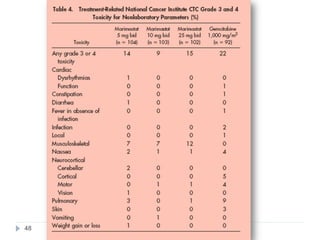
       7137 of 122 429 study deaths were due to cancer, corresponding to 556 400 national
        cancer deaths in India in 2010.
       395 400 (71%) cancer deaths occurred in people aged 30—69 years (200 100 men
        and 195 300 women).
       At 30—69 years, the three most common fatal cancers were oral (including lip and
        pharynx, 45 800 [22·9%]), stomach (25 200 [12·6%]), and lung (including trachea
        and larynx, 22 900 [11·4%]) in men, and cervical (33 400 [17·1%]), stomach
        (27 500 [14·1%]), and breast (19 900 [10·2%]) in women.
       Tobacco-related cancers represented 42·0% (84 000) of male and 18·3% (35 700) of
        female cancer deaths and there were twice as many deaths from oral cancers as lung
        cancers.
       Age-standardized cancer mortality rates per 100 000 were similar in rural (men 95·6
        [99% CI 89·6—101·7] and women 96·6 [90·7—102·6]) and urban areas (men 102·4
        [92·7—112·1] and women 91·2 [81·9—100·5]), but varied greatly between the
        states.
       Cervical cancer was far less common in Muslim than in Hindu women (study deaths
        24, age-standardized mortality ratio 0·68 [0·64—0·71] vs 340, 1·06 [1·05—1·08]).
    8
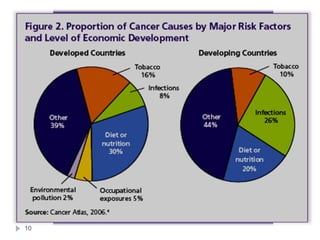
10
Survival Analysis
 Survival analysis is studying the time between entry
  to a study and a subsequent event (such as death).
 Also called “time to event analysis”
 Survival analysis attempts to answer questions such
  as:
       which fraction of a population will survive past a certain
        time ?
       at what rate will they fail ?
       at what rate will they present the event ?
       How do particular factors benefit or affect the probability of
        survival ?

 11
What kind of time to event data?
   Survival Analysis typically focuses on time to event data.
   In the most general sense, it consists of techniques for
    positive-valued random variables, such as
       time to death
       time to onset (or relapse) of a disease
       length of stay in a hospital
       money paid by health insurance
       viral load measurements
   Kinds of survival studies include:
       clinical trials
       prospective cohort studies
       retrospective cohort studies
       retrospective correlative studies
12
Definition and Characteristics of Variables
   Survival time (t) random variables (RVs) are always non-
    negative, i.e., t ≥ 0.
   T can either be discrete (taking a finite set of values, e.g.
    a1, a2, …, an) or continuous [defined on (0,∞)].
   A random variable t is called a censored survival time RV
    if x = min(t, u), where u is a non-negative censoring
    variable.
   For a survival time RV, we need:
       (1) an unambiguous time origin (e.g. randomization to clinical
        trial)
       (2) a time scale (e.g. real time (days, months, years)
       (3) defnition of the event (e.g. death, relapse)
13
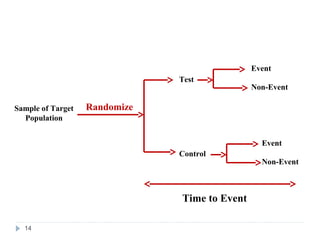
Event
                               Test
                                               Non-Event

Sample of Target   Randomize
  Population


                                                 Event
                               Control
                                                 Non-Event


                               Time to Event

  14
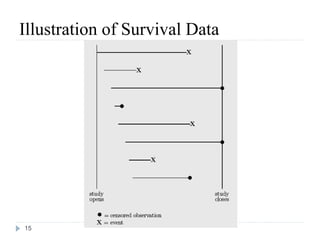
Illustration of Survival Data


15
Characterization of Survival
   There are several equivalent ways to characterize the
    probability distribution of a survival random variable.
   We will use the following terms:
       The density function f(t)
       The survival or survivor function S(t)
       The hazard function H(t)
       The cumulative hazard function Λ(t)
   Median survival, called τ, is defined as
       S(τ ) = 0.5
       Similarly, any other percentiles could be defined
Practically, we estimate median survival as the smallest
 time τ such that
  Ŝ (τ) ≤ 0.5
16
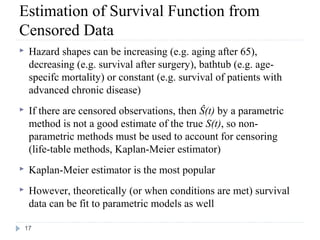
Estimation of Survival Function from
Censored Data
    Hazard shapes can be increasing (e.g. aging after 65),
     decreasing (e.g. survival after surgery), bathtub (e.g. age-
     specifc mortality) or constant (e.g. survival of patients with
     advanced chronic disease)
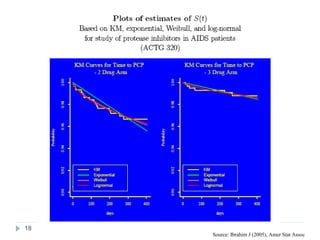
    If there are censored observations, then Ŝ(t) by a parametric
     method is not a good estimate of the true S(t), so non-
     parametric methods must be used to account for censoring
     (life-table methods, Kaplan-Meier estimator)
    Kaplan-Meier estimator is the most popular
    However, theoretically (or when conditions are met) survival
     data can be fit to parametric models as well

    17
18
     Source: Ibrahim J (2005), Amer Stat Assoc
Survival Rate by Kaplan Meier
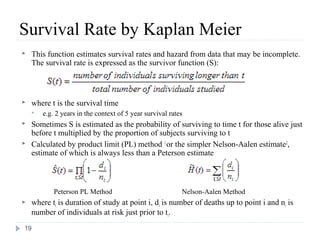
   This function estimates survival rates and hazard from data that may be incomplete.
    The survival rate is expressed as the survivor function (S):


   where t is the survival time
       e.g. 2 years in the context of 5 year survival rates
   Sometimes S is estimated as the probability of surviving to time t for those alive just
    before t multiplied by the proportion of subjects surviving to t
   Calculated by product limit (PL) method 1 or the simpler Nelson-Aalen estimate2,
    estimate of which is always less than a Peterson estimate


            Peterson PL Method                             Nelson-Aalen Method
   where ti is duration of study at point i, di is number of deaths up to point i and ni is
    number of individuals at risk just prior to ti.
19
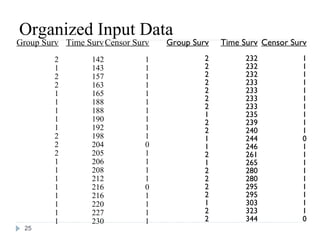
Data
    Following example is data of death from a cancer after
     exposure to a particular carcinogen in two groups of patients.
    Group 1 had a different pre-treatment régime to group 2
    The time from pre-treatment to death is recorded.
    If a patient was still living at the end of the experiment or it
     had died from a different cause then that time is considered
     censored (* below). A censored observation is given the value
     0 in the death/censorship variable to indicate a "non-event".
    Group 1: 143, 165, 188, 188, 190, 192, 206, 208, 212, 216, 220, 227, 230,
     235, 246, 265, 303, 216*, 244*
    Group 2: 142, 157, 163, 198, 205, 232, 232, 232, 233, 233, 233, 233, 239,
     240, 261, 280, 280, 295, 295, 323, 204*, 344*

    20
Assumptions
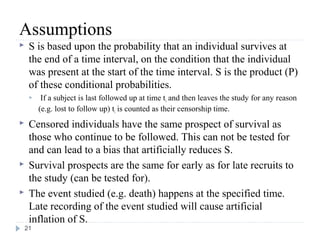
    S is based upon the probability that an individual survives at
     the end of a time interval, on the condition that the individual
     was present at the start of the time interval. S is the product (P)
     of these conditional probabilities.
         If a subject is last followed up at time ti and then leaves the study for any reason
         (e.g. lost to follow up) ti is counted as their censorship time.
    Censored individuals have the same prospect of survival as
     those who continue to be followed. This can not be tested for
     and can lead to a bias that artificially reduces S.
    Survival prospects are the same for early as for late recruits to
     the study (can be tested for).
    The event studied (e.g. death) happens at the specified time.
     Late recording of the event studied will cause artificial
     inflation of S.
    21
Other Parameters
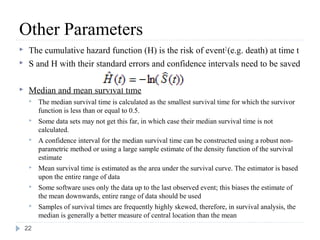
    The cumulative hazard function (H) is the risk of event 2 (e.g. death) at time t
    S and H with their standard errors and confidence intervals need to be saved

    Median and mean survival time
        The median survival time is calculated as the smallest survival time for which the survivor
         function is less than or equal to 0.5.
        Some data sets may not get this far, in which case their median survival time is not
         calculated.
        A confidence interval for the median survival time can be constructed using a robust non-
         parametric method or using a large sample estimate of the density function of the survival
         estimate
        Mean survival time is estimated as the area under the survival curve. The estimator is based
         upon the entire range of data
        Some software uses only the data up to the last observed event; this biases the estimate of
         the mean downwards, entire range of data should be used
        Samples of survival times are frequently highly skewed, therefore, in survival analysis, the
         median is generally a better measure of central location than the mean
    22
Variances of S & H hat
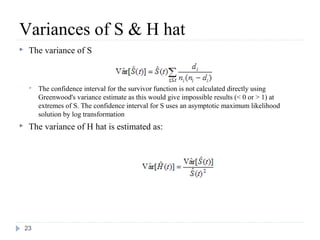
    The variance of S


        The confidence interval for the survivor function is not calculated directly using
         Greenwood's variance estimate as this would give impossible results (< 0 or > 1) at
         extremes of S. The confidence interval for S uses an asymptotic maximum likelihood
         solution by log transformation
    The variance of H hat is estimated as:


    23
Cancer Trial Data Preparation
    Data is very complex, statistical skills & insight are necessary
    Time-to-event:
        time a patient in a trial survived
        time to tumor progression or relapse in a patient
    Event / censor code: 1 or 0
        1 for event(s) happened
        0 for no event or lost to follow up but survival assumed
    Stratification:
        e.g. centre code for a multi-centre trial
        Be careful with your choice of strata

    Predictors (covariates):
        which can be a number of variables that are thought to be related to the
         event under study, e.g., drug treatment, disease stage

    24
Organized Input Data
Group Surv Time Surv Censor Surv   Group Surv   Time Surv Censor Surv
         2        142          1            2         232           1
         1        143          1            2         232           1
         2        157          1            2         232           1
         2        163          1            2         233           1
         1        165          1            2         233           1
         1        188          1            2         233           1
                                            2         233           1
         1        188          1            1         235           1
         1        190          1            2         239           1
         1        192          1            2         240           1
         2        198          1            1         244           0
         2        204          0            1         246           1
         2        205          1            2         261           1
         1        206          1            1         265           1
         1        208          1            2         280           1
         1        212          1            2         280           1
         1        216          0            2         295           1
         1        216          1            2         295           1
         1        220          1            1         303           1
         1        227          1            2         323           1
         1        230          1            2         344           0
 25
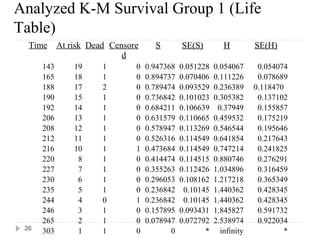
Analyzed K-M Survival Group 1 (Life    


Table)
  Time      At risk Dead Censore     S        SE(S)         H         SE(H)
                            d
      143       19     1       0   0.947368   0.051228   0.054067      0.054074
      165       18     1       0   0.894737   0.070406   0.111226      0.078689
      188       17     2       0   0.789474   0.093529   0.236389     0.118470
      190       15     1       0   0.736842   0.101023   0.305382      0.137102
      192       14     1       0   0.684211   0.106639    0.37949      0.155857
      206       13     1       0   0.631579   0.110665   0.459532      0.175219
      208       12     1       0   0.578947   0.113269   0.546544      0.195646
      212       11     1       0   0.526316   0.114549   0.641854      0.217643
      216       10     1       1   0.473684   0.114549   0.747214      0.241825
      220        8     1       0   0.414474   0.114515   0.880746      0.276291
      227        7     1       0   0.355263   0.112426   1.034896      0.316459
      230        6     1       0   0.296053   0.108162   1.217218      0.365349
      235        5     1       0   0.236842    0.10145   1.440362      0.428345
      244        4     0       1   0.236842    0.10145   1.440362      0.428345
      246        3     1       0   0.157895   0.093431   1.845827      0.591732
      265        2     1       0   0.078947   0.072792   2.538974      0.922034
 26   303        1     1       0          0          *     infinity            *
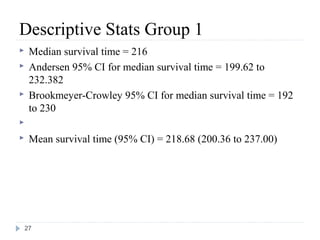
Descriptive Stats Group 1
    Median survival time = 216
    Andersen 95% CI for median survival time = 199.62 to
     232.382
    Brookmeyer-Crowley 95% CI for median survival time = 192
     to 230

    Mean survival time (95% CI) = 218.68 (200.36 to 237.00)


    27
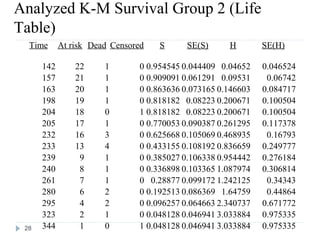
Analyzed K-M Survival Group 2 (Life   


Table)
  Time      At risk Dead Censored    S     SE(S)      H        SE(H)

      142       22     1        0 0.954545 0.044409 0.04652    0.046524
      157       21     1        0 0.909091 0.061291 0.09531     0.06742
      163       20     1        0 0.863636 0.073165 0.146603   0.084717
      198       19     1        0 0.818182 0.08223 0.200671    0.100504
      204       18     0        1 0.818182 0.08223 0.200671    0.100504
      205       17     1        0 0.770053 0.090387 0.261295   0.117378
      232       16     3        0 0.625668 0.105069 0.468935    0.16793
      233       13     4        0 0.433155 0.108192 0.836659   0.249777
      239        9     1        0 0.385027 0.106338 0.954442   0.276184
      240        8     1        0 0.336898 0.103365 1.087974   0.306814
      261        7     1        0 0.28877 0.099172 1.242125     0.34343
      280        6     2        0 0.192513 0.086369 1.64759     0.44864
      295        4     2        0 0.096257 0.064663 2.340737   0.671772
      323        2     1        0 0.048128 0.046941 3.033884   0.975335
 28   344        1     0        1 0.048128 0.046941 3.033884   0.975335
Descriptive Stats Group 2
    Median survival time = 233
    Andersen 95% CI for median survival time = 231.89 to 234.10
    Brookmeyer-Crowley 95% CI for median survival time = 232
     to 240

    Mean survival time (95% CI) = 241.28 (219.59 to 262.98)


    29
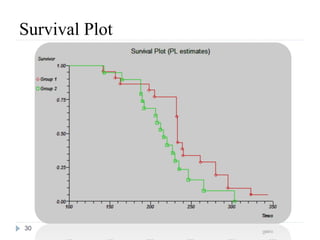
Survival Plot


30
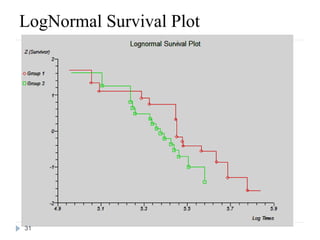
LogNormal Survival Plot


31
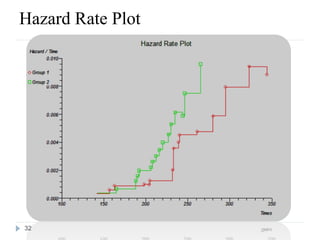
Hazard Rate Plot


32
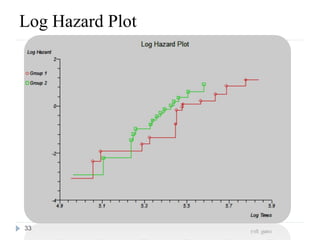
Log Hazard Plot


33
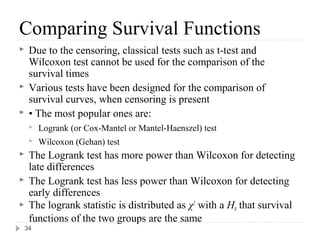
Comparing Survival Functions
    Due to the censoring, classical tests such as t-test and
     Wilcoxon test cannot be used for the comparison of the
     survival times
    Various tests have been designed for the comparison of
     survival curves, when censoring is present
    • The most popular ones are:
        Logrank (or Cox-Mantel or Mantel-Haenszel) test
        Wilcoxon (Gehan) test
    The Logrank test has more power than Wilcoxon for detecting
     late differences
    The Logrank test has less power than Wilcoxon for detecting
     early differences
    The logrank statistic is distributed as χ2 with a H0 that survival
     functions of the two groups are the same
    34
35
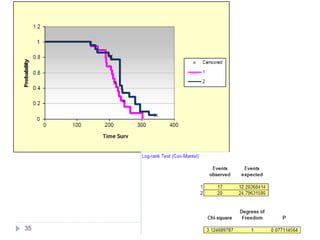
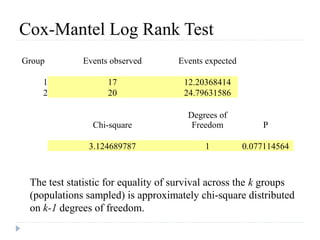
Cox-Mantel Log Rank Test
Group        Events observed        Events expected

    1              17                12.20368414
    2              20                24.79631586

                                      Degrees of
                Chi-square             Freedom            P

               3.124689787                1           0.077114564


 The test statistic for equality of survival across the k groups
 (populations sampled) is approximately chi-square distributed
 on k-1 degrees of freedom.
Show the Excel Sheet
     followed by Case Study


37
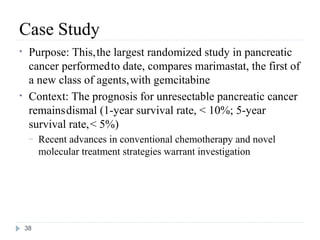
Case Study
•    Purpose: This, the largest randomized study in pancreatic
     cancer performed to date, compares marimastat, the first of
     a new class of agents, with gemcitabine
•    Context: The prognosis for unresectable pancreatic cancer
     remains dismal (1-year survival rate, < 10%; 5-year
     survival rate, < 5%)
     –   Recent advances in conventional chemotherapy and novel
         molecular treatment strategies warrant investigation


    38
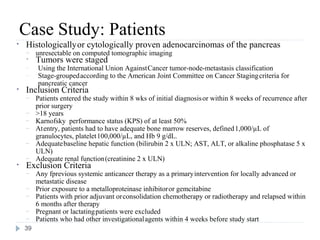
Case Study: Patients
•   Histologically or cytologically proven adenocarcinomas of the pancreas
    –    unresectable on computed tomographic imaging
    •    Tumors were staged
    –    Using the International Union Against Cancer tumor-node-metastasis classification
    –    Stage-grouped according to the American Joint Committee on Cancer Staging criteria for
         pancreatic cancer
•   Inclusion Criteria
    –    Patients entered the study within 8 wks of initial diagnosis or within 8 weeks of recurrence after
         prior surgery
    –    >18 years
    –    Karnofsky performance status (KPS) of at least 50%
    –    At entry, patients had to have adequate bone marrow reserves, defined 1,000/µL of
         granulocytes, platelet 100,000/µL, and Hb 9 g/dL.
    –    Adequate baseline hepatic function (bilirubin 2 x ULN; AST, ALT, or alkaline phosphatase 5 x
         ULN)
    –    Adequate renal function (creatinine 2 x ULN)
•   Exclusion Criteria
    –    Any fprevious systemic anticancer therapy as a primary intervention for locally advanced or
         metastatic disease
    –    Prior exposure to a metalloproteinase inhibitor or gemcitabine
    –    Patients with prior adjuvant or consolidation chemotherapy or radiotherapy and relapsed within
         6 months after therapy
    –    Pregnant or lactating patients were excluded
    –    Patients who had other investigational agents within 4 weeks before study start
    39
Case Study: End Points
•    The primary study end point
     –    Overall survival, along with prospectively defined comparisons
          between gemcitabine and marimastat 25 mg bid and between
          gemcitabine and marimastat 10 mg bid
     –    Secondary study end points
          •   Progression-free survival
          •   Patient benefit s
              –   quality of life [QOL], weight loss, pain, analgesic consumption, surgical
                  intervention to alleviate cancer symptoms, and KPS)
          •   Safety and tolerability
•        Tumor response rate was also assessed


    40
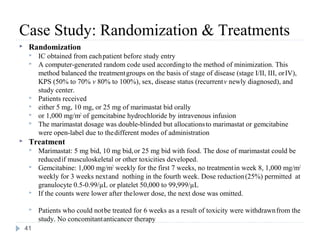
Case Study: Randomization & Treatments
    Randomization
        IC obtained from each patient before study entry
        A computer-generated random code used according to the method of minimization. This
         method balanced the treatment groups on the basis of stage of disease (stage I/II, III, or IV),
         KPS (50% to 70% v 80% to 100%), sex, disease status (recurrent v newly diagnosed), and
         study center.
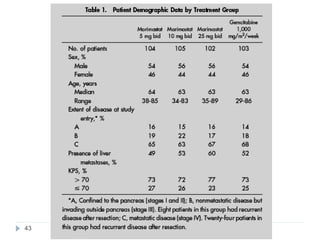
        Patients received
        either 5 mg, 10 mg, or 25 mg of marimastat bid orally
        or 1,000 mg/m2 of gemcitabine hydrochloride by intravenous infusion
        The marimastat dosage was double-blinded but allocations to marimastat or gemcitabine
         were open-label due to the different modes of administration
    Treatment
        Marimastat: 5 mg bid, 10 mg bid, or 25 mg bid with food. The dose of marimastat could be
         reduced if musculoskeletal or other toxicities developed.
        Gemcitabine: 1,000 mg/m2 weekly for the first 7 weeks, no treatment in week 8, 1,000 mg/m2
         weekly for 3 weeks next and nothing in the fourth week. Dose reduction (25%) permitted at
         granulocyte 0.5-0.99/µL or platelet 50,000 to 99,999/µL
        If the counts were lower after the lower dose, the next dose was omitted.

        Patients who could not be treated for 6 weeks as a result of toxicity were withdrawn from the
         study. No concomitant anticancer therapy
    41
Case Study: Statistical Analysis
    Sample size (n= 400: 100 per group); based on absolute
     differences in survival rates at 18 months of 14.5%, power of
     80% and using a significance level of .025 (log-rank test,
     Bonferoni adjusted)
     •   Also based on 10% survival rate at study censure with gemcitabine and a
         mortality rate 75.5% in 10- or 25-mg marimastat groups
    Data Analysis
     •   Intent-to-treat -- Kaplan-Meier
     •   Cox proportional hazards model to identify prognostic factors and to explore their
         influence on the comparative hazard of death between the treatment groups
     •   Plots of Log (-Log, survivor function) versus time for each individual variable
         were produced to ensure proportional hazard assumptions were met
     •   In all survival analyses, patients who were lost to follow-up were censored at
         their last known date alive.
     •   Proportions were tested using the χ2 test. Patient benefit data were tested using the
         Wilcoxon rank sum test, and repeated measures analysis was applied to the QOL
         data.
    42
43
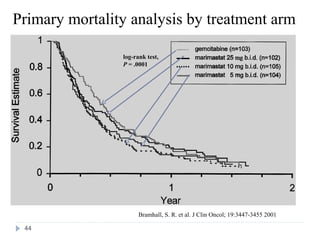
Primary mortality analysis by treatment arm

                log-rank test,
                P = .0001


                      Bramhall, S. R. et al. J Clin Oncol; 19:3447-3455 2001

 44
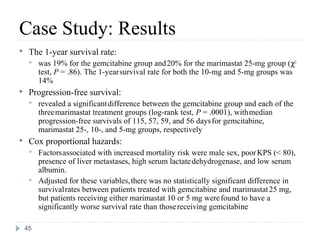
Case Study: Results
    The 1-year survival rate:
        was 19% for the gemcitabine group and 20% for the marimastat 25-mg group (χ2
         test, P = .86). The 1-year survival rate for both the 10-mg and 5-mg groups was
         14%
    Progression-free survival:
        revealed a significant difference between the gemcitabine group and each of the
         three marimastat treatment groups (log-rank test, P = .0001), with median
         progression-free survivals of 115, 57, 59, and 56 days for gemcitabine,
         marimastat 25-, 10-, and 5-mg groups, respectively
    Cox proportional hazards:
        Factors associated with increased mortality risk were male sex, poor KPS (< 80),
         presence of liver metastases, high serum lactate dehydrogenase, and low serum
         albumin.
        Adjusted for these variables, there was no statistically significant difference in
         survival rates between patients treated with gemcitabine and marimastat 25 mg,
         but patients receiving either marimastat 10 or 5 mg were found to have a
         significantly worse survival rate than those receiving gemcitabine

    45
46
47
48
End of Part 1

       Your ?s


49
References
1.        Kaplan EL, Meier P. Nonparametric estimation from incomplete observations.
          Journal of the American Statistical Association (1958); 53: 457-481
2.        Peterson AV Jr.. Expressing the Kaplan-Meier estimator as a function of
          empirical subsurvival functions. Journal of the American Statistical Association
          (1977); 72: 854-858
3.        Nelson W. Theory and applications of hazard plotting for censored failure data.
          Technometrics (1972); 14: 945-966
4.        Aalen OO. Non parametric inference for a family of counting processes. Annals
          of Statistics 1978; 6: 701-726.
5.        R. Peto et al. Design and analysis of randomized clinical trials requiring
          prolonged observation of each patient. British Journal of Cancer (1977); 31: 1-
          39.


     50
Thank You Very Much


51

Part 1 Survival Analysis

  • 1.
    Survival Analysis andCox Regression for Cancer Trials Presented at PG Department of Statistics, Sardar Patel University January 29, 2013 Dr. Bhaswat S. Chakraborty Sr. VP & Chair, R&D Core Committee Cadila Pharmaceuticals Ltd., Ahmedabad 1
  • 2.
    Part 1: SurvivalAnalysis of Cancer CTs 2
  • 3.
    Clinical Trials  Organized scientific efforts to get direct answers from relevant patients on important scientific questions on (doses and regimens of) actions of drugs (or devices or other interventions).  Questions are mainly about differences or null  Modern trials (last 40 years or so) are large, multicentre, often international and co-operative endeavors  Ideally, primary objectives are consistent with mechanism of action  Results can be translated to practice  Would stand the regulatory and scientific scrutiny 3
  • 4.
    Cancer Trials (PhasesI–IV)  Highly complex trials involving cytotoxic drugs, moribund patients, time dependent and censored variables  Require prolonged observation of each patient  Expensive, long term and resource intensive trials  Heterogeneous patients at various stages of the disease  Prognostic factors of non-metastasized and metastasized diseases are different  Adverse reactions are usually serious and frequently include death  Ethical concerns are numerous and very serious  Trial management is difficult and patient recruitment extremely challenging  Number of stopped trials (by DSMB or FDA) is very high  Data analysis and interpretation are very difficult by any standard 5
  • 5.
    6 Source: WHO
  • 6.
  • 7.
    India: 2010  7137 of 122 429 study deaths were due to cancer, corresponding to 556 400 national cancer deaths in India in 2010.  395 400 (71%) cancer deaths occurred in people aged 30—69 years (200 100 men and 195 300 women).  At 30—69 years, the three most common fatal cancers were oral (including lip and pharynx, 45 800 [22·9%]), stomach (25 200 [12·6%]), and lung (including trachea and larynx, 22 900 [11·4%]) in men, and cervical (33 400 [17·1%]), stomach (27 500 [14·1%]), and breast (19 900 [10·2%]) in women.  Tobacco-related cancers represented 42·0% (84 000) of male and 18·3% (35 700) of female cancer deaths and there were twice as many deaths from oral cancers as lung cancers.  Age-standardized cancer mortality rates per 100 000 were similar in rural (men 95·6 [99% CI 89·6—101·7] and women 96·6 [90·7—102·6]) and urban areas (men 102·4 [92·7—112·1] and women 91·2 [81·9—100·5]), but varied greatly between the states.  Cervical cancer was far less common in Muslim than in Hindu women (study deaths 24, age-standardized mortality ratio 0·68 [0·64—0·71] vs 340, 1·06 [1·05—1·08]). 8
  • 8.
  • 9.
    Survival Analysis  Survivalanalysis is studying the time between entry to a study and a subsequent event (such as death).  Also called “time to event analysis”  Survival analysis attempts to answer questions such as:  which fraction of a population will survive past a certain time ?  at what rate will they fail ?  at what rate will they present the event ?  How do particular factors benefit or affect the probability of survival ? 11
  • 10.
    What kind oftime to event data?  Survival Analysis typically focuses on time to event data.  In the most general sense, it consists of techniques for positive-valued random variables, such as  time to death  time to onset (or relapse) of a disease  length of stay in a hospital  money paid by health insurance  viral load measurements  Kinds of survival studies include:  clinical trials  prospective cohort studies  retrospective cohort studies  retrospective correlative studies 12
  • 11.
    Definition and Characteristicsof Variables  Survival time (t) random variables (RVs) are always non- negative, i.e., t ≥ 0.  T can either be discrete (taking a finite set of values, e.g. a1, a2, …, an) or continuous [defined on (0,∞)].  A random variable t is called a censored survival time RV if x = min(t, u), where u is a non-negative censoring variable.  For a survival time RV, we need:  (1) an unambiguous time origin (e.g. randomization to clinical trial)  (2) a time scale (e.g. real time (days, months, years)  (3) defnition of the event (e.g. death, relapse) 13
  • 12.
    Event Test Non-Event Sample of Target Randomize Population Event Control Non-Event Time to Event 14
  • 13.
  • 14.
    Characterization of Survival  There are several equivalent ways to characterize the probability distribution of a survival random variable.  We will use the following terms:  The density function f(t)  The survival or survivor function S(t)  The hazard function H(t)  The cumulative hazard function Λ(t)  Median survival, called τ, is defined as  S(τ ) = 0.5  Similarly, any other percentiles could be defined Practically, we estimate median survival as the smallest time τ such that  Ŝ (τ) ≤ 0.5 16
  • 15.
    Estimation of SurvivalFunction from Censored Data  Hazard shapes can be increasing (e.g. aging after 65), decreasing (e.g. survival after surgery), bathtub (e.g. age- specifc mortality) or constant (e.g. survival of patients with advanced chronic disease)  If there are censored observations, then Ŝ(t) by a parametric method is not a good estimate of the true S(t), so non- parametric methods must be used to account for censoring (life-table methods, Kaplan-Meier estimator)  Kaplan-Meier estimator is the most popular  However, theoretically (or when conditions are met) survival data can be fit to parametric models as well 17
  • 16.
    18 Source: Ibrahim J (2005), Amer Stat Assoc
  • 17.
    Survival Rate byKaplan Meier  This function estimates survival rates and hazard from data that may be incomplete. The survival rate is expressed as the survivor function (S):  where t is the survival time  e.g. 2 years in the context of 5 year survival rates  Sometimes S is estimated as the probability of surviving to time t for those alive just before t multiplied by the proportion of subjects surviving to t  Calculated by product limit (PL) method 1 or the simpler Nelson-Aalen estimate2, estimate of which is always less than a Peterson estimate Peterson PL Method Nelson-Aalen Method  where ti is duration of study at point i, di is number of deaths up to point i and ni is number of individuals at risk just prior to ti. 19
  • 18.
    Data  Following example is data of death from a cancer after exposure to a particular carcinogen in two groups of patients.  Group 1 had a different pre-treatment régime to group 2  The time from pre-treatment to death is recorded.  If a patient was still living at the end of the experiment or it had died from a different cause then that time is considered censored (* below). A censored observation is given the value 0 in the death/censorship variable to indicate a "non-event".  Group 1: 143, 165, 188, 188, 190, 192, 206, 208, 212, 216, 220, 227, 230, 235, 246, 265, 303, 216*, 244*  Group 2: 142, 157, 163, 198, 205, 232, 232, 232, 233, 233, 233, 233, 239, 240, 261, 280, 280, 295, 295, 323, 204*, 344* 20
  • 19.
    Assumptions  S is based upon the probability that an individual survives at the end of a time interval, on the condition that the individual was present at the start of the time interval. S is the product (P) of these conditional probabilities.  If a subject is last followed up at time ti and then leaves the study for any reason (e.g. lost to follow up) ti is counted as their censorship time.  Censored individuals have the same prospect of survival as those who continue to be followed. This can not be tested for and can lead to a bias that artificially reduces S.  Survival prospects are the same for early as for late recruits to the study (can be tested for).  The event studied (e.g. death) happens at the specified time. Late recording of the event studied will cause artificial inflation of S. 21
  • 20.
    Other Parameters  The cumulative hazard function (H) is the risk of event 2 (e.g. death) at time t  S and H with their standard errors and confidence intervals need to be saved  Median and mean survival time  The median survival time is calculated as the smallest survival time for which the survivor function is less than or equal to 0.5.  Some data sets may not get this far, in which case their median survival time is not calculated.  A confidence interval for the median survival time can be constructed using a robust non- parametric method or using a large sample estimate of the density function of the survival estimate  Mean survival time is estimated as the area under the survival curve. The estimator is based upon the entire range of data  Some software uses only the data up to the last observed event; this biases the estimate of the mean downwards, entire range of data should be used  Samples of survival times are frequently highly skewed, therefore, in survival analysis, the median is generally a better measure of central location than the mean 22
  • 21.
    Variances of S& H hat  The variance of S  The confidence interval for the survivor function is not calculated directly using Greenwood's variance estimate as this would give impossible results (< 0 or > 1) at extremes of S. The confidence interval for S uses an asymptotic maximum likelihood solution by log transformation  The variance of H hat is estimated as: 23
  • 22.
    Cancer Trial DataPreparation  Data is very complex, statistical skills & insight are necessary  Time-to-event:  time a patient in a trial survived  time to tumor progression or relapse in a patient  Event / censor code: 1 or 0  1 for event(s) happened  0 for no event or lost to follow up but survival assumed  Stratification:  e.g. centre code for a multi-centre trial  Be careful with your choice of strata  Predictors (covariates):  which can be a number of variables that are thought to be related to the event under study, e.g., drug treatment, disease stage 24
  • 23.
    Organized Input Data GroupSurv Time Surv Censor Surv Group Surv Time Surv Censor Surv 2 142 1 2 232 1 1 143 1 2 232 1 2 157 1 2 232 1 2 163 1 2 233 1 1 165 1 2 233 1 1 188 1 2 233 1 2 233 1 1 188 1 1 235 1 1 190 1 2 239 1 1 192 1 2 240 1 2 198 1 1 244 0 2 204 0 1 246 1 2 205 1 2 261 1 1 206 1 1 265 1 1 208 1 2 280 1 1 212 1 2 280 1 1 216 0 2 295 1 1 216 1 2 295 1 1 220 1 1 303 1 1 227 1 2 323 1 1 230 1 2 344 0 25
  • 24.
    Analyzed K-M SurvivalGroup 1 (Life   Table) Time At risk Dead Censore S SE(S) H SE(H) d 143 19 1 0 0.947368 0.051228 0.054067 0.054074 165 18 1 0 0.894737 0.070406 0.111226 0.078689 188 17 2 0 0.789474 0.093529 0.236389 0.118470 190 15 1 0 0.736842 0.101023 0.305382 0.137102 192 14 1 0 0.684211 0.106639 0.37949 0.155857 206 13 1 0 0.631579 0.110665 0.459532 0.175219 208 12 1 0 0.578947 0.113269 0.546544 0.195646 212 11 1 0 0.526316 0.114549 0.641854 0.217643 216 10 1 1 0.473684 0.114549 0.747214 0.241825 220 8 1 0 0.414474 0.114515 0.880746 0.276291 227 7 1 0 0.355263 0.112426 1.034896 0.316459 230 6 1 0 0.296053 0.108162 1.217218 0.365349 235 5 1 0 0.236842 0.10145 1.440362 0.428345 244 4 0 1 0.236842 0.10145 1.440362 0.428345 246 3 1 0 0.157895 0.093431 1.845827 0.591732 265 2 1 0 0.078947 0.072792 2.538974 0.922034 26 303 1 1 0 0 * infinity *
  • 25.
    Descriptive Stats Group1  Median survival time = 216  Andersen 95% CI for median survival time = 199.62 to 232.382  Brookmeyer-Crowley 95% CI for median survival time = 192 to 230   Mean survival time (95% CI) = 218.68 (200.36 to 237.00) 27
  • 26.
    Analyzed K-M SurvivalGroup 2 (Life   Table) Time At risk Dead Censored S SE(S) H SE(H) 142 22 1 0 0.954545 0.044409 0.04652 0.046524 157 21 1 0 0.909091 0.061291 0.09531 0.06742 163 20 1 0 0.863636 0.073165 0.146603 0.084717 198 19 1 0 0.818182 0.08223 0.200671 0.100504 204 18 0 1 0.818182 0.08223 0.200671 0.100504 205 17 1 0 0.770053 0.090387 0.261295 0.117378 232 16 3 0 0.625668 0.105069 0.468935 0.16793 233 13 4 0 0.433155 0.108192 0.836659 0.249777 239 9 1 0 0.385027 0.106338 0.954442 0.276184 240 8 1 0 0.336898 0.103365 1.087974 0.306814 261 7 1 0 0.28877 0.099172 1.242125 0.34343 280 6 2 0 0.192513 0.086369 1.64759 0.44864 295 4 2 0 0.096257 0.064663 2.340737 0.671772 323 2 1 0 0.048128 0.046941 3.033884 0.975335 28 344 1 0 1 0.048128 0.046941 3.033884 0.975335
  • 27.
    Descriptive Stats Group2  Median survival time = 233  Andersen 95% CI for median survival time = 231.89 to 234.10  Brookmeyer-Crowley 95% CI for median survival time = 232 to 240  Mean survival time (95% CI) = 241.28 (219.59 to 262.98) 29
  • 28.
  • 29.
  • 30.
  • 31.
  • 32.
    Comparing Survival Functions  Due to the censoring, classical tests such as t-test and Wilcoxon test cannot be used for the comparison of the survival times  Various tests have been designed for the comparison of survival curves, when censoring is present  • The most popular ones are:  Logrank (or Cox-Mantel or Mantel-Haenszel) test  Wilcoxon (Gehan) test  The Logrank test has more power than Wilcoxon for detecting late differences  The Logrank test has less power than Wilcoxon for detecting early differences  The logrank statistic is distributed as χ2 with a H0 that survival functions of the two groups are the same 34
  • 33.
  • 34.
    Cox-Mantel Log RankTest Group Events observed Events expected 1 17 12.20368414 2 20 24.79631586 Degrees of Chi-square Freedom P 3.124689787 1 0.077114564 The test statistic for equality of survival across the k groups (populations sampled) is approximately chi-square distributed on k-1 degrees of freedom.
  • 35.
    Show the ExcelSheet followed by Case Study 37
  • 36.
    Case Study • Purpose: This, the largest randomized study in pancreatic cancer performed to date, compares marimastat, the first of a new class of agents, with gemcitabine • Context: The prognosis for unresectable pancreatic cancer remains dismal (1-year survival rate, < 10%; 5-year survival rate, < 5%) – Recent advances in conventional chemotherapy and novel molecular treatment strategies warrant investigation 38
  • 37.
    Case Study: Patients • Histologically or cytologically proven adenocarcinomas of the pancreas – unresectable on computed tomographic imaging • Tumors were staged – Using the International Union Against Cancer tumor-node-metastasis classification – Stage-grouped according to the American Joint Committee on Cancer Staging criteria for pancreatic cancer • Inclusion Criteria – Patients entered the study within 8 wks of initial diagnosis or within 8 weeks of recurrence after prior surgery – >18 years – Karnofsky performance status (KPS) of at least 50% – At entry, patients had to have adequate bone marrow reserves, defined 1,000/µL of granulocytes, platelet 100,000/µL, and Hb 9 g/dL. – Adequate baseline hepatic function (bilirubin 2 x ULN; AST, ALT, or alkaline phosphatase 5 x ULN) – Adequate renal function (creatinine 2 x ULN) • Exclusion Criteria – Any fprevious systemic anticancer therapy as a primary intervention for locally advanced or metastatic disease – Prior exposure to a metalloproteinase inhibitor or gemcitabine – Patients with prior adjuvant or consolidation chemotherapy or radiotherapy and relapsed within 6 months after therapy – Pregnant or lactating patients were excluded – Patients who had other investigational agents within 4 weeks before study start 39
  • 38.
    Case Study: EndPoints • The primary study end point – Overall survival, along with prospectively defined comparisons between gemcitabine and marimastat 25 mg bid and between gemcitabine and marimastat 10 mg bid – Secondary study end points • Progression-free survival • Patient benefit s – quality of life [QOL], weight loss, pain, analgesic consumption, surgical intervention to alleviate cancer symptoms, and KPS) • Safety and tolerability • Tumor response rate was also assessed 40
  • 39.
    Case Study: Randomization& Treatments  Randomization  IC obtained from each patient before study entry  A computer-generated random code used according to the method of minimization. This method balanced the treatment groups on the basis of stage of disease (stage I/II, III, or IV), KPS (50% to 70% v 80% to 100%), sex, disease status (recurrent v newly diagnosed), and study center.  Patients received  either 5 mg, 10 mg, or 25 mg of marimastat bid orally  or 1,000 mg/m2 of gemcitabine hydrochloride by intravenous infusion  The marimastat dosage was double-blinded but allocations to marimastat or gemcitabine were open-label due to the different modes of administration  Treatment  Marimastat: 5 mg bid, 10 mg bid, or 25 mg bid with food. The dose of marimastat could be reduced if musculoskeletal or other toxicities developed.  Gemcitabine: 1,000 mg/m2 weekly for the first 7 weeks, no treatment in week 8, 1,000 mg/m2 weekly for 3 weeks next and nothing in the fourth week. Dose reduction (25%) permitted at granulocyte 0.5-0.99/µL or platelet 50,000 to 99,999/µL  If the counts were lower after the lower dose, the next dose was omitted.  Patients who could not be treated for 6 weeks as a result of toxicity were withdrawn from the study. No concomitant anticancer therapy 41
  • 40.
    Case Study: StatisticalAnalysis  Sample size (n= 400: 100 per group); based on absolute differences in survival rates at 18 months of 14.5%, power of 80% and using a significance level of .025 (log-rank test, Bonferoni adjusted) • Also based on 10% survival rate at study censure with gemcitabine and a mortality rate 75.5% in 10- or 25-mg marimastat groups  Data Analysis • Intent-to-treat -- Kaplan-Meier • Cox proportional hazards model to identify prognostic factors and to explore their influence on the comparative hazard of death between the treatment groups • Plots of Log (-Log, survivor function) versus time for each individual variable were produced to ensure proportional hazard assumptions were met • In all survival analyses, patients who were lost to follow-up were censored at their last known date alive. • Proportions were tested using the χ2 test. Patient benefit data were tested using the Wilcoxon rank sum test, and repeated measures analysis was applied to the QOL data. 42
  • 41.
  • 42.
    Primary mortality analysisby treatment arm log-rank test, P = .0001 Bramhall, S. R. et al. J Clin Oncol; 19:3447-3455 2001 44
  • 43.
    Case Study: Results  The 1-year survival rate:  was 19% for the gemcitabine group and 20% for the marimastat 25-mg group (χ2 test, P = .86). The 1-year survival rate for both the 10-mg and 5-mg groups was 14%  Progression-free survival:  revealed a significant difference between the gemcitabine group and each of the three marimastat treatment groups (log-rank test, P = .0001), with median progression-free survivals of 115, 57, 59, and 56 days for gemcitabine, marimastat 25-, 10-, and 5-mg groups, respectively  Cox proportional hazards:  Factors associated with increased mortality risk were male sex, poor KPS (< 80), presence of liver metastases, high serum lactate dehydrogenase, and low serum albumin.  Adjusted for these variables, there was no statistically significant difference in survival rates between patients treated with gemcitabine and marimastat 25 mg, but patients receiving either marimastat 10 or 5 mg were found to have a significantly worse survival rate than those receiving gemcitabine 45
  • 44.
  • 45.
  • 46.
  • 47.
    End of Part1 Your ?s 49
  • 48.
    References 1. Kaplan EL, Meier P. Nonparametric estimation from incomplete observations. Journal of the American Statistical Association (1958); 53: 457-481 2. Peterson AV Jr.. Expressing the Kaplan-Meier estimator as a function of empirical subsurvival functions. Journal of the American Statistical Association (1977); 72: 854-858 3. Nelson W. Theory and applications of hazard plotting for censored failure data. Technometrics (1972); 14: 945-966 4. Aalen OO. Non parametric inference for a family of counting processes. Annals of Statistics 1978; 6: 701-726. 5. R. Peto et al. Design and analysis of randomized clinical trials requiring prolonged observation of each patient. British Journal of Cancer (1977); 31: 1- 39. 50
  • 49.